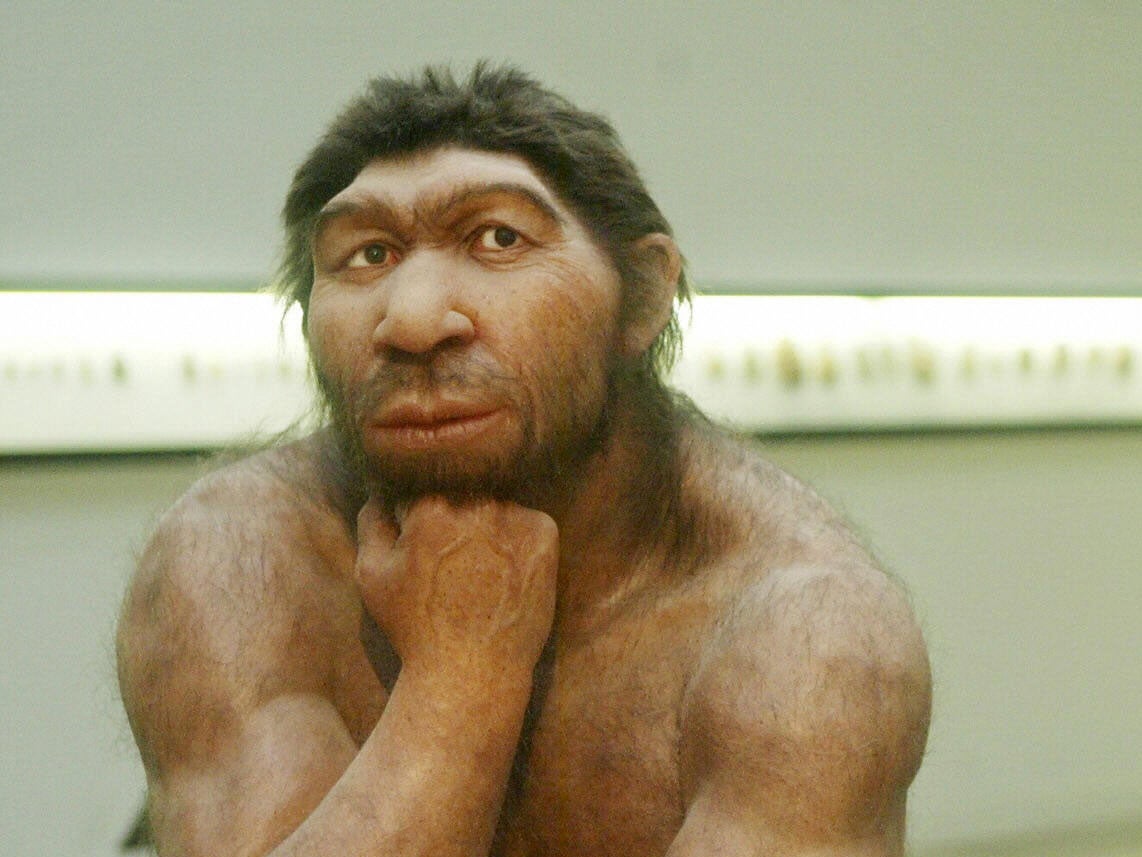
A reconstruction of a Neanderthal man at the Prehistoric Museum in Halle, eastern Germany (SEBASTIAN WILLNOW/AFP/Getty Images)
Stay ahead of the trend in fashion and beyond with our free weekly Lifestyle Edit newsletter
SIGN UPI would like to be emailed about offers, events and updates from The Independent. Read our privacy notice
As one of Britain’s fastest growing lifestyle movements, the vegan population in the UK has risen by 360 per cent over the last decade. Now more than half a million people aged 15 and over self-described vegans – but where and why did the diet begin? Who were the world’s very earliest vegans?
Archaeologist Dr Richard Leakey says our prehistoric ancestors started off on a plant based diet. “You can’t tear flesh by hand, you can’t tear hide by hand, and we wouldn’t have been able to deal with the food sources that required those large canines”.
This theory suggests that we turned to animal flesh out of necessity when there were shortages of our nut, seed and wild cereal staples. Hominins are considered to be opportunistic scavengers of meat where they could find it, while relying on plant based diets. Even in the Neolithic as early farmers, diets were still largely plant-based with meat as an occasional feasting food.
Biology professor Robert Dunn argues this is correlated by our closest related living primates, chimpanzees, for whom meat is a rare treat if eaten at all. This substantiates the claim of plant based digestion dictating the last 30 million years of gut evolution.
Archaeologists also debunk the recent fads of paleo and raw-food diets – as cooking in some form has been around since anatomically modern humans emerged and the emphasis on meat in the “hunter- gatherer” model is now largely omitted.
But when did veganism out of necessity become veganism out of principal?
Hindus, Buddhists and Jains have all long promoted plant based diets for ethical reasons. An early Jain called Parsva 877-777 BCE, taught followers about Ahimsa, one of the cornerstone beliefs meaning non-violence to living forms.
Jain monks often carry brushes to sweep the ground in front of them in order to avoid accidentally crushing insects when they walk. The practice of wearing muslin cloths over their mouths in case they swallow any insects is also observed.
Other notable vegan-leaning leaders include the Egyptian Pharaoh Akhenaten who banned animal sacrifice because he thought it was sinful to take away any given life by the Aten god. Taoism and Chinese Buddhism in the late 4th century stipulated that their monks and nuns were to eat an egg free vegetarian diet and the Japanese Emperor Tenmu banned the use of all livestock.
In ancient Greece, early veganism was referred to as “abstinence from beings with a soul”. In 500 BCE, the Greek mathematician Pythagoras advocated the idea that all animals had immortal souls which would be reincarnated after death. He shunned harming animals and along with the mythical poet Orpheus, also abstained from eggs. Apollonius of Tyana shared these strong views on animal rights and the Greek philosopher Plotinus even eschewed medicines made from animals.
Historian Dr Catherine Oliver suggests that 18th Century philosopher Jeremy Bentham is the earliest notable proponent of likening animal suffering to that of humans: “The question is not ‘can they reason?’ Nor, ‘can they talk?’ But, ‘can they suffer?’ Dr Oliver told The Independent that veganism today is being increasingly situated “not as a diet but as a social justice issue”.
The term “veganism” itself however, was coined much more recently. In 1944, carpenter Donald Watson and his wife Dot invented the word to mark the “beginning and end of vegetarianism”. Watson decided to become a vegan after he saw and heard the death of a pig on his uncle’s farm.
“I decided that farms, and uncles, had to be reassessed”. Watson lived to the age of 95 and predicted that at his funeral “there’ll be a smattering of people but there’ll be the spirits of all the animals I’ve never eaten. In that case it’ll be a big funeral”.
Donald Watson’s first newsletter was sent to just 25 subscribers. There are now over half a million self-ascribed vegans in the UK alone.
Thom Yorke, Moby and Woody Harrelson are just a handful of the celebrities now propounding the vegan lifestyle. Morrissey has even campaigned for General Motors to make vegan leather for car interiors. Whether you think it’s just a fad or that it has defensibly firm roots deep in human history, the first vegans certainly weren’t the last.
In 25 years, the red wolf went from being declared extinct in the wild to becoming hailed as an Endangered Species Act success story. Now it’s under threat again.
NORTH CAROLINA, USA — Jeff Akin had to bite his tongue.
He was chatting with a neighbor about efforts to protect and grow the area’s red wolf population. The endangered wolves are equipped with bright orange radio collars to help locals distinguish the federally protected species from invasive, prolific coyotes.
“If I see one of those wolves with a collar on, I’m going to shoot it in the gut, so it runs off and dies,” Akin says the neighbor told him. “Because if it dies near you, and they come out and find the collar, they can arrest you.”
Akin is a hunter and the walls of his country house are lined with photos of the animals he’s killed. But what he heard made him sick.
“I wouldn’t shoot a squirrel in the stomach if I was hungry,” he says. “It’s just not humane.”
In a way, the anecdote sums up the plight of this uniquely American species.
Once declared extinct in the wild, Canis rufus — the only wolf species found solely in the United States — was reintroduced in the late 1980s on the Alligator River National Wildlife Refuge, just across the sound from eastern North Carolina’s famed Outer Banks. Over the next quarter century, it became a poster child for the Endangered Species Act and a model for efforts to bring back other species.
“The red wolf program was a tremendous conservation success,” says Ron Sutherland, a biologist with the Wildlands Network. “It was the first time that a large carnivore had been returned to the wild after being driven extinct, anywhere in the world.”
But the wild population is now back to the brink of oblivion, decimated by gunshots, vehicle strikes, suspected poisonings and, some have argued, government neglect.
For the first time in nearly three decades, the U.S. Fish and Wildlife Service is poised to release an updated recovery plan for the red wolf. According to a draft, the agency proposes spending a quarter billion dollars over the next 50 years to rebuild and expand the wild wolf population.
“It was done once before,” says Joe Madison, North Carolina manager for the Red Wolf Recovery Program. “And we can do it again.”
But the effort depends heavily on cooperation from private landowners. And the passage of 36 years seems to have done little to soften locals’ hearts toward the apex predator.
Out here, farming and leasing land to hunters are big business. The red wolf is seen by some as competition, and a threat to a way of life on a fragile landscape already imperiled by climate change.
“They don’t belong here!” a woman shouted at agency staff during a recent public meeting on the program.
Add to that a widespread mistrust of government and the road ahead looks long and perilous for “America’s wolf.” But allies like Akin and Sutherland say they have to try.
“The red wolf, it’s ours,” Sutherland says. “It’s ours to save.”
___
On a recent visit to Alligator River, Madison parks his truck beside a canal, climbs out and hoists an H-shaped antenna into the air. Faint beeps emanate from a radio in his left hand as he slowly swivels from side to side.
“Based on the radio telemetry, there are six red wolves hunkered down in there,” says Madison, motioning to a patch of brush between two cleared farm fields. His bushy red-and-grey beard lends him an uncanny resemblance to his quarry.
That’s roughly half of the world’s total known wild red wolf population.
The red wolf once roamed from central Texas to southern Iowa and as far northeast as Long Island, New York. But generations of persecution, encroachment and habitat loss reduced them to just a remnant clinging to the ragged Gulf coast along the Texas-Louisiana border.
Starting in 1973, the year Congress passed the Endangered Species Act, the last wolves were pulled from the wild and placed in a captive-breeding program.
“By 1980,” Madison says, “they had declared red wolves extinct in the wild.”
But the captive breeding program did so well that, after just a few years, officials felt it was time to try restoring the red wolf to the wild.
They chose Alligator River, a 158,000-acre (63,940-hectare) expanse of upland swamp on North Carolina’s Albermarle Peninsula, not far from Sir Walter Raleigh’s doomed “lost colony” of Roanoke.
The program started in 1987 with four breeding pairs. Five years later, a second group was placed in Great Smoky Mountains National Park — 522,427 acres (211,418 hectares) of forest straddling the border of North Carolina and Tennessee.
The inland experiment was ended in 1998, due to “low prey availability, extremely low pup survival, disease, and the inability of red wolves to maintain stable territories within the Park,” the government said at the time.
But with the releases of adults and fostering of captive-born pups into wild family groups, the Alligator River population thrived.
“It was the model for how gray wolves were returned to Yellowstone,” Sutherland says of the Western species, which has since been taken off the endangered list. “And it’s been the model since then for all kinds of re-wilding of projects all over the world.”
By 2012, the population in the five-county restoration area reached a peak of about 120 animals. Then the bottom fell out.
Shootings and vehicle strikes — busy U.S. 64 to the Outer Banks runs through the middle of the refuge — were the leading causes of death.
Meanwhile, coyotes moved into the area and began mating with the depleted wolf stock. Around the same time, the North Carolina Wildlife Resources Commission allowed nighttime spotlight hunting of coyotes, which are much smaller, but look similar to red wolves.
In January 2015, the state commission asked Fish and Wildlife to end the program and once again declare the red wolf extinct in the wild. The federal agency suspended releases from the captive population while it re-evaluated the “feasibility” of species recovery.
A 2018 species status assessment declared the wild population would likely disappear within six years “without substantial intervention.”
With no new releases, the wild population eventually dipped to just seven known animals.
In 2020, conservationists sued the agency, alleging the suspension of captive releases violated the Endangered Species Act. Releases and pup fostering resumed the following year.
In early August, the agency settled with the groups, promising regular releases from the captive population, which currently stands at around 270, over the next eight years. Meanwhile, a new recovery plan and population viability analysis are due out this fall.
The most recent draft called for spending of more than $256 million over the next 50 years. The red wolf could be delisted by 2072, the agency concluded, providing “all actions are fully funded and implemented” and with “full cooperation of all partners.”
The service has yet to identify suitable locations for other wild populations and it’s unclear whether the North Carolina wolves have a half century.
If Greenland continues to melt at the current rate, the East Coast could see more than 3 feet (0.9 meters) of sea level rise in the next 50 years, says Jeffress Williams, a senior scientist emeritus with the U.S. Geological Survey. The average elevation at Alligator River: about 3 feet (0.9 meters).
“They ought to be factoring that in,” says Williams, who works at the Woods Hole Coastal and Marine Science Center in Massachusetts. “Because within 50 years, a lot of the habitat areas that they’re looking at will very likely be underwater due to sea level rise or, certainly, underwater during the storm surge events such as such as hurricanes.”
So, the wolves will have to roam farther and farther inland, into more densely populated areas. And that is only going to put them in more competition with what Akin calls the real “apex predator” — Homo sapiens.
___
One of the big complaints around here is that the wolves will gobble up all the game, especially white-tailed deer, the main food source of Canis rufus. And that would eat into landowner profits.
Although exact numbers for the recovery zone are hard to come by, the wildlife commission says hunting generated $1 billion statewide last year. Recent hunting leases posted online ranged from $861 for a 22-acre (8.9-hectare) property to $3,050 on 167 acres (67.5 hectares) with “everything deer need,” the site boasted.
Sutherland believes fears of “a wildlife disaster” are unfounded, and he’s out to prove it.
Braving snakes and brushing feeder ticks from his clothes and gear, he kneels beside a pine tree on the Pocosin Lakes National Wildlife Refuge and starts drilling holes. He bolts a wildlife camera about a foot up the trunk, secures it with a lock and cable, then uses pruning shears to cut down any brush that might obscure the camera’s view.
“The animals the wolves eat, like rabbits and rats and deer and things and species like that, they like this kind of habitat,” he says. “Our job is to document whether this fire break is … creating more local abundance of these different wildlife species.”
As for the wolves, their numbers are in constant flux.
Two litters of four pups each were born in April at Pocosin Lakes, followed in May by five pups at Alligator River. Coupled with recent releases of captive-bred adults and the fostering of pups, one might assume the population is growing.
But as of August, Fish and Wildlife said the known/collared wild population was 13, with a total estimated wild population of 23 to 25. That’s down from June, when the numbers were 16 and 32 to 34.
“It’s certainly trending in the right direction,” says Ramona McGee, an attorney with the Southern Environmental Law Center, which filed the lawsuit to restart the captive release program. “Although the population remains in dire straits.”
“We’ve got a long way to go,” Madison concedes.
Fish and Wildlife has launched numerous initiatives to cut down on human-caused deaths. Gunshots are top of the list.
The wolves are outfitted with orange, reflective collars to make them more visible at night.
“Most hunters and the general public know that bright orange, hunter orange, means, ‘Don’t shoot,’” says Madison. “It’s a safety color.”
He also reminds people at public meetings it’s illegal to intentionally kill an endangered wolf that is not threatening humans, pets or livestock. The death must be reported to Fish and Wildlife within 24 hours.
The agency enlists landowners to help trap, but preferably not shoot, coyotes.
“You can’t kill your way out of a coyote problem,” Madison says.
The coyotes are sterilized, but left hormonally intact. That way, they can act as “placeholders” for the wolves, Madison says.
“They will continue to defend their territory,” he says. “They’ll hold that space for the rest of their lives and they won’t allow other coyotes to move in, but they also can’t reproduce.”
Those coyotes get white collars, to further differentiate them from the wolves.
To cut down on road kills, officials have placed flashing signs at both ends of the Alligator River preserve to warn motorists on US 64 to watch out for endangered wolves and “drive with caution.”
But the biggest hurdle to red wolf recovery is space.
The two refuges’ combined 270,000 acres (109,265 hectares) — roughly 422 square miles (1,093 kilometers) — of federal land might sound like a lot. But Madison says a single pack’s territory can be as much as 80 square miles (207 square kilometers), depending on prey availability.
“There’s not a large enough land mass of public land in the Southeast within the historic range that can fully support a viable red wolf population,” he says. “We’re going to have to rely somewhat on private land for reintroduction.”
That’s where Prey for the Pack comes in.
___
Started in 2020, the program offers landowners incentives to make habitat improvements. The government will reimburse people up to 80% of the cost of thinning woods and planting the kinds of vegetation that will attract the types of prey red wolves prefer, says Luke Lolies, who runs the program.
In exchange, Fish and Wildlife gets access to do such things as install wildlife cameras or come onto their land to capture coyotes.
Basically, Lolies says, “They allow red wolves to peacefully live on their property.”
But if a recent public meeting is any indication, Lolies and the wolves are facing an uphill battle.
A crowd of about 60 braved thunderstorms and torrential rains to gather in the gymnasium of Mattamuskeet High School in Swanquarter, North Carolina.
They listened politely as Madison and others gave an update on the program. But no sooner had the floor been opened to questions than things got heated.
One man referred to the wolves as a “hybrid predator,” repeating a common belief here that all the animals are now mixed with coyotes. That’s despite a 2019 National Academy of Sciences report confirming the red wolf was a “distinct” and “taxonomically valid” species.
Madison noted two hybrid litters were discovered last year and euthanized.
Another concern was safety for humans and animals.
There has never been a documented attack by a red wolf on a human, Madison says. And a “depredation fund” set up by the Red Wolf Coalition to reimburse people for animals killed by a wolf has only paid out one claim, coalition director Kim Wheeler says.
A bearded man in a camouflage jacket questioned the program’s costs versus the number of jobs created in the five counties. Another wondered how landowners who make money off hunting would be compensated for all the game the wolves will eat.
“If you do not get landowner cooperation in the five-county area, will you stop the program?” asked one man, who farms 15,000 acres (6,070 hectares) in the wolf-recovery area.
An exasperated Madison says it wasn’t for him to say.
“We all know what the answer is,” the farmer replies sarcastically. “You just can’t say it out loud.”
Aspen Stalls, who recently started a wildlife guiding business in the area, says the wolves can benefit the local economy, but that’s not the point.
“They have been here for a very, very, very long time, long before us,” says Stalls, who studied canid ecology in college and sports a wolf tattoo on her left arm. “And they are a vital part of keeping this ecosystem balanced.”
The five-county wolf recovery area covers 2,765 square miles (7,161 square kilometers), which is nearly 1.8 million acres (728,434 hectares). But in three years, Prey for the Pack has managed to sign up only four landowners, for a total of just 915 acres (370 hectares).
Of the four Prey participants, only one agreed to be identified: Jeff Akin.
___
About eight years ago, the retired Raleigh real estate developer built a hunting and fishing getaway on 80 acres (32 hectares) of what he calls “Hyde County thicket: Sucker pines, loblolly pines, wax myrtles and briers.”
“I had to use a machete to walk through it the first time to find the edges,” he says. “Snakes and mosquitoes love it.”
With help from Lolies and his staff, he hopes the wolves will love it, too.
Riding through the woods on an all-terrain vehicle, he points to areas of scorched scrub and tree stumps.
“This has been thinned and burned,” he says. “And the burning should release the seeds, and the sunlight will grow the types of grass and plants that’ll bring in small mammals and game animals that would be ultimately prey for a pack of wolves.”
New grasses and wildflowers are already coming up. Recently planted blackberry bushes are ready to bear fruit.
A white sign bolted to a tree along the main road declares Akin a member of “Partners for Fish & Wildlife.” He suspects his neighbors aren’t too happy about it.
Lee Williams, who lives just down the road, can’t believe the government is spending millions of taxpayer dollars to protect what he considers “a mongrel.”
“I never had it around here when I was growing up, and I really didn’t miss it,” the 74-year-old retired state marine patrol officer says. “I didn’t miss a dinosaur and I wouldn’t miss them.”
About a week after the public meeting, a red wolf was found dead along a fence line in neighboring Washington County, shot in the torso.
After witnessing the hostility in the school gym, Akin got together with another wolf supporter to try to develop a better “sales pitch” for fellow landowners.
“We need to break down some resistance to wolf recovery and some existing fears about putting your land in a government program of any kind,” he says.
He knows his 80 acres (32 hectares) are just “a drop in the bucket.” But he can’t just do nothing.
“It’s not nature that’s taken the red wolf out,” he says. “It’s us. So, we are the ones to help them get back.”
Have you ever known a cat whose temperament could change on a dime? One moment they’ll crawl into your lap, purring affectionately. The next, they’ll lash out with a paw and dash away.
Your best clue about your cat’s moods could be their tail.
Cats use several strategies to communicate with their humans, including body language. One of the best ways to read your cat’s mood is to look at their tail.
Newsweek spoke to Carlo Siracusa, associate professor of animal behavior at the University of Pennsylvania, about the meaning behind cats’ tails.
Cat Tail Language
Cats can’t tell us how they’re feeling. It can be annoying when we’re not sure if they’re happy or upset with us, or worrying when they can’t tell us if they’re sick.
NEWSLETTER
The Bulletin
Your daily briefing of everything you need to know
Understanding your cat’s tail language can help you improve your relationship with your companion. It can also help you identify health concerns before they get out of control.
Cats are happy when their tails point straight up or have a slight curve.ISTOCK/GETTY IMAGES PLUS
Straight Up
“An upward or upright tail, with or without a hook, is typically a sign of positive emotions and precedes a safe and friendly interaction,” Siracusa said.
This is the ideal tail position you want to see when you get home. If your cat is running towards you with their tail straight up like this, it means they’re happy to see you. Or just happy you’re about to refill their food bowl.
If your cat’s tail is hooked in the shape of a question mark, that’s another positive indication. This is a variation on the straight-up tail position.
Treat this the same way you would treat a straight-up tail. It’s a good sign and means that you’re doing something your cat likes.
Cats will rub up against you and wrap their tails around your leg when they want attention.ISTOCK/GETTY IMAGES PLUS
Wrapped Around You
This is another positive indicator. Cats use their tails for expression, so if they wrap their tail around you, treat it like a handshake. When your cat does this, it means they feel comfortable getting close to you.
Cats may also wrap their tails around your leg when they rub up against you. They do this to spread pheromones and mark you as their human. It’s a way of getting your attention when they want affection or food.
Relaxed
“A relaxed tail position that does not move much is usually indicate of a low emotional arousal,” Siracusa said. “For example, when a cat is just moving from point A to point B and does not want to communicate any specific emotion.”
Cats often use their tail language like we use speech or body language. Sometimes you just don’t have anything to say, and cats are the same way. Don’t read too much into a relaxed tail.
If your cat has their tail—and possibly their whole body—low to the ground, it’s a sign they’re scared or anxious. Cats do this when they want to avoid being seen or caught.
Many cats do this when it’s time to go to the vet. Especially if they don’t like the cat carrier very much.
If your cat consistently has its tail and body low to the ground and there are no frightening stimuli nearby, that could mean they are in pain. Talk to your veterinarian and mention your cat’s body language as your reason for concern.
Cats puff their tails up to look bigger when they’re agitated.ISTOCK/GETTY IMAGES PLUS
Puffed-Up
This is probably the most well-known declaration in cat tail language. A puffed-up tail means your cat is extremely agitated.
Cats instinctually puff their tails up in dangerous situations to appear bigger and more frightening to other cats and potential predators. If their tail is puffy at home, that probably means you’ve done something to alarm them.
Fast Slapping
If your cat is moving their whole tail back and forth quickly, that’s a sign that they’re emotionally aroused. This isn’t necessarily a bad thing—those emotions could be positive or negative—but it is a sign that you should be especially gentle and avoid doing things that would upset your cat in this state.
“I would approach with caution a cat that is so emotionally aroused,” Siracusa said, “in particular if the entire tail is moving from one side to the other with very fast ‘slaps’.”
Cats will swish their tails back and forth when they’re focused and alert.ISTOCK/GETTY IMAGES PLUS
Slow Swishing
“Slower movements of the tail, that may not involve the entire length of it, may mean an increased focus and not necessarily aggression,” Siracusa said. “For example, before a cat pounces when playing.”
Your cat might do this when you bring out their favorite toy. It’s common behavior for cats who are excited and ready to play.
Sudden Twitching
If your cat starts twitching their tail, it probably means they’re upset with you. They might be annoyed with how you’re touching them or just done with you for now.
The best thing to do in this situation is to give your cat some space. Respect their boundaries and let them seek you out when they’re ready for attention again.
How to Interpret the Meaning of Your Cat’s Tail Movement
“Cats’ body language, including tail language, is pretty universal,” Siracusa said. “However, individualities have to be considered always.”
You know your cat best. Take what you’ve learned about the general meanings behind cats’ tails and apply it to them. Consider things like:
Your cat’s temperament. Are they usually shy or outgoing? That could influence how you read their tail.
The situation. In some situations, a twitching tail could mean your cat is getting annoyed. But if they’re sitting on your lap and purring at the same time, they’re probably just excited.
Your cat’s history. Cats can change their tail language based on their history. For example, some cats behave like dogs if they’re raised in a canine-heavy environment.


 NEWSLETTER


