Alaska pilot, hunter are presumed dead in plane crash at Denali National Park and Preserve
1

By Madilynne MedinaAug 11, 2023

A new gray wolf pack has been confirmed in the southern Sierra Nevada, the California Department of Fish and Wildlife said in a Friday press release, making the wolves the southernmost pack in the state.
https://imasdk.googleapis.com/js/core/bridge3.584.2_en.html#goog_745661709
https://imasdk.googleapis.com/js/core/bridge3.584.2_en.html#goog_745661710
https://imasdk.googleapis.com/js/core/bridge3.584.2_en.html#goog_745661711
https://imasdk.googleapis.com/js/core/bridge3.584.2_en.html#goog_745661712

The origins of sourdough bread in San Francisco
Watch More
These gray wolves are more than 200 miles away from the nearest known pack in northeastern California, the agency said. Native to California, gray wolves were eradicated from the state in the 1920s, so each rare wolf sighting is investigated by the CDFW.
The wolves were spotted in the Sequoia National Forest in Tulare County in July, the CDFW said. The sighting was reported to the agency and, upon investigation, the CDFW found wolf tracks and other indicators of wolves.
ADVERTISEMENT
Article continues below this ad
Wolf presence was confirmed using 12 scat and hair samples, which the agency was able to verify belonged to gray wolves via DNA analysis, the CDFW said.
The new pack includes at least five wolves that weren’t previously identified in the state, including two male and two female offspring. Another adult wolf was identified as a descendant of the first wolf identified in recent history in California, named OR-7.
OR-7 was a male wolf that crossed into California from Oregon in 2011 and made the state part of his range after traveling back and forth between the two states, the agency said on its website.
The DNA samples indicated that the breeding male wolf of the four offspring came from the Lassen Pack, the CDFW said.
ADVERTISEMENT
Article continues below this ad
Gray wolves are protected under the California Endangered Species Act, which prohibits anyone from harming, killing or capturing them.

An Italian man has been crushed to death under thousands of wheels of a Parmesan-style cheese, authorities said.
Giacomo Chiapparini, 74, was buried when a shelf broke in his warehouse in the Lombardy region on Sunday, firefighter Antonion Dusi told AFP.
The collapse created a domino effect bringing down thousands of wheels, which weigh about 40kg (84lbs) each.
It took 12 hours to find Mr Chiapparini’s body, Mr Dusi said.
Some of the wheels reportedly fell about 10m (33ft) and a local resident told Italian media the collapse sounded “like thunder”.
The economic damage caused has been estimated at €7m (£6m).
Speaking to Italian media, a neighbour described Mr Chiapparini as “very supportive… and generous”. They also said he lost a child decades ago.
The warehouse, located in Romano di Lombardia, about 50km (31 miles) east of Milan, contained a total of 25,000 wheels of Grana Padano, a hard cheese which resembles Parmesan and is popular in Italy.






(Photo courtesy Direct Action Everywhere) Animal activists hold two pigs at the Smithfield Food hog farm near Milford in 2017, which they filmed under cover of night with the objective of “exposing” injustices within the facility.
By Max Corwin | For The Salt Lake Tribune
| Aug. 10, 2023, 5:00 a.m.
https://www.sltrib.com/opinion/commentary/2023/08/10/max-corwin-government-is-trying/
Comment
As a Utah resident, I want to ensure the safety and well-being of those who reside here from the encroaching threat of big industry. I’ve seen firsthand the stronghold big industry has on the local economy and politics.
In October of last year I supported animal rights activists with Direct Action Everywhere (DxE) as they faced trial for the rescue of two sick and dying piglets, Lily and Lizzie, from a Smithfield factory farm in Beaver, Utah — a trial which resulted in an acquittal. When later interviewed, the jurors relayed that they saw the charges as prosecutorial overreach at the behest of an industry trying to hide the truth about how our food is produced.
This year, a similar trial in Merced, California, yielded another acquittal with similar statements from jurors — demonstrating that when the public sees what occurs on factory farms, they side with the compassionate activists, not the corporations inflicting cruelty on animals.
https://imasdk.googleapis.com/js/core/bridge3.584.2_en.html#goog_982838090
212.3K
Taylor Hendricks Utah Jazz rookie update: Sitting out summer league, and already missing mom
However, the government continues to ignore public sentiment and to collude with Big Ag to repress animal advocates. In just the past year, state legislative bodies across the country saw an alarming number of retaliatory bills.
Here in Utah, legislators introduced H.B. 114 in direct response to the outcome of the Smithfield trial. The bill “amends the defenses available to those charged with theft” to disallow the main defense used in the trial: that the animals were “sick, injured, or a liability to the owner.” I testified against this bill, as did a juror from the trial, Lynn Carlson, who called the bill “an affront to the jurors who considered all the evidence at the trial and ruled appropriately in the defendants’ favor.” In an op-ed, he called the bill a “reckless and impulsive reaction by politicians who are clearly re-writing the law to appease Smithfield and the powerful agriculture lobby in Utah.”

Report this ad
I also testified against S.B. 113, which preempts local governments from enacting regulation on “animal enterprises” such as farms, laboratories, and rodeos. Despite public outcry, both bills passed.
In Wyoming, a similar bill, ironically named the “Working Animal Protection Act” aimed not at protecting animals but at protecting rodeos from local control, narrowly failed to pass. This legislation was drafted in response to cities across the country successfully enacting rodeo bans.
In South Dakota, H.B. 1090 was signed into law on July 1, 2023, making it more difficult for neighboring residents to file nuisance claims against farms for issues such as noise and odor pollution.
In previous years in Iowa, several bills aimed at preventing whistleblowers from recording footage of animal agriculture were struck down due to infringing on free speech guaranteed by the First Amendment. This year, in response to animal welfare organizations documenting the conditions and treatment of animals at Iowa livestock and dog-breeding facilities, the Iowa House passed H.F. 572, which, if enacted, would restrict drone surveillance at these facilities.
The backlash to the success of the animal rights movement echoes the backlash to other growing social movements. In response to the public awakening about racism and police brutality after the murder of George Floyd, the Florida government prohibited the teaching of these topics, chalking them up to “critical race theory,” and passed a law that, in some cases, grants civil immunity to those who hit protestors with their cars. As a response to the growing public acceptance of LGBTQ people, several states, including Utah, have passed laws to prohibit transgender kids from participating in school sports, using the bathroom of their choice, and seeking gender-affirming care.
Report this ad
Successes in the animal rights movement are also driving federal government retaliation. After failed attempts to regulate animal welfare via the state legislature, voters overwhelmingly passed Proposition 12, a ballot measure that “establishes minimum requirements for confining certain farm animals.” The National Pork Producers Council challenged the law, and the Biden administration sided with the industry. Ultimately, however, the law was upheld by the U.S. Supreme Court.
With elected officials unwilling to heed the public’s growing concern over factory farming and animal welfare, ordinary people are left to take action themselves. Fortunately, open rescues are continuing, and DxE animal rescuers have two more trials scheduled for this year in Sonoma County, California, and Dane County, Wisconsin, that could lead to more groundbreaking acquittals and propel the animal rights movement forward.
Just as I took the stand to speak out against bills in Utah, community members can find ways to push for justice and transparency. The acquittals of activists in Utah and California, the rejection of industry-driven bills and the introduction of animal welfare propositions indicate that our message is reaching the public and show that we need to continue to exercise the power of collective action — even though we won’t always succeed.
In Millard County, Utah, local residents championed Proposition 6, which aimed to halt new industrial hog farms, in response to a proposal for seven new large-scale hog farms. The initiative failed by a small margin, but the collective action demonstrated that Utahns are ready and willing to take action to protect their environment and values.

Max Corwin
Max Corwin, 28, is a Utah resident and activist who has been involved with Direct Action Everywhere (DxE) and Utah Animal Rights Coalition (UARC) for several years.
By Max Corwin | For The Salt Lake Tribune
Donate to the newsroom now. The Salt Lake Tribune, Inc. is a 501(c)(3) public charity and contributions are tax deductible
U.S. District Judge Larry Hicks said after a seven-hour hearing he was denying a after a seven-hour hearing bid for an emergency order to halt the roundup that a nonprofit advocacy group argues is inhumane and illegal.
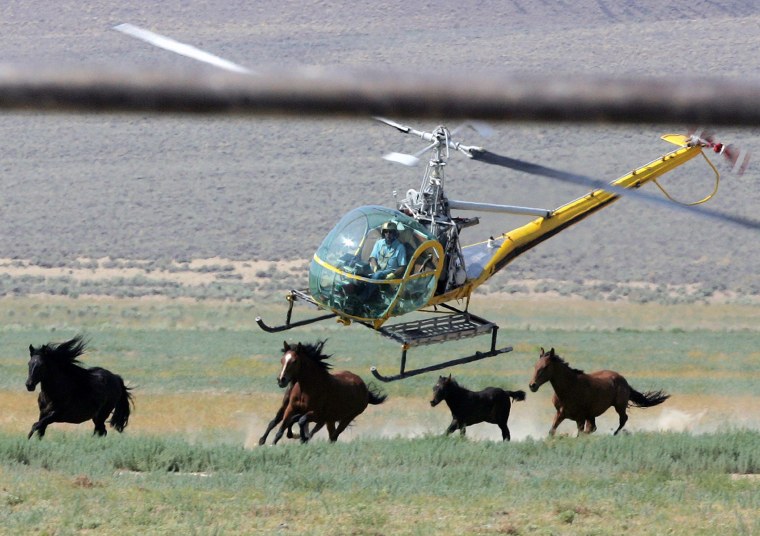
A livestock helicopter pilot rounds up wild horses in Washoe County, Nev., on July 13, 2008.Brad Horn / AP file
Aug. 10, 2023, 9:46 AM PDT / Source: The Associated Press
By The Associated Press
RENO, Nev. — Over the objections of wild horse advocates, a judge cleared the way Wednesday night for the U.S. government to continue capturing thousands of mustangs in Nevada despite the deaths of 31 horses during the weekslong roundup.
In a ruling from the bench after a seven-hour hearing in Reno, U.S. District Judge Larry Hicks said he was denying Wild Horse Education’s bid for an emergency order to halt the roundup the nonprofit advocacy group argues is inhumane and illegal.
“The fact is, I don’t have evidence that would support the granting of a preliminary injunction or temporary restraining order,” Hicks said.

JULY 19, 202301:39
“These tragedies are going to occur when you have gathers, so I cannot find there are inhumane treatments with these incidents,” Hicks said.
“The stallions, mares, foals — they are beautiful animals but at they same time they are wild animals. There are going to be some that are lost,” he said.
Of little consolation to horse advocates, Hicks said he agreed with their claim that the federal agency illegally denied them access to observe one of the mustang traps because it required passing through private land owned by a man who didn’t want the public there.
But the judge said bureau officials assured him the roundup in that particular area was complete and a similar situation wouldn’t occur again.
“I’m of the view that was a constitutional violation,” Hicks said. “But I’m also of the opinion that is moot. … It’s behind us.”
Government lawyers representing the Bureau of Land Management said the deaths among 2,500 horses gathered since July 9 were unfortunate but expected. They said the free-roaming animals pose a threat to the ecological health of public rangeland.
Horse advocates argued the deaths were unnecessary, resulting from inhumane tactics being used to expedite removals from public lands where pregnant mares and young foals were being chased in summer heat across rocky high desert into makeshift corrals.
The roundup halfway between Reno and Salt Lake City is scheduled to continue through Aug. 22.
Laura Leigh, founder of the Nevada-based Wild Horse Education, said Wednesday night that she was “extremely disappointed” in the ruling.


“We are discussing with our attorney our options on how to proceed with the underlying complaint to address the lack of enforceable humane standards,” she said in an email to The Associated Press.
“Although the Judge said that our Constitutional Rights to view one of the traps was likely violated, he did not see any necessity to restrain BLM from doing it again,” Leigh said. “He trusted that BLM’s statement that there would be no further trapping on private property with access denial.”
Government lawyers said in earlier court filings the horse advocates have been trying to inflame emotions with photos and videos of injured mustangs trying to flee helicopters and wranglers on horseback. One with a broken leg was chased for 35 minutes before it was euthanized.
“Deaths are tragic, but they are a known and anticipated part of wild horse gathers that must be weighed against the harm the same horses face under drought and overpopulation conditions if the gather cannot be completed,” Justice Department lawyers wrote.
The agency says the 31 deaths are within the average mortality rate of 1% to 1.2% for wild horse gathers conducted from 2010 to 19.
“Despite plaintiffs’ sensational allegations, there is nothing out of the ordinary … and nothing to suggest the conditions of these gathers have been unusually dangerous to the horses,” government lawyers said.
Horse advocates said the mustangs have been made scapegoats for damage most often caused by taxpayer-subsidized cattle grazing the same limited forage on the high-desert range at much higher numbers.
Among other things, they said in a lawsuit filed July 26, the roundup is illegally based on an outdated environmental review that fails to reflect current conditions on the range. They said it also ignores evidence the herds are still in the midst of foaling season when the use of helicopters is largely prohibited.
Democratic U.S. Rep. Dina Titus of Nevada is pushing legislation in Congress to outlaw the use of helicopters altogether.

