American Forests to Become Carbon Emitters by 2070, Scientists Warn
Reply


1945Follow
Story by Maya Carlin •2h
North Korea. Image: Creative Commons.© Provided by 1945
What is North Korea thinking? North Korean leader Kim Jong Un ordered the military to ramp up war preparations in an “offensive war” during the country’s enlarged meeting of the party’s Central Military Commission this week.
According to state-media outlets, Kim discussed plans to conduct additional missile tests and boost weapons production.
This hostile rhetoric comes amidst growing tensions between Pyongyang, Washington and its other adversaries. Pyongyang has carried out multiple provocations in recent months, openly defying international sanctions and criticism alike.
In addition to these concerning remarks, Kim also dismissed a handful of military officials and appointed replacements. As noted in the KCNA report, the meeting focused on the “important issue of making the army more thoroughly grid for a war given the grave political and military situation prevailing in the Korean Peninsula.” Photos released show Kim pointed at Seoul in front of uniformed generals. Last month, Kim’s regime threatened to retaliate when the U.S. deployed a nuclear-armed submarine to Seoul for the first time in decades.
Pyongyang’s anti-American sentiment certainly influences the country’s contempt for American presence and purpose on the peninsula. Later this month, South Korean president Yoon Suk Yeol and Japanese Prime Minister Fumio Kishida are set to visit president Biden at Camp David, Maryland. Joint U.S.-South Korean military drills are also scheduled to commence in August. Kim’s “offensive war” broadcast is probably related to what he perceives as a threatening partnership between Seoul and Washington.
In light of Pyongyang’s aggressive posturing, South Korea’s Foreign Ministry spokesperson Ahn Eun-ju expressed that the Kim regime should focus their efforts on more significant matters, including the safety of its citizens as a typhoon approaches, adding that Seoul is “maintaining a firm readiness posture, and North Korea’s empty threats of force will not work with us.”
 Related video: North Korea’s Kim Replaces Military General (CNBCTV18)
Loaded: 100.00%Play
Current Time 0:04
/
Duration 0:17Quality SettingsCaptionsFullscreen

North Korea’s Kim Replaces Military GeneralUnmute
0
More videos
The “offensive war” remarks are not the only threats Pyongyang has issued in recent months.
Borrow from Your Home, Not the Bank ($25k for $164/mo)
In July, the Kim regime claimed that any deployment of American bombers, aircraft carriers or missile submarines in Seoul could catalyze a nuclear response.
Since 2022, North Korea has carried out more than 100 missile tests. In addition to launching ballistic missiles capable of reaching Seoul and Tokyo, the country is continuously working on longer-range rockets designed to strike the United States.
After Kim’s sister threatened U.S. spy planes flying routine flights in the international airspace near North Korea, the Hwasong-18 solid-fueled intercontinental ballistic missile (ICBM) was launched. According to Japan, this weapon flew for more than 70 minutes, representing Pyongyang’s longest-ever missile test.
The Hwasong-18, along with various other weapons, were shown off at what North Korea calls its Victory Day Parade.
The annual event commemorates the armistice that ended the fighting in the Korean War more than seven decades ago. However, no formal treaty ever technically was signed by Seoul or Pyongyang.
South Korea’s current administration would “never’ seek to end the 70-year conflict, according to the country’s Reunification Minister, since a formal termination of the war would jeopardize Pyongyang’s accountability for kidnapping victims and prisoners of war.

Updated: 4:20 PM PDT Aug 9, 2023Infinite Scroll Enabled
Torstein RehnPlay VideoSHOW TRANSCRIPT
The latest breaking updates, delivered straight to your email inbox.Your Email AddressSUBMITPrivacy Notice
SANTA CRUZ, Calif. —
A significant increase in people disturbing sea otters has caused the United States Fish & Wildlife Service to issue a reminder to stay away.
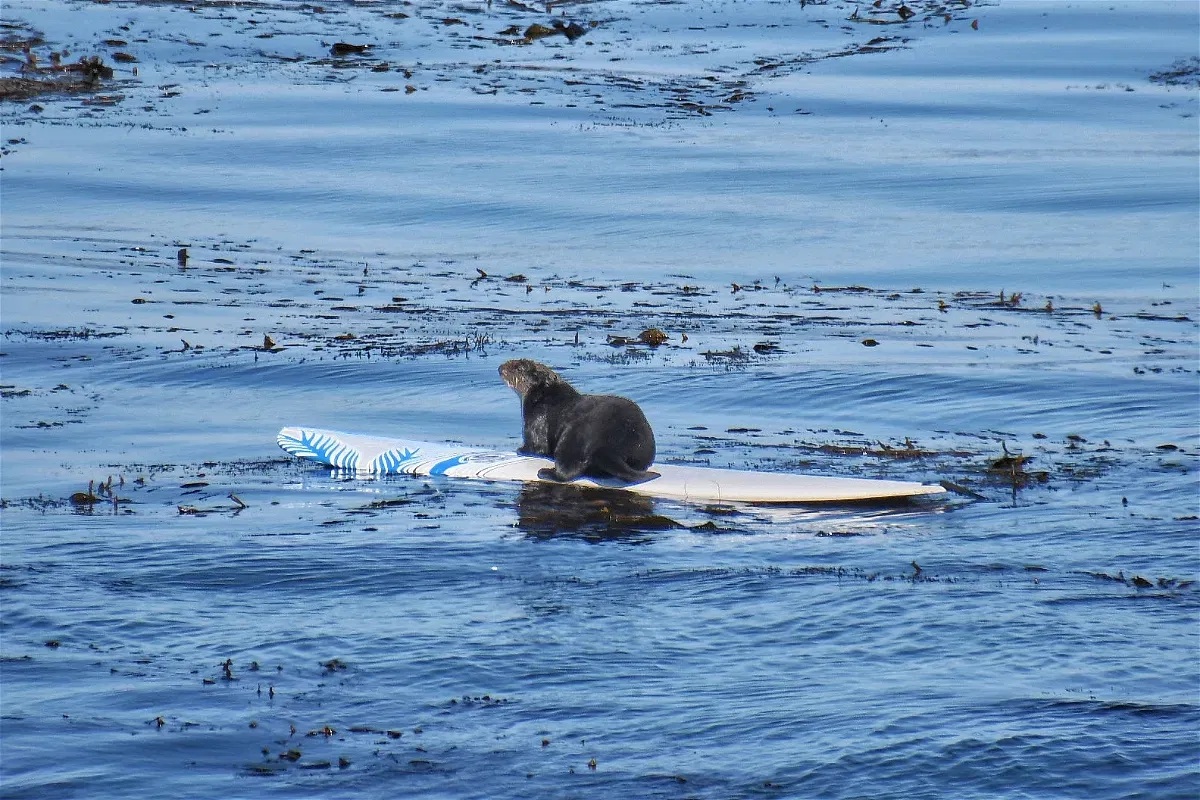
The increase is from the now world famous Otter 841. The female otter skyrocketed to stardom after videos of her climbing on and biting surfboards went viral. For the past month, FWS has tried and failed to capture 841.
Advertisement
Ashley McConnell, the public affairs supervisor for FWS, told KSBW that the attempts to capture 841 will continue as long as the otter poses a threat to the public or herself. The capture attempts, which have gone on for 29 days, could take several days or weeks longer.
Recently, ocean-goers have been approaching and disturbing resting sea otters with personal watercrafts like jet skis.
In a statement released Monday, FWS warned that the extra attention could be lethal to the endangered sea otter population. Resting otters need to conserve energy to make sure they can raise their young. If otters expend too much energy on human disruptions, the result could be fatal.
Sea otters consume roughly 20-30% of their mass in food just to meet daily energy needs. The iconic look of an otter floating on its back is because they need to rest for a significant portion of their day.
FWS has released the following recommendations for safe sea otter viewing:
By Derrick Ow
August 6, 2023 6:24 PM

Share on FacebookShare on TwitterShare on Linkedin
SANTA CRUZ, Calif. (KION-TV)- Otter 841 mania is in full effect as a Santa Cruz ice cream shop has honored her with an ice cream flavor.
Marianne’s in Santa Cruz announced on their social media pages on Sunday that the Otter 841 ice cream is now available.
The ice cream is made up of cinnamon caramel ice cream laced with snickerdoodle dough chunks courtesy of Pacific Cookie.
Marianne’s said that the ice cream is cute, sweet, and local but has a bit of a bite.
The otter has gained a following since it continues to evade capture from U.S. Fish and Wildlife since June when she has taken over surfboards and kayaks in Santa Cruz.


