BY DANIELLA SEGURA JUNE 20, 2023 2:53 PM A tiny critter, which hasn’t been documented in Santa Clara County since 1947, has been found in the California mountains. Photo from Midpeninsula Regional Open Space District A tiny critter, which hasn’t been seen in a California county in decades, has been found in the mountains. After setting up trail cameras in the Sierra Azul Preserve, Ken Hickman captured images of the “elusive” Santa Cruz kangaroo rat in 2019, The Santa Cruz Sun Sentinel reported. Hickman, an idependent researcher, built trail cameras and, with a permit, placed them around the preserve. “I was shocked when I found these animals. It was unbelievable,” Hickman, who had identified the preserve as a potential habitat, told the news outlet. “People have been looking for them for years.” TOP VIDEOS Top Videos 01:05 01:30 Fort Mill high schools holdgraduation ceremonies The species, which hasn’t been documented in Santa Clara County since 1947, is listed as a “critically imperiled subspecies,” meaning the animal is at high risk of extinction, according to the Midpeninsula Regional Open Space District. Photos of Hickman’s discovery left Matt Sharp Chaney, a wildlife biologist with Midpen, “awestruck,” Sharp Chaney told NBC Bay Area in a video posted on the agency’s YouTube. From there, “it took a lot of work and a lot of diligence to find” the rodents, he told the outlet. “It wasn’t an instant success story,” Sharp Chaney told the outlet. After trekking through the preserve last year, researchers from the University of California, Santa Cruz and Midpeninsula Regional Open Space District found several Santa Cruz kangaroo rats, the agency said in a June 12 Facebook post. Get unlimited digital access Try 1 month for $1 CLAIM OFFER The animals are “neither a kangaroo nor a rat” but are instead “more closely related to chipmunks,” according to the agency. “Although small in stature, kangaroo rats are considered a ‘keystone’ species, meaning its activities have great influence on the plants and animals that make up its habitat,” the agency said. Biologist Matt Sharp Chaney holds a Santa Cruz Kangaroo rat. Photo from Midpeninsula Regional Open Space District The species is only known to live in one other area, the Henry Cowell Redwoods State Park, according to the agency. To help support the rodents’ population, the agency said it is helping ongoing genetic research being conducted with a “collaborative team,” which includes researchers from UC Davis, UC Santa Cruz and California Polytechnic State University in San Luis Obispo. The agency said it plans to use the results from the study to potentially get the rodent protection under the California Endangered Species Act. In addition to genetic research, the agency said it is creating a “habitat and population management plan,” meant to find improvements for the species’s habitat to help support the animal’s population. Sierra Azul Preserve is about 20 miles northeast of Santa Cruz.
According to the U.S. Environmental Protection Agency, protecting endangered species is important because all living beings, including people, depend on other species for survival.
Outforia— an online resource for outdoor recreation that aims to “empower people to connect with nature” with “trusted” reviews, “best local guides and leading regional knowledge” — revealed the state rankings for most endangered species on recordin anew report, which was based on data from the U.S. Fish & Wildlife Service (FSW).
The impact of human activity on the Earth system could result in unpredictable chaos from which there is no return, physicists have calculated.
Using a theory conceived to modelsuperconductivity, a team of physicists led by Alex Bernadini of the University of Porto in Portugal showed that, after a certain point, we will not be able to restore equilibrium to Earth’s climate.
A finite amount of human activity could result in a Hothouse Earth from which there is no return. They detailed their work in apaper made available in April 2022on the preprint server arXiv that remains to be peer-reviewed.
“The implications ofclimate changeare well known (droughts, heat waves, extreme phenomena, etc.),” physicist Orfeu Bertolamitold Live Sciencelast year.
“If the Earth System gets into the region of chaotic behavior, we will lose…
ST. BERNARD PARISH, La. (WGNO) — Three hunters are facing legal consequences after an agent with the Louisiana Department of Wildlife and Fisheries witnessed the group violating hunting laws.
On Thursday, June 15, Senior Agent Salvador Mangano issued citations to 31-year-old Jorge A. Caballero del Cid, 26-year-old Alfredo J. Rodriguez-Soler, and 30-year-old for hunting from a moving vehicle, hunting from a public roadway and hunting rabbits during a closed season.
According to agents, within the last two weeks, several calls were made reporting subjects in a dark-colored Dodge Ram truck hunting rabbits at night off Highway 46.
Wolves have gradually returned in recent years to Austria.
Several regions of Austria have allowed the controversial killing of wolves after reporting an increase in livestock attacks, sparking debate in the Alpine EU member.
The World Wildlife Fund (WWF) says the orders to kill the wolves violate European law, which lists them as protected animals.
In the southern province of Carinthia, five wolves have been killed so far this year under legislation introduced in January. The killing of eight more has been authorized, according to authorities.
Neighboring Tyrol, known for cattle grazing freely on mountain pastures, has authorized the killing of six wolves—yet to be carried out—under a decree from February, according to province spokesman Maximilian Brandhuber.
“Time and again wolves are sighted near settlements and kill livestock,” he told AFP this week, adding that evidence of their presence has “risen sharply since 2019.”
After disappearing in the 19th century, the wolf has gradually returned in recent years to repopulate former habitats in Austria.
Some 80 wolves were counted in 2022, according to official estimates.
The wolf is protected under a European Union directive adopted in 1992, but it does provide for exemptions to the directive, according to Brandhuber.
“Austria does not yet have many wolves and it must make its contribution to the conservation of the species, as other European countries do,” WWF expert Christian Picher told AFP, urging the European Commission to act.
WWF said the country of 9.1 million people should learn from neighboring states like Italy, which “already have decades of experience on the subject,” calling on Austria to improve the monitoring of the animals and avoid “alarming” the population unnecessarily.
Citing animal welfare concerns, Iceland has suspended its whale hunting season until Aug. 31.
This decision follows the release of a government-commissioned independent report that found that many whales suffer immensely after being harpooned.
Iceland had been set to kill around 200 fin whales, up from the 148 it killed in 2022.
Iceland has suspended its planned hunt for fin whales this year, citing animal welfare concerns.
On June 20, Svandís Svavarsdóttir, the country’s minister of food, agriculture and fisheries, announced that the whale hunt was postponed because “the fishing method used when hunting large whales does not comply with the law on animal welfare.”
This decision follows the release of a government-commissioned independent report that found that 41% of whales targeted in the Icelandic hunts did not die immediately, but suffered immensely after being shot with harpoons. It also found that some whales took up to two hours to die.
The hunt has been suspended until Aug. 31, but experts close to the matter say it’s unlikely it will start after the suspension lifts, since September usually marks the end of the whaling season.
A harpoon on an Icelandic whaling vessel. The 2023 whale hunt in Iceland was suspended until August 31, 2023. Image by Arne Feuerhahn / Hard to Port.
“I have made the decision to temporarily stop whaling in light of the unequivocal opinion of the professional council on animal welfare,” Svavarsdóttir said in a statement in Icelandic. “The conditions of the law on animal welfare are inescapable in my mind, if the government and license holders cannot guarantee welfare requirements, this activity does not see a future.”
Only one whaling company, Hvalur, holds a license to hunt whales in Iceland, which is set to expire in 2023. Another Icelandic whaling company, IP-Utgerd, ceased operations in 2020 due to financial difficulties.
Arne Feuerhahn, founder of Hard to Port, a German organization that has worked to end the Icelandic whale hunts, says the news surprised him.
“I was standing in front of one of the whaling ships … when I received the news,” Feuerhahn, currently in Iceland, told Mongabay by phone. “It was a very, very special and emotional moment because so many people have put a lot of energy over the past few months and years to get to this outcome.”
Before receiving the news, Feuerhahn said he’d been expecting the whalers to begin hunting on June 21.
Feuerhahn, who has been working with partners to document the Icelandic whale hunts since 2015, says he previously shared video of the whale hunts with Svavarsdóttir. The government then placed observers on all whaling ships in 2022.
This year, Iceland was set to kill around 200 fin whales (Balaenoptera physalus), considered vulnerable to extinction by the global conservation authority IUCN.
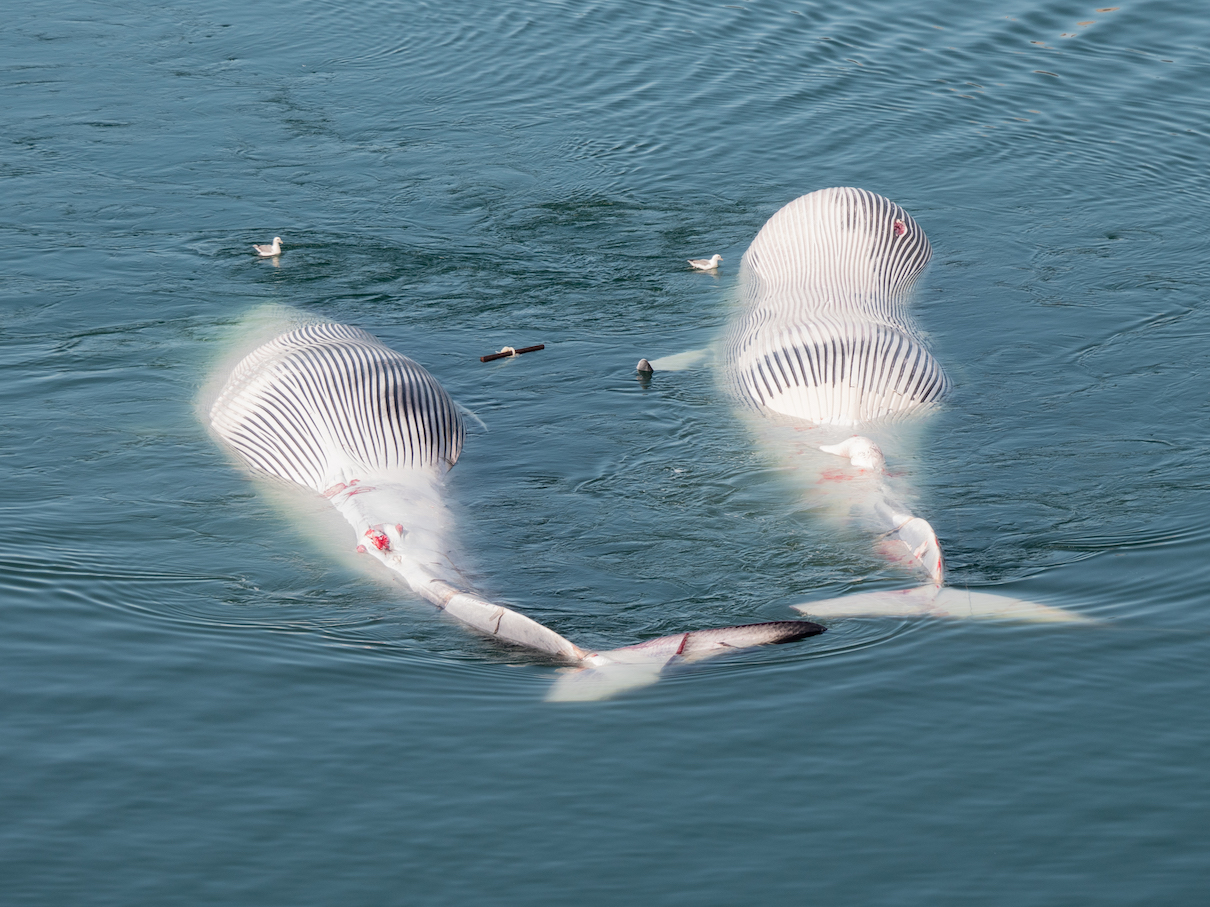
Two fin whales being dragged through the water. In 2022, Iceland killed 148 fin whales. Image by Arne Feuerhahn / Hard to Port.
In 2022, Iceland killed 148 fin whales. In 2018, it killed 44 fin whales and two rare hybrids of fin and blue whales.
Iceland has been one of the very few countries, along with Japan and Norway, that has continued to hunt whales despite the International Whaling Commission enacting a global moratorium on commercial whaling in 1986.
A survey conducted by Icelandic research company Maskína found that 51% of Icelanders oppose the whale hunts, while only 29% are in favor. Most of those in favor were 60 years or older.
“This is a major milestone in compassionate whale conservation,” Ruud Tombrock, the executive director of the Humane Society International in Europe, said in a statement.
“There is no humane way to kill a whale at sea, and so we urge the minister to make this a permanent ban,” Tombrock added. “Whales already face so many serious threats in the oceans from pollution, climate change, entanglement in fish nets and ship strikes, that ending cruel commercial whaling is the only ethical conclusion.”
Banner image caption: The harpoon or catcher ship Hvalur 8 arrives at the whaling station in Hvalfjörður, West Iceland. Two fin whales are tied to the starboard side of the ship. Image by Arne Feuerhahn / Hard to Port.
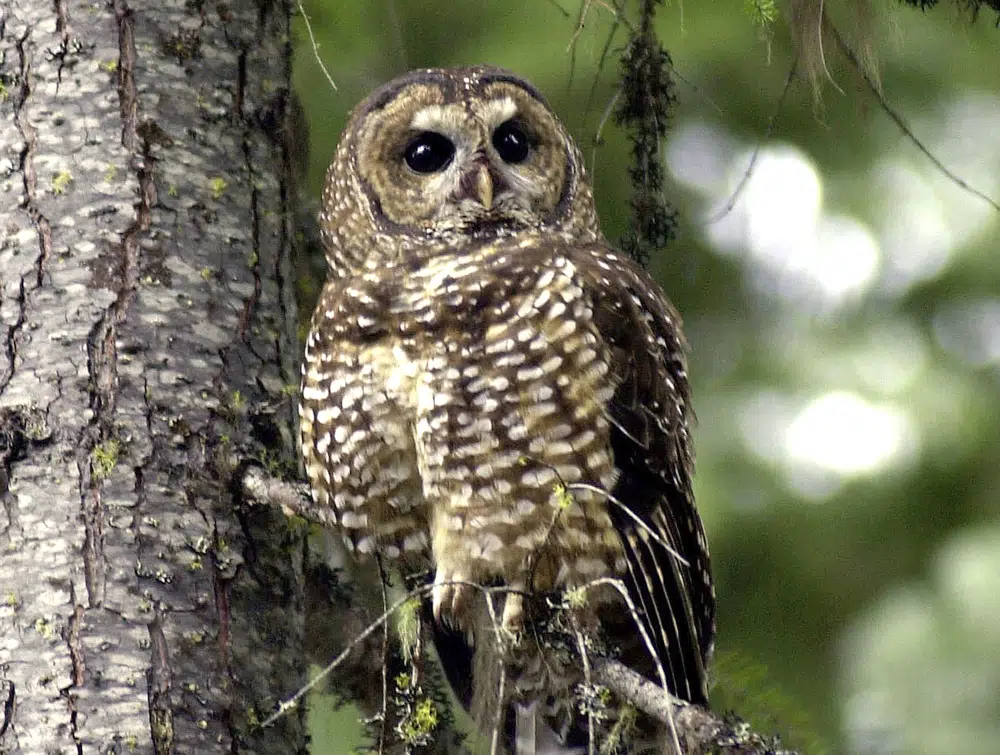
FILE – In this May 8, 2003, file photo, a northern spotted owl sits on a tree branch in the Deschutes National Forest near Camp Sherman, Ore. The U.S. Fish and Wildlife Service plans to reinstate a decades-old regulation that mandates protections for species that are newly classified as threatened. (AP Photo/Don Ryan, File)
BILLINGS, Mont. (AP) — The Biden administration proposed bringing back rules to protect imperiled plants and animals on Wednesday as officials moved to reverse changes under former President Donald Trump that weakened the Endangered Species Act.
The U.S. Fish and Wildlife Service said it would reinstate a decades-old regulation that mandates blanket protections for species newly classified as threatened.
Officials also would no longer consider economic impacts when deciding if animals and plants need protection. And the rules make it easier to designate areas as critical for a species’ survival, even if it is no longer found in those locations.
That could help with the recovery of imperiled fish and freshwater mussels in the Southeast, where the aquatic animals in many cases are absent from portions of their historical range, said Fish and Wildlife Service Assistant Director Gary Frazer.
Frazer said Wednesday’s proposal would restore “baseline” protections so species don’t get pushed further toward extinction.
“We have the opportunity to try to improve the status of species before they get to the brink,” he said.
Details on the proposed rules, which could take a year to finalize, were obtained by The Associated Press in advance of their public release.
They’ll face strong pushback from Republican lawmakers, who say President Joe Biden’s Democratic administration has hampered oil, gas and coal development, and favors conservation over development.
ADVERTISEMENT
ADVERTISING
“These proposed rules take us in the wrong direction and are entirely unnecessary given the proven track record of success from private conservationists and state and local land managers,” said House Natural Resources Committee Chairman Bruce Westerman, a Republican from Arkansas.
ADVERTISEMENT
Industry groups have long viewed the 1973 Endangered Species Act as an impediment. Under Trump they successfully lobbied to weaken the law’s regulations as part of a broad dismantling of environmental safeguards. Trump officials rolled back endangered species rules and protections for the northern spotted owl, gray wolves and other species.
The spotted owl decision was reversed in 2021 after career wildlife officials said Trump’s political appointees used faulty science to justify opening millions of acres of West Coast forest to potential logging. Protections for wolves across most of the U.S. were restored by a federal court last year and the Biden administration has said it will decide by next February if they should remain in place.
Many of the changes under Trump were finalized during his last weeks in office.
Since then, officials imposed less restrictive protections for more than a dozen animals and plants compared to what they would have received, said Jonathan Wood with the Property and Environment Research Center, a free-market policy group based in Bozeman, Montana.
ADVERTISEMENT
Wood said the Biden administration changes could hurt efforts by state and private landowners to recover species, by imposing more punitive regulations that undermine the incentive to work voluntarily for conservation.
Biden administration officials said they were trying to bring the endangered species law into alignment with its original intent and purpose.
U.S. Fish and Wildlife Service Director Martha Williams said in a statement that the changes “reaffirm our commitment to conserving America’s wildlife and ensuring the Endangered Species Act works for both species and people.”
National Oceanic and Atmospheric Administration Fisheries Assistant Administrator Janet Coit said the rules would ensure the species law remains effective as climate change alters habitats around the globe, and plants and animals become extinct.
The Biden administration had earlier withdrawn a 2020 rule that limited which lands and waters could be designated as places where imperiled animals and plants could receive federal protection. It also reversed Trump’s decision to weaken enforcement of the century-old Migratory Bird Treaty Act, which made it harder to prosecute bird deaths caused by the energy industry.
But environmentalists have been frustrated that it’s taken more than two years for Biden to act on some of the Trump-era rollbacks. Stoking their urgency is the prospect of a new Republican administration following the 2024 election that could yet again ease protections.
“These are promising steps to get us back to the Endangered Species Act’s purpose, its power to protect,” attorney Kristen Boyles with Earthjustice said of the new rules. The group sued on behalf of environmental groups to block the Trump rules and prevailed in U.S. District Court then lost on appeal.
An array of industry groups have long maintained that economic impacts are not given enough consideration in U.S. government wildlife decisions. Those groups range from livestock and ranching organizations to trade associations representing oil, gas and mining interests.
The Endangered Species Act is credited with helping save the bald eagle, California condor and scores of other animals and plants from extinction since President Richard Nixon signed it into law. It currently protects more than 1,600 species in the United States and its territories.
In a move that raised global tensions,a Chinese Navy vessel cruised within 150 yards of an American destroyer, causing a near collision in the Taiwan Strait. This provocative June 4th encounter comes on the heels of a Chinese fighter jet executing an “unnecessarily aggressive maneuver”…
BEIJING (AP) — China has called comments by President Joe Biden describing Chinese leader Xi Jinping as a dictator “extremely absurd and irresponsible.”
Related video:What will happen to the markets if China invades Taiwan?(Benzinga)
This is the wild card. This is always been the
Loaded:37.78%Play
Current Time0:00
/
Duration1:35QualitySettingsCaptionsFullscreen
Benzinga
What will happen to the markets if China invades Taiwan?Unmute
The new clash of words comes just over a day after Secretary of State Antony Blinken concluded a visit to Beijing that sought to break the ice in a relationship that…
Elena Duvernay/Stocktrek Images/Stocktrek Images/Getty Images
The earliest people who lived in North America shared the landscape with huge animals. On any day, these hunter-gatherers might encounter a giant, snarling saber-toothed cat ready to pounce or a group of elephant-like mammoths stripping tree branches. Maybe a herd of giant bison would stampede past.
Obviously, you can’t see any of these ice-age megafauna now. They’ve all been extinct for about 12,800 years. Mammoths, mastodons, huge bison, horses, camels, very large ground sloths, and giant short-faced bears all died out as the huge continental ice sheets disappeared at the end of the Ice Age. What happened to them?


 (buradaki/Getty Images Plus)




 Related video:What will happen to the markets if China invades Taiwan?(Benzinga)
 Benzinga