Two people at Grand Teton National Park in Wyoming harassed a bison calf, the National Park Service said Thursday.
They were seen approaching and touching the baby bison at the southern end of Elk Ranch Flats on Sunday around 1 p.m., officials said. Interaction with people can cause wildlife to reject their children.
“In this case, fortunately, the calf was successfully reunited with its herd, but often these interactions result in euthanizing the animal,” authorities said. “Approaching wildlife can drastically affect their well-being and survival.”
The National Park Service says two people harassed a bison calf at Grand Teton National Park. / Credit: National Park Service
In a recent incident at Yellowstone National Park, a bison calf needed to be euthanized after a man disturbed it. The bison had been separated from its mother on May 20 when a herd crossed a river. A park visitor spotted the struggling calf and pushed it onto the roadway. Park rangers failed to reunite the bison with the herd. Officials euthanized the calf because it had been abandoned and was causing a hazardous situation.
In another incident, tourists picked up a baby elk and put it in their car at Yellowstone over Memorial Day weekend. They drove the newborn elk to West Yellowstone, Montana, Police Department, park officials said. The calf “later ran off into the forest” and its condition was unknown.
The National Park Service has urged visitors to stay away from animals.
“It’s important to view wildlife safely, responsibly and ethically. Treat all wildlife with caution and respect as they are wild, unpredictable and can be dangerous,” officials said in a Thursday news release. “The safety of visitors and wildlife depends on everyone playing a critical role in being a steward for wildlife by giving them the space they need to thrive – their lives depend on it.”
Park officials have asked visitors to follow guidelines around animals to prevent future problems. They suggest all visitors stay at least 25 yards away from most wildlife, including bison, elk and deer. Visitors are required to remain at least 100 yards away from bears and wolves.
It’s illegal to feed, touch, tease, frighten or intentionally disturb wildlife at National Parks. In the case of the bison that was euthanized, the park visitor pleaded guilty to one count of feeding, touching, teasing, frightening or intentionally disturbing wildlife. The visitor was ordered to pay a $500 fine, along with a $500 community service payment to Yellowstone Forever Wildlife Protection Fund, a $30 special assessment and a $10 processing fee, the park service said.
Oregon’s snowpack has gone from above average to below average across most of the state
PORTLAND, Ore. (KOIN) – Like water melting from a frozen peak and running into a stream, Oregon’s snowpack has been sliding downhill for the past several weeks.
The Willamette region had snowpack levels at or above 189% of median levels on April 10, 2023.The Umatilla/Walla Walla/Willow region was at 155% of median levels.
Ukrainian service members of the 55th Separate Artillery Brigade fire a Caesar self-propelled howitzer towards Russian troops, amid Russia’s attack on Ukraine, near the town of Avdiivka in Donetsk region, Ukraine May 31, 2023.Viacheslav Ratynskyi/ReutersCNN—
Ukrainian forces have suffered losses in heavy equipment and soldiers as they met greater than expected resistance from Russian forces in their first attempt to breach Russian lines in theeast of the countryin recent days, two senior US officials tell CNN.
One US official described the losses – which include US supplied MRAP armored personnel vehicles as “significant.”
Ukrainian forces managed to overrun some Russian forces in the east around Bakhmut. However, Russian forces, armed with anti-tank missiles, grenades and mortars, have put up “stiff resistance,” with their forces dug into defensive lines that are several…
In honor of May’s International Respect for Chickens Month, we began efforts to shut down a cruelly exploitative chick hatching event at Oberlin Public Library (OPL) in Oberlin, Ohio – a town known for its historic fight for abolition, equality, sensitivity, and inclusivity.
The OPL arranges this yearly event through Ohio State University’s (OSU’s) Extension Program and is made available to all public libraries in Lorain County, Ohio. Eggs for this program come from Meyer Hatchery, in Polk, Ohio. See meyerhatchery.com.
This year’s chick-hatching event at OPL began in late April, 2023. David Fausnaugh, the new Library Director, is the person responsible for deciding to have chick-hatching events at the library. These free public events are for the community’s entertainment (in the guise of “education”), in the hope of prompting monetary donations and/or new memberships from visitors who find the event appealing and thus worth continuing.
The chick-hatching event stretched into May 2023, and on May 4 (United Poultry Concerns’ International Respect for Chickens Day), a group of local activists protested outside the library. In response, the library covertly ended the event prematurely, trying to avoid further negative attention. By that time, it was known that one egg out of the eleven featured in the event “didn’t make it,” and at least two hatched chicks were visibly ill. Most disturbing was the fact that one tiny brown chick with splayed legs was separated from the others, trapped inside a makeshift room divider inside the comfortless metal cage. This weak, sickly chick was seen suffering in distress and misery and died not long after. It is suspected that the sick chicks were denied proper medical care, contrary to Mr. Fausnaugh’s claim when questioned about it.
The activists have continued their protests, calling the OPL’s chick hatching event CRUEL and SHAMEFUL based on the following:
At this year’s chick-hatching event, eleven eggs were placed inside of a comfortless styrofoam incubator machine. Those eleven eggs were from mother hens who were exploited for their egg producing capabilities, had their eggs stolen from them, and became stressed and frustrated when their strong brooding instincts were thwarted.
Newly hatched chicks peeped and searched about for their absent mothers, instinctively seeking their safety, nurturing, and guidance. The incubator they were trapped in bore no resemblance whatsoever to a welcoming, protective mother hen they so desperately needed.
While trapped inside the incubator and later when placed in a metal cage, the chicks trampled and pecked at each other, were handled by staff, and were poked at by visitors. The chicks were forced to endure bright lights, strange sounds/voices, and other intrusive conditions as both staff and visitors hovered over the unnatural spectacle throughout the library’s open hours. This constantly disrupted the chicks’ sleep, a crucial need for baby chicks. (These continuous interruptions could be seen on a livestream of the event on the OPL’s YouTube channel.)
The eggs came from “America’s industry-leading hatchery” – Meyer Hatchery in Polk, Ohio – a hatchery offering “more than 160 breeds of poultry including chickens, ducks, geese, turkeys, guineas, and game birds.” Hatcheries are known to destroy male chicks as well as any sick or otherwise unwanted female chicks after hatching. Gruesome “standard practices” for murdering hatchery chicks include gassing, suffocation in plastic bags, or shredding chicks alive in macerators.
In 2022, the library had their first chick-hatching program. One of the librarians volunteered to take the chicks home with her once the event ended. She was permitted to do so, and off they went. But later, as the chicks grew a bit older, the librarian discovered that 5 out of the surviving 6 chicks turned out to be males who were growing into roosters. Not wanting “annoying” roosters, she tried finding homes for them but was unsuccessful. She then took the 5 male chicks to a farm that would “take care of them.” Upon learning this, an activist asked the librarian if that farm was a sanctuary and was told that the farm was “a place that processes roosters.” (Like so many others who “keep” chickens in order to steal their eggs, she felt that since the roosters wouldn’t be profitable they were unworthy of living.) Mr. Fausnaugh allowed this same librarian to take home all of the surviving chicks when this year’s (2023) chick-hatching event abruptly ended. Both Mr. Fausnaugh and the librarian refused to release the chicks to farm animal sanctuaries that activists had lined up.
Mr. Fausnaugh is claiming that he personally didn’t see any animal cruelty. Along with this, he’s made numerous mentions that the library received a greater amount of positive feedback from the community versus vocal protest from a small group. It is because of this overall positive feedback that Mr. Fausnaugh is unwilling to “definitively” say whether he’ll be renewing the chick-hatching event in the future. What we are asking is that he state in writing that he will NOT renew OSU’s chick-hatching program NOR decide to have other library programs featuring animals dead or alive.
Chick-hatching programs are CRUEL lessons, but thankfully, kind alternatives are available that do not exploit animals. United Poultry Concerns puts out a helpful 16-page booklet titled Hatching Good Lessons: Alternatives To School Hatching Projects. (NOTE: Mr. Fausnaugh and his staff have already been given copies of this booklet. As yet, there has been no response.)
PLEASE help us end Oberlin Public Library’s chick-hatching events once and for all by contacting Mr. Fausnaugh with a message of support for our efforts to shut down this program. Your action could help convince Mr. Fausnaugh that the program is not worth renewing.
You can phone David Fausnaugh (Oberlin Public Library’s new Director)
Konark: The forest department personnel today apprehended a poacher and seized the carcass of a spotted deer from Nadia Matha Reserve forest within Balukhand Sanctuary under Konark forest division on Thursday.
On the basis of reliable inputs and following the order of Konark Forest Officer Benudhar Behera, forester Ravindra Kumar and others raided the spot when four poachers were skinning the deer they had hunted by laying traps in the reserve forest of Balukhand Sanctuary.
The forest personnel managed to arrest Chandra Shekhar Pradhan of Chennua village from Nadia Math beat but other accused identified as Nanda Pradhan, Pankaj Pradhan and Duryodhan Naik of Nadia Math village managed to flee the spot.
“As few personnel of the local forest department were present during the raid, while arresting one, the others managed to give a slip,” said ranger…
According to the Ontario County Humane Society, 21-year old Mackenzie Clarke of Newark and her boyfriend Isiah Dishaw have been charged with Aggravated Cruelty to an Animal, a felony, and Animal Abandonment, a misdemeanor. Clarke was also charged with Falsely Reporting an Incident.
Clarke claimed that she and Dishaw tried to take her 1-year old Pitbull mix, named Ash, to the Humane Society last Thursday after becoming ill but they weren’t open. She then decided to leave Ash on the side of Styker Road and reported the abandoned dog to authorities.
Ash would die the next day.
Both Clarke and Dishaw will answer their charges at a later date in Phelps Town Court.
Sadie Odell with the U.S. Fish and Wildlife Servicechecks and totals Caspian tern nests located at the northeastern end of Gravel Island offshore from the Door County peninsula on June 2, 2023. The white birds in the background are Herring Gulls, which also nest on the island. Photo courtesy of Sumner Matteson
Bird flu killed nearly two-thirds of the state’s population of Caspian terns
A state avian ecologist says a highly contagious bird flu that hit Wisconsin last year may have been the most deadly avian flu outbreak ever for wild birds in the Midwest.
Last year, highly pathogenic avian influenza killed almost two-thirds of the state’s breeding population ofCaspian terns. The white gull-sized tern with a black cap and coral-red bill is astate endangered bird. It’s only found at three sites in…
While emphasising that the risk to humans remains low, experts said that the surging number of bird flu cases in mammals is a cause for concern.PHOTO: REUTERS
PARIS – The virus causing record cases of avian influenza in birds across the world is changing rapidly, experts have warned, as calls increase for countries to vaccinate their poultry.
While emphasising thatthe risk to humans remains low,the experts who spoke to Agence France-Presse said that the surging number of bird flu cases in mammals is a cause for concern.
Since first emerging in 1996, the H5N1 avian influenza virus had previously been confined to mostly seasonal outbreaks.
But “something happened” in mid-2021 that made the group of virusesmuch more infectious,according to Dr Richard Webby, the head of a World Health Organisation collaborating centre studying influenza in animals.
In June 2005, four women spoke at a San Francisco celebration of the first World Environment Day in North America. The Bay Area locals – Jen Maiser, Jessica Prentice, Sage Van Wing and Dede Sampson – invited the audience to join them in a local food challenge: spending the next month eating only food produced within 100 miles (160km) of their homes.
Although the concept of eating locally was not new – the farm-to-table movement had kicked off in the 1960s and 70s as hippies protested against processed foods and Alice Waters opened the first farm-to-table restaurant, Chez Panisse, in Berkeley, California – these women gave it new life with a new name, calling themselves “locavores”. In his 2006 book, The Omnivore’s Dilemma, Bay Area local Michael Pollan also advocated for the local food movement, and by 2007 the Oxford American Dictionary had dubbed “locavore” its word of the year.
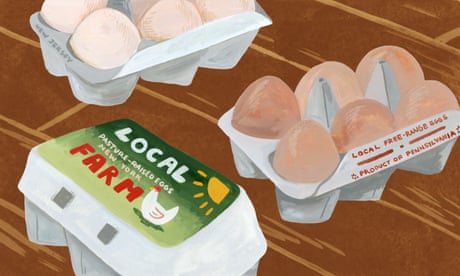
Nearly two-thirds of Americans believe that eating local food is better for the environment. But in recent years, a series of studies have shown that eating locally might not be as environmentally impactful – in and of itself – as advocates once hoped. In fact, research shows that the carbon footprint of transporting food is relatively small, and that it’s more important to focus on how your food is produced. Eating local can be a part of that, but it doesn’t have to be.
What’s the evidence for eating local?
In 1994, the UK-based Sustainable Agriculture Food and Environment Alliance (now called Sustain) published The Food Miles Report – the Dangers of Long-Distance Food Transport, which offered scientific backing for the burgeoning local food movement. It argued that the long-distance transportation of food was only possible because of cheap, non-renewable fossil fuels that allowed transnational corporations to “exploit land, labour and resources in developing countries for the production of raw commodities to which they add considerable mark-ups before sale in the North”.
“As you can perceive in the title, food miles were initially considered (almost by definition) as a big threat and contributor to climate change,” Laura Enthoven, a PhD researcher in agricultural economics at the Université catholique de Louvain in Belgium and author of a recent review of local food systems research, said in an email. The farther food had to travel, the more fossil fuel was used and greenhouse gases emitted.
Those emissions are especially high for food transported by airplane: food that is flown is responsible for up to 50 times as much carbon dioxide as food transported by boat. Fortunately, very little food travels by air (think perishables that need to be eaten soon after harvest, like asparagus and berries). Many fruits and vegetables with a longer shelf life, like apples and broccoli, can be shipped by boat, truck or rail, whose food miles produce far fewer emissions.
Is it the best way to reduce food-related emissions?
In the 2000s, scientists began conducting full life cycle assessments of food supply chains – looking at how much greenhouse gases are emitted not just when food is transported, but also when crops are planted and fertilized, animals are taken out to pasture or kept in confinement, and food scraps end up in the garbage. What they found was that transporting food made up a relatively small percentage of food’s total carbon footprint.
In a 2018 paper, a team of researchers from the UK and Switzerland found that only 1% to 9% of food’s emissions come from packaging, transport and retail. The vast majority of greenhouse gas emissions – 61% – come during production, while food is still on the farm. That’s supported by research published in the early 2000s in the US and Europe.
What we eat and how it is produced makes more impact on our food carbon footprint than purely where it comes from in terms of distance
Researcher Laura Enthoven
“What we eat and how it is produced makes more impact on our food carbon footprint than purely where it comes from in terms of distance,” said Enthoven.
The greatest source of emissions can vary among foods. In many crops, it’s the fertilizer and pesticides required to grow large quantities of food on industrial farms. In beef, for example, less than 1% of emissions come from transportation while the vast majority come just from feeding cattle (and their methane-heavy burps).
Scientists are still grappling with how to define food miles: some only take into account the emissions of transporting food while others consider the full life cycle of producing food in one region before it is moved to another. As recently as last year, a study inNature Foodfound that food miles accounted for a significantly larger share of the food system’s emissions than had been previously thought by taking into account the emissions from transporting fertilizers, machinery and animal feed to grow that food.skip past newsletter promotion
Sign up to Down to Earth
Free weekly newsletter
The planet’s most important stories. Get all the week’s environment news – the good, the bad and the essential
Does the research mean there are no benefits to eating locally? “It depends,” both Enthoven and Mike Hamm, a professor emeritus and founding director of the Michigan State University Center for Regional Food Systems, said separately. Eating locally can be a means of supporting farms that use more environmentally friendly production practices, such as minimizing their use of fossil fuel-rich pesticides and fertilizers.
“I’ve often said the whole idea of local foods wasn’t about just reducing food miles,” said John Ikerd, professor emeritus of agricultural economics at the University of Missouri. It’s also a solution for people “looking for an alternative to the industrial food system”.
Ikerd recalls the farm-to-table movement and hippy-led rebellion against industrial food beginning shortly after Rachel Carson’s indictment of pesticides, Silent Spring, was published in 1962. That led to the birth of the organic food movement, which sought to produce food without greenhouse gas-emitting fertilizers, pesticides and other chemicals. But as more corporations began producing organic-labeled food, Ikerd saw consumers turn to local farms where they might have a better sense of how their food was grown – and more peace of mind that farmers were using regenerative agricultural practices.
“Well-designed, inclusive, local food initiatives can have a positive impact,” said Enthoven. But she cautions that consumers can fall into a “local trap”, a term coined in a 2007 article by researchers at the University of Washington, if they “believe that the whole system should switch to local only, which is not per se more sustainable or inclusive”.
Local farms can be important alternatives, especially when there are disruptions in supply chains, as occurred at the beginning of the Covid-19 pandemic. But “we need a diversity of scale in our production system across product types,” said Hamm, especially as we look at ways to feed 8 billion people in the era of climate crisis.