If it involves an animal, it is not vegan

Published in News on May 31, 2023
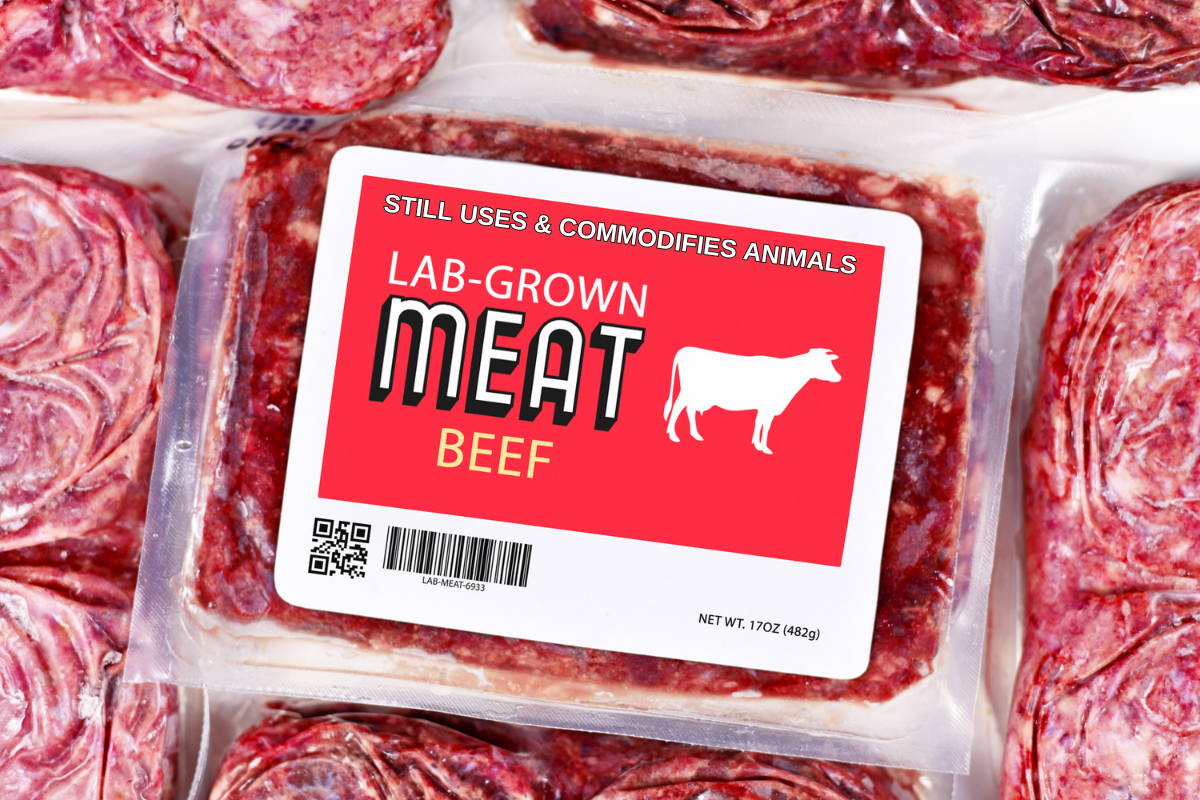
There’s a lot of buzz about lab-grown “meat” technology. It involves taking stem cells from an animal to grow inside bioreactors, where cells are fooled into believing they are still inside an animal’s body because they are fed a mixture of nutrients such as amino acids, vitamins, sugars and minerals.

Though these biopsies are invasive, supporters argue the process is less painful than many of the procedures an animal might endure during its lifetime on a farm, and the process does not involve the animal being killed.

However, Gary L. Francione, philosopher at Rutgers University and author of the 2020 work Why Veganism Matters: The Moral Value of Animals, said of lab-grown meat that “if an animal was used, it is not vegan.” Period. 

We couldn’t agree more.

Eating “clean meat” will not eliminate harm to animals; eating plants will, in addition to improving individual health.

Flesh produced by lab workers doesn’t offer a better future for animals or the environment. As of right now, all lab-grown meat still uses and commodifies animals — whether it’s foie gras grown from avian starter cells that are taken from a muscle-biopsy procedure or a “clean” hamburger using bovine starter cells, a byproduct from blood of cow fetuses extracted during the slaughtering process.

Find out the truth about lab-grown meat in this Q&A between Friends of Animals President Priscilla Feral and Francione.

As you know, on Nov. 21, 2022, the U.S. Food and Drug Administration decided that lab-grown meat made by culturing animal cells is safe to eat. The FDA gave the green light to California-based Upside Foods “chicken,” putting it one step closer to grocery store shelves and restaurants. What’s your reaction to this development?

I am absolutely opposed to any animal use. There is no sort of animal use that I will praise or support. I am not a utilitarian (or consequentialist of any sort) where fundamental rights are involved. So the “but it will reduce the killing of animals” arguments don’t resonate with me. And by the way, I do not think for a second cultured meat will reduce animal use in any significant way. The large agricultural corporations that produce meat know that world population is increasing, and we are running out of space to expand conventional meat production. Cultured meat will supplement a market that I do not think will be substantially reduced and certainly not eliminated. That is, cultured meat is just going to become part of the meat industry. That is why some of those large meat companies are investing in cultured meat.

 Dr. Uma Valeti, the CEO of Upside Foods, said that he’s “thrilled that U.S. consumers will soon have the chance to eat delicious meat that’s grown directly from animal cells.” What’s your response?

Valeti is the CEO of a corporation that develops and makes cultured meat. Of course he’s thrilled.

Will lab-grown meat spare animals from being bred into existence on animal farms, reducing their misery and greenhouse gas emissions?

There is no indication whatsoever that cultured meat is going to replace meat to any significant degree. I think that there is every indication that it will do little more than supplement the existing supply of meat.

Bruce Friedrich, who founded The Good Food Institute, says he’s long been focused on creating a clean alternative to animal agriculture that competes on taste, price and convenience.  He also said a “clean meat” industry would be an alternative to the current objectionable animal farming practices. Do you agree?

I think that we need to shift the paradigm away from animal bodies as food. It makes no sense to me that “animal people” are perpetuating the notion that animals from any source or however produced are food. That is what needs to change. I wish “animal people” would put their time, energy and money into really promoting veganism as a moral imperative and as a major contributor to improved human health and environmental integrity, rather than trying to make money off perpetuating any sort of animal use. That is the same thinking that has fueled the animal welfare movement—a bunch of corporate charities that bring in millions selling “happy” exploitation. That has been a disaster. Why don’t “animal people” stop trying to make a living by promoting anthropocentric and speciesist thinking and behavior?

Gary L. Francione is Board of Governors Distinguished Professor of Law and Katzenbach Scholar of Law and Philosophy at Rutgers University School of Law (USA). He has written numerous books, articles, and essays on animal rights, the property status of animals, the problems with animal welfare reform campaigns and single issue campaigns, and veganism as a moral imperative. His most recent book is Why Veganism Matters: The Moral Value of Animals, published in 2020 by Columbia University Press. With his colleague and partner, Anna Charlton, he started the Rutgers Animal Rights Law Clinic in 1990, which was the first of its kind anywhere.

Ultra-rare, deep-diving whale dies on New England beach with possible case of bird flu

Exposing the Big Game's avatarThe Extinction Chronicles

News

BySascha Pare

publishedabout 23 hours ago

A necropsy revealed that the animal may have been infected with avian influenza, which would be “a big deal” if it is confirmed by further testing, scientists say.

Comments (0)

We see a slender whale on a beach with yellow ties around its head and tail. The ties are attacked to an excavator.

The whale was alive when rescuers arrived on the scene, but died a few hours later.(Image credit: Seacoast Science Center – Marine Mammal Rescue. All photos were taken under Seacoast Science Center’s marine mammal stranding agreement with NOAA Fisheries, and are shared with their permission. )

A mysterious, deep-diving whale has died after a “highly unusual” stranding in Gloucester, Massachusetts — and it may have been infected with bird flu, scientists say.

The animal was still breathing when a response crew arrived on the scene at Wingaersheek Beach on May 18. The team had never seen anything like it before.

“It was alive when it initially stranded, and was noted to…

View original post 669 more words

Huron East Hunter convicted in December 2020 Deer Hunting Incident

Exposing the Big Game's avatarCommittee to Abolish Sport Hunting Blog

He was convicted of charges relating to discharge of a fire arm across public right of way, having loaded firearm in vehicle and failing to invalidate his deer tag. It was repeat offence with previous incident in 2019.

June 9, 2023

The Ministry of Natural Resources and Forestry have seen a Huron East resident convicted of multiple hunting and gun related charges after an incident in Huron East in December of 2020.

A Conservation Officer on patrol in the area encountered the suspect with a loaded firearm in his front seat and a deer in the truck bed with an un-notched deer tag.

It was also determined he discharged a firearm in an unsafe direction, with barns and farm lanes a short distance away.

He was convicted of charges relating to discharge of a fire arm across a public right…

View original post 50 more words

Video shows pigs on the loose after semi crashes at I-694 and 35E

BY JOHN LAURITSEN

JUNE 9, 2023 / 11:41 AM / CBS MINNESOTA

https://www.cbsnews.com/embed/video/?v=25ceb23d1f5bcf0219e5fe8dfd3f686d1686330533&usprivacy=null#xVj7b9vIEf5XBAKnH2qvxPdDB6GVLTs1LpHdOA%2BgViAsd5fSnvkCl5TsOPrfO7OkHnbSND1c2sslJPcxMzvzzew3ejJoUxdlSh%2BNUV014tSQ6rxIU1oqGafCGCU0VTDKxVoy%2BIQXdQ8bjFNjLbkojNGTIWuRKWN092TUjyWuWRcc5iWHVzPhDvNjQURiu8SNfUao7frEtZhn%2B5HvBQzXZuXDW5Fc4Y7w4tXNx2bx4bf3kX82%2B8dk82HGpuY%2F%2FcQK6o%2FVagGri0ouZX7BZS2LHLZkModRlTZLVI5mkZRuiMiTomIiE3lNqqLJucyXpClJKZeK0KQWFVEik4RVVK2EIkVOMlFXBVnJ5WoDHjk1almjE4wPKHTUe003vSOpvZ3UXlP2UGpPSx0MBgZ67B42wkvSpOkfktND63qddb0i72nregfrGM2LXDKavvsp4muZCVXTrDRGlh%2F6juW5oQn%2Fwdmaira%2Bd4%2B%2BXtNYpBhzE4Zhf9p%2B53B%2BQENGl0IhXBRGeVXXpRrNh%2FMhVUrUyh6wWOVio0BhLdmAFdl8uGri%2BVDOh9V8aJu2Mx%2BaPvyN5kMriMIkEpQIF7FkJ4JEbmITQBT1zMhLLDeYD%2BtVk8U5lel86Lvmg%2BOboI0nNPStwIxc4TJmctOLHStmEeyyRUhBdhwENOaC2aEd%2BxFzTceNYhZ7nhdxGtPB7%2BUSDrf6P5zCskPzIbDhGE7k2k7ELScIzCSJzSSMKI%2BiCLaI0GTJDx5je2qUFWS22Lyv0mfnUWUK%2BT6gWbocyALOV8IJ1jb8RYjNh%2F8pS%2BfDTvB8eCgVR%2FLLquADqBN6Zue11l%2FdB6gCj61ShW5z%2FNDyF%2FojowpzLHOacCfZ%2FimiIX8yWoNoWqIzNMTnwweSlWL5%2Fu1rWNG8cNpms3muDwpTLlRR073f%2FrzqpB0r1VVWFmj1vlJDcZZMl2VEqO96rhvyhIReEhLXYS6hvhcTSqlp2RaCjL2snRvGCuISPAYCXYqKVmwFF8RdF8jO7T1c2HN7euEngBKt4DDvUP%2BMZvt6dCzj7LGdudtPfTw%2FvwYZs04GTdOv9Dwz6BNgVpRSFRzEWGC5oEpfAhYeQyzRn%2B1EUwIEldo7BkRPGIORs7Rg9%2Fu6pN4rUd02sWKVjAXfL1dlkaui2q1biYfJVCS0SRES5in8MfTo2WHUiU5d79SLYIJyDEGyaf9dpDK%2FfwaVIDGDYLAeJJusyga5qLE0zYdLSNy%2FMiX5%2BAkKJmzE922fqnwz9gCrltVnFGfx320%2FSely%2FIt9RjMWw0NkrIIHrysOD5XWpX7oObi%2B8ZHEVM895gweeaM3UFHLPoJrbEGB6h90QSol3fsvzuRVUSxTMZ1cnd9Orhaz4sPN5GraL9dVPr57O5lNr9986oPHy%2FE6o6WFOiGf3L46Mn5dHi3%2BdQEHVMAeFiXcDeMnyLMFngqHcykgCvmiHRvfmOfmuRNMpsQ2z4FHXFwGZHJpe%2BTs4uz8zPKnl6F30V8vG%2FSNfmz76vP4CYmNqEDJZ7HtryBRxjoEcJhf7Ev4%2F0XG9ktkMLANH60h9%2BJxsSkqrsZPOrO2%2FZYKjZ%2Fa57YPOmqsFeONiPUWqRYwBBHUz1ZMoxZlJdeUPYL09gXCyjNZ0XRWrEUWi2qSlisKbmhHt%2F2lXIOzXl1fv3p9sbia3b57ezF5s%2FhwNb24XsyuZ%2BcXn%2FpPSQaCaUUztf3V0ClIM33LInAAcccwQlhCLIxRGwzkD%2B0aDSaseAAn%2BD5BOJ0gmE4QSicIpBOE0QmC6AQhdIIAOkH4nCB4kMEBfCDvAD%2BnxrEOhBDIbD9H34QQ2g0gglU7ZMAIAgkrEkLpRAMJ8%2FuZ%2BQim55ueAQpP1kGqm3oOKpj%2FIVhhGUJEobwWWmjJZ%2Fw8hhdWAwDY9y4EPGhHkTuIdYbtQYYzLcyMI869gxru78AGowC3bnsLNB3tFnLd%2BAF0WmMHO12dvgaedlcHPViC4EPnfg9%2Bmj8cDNq1BlsYrivK7uFG01AsMsWKSuh3uKsd0%2FTM0Af8ubDr%2FOz2dQEc9s3urkRi68PEX7DwwkeuFqpe6Hh2VxKM0HJB0b7ZfDjZr2HogzWzrP2IjgdomO0igLYt27aFwaVbVxJJ6R3cPHEKFqcSd%2BgbYIt3wyWYcLG7bbqLIWsebqqiFFX9%2BJtAz9puIDj1gCAHHDhy5EaW7TjU8Y3tJ50YVNNecEktlo%2F4DmOrgrfUQuRcW9VdwXvKQBJB66YSnDDk1wLbpA48cBC4nPCiO3QoGNVSwsueajysgOQw6OUEa6nLftsRMflKC9CKF%2BGT6iKn0Avy7pKlFVDbVEwaOEOFLdudEQSxRYFSEx6wiLiBzUhk8pgwP7CSxPUFcFB9ux9v3TGB34tV3ktpU8kakvNomW4HRcR9O7JiIvwwIS4THqFxwIjjJQENuQs%2Btw9G3TTxFE6BQYFKREyfmFHPckamM7K%2Bsh2z7YXy%2FYpbwYqc0%2Bpxv%2FTuYNiu3dK9FDRO9Ur00qJQQn9sZN5j0JpCU9VRteN%2BC5psdg8dWZqqg7Z3u7jmNYRn0Y3uS0A3fWi9pZqKNR5Sl%2FzlbgGmxwK7cSxQ8PyqQ4axv0vkindGijnX6xLq8HFsPoYCt9y2AAIxep3mYQTXkW5du6wzAgs3MCe5Fr22Qul6pmNpWwGFfisiIY%2BAjNox8FA%2F5kQkJnUtNw655%2B82dAzy31gGJstMYnK7nfZr%2FZvA%2Fqi7MBZNpUsoVOFedlRh4orm%2FKarXdq4rk6398fB1fse%2B4bWK51eR6S%2BayY0SdW8HUg6gIFoMHyLxNOaSOJDooB2gLDQJH6v4mUT9r1%2B4s9RDZxY83W1hwQ5hsS3Qq0n0OmP0LIwLBlkPyREjnZovl6v9QhYoCGvwbRLqoPOH5JyZNhXUq64lmPR0POcICaxyT0oE5wT6nFKAp%2FaLEyYzRwMO5QL1%2FGpT%2BwwCYgbxgGJGbUIjZjj2i71GcU6K5I4iVjikzAOYRl1HEK5CTWSB36UJKYf2F7b8SxFB9SfEJzFzUF8B4PRT1Czy93pjm48z%2BAvX74csgHX3lTAKavHty3BBMPk7kcPmEQmSKt74IT58jwtGn5dLXV6WebUsWzb82zv8tILInPiRubUnf5twosYshd%2FU3lJFIyOKRgdVQA9GgrZH6IKcAPS58TgmJpt28M9d3d34nN9%2FR8N1oKmssnQTuS3Mj2a7rwgcizQ%2BFsEis4El%2FSmULoed4UyFRpriKH%2FfeLr%2Ff%2BN2p%2Fx%2B8V2%2By8%3D

ST. PAUL, Minn. — A number of Twin Cities drivers had their morning commute delayed, due to pigs on the freeway.

Around 8 a.m., a semi hauling a trailer full of pigs overturned in Little Canada, stopping eastbound traffic on Interstate  694. Some of the pigs died, and those that did survive made their way onto the interstate. Luckily, no people were hurt in the crash.

The common reaction from drivers who were heading eastbound on I-694 Friday morning often matched that of Ethan Knox: “Oh wow, really?”

Many knew there was a crash near 35E, but they didn’t know why. Asked if he’d ever been delayed because of livestock on the loose, Knox said, “No, it’s kind of a shock.”

“No, never. First time. I’ve lived here for 27 years,” said another driver.

The Minnesota State Patrol said the semi-trailer full of pigs was the only vehicle involved in the rollover. Unfortunately, some of the pigs died, But those that didn’t had time to roam a small part of I-694.

The Minnesota Department of Transportation’s traffic cameras captured some of the chaos.

“That’s not good,” Uber driver Horatius Thomas said.

Thomas had to take a detour to get around the accident, and due to backed-up traffic, he had to tell someone he was picking up that he was going to be late.

https://6269b94aa17458bd8af0118d2f54d173.safeframe.googlesyndication.com/safeframe/1-0-40/html/container.html

“Yes, I had to do that. And I had to get off because I was just burning gas just being in traffic. Very frustrating,” he said.

The scene was cleared by lunchtime.

The State Patrol said it’s investigating what caused the rollover. 

The State Patrol is investigating a single-vehicle rollover crash, involving a semi and trailer (carrying livestock), eastbound 694 to northbound 35E in Little Canada. There are no injuries at this time. The cause of the crash is under investigation. Find an alternative route. pic.twitter.com/I3OYW1qY5b— State Patrol PIO (@MSPPIO) June 9, 2023

Record pollution and heat herald a season of climate extremes

Scientists haven’t settled on a reason, though some say that rise in ocean temperatures could signal the coming of El Niño.

By: New York Times
New York | Updated: June 8, 2023 20:24 IST

Newsguard

Follow Us

pollutionPedestrians walk amid heavy haze from wildfire smoke on the Brooklyn Heights promenade in New York on Wednesday, June 7, 2023. (Photo: The New York Times)

Listen to this article

00:00

1×1.5×1.8x

Written by Somini Sengupta

It’s not officially summer yet in the Northern Hemisphere. But the extremes are already here.

Fires are burning across Canada, blanketing parts of the eastern United States with choking, orange-gray smoke. Puerto Rico is under a severe heat alert, as are other parts of the world. Earth’s oceans have heated up at an alarming rate.

Human-caused climate change is a force behind extremes like these. Although there is no specific research attributing this week’s events to global warming, the science is unequivocal that global warming significantly increases the chances of severe wildfires and heat waves like the ones affecting major parts of North America.

Also Read | Quebec orders more evacuations as dozens of wildfires in Canada remain out of control

Scientists are also warning that before the end of the year a global weather pattern known as El Niño could arrive, potentially setting new heat records.

Taken together, the week’s extremes offer one clear takeaway: The world’s richest continent remains unprepared for the hazards of the not-too-distant future. A sign of that came Wednesday when Canadian Prime Minister Justin Trudeau said his government may soon create a disaster response agency in order to “make sure we’re doing everything we can to predict, protect and act ahead of more of these events coming.”

The recent fires have also punctured the notion that some places are relatively safe from the worst hazards of climate change because they’re not near the equator or they’re far from the sea. Almost without warning, smoke from faraway fires upended daily life.

ADVERTISEMENT

So much wildfire smoke pushed through the border that schools in Buffalo, New York, canceled outdoor activities. Detroit was suffocated by a toxic haze. Flights were grounded at airports in the Northeast.

Explained | Bonn meeting: Taking stock of climate action

“Wildfires are no longer a problem just for people who live in fire-prone, forested areas,” said Alexandra Paige Fischer, a professor who studies fire adaptation strategies at the University of Michigan.

In the United States, more people are already living with wildfire smoke. A 2022 study by Stanford researchers found that the number of people exposed to toxic pollution from wildfires at least one day a year increased 27-fold between 2006 and 2020.

ADVERTISEMENT

The two countries experiencing these extremes, the United States and Canada, are major producers of oil and gas, which, when burned, produce the greenhouse gases that have significantly warmed the Earth’s atmosphere. The average global temperatures today are more than 1.1 degrees Celsius (2 degrees Fahrenheit) higher than in the preindustrial era.

Park Williams, a geologist at the University of California, Los Angeles, pointed out that eastern Canada and northern Alberta are actually projected to get wetter in the coming years, according to climate models. But that wasn’t the case this year. It was an unusually dry year across much of Canada. Then came the heat.

The boreal forests of western Canada offered ready fuel. The trees and grasses of eastern Canada turned to tinder. “Under warmer temperatures, those dry years will cause things to dry out and become flammable more quickly than they would have otherwise,” Williams said.

By Wednesday, more than 400 fires were burning from west to east in Canada, more than half of them out of control.

Also in Explained | ExplainSpeaking: The economics of climate change in India

Other parts of the world have felt the scorch this year. Vietnam broke a heat record in May, with temperatures soaring past 44 degrees Celsius, or 111 Fahrenheit. China broke heat records in more than 100 weather stations in April. The boreal forests of Siberia are also burning.

ADVERTISEMENT

As in the North American boreal forests, climate change is making the Siberian fire season longer and more severe. It has also increased lightning ignitions, said Brendan Rogers, a boreal forest fire expert at the Woodwell Climate Research Center. There are different conditions in different years, to be sure, he said in an email, but “the common denominator is warm / hot and dry conditions that prime the ecosystems for burning.”

Where does all that excess heat in the atmosphere go? Much of it is absorbed by the oceans, which is why ocean temperatures have been steadily rising for the past several decades, reaching records in 2022.

ADVERTISEMENT

But this spring, something strange happened. Scientists announced with uncharacteristic alarm that ocean temperatures were the hottest they had been in 40 years.

Scientists haven’t settled on a reason, though some say that increase could signal the coming of El Niño. That weather pattern, which typically lasts several years, brings heat up to the surface of the eastern Pacific Ocean. We have been living with its cooler cousin, La Niña, for the past few years.

ADVERTISEMENT

Jeff Berardelli, a meteorologist at WFLA, a television station in Tampa Bay, Florida, warned on Twitter of the double punch of El Niño in a world already warming because of climate change. “We should expect a stunning year of global extremes,” he wrote.

Puerto Rico was feeling it already this week, with record temperatures and high humidity that brought the heat index to 125 degrees Fahrenheit (nearly 52 degrees Celsius) in parts of the island.

ALSO READ

El Nino, El Nino formation

Dramatic warming in Pacific Ocean, El Nino returns after 7 years, declare…

dam collapse

Before-and-after satellite images show profound toll of Ukraine dam collapse

Donald Trump, Trump indicted

Former United States President Donald Trump indicted in classified docume…

Pentagon Press Secretary John Kirby (AP Photo/Alex Brandon)

China to build spy base in Cuba, says media; US and Cuba cast doubt on re…

“We are sailing in uncharted waters,” Ada Monzón, a meteorologist at WAPA, a television station in Puerto Rico, tweeted.

This article originally appeared in The New York Times.

First published on: 08-06-2023 at 20:23 IST

125 degrees? Puerto Rico faces ‘dangerous situation’ with record

Exposing the Big Game's avatarThe Extinction Chronicles

NBC News

389

Nicole Acevedo

https://news.yahoo.com/125-degrees-puerto-rico-faces-225745341.html

Wed, June 7, 2023 at 3:57 PM PDT·4 min read

Puerto Rico endured temperatures that felt as hot as125degrees Fahrenheit this week, according to the National Weather Service, as the U.S. territory experiencesexcessive heat conditionsthat will continue for another week.

The tropical island already experienced record-breaking minimum and maximum temperatures for this time of year onMondayandTuesday, when it jumped to 95 degrees. But theheat index, which measures how temperatures feel like to the human body,surpassed 120degrees Fahrenheit on Tuesday in parts of Puerto Rico, evenpeaking to 125in the northern towns.

High temperatures in Puerto Rico and surrounding islands on June 7, 2023.  (NOAA)
High temperatures in Puerto Rico and surrounding islands on June 7, 2023. (NOAA)

The combination of a low-pressure system near Florida and a high-pressure system just east of Puerto Rico has essentially formed a “heat dome” that has remained stuck in the…

View original post 631 more words

World’s most endangered porpoise hangs on, avoiding extinction in Mexico’s Gulf of California

Exposing the Big Game's avatarThe Extinction Chronicles

Experts ona research expedition estimate they saw from 10 to 13 of the tiny, shy, elusive porpoises during nearly two weeks of sailing in the gulf last month.

TAP TO UNMUTE

June 8, 2023, 1:43 AM PDT/Source:Associated Press

ByThe Associated Press

MEXICO CITY — Against all odds, the remaining handful of Mexico’s endangeredvaquita porpoisesare holding on in their only habitat in the Gulf of California, according to a new research expedition report released Wednesday.

Experts onthe expeditionestimate they saw from 10 to 13 of the tiny, shy, elusive porpoises during nearly two weeks of sailing in the gulf last month.

That is a similar number to those seen in the last such expedition in 2021. Because they are so small and elusive, many of the sightings through powerful binoculars are categorized as probable or likely. The…

View original post 649 more words

Senators to introduce a bipartisan AI bill aimed at keeping up with China

Exposing the Big Game's avatarThe Extinction Chronicles

The Global Technology Leadership Act comes as Senate Majority Leader Chuck Schumer and other members of Congress have made addressing artificial intelligence a key target.

U.S. flags at the Washington Monument near the Capitol.

The Global Technology Leadership Act would establish an office to analyze how competitive the country is in critical technologies like AI in comparison to rivals such as China.Al Drago / Bloomberg via Getty Images

June 8, 2023, 4:00 AM PDT

ByLiz Brown-Kaiser

WASHINGTON —A bipartisan group of senators will introduce legislation on Thursday aimed at managing the rise of artificial intelligence and its use by U.S. adversaries.

The new bill comes as Senate Majority Leader Chuck Schumer, D-N.Y., has vowed to make addressing AI a priority and members of both parties areeyeing Big Tech, andAI in particular, as key focuses for this Congress.

The Global Technology Leadership Act would…

View original post 673 more words

What’s next? After you climb Mt. Everest

Exposing the Big Game's avatarCommittee to Abolish Sport Hunting Blog

by:Dana Winklepleck

Posted:Jun 8, 2023 / 05:04 PM EDT

Updated: Jun 8, 2023 / 05:04 PM EDT

https://www.mywabashvalley.com/news/local-news/whats-next-after-you-climb-mt-everest/

DUGGER, Ind. (WTWO/WAWV) – Lonnie Bedwell enjoys the warmth of an 80-plus degree day outside his home in Dugger.

“I’ll take this, yeah, big time,” Lonnie Bedwell laughed.

Lonnie Bedwell climbing Mt. Everest. Photo Courtesy: Bryan Hill

The blind Sullivan County veteran spent more than a month climbing to the top of the world’s tallest peak, Mt. Everest. Temperatures on Everest remain below freezing and often are in negative numbers. Just one of the potentially deadly encounters climbers face.

ADVERTISING

“Here were these guys carrying this one lady,” Bedwell said. “She didn’t know where she was at. She was limp, incoherent.”Bedwell trains to climb Mt. Everest

And while Bedwell is an experienced climber, he says there were still times he wanted to turn around, but did not share those thoughts with…

View original post 153 more words

El Niño has officially begun. Here’s what that means for the U.S.

Exposing the Big Game's avatarThe Extinction Chronicles

June 8, 20233:13 PM ET

https://www.npr.org/2023/06/08/1181086972/el-nino-has-officially-begun-heres-what-that-means-for-the-u-s

Rebecca Hersher

Early morning hikers rest before walking down Piestewa Peak, a city park in Phoenix, Ariz. El Niño drives even hotter, drier weather in the Southwest United States, on top of growing heat risk from human-caused climate change.

Ryan Kellman/NPR

El Niño is officially here, and that means things are about to get even hotter. The natural climate phenomenon is marked by warmer ocean temperatures in the equatorial Pacific, which drives hotter weather around the world.

“[El Niño] could lead to new records for temperatures,” says Michelle L’Heureux, a climate scientist at the National Oceanic and Atmospheric Administration’s Climate Prediction Center.

The hottest years on recordtend to happen during El Niño. It’s one of the most obvious ways that El Niño, which is a natural climate pattern, exacerbates the effects of climate change, which is caused by humans burning fossil fuels…

View original post 281 more words