SHAREShare Article via FacebookShare Article via TwitterShare Article via LinkedInShare Article via Email
A man dressed as a tree walks on stilts past the Houses of Parliament at ‘The Big One’ environment event which coincides with “Earth Day”, in London, April 22, 2023.
Kevin Coombs | Reuters
Climate change campaigners gathered outside Britain’s parliament building ahead of Earth Day to urge action on global warming, while volunteers worldwide geared up to plant trees and clear trash to mark the 54th annual celebration of the environment.
Earth Day this year, officially on Saturday, follows weeks of extreme weather with temperatures soaring to record highs in Thailand and a punishing heatwave in India, where at least 13 people died of heatstroke at a ceremony last weekend.
Average global temperatures could hit all-time highs in 2023 or 2024, climate scientists have warned.
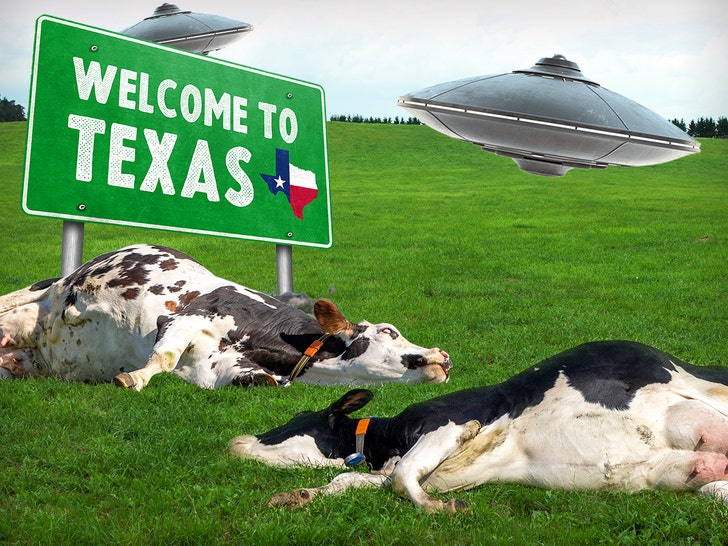
Half a dozen cows were found dead deep in the heart of Texas this past week — and some of the things that were done to their bodies are suggesting one culprit to some … aliens.
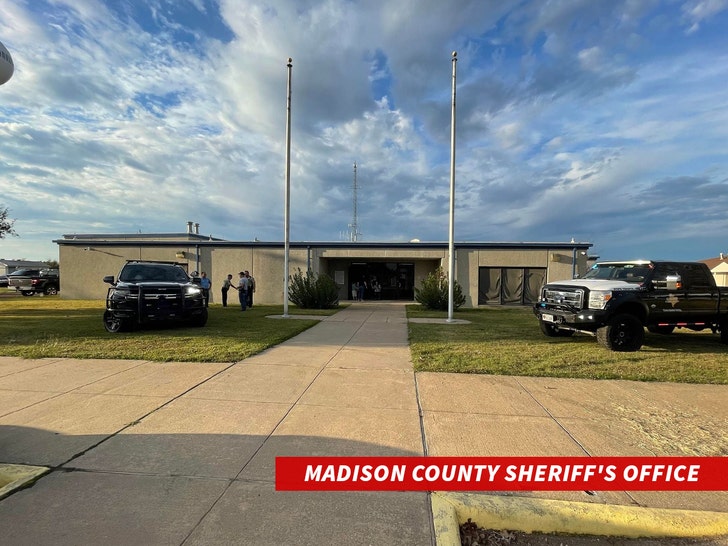
According toreports, the Madison County Sheriff’s Office — which is about an hour and a half north of Houston — detailed the mysterious tale Wednesday … including what had been done to the carcasses, like the removal of their tongues and flesh from parts of their faces.
The strange thing about this — besides the fact that the same thing had been done to all 6 of the dead cattle — is that the Sheriff’s Office there says no blood was spilled or left behind.
This story gets even weirder … apparently, the dead cows each belonged to different herds…
AP Photo/Wayne ParryThe CPV power plant operates in Woodbridge N.J. on Feb. 27, 2023.
The Biden administration faces what could be one of its most consequential climate decisions yet as the Environmental Protection Agency (EPA) weighs how to regulate power plants.
The power sector is a major contributor to climate change, making upa quarterof total U.S. greenhouse gas emissions in 2021.
The agencyis expectedto soon propose new regulationsthat aim to limit how much carbon power plants can emit, but the specifics of how they will do so is unclear.
Nevertheless, climate activists say the rules will be monumental in the fight against global warming.
David Doniger, senior strategic director for the Natural Resources Defense Council’s Climate & Clean Energy Program, said that cutting emissions from vehicles — which the Biden administrationrecently proposed to…
A woman holds an umbrella to shelter from the sun in Bangkok, Thailand, Saturday, April 22, 2023. The authorities warned residents across Thailand to avoid outdoor activities due to extreme heat over the weekend. (AP Photo/Sakchai Lalit)
BANGKOK (AP) — Extreme heat has sent temperatures soaring in Thailand as authorities warned people to stay indoors.
The Meteorological Department’s forecast on Saturday said the highest temperature in the next 24 hours could reach 43 degrees Celsius (107 degrees Fahrenheit) in country’s north and could hit 40 C (104 F) in the capital, Bangkok. The highest temperature on Saturday was in the northern province of Phetchabun at 42.5 C (109 F).
“Even if I turn the air conditioning to 20 degrees, I still sweat,” said 37-year-old Supichaya Jittaleela, who attended an outdoor political rally despite the heat.
People should be wary of extremely high temperatures as well as…
A dead pelican on the beach in Lima, Peru on December 07, 2022.
A new strain of bird flu, also known as avian influenza, is spreading across the US.
The H5N1 strain is causing a variety of new problems and has killed more than 58 million birds.
One scientist said the variant is “wiping out everything in numbers we’ve never seen before.”
Top editors give you the stories you want — delivered right to your inbox each weekday.Email address
By clicking ‘Sign up’, you agree to receive marketing emails from Insider as well as other partner offers and accept our Terms of Service and Privacy Policy.
The US is currently experiencing its worst-ever outbreak of bird flu, also known as avian influenza, and a new strain could become endemic in the US, a new study has found.
The outbreak is “wiping out everything in numbers we’ve never seen before,” Professor Jennifer Mullinax from the University of Maryland told Sky News. The new H5N1 strain has already killed over 58 million chickens, turkeys, and other birds, per Reuters.
The US is no stranger to the impact of the disease, with the H5N8 strain leading to the culling of 50 million birds in 2015. But the new, more contagious strain is particularly affecting wild birds, Sky reported.
Bill Powers with his flock of white turkeys, kept under shelter to prevent exposure to bird flu, on November 14, 2022 in Townsend, Delaware.
Johanna Harvey, a postdoctoral researcher and lead author of the study published in Conservation Biology at the University of Maryland, said, “Unlike H5N8, this disease is heavily impacting wild birds.”
“It’s difficult to estimate how many birds are truly affected across wild populations, but we’re seeing dramatic disease impacts in raptors, sea birds, and colonial nesting birds. And we now have the highest amount of poultry loss to avian influenza, so this is a worst-case scenario,” she added.
The researchers believe that bird flu will probably become endemic, where a disease is constantly present within an area or community in the US, which could affect food security and the economy.
Last week the US Government started testing four new bird flu vaccines to try and protect the poultry from this mass outbreak, per Reuters.
Are humans in danger?
The disease can and does affect humans, but it’s rare.
Speaking about this death to AP, Professor James Wood, head of the department of veterinary medicine at Cambridge University, said there is no reason to be unduly concerned about human infection with avian influenza.
“Tragic though this case in Cambodia is, we expect there to be some cases of clinical disease with such a widespread infection. Clearly, the virus needs careful monitoring and surveillance to check that it has not mutated or recombined, but the limited numbers of cases of human disease have not increased markedly, and this one case in itself does not signal the global situation has suddenly changed,” he said.
Markets are in trouble
Farmers and the markets are being hit hard by the ravages of avian flu.
The average cost of a dozen eggs rose 59% last year, according to the Bureau of Labor Statistics, with prices more than doubling in West Virginia and six states in the upper Midwest.
Large carton of eggs.
The jump was caused by the unprecedented spread of disease and 2022’s high inflation rates raising farmers’ costs — and it doesn’t look like it will change soon.
SANTIAGO (Reuters) – Growing pollution, industrial activities and now bird flu are threatening the Chilean dolphin, one of the world’s smallest cetaceans, in the cold Pacific waters off Chile’s western coastlines.
Also known as the “tonina negra,” the dolphin’s small population lives along the Chilean southern and central coasts, in bays also used for industrial activities such as sea farming and seaweed extraction.
Chile’s long coastline helps make it one of the world’s top exporters of fish and aquatic crops.
“Chilean dolphins share spaces with humans, and knowing this, we have to work even more to protect this unique species,” said veterinarian Cayetano Espinosa, adding that the species is “very fragile, because there are only a few of the dolphins left.”
Espinosa is a member of the Yaqu Pacha study center on marine ecosystems.
Jose Luis Brito, curator of the Natural History Museum at the country’s main maritime terminal, San Antonio, said he receives constant reports of dolphins stranded on beaches, sometimes tangled in nets and other times killed by pollution after consuming plastic or other waste.
“The Chilean dolphin is disappearing at an alarming rate,” he said. “Every day we see less of them on the coast.”
One official also pointed to the threat of bird flu, which has been detected in Chile’s wild birds, marine animals and industrial complex. A human case was also reported in March.
Soledad Tapia, the director of the country’s fisheries service, said two species of dolphins had been infected by the virus. “They are also a vulnerable category,” she said.
(Reporting by Reuters TV; Writing by Natalia Ramos and Sarah Morland; Editing by Leslie Adler)
FOX Business correspondent Madison Alworth provides details on a NOAA scientist’s warning about the impact of offshore wind projects on whales. The warning, Alworth reports, was ignored, and 23 dead whales have since washed up along the East Coast.
The Biden administration is pushing full steam ahead to massively expand offshore wind development across millions of acres of federal waters, actions that critics warn would have dire ecological and economic impacts.
Days after taking office, President Biden issued an executive action ordering his administration to expand opportunities for the offshore wind industry as part of his aggressive climate agenda to curb greenhouse gas emissions and stop global warming. Months later, he outlined goals to deploy 30 gigawatts of offshore wind energy by 2030, the most ambitious goal of its kind worldwide.
“Two years ago, President Biden issued a bold challenge to move America towards a clean energy future,” Deb Haaland, the secretary of the Department of the Interior (DOI), said earlier this month. “The Interior Department answered that call and is moving rapidly to create a robust and sustainable clean energy economy with good-paying union jobs.”
In May 2021, the DOI’s Bureau of Ocean Energy Management (BOEM) approved the 800-megawatt Vineyard Wind project 12 miles off the coast of Massachusetts, marking the first ever large-scale offshore wind approval. Then, in November 2021, the agency approved the 130-megawatt Southfork Wind project off the coast of Long Island, New York, the second commercial-scale offshore project.
Interior Secretary Deb Haaland attends an event on April 14 in Las Vegas. (AP Photo/John Locher)
A number of other proposed offshore wind projects along the Atlantic coast are under development and in the federal permitting stage. The Biden administration has leased hundreds of thousands of acres to energy corporations and plans future lease sales in the Gulf of Mexico and off the coast of California.
“This is an environmental wrecking ball,” David Stevenson, the president of the American Coalition for Ocean Protection (ACOP), told Fox News Digital in an interview. “It’s an economic disaster. From an environmental — from a climate change standpoint, it’s also useless.”
“It is going to turn the oceans into an industrial park, particularly at night when you’ve got red flashing lights. It’s going to look like the industrial area in northern New Jersey,” added Stevenson, who founded ACOP to mount legal defenses in response to offshore wind development on behalf of local shoreline communities.
Stevenson and other opponents of large-scale offshore wind development have noted that BOEM has acknowledged the negative impacts of the proposals it has approved.
According to a report ACOP published in February, BOEM has stated that wind turbine structures will lead to radar interference, increasing likelihood of vessel collisions and complicating search-and-rescue missions; likely harm wildlife; industrialize ocean views, possibly harming tourism industries; impede key military operations; and impair oceanic scientific research.
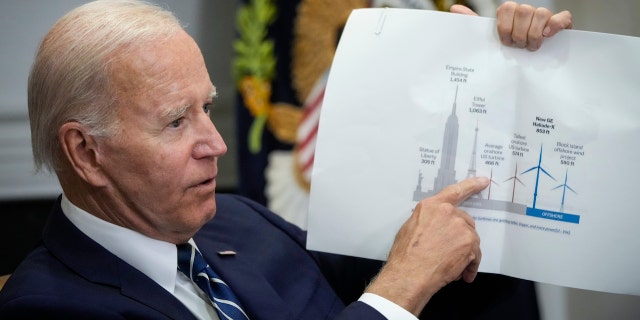
President Joe Biden points to a wind turbine size comparison chart during a meeting about the Federal-State Offshore Wind Implementation Partnership on June 23, 2022. (Drew Angerer/Getty Images)
BOEM has admitted that the commercial fishing industry would shoulder millions of dollars in economic damages.
“While Vineyard Wind is not authorized to prevent free access to the entire wind development area, due to the placement of the turbines it is likely that the entire 75,614 acre area will be abandoned by commercial fisheries due to difficulties with navigation,” BOEM stated in its May 10, 2021, record of decision green-lighting the Vineyard Wind project, for example.
“The extent of impact to commercial fisheries and loss of economic income is estimated to total $14 million over the expected 30-year lifetime of the Project,” it continued.
In another example, BOEM’s environmental impact analysis published last summer for Ocean Wind 1 — a 1,100-megawatt project proposed off the southern New Jersey coast — the agency concluded that impacts on commercial fisheries, navigation and views would all be “major.”
“This is the industrialization of our oceans,” Bonnie Brady, executive director of the Long Island Commercial Fishing Association, told Fox News Digital.
“This is creating a construction zone, pile-driving a 4,000-kilojoule hammer that’s about 30 to 40 feet wide, pounding giant steel, thousand-foot poles into the ocean floor and then jet-plowing, which is liquefying the ocean floor up to 10 or 12 feet, and laying giant 100,000-volt cables in the ocean floor and then turning on the switch and seeing what happens,” she continued.
“I mean, that’s a problem,” Brady said. “These are areas of extreme productivity for not just fish, but marine mammals.”
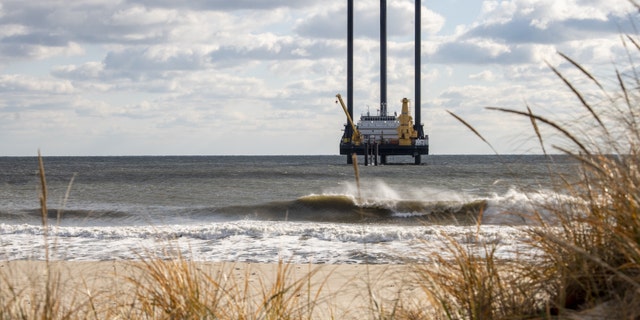
A lift boat is pictured off the beach near Wainscott, New York, on Dec. 1. The vessel’s drill will be used in the construction of the South Fork Wind farm that is expected to start generating power in late 2023. (Johnny Milano/Bloomberg via Getty Images)
Brady’s Long Island Commercial Fishing Association is a plaintiff in a federal lawsuit led by the Rhode Island-based fishing company Seafreeze challenging the Biden administration’s approval of Vineyard Wind. An attorney representing plaintiffs said the project was an example of the administration’s “stubborn pursuit of increasing renewable energy generation regardless of who it hurts.”
According to Brady, the federal wind lease area off the shores of Massachusetts and Rhode Island is larger than Rhode Island, Long Island and much of the 1,902-square-mile Grand Canyon National Park in Arizona. And offshore wind turbines are massive, nearly three times the height of the Statue of Liberty.
“Imagine that we’re all standing on that beautiful [Grand Canyon] vista and there’s a turbine a mile apart in every single direction, a thousand feet tall,” Brady said. “There you go, that’s your picture. And that’s going to be the picture all up and down every single coastline.”
Overall, the Biden administration’s rapid development of offshore wind has faced resistance from environmental groups, fishing industry groups, federally-established fishery councils, small business organizations, local officials, lawmakers and, most recently, the Department of Defense.
Haaland participates in a groundbreaking ceremony for the South Fork project alongside Democratic New York Gov. Kathy Hochul. (Steve Pfost/Newsday RM via Getty Images)
Rep. Jeff Van Drew, R-N.J., who represents New Jersey’s southern coastline, including Atlantic City, has criticized the White House over the last several months for looking the other way at wildlife impacts of offshore wind projects.
“In Joe Biden’s mad rush to a net zero energy economy, federal agencies responsible for the implementation of offshore wind have hastily pushed forward these projects with little regard to industries like fishing and maritime transports, ignored the concerns of coastal communities who rely on the ocean for jobs and tourism, ignored the national security concerns raised by our own military, and have been negligent in properly studying the harmful impacts these turbines will have on our environment,” Van Drew told Fox News Digital.
“And despite these concerns and warnings from communities, stakeholders, and members of Congress, this administration pushes it aside with the sole excuse being that the industrialization of our oceans will save the planet by ‘stopping climate change,’” he continued.
Since the beginning of the year, more than 20 humpback whales and endangered North Atlantic right whales have been discovered dead along the East Coast, with most beaching in New Jersey, New York and Virginia, according to federal data. The uptick in whale deaths has led to calls from lawmakers, local officials and conservation organizations for a federal moratorium on wind development in the Atlantic Ocean.
While administration officials and some environmental groups have said there is no evidence suggesting that wind turbine construction is killing whales and that the deaths are part of an “unusual mortality event” for both whale species dating back years, the region is on pace to far surpass death figures set since the mortality events were declared.
“Think about it: a wall of turbines lining our horizons for decades to come, generating more expensive energy for homes and businesses, killing sea life, destroying generational industries,” says Rep. Jeff Van Drew, R-N.J. (Republican National Committee via Getty Images)
“The agencies admit it themselves in their environmental impact statements that offshore wind will increase impacts on climate change unless it completely replaces the fossil fuel industry,” Van Drew said. “That’s their goal — to make America completely reliant on an unreliable renewable energy source. And that’s the crux of this situation.”
“These industrial wind grids are money grabs for major corporations and legacy builders for politicians,” he added. “To replace fossil fuels, they will need to lease millions upon millions of acres of our oceans and lakes to generate the power we are already producing.”
“Think about it: a wall of turbines lining our horizons for decades to come, generating more expensive energy for homes and businesses, killing sea life, destroying generational industries.”
Van Drew noted that wind turbine technology is mainly manufactured overseas and that, over the long-term, offshore wind projects will create a few dozen permanent jobs.
“The warnings are clear, and our president and our government need to listen and act before it is too late.”
A Sudbury man is banned from hunting in Ontario for two years and has been fined $5,000 for killing a calf moose when the season was closed. Two people who helped him retrieve it have also been fined.
Patrick Stillar pleaded guilty to unlawfully hunting a moose Sept. 17, 2020, in the French River town of Alban, the Ontario Ministry of Natural Resources and Forestry said in a news release Friday morning.
Justice of the Peace Diane Lafleur heard the case on March 13.
After the moose was shot and killed, he called a friend to come to the site and claim it because the friend was a local First Nation member with harvesting rights, the court heard.
JOHNSON CITY, Tenn. — The state’s 2023-24 hunting and trapping seasons were set by the Tennessee Fish and Wildlife Commission at its April meeting on Friday. The Commission approved the Tennessee Wildlife Resources Agency’s recommendations to the elk hunt proclamation to add four new elk permits and two additional elk hunt zones.
The new zones are located on the Ed Carter Tract and on the Sundquist tract. The increase brings the number of elk zones to 10 and total permits to 19. Two of the permits are for the archery hunt and two for the gun hunt. The Young Sportsman Hunt, which has one permit, has been aligned to coincide with school fall break dates.
Elk were reintroduced in Tennessee in 2000. Since the elk hunt began in 2009 with five gun permits, 96 bull elk have been harvested.