GLYNN COUNTY, Ga. — A Georgia hunter pleaded guilty to shooting and killing a teen whom he had mistaken for a deer. Officials say he was high on meth at the time of the shooting, according to local reports.
In Sept. 2019, Hector Romero-Hernandez shot 17-year-old Bobby Lane in a wooded area in Glynn County. Police said the two knew each other and met in the Myers Hill area to hunt together.
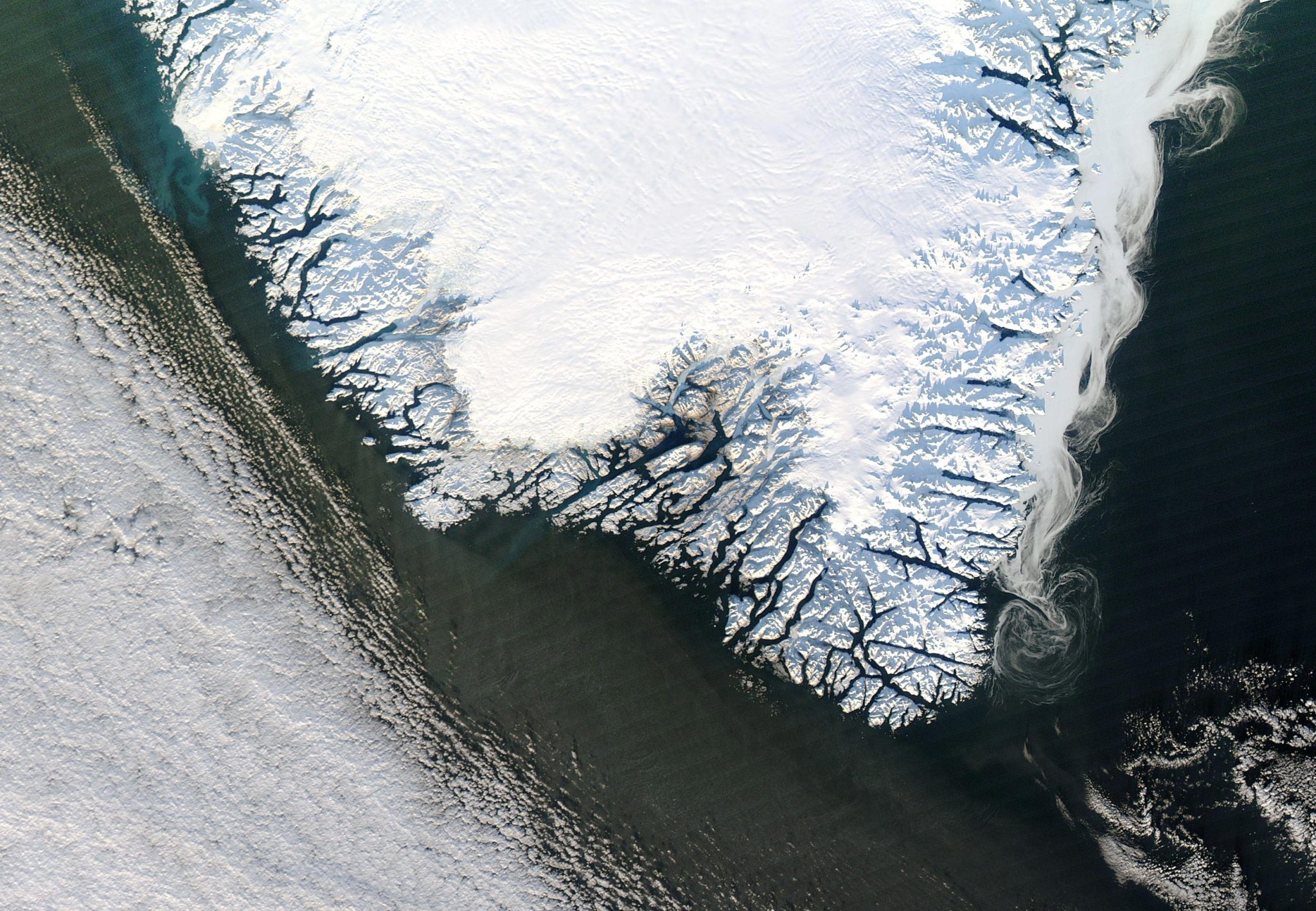
Much of the southern Greenland Ice Sheet, shown here, will melt irreversibly if we emit about 1000 gigatons of carbon, according to models in a new Geophysical Research Letters study. Credit: NASA GSFC
Once we emit about 1000 gigatons of carbon, much of the massive ice sheet will melt irreversibly. We’ve emitted 500 gigatons so far.
The Greenland Ice Sheet covers 1.7 million square kilometers (660,200 square miles) in the Arctic. If it melts entirely, global sea level would rise about 7 meters (23 feet), but scientists aren’t sure how quickly the ice sheet could melt. Modeling tipping points, which are critical thresholds where a system behavior irreversibly changes, helps researchers find out when that melt might occur.
Based in part on carbon emissions, a new study using simulations identified two tipping points for the Greenland Ice Sheet: releasing 1000 gigatons of carbon into the atmosphere will cause the southern portion of the ice sheet to melt; about 2500 gigatons of carbon means permanent loss of nearly the entire ice sheet.
Having emitted about 500 gigatons of carbon, we’re about halfway to the first tipping point.
“The first tipping point is not far from today’s climate conditions, so we’re in danger of crossing it,” said Dennis Höning, a climate scientist at the Potsdam Institute for Climate Impact Research who led the study. “Once we start sliding, we will fall off this cliff and cannot climb back up.”
The study was published in AGU’s journal Geophysical Research Letters, which publishes short-format, high-impact research spanning the Earth and space sciences.
When Greenland’s ice sheet melts, it loses elevation and is exposed to warmer air. The warmer air then increases melt further. Credit: NASA GSFC
The Greenland Ice Sheet is already melting; between 2003 and 2016, it lost about 255 gigatons (billions of tons) of ice each year. Much of the melt to date has been in the southern part of the ice sheet. Air and water temperature, ocean currents, precipitation, and other factors all determine how quickly the ice sheet melts and where it loses ice.
The complexity of how those factors influence each other, along with the long timescales scientists need to consider for melting an ice sheet of this size, make it difficult to predict how the ice sheet will respond to different climate and carbon emissions scenarios.
Previous research identified global warming of between 1 degree to 3 degrees Celsius (1.8 to 5.4 degrees Fahrenheit) as the threshold beyond which the Greenland Ice Sheet will melt irreversibly.
To more comprehensively model how the ice sheet’s response to climate could evolve over time, Höning’s new study for the first time used a complex model of the whole Earth system, which includes all the key climate feedback processes, paired with a model of ice sheet behavior. They first used simulations with constant temperatures to find equilibrium states of the ice sheet, or points where ice loss equaled ice gain. Then they ran a set of 20,000-year-long simulations with carbon emissions ranging from 0 to 4000 gigatons of carbon.
From among those simulations, the researchers derived the 1000-gigaton carbon tipping point for the melting of the southern portion of the ice sheet and the even more perilous 2,500-gigaton carbon tipping point for the disappearance of nearly the entire ice sheet.
As the ice sheet melts, its surface will be at ever-lower elevations, exposed to warmer air temperatures. Warmer air temperatures accelerate melt, making it drop and warm further. Global air temperatures have to remain elevated for hundreds of years or even longer for this feedback loop to become effective; a quick blip of 2 degrees Celsius (3.6 degrees Fahrenheit) wouldn’t trigger it, Höning said. But once the ice crosses the threshold, it would inevitably continue to melt. Even if atmospheric carbon dioxide were reduced to pre-industrial levels, it wouldn’t be enough to allow the ice sheet to regrow substantially.
“We cannot continue carbon emissions at the same rate for much longer without risking crossing the tipping points,” Höning said. “Most of the ice sheet melting won’t occur in the next decade, but it won’t be too long before we will not be able to work against it anymore.”
Reference: “Multistability and Transient Response of the Greenland Ice Sheet to Anthropogenic CO2 Emissions” by Dennis Höning, Matteo Willeit, Reinhard Calov, Volker Klemann, Meike Bagge and Andrey Ganopolski, 27 March 2023, Geophysical Research Letters. DOI: 10.1029/2022GL101827
The Biden administration on Thursday approved exports of liquefied natural gas from the Alaska liquefied natural gas (LNG) project, a document showed, prompting criticism from environmental groups over the approval of another “carbon bomb”.
The US energy department approvedAlaskaGasline Development Corp’s (AGDC) project to export LNG to countries with which the United States does not have a free trade agreement, mainly in Asia. Backers of the roughly $39bn project expect it to be operational by 2030 if it receives the required permits.
The project, for which exports were first approved by the administration of Donald Trump, has been strongly opposed by environmental groups.
ByCarter Williams, KSL.com|Updated- April 13, 2023 at 4:22 p.m. | Posted – April 13, 2023 at 3:02 p.m.
An undated photo of female California condor “409” at Zion National Park. Federal wildlife officials say avian influenza has likely killed 18 California condors in the Arizona-Utah flock over the past month, though all the cases have been in Arizona so far. (National Park Service)
SALT LAKE CITY — The avian influenza outbreak that has impactedmillions of birdsacross the U.S. for over a year is now taking a toll on efforts to save a severely endangered species found in Utah and other parts of the Southwest.
The U.S. Fish and Wildlife Service officials said Wednesday that six free-flying California condors in the Arizona-Utah flock have died from the influenza outbreak, while 12 more have died…
SEOUL, April 14 (Reuters) – North Korea announced on Friday it had tested a new solid-fuel intercontinental ballistic missile (ICBM), a development set to “radically promote” its forces, which experts said would facilitate missile launches with little warning.
Leader Kim Jong Un guided Thursday’s test, and warned it would make enemies “experience a clearer security crisis, and constantly strike extreme uneasiness and horror into them by taking fatal and offensive counter-actions until they abandon their senseless thinking and reckless acts”, North Korean state media said.
Advertisement · Scroll to continue
Analysts said it was the North’s first use ofsolid propellantsin an intermediate-range or intercontinental ballistic missile, a key task to…
A coyote makes its way through the snow in northern Maine.Credit:Courtesy of Keith Dirago, Mainely Wildlife Photography
A hotly contested bill that would have shortened the coyote hunting seasons in Maine was soundly defeated during Wednesday afternoon’s work session of the Committee on Inland Fisheries and Wildlife in Augusta.
After more than an hour of discussion on the bill, the committee voted 9-2 that LD 814 ought not to pass. That means it is unlikely to be passed by the Legislature.
On Tuesday, April 11, 2023, Raoul Brown pleaded guilty to felony Involuntary Manslaughter in Clearwater County after he shot and killed 38-year-old Lanae Tackely during a hunting incident in October of last year.
According to the Clearwater County Sheriff’s Office, deputies and medical crews responded to the area of South Dicks Creek and Teakean Butte at approximately 4:14 p.m. on October 15 after receiving reports of a shooting. Upon arrival, deputies found 38-year-old Lanae A. Tackely on the ground suffering from a gunshot wound.
According to a probable cause affidavit obtained by Big Country News Connection, Brown told deputies on scene that he had been attempting to shoot an elk when Tackely allegedly walked in front of the rifle.
PORTLAND, Ore. — Last week, KGW reported on video captured on the Columbia River near Hayden Island that showed a boater deliberately veering toward groups of sea lions, seemingly trying to hit or harass the creatures.
Many people were outraged at the video, though the boater also had their share of defenders.
That dichotomy mirrors the pinnipeds’ legal status. Sea lions are federally protected under the Marine Mammal Protection Act— making it illegal to harass, hunt or kill any marine mammals. But at the same time, Oregon wildlife officials have used exceptions in the law to kill hundreds of sea lions over the past few years.
While sea lion populations in the Pacific Northwest have soared in recent decades, salmon and steelhead numbers have not. And sea lions’ voracious appetite for salmon is the issue at hand.
Many of the fish that sea lions eat are among 13 threatened and endangered runs protected under the federal Endangered Species Act. And groups of sea lions have taken to simply waiting at the Bonneville Dam, Willamette Falls and other pinch points where the fish gather as they struggle to make their way upriver to spawn.
The Oregon Department of Fish & Wildlife estimates that sea lions eat up to 44% of the Columbia River spring Chinook run and 25% of the Willamette winter steelhead run each year. The creatures are a huge headache to people who fish — sometimes snatching salmon right off their lines as fishers reel them in.
The competition for a dwindling resource means that many fishers have come to resent sea lions. Michael Brady, a Portland man who captured the video of a boater harassing sea lions last week, told KGW that he has been fishing since he was young and once fished for a living.
“I see both sides of it. I understand the frustration. I understand this year is tough on salmon. Lower coast, I think, is even closed for some people,” Brady said. “But I think this was a sport fisherman who had a little chip on his shoulder, and it was terrible to witness as a community here.”
The Marine Mammal Protection Act was amended in 1994 to allow for states to apply for lethal removal authority under narrow circumstances. And in 2018, Congress amended the act again to allow for more flexibility in killing sea lions at chokepoints like dams and falls.
“Removal” or killing of sea lions has been going on at the Bonneville Dam since 2008, and it started at Willamette Falls a decade later. For a few years, repeat offenders were branded with a hot iron in order to track how many times they were a problem at the dam before they were killed.
Killings sea lions wasn’t the first course of action. Wildlife officials originally tried all kinds of non-lethal methods, or “hazing,” to deter the animals. They tried exclusion gates, using fireworks, firing rubber buckshot from 12-gauge shotguns.
For a time, Oregon even tried caging sea lions and driving them over 100 miles back to the coast. In several cases, transported sea lions were right back at the lunch counter in just a matter of days, so state officials stopped bothering with that option.
ODFW said that they first trap the animals, then pursue one of two options. The first is to have the creatures placed at an accredited zoo or aquarium. But if no facility is available, the sea lions are taken to an indoor facility and chemically euthanized by a veterinarian. Wildlife officials also have the authority to tranquilize sea lions with a dart before euthanizing them.
Until 2020, sea lions could only be killed if they were gathering at the Bonneville Dam or Willamette Falls. But now, the federal government has issued a permit to Oregon, Washington, Idaho and six regional tribes to kill the animals in certain zones across the Columbia River Basin — stretching from the I-205 bridge to east of Umatilla — as well as any tributary of the Columbia where endangered fish species spawn.
These zones include locations where endangered salmon and steelhead, sturgeon and lamprey are especially vulnerable. ODFW said that removing sea lions was a significant factor in 2020 for the best return of wild Willamette steelhead in years, after biologists believed the species was on the verge of extinction.
Nearly 400 sea lions have been killed by wildlife crews in Oregon since removals began — 277 before 2020, and 99 since then. In an email, ODFW told KGW that they will begin trapping more sea lions later this month at both the Bonneville Dam and Willamette Falls.
Efforts to stop the state from killing sea lions have fallen short. The Humane Society of the U.S. sued in 2008 but lost in court.
Monkeys are considered pests in Sri Lanka because they destroy crops and raid villages in search of food, and sometimes attack people. Now, cash-strapped Colombo wants to send some to China
Sri Lanka has a monkey problem and it is now seeking China’s help for a solution. The cash-strapped nation is reportedly mulling exporting around 1,00,000 endangered monkeys to the Asian country.
On Wednesday (12 April), Sri Lanka’s agriculture minister Mahinda Amaraweera said, as per AFP, “They want the monkeys for over 1,000 zoos they have across China”.
He further said a committee has been formed to study the request and iron out a plan for the proposed sale.
Let’s take a closer look at the monkey menace in Sri Lanka and why China’s request has caused concerns among conservationists.
Sri Lankan monkeys
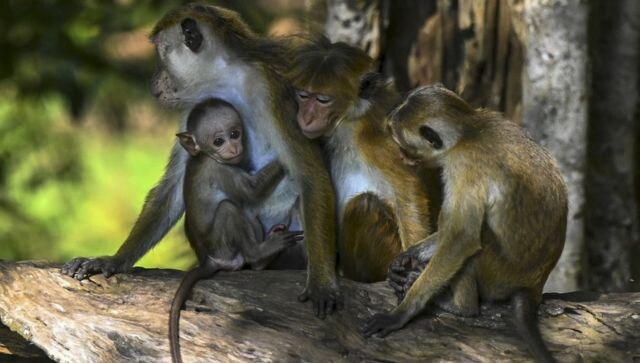
Sri Lanka is home to three monkey species, with the endemic toque macaque causing the most menace.
The toque macaque is labelled as endangered on the International Union for Conservation of Nature (IUCN) red list.
Toque macaques are estimated to have a population between two million and three million in Sri Lanka.
As per the AFP report, the island nation removed several animals, including monkeys, peacocks and wild boars, from its protected list this year, thus giving a green light to farmers to kill them.
Monkey menace
Monkeys spell trouble for farmers in Sri Lanka as they destroy their crops. They also enter homes, steal food, sometimes attack people and leave the place in an upheaval.
According to Amaraweera, monkeys and giant squirrels destroy nearly 100 million coconuts every year, fuelling a loss of around 6,638 million Sri Lankan rupees ($19.3 million), reported Mongabay.
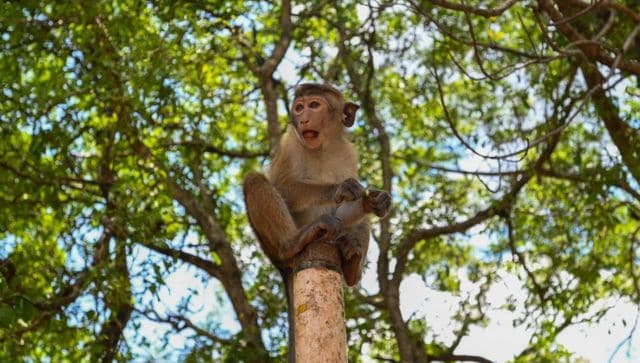
Sri Lanka has three monkey species, with the endemic toque macaque causing the most menace. Wikimedia Commons (Representational Image)
Arjuna Jinadasa, a farmer who owns land full of coconut trees in Kurunegala, in northwestern Sri Lanka, told Mongabay in March: “These monkeys destroy at least 200 young coconuts daily, and now my monthly yield is reduced to about 250 coconuts”.
He said despite trying several non-lethal methods to prevent these monkeys from raiding crops, the primates continued their aerial attacks.
As per a preliminary report on crop damage caused by wild animals in the country, toque macaques and giant squirrels mostly target coconuts, while elephants, wild boars and peafowl are majorly after paddy.
The report says wild animals were responsible for crop damage that caused an estimated financial loss worth 30,215 million Sri Lankan rupees ($87.5 million) in the first half of 2022.
“Sri Lanka is facing a severe economic crisis, and the recorded crop devastation intensifies the food crisis we already face here. The government is looking for ways to reduce the population of identified wild animals considered agricultural pests,” Amaraweera was quoted as saying by Mongabay.
The minister also blamed the increase in human-elephant conflict on crop raiding.
Speaking to Mongabay, Buddhi Marambe of the Faculty of Agriculture at the University of Peradeniya said that animals targeting crops are a “complex” issue that “doesn’t have simple, ready-made solutions”. However, Marambe stressed on controlling the population of such menace-causing animal populations.
Marambe, who was part of a meeting of experts convened by the agriculture ministry last December, said many solutions were being considered to deal with the menace, including translocations and sterilisation.
However, Ashoka Dangolla of the veterinary faculty at the University of Peradeniya told Mongabay that translocation of the animals “does not work” and instead called for sterilisation to control the crop-damaging animal populations.
Criticism of sending monkeys to China
PTI reported citing Ada Derana news portal that a special meet chaired by minister Amaraweera and attended by officials from the Agriculture Minister, Department of National Zoological Gardens and Department of Wildlife Conservation was held on Tuesday to discuss the possible translocation of 1,00,000 monkeys in the first stage.
But conservationists have expressed doubts about Sri Lanka’s possibly selling toque macaques, commonly known as rilawa, to China – one of Colombo’s biggest bilateral lenders.
The island nation, which is facing its worst-ever economic crisis, prohibits almost all live animal exports, according to AFP.
Sri Lanka has an estimated population of 3 million toque macaques. AFP
The Environmental Foundation, a Sri Lankan animal rights group, has objected to the proposal saying a proper population survey of macaques should be carried out in the country which has not been done for the last 40 years.
“We want to know why they want so many monkeys – whether it is for meat, medical research or some other purpose,” the foundation’s Jagath Gunawardana was quoted as saying by AFP.
“Monkeys are not a protected species in Sri Lanka, but they are in the international red list of endangered animals,” Gunawardana added.
Gunawardana also cited agricultural growth curtailing wild animal habitats for rise in human-animal conflict in the island nation.
The Grand National has been heavily criticized by animal rights groups.Shaun Botterill/Getty ImagesCNN —
It’s watched by more than 500 million people from 140 different countries, but the Grand National remains one of the most controversial horse races in the world.
Since it was first run in 1839, the spectacle has become a national institution in the United Kingdom which has transformed into the greatest steeplechase – a race run over fences with a variety of obstacles, including “plain fences, water jumps or open ditches” – on Earth.
However, animal rights groups claim the race represents the “broken relationship” between humans and nature due to the potential dangers the horses face.
The race, which has been modified in recent years to ease safety concerns, sees a field of up to 40 horses galloping 4.3 miles and jumping 30 fences the size of small cars.
The demanding course has resulted in multiple fatalities over the years – two horses died during the 2022 edition – with many others injured and some put down as a result.
“Most people would say they love animals, so why are we OK with this?” Animal Rising, previously called Animal Rebellion, said in a statement sent to CNN Sport.
“Whether it is for food or for sport, our relationship with animals is beyond broken.”
The animal rights group is launching its biggest ever campaign to protect animals this month and has suggested it plans to disrupt this year’s Grand National, which will take place at Aintree Racecourse in Liverpool, UK, on April 15.
The showpiece event is part of a three-day festival which begins on Thursday.
Enter your email to subscribe to the CNN Five Things Newsletter.
“This April we are launching the biggest campaign to protect animals and the climate this country has ever seen,” Animal Rising added.
“Already over 500 people are signed up for training to take peaceful action this summer.”
The Grand National race is part of a three day festival at Aintree Racecourse every year.David Davies/PA Images/Getty Images
Last month, a reporter from the UK newspaper The Mail on Sunday went undercover to reveal the plans the group had regarding disrupting the race.
The story detailed how the organization was planning to help multiple people break onto the track with the hope of preventing the race from starting.
Animal Rising says the report won’t stop them from finishing their mission of raising awareness of what they claim are unethical practices.
“One undercover Mail on Sunday reporter is not going to stop teachers, nurses, and more from acting for all life and really beginning the crucial conversation about our broken relationship with other animals,” the statement added.
“This conversation is vital if we are to tackle the root causes of our climate and ecological crises.”
The Grand National is no stranger to demonstrators looking to disrupt the race and Merseyside Police say they have a “robust policing plan” in place for this year’s edition.
Local police say they have been working with the race organizer – the Jockey Club – for months in order to ensure the safety of those participating and attending the spectacle.
“We respect the right to peaceful protest and expression of views, but public order or criminal offenses will not be tolerated and will be dealt with robustly,” a police spokesperson said, while also releasing safety advice to racegoers this week.
The Jockey Club referred CNN to the Merseyside Police when asked for comment, while Aintree Racecourse said that horse welfare and safety is “the most important thing to the racecourse.”
Amid the controversy, thousands of attendees are once again set to descend on Aintree on Saturday for a race which animal rights activists hope will never happen.