Snow, floods and wildlife in peril: grueling winter leaves Yosemite scarred

The national park is open again but intense storms mean the specter of climate crisis is more evident than ever

Gabrielle Canon in Yosemite

https://www.theguardian.com/us-news/2023/apr/08/yosemite-national-park-extreme-weather-climate-change

@GabrielleCanonSun 9 Apr 2023 01.00 EDT

It’s been a winter few in Yosemite valley will ever forget.

After wildfires left the national park’s dramatic views shrouded in smoke over the summer, winter brought a series of historic storms that left the region inundated with snow. The deluge buried homes, cars and fire hydrants, chewed into stretches of winding mountain roads and downed trees along the park’s slopes.

As conditions intensified, officials opted to close the park, forced to turn away the hundreds of thousands of visitors who come from all over the world to take in its iconic scenery.

Park personnel worked for weeks to dig the valley out of shoulder-high piles of snow, repair crucial infrastructure and prepare for the imminent threat of melt-off flooding.
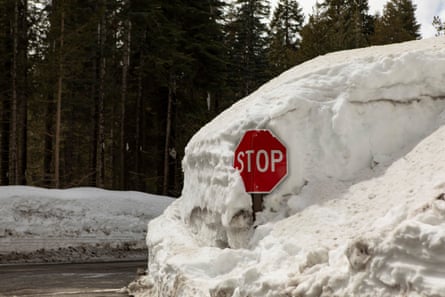
A stop sign is surrounded by a pile of snow.
Snow in Yosemite national park is still piled overhead in some areas even as the weather turns sunny and crisp. Photograph: Gabrielle Canon/The Guardian

But on a crisp and sunny morning last week, a surge of visitors trickled back into the valley. The park had partially reopened in mid-March, just in time for spring break. A churn of cars circled across the valley floor and pedestrians dotted the roads and meadows as the snow ceded ground to soil below.

https://8871ed0e5290f34dbbfc2ca24ab2be9a.safeframe.googlesyndication.com/safeframe/1-0-40/html/container.html

“It isn’t as bad as we thought it would be,” said Nicole Torres, who had booked her family’s spring break eight months out, long before it became clear that California would be in for a wild winter. “Getting some sun and not having to worry about snow chains – it has been really nice.”

“Even though there is snow everywhere it feels like the quintessential California day,” added Stephanie Sanchez, who was there with the Torres family.

Jason and Shannon Smith, who own Airbnbs tucked into the slopes, had also ventured into the valley to see how the park fared. The couple was surprised by the ease in access, given the severity of the weather that had hit them in recent weeks.

Near their home and business, hundreds of power poles were toppled in the storms. The couple lost power for weeks, Jason said, and had to cancel bookings.
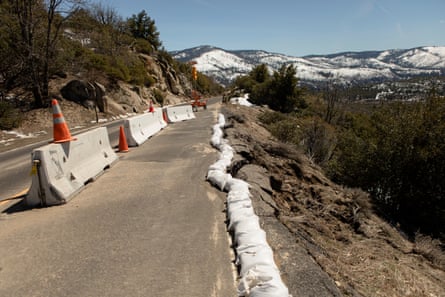
Guard rails block a road where the hillside washed away in winter storms.
Intense winter storms caused landslides that damaged infrastructure in Yosemite. Photograph: Gabrielle Canon/The Guardian

The danger hasn’t completely passed. Water is still cascading around three sides of their home, which is sandwiched between storm runoff, a drainage ditch, and the Fresno River. Jason’s worried about the snow still waiting to melt, and whether the area will get hit with another late-season storm. Even a smaller-scale event could wreak havoc on the sodden hillsides, he said.

This year’s winter offered just a taste of what is possible when the weather grows more intense, he added. “I don’t want to see it,” he said. “From what we went through, with power poles failing and people just living out of the pantries with whatever they had.”

Park officials share their fears. Threats posed by the enormous snowpack, supercharged with water content, loom large.

“This winter has been one for the record books and California keeps on setting new ones,” park officials said in a post online, noting that the snow along its Tioga Pass had measured higher than 162in. Just eight years ago, they added, it reached only 11.5in at the same time and place.

Even on a balmy day in the park, signs of severe impact are showing, and to scientists and conservationists it’s clear that the rich and diverse ecosystems are taking a hit.

“Yosemite is ground zero for climate change,” said Beth Pratt, who, along with being a local resident and regular among the wilderness areas of Yosemite, serves as the California regional executive director for the National Wildlife Federation. Wildlife is feeling the weather whiplash, she said: “We go into this winter, coming off of drought for a decade. I have never seen anything like it.”
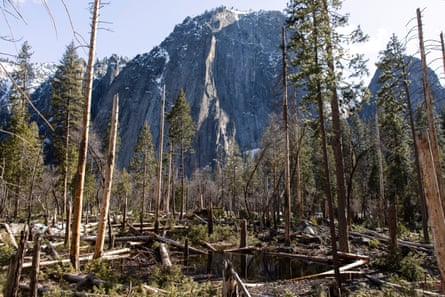
A stand of trees are bare and some broken. A mountain in the background is dusted with snow.
The diverse ecosystems in Yosemite national park show the signs of severe impact. Photograph: Gabrielle Canon/The Guardian

She pointed at the Sonoran blue butterfly, which typically seeks refuge among the alpine succulents. This year, because of washouts, the essential host plants are in dangerously short supply, Pratt said. Just months ago, during a brutal heatwave that pushed temperatures past 114F, there weren’t enough flowers for the butterflies.

The pica, a resilient, and incredibly cute rodent that lives at high elevations, is also struggling with the intense shifts, she noted. They live under the snow in the winter but this season may prove too much. When the heat comes, the fast-melting snow could drown them. “Every species is impacted by this whiplash” she said, “and at some point they won’t be able to adapt.”

And, as the weather warms and camping season starts to peak, the park and its inhabitants will once again be contending with another pressing dilemma: crowds.

“Yosemite’s visitation pattern has changed – it is a year-round park,” said Neal Desai, a senior director at the National Parks Conservation Association. He worried that with other recreation areas across the Sierra Nevada range socked in with snow into the summer, even more people will push into the snow-cleared sites. “Yosemite valley is going to be a sacrifice zone.”

He and his organization have been pushing the park to commit to a reservation system that would stem the surge of tourists and enable better planning.

Yosemite has opted out this year, but officials say they are working on implementing a permanent solution.
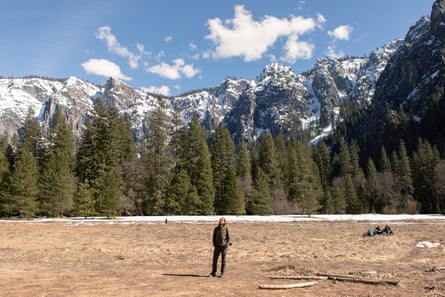
Visitors to Yosemite national park enjoy a clearing that is mostly devoid of snow.
As snow in Yosemite national park has melted, visitors have returned and experts have warned that the surge of tourists must be stemmed. Photograph: Gabrielle Canon/The Guardian

Desai pleaded for more urgency. “It is how we will actually steward this place in the face of climate change,” he said. “The thing that is fully within their control is managing their visitation – and it is their biggest problem.”

“We are over our carrying capacity,” Pratt agreed. “These parks are supposed to be the most protected places on the planet. They are really the only place where the wildlife and ecosystems are supposed to have privacy.”

For now, the gates will be open to those who can snag a campsite or room in the lodge. The snow will melt and the next round of dangers will start to take shape. The shifts will be on full display for crowds coming in as the weather warms.

Pratt hopes those who visit will be able to see the importance of protecting the lands along with the creatures who call them home.

“Yosemite has more biodiversity than Yellowstone – and to that point, there is more wildlife in peril,” she added. “We are risking this incredible center of life in Yosemite and the Sierra with our climate impacts.”

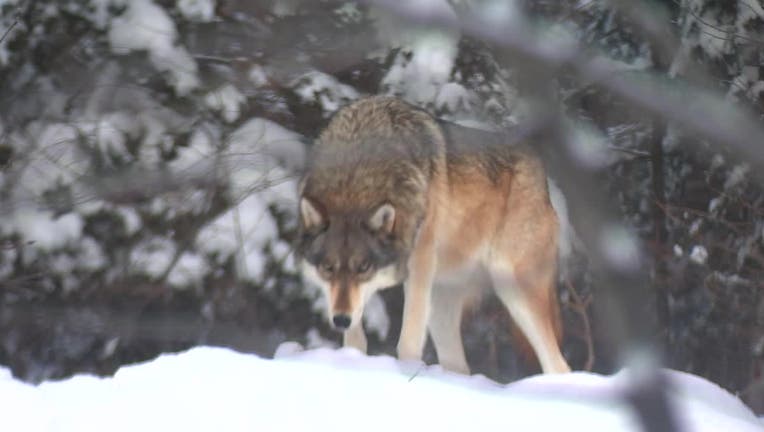
Wisconsin DNR wolf plan; 3,500 public comments released

Exposing the Big Game's avatarCommittee to Abolish Sport Hunting Blog

By Todd Richmond

https://www.fox6now.com/news/wisconsin-wolf-plan-public-comments

PublishedApril 8, 2023 2:17PM

Wild Nature

Associated Press

article

MADISON, Wis.-Wisconsinwildlife officials on Friday released thousands of public comments on a new wolf management plan, some calling for the restoration of a statewide population limit and others urging a total hunting ban.

Department of Natural Resources in November released a draft of its first new wolf management plan in almost 25 years. It would eliminate the existing 350-animal population goal and recommends instead that the DNR work with local advisory committees on whether to reduce local wolf populations, keep them stable, or allow them to grow.

Who Holds The Key To Slimming Down This Summer? Nutrisystem, WW, Or Noom?Topdust for Nutrisystem|

Sponsored

Read More

The window for submitting comments on the draft planended on Feb. 28. The DNR postedabout 3,500 redacted commentson its website Friday afternoon.

SIGN UP…

View original post 520 more words

Wild Meat Raises Lead Exposure

Exposing the Big Game's avatarCommittee to Abolish Sport Hunting Blog

Tests by the CDC show that eating venison and other game can raise the amounts of lead in human bodies by 50 percent

https://www.scientificamerican.com/article/wild-game-deer-venison-condors-meat-lead-ammunition-ban/

To Dr. William Cornatzer, it was an unforgettable image, one that troubled him deeply.

An avid hunter, Cornatzer was listening to a presentation on thelead poisoningof Californiacondorswhen an x-ray of a muledeerflashed on an overhead screen. The deer had been shot in the chest with a high-powered rifle. Cornatzer was shocked that the deer’s entire carcass was riddled with dozens of tiny lead-shot fragments.

“My first thought had nothing to do with California condors; it had to do with what I had been doing as a hunter myself, and what I had been feeding our kids,” said Cornatzer, a clinical professor of medicine at theUniversity of North Dakota School…

View original post 1,466 more words

4 ways avian flu must evolve to become a human pandemic

Exposing the Big Game's avatarThe Extinction Chronicles

Ashleigh Hollowell (Twitter) – yesterday

https://www.beckershospitalreview.com/public-health/4-ways-avian-flu-must-evolve-to-become-a-human-pandemic.html

SavePostTweetShareListenText SizePrintEmail

Anoutbreakof avian flu at a Spanish mink farm in October 2022 and several other reported cases of the virus’sspreadto mammals sparked concern of its transmission to humans. But experts say it will take a lot for avian flu to become a full-fledged human pandemic,Sciencereported.

Human cases of avian flu are deadly, but historically rare, according to theCDC. A few have cropped up across the globe in places like China, Cambodia and Chile throughout the past year, but largely from direct contact with infected birds or animals — not from human-to-human transmission.

The H5N1 strain of avian flu has been the one responsible for a majority of human cases to date, but for the flu to become a full-scale, concerning human pandemic, experts say a few key things…

View original post 148 more words

3 cats in the U.S. test positive for H5N1 bird flu

Exposing the Big Game's avatarThe Extinction Chronicles

Published1 day ago

on April 7, 2023

ByBNO News

File photo (Credit: Erik-Jan Leusink)

Three domestic cats in the U.S. – two in Nebraska and one in Wyoming – have recently tested positive for H5N1 avian influenza after eating wild birds, scientists say. A dog in Canada died of bird flu last week.

In Wyoming, the State Veterinary Laboratory said in a brief statement that a barn cat tested positive for bird flu near Thermopolis, a small town in Hot Springs County, about 110 miles southeast of Casper.

ADVERTISMENT

https://imasdk.googleapis.com/js/core/bridge3.567.2_en.html#goog_262546396

“This is the first report of HPAI (highly pathogenic avian influenza) in a domestic cat in Wyoming, and it likely became infected from ingesting meat from wild waterfowl,” the lab’s statement said.

There was no information about the cat’s condition, but Dr. Myrna Miller, the lab’s supervisor of virology…

View original post 549 more words

South Carolina woman charged after dozens of animals found dead, dying, deputies say

Share https://www.wyff4.com/article/south-carolina-woman-dead-animals-cruelty-charged/43533140

WYFF 4

Updated: 11:22 PM EDT Apr 6, 2023Infinite Scroll Enabled

Janice Limon 

Social Media Executive ProducerPlay VideoSHOW TRANSCRIPT

GET LOCAL BREAKING NEWS ALERTS

The latest breaking updates, delivered straight to your email inbox.Your Email AddressSUBMITPrivacy Notice

OCONEE COUNTY, S.C. —

An Upstate woman faces dozens of charges, some of them felonies, for what she did to animals on her property, ranging from a bearded dragon lizard to dogs, officials said.

Master Deputy Jimmy Watt, with the Oconee County Sheriff’s Department, said Jennifer Marie Hunnicutt, 36, of Seneca, was arrested Wednesday on 35 charges related to animal cruelty.

Advertisement

Watt said the investigation started on March 13 when animal control officers were called to Hunnicutt’s property on Alexander Road, near Seneca, for a welfare check after reports of a goat being stuck in a fence and multiple animals that had been abandoned.

MORE HEADLINES:

After receiving no response after knocking on the front door of the residence, the animal control deputies found two dead goats on the property, according to Watt.

He said deputies then obtained a search warrant for the property in order to search for other animals that may be deceased or neglected.

Recommended

‘I thought it was an earthquake’: Woman’s refrigerator explodes less than year after purchase

That’s when deputies discovered a total of 15 dead animals, including four dogs, one cat, one bearded dragon domesticated lizard, one chicken and eight goats, Watt said.

He said the dead animals were either in a state of decomposition or only skeletal remains were recovered.

Deputies also discovered six animals that were still alive, including one ram, one ewe, and four pygmy goats, according to Watt.

He said the remains of the dead animals, as well as the animals that were still alive, were seized by animal control deputies.

Hunnicutt is charged with:

  • Six counts of ill-treatment of animals, in general, overworking (first offense)
  • 15 counts of felony ill treatment of animals in general, torture
  • 14 counts of abandonment of animals

Investigators say Hunnicutt deprived the animals of necessary sustenance and/or shelter, or by omission, which led the death of some of the animals.

They also said Hunnicutt was not seen at the property location for about a month and a half, Watt said.

Hunnicutt was also charged with abandoning some of the animals without securing another owner or providing the necessities of life.

She was released from jail Thursday after posting bail on a $102,975 surety bond, Watt said.

The Oconee County Sheriff’s Office is continuing its investigation.

Up to 70 North Atlantic right whales were spotted in Cape Cod Bay

  • Facebook
  • Twitter
  • Flipboard
  • Email

April 2, 20235:00 AM ET

https://www.npr.org/2023/04/02/1167631441/north-atlantic-right-whale-cape-cod-tangled

Emma Bowman

A North Atlantic right whale is seen in 2018 feeding in Cape Cod bay off the coast of Plymouth, Mass. As many as 70 right whales were seen in the area on Friday.

Michael Dwyer/AP

About one-fifth of the world’s entire population of North Atlantic right whales were all spotted hanging out in Cape Cod, Mass., heading into the weekend.

Between 60 to 70 right whales, including a mother and calf, were seen feeding outside the east end of the Cape Cod Canal in the Cape Cod Bay on Friday, according to the Massachusetts Environmental Police.

Scientists believe that fewer than 350 North Atlantic right whales, an endangered species, remain.

The wildlife officials sent out two patrol vessels to protect the whales from boat traffic.

By Saturday, the whales had seemingly moved on. The MEP did not provide details about where they might have been headed.

“No right whales have been spotted in the vicinity of the Canal today,” the officials said in an emailed statement.

SCIENCE

An unusually high number of whales are washing up on U.S. beaches

The New England coast, a foraging area for the marine mammal, is one of the North Atlantic right whale’s two critical habitats designated by the National Oceanic and Atmospheric Administration Fisheries. The other critical region — where some right whales migrate in the fall for feeding, nursery and calving habitat — spans from coastal waters off of southeast North Carolina to northeast Florida.

Meanwhile, crews have been working to untangle a North Atlantic right whale wrapped in fishing rope in the Cape Cod Bay. A team from the nonprofit Center for Coastal Studies managed to remove 200 feet of rope from the whale, the center said on Friday, but the whale remains entangled. The rescue team is monitoring sea and weather conditions for another attempt to untangle the whale.

Sponsor Message

https://2628103d15497b73557683e82588393a.safeframe.googlesyndication.com/safeframe/1-0-40/html/container.html

While right whale casualties are not well documented, entanglement in fishing gear is one of the greatest threats to the animal, according to NOAA, killing at least nine right whales since 2017.

  • Facebook
  • Twitter
  • Flipboard
  • Email

Colorado’s wolf reintroduction plan will allow killing ‘chronically depredating wolves,’ but won’t define what that means

Rancher at the center of wolf-livestock conflicts fears a lack of a definition will degrade trust between livestock producers, wolf advocates and CPW

News NEWS | Apr 7, 2023

Dylan Anderson  

danderson@SteamboatPilot.com

The plan to reintroduce gray wolves in Colorado will allow wildlife officers and ranchers to kill chronically depredating wolves after obtaining a permit, but what has to happen for a wolf to rise to that level will not be defined.

Regulations that outline the process to kill chronically depredating wolves were presented to the Colorado Parks and Wildlife Commission at its meeting in Steamboat Springs on Thursday, April 6, but those regulations do not include a definition either.

Eric Odell, Colorado Parks and Wildlife’s species conservation program manager, said the lack of specificity has been intentional, as a lack of any parameters gives wildlife officers on-the-ground flexibility to make decisions on a case-by-case basis.


https://f7fd216c08c452f6bdda6306bd5c961a.safeframe.googlesyndication.com/safeframe/1-0-40/html/container.html


Don Gittleson — whose ranch in North Park near Walden has been ground zero for conflicts between wolves and livestock in Colorado as wolves naturally migrated down from Wyoming and multiplied — said a definition of what constitutes chronically depredating wolves is paramount to maintaining trust between the agency managing wolves and the public.

“You need to have a definition for chronically depredating packs,” Gittleson said during public comment Thursday. “That definition is what triggers the 10(j) (rule), without that you don’t have a trigger.”


The 10(j) rule is a process Parks and Wildlife is working on in cooperation with the U.S. Fish and Wildlife Service, which has the authority to manage wolves since the animal was relisted as a federally endangered species. The rule, which is going through a federal environmental review process, gives the agency the authority to manage wolves as an experimental population.

The federal process won’t be done until Dec. 15 at the earliest, though that could be delayed if courts get involved. A bill in the Colorado Legislature sponsored by Sen. Dylan Roberts (D-Avon) and Rep. Meghan Lukens (D-Steamboat Springs) would prevent reintroduction from happening until that rule is in place.

Colorado Parks and Wildlife confirmed Tuesday, Dec, 21, that this heifer was killed by wolves near Walden, the first kill in about 70 years.
Colorado Cattleman’s Association/Courtesy photo

Parks and Wildlife Commissioner Karen Bailey addressed Gittleson’s comments later in the meeting, posing the question to Lisa Reynolds, an assistant state attorney general who has been working with the commission on reintroduction. Reynolds said she didn’t believe a lack of a definition would cause an issue with the agency’s ability to kill chronically depredating wolves.

“I don’t think that the not having a definition of chronic depredation has any impacts at all on the validity of a 10(j), of the management flexibility that is there,” Odell said in response to Bailey’s question.

“It was intentional from both the stakeholder advisory group … and also from the technical group to not have a quantitative metric in there, just to provide that flexibility and not to provide the exact scenario that might arise if those metrics are made,” Odell continued.


Get the top stories in your inbox every morning. Sign up here: steamboatpilot.com/newsletter


The wolf plan addresses the lack of a definition, as do reports from the two working groups that worked to inform the plan’s current form.

“CPW program managers will make the determination as to whether a situation is characterized as chronic depredation on a case-by-case basis,” the draft plan reads.

Before killing a so-called problem wolf, the reintroduction plan says wildlife officials will consider documented, repeated depredations and harassment in a limited area by a wolf or pack of wolves, previously implemented practices to prevent wolf-livestock conflicts, the likelihood that wolf killings would persist if wolves remain and the presence of attractants that may lure or bait wolves into depredation.

North Park Rancher Don Gittleson speaks to the Colorado Parks and Wildlife Commission at Colorado Mountain College in Steamboat Springs on Thursday, April 6, 2023.
Dylan Anderson/Steamboat Pilot & Today

After it was clear a definition would not be added to the plan before the Parks and Wildlife Commission considers its adoption at its May 3 and May 4 meeting in Glenwood Springs, Gittleson said he feared a lack of specificity would degrade trust between ranchers, wolf advocates and Parks and Wildlife officials deciding when a wolf needs to be killed.

“There already is that (trust) problem, you don’t need to do anything to add to that,” Gittleson said.

Other states that have reintroduced wolves do have a threshold that defines a chronically depredating wolf pack. In Oregon, two or more depredations by a single pack in nine months rises to that level. In Washington, three depredations in 30 days or four depredations in a 10-month window by a single pack is considered chronic depredation.

Without a specific definition, Gittleson predicted that ranchers would demand wolves be killed after a lone livestock killing and wildlife advocates would push back even if a pack or wolf has killed several animals.

“If you don’t say, ‘This is the point that triggers it’, you are going to have a problem on both sides of the aisle,” Gittleson said. “One of them is going to keep saying, ‘Oh no we don’t need it yet because we don’t have a definition,’ and the other is going to say, ‘We need it right now, because there’s not a definition.’”

The draft plan has received nearly 4,000 online public comments. Of those, 46% of them have come from out of state, 36% have come from the Front Range and 19% have come from the Western Slope.

The commission is set to consider approving the reintroduction plan at its May 3 and May 4 meeting in Glenwood Springs. As outlined in the ballot measure narrowly approved by Colorado voters in 2020, wolves will be released before the end of the year.

The proposed area where the first group of 10 to 15 wolves will be released includes parts of South Routt County.

To reach Dylan Anderson, call 970-871-4247 or email danderson@SteamboatPilot.com.

Agriculture

Lose the permafrost, lose the planet: A very chilling Doomsday scenario

CLIMATE CHANGESUSTAINABILITYMARSHALL BRAINEXCLUSIVEDOOMSDAY

Lose the permafrost, lose the planet: A very chilling Doomsday scenario

Pixabay image https://wraltechwire.com/2023/04/07/lose-the-permafrost-lose-the-planet-a-very-chilling-doomsday-scenario/

by Marshall Brain — April 7, 2023 .

Editor’s note: Marshall Brain – futurist, inventor, NCSU professor, writer and creator of “How Stuff Works” is a contributor to WRAL TechWire.  Brain takes a serious as well as entertaining look at a world of possibilities for Earth and the human race.  He’s also author of “The Doomsday Book: The Science Behind Humanity’s Greatest Threats.” 

Note to readers: WRAL TechWire would like to hear from you about views expressed by our contributors. Please send email to: info@wraltechwire.com.

+++

RALEIGH – If we sit here together and think about the things that could destroy human civilization, there are several possibilities that come immediately to mind:

  • Nuclear Armageddon (especially the nuclear winter that could follow the detonation of multiple nuclear warheads)
  • Asteroid Strike (by a large asteroid, say one mile in diameter or greater)
  • Supervolcano eruption (wherein the eruption pushes so much hydrogen sulfide and ash into the atmosphere that it has a severe winterizing effect)

We’ve all heard of these three threats. They all “make sense.” They also happen quickly. One minute the planet is fine, and then a few minutes later it’s a complete disaster.

Get the top stories in your inbox every afternoon

There is one threat you may not have heard of. It is far more subtle. It is also slower acting, meaning it would unfold over the course of years. But it has the potential to be just as catastrophic. This threat is called Melting Permafrost. This video can help you understand why melting Permafrost is such an enormous problem: https://www.youtube.com/watch?v=XpqZTqIKMxs

WHY IS MELTING PERMAFROST SUCH A HUGE PROBLEM?

In the northern regions of planet Earth, there are millions of acres where the ground has been permanently frozen, sometimes for hundreds or thousands of years. These Permafrost regions contain many gigatons of carbon dioxide and methane that have all been nicely locked away and kept out of the atmosphere.

When Permafrost melts, all of this locked up carbon dioxide and methane gets released into the atmosphere. The huge problem with melting Permafrost is that it has the potential to create an unstoppable feedback loop that goes like this:

  1. Global warming, which is caused by rising carbon dioxide and methane concentrations in the atmosphere, melts some Permafrost.
  2. The melting Permafrost releases more carbon dioxide and methane that has been locked up in the Permafrost.
  3. These Permafrost emissions cause more global warming.
  4. Which melts more Permafrost… and the cycle repeats.

As more and more Permafrost melts, the planet gets hotter and hotter. Eventually civilization collapses from all the side effects of the Permafrost-caused global heating:

  • Droughts
  • Floods
  • Crop failures and subsequent starvation
  • Regions of the planet becoming uninhabitable due to the heat
  • Glacial and ice sheet melting and subsequent sea level rise
  • Ocean warming and marine die offs
  • Collapse of the AMOC
  • Blue ocean event in the Arctic (which causes even more heating)
  • Severe weather events like more powerful hurricanes
  • And so on…

This video reiterates the point and shows other effects of melting permafrost: https://www.youtube.com/watch?v=WaiXYQJUwQw

Geology experts find evidence of dual mass extinctions 260 million years ago

Exposing the Big Game's avatarThe Extinction Chronicles

by Michael Miller,University of Cincinnati

Geology experts find evidence of dual mass extinctions 260 million years ago
An international team of researchers discovered evidence that a mass extinction 260 million years ago was actually two events separated by 3 million years. Scientists say both likely were caused by volcanic eruptions. Credit: Margaret Weiner/UC Marketing + Brand

https://phys.org/news/2023-04-geology-experts-evidence-dual-mass.html

Long before dinosaurs, Earth was dominated by animals that were in many ways even more incredible.

Carnivores such as Titanophoneus, or “titanic murderer,” stalked enormous armored reptiles the size of buffalo.

Many of these animals died out in amass extinctionduring the Capitanian Age approximately 260 million years ago.

Now an international team of researchers says evidence suggests this mass extinction was not a single event but two, separated by nearly 3 million years. Both were caused by the same culprit: massive volcanic eruptions.

By studying uranium isotope profiles of marine samples collected in the South China Sea, scientists identified two “pulses” in…

View original post 605 more words