Mar 2, 2023
10
22 minutes https://columbiainsight.org/cougar-killings-continue-in-klickitat-county-this-time-its-a-kitten/
Locals upset by latest “removal” but sheriff’s office policy of hunting cougars with dogs remains intact

Law enforcement: This cougar kitten was treed by hound hunters and killed by a Klickitat County Sheriff’s Office deputy in January. Spots on its fur indicate its age. Photo used with permission
In September 2020, Dawn Stover and Columbia Insight reported on a war on cougars being waged in Washington’s Klickitat County. Despite more than two years of public outrage, wildlife agency hearings and proposed legislation, the killings in Klickitat County continue. Stover has continued to follow the story and now files this exclusive update. —Editor
By Dawn Stover. March 2, 2023. About 50 feet up an oak tree, a spotted cougar kitten hangs limply from a cluster of branches. The kitten climbed high into the tree to escape a pack of hounds.
After the dogs treed the kitten on public land near the Klickitat River, a Klickitat County Sheriff’s Office deputy shot and killed it.
“I saw the cougar in the tree. I euthanized the animal,” wrote the officer in his report on the Jan. 22 incident. The report does not mention the animal’s age.
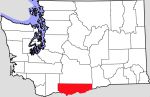
Klickitat County (red) borders the Columbia River. Wikimedia Commons
Experts at the Washington Department of Fish and Wildlife estimate the cougar was about five-to-six-months-old based on its spots and its body size and proportions. Cougar offspring, which are born with spots that fade over time, typically stay with their mothers until they are about 18 months old. WDFW classifies cougars as “kittens” until they reach 12 months of age. [An earlier version of this story incorrectly reported the WDFW age estimate of the cougar as six-to-eight months.—Editor]
The kitten was the latest of at least 32 cougar shootings authorized by Sheriff Bob Songer since August 2019, when he adopted a controversial Dangerous Wildlife Policy under which he routinely sends hound hunters in response to cougar sightings—and, to a lesser extent, reports of bobcats or bears. The sheriff’s office has authorized more than 120 hound hunts for cougars during that time and has deputized seven hound hunters as part of his 155-person volunteer posse. Recreational hunting with hounds has been banned in Washington since 1996.
A loophole in state law allows the sheriff to kill cougars that he deems a public safety threat, regardless of whether the state’s wildlife agency agrees with his assessment. Legislation intended to rein in Sheriff Songer, who narrowly won reelection in November, passed the Washington state senate last year but died in the House Committee on Agriculture and Natural Resources.
Communications and coordination between Songer and the wildlife agency have improved since then. However, Songer has not changed his lethal approach to cougar management.
Frequent callers
The Jan. 22 hound hunt began with an 8:34 a.m. call from Garrett Towle (pronounced “toll”), who lives a few miles north of Lyle, Washington. Towle told the dispatcher that a trail camera within walking distance of his home had photographed four cougars. Female cougars typically have two or three kittens in each litter.
It was not the first time Towle had called to complain about wildlife. In July 2020, he reported “what he believes to be cougars chirping behind his house,” according to the police report from that call. (Cougars, which are also known as mountain lions or pumas, make a variety of sounds, including a bird-like chirping that mothers sometimes use to communicate with their young.) Songer advised Towle that he would need more information to authorize a hound hunt.
In April 2021, Towle called to report a goat missing from its pen. The police report notes that Towle said the pen panel was bent and had been ripped off on an earlier occasion. He “believes this may be a bear,” the report noted. Songer authorized a hound hunt, but no bear was located.

Family portrait: Four cougars were captured on a trail camera just hours before a kitten—possibly one in this photo—was treed and killed. Photo: Kaylee Towle
In January 2022, Garrett’s wife Kaylee Towle called to report what she described as a fresh cougar kill of a deer by their house, which she estimated had been killed within the past hour. In Washington, deer are cougars’ preferred and most common prey.
The Towles requested the services of a hound hunter, and the sheriff agreed. A deputy’s report states that “even though the cougar had killed a deer, [Songer] was aware that livestock was present in the immediate vicinity and he believed it was appropriate to attempt to dispatch the cougar.”
Despite the freshness of the kill, hounds did not pick up any cougar track. A hound handler told the deputy the deer was likely killed by coyotes or domestic dogs.
In June 2022, Garrett Towle called again, this time reporting that his dog had been attacked by a bobcat. Songer approved a hunt, but the hounds were unable to locate a cat.
On Jan. 15 of this year, a week before he called to report seeing four cougars on his trail camera, Towle made yet another call to the sheriff’s office. He reported that he had found a dead goat on his property and believed it had been killed late the previous night or early that morning. Hound hunters responded, but no cougar was located.
A six-month-old cougar is capable of killing a goat. There is no official confirmation that a cougar was responsible for killing Towle’s goat on Jan. 15, but there are signs. Most notably, the goat was dragged to the same location where two other goats owned by the family were found dead and partially buried in the last two years.
Cougars typically drag large prey to a wooded area where they continue to feed on it over several days. They often cover the body with leaves, branches, and other debris.

Gruesome find: Goat found on private land near Lyle, Wash. Property owners believe it was killed by a cougar. Photo: Kaylee Towle
The place where the Towles have repeatedly found dead goats cached is only about 70 yards from her house, says Kaylee Towle. She and her husband have two children, ages six and eight.
“We want them to be able to run and play and build forts in the trees,” she says.
But the place where cougars have repeatedly dragged dead goats is just below where her children built a fort.
“We can’t send our kids out there anymore, because these animals are coming right up to our back door,” she says.
As ranchers, “we are somewhat prepared for losing animals,” she says. “But with it being right here in our yard, it’s been pretty devastating.”
She says her grandparents, who live nearby, lost 10 lambs last year.
Kaylee Towle was surprised when their trail camera showed a whole family of cougars. As a mom, she felt sad for the cougar mother that lost one of its young later that day.
“I don’t feel good about killing any animal,” she says. “But [the cougars] are absolutely capable of killing; they are teaching their young to kill; and they’re coming to our back door and doing it. So we have to protect our young.
“We’re not heartless people because we participate in [Sheriff Songer’s] program. We’re just trying to protect our livelihood and our families.”
Kaylee Towle does not want cougars entirely eliminated.
“I think they’re here for a reason,” she says, but “the numbers have gotten out of control.”
Like many Klickitat County rural residents, the Towles are quick to call the sheriff’s office when they see a cougar or a suspected cougar kill, and willing to have hound hunters track and kill cougars on their property.
Some of their neighbors see things very differently.
Coexisting with cougars
On Jan. 22, Deputy Zachariah McBride and hound hunter Quincy Atchley arrived at the Towle house. They drove up the hill behind the house and saw what appeared to be cougar prints in the mud about 666 yards (a little more than one third of a mile) from the house, according to the police report.
The hounds picked up a scent and began running south toward a large canyon. Within 20 minutes, Atchley told McBride that he believed his hounds had treed one of the four cougars.
But Atchley’s GPS signals from the dogs indicated that the dogs had then moved on, probably in pursuit of one of the other three cougars.
Atchley’s GPS tracked the dogs up over the south side of the canyon, across private property belonging to another landowner, and down into another canyon on public land owned by the Washington Department of Natural Resources and leased by Kaylee Towle’s grandfather for cattle grazing. Cattle typically are not released onto grazing lands until later in the year, however.

What now? Cougar kitten treed by hounds on Jan. 22 looks down on its pursuers shortly before being shot. Photo: Kaylee Towle
Towle, Atchley and McBride climbed into their vehicles and drove to the end of a road closer to where the GPS showed the dogs.
They parked there and made their way on foot along the ridge and down into the canyon. It was there that the hounds treed the cougar kitten, and McBride shot it.
Kris Joy, who owns 40 acres nearby, heard a single gunshot sometime after 1 p.m. that afternoon.
Earlier that day, she had been looking out the window of her home when she saw three men moving quickly across the ridge on her partner Trevor Yasbek’s 40 acres, adjacent to her own land.
At first she thought Yasbek’s son had invited some friends for a hike, but soon afterward the son called to say he had seen a sheriff’s vehicle and a couple of trucks driving up their road, which dead-ends at their neighbor’s house.
Joy and Yasbek walked next door and saw the vehicles, including a pickup with several dog boxes in the back, but there was nobody around.
“It was like everybody just took off and disappeared quickly,” Joy recalls, “but you could hear hounds howling down in the canyon.”
They knocked on the door, and their neighbor “had this funny look on his face when he opened the door,” Joy says.
When she asked him what was going on, he turned and looked at Danny Frey, who was standing in his living room.
Frey is a rancher who lives near Towle—he’s a family member of Towle’s—and holds the cattle-grazing lease for the public land down in the canyon.
Frey told Joy and Yasbek that the men whose vehicles they had seen were tracking cougars and planning to dispatch them. Frey said he had lost a lamb. (Sheriff’s office records do not show any calls from Frey or his wife to report a depredation since March 2021.)
Too upset to continue the conversation, Joy excused herself and went home to make bread. After she heard the gunshot, she saw three men walking back up the steep hill to their vehicles.

Excerpt from KCSO for incident reported at 8:34 a.m.on Jan. 22, 2023 in Lyle, Wash.
Yasbek, who was still at his neighbor’s house, remembers that the last man up the hill was wearing a sheriff’s uniform and carrying a rifle. He showed Yasbek a photo of a dead cougar.
When a sheriff’s deputy or hound handler kills a cougar, the standard procedure is to cut the ears off the animal (to prevent it from becoming anyone’s trophy) and notify wildlife officials of the carcass location so they can collect tissue and teeth samples from the animal to record its age, gender and overall health.
But when the three men reached the neighbor’s house, they told Yasbek the cougar carcass had been too high in the tree to retrieve.
“It haunted me that the cat was there,” says Joy.
Five days later, she went with a friend to look for it.
They walked all over the canyon and finally decided they wouldn’t be able to find the cat among so many trees. But as they walked back up the streambed, Joy saw “the most beautiful red oak leaf I have ever seen in my life.” It was so pretty that she went back to pick it up.
“I was looking at it, and then it just suddenly hit me that it was not natural, and so I looked at the ground in the vicinity, and there were a lot of other very red leaves. Obviously blood.”
She looked straight up. In an oak tree to her left she saw the cougar “draped over a branch in the tree, like a rag doll.” It looked like one eye was damaged.
She felt sick when she saw it and started crying.
“It was very difficult,” she says.

On the trail: Blood-stained leaves. Photo used with permission
Joy is still grieving the loss of the cougar kitten, as are some of her neighbors and friends.
Yasbek’s 31-year-old son “was extremely upset,” Yasbek says. “He wouldn’t even go out there to see [the cougar carcass].”
Joy, who has lived in the area for about seven years, knows it’s cougar country. She has seen cougar tracks on her property and neighbors have called to tell her of sightings. She keeps her chickens confined at night.
But Joy says she feels completely safe coexisting with cougars, even when her granddaughters are visiting.
“I worry more about one of them stepping on a rattlesnake,” she says.
Yasbek, who has lived in the area for 18 years, also says he doesn’t have a problem with cougars.
“I don’t see them. If the sheriff didn’t have hounds, he wouldn’t see them either,” says Yasbek. “It’s a mindset.”
Captain Jeff Wickersham, who heads the Washington Department of Fish and Wildlife (WDFW) enforcement division for southwest Washington, says he would not have called dogs in this case.
“This would not have been an issue for us to respond to, based on the available information,” Wickersham says. “We can’t know that it was the same cougar that killed a goat.”
Sheriff Songer says he stands by the decision made to euthanize the cougar.
“I wouldn’t call this a kitten,” he says.
A WDFW officer who responded to the Jan. 22 call but was not present when the cougar kitten was shot reported that the Towle’s trail camera was located nearly one third of a mile from their house. The cougars were photographed there in the early morning, when it was still dark outside.
The WDFW officer talked with Kaylee Towle about building a hardened structure to house the family’s goats at night.
Towle said she would be interested in doing that, but her goats are not tame and would be difficult to herd into a barn.
Predator-prey research
Many livestock owners and hunters in Klickitat County believe that cougar populations are increasing, and that deer and elk populations are decreasing as a result.
There is plenty of support for this viewpoint from trail-camera photos shared on social media, but little support from science.
Although WDFW has not studied Klickitat County cougars specifically, “the data we have on cougar populations as a whole is pretty good statewide,” says Todd Jacobsen, WDFW’s wildlife conflict specialist for Klickitat, Skamania and Clark Counties.
Based on the statewide estimate of 2.2 independent-aged cougars (more than 18 months old) per 100 square kilometers of cougar habitat—with about half the county offering sufficient cover for cougars—the county’s estimated cougar population would be roughly 54 independent-aged cougars.
The agency’s harvest guidelines aim to keep the number of cougars killed by licensed hunters at 12% to 16% of the adult population annually.
Washington hunting licenses do not permit the killing of spotted kittens or adults accompanied by spotted kittens. The harvest guidelines do not currently account for any cougars killed by the sheriff’s office.
Surveys of mule deer and elk in Klickitat County have found populations fluctuating, with declines attributed by WDFW to severe weather and disease rather than cougar predation.
Deer surveys showed population declines in 2017 and 2018 after the severe winter of 2016-17. A survey conducted in spring 2022 found a high ratio of fawns to does, suggesting that the population is recovering. Habitat loss—to energy facilities and vineyards—is the greatest concern for deer in the East Columbia Gorge, according to WDFW’s latest status report.
The Predator-Prey Project, led by a group of researchers at the University of Washington, conducted legislatively mandated research in two study areas in northeast Washington to determine whether cougars and wolves are competing for deer and other prey.
The researchers studied scat from 60 collared cougars over five years. Their research is not yet published, but a presentation to the Fish and Wildlife Commission in December showed that deer DNA was found in more than 50% of the cougar scat, and in some cases (depending on the season and location) close to 100%.
Livestock DNA was found too rarely in cougar scat to be included in graphs of the results for each year.

Facebook post from Jan. 15, 2023
The two most common causes of human-cougar conflicts are feeding deer and turkeys, which brings cougars closer to human homes, and animal husbandry practices. Most cougar depredations in Klickitat County involve goats, sheep and chickens that are not adequately protected by fencing or guardian animals at night—or pets left outdoors at night. Last year, WDFW published a manual to help small livestock owners minimize conflict.
Sheriff’s Office reports often mention the presence of cattle in the vicinity of cougar sightings, and the sheriff’s report for the Jan. 22 incident mentions a cattle-grazing lease on the land where the cougar was shot.
However, Jacobsen has never had a confirmed cougar depredation involving cattle during his seven-year tenure, and WDFW bear and cougar specialist Rich Beausoleil calls cattle depredation “highly unusual.”
Cougars appear to avoid cattle even when deer are not present, the Predator-Prey Project reported in its recent presentation.
At WDFW, a team of staff and external scientists spent 10 months in 2021 and early 2022 reviewing the scientific literature in attempt to answer this question: “Do cougar removals through recreational hunting and/or agency conflict response affect the number or probability of cougar-human interactions?”
Their answer, in results published last year: “inconclusive.” Four of the seven studies they reviewed suggested that increased removals correlate with increased conflicts between humans and cougars.
A critique of the WDFW review, published in December, deemed its characterization of one of those seven studies inaccurate and dismissive.
The critique also charged that the WDFW review team lacked diversity, because the majority of the team members were WDFW employees, and 100% of the team members were current or former employees of government agencies, which made it difficult for the team to prepare an impartial report.
The study in dispute was a 2020 paper that compared California (where there is no sport hunting of cougars) with other states to test the idea that hunting reduces cougar population densities, problematic cougar-human encounters and predation on domestic animals, deer and elk.
The 2020 study found that, in Washington, higher kill rates of cougars coincided with higher numbers of incidents.
“Indiscriminate killing of [cougars] appears to disrupt social structure and stability, resulting in younger less experienced individuals having more conflicts with humans,” the researchers from Western Oregon University and California State University reported.
What is “public safety”?
Klickitat County is unique in its management of cougars. WDFW handles most cougar removals statewide, and local law enforcement officers rarely remove cougars or run hounds.
WDFW conducted a review of how many cougars have been removed by local law enforcement agencies.
The review, compiled in January 2022, found a total of 34 cougars lethally removed statewide between August 2019 and December 2021. Of those, 27 were removed by the Klickitat County Sheriff’s Office.
Klickitat County has “one tool in the toolbox,” Kessina Lee, then WDFW’s regional director for southwest Washington, testified at a legislative hearing last year.
Lee said WDFW understands “the mere presence of a cougar on the landscape is not inherently a public safety issue. We generally see this value shared by law enforcement officers around the state, but the [Klickitat County Sheriff’s Office] policy takes the de facto position that the presence of a cougar is a threat to public safety.”
Neither Washington state law nor Sheriff Songer’s Dangerous Wildlife Policy defines “public safety” or offers examples of situations in which a cougar would or would not pose a public safety threat.
The hearing at which Lee testified in 2022 was for a bill that would have placed hound-hunting authority under the supervision of wildlife agency experts trained to assess and address wildlife conflicts, but would not have prevented county law enforcement officials from killing an animal that posed an imminent threat to human life or property.
WDFW supported the bill, which was aimed squarely at Songer’s program. It passed the state senate but died in committee in the House when it failed to win unanimous support from Democrats.

The resistance: Sheriff Bob Songer testifies in a 2022 Washington Senate committee hearing in opposition to a bill that would have prohibited his office from hunting cougars with dogs. The bill died in a House committee. Photo: TVW/Capital Press
WDFW and Songer remain at odds over what constitutes a public safety threat, but they are working on their difficult marriage.
“Formerly we were on two different [communications] systems,” so WDFW was not receiving information about cougar calls quickly “and sometimes not at all,” says Songer. “Now we’re both on the same page.”
“The bottom line is, we operate within the law and we’re building good relationships with the wildlife department,” Songer says. “We’re not even required to tell the wildlife department anything.”
The sheriff’s office is now providing WDFW with timely notifications of all cougar removals—which did not happen in the early years of the sheriff’s program—and has improved its notification process so that WDFW is usually notified when Songer decides to run dogs.
“It’s still not perfect, but the sheriff is committed to working on that,” Wickersham says.
WDFW is not currently receiving notice of every cougar-related call to the sheriff’s office, however.
“That’s still a concern,” says Wickersham. “We are not getting timely notification on that.”
And without timely notification, WDFW has no opportunity to confirm depredations or to help landowners address a cougar conflict.
“I don’t see them. If the sheriff didn’t have hounds, he wouldn’t see them either. It’s a mindset.”
WDFW has offered training to help sheriff’s office personnel identify and address cougar depredations, but “formalized training didn’t happen,” Wickersham says. He offered that again to Songer at a meeting they had on Feb. 17.
Wickersham says they talked about how to prioritize the cougar calls the sheriff receives.
“Moving forward, there is the possibility of greater consideration of alternatives to lethal removal,” says Wickersham.
Nonlethal options for removing cougars were among the ideas discussed by a WDFW Cougar Focus Group of seven people, representing various stakeholder communities, who met four times last year to come up with recommendations for “how WDFW could enhance its public outreach, education, and engagement programs to reduce the risk of negative human-cougar interactions.”
According to Jim Brown, the wildlife conflict section manager at WDFW, an interdisciplinary team is now reviewing the focus group’s recommendations and whittling them down to a more focused list for management to consider.
None of the recommendations have been implemented yet.
The focus group recommended that WDFW prioritize its outreach to small-scale livestock owners, because cougars that interact with these owners’ livestock and pets typically do so near their houses.
The potential action that received the most support from focus group members was “seeking state funding to provide support to small-scale livestock owners building defensive structures.”
Such funding might help people like the Towles protect their goats from cougars.
At least two members of the cougar family they saw on their trail camera were still in the vicinity on Feb. 11.
When Kaylee Towle contacted a new neighbor, who is renting property from her family, to warn him about cougars in the area, he told her he had seen two cougars standing outside his house. They slowly backed away when they saw him.
One big one and one smaller one.
Columbia Insight’s reporting on biodiversity in the Columbia River Gorge is supported by the Autzen Foundation and Pacific Power Foundation.