Wild Elephants Appear to Have Been Domesticated, But Not by Humans

NATURE04 April 2023

https://www.sciencealert.com/wild-elephants-appear-to-have-been-domesticated-but-not-by-humans
ByMIKE MCRAE

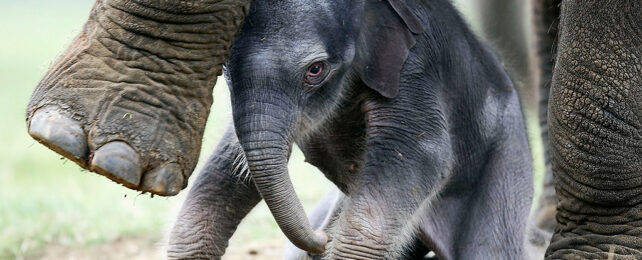
Juvenile elephants have a lot in common with domesticated species. (Paul Gilham/Getty Images)

Over many thousands of years, a species of animal that shared a close relationship with wolves slowly morphed into something that loves to curl up in your lap, get belly rubs, and eat kibble three times a day.

https://b2307899dbe5ff55dfdf2dbf3412d8df.safeframe.googlesyndication.com/safeframe/1-0-40/html/container.html

These changes in dogs weren’t just behavioral. In fact, the changes in body plan – like shorter snouts, floppy ears, more expressive faces, less body hair, and prolonged infancy – are common to many domesticated animals.

An international team of researchers has now pointed out that similar features exist within populations of elephants, prompting the question of who or what might have domesticated them.

The answer the researchers propose sounds just as surprising: Elephants may have domesticated themselves.

On a fundamental level, domestication is the process of artificially selecting representatives from each generation of animal (or plant) that suit the best criteria for living among humans. Number one on that list has to be ‘play nice’. Nobody wants to wrestle a big, hairy mammal for its milk or risk their eyes for a morning fried egg.

https://b2307899dbe5ff55dfdf2dbf3412d8df.safeframe.googlesyndication.com/safeframe/1-0-40/html/container.html

While many common traits might not be intentionally selected for, some genes go hand-in-hand with those for a docile companion, giving many animals a more slender, less threatening look. Termed ‘domestication syndrome‘, the collection of characteristics that go with calm, cute, and content animals might not help them in the wild, but it certainly makes them more suitable for human society.

Back in 2017, Duke University anthropologist Brian Hare took the concept of domestication syndrome a step further, speculating whether it might apply to us humans as well.

If we could pick which dogs, sheep, pigs, and cows should have babies based on their temperament and attraction, why couldn’t we have done it to ourselves?

Known as the Human Self-Domestication Hypothesis, it presumes our evolution was increasingly guided from the middle to late Paleolithic by a preference for less-aggressive, more pro-social partners.

https://b2307899dbe5ff55dfdf2dbf3412d8df.safeframe.googlesyndication.com/safeframe/1-0-40/html/container.html

Consequently, there was increased pressure on our ability to communicate, facilitating complex language skills. Changes in how our brains function may have had an impact on our skull’s size and shape, not all that dissimilar to how skulls have changed in domesticated animals.

We might not be the only primates to have experienced this preference for a more peaceful, expressive path over a violent existence. Hare identifies our close relative, the bonobo (Pan paniscus), as a candidate for self-domestication based on assertions of the species’ lack of aggression compared with its other close relative, the chimpanzee.

Now African and Asian elephants are being nominated as two new examples of self-domestication, having arguably undergone similar selection processes as humans and bonobos.

The authors of this new study supplied an extensive laundry list of similarities between the groups that serve as evidence of a shared domestication process. For example, in all three cases, the jaw and cranium have changed shape, with jaws shortening or skulls becoming less elongated, and teeth reducing in number.

https://b2307899dbe5ff55dfdf2dbf3412d8df.safeframe.googlesyndication.com/safeframe/1-0-40/html/container.html

Behaviorally, there’s a propensity for peaceful interactions, with examples of aggression tending to be proactive rather than reactive. Infants in all species tend to engage in social and non-social play that often facilitates socializing and bonding. There is also significant evidence of ‘alloparenting’, where offspring are guided and cared for by adults who aren’t their direct ancestors.

The team conducted a review of hundreds of genes speculated to be involved in changes to embryonic tissues considered to be in part responsible for domestication, finding some evidence that evolution has favored at least a few dozen such sequences in elephants.

The examples provided may be simply cases of cherry-picking what fits. For example, other animals that have undergone domestication develop into breeds with floppy ears and curly tails.

The researchers argue “domesticated species do not usually show the full suite of features associated with domestication”, as different blocks of traits can fragment and no longer undergo selection. Meaning elephants are less likely to lose the already evolved structure in their ears, given how useful they are for thermoregulation.

https://b2307899dbe5ff55dfdf2dbf3412d8df.safeframe.googlesyndication.com/safeframe/1-0-40/html/container.html

To what degree the three species of elephants might or might not have taken the evolutionary road to pro-social, domestic ‘bliss’ depends mainly on whether the hypothesis itself makes for a good theory capable of explaining why certain social characteristics might be commonly found in diverse species.

If it does, we might find other animals on a continuum of domestication. Dolphins, perhaps, or various species of birds or rodents might have also undergone similar changes that favor degrees of social complexity over brawn and fury.

Once seen as an exclusive virtue of humanity, the tendency to prioritize peaceful guidance, complex emotional expression, and a general love for one another might be an option open to many social animals.

As with many traits that once defined our species, humans have simply taken domestication to the next level.

This research was published in PNAS.
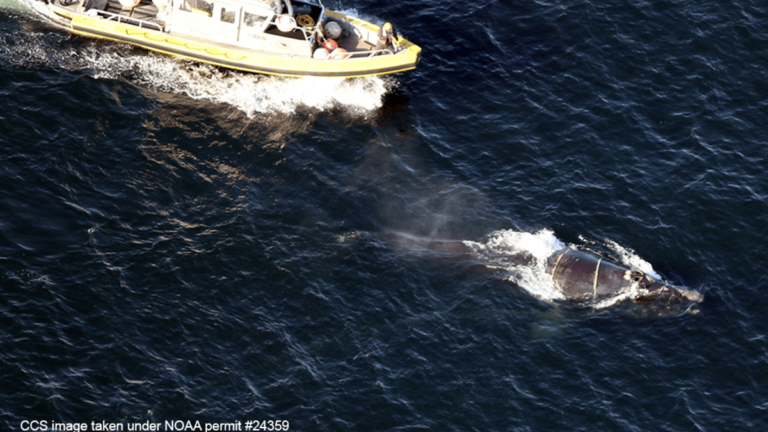
Right whale dangerously entangled amid large gathering in Cape Cod Bay

The North Atlantic right whale has been entangled since at least February. Her location is being monitored, but weather has prevented further disentanglement efforts.

A North Atlantic right whale identified as #4545 entangled in heavy rope in Cape Cod Bay. NOAA permit 24359 Center for Coastal Studies

By Ross CristantielloApril 2, 2023

As nearly 100 North Atlantic right whales gather in Cape Cod bay, one particular creature is in grave danger. A female, identified as #4545, has been badly entangled since at least February. She is one of only 350 or so North Atlantic right whales on the planet. 

The Marine Animal Entanglement Response (MAER) team from the Provincetown-based Center for Coastal Studies has been working on the whale and monitoring it since last Wednesday. MAER Director Scott Landry confirmed that #4545 was still entangled as of Sunday evening. Landry and his colleagues are monitoring weather conditions for an opening to continue working on the whale. In the meantime, her location is being constantly tracked using a telemetry buoy. 

ADVERTISEMENT:

https://50925d86b26d70a5fe2e285b1fb52fbc.safeframe.googlesyndication.com/safeframe/1-0-40/html/container.html

She was found entangled south of Nantucket in February, but the team could not respond due to distance and a lack of daylight, the organization said. At the time, all they could determine was that she had a long piece of heavy rope caught in her mouth. 

ADVERTISING

She was spotted once again last week, feeding with a large group of the endangered whales in Cape Cod Bay. Since February, her entanglement has developed into a “highly complex and lethal” situation, according to the Center for Coastal Studies. They believe rope is still wrapped dangerously around the whale’s body and flippers. 

Last Wednesday, the team was able to remove about 200 feet of thick rope from the whale and attach the tracking buoy. Further disentanglement efforts are expected to be complicated, and the proper weather conditions for such a rescue effort are rare this time of year. 

“This is obviously a difficult situation. We worked very hard for this whale on Wednesday and she did all she could to avoid us. With the telemetry buoy in place on her entanglement all of our attention will be focused on trying again,” Landry said in a statement. 

ADVERTISEMENT:

https://50925d86b26d70a5fe2e285b1fb52fbc.safeframe.googlesyndication.com/safeframe/1-0-40/html/container.html

The whale known as #4545 is just one of at least 79 right whales currently swimming in Cape Cod Bay, The Boston Globe reported. About half of them were gathered near the Cape Cod Canal Saturday. 

The waterway was closed Sunday around noon so that a right whale mother and her calf could swim safely. The Massachusetts Environmental Police escorted the whales through the canal, the Globe reported. 

John Chisholm, a scientist with the New England Aquarium, documented the sight on Twitter. The canal was opened back up by 5 p.m. Sunday, WHDH reported. 

https://platform.twitter.com/embed/Tweet.html?creatorScreenName=BostonDotCom&dnt=true&embedId=twitter-widget-0&features=eyJ0ZndfdGltZWxpbmVfbGlzdCI6eyJidWNrZXQiOltdLCJ2ZXJzaW9uIjpudWxsfSwidGZ3X2ZvbGxvd2VyX2NvdW50X3N1bnNldCI6eyJidWNrZXQiOnRydWUsInZlcnNpb24iOm51bGx9LCJ0ZndfdHdlZXRfZWRpdF9iYWNrZW5kIjp7ImJ1Y2tldCI6Im9uIiwidmVyc2lvbiI6bnVsbH0sInRmd19yZWZzcmNfc2Vzc2lvbiI6eyJidWNrZXQiOiJvbiIsInZlcnNpb24iOm51bGx9LCJ0ZndfbWl4ZWRfbWVkaWFfMTU4OTciOnsiYnVja2V0IjoidHJlYXRtZW50IiwidmVyc2lvbiI6bnVsbH0sInRmd19leHBlcmltZW50c19jb29raWVfZXhwaXJhdGlvbiI6eyJidWNrZXQiOjEyMDk2MDAsInZlcnNpb24iOm51bGx9LCJ0ZndfZHVwbGljYXRlX3NjcmliZXNfdG9fc2V0dGluZ3MiOnsiYnVja2V0Ijoib24iLCJ2ZXJzaW9uIjpudWxsfSwidGZ3X3ZpZGVvX2hsc19keW5hbWljX21hbmlmZXN0c18xNTA4MiI6eyJidWNrZXQiOiJ0cnVlX2JpdHJhdGUiLCJ2ZXJzaW9uIjpudWxsfSwidGZ3X2xlZ2FjeV90aW1lbGluZV9zdW5zZXQiOnsiYnVja2V0Ijp0cnVlLCJ2ZXJzaW9uIjpudWxsfSwidGZ3X3R3ZWV0X2VkaXRfZnJvbnRlbmQiOnsiYnVja2V0Ijoib24iLCJ2ZXJzaW9uIjpudWxsfX0%3D&frame=false&hideCard=false&hideThread=false&id=1642625779816185857&lang=en&origin=https%3A%2F%2Fwww.boston.com%2Fnews%2Flocal-news%2F2023%2F04%2F02%2Fright-whale-entangled-cape-cod-bay%2F&sessionId=e6c072c7cefcea6eea3ceb264be651f09fd6753d&siteScreenName=BostonDotCom&theme=light&widgetsVersion=aaf4084522e3a%3A1674595607486&width=500px

While the whale and her calf swimming through the canal were unimpeded, the continuing entanglement of #4545 highlights the dangers facing these animals. The MAER has freed more than 200 large whales and other marine animals from entanglements since 1984.

“Whales can pick up gear from anywhere within their range and drag it around for weeks and months. Their range is huge, stretching from Canada to Florida. Using disentanglement as a tool for conservation is helpful but has its limitations. We have no control over when or where an entangled whale will be discovered,” Landry said in a statement. 

North Atlantic right whales are some of the most endangered whales on the planet. They got their name because whalers viewed them as the “right” whales to hunt due to the fact that they floated after dying, according to the National Oceanic and Atmospheric Administration. They were hunted to the brink of extinction by the 1890s. 

ADVERTISEMENT:

https://50925d86b26d70a5fe2e285b1fb52fbc.safeframe.googlesyndication.com/safeframe/1-0-40/html/container.html

While commercial whaling is no longer a problem, entanglement in fishing gear and vessel strikes are the leading causes of North Atlantic right whale mortality, according to NOAA. Officials estimate that over 85% of right whales have been entangled in fishing gear at least once. On top of that, rising levels of ocean noise caused by human activities interfere with their communication and increase their stress levels. 

Only about one third of North Atlantic right whale deaths are documented, and the species has experienced a spike in deaths since about 2017. Just 57 new calves have been born since then, according to NOAA.

Manitoba convicts, pulls licences of hunting outfitters following Wildlife Act violations

Exposing the Big Game's avatarCommittee to Abolish Sport Hunting Blog

A black bear walks across the ground in Lyme, N.H., on Wednesday, Aug. 1, 2007. (AP Photo/Cheryl Senter)A black bear walks across the ground in Lyme, N.H., on Wednesday, Aug. 1, 2007. (AP Photo/Cheryl Senter)

https://winnipeg.ctvnews.ca/hunting-operators-convicted-of-numerous-wildlife-act-violations-lose-licences-province-1.6336065

UpdatedMarch 30, 2023 12:50 p.m. PDT

PublishedMarch 30, 2023 11:18 a.m. PDT

Share

Two Manitoba hunting outfitters have been fined thousands of dollars and lost their licences after a four-year investigation revealed numerous violations of the wildlife act.

Manitoba Natural Resources and Northern Development said it started on Sept. 27, 2019, when a hunter from Iowa was crossing back into the U.S. through the Pembina, North Dakota port of entry. Inspectors found two raw black bear hides, one had a game tag on it, but the other did not. Both hides were seized and the Manitoba Conservation Officer Service began its investigation.

The U.S. Fish and Wildlife and Environment Department and Environment and Climate Change Canada became involved. The investigation…

View original post 227 more words

unting accident left former Canadian soldier who served in Afghanistan ‘living in darkness,’ court told

Exposing the Big Game's avatarCommittee to Abolish Sport Hunting Blog

‘The accused stated that he thought he was shooting at geese, but it was actually another hunter in the bushes’

https://calgaryherald.com/news/crime/canadian-veteran-blinded-hunting-accident-okotoks

Author of the article:

Kevin Martin

Published Mar 30, 2023•3 minute read

Join the conversation

The brass doors outside the Calgary Courts Centre were photographed on Tuesday, September 27, 2022.
The brass doors outside the Calgary Courts Centre were photographed on Tuesday, September 27, 2022.Gavin Young/Postmedia

Article content

For most of his life Canadian military vet Christopher Rusk was the consummate outdoorsman.

Advertisement 2

STORY CONTINUES BELOW

Article content

Too Stupid to Steal: 5 Dumbest car thieves in recent memory

Close sticky video

Too Stupid to Steal: 5 Dumbest car thieves in recent memory

https://s3-us-west-2.amazonaws.com/distroscale-public/vplayer-parallel/20230112_2004/ima_html5/index.htmlhttps://c5x8i7c7.ssl.hwcdn.net/vplayer-parallel/20230112_2004/ima_html5/index.html

dslogo

But that all changed for the former soldier, who did a 13-month tour of duty in Afghanistan, on Dec. 15, 2020.Calgary Herald Headline News Banner

Calgary Herald Headline News

Sign up to receive daily headline news from the Calgary Herald, a division of Postmedia Network Inc.Email AddressSign Up

By clicking on the sign up button you…

View original post 393 more words

Highly Intelligent and Possibly Invincible Super Pigs Are Invading America

Exposing the Big Game's avatarCommittee to Abolish Sport Hunting Blog

Popular MechanicsFollow

https://www.msn.com/en-us/news/technology/highly-intelligent-and-possibly-invincible-super-pigs-are-invading-america/ar-AA18aXVc?ocid=msedgntp&cvid=4077f9e735af4fc0bbdb172c385373e8&ei=14

Story by Tim Newcomb•7h ago

TOPICS IN THIS ARTICLE

Technology

Science

News

A special breed of highly intelligent super pigs from Canada have started to travel south into the northern United States. Here’s what we know.©Getty Images

  • A special breed of hybridsuper pigsfrom Canada have started to travel south into the northern United States.
  • Thepigspose a threat to native wildlife and may prove tough to eradicate.
  • The spread of the pigs has only increased in recent years.

A hybrid breed of super pigs—a mix of a domestic pig and a wild boar—is running wild in Canada. And now they have their sights set on the United States.

Originally crossbred to help farmed pigs grow larger and tolerate the cold temperatures of Canada, a drop in the market about two decades ago led some farmers to let their hybrid pigs…

View original post 399 more words

Morosko sentenced to jail in Cortez for fatal shooting of bowhunter

Exposing the Big Game's avatarCommittee to Abolish Sport Hunting Blog

https://www.durangoherald.com/articles/morosko-sentenced-to-jail-for-fatal-shooting-of-bowhunter/

Convicted felon may not own firearms; defense plans appeal

By Jim Mimiaga Journal staff writer

Friday, Mar 31, 2023 9:01 PMUpdated Friday, Mar. 31, 2023 9:13 PM

Ronald J. Morosko of Elizabeth, Pennsylvania, was sentenced to 90 days in jail for criminally negligent homicide and careless hunting in the 2021 shooting death of bowhunter Gregory Gabrisch. (Montezuma County Detention Center)

Montezuma County Detention Center

Ronald Morosko, a black powder hunter convicted of criminally negligent homicide and careless hunting in the 2021 shooting death of bowhunter Gregory Gabrisch, was sentenced Friday in Montezuma County Combined Courts in Cortez.

Chief Judge Todd Plewe handed down a 90-day jail sentence, plus 12 months’ state-supervised probation for the criminally negligent homicide conviction.

Related Stories

Jan 25, 2023

Jury finds Ronald J. Morosko guilty in fatal hunting incident

Jan 24, 2023

Jury hears closing arguments in Morosko hunting trial

A $500 fine was issued…

View original post 404 more words

Southeast Nebraska man fined for multiple hunting violations

Exposing the Big Game's avatarCommittee to Abolish Sport Hunting Blog

DefaultMono SansMono SerifSansSerifComicFancySmall CapsDefaultX-SmallSmallMediumLargeX-LargeXX-LargeDefaultOutline DarkOutline LightOutline Dark BoldOutline Light BoldShadow DarkShadow LightShadow Dark BoldShadow Light BoldDefaultBlackSilverGrayWhiteMaroonRedPurpleFuchsiaGreenLimeOliveYellowNavyBlueTealAquaOrangeDefault100%75%50%25%0%DefaultBlackSilverGrayWhiteMaroonRedPurpleFuchsiaGreenLimeOliveYellowNavyBlueTealAquaOrangeDefault100%75%50%25%0%

Jason Harms, 39, was convicted on nine counts related to the illegal hunting of geese that occurred on Feb. 26 in Johnson County.

By 10/11 NOW and News Channel Nebraska

https://www.1011now.com/2023/03/30/southeast-nebraska-man-fined-5600-related-illegal-geese-hunting/

Published:Mar. 30, 2023 at 2:38 PM PDT|Updated:Mar. 31, 2023 at 7:24 AM PDT

LINCOLN, Neb. (KOLN) – A Sterling man has been fined and must pay liquidated damages for hunting violations.

Jason Harms, 39, was convicted on nine counts related to the illegal hunting of geese that occurred on Feb. 26 in Johnson County.

Harms was fined $1,700 and assessed $3,900 in liquidated damages. His hunting permits have been revoked for two years.

The discovery of several dead geese near sanitation ponds south of Sterling led to the arrest. Sheriff’s officers were notified by a group of hunters, who discovered numerous dead…

View original post 82 more words

State biologists recommend a decrease in hunting licenses in Northwest Colorado

Exposing the Big Game's avatarCommittee to Abolish Sport Hunting Blog

NewsNEWS|13 hrs ago

Tom Skulski

tskulski@steamboatpilot.com

Elk brave the cold weather off of U.S. Highway 40 east of Steamboat Springs on Dec. 22, 2022. Elk and other big game have struggled this winter and have migrated further westward, forcing Colorado Parks and Wildlife to consider limiting hunting licenses for the 2023 hunting season.
John F. Russell/Steamboat Pilot & Today

As the intense winter weather continues, thousands of big game wildlife in Northwest Colorado have been forced to migrate farther west than ever before.

If the area populations continue to thin without return, Colorado Parks and Wildlife may decrease hunting license permits for the 2023 season.

The mortality rates of big game are the highest the area has seen since the mid-1980s, according to CPW, and what started as a catastrophic winter for younger animals has begun to affect the adult antelope, deers and elk as well.


“This…

View original post 494 more words

The black summer bushfires killed 3 billion animals. They are our relatives; they deserve to be mourned

Exposing the Big Game's avatarExposing the Big Game

Three years after Australia’s firestorm tragedy, Alexis Wright offers a eulogy for the living creatures lost – and a plea for the humans left behind

Alexis WrightFri 31 Mar 2023 10.00 EDT

16

Many times since the black summer fires came, and finally passed, I have thought about the enormity of what happened on vast areas of country, killing 3 billion animals and trillions of invertebrates. I thought, what can one human being say to this unimaginable loss, when I know in my heart that the human world did not do enough to prevent this disaster? A disaster brought on by the global warming emergency. A disaster that created colossal, unprecedented pyro-convective firestorms.

Do we even have the right to speak? Who should be speaking about this?

View original post 993 more words

The black summer bushfires killed 3 billion animals. They are our relatives; they deserve to be mourned

Three years after Australia’s firestorm tragedy, Alexis Wright offers a eulogy for the living creatures lost – and a plea for the humans left behind

Alexis WrightFri 31 Mar 2023 10.00 EDT

16

Many times since the black summer fires came, and finally passed, I have thought about the enormity of what happened on vast areas of country, killing 3 billion animals and trillions of invertebrates. I thought, what can one human being say to this unimaginable loss, when I know in my heart that the human world did not do enough to prevent this disaster? A disaster brought on by the global warming emergency. A disaster that created colossal, unprecedented pyro-convective firestorms.

Do we even have the right to speak? Who should be speaking about this?

Of course, we should all speak. We should all say something of how we feel about what happened. But who should take the lead in expressing the thoughts of the entire continent? Where is the leadership of this country in this global emergency? Where are the world leaders? Where are those who have allowed the global warming disasters of unprecedented and unimaginable scale, which are now occurring with more frequency across the planet? We need the head of state to lead the nation in grieving and seeking forgiveness. To speak honestly about what a loss of this magnitude means, and what we will do to ensure it never happens again.

I feel that I need to seek the forgiveness of all these animals that died. We need to speak to the ancestral creators of this continent. Australians must recognise the magnitude and scale of what happened here. Australians must own up to their neglect in caring for country – the ancestral homelands of all those creatures who perished.

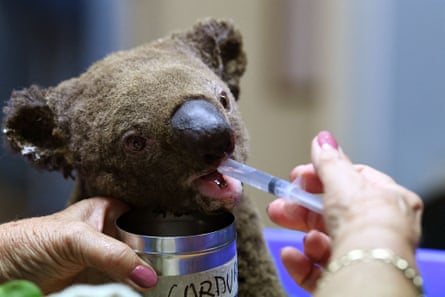
A dehydrated and injured koala is cared for in November 2019
A dehydrated and injured koala in November 2019. Photograph: Saeed Khan/AFP/Getty Images

It troubles me that I am not able to find the right way to deal with the magnitude of this loss. I have seen reports that the ashes from these fires became a massive plume of smoke circling our planet for months. I have read that the fires temporarily depleted the ozone layer by up to 5%; and that ozone recovery may become slower with increasingly greater and more frequent fires. Surely this loss is a warning.

https://imasdk.googleapis.com/js/core/bridge3.566.2_en.html#goog_966644944

https://imasdk.googleapis.com/js/core/bridge3.566.2_en.html#goog_1146944701

https://imasdk.googleapis.com/js/core/bridge3.566.2_en.html#goog_163438189Will Trump indictment make white evangelicals ditch ‘imperfect vessel’?Harvard professor’s fossil fuel links under scrutiny over climate grant‘Why mine so close?’: the fight to protect the pristine Okefenokee swampSuing Gwyneth Paltrow ‘absolutely not’ worth it, says Utah manRepublican donor convicted of sex trafficking teenage girlsIran’s chief justice says unveiled women will be prosecuted ‘without mercy’Suing Gwyneth Paltrow ‘absolutely not’ worth it, saysUtah man

The rightful sovereign caretakers, guardians, law managers of country since time immemorial all carry the weight of this loss. We feel diminished knowing that we were unable to protect our traditional lands. Our sadness haunts country like a sickness. In 2020 the Gamilaroi scholar Amy Thunig tweeted: “Seeing people start to ask ‘what is going on in Australia?’ Ongoing colonisation, that’s what’s going on. This land was nurtured in reciprocal relationships with First Nations peoples for some 120,000+ years. THIS is the result of 200 odd years of extractive invasion.”

I am humbled and sad of heart to be writing this eulogy. Although its focus is on the animals and living creatures who died, I acknowledge the deep and tragic loss of human life in this catastrophe too. Many families and communities carry their grief and loss to this day.

–

Today –

We honour, and express our sorrow for, each and every one of the 3 billion animals and all living creatures whose lives were tragically lost in the fires that burnt approximately 30,000 sq km of our country.

We honour, and are sorry for, the further loss of the smaller animals, the 240 trillion insects, beetles, butterflies, moths, spiders, yabbies and other invertebrates estimated to have died while unable to escape the fires that engulfed their rightful world, their ancient and natural homeland.

We honour, and say thank you to, the thousands of brave firefighters and community members who worked so desperately hard over soul-destroying weeks and months to save our bushlands and forests, and the lives of people and living creatures in these places.

We honour, and say thank you to, the many people who rescued badly burnt and injured animals, and painstakingly nursed and healed these animals with care and compassion before returning them to the bush.

–

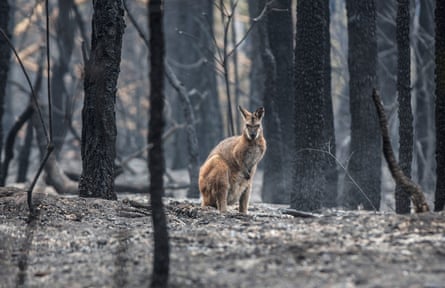
A wallaby in burnt-out bush
A wallaby in burnt-out bush in Kangaroo Valley, NSW, in January 2020. Photograph: Jessica Hromas/The Guardian

In the Aboriginal world, we deeply understand that all animals that belong to this land are our close relatives. We understand the importance of our close inter-connectivity with everything in our world. This is the ancient wisdom that we must follow. If we care for our country, the country will care for us.

I once wrote a libretto for Dirtsong, a musical performance by the Black Arm Band. It used the voices of elders expressing what country was all about. Their words included:

It comes from where we bin start off … Coming up from ancient song for making country good – looking good all of the time. Singing it up, singing it up, looking after it well … Watching my country, watching story … Listen for the heartbeat. The heartbeat now – with the pulse of the land, Bringing it up. … Bring the country back.

Australia, already broken by this relationship with the traditional owners of country, became more broken while witnessing the unfathomable scale of this firestorm tragedy. A tragedy that took away the fresh breath of the natural world. A tragedy that took away the sound of this country’s natural music. A tragedy that took away its peacefulness and powerful ability to calm our spirit. A tragedy that silenced the sounds of its life, like the rustle of animals moving through the bush. A tragedy that silenced the songs and voices of the vast multitude of animals, our company, our relatives, that belong in the bushlands and forests.

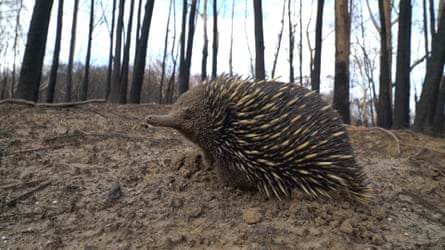
An echidna after the fires
An echidna after the fires. Photograph: WWF-Australia/Reuters

In this silence, we hear the voice of our conscience. We do not look after the country well enough, the land on which we live. We do not look after the health of our planet that we depend upon to survive.

We will never forget what happened, and we will never forget that 3 billion animals and the trillions of other living creatures that died through no fault of their own.

We cannot be guided by an ethos of neglect, brokenness of heart, misery of spirit that will lead us into a future world devoid of joy.

The world’s combined humanity must sing the planet up with careful songs, songs of responsibility and respect.

  • This is an edited version of a speech to be delivered by proxy at the Black Summer Vigil on Sunday from 2pm at Camperdown Memorial Park in Sydney, weather permitting. It will be streamed online