Artistic reconstruction of the reptile adaptive radiation in a terrestrial ecosystem during the warmest period in Earth’s history. Image depicts a massive, big-headed, carnivorous erythrosuchid (close relative to crocodiles and dinosaurs) and a tiny gliding reptile at about 240 million years ago. The erythrosuchid is chasing the gliding reptile and it is propelling itself using a fossilized skull of the extinct Dimetrodon (early mammalian ancestor) in a hot and dry river valley. Credit: Image created by Henry Sharpe
Harvard researchers find rapid evolution of reptiles was triggered by nearly 60 million years of global warming and climate change.
Researchers can explore the impact of environmental crises on organismal evolution by studying climate change-induced mass extinctions in the deep geological past. One principal example…
Emu oil is obtained by slaughtering an emu. There is no other way to get this oil which is touted by emu exploiters as a virtual cure-all for whatever ails you (except as a balm for the sin-sick soul which wearing this oil can only make sicker). Put a glow on your face by smearing slaughtered emu oil on your nose, lips, and cheeks. Soothe and smooth your body with it. Just make sure before purchasing those dainty bottles and tubes of this murdered emu “wellness” ointment that it is “sustainably, ethically sourced.”
On June 2, 2022, I wrote a letter (see below) to the president and publisher of Harper’s Magazine, John MacArthur, urging him to discontinue an ad for a cosmetic skin cream called Airbrush. This cream is made of emu oil, extracted from the thick layer of fat beneath the emu’s skin, a reserve for hard times in the bird’s native Australia where this fleet-footed, flightless, gentle nomad evolved 90 million years ago.
Concluding an email correspondence with Mr. MacArthur’s assistant, Virginia Navarro, I received the following email from Ms. Navarro on July 12, 2022:
Dear Dr. Davis,
After much internal discussion and consideration, Mr. MacArthur concluded that we must honor our existing contracts and will continue working with this advertiser. We understand not every reader will approve of every advertisement that appears in Harper’s Magazine, but we will leave it to them to make their own purchasing choices. We will not be publishing your letter in the magazine, as our “Letters” section is reserved for comment on editorial features and not on advertising.
We respect your concerns and we sincerely appreciate your many years as a subscriber, and we hope you will continue to read Harper’s Magazine.
What Can I Do?
Protest Politely But Firmly: Please remove this cruel advertisement!
John R. MacArthur, President and Publisher Harper’s Magazine 666 Broadway, 11th Floor New York, NY 10012
Dear Mr. MacArthur:
I am a decades-long, devoted reader of Harper’s Magazine.
I am writing to you now about an advertisement that Harper’s has been running for a year or more, for a product called Airbrush. This product contains emu oil, which is obtained by raising and slaughtering emus. I respectfully ask you please to stop running this ad promoting slaughterhouse emu oil.
I understand that most people are not familiar with emus other than as a demeaning cartoon character, which has nothing to do with actual emus, who, with ostriches, belong to the oldest living family of birds on earth, the ratites, or nomadic flightless fowl.
I do not wish to overwhelm you and Harper’s with material about emus, although I am prepared to do so if the Airbrush ad continues to appear in Harper’s Magazine. With this in mind, I’m enclosing two copies of our brochures about ostriches and emus entitled Nowhere To Hide.
I also respectfully refer you to our webpage on ostriches and emus at www.upc-online.org/ostriches. I urge you to read about these birds, their natural dignity, their strong family life, their amazing fleetness, and the horror of the slaughter to which they are subjected for their body parts. The high standards of Harper’s Magazine are incompatible with the brutality of the product, fittingly called “Airbrush,” since anyone who does not understand the source and meaning of emu oil is undergoing an airbrush.
I would appreciate receiving a response from you to my letter, and I hope for good news.
That said, thank you very much for your attention. Please do not hesitate to contact me for more information. I look forward to hearing from you.
Sincerely,
Karen Davis, PhD, President United Poultry Concerns
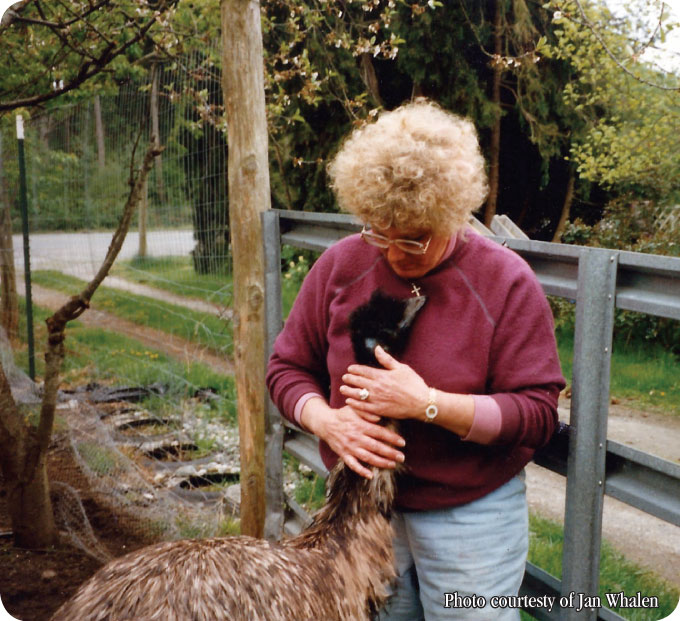
Jan Whalen and Bluie the Emu in Everett, Washington
Emus are feathered dinosaurs that have existed in their present form for at least 2 million years. In contrast, anatomically modern humans have existed for only about 160,000 years. Emus have survived two brushes with extinction because of humans and are currently confronting the existential threat of climate change. Probably, they will survive us. Certainly, their collective dignity is undiminished by human mockery, despite the antics of humans who laugh at the frantic behavior of traumatized captives such as Emmanuel and the emus misused by Liberty Mutual for its commercials.
We could learn a lot from emus, whose flexibility, persistence and cooperative culture have helped them to flourish despite changing circumstances, including a war in which Australian farmers used machine guns to try to drive them from their homelands. To this day, they have not ceded those lands. Nor have they consented to be held perpetually captive and forcibly bred for human amusement and profit. Their captors cannot speak for them.
Before it’s too late, let’s respect and learn from emus and other nonhuman elders who may know things about the world that we cannot yet see. Let’s have empathy, too, and release the captives to sanctuaries or the wild.
Pattrice Jones, Springfield, Vt.
The writer is coordinator of VINE Sanctuary, a multispecies community that includes emus.
Louisiana officials announced they discovered the hatchlings of the world’s smallest sea turtle species on an island just off the coast of New Orleans for the first time in 75 years.
Officials identified at least 53 sea turtle crawls (the unique paths turtles impress in the sand on their way to the sea) belonging to the endangered Kemp’s ridley turtleat the Breton National Wildlife Refuge on Louisiana’s Chandeleur Islands. Kemp’s ridley turtles only grow to be two feet in length,according to the National Oceanic and Atmospheric Administration.
They observed two live hatchlings go into the water,the Louisiana Coastal Protection and Restoration Authority and Louisiana Department of Wildlife and Fisheries said in anews release.
Officials said the discovery of the turtles marked a positive sign for the island chain, which was decimated as a habitat followingthe Deepwater Horizon…
Gordon Burrell, from Hempton, near Fakenham, said villagers had come to the aid of ducks who have been left without a pond- Credit: Gordon Burrell
Concerned localshave stepped in provide pools of water for wildlifeafter seeing their beloved pond dry up.
Extreme heat and a lack of rain has taken its toll on the pond in Hempton, near Fakenham, which now resembles a barren pit.
Gordon Burrell, who lives in the village, said he believed it had been “neglected”, with mud and sludge allowed to build up.
Gordon Burrell, who lives in Hempton, near Fakenham- Credit: Gordon Burrell
He recently approached Hempton Parish Council (HPC), who told himthey are in talks with conservation contractors who will soon attempt to dredge the site.
A spokesman for the council said advice was being sought from conservation experts, and that…
TOWN OF ETTRICK (Trempealeau County), Wis. (WEAU) – One man has died after an ATV crash in Trempealeau County Thursday evening.
The Trempealeau County Sheriff’s Office said deputies were called to the Town of Ettrick just before 6:30 p.m. Thursday for a report of a missing man who had not returned home since Wednesday who was expected to be checking on hunting land near Lindberg Lane northeast of Ettrick.
Deputies searched the area and found the man pinned under his ATV. He was pronounced dead at the scene. Deputies said it appears he hit an embankment before it rolled. The victim’s name has not been released yet…
When was the last time a wild walrus ever injured anyone?
OSLO, Norway––Was Freya the walrus killed by Norwegian directorate of fisheries on August 14, 2022 in Oslo fjord to protect herself, or to protect human swimmers and boaters, as the Norwegian government alleges?
Or was Freya really killed to protect the heavily subsidized Norwegian whaling and sealing industries from the political consequences of the Norwegian public falling in love with a marine mammal?
Among the only public defenders of killing Freya were directorate of fisheries director general Frank Bakke-Jensen, whose mandate includes defense of whaling and sealing, but not any aspect of protecting public safety, and prime minister Jonas Gahr Støre.
Støre, a hard-line right winger, owes his position to voting support from the coastal regions where whaling and sealing are entrenched traditions, while showing any sympathy toward either marine mammals or terrestrial wildlife tends to be seen as suspect.
Norwegian prime minister defends killing Freya
“I support the decision to euthanize Freya,” Støre told the Norwegian national television network NRK hours after the killing.
“It was the right decision,” Støre insisted. “I am not surprised that this has led to many international reactions. Sometimes we have to make unpopular decisions.”
Much of the outrage over killing the 1,300-pound female walrus came from England, the Netherlands, and Denmark, where Freya stopped earlier during a 16-month odyssey around the North Sea, more than a thousand miles south of normal walrus habitat in the Arctic ocean.
But much criticism of killing Freya also came from within Norway.
(Beth Clifton collage)
“Norse goddess of beauty & love”
“Freya, named for the Norse goddess of beauty and love,” reported Jon Henley for Associated Press, “had become a popular attraction since arriving on July 17, 2022 in the waters off the Norwegian capital, where crowds approached to watch as she basked in the sun or dozed on boats.
“Norway’s fisheries directorate,” Henley recounted, “said the walrus was euthanized ‘based on an overall assessment of the threat to human safety’ after the public ignored warnings not to get too close to her, often with small children, to pose for photographs.
“Other reports,” Henley continued, “showed people swimming with the walrus, throwing things at her, and surrounding her in large numbers. On one occasion police had to evacuate and seal off a bathing area after Freya chased a woman into the sea.”
(Beth Clifton collage)
“Who decided to euthanize Freya, & on what grounds?”
Spokespersons Siri Martinsen and Christian Steel of the Norwegian animal advocacy organizations NOAH and Sabima, Norwegian marine biologist Rune Aae, Oslo city council member Eivind Trædal, and Truls Gulowsen of the [Norwegian] Nature Conservation Association were among the outspoken critics of the killing,
Steel demanded release of “full documentation of who decided to euthanize Freya, and on what grounds,” Henley summarized.
Said Steel, “The directorate cannot keep this a secret just to make things convenient for itself. They have a reason for it. There must have been professionals in the picture who have made an assessment that this animal was stressed.”
Walrus at Tacoma-Point Defiance Zoo. (Beth Clifton photo)
“An embarrassing collective failure”
Gulowsen called the killing “an embarrassing collective failure,” acknowledging that people “behaved like idiots faced with nature.
“Elsewhere,” Gulowsen told media, “authorities managed to keep people away, and people managed to show consideration [for Freya]. But here in Oslo fjord, no one could be bothered––so we killed her instead.”
Zoologist Per Espen Fjeld, who also defends the Norwegian whaling and sealing industries, had argued for about a month that Freya should be shot, old VG on Monday it was “obvious” that Freya would have to be put down eventually, adding that the decision was entirely justifiable and had no consequences for the future of the species.
“You cannot expect 1.6 million people not to swim in Oslo fjord,” Per Espen Fjeld said. “People were out swimming and suddenly there it was, a meter away. If you get hit by even a little bit of 600 kilograms of muscle and blubber, everyone knows what happens.”
Top: Pia Ve Dahlen. Bottom: Per Espen Fjeld. (Facebook photos)
Per Espen Fjeld vs. Pia Ve Dahlen
But Per Espen Fjeld cited no precedent for a wild walrus ever injuring anyone. The ANIMALS 24-7 archives from the past 36 years include not even a report of a wild walrus injuring a traditional Inuit hunter in the act of trying to kill the walrus with a harpoon.
Changing the subject, Per Espen Fjeld pointed out that “There are 30,000 walruses in the North Atlantic. The difference between Freya and animals we issue death sentences on daily, because it is profitable or convenient for us,” Per Espen Fjeld wrote in a media statement, “is that Freya is an exotic feature in the media and has been given a name. A pure Bambi effect,” Per Espen Fjeld complained.
Countered Norwegian marine biologist and author Pia Ve Dahlen, “It’s crazy that a wild animal, who usually doesn’t care if a polar bear trudges past, died because we couldn’t keep away. I get so tired of the Norwegian approach that ‘No, now it must be shot’ if possible. As soon as these fascinating animals do something we consider inconvenient, the first thing we think about is shooting them.”
(Merritt Clifton collage)
Dangerous dogs
Said Norwegian Directorate of Fisheries director general Frank Bakke-Jensen, in a somewhat self-contradictory written statement, “According to veterinary experts the walrus seemed stressed by the massive attention [she received] and the welfare of the animal was compromised.
“Therefore, the Directorate concluded, the possibility for potential harm to people was high and animal welfare was not being maintained.
“We considered all possible solutions carefully. We concluded that we could not ensure the animals welfare through any means available,” Bakke-Jensen finished.
Some defenders of the decision to kill Freya likened the situation to the rationale for the Norwegian national ban on possession of pit bulls, including American Staffordshire terriers, Fila Brasileros, Tosa Inus, Dogo Argentinos, and Czechoslovakian wolfhounds: to prevent a public safety hazard from developing.
But that ban was enacted after dangerous dogs bred at a farm in Dragsten, Selbu, South Trøndelag in July 2014 killed a two-year-old girl. As many as 20 dogs were reportedly involved, many of whom had been offered for sale to the public.
Norway has had no fatal dog attacks since the dangerous dogs prohibition has been in effect.
The Freya case also evoked memories of the December 12, 2003 death of Keiko, the orca star of the Free Willy film series. Released off Iceland in July 2002, Keiko on September 1, 2002 swam into Skaalvik Fjord, Norway, 250 miles northwest of Oslo, and then into Taknes Fjord.
“The orca surprised and delighted Norwegians, who petted and swam with him, and climbed on his back,” reported Doug Mellgren of Associated Press.
Niels Oeien, of the Institute for Marine Research in Bergen, Norway, on September 3, 2002 accused Keiko of “disturbing fish farms,” and told Aftenposten Multimedia, “If there are more such episodes, he should be destroyed.”
Controversy over what to do about Keiko raged on for more than a year, until Keiko reportedly died of apparent acute pneumonia. His remains were buried before dawn three days later by five local volunteers and three of his former keepers from the final phase of his rehabilitation for release, after spending most of his life in captivity.
The Keiko episode visibly raised Norwegian opposition to whaling and sealing, but both heavily subsidized hunts continue with the aggressive support of the Jonas Gahr Støre government.
Minke whale. (Beth Clifton collage)
Minke whales “sold for dog food or just dumped”
Bjørnar Skjæran, named Norwegian minister of fisheries & marine affairs in February 2022, immediately set a 2022 whaling quota of 917 minke whales, down from the previous quota of about 1,200.
“The reduction in the quota number is largely meaningless,” said Michelle Collins of the British-based organization Whale & Dolphin Conservation.
“Full quotas have not been taken in recent years,” Collins explained, “but hundreds of whales are still slaughtered, often taking a long time to die. 2021 saw 575 minke whales killed, marking the deadliest whaling season since 2016. 503 whales were killed in 2020, and 429 in 2019.
“Norway’s government allows the minke whale hunts to go ahead under an ‘objection’ to the global ban on commercial whaling, and whalers continue to carry out this slaughter despite falling demand for whale meat in the country and a decline in the number of boats hunting each year.
“Last year,” Collins charged, “shocking new documents revealed that dwindling domestic demand for the meat means it is sold for dog food or just dumped into the sea.”
Sealing
Norwegian sealing, meanwhile, was for several years conducted with animal welfare inspectors aboard the vessels taking seal hunters to the ice floes, but the global COVID-19 pandemic in 2019 became a pretext for dispensing with the inspectors.
“Among the crews to go hunting without inspection,” the Norwegian organization NOAH charged, “are crew members who have been convicted of animal cruelty after several offences during seal hunting in 2009. In 2010 these crew members received some of the highest fines ever given for animal cruelty in Norway. The men were convicted based on documentation from an animal welfare inspector’s report, and video recorded evidence.
(Beth & Merritt Clifton)
“Around 80%” of the annual Norwegian seal hunt is subsidized,” NOAH continued. “In 2015 the government decided not to grant subsidies for 2016. That year there was no seal hunt. Sadly, subsidies were re-established in the following years.”
Recent Norwegian sealing quotas have allowed for killing up to 18,548 harp seals, the same species persecuted in Atlantic Canada, also with heavy governmental subsidies, in a region whose voting has often tipped the balance in Canadian national elections.
When most people hear the word “tsunami,” they may imagine a massive wave, but that’s actually a misconception that researchers in Washington state are trying to correct. Since the state’s coastline is at risk of being hit with a devastating tsunami following an earthquake of magnitude 7.5, the state is trying to educate the public about what it actually would be like.
The Washington State Department of Natural Resources released awave simulation studyin July and shared a bit of startling news: a tsunami in Puget Sound could engulf Seattle’s shoreline, leaving it under more than 20 feet of water within minutes.
Several videos released along with the study illustrate how an earthquake-triggered tsunami would most likely cause water to inundate the coastal areas around Seattle. From land, a tsunami functions and looks…
People cross the Diyala River, a tributary of the Tigris, where decreasing water levels this year have raised alarm among residents near Baghdad, Iraq, on June 29.Hadi Mizban/AP
Editor’s Note:A version of this story first appeared in CNN’s Meanwhile in the Middle East newsletter, a three-times-a-week look inside the region’s biggest stories.Sign up here.Abu Dhabi, UAECNN—
London got so warm this summer that newspapers splashed with headlines saying temperatures in the city had exceeded those of scorching hot Dubai.
One after another, European countries such as Spain and Portugal registered record highs this year.
The northern hemisphere did indeed witness record temperatures, with wildfires engulfing parts of Europe and drought threatening food supplies. And, often, European cities witnessed hotter conditions than those in the Persian Gulf.
In mid-July, a 600kg (94 stone) walrus, affectionately nicknamed Freya, appeared near Norway’s capital city in the Oslo Fjord.
Not one to remain low-key, she soon became a local celebrity, as videos of her awkwardly and slowly scrambling onto boats went viral.
However, less than a month after her first appearance, Freya was killed by government authorities, having been deemed a danger to the public.
This has not gone down well – some went as far as to accuse Norway of “murdering” the mammal, while an online fundraising campaign for a bronze statue has raised almost $24,000 (£20,000) in a matter of days.
Indeed, the outrage – which fanned out far beyond Norway’s borders – has been such that even the country’s prime minister has been forced to comment, saying putting Freya down was “the right decision”.
But still people are asking: could Freya have been saved?
Freya’s journey to Oslo most likely started in the Arctic, but over the last year she appeared to have undertaken a European tour, with sightings in UK, Dutch, Danish and Swedish waters.
Everywhere the walrus went she attracted attention – but in Norway this started to worry officials.
Photographs showed large crowds gathered on the edge of the water, standing within touching distance. Meanwhile, reports emerged in local media of Freya chasing a woman into the water, while one kayaker described a “scary encounter” with the animal when she came too close to his vessel.
Image caption,The fisheries ministry released a picture of people gathered very close to the walrus
“Walruses are unpredictable in their behaviour,” says Erik Born, a senior scientist at the Greenland Institute of Natural Resources, “and are perfectly well able to catch a seal between their front flippers and stab them to death.”
As the walrus got closer to people – or the people got closer to her – there was an obvious danger. “Having a half-tonne heavy walrus – with sharp tusks – swimming among people is pretty risky,” Dr Born says.
What’s more, walruses have been known to attack scuba divers and small boats – although these cases are few and far between.
But then, says Mads Frost Bertelsen, the Zoological Director at Copenhagen Zoo, that is not surprising. Walruses tend to live in remote areas, which means they don’t often come into contact with humans. This means statistics on incidents are low – but, he points out, they are capable of inflicting “serious damage”.
So would Prof Bertelsen have come to the same decision as the fisheries ministry? He says he would.
The blame, however, does not sit with Freya, according to Dr Jeff W Higdon, a consulting Arctic marine mammal biologist from Canada with experience of walruses.
“Human behaviour significantly increased risk in this case,” he says – questioning why common sense did not prevail among the sightseers.
“Everyone who crowded that animal put themselves and their children at risk and contributed to the unfortunate outcome.”
But not everyone agrees that the risk inevitably should have led to Freya’s death.
Image caption,Freya climbs on board a boat in July
“The risk was potential rather than demonstrated,” argues Fern Wickson, a professor at the Arctic University of Norway.
Indeed, she says the level of risk posed by Freya was no greater than those “we regularly tolerate in our society and daily lives”.
“That the government chose to take Freya’s life rather than try to manage this potential risk through implementing more effective measures to manage the behaviour of people was surprising and disappointing,” Prof Wickson says.
Alternative methods
Norway’s Fisheries Directorate did discuss a possible solution to the issue other than euthanasia with experts before acting, including members of the Institute of Marine Research (IMR).
Attempting to immobilise the animal with drugs so she couldn’t swim away and drown would have come with its own risk, warns biologist Dr Higdon.
“Immobilising, capturing and moving wild animals can lead to physiological stress – and in extreme cases cause death,” he says.
The directorate agreed and had further concerns – pointing to the walrus’s large size, limited access to blood vessels and “severe respiratory and circularity problems” when anaesthetised.
But that wasn’t the only option put on the table – the IMR also considered putting a net under a boat with the aim of catching Freya.
“This would also entail a relatively high risk, as the walrus could easily become entangled in the net and panic and drown,” the institute explained in a statement.
The “gentlest” decision would have involved building an open-top cage which would be placed in the water with the top slightly sticking out. Freya could then have possibly been placed inside, and taken somewhere safer.
“If it had been successful, there would be little chance of the animal getting stuck under water or damaging the device,” explained the IMR.
However, the IMR revealed that it did not recommend a solution, and the Directorate of Fisheries made the final decision on Freya’s fate.
Their conclusion was that due to the high risk of harming or killing her and the “significant use of resources” and costs required to move her, it was not feasible to relocate Freya. Their statement said that growing crowds and ignored warnings led to more situations where Freya or nearby people could be injured.
“Both the behaviour of the walrus and people have changed recently. We therefore decided that euthanasia was the right measure,” the directorate told the BBC.
As Rod Downie, chief adviser for the WWF on Polar Regions, put it: “Freya posed a danger to the public – and the public posed a danger to Freya.”
But Freya’s journey isn’t quite over.
The IMR has announced that the Norwegian Veterinary Institute will perform a post-mortem examination on her which they say could provide valuable information about the animal.
Walruses are listed as vulnerable by the International Union for Conservation of Nature Red List of Threatened Species. However, several experts pointed out that Freya’s death will have little impact on walrus numbers.
“The Atlantic walrus population is not at risk and the loss of this animal, while unfortunate, isn’t a conservation concern,” says Dr Higdon.
Meanwhile, Prof Bertelsen was keen to emphasise that there were more pressing issues. “The bigger picture,” he says, “is global warming and pollution of the sea.”