The Sun has been waiting to kill us for a long time. In our high-tech era, it has a whole new tool it can use to strike us.
When conditions are right, coronal mass ejections (CMEs),magnetic loops drenched in hot plasma, can be fired toward Earth. This has happened before, and we refer to them now as Carrington Events.
If a Carrington Event happened today, most experts agree it would fry our power, GPS, and communication systems, leaving us cold, in the dark, and alone.
Kyiv and Moscow continued to accuse each other on Friday of shellingEurope’s largest nuclear power plant, stoking international fears of a catastrophe on the continent as Russian President Vladimir Putin said independent inspectors should visit the Zaporizhzhia plant “as soon as possible.”
“The Russian side confirmed its readiness to provide the (International Atomic Energy) Agency inspectors with the necessary assistance,” the Kremlin said in a statement after a call between Putin and French President Emmanuel Macron – their first call in nearly three months, the AFP news agency reported.
“The two presidents will speak about this subject again in the next few days following discussions between the technical teams and before the deployment of the mission,” a French readout of the call said.
Earlier, Nikolai Patrushev, the secretary of Russia’s Security Council, accused the United States of encouragingUkrainianattacks on the Zaporizhzhia nuclear power plant…
Zion’s dwindling cougar population traces its roots to the late 1920s, when the park’s management made efforts to increase visitation. Photo by Washington Department of Fish and
Growing crowds at Utah’s Zion National Park have led to the displacement of cougars, the area’s top predator, resulting in a devastating series of changes to the region’s biodiversity, environmental scientists report.
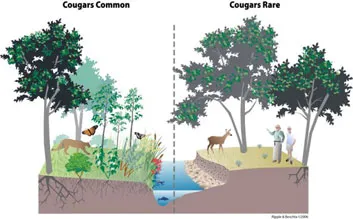
Compared with a nearby habitat in which cougars still thrive, Zion has fewer cottonwood trees, butterflies, amphibians and wetland plants, and much more deer, according to a paper that appears in the December Biological Conservation.
Report an ad
about:blank
“The effects have been quite strong and rippled through this ecosystem,” says Robert L. Beschta of Oregon State University, who coauthored the study.
Zion’s dwindling cougar population traces its roots to the late 1920s, when park management made efforts to increase visitation. By 1934, tourism had risen considerably, attracting some 70,000 visitors a year—about eight times what it had been only a decade earlier. Today the park receives about three million annual visitors.
To measure the impact of the shrinking cougar population, Beschta and William J. Ripple, also of Oregon State, collected census data on Zion’s deer populations dating back to the 1930s. They also studied tree rings to estimate the age and abundance of cottonwoods, a favorite food of young deer, and surveyed nearby river banks to gauge the number of butterflies, frogs, lizards and certain plants.
The researchers compared their figures with similar populations from an area next to Zion called North Creek, which has a stable cougar population. They found more deer, fewer young cottonwood trees and less riverbank life in Zion—a difference they attribute to the absence of cougars in the park.
An absence of cougars has had a major impact on Zion’s biodiversity. William J. Ripple
“These major predators are a key component of maintaining biodiversity,” Beschta says. “Most people look [around Zion] today and think it’s natural, but it’s not.”
The evidence from Zion suggests a system of trophic cascading, in which a reduced population of top predators has a trickle-down affect on the plants and animals below them in the food chain.
In Zion’s case, tourists caused the shy cougar, also called the mountain lion, to flee the area. Deer, which are the cougar’s main prey, increased in abundance, leading to a spike in the consumption of young cottonwood trees. These changes contributed to the erosion of riverbanks and a decline in wetland species.
Though trophic cascades have been well-documented in marine life, environmental scientists have debated their presence on land, says biologist Robert T. Paine of the University of Washington, who was not part of the study. Some cascade doubters believe that competition for food regulates deer populations in the absence of a top predator.
“This is a terrific contribution to a growing body of evidence that [cascades] occur in major terrestrial systems,” says Paine, who coined the term “trophic cascade” in 1980. Recent studies of shrinking numbers of wolves in Yellowstone National Park have shown similar effects on plant-life.
Restoring at least part of the cougar population could, over time, rebalance Zion’s ecosystem. One way to boost the number of predators might be to limit vehicle access to the park, speculates Ripple. When the park implemented a bus system that reduced car traffic in 2000, he says, cougar sightings increased.
NR Daily is delivered right to you every afternoon. No charge.SUBSCRIBE
Our climate Metternich does not seem to be proving as effective as he might have hoped. A couple of weeks ago, angered by Nancy Pelosi’s visit to Taiwan, the Chinese regime made it clear that it was not too interested in cooperating with the U.S. on climate issues. In reality, that won’t make much difference; Chinese energy policy has long been driven by other considerations (its investment in renewables owes more to Beijing’s pursuit of self-sufficiency — and export opportunities — than concerns about the climate), but it will make it even more difficult for Kerry to claim that the “world is with us” on our current climate-policy trajectory.
India’s government is studying a slower retirement of aging coal-fired power plants as it also adds newer sites, a move that would keep fossil fuel capacity higher for years and potentially stall efforts to hit climate goals.
Officials are considering a proposal to shutter less than 5 gigawatts of existing capacity by the end of the decade as the nation grapples with surging electricity demand and a global energy shortage, according to people familiar with the matter. That compares with plans drawn up in 2020 that proposed shuttering about 25 gigawatts by the same date…
The world’s third-largest emitter doesn’t envisage hitting net-zero until 2070, and is aiming only for half of its electricity generation capacity to use clean fuels by 2030, giving the nation scope to continue relying on coal for decades more. Together with China, India frustrated efforts to set a date to phase out the use of unabated coal power at last year’s Glasgow climate talks.
Never mind; there’s always the U.K., still wondering how to move forward with the war against meat.
The only way to have sustainable land use in [Britain], and avoid ecological breakdown, is to vastly reduce consumption of meat and dairy, according to the UK government’s food tsar.
Henry Dimbleby told the Guardian that although asking the public to eat less meat — supported by a mix of incentives and penalties — would be politically toxic, it was the only way to meet the country’s climate and biodiversity targets.
“It’s an incredibly inefficient use of land to grow crops, feed them to a ruminant or pig or chicken which then over its lifecycle converts them into a very small amount of protein for us to eat,” he said.
Currently, 85% of agricultural land in England is used for pasture for grazing animals such as cows or to grow food which is then fed to livestock. Dimbleby, the Leon restaurant chain co-founder and a respected voice in Conservative circles, believes a 30% meat reduction over 10 years is required for land to be used sustainably in England. Others go much further: Greenpeace, for example, say we must reduce our meat intake by 70%.
“If we fail on this,” Dimbleby said, “we will fail to meet our biodiversity or climate goals in this country. We also have a huge opportunity to show thought leadership worldwide, and show them that this can be done, that we can farm sustainably and still feed people.”
“Thought leadership worldwide”: Delusional, of course, but, as a phrase that combines both megalomania and McKinseyspeak, it’s not unimpressive.
TheWSDAreleased a newonline surveillance self-reporting tool that allows a veterinarian to make phone contact to discuss biosecurity, without having to make in-person contact.
A bird of prey found in Peel last week died from avian influenza, tests have confirmed.
The peregrine falcon is the seventh bird confirmed to have died from the highly contagious H5N1 strain on the Island since July.
In that time, nearly 200 dead seabirds have been collected by the Department of Environment, Food and Agriculture (DEFA) on Manx beaches.
It has not been possible to test all the birds, but it is strongly believed that the H5N1 strain confirmed in recent outbreaks in seabird colonies in Scotland, is to blame for the deaths.
As the virus is not affecting kept or farmed birds, no restriction zones or other measures have been introduced and the risk to people is considered very…
The use of all centerfire and rimfire rifles and handguns for the purposes of hunting is prohibited at Evansburg (Montgomery County), Marsh Creek (Chester County) and Nockamixon (Bucks County) state parks, as well as White Clay Creek Preserve in Chester County.
The DCNR reports hunters can still use shotguns, muzzleloaders and bows and arrows during established hunting seasons, except for the portion of White Clay Creek Preserve in London Britain Township where only the use of muzzleloaders and archery gear is permitted.
A dispatch to the Journal from Salem says: After chasing both ends of the low rainbow in an effort to recover the money he expended in serving a subpoena issued in another county, Sheriff W. B. Snider is still holding the sack and has been advised by Assistant Attorney General Van Winkle that his fees are gone forever.
When the sheriff of Crooks County sent the subpoena to Sheriff Snider of Lake…
Fast-food chain Taco Bell expands its test of vegan beef to the South, where customers can order a meatless version of fan-favorite Nachos BellGrande—along with tacos, burritos, and more.
Fast-food giant Taco Bell is delving deeper into plant-based meat with a new test launch of vegan beef. Starting today, approximately 50 locations in Birmingham, AL will offer the chain’s proprietary “real seasoned plant-based protein” in place of beef across its menu in tacos, burritos, and more. Inspired by Taco Bell’s classic flavors, the vegan beef is made from a proprietary blend of soy and pea proteins.
To highlight the new option, Taco Bell is featuring the vegan protein atop Nachos BellGrande and is launching a new Crispy Melt Taco. This taco option is priced at $2.49 and can be ordered with either beef or its plant-based protein at no extra cost—which is unique, as many plant-based meat options at fast-food restaurants come at a premium price.
“Taco Bell worked hard to innovate and develop a plant-based protein that is just as craveable as Taco Bell’s iconic real seasoned beef,” a Taco Bell spokesperson told VegNews. “We believe that fans should never have to compromise taste for their cravings and dietary choices. We pride ourselves on offering food that’s delicious—and accessible—for everyone. That’s why the Crispy Melt Taco will available for the same price regardless of choice of plant-based protein or beef.”
Taco Bell’s proprietary vegan beef will be available at Birmingham locations from now until mid-October, or while supplies last. Restaurant participation may vary so customers in Birmingham are encouraged to contact their local Taco Bell about the new option.
Taco Bell
Taco Bell’s vegan beef
While Taco Bell’s customizable menu has been a favorite for vegetarians and vegans for years, the chain has recently begun exploring plant-based meat alternatives. Taco Bell first unveiled its “seasoned plant-based protein” at one location in Tustin, CA last April. There, Taco Bell offered the vegan meat as part of the Cravetarian Taco (a meatless version of its Crunchy Taco Supreme).
Last fall, Taco Bell expanded the test of its first plant-based beef to 95 Detroit area locations. The new Birmingham test will further inform Taco Bell of the vegan beef’s viability on a larger scale.
Taco Bell
VegNews was among the first to taste Taco Bell’s vegan beef, before its trial and during a media event this week. Our editors agree that the plant-based protein is a close replica of the taste and texture of Taco Bell’s animal-derived beef.
In addition to testing its proprietary vegan beef, Taco Bell has been experimenting with other plant-based meat options, including fun ideas from its test kitchen. In June 2021, Taco Bell toyed around with plant-based chicken at its Irvine, CA test location. Taco Bell’s Test Kitchen developed the Naked Chalupa with a Crispy Plant-Based Shell to mirror the chain’s Naked Chicken Chalupa but instead of using animal meat, the shell was made entirely from vegan chicken which was crafted from a proprietary pea protein-based blend that was breaded and fried.
Beyond Meat at Taco Bell
While its vegan chicken chalupa shell has not resurfaced since last summer, Taco Bell has been diligently working with vegan brand Beyond Meat since March 2021 on what it says is a “not quite yet seen in the industry” plant-based protein. Last December, rumors began circulating that this option was plant-based carne asada and that Taco Bell was not satisfied with the test.
However, a Taco Bell spokesperson quickly quashed the rumors. “The test between Taco Bell and Beyond Meat was not canceled,” a Taco Bell spokesperson told VegNews at the time. “Taco Bell and Beyond Meat are actively still working together to create a plant-based protein that’s just as craveable as Taco Bell’s current meat options and completely innovative to the national quick-service restaurant space.”
During this week’s tasting event at Taco Bell’s California headquarters, Missy Schaaphok—Taco Bell Director of Global Nutrition and Sustainability—was on hand to speak about the developments around its work with Beyond Meat. “I’m excited to confirm that Taco Bell’s long-awaited innovation with Beyond Meat will be available before the end of 2022,” Schaaphok told VegNews. “Delicious innovations take time, so I look forward to sharing more soon.”
Taco Bell
What about vegan cheese for next-level Nachos BellGrande, Mexican Pizza, and Chalupas? Schaaphok explained that the chain is focusing first on testing the performance of its plant-based meats. While vegan cheese is not in Taco Bell’s immediate plan, she said the chain is actively keeping an eye on the dairy-free space.
In the meantime, Taco Bell is also launching a new, chunky guacamole nationwide made with Hass avocados, fresh tomatoes, and onions, that is a perfect topper for items made with its reinstated seasoned potatoes.
Sarah McLaughlin (@sarahmclaughlin) is the New Products Editor at VegNews and is always on the search for the newest innovations in plant-based food.
Anna Starostinetskaya is the Senior News Editor at VegNews and is always keeping an eye on all things vegan in her home city of San Francisco, CA and everywhere else.
Every year, in more than 40 states, countless numbers of wild coyotes, foxes, bobcats, rabbits, prairie dogs, and other wildlife are hunted down and murdered like trophies as part of legalized “killing contests.” These cruel events, which are largely unregulated and unfold far from the public view, are reminiscent of the days in which predators and other “pest” animals were routinely slaughtered on sight. Today, wildlife killing contests remain one of the most blatant forms of persecution of wild species who play vital roles in native ecosystems, but who are disliked by many people.
In a typical example that shows the brutal practices endemic at wildlife killing contests, an investigation by the Humane Society of the United States reported at least 60 animals were killed in the span of less than 24 hours at a contest held in Texas last year. The victims included coyotes, foxes, bobcats, and raccoons, with cash prizes awarded for the hunting teams that brought in the heaviest of each species and for the one that killed the most and biggest animals as measured by combined weight. This type of celebration of the killing of predators encourages the wholesale slaughter of species that play important roles in natural food chains.
While contests targeting predatory mammals have rightly received much attention, events where cold-blooded creatures are killed can be just as devastating. At “rattlesnake roundups” held in many southern states, untold numbers of these shy and elusive reptiles are hunted, skinned, and often butchered for meat. Meanwhile, shark killing tournaments in coastal regions award money to whomever can kill the largest victim. Like other types of wildlife killing contests, such events have been roundly condemned by animal welfare advocates and environmental groups alike.
“These bloodbaths constitute neither wildlife management nor sport,” said Tracie Letterman of the Humane Society Legislative Fund, in a statement of support for legislation that would ban wildlife killing events on U.S. public lands.. “Killing contests aren’t merely retrograde cruelty, either. They destroy native carnivores…who play a vital role in ensuring the health of forest and pastoral ecosystems.”
In fact, as the cruelty that goes on at these events has become more widely known, some states have taken action. Eight states–Washington, California, Arizona, New Mexico, Colorado, Maryland, Massachusetts, and Vermont–have made at least some types of wildlife killing contests illegal, with efforts underway to pass similar legislation in other parts of the country. There are also examples of organizations that hold killing practices voluntarily changing the events in response to grassroots pressure or changing public sentiment. In the town of Whigam, Georgia, the local Community Club announced earlier this year that its annual rattlesnake roundup would be replaced by an educational event that celebrates rattlers and educates the public about their conservation. The Center for Biological Diversity lauded the overhaul as a “new vision [that] emphasizes how cruel and antiquated” killing contests are.
Yet, dozens of other states continue to allow predator killing contests, rattlesnake roundups, and similar mass slaughter events. The one with by far the largest number is Texas, where nearly two hundred such contests are believed to happen each year. In response, animal defenders are now calling for a federal ban on events where wildlife are killed for prizes. As a first step, the proposed Prohibit Wildlife Killing Contests Act of 2022 would make it illegal to hold the contests on federal public lands.
Most wildlife killing contests are rooted in the scientifically outdated belief that the indiscriminate killing of predatory animals is good for people and game species targeted by hunters. Prior to modern environmental laws and management practices, predators like wolves and grizzly bears were systematically slaughtered as a matter of government policy, leading to their near-extinction in the contiguous United States. The thinking was that fewer predators would lead to more deer, elk, and other prey animals. However, the actual result of this government-sanctioned kill policy was devastating for ecosystems.
Today, good wildlife managers understand that healthy predator populations are essential to the overall well-being of an ecosystem. A classic example comes from Yellowstone National Park, where the elimination of gray wolves resulted in elk herds overgrazing sensitive landscapes. Reintroducing wolves to Yellowstone in the 1990s caused elk to resume natural behaviors like being continually on the move to escape predators–with the result that overgrazed streambanks and woodlands were able to regenerate. In fact, predators are vital to the health of entire ecosystems, including the prey species they feed on. Yet, the persistence of wildlife killing contests shows that outdated ways of thinking about predators have not gone away.
Because they usually focus on common predator species like coyotes that are not protected by federal law, killing contests have been allowed to continue even as scientists and wildlife managers’ thinking about the importance of carnivores has shifted. However, while the target species may not be at high risk of extinction, their removal still puts a strain on food webs in the local environment. Fortunately, a growing and increasingly successful movement has come together to end killing contests for good.
As recently as 2013, no U.S. state prohibited wildlife killing contests. The following year, in response to grassroots advocacy, California passed a ban on contests that target non-game furbearing animals. The fact that several other states have followed with similar policies in the years since shows efforts to expose the cruelties of killing contests are working. This should be encouraging for animal lovers everywhere who want to eventually see the events banned at a national level. For the movement to continue winning victories, more grassroots activism will be key.
If you dislike the idea of wild animals being senselessly hunted for sport and prizes, getting involved in the fight against killing contests is a great way to have an impact. Write to your state legislators in support of a statewide ban on all types of killing events, including those targeting snakes and aquatic predators. Or contact your federal representatives in support of legislation like the Prohibit Wildlife Killing Contests Act of 2022. Your letter may be the one that helps convince the next lawmaker to sign onto one of these important efforts.
While the persecution of predators is a centuries-old reality, the movement to end killing contests is in many ways just getting started. With enough grassroots support, it will continue winning fresh victories for animals who have been indiscriminately targeted by hunters for far too long.






 Taco Bell
 Taco Bell
 Taco Bell


