Not so long ago, a distressing footage showed her banging her head against the side of her tank. The footage captured by an anti-captivity activist called Phil Demers had raised concerns among experts because it clearly showed the orca in distress. As per Demers, Kiska’s odd behaviour is the result of her damaged mental and physical health.
The orca or killer whale has a lifespan in captivity of 10-45 years (female) and 10-30 years (male). As there is quite a huge gap in the range, many orcas outlive their families and friends despite being born at the same time,
Experts estimate the lifespan of most female orcas to be between 40 and 50 years. But in some cases, it can even reach above 60 years.
In captivity, orcas are usually placed in giant tanks with their mates. But there comes the unavoidable and unfortunate time when they start dying and only a few are left in the enclosure.
A heartbreaking footage released online shows an orca dubbed the ‘world’s loneliest’, circling its tank after outliving its friends and its own family.
Kiska is seen circling the perimeter of her isolated tank at MarineLand Park in Niagara Falls, Canada. The clip was reportedly taken in June
Kiska was captured from Icelandic waters in 1979. Since then, she has been living in captivity. Now at age 45, she is all by herself after outliving her five offspring and her friends.
Not so long ago, a distressing footage showed her banging her head against the side of her tank.
The footage captured by an anti-captivity activist called Phil Demers had raised concerns among experts because it clearly showed the orca in distress.
As per Demers, Kiska’s odd behaviour is the result of her damaged mental and physical health.
“Kiska is MarineLand’s last surviving orca. She was captured in 1979 in Icelandic waters and has been at MarineLand ever since. Her mental and physical health is deteriorating and as seen in the video, she repeatedly swims around her pool in the exact same way, even stopping briefly in some shallow water to shake erratically. For Kiska, her isolation is torture,” said Phil Demers.
“Sadly, Kiska’s fate is largely sealed at MarineLand as she is their property, and as no viable seaside sanctuaries exist, her future is heartbreakingly bleak,” he added.
For weeks, former suburbanite Eli Arnow had spent his mornings and evenings stalking deer in the woods around his new home in New York’s Hudson Valley. Besides killing a chipmunk or two as a kid, he was new to hunting, and he was starting to get discouraged: He’d only gotten a few shots within range and they were all misses. Then one November day, he looked out the window to see a deer — not only on his own lawn but right in front of his archery target.
He didn’t hesitate. He ran downstairs and grabbed his crossbow, stepped outside, and pulled the trigger. When he saw the deer hit the ground, he didn’t feel sadness or guilt. Instead, he experienced a sense of purpose. “I felt like…
WARNING: This story contains graphic imagery. Viewer discretion is advised.
HENDERSONVILLE, Tenn. (WKRN) — The Tennessee Wildlife Resources Agency is investigating after a buck was shot with a crossbow out of season.
The mature buck was spotted in a Hendersonville neighborhood and photos of the injured animal, with a crossbow bolt protruding from its head, began circulating on social media.
“While this agency doesn’t make a habit of going out and handling every injured animal, this animal was in distress, and we felt like we could make a difference for it,” said Barry Cross with TWRA.
Lolita the captive killer whale could finally return home to her mom after living in captivity for 52 years.
Lolita, also known as Tokitae, is one of the most famous captive orcas in the world. The 56-year-old orca lives at Miami Seaquarium, in the smallest captive orca tank in North America, where she has been since 1970.
She is the last surviving killer whale out of 45 that were originally captured and delivered for display in aquariums between 1965 and 1973. These were some of the first orcas ever kept in captivity.
Animal welfare groups have been campaigning for Lolita’s release for years. And now, this looks like more of a possibility.
Lolita was originally captured from a pod of southern resident whales living off British Columbia, Washington and Oregon. And her mother, is still believed to roam the waters—experts believe it is a 93-year-old whale called L25 or “Ocean Sun,” however there is no evidence to corroborate this.
A picture shows protesters advocating for the release of Lolita in 2015. Animal rights campaigners have been arguing for her release for years.MICHELE SANDBERG/GETTY
According to The Guardian, Miami Seaquarium was sold to a new owner more open to discussing plans for her release in 2021. A report last year from the United States Department of Agriculture (USDA) was also the catalyst for a renewed urgency around Lolita’s release.
After an inspection of the Miami Seaquarium, the report cited multiple concerns about Lolita’s environment. It said that the Seaquarium’s management had been ignoring the recommendations of its in house veterinarian, who at the time was Magdalena Rodriguez. Rodriguez left the post shortly afterwards.
At 56 years old, Lolita is already an enigma. Captive killer whales have a much shorter life expectancy than those living in the wild. There are concerns whether Lolita would even survive the journey from her tank to the ocean, let alone whether she could deal with the stress of the new environment once she got there.
Charles Vinick, executive director of the Whale Sanctuary Project, which has been campaigning for better conditions for the whale, told The Guardian: “How do you evaluate those risks with an endangered species? Do you take any risks? And do you take risks for her life? Those are the issues we are dealing with I think for the first time ever in her life.”
Southern resident killer whales are an endangered species, with only 75 thought to be living in the wild as of July 2022. During her time at Miami Seaquarium, Lolita has fought off infections that some fear could harm the wider population if she were to return to the wild.
Vinick told Newsweek: “The priority today is on Toki’s health and welfare, making sure that she receives the best medical care possible, that her current physical environment is as optimal for her as possible, and that she has a stimulating enrichment program. We remain focused first and foremost on her health and, as her health stabilizes, we look forward to her return to her home waters in the Salish Sea.”
Miami Seaquarium told Newsweek that it doesn’t have an updated statement right now, but it’s “working with Friends of Lolita and independent marine mammal experts to provide the best possible care” for the orca.
A file photo of a captive orca in the water. Lolita has been in captivity for over five decades.FRIEDGREENBEANS/GETTY
Update 8/16/21 at 3:08 a.m. ET: This article has been updated to include comments from Charles Vinick and the Miami Seaquarium.
I like beavers and if it were not for rescuing beavers and destroying leg hold traps when I was eleven I most likely would not be a conservation and animal rights activist today.
I hate trappers and the crimes they commit against these wonderfully industrious semi aquatic beings.
I love beaver dams and all the positive ecological benefits these dams contribute to streams and wetlands.
I hate these immense monstrosities that humans call dams, the ones that destroy rivers, wildlife and wetlands.
And right now, the dam that I hate the most is the Site C mega dam project in British Columbia.
It appears that beavers, yes, the very beavers that are the symbol of Canada are to be slaughtered because they are “aggressive obstacles” to the huge dam that B.C. Hydro has constructed.
They want to log the place out before the area is flooded. But before they log they intend to breach the beaver dams and kill off all (ALL) the beavers in Watson Slough.
And what really pisses me off, is this planned massacre will take place in the Watson Slough.
Who in the world is afraid of beavers? Calling them aggressive is insane. I have swum with them, spent time with them. One of the gentlest and most harmless creatures on the planet. Calling them aggressive is just a means to demonize the victims.
Dams are aggressive destroyers of nature. Dams are destructive river killers. Beavers are contributing citizens to the eco-systems they live in.
I’m sure they will find plenty of psychos willing to murder beavers for money. Humans willing to be hired killers are in large supply.
What is not in large supply is wildlife. What is not in large supply are beavers.
BC Hydro has created a webpage for their work planned in this area: Watson Slough: We’re listening. If members of the public want to share their concerns over BC Hydro’s plan to kill beavers in the Watson Slough, use their form on the contact page: sitecproject.com/contact-us
Sometimes (oftentimes, most of the time) I resent being called human. More specifically, I resent being blamed for and associated with the careless, destructive things people sometimes do that I know I, in my right mind, would never do. Examples are countless, but the instance that came up today that made me want to renounce my membership in the species Homo sapiens was the euthanizing (killing, murder, assassination) of Freya the walrus.
Perhaps some people were bothering or stressing the poor big gal, and sure, someone could have ended up getting hurt, but that doesn’t justify executing the beloved, gregarious animal. A self-fulfilling prophecy—somebody got hurt alright—thanks to the “authorities” it was Freya. I’m getting tired of this attitude that human life outweighs all others—even if said life form is 1,300 pounds. ‘We don’t want people to get too comfortable or friendly with mere animals….’
FILE – An alligator is seen in a pond at the Kennedy Space Center in Cape Canaveral, Fla., Sunday, Aug. 27, 2006. Florida’s alligator hunting season started Monday, Aug. 15, 2022, with new rules expanding the time and weapons that can be used. (AP Photo/Dr. Scott M. Lieberman, File)
ORLANDO, Fla. (AP) — Florida’s alligator hunting season started Monday with new rules expanding the time and weapons that can be used.
The new rules expanded alligator hunting to 24 hours a day, instead of the previous 17 hours a day, primarily at night and early morning, that had been allowed.
Additionally, hunters now will be allowed to use pneumatic air-bows attached to a restraining line to hunt the alligators. The Florida Fish and Wildlife Conservation Commission says the pneumatic air-bows are easier to use for people with mobility challenges and young people.
The sun has spat out two clouds of plasma in the past two days, which might trigger beautiful aurora displays observable much farther south than usual.
The twocoronal mass ejections(CMEs), eruptions of charged particles from thesun’s upper atmosphereknown as the corona, burst from the sun on Aug. 14 and 15 respectively, according to the U.K. forecasterMet Office(opens in new tab). As the CMEs cross the 900,000-mile (150 million kilometers) distance between the star and our planet, they might cannibalize each other, according toSpaceWeather.com(opens in…
Water may have been brought to Earth by asteroids from the outer edges of the solar system, scientists said after analyzing rare samples collected on a six-year Japanese space mission.
In a quest to shed light on the origins of life and the formation of the universe, researchers are scrutinizingmaterial brought back to earth in 2020from the asteroid Ryugu.
Japan’s Hayabusa2 probe, which is roughly the size of a refrigerator, launched in December 2014, landing on the diamond-shaped asteroid Ryugu, which means “dragon palace” in Japanese, located 185 million miles away. When it plummeted to Earth in 2020, the capsule provided a stunning show above the Australian outback, streaking across the sky as a dazzling fireball.
The toll of nuclear war would be instantly catastrophic for those who are within the immediate path of the weapons. But a new study shows just how deadly the scope of such a war would be.
A nuclear blast would cause worldwide famine, according to the study, published in Nature Food on Monday, as massive amounts of soot would block sunlight, disrupt climate systems and limit food production.
“[It] would be a global catastrophe for food security,” the authors said.
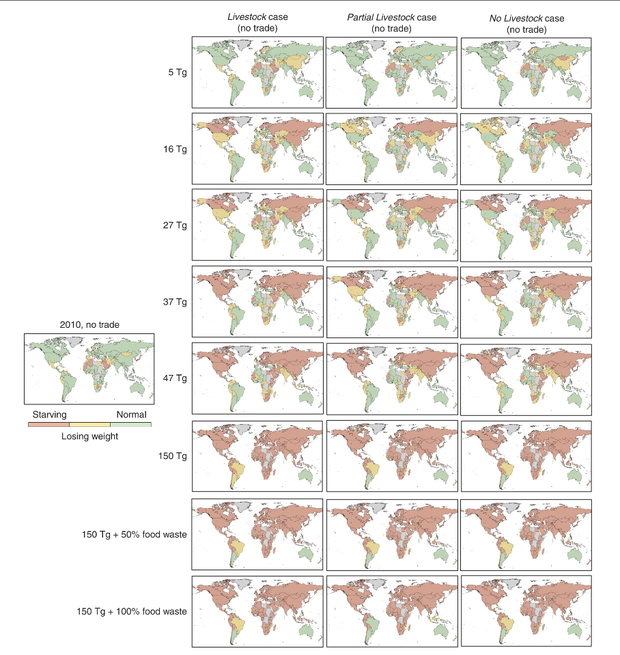
Even a relatively small nuclear conflict, such as one between India and Pakistan, would be devastating, researchers found. A week-long nuclear war involving about 100 weapons and the release of 5 Tg, about 11 billion pounds, of soot would kill 27 million people directly. The study said after two years, with international trade at a halt and a 34.7ºF temperature drop, the famine it creates would kill 255 million people, assuming that the rest of the population got the minimum food needed to survive, about 1,999 calories per capita per day.
The largest scenario examined, a week-long war involving 4,400 weapons and 150 Tg, or 330.6 billion pounds, of soot – such as one that would occur between the U.S., its allies and Russia – would kill 360 million people directly – and more than 5 billion from starvation, the study said. The density of the soot would reduce global temperatures by more than 58ºF. WATCH MOREU.N. asks for halt in fighting near Ukraine nuclear plant; bothsides blaming each other for attacks
“While amounts of soot injection into the stratosphere from the use of fewer nuclear weapons would have smaller global impacts,” researchers said in their article, “once a nuclear war starts, it may be very difficult to limit escalation.”
Using climate, crop and fishery models, researchers found that the climatic impacts of soot from nuclear war would peak in the first few years but last for about a decade.
In the worst-case scenario, when 150 Tg of soot is unleashed, the global average calorie production from crops would decline by about 90% just three to four years after the nuclear war, the study found.
“The changes would induce a catastrophic disruption of global food markets,” the study says, “as even a 7% global yield decline compared with the control simulation would exceed the largest anomaly ever recorded since the beginning of Food and Agricultural Organization (FAO) observational records in 1961.”
Lead author Lili Xia, a climate scientist at Rutgers University, told Nature that the situation would be “really bad.”
“A large percentage of the people will be starving,” they said.
Food intake (kcal per capita per day) in Year 2 after different nuclear war soot injections.NATURE FOOD
The findings are the result of looking at a range of scenarios. The scientists considered whether people would continue to farm animals or use any remaining crops to feed people instead. They also assumed that people would repurpose biofuel crops for human consumption, that food waste would be limited and that global food trade would halt as nations tried to save their own.
But not all nations of the world would face the same fate under the scenarios studied. Under the smallest nuclear war situation studied, researchers found that the Middle East, parts of Central America and parts of Asia would see some food deprivation to starving while most of the rest of the world would continue to have a normal food intake.
In the most extreme situation studied, every country aside from Australia, Argentina, Uruguay, Oman, Brazil, Paraguay and few others, would starve.
“The first time I showed my son the map, the first reaction he had is, ‘let’s move to Australia,'” Xia said.
Earlier this year, CBS News conducted a study that found 70% of adults are worried that Russia’s invasion of Ukraine could trigger nuclear conflict. Those findings emerged after Russia’s foreign minister said the risk of nuclear conflict “should not be underestimated.”
That fear has only been stoked throughout the year. In July, Iran said it has the technical capacity to build a nuclear weapon, though it said it hasn’t yet done so, and North Korean leader Kim Jong Un said he would use nuclear weapons in potential military conflicts with the U.S. and South Korea.
Nuclear weapons haven’t been used in a conflict since 1945, but currently, the U.S. and Russia have more than 1,500 nuclear weapons deployed and ready to fire.
Alex Wellerstein, historian and professor at the Stevens Institute of Technology, said that it’s not in the interests of U.S. enemies to get involved with such actions.
But, he said, it should still be a concern.
“Future problems are brewing,” he said. “I guarantee it.”
CBS Mornings’ Tony Dokoupil contributed to this story.





 (Courtesy: Tennessee Wildlife Resources Agency)Read More »
 (Courtesy: Tennessee Wildlife Resources Agency)
 (Courtesy: Tennessee Wildlife Resources Agency)
 (Courtesy: Tennessee Wildlife Resources Agency)