Will humans ever learn to speak whale?

https://www.livescience.com/can-humans-understand-whales.html

By Randyn Bartholomew – Live Science Contributor about 7 hours ago

What do those clicking sounds mean?

sperm whale in the ocean

What’s this sperm whale saying? (Image credit: Reinhard Dirscherl via Getty Images)

Sperm whales are among the loudest living animals on the planet, producing creaking, knocking and staccato clicking sounds to communicate with other whales that are a few feet to even a few hundred miles away. 

This symphony of patterned clicks, known as codas, might be sophisticated enough to qualify as a full-fledged language. But will humans ever understand what these cetaceans are saying?

The answer is maybe, but first researchers have to collect and analyze an unprecedented number of sperm whale communications, researchers told Live Science.

Related: Tale of 2 tails: Why do sharks and whales swim so differently?

With brains six times larger than ours, sperm whales (Physeter macrocephalus) have intricate social structures and spend much of their time socializing and exchanging codas. These messages can be as brief as 10 seconds, or last over half an hour. In fact, “The complexity and duration of whale vocalizations suggest that they are at least in principle capable of exhibiting a more complex grammar” than other nonhuman animals, according to an April 2021 paper about sperm whales posted to the preprint server arXiv.org. 

This paper, by a cross-disciplinary project known as CETI (Cetacean Translation Initiative), outlines a plan to decode sperm whale vocalizations, first by collecting recordings of sperm whales, and then by using machine learning to try to decode the sequences of clicks these fellow mammals use to communicate. CETI chose to study sperm whales over other whales because their clicks have an almost Morse code-like structure, which artificial intelligence (AI) might have an easier time analyzing.

Breaching the surface

The little that humans do know about sperm whales has all been learned quite recently. It was only in the 1950s that we noted they made sounds, and it wasn’t known that they were using those sounds to communicate until the 1970s, according to the new research posted by CETI.

This clicking appears to serve a dual purpose. Sperm whales can dive to depths of 4,000 feet (1,200 meters), or three times deeper than nuclear submarines, according to the Woods Holes Oceanographic Institution. Because it is pitch black at these depths, they have evolved to seek out squid and other marine creatures by using clicks for echolocation, a type of sonar. This same clicking mechanism is also used in their social vocalizations, although the communication clicks are more tightly packed, according to the CETI paper.

Figuring out even this much has been challenging, as sperm whales have “been so hard for humans to study for so many years,” David Gruber, a marine biologist and CETI project leader, told Live Science. But now, “we actually do have the tools to be able to look at this more in depth in a way that we haven’t been able to before.” Those tools include AI, robotics and drones, he said.

Pratyusha Sharma, a data science researcher for CETI and a doctoral candidate in the Computer Science and Artificial Intelligence Laboratory at MIT, told Live Science more about recent developments in artificial intelligence and language models, such as GPT-3, which uses deep learning to construct human-like text or stories on command, and last year took the AI community by storm. Scientists hope these same methods could be applied to the vocalizations of sperm whales, she said. The only problem: these methods have a voracious appetite for data.

The CETI project currently has recordings of about 100,000 sperm whale clicks, painstakingly gathered by marine biologists over many years, but the machine-learning algorithms might need somewhere in the vicinity of 4 billion. To bridge this gap, CETI is setting up numerous automated channels for collecting recordings from sperm whales. These include underwater microphones placed in waters frequented by sperm whales, microphones that can be dropped by eagle-eyed airborne drones as soon as they spot a pod of sperm whales congregating at the surface, and even robotic fish that can follow and listen to whales unobtrusively from a distance.

But even with all this data, will we be able to decipher it? Many of the machine-learning algorithms have found audio more difficult to analyze than text. For instance, it might be challenging to parse apart where one word begins and ends. As Sharma explained, “Suppose there’s a word ‘umbrella.’ Is ‘um’ the word or is it ‘umbrell’ or is it ‘umbrella’?” The barriers between spoken words are more ambiguous and less regular, and patterns may therefore require more data to suss out.

That’s not the only difficulty CETI will face. “Whether someone comes from let’s say Japan or from the U.S. or from wherever, the worlds we talk about are very similar; we talk about people, we talk about their actions,” Sharma said. “But the worlds these whales live in are very different, right? And the behaviors are very different.”RELATED MYSTERIES

How much of the ocean is whale pee (and worse)?

Why do whales beach themselves?

What’s the world’s largest whale?

What’s more, sperm whales are known to have dialects, according to a 2016 study in the journal Royal Society Open Science, which analyzed codas from nine sperm whale groups in the Caribbean for six years.

But these difficulties are also what make the project so worthwhile. What exactly one sperm whale says to another remains as dark and murky as the waters they swim in, but this mystery makes any answers CETI finds all the more intriguing. As Gruber put it, “We learn so much when we try to view the world from the perspective of the other.”

Originally published on Live Science.

Chicken Talk

By Karen Davis, PhD, President of United Poultry Concerns

© This article originally appeared in the Young Friends section of the July 1994 issue of Best Friends Magazine.

Our rooster, Glippie, sings on the roof of his house, adding to the music of the yard a steady, quiet trill. Living with chickens has made me realize how tuneful and talkative these fascinating birds are. The language of chickens is an essential part of their personalities and of their highly developed social life. Chickens start talking even before they are born.

Communication from inside the egg and after hatching

Peep! About twenty-four hours before a chick is ready to hatch, it starts peeping to notify its mother and siblings that it is ready to emerge from its shell. This activity, which biologists call “clicking,” helps to synchronize the hatching of the baby chicks. A communication network is established among the chicks, and between the chicks and their mother, who must stay calm and unruffled for as long as two days while all the peeping, sawing, and breaking of eggs goes on underneath her. Since some of the chicks may have aborted in the shell during incubation, the peeps inform her how long she needs to continue sitting on the nest.

chicken talk - peep

Peeps and clucks. As soon as all the eggs are hatched, the hungry mother and her brood go forth eagerly to eat, drink, scratch and explore. The chicks venture away from their mother, communicating back and forth all the while by peeps and clucks. The hen keeps track of her little ones by counting the peeps of each chick and noting the emotional tones of their voices. When a chick becomes separated from its mother, it gives a distress call, and the mother hen dashes out to find it and, if the chick is in danger, to deliver it-hopefully-from the hole in the ground, tangled foliage, or threatening predator.

Chicken talk when hens and roosters coordinate

Nesting calls. When a hen is ready to lay an egg, she gives a pre-laying, or nesting, call, inviting her mate to join her in finding a nest site.

Together, the hen and rooster find and create a nest by pulling and flinging around themselves twigs, feathers, hay, leaves and loose dirt, after they have scraped a depression with their beaks and feet. But first comes the search.

Primeval grumbling growls and gentle squawks. When the rooster finds a place he likes (under a log, perhaps), he settles into it and rocks from side to side, while turning in a slow circle and uttering primeval grumbling growls which may or may not convince the hen that this is the place. She may accept it, or they may look for another site. Throughout the search, the hen squawks gently with her beak open, followed by a series of short squawks of diminishing intensity, to keep the rooster coming back to her while she is away from the protection of the flock.

Egg cackles. Upon laying her egg, the hen gives out an egg cackle to announce her happy accomplishment. This brings the rooster quickly to her side, and together they rejoin the flock. To human ears, the egg cackle resembles the chicken’s cry of alarm, but to the birds there is a clear difference. A hen with chicks will continue feeding during the egg call, but will dart for cover when the alarm call goes out.

The “come over here” squawk. Often I have heard one of our hens call out to her rooster partner: “I’m all alone. Get over here!” Our normally quiet hen, Petal, raises a ruckus if her adored Jules is out of her sight for long, even if she has not just laid an egg. Her otherwise demure little voice becomes SQUAWK, SQUAWK, SQUAWK. Jules lifts his head up, straightens up, mutters to himself in what can only be described as Chicken Talk, and does an about-face. Off he goes to comfort Petal. Silence.

Chicken talk: Rooster communications

Cock-a-doodle-doo. Why do roosters crow? Remember that chickens are originally from the jungle. Their wild relatives have lived in tropical forests for tens of thousands of years. Perched in the trees, and sensitive to infrared light, roosters see morning light at least forty-five minutes before we do.

They also have very keen ears, a distinct advantage when living amid dense foliage. It can be difficult to see a predator and keep track of one’s flock when the sub-flocks are constantly moving from place to place while feeding. Through their crowing, every rooster can recognize the crow of at least thirty other roosters, probably more. As the protectors of the flock, roosters are always on the lookout.

chicken talk - rooster

A rooster’s crowing has been a muse behind many artistic works.

A shrill cry. If a rooster spots danger, he sends up a shrill cry. The other roosters echo the cry. Thereupon, the whole flock will often start up a loud, incessant, drumbeating chorus with all members facing the direction of the first alarm, or scattering for cover in the opposite direction.

chicken talk - peeps and clucks

All clear? All clear! When it looks safe again, an “all clear?” query goes out from the rooster, first one, followed by the others, in their various new places. Eventually, the “all clear’ crow is sent up by the bird who first raised the alarm, and a series of locator crows confirms where every other rooster and his sub-flock are at this point.

The “here’s food” song! The finding of food elicits another kind of vocal communication within the flock. Roosters love to find food and call their hens to the feast while they play deferential host at the banquet. The speed and intensity of the “here’s food” song varies according to the type of delicacy and the amount.

chicken talk - the here's food song

According to a biologist, “Two or three kernels of corn elicit about half the intensity and speed between song peaks that several bugs will be granted. When the hens hear this song they and the chicks come running to check out what the rooster has found to eat.” Soon the good news is excitedly clucked to everybody to come join the party. Hens call their chicks to food in a similar clucking voice.

Viva!

Soft trills and peeps. My first chicken was a crippled hen named Viva. She touched me deeply with her soft trills and peeps that seemed to come from somewhere in the center of her body, as her tail pulsed at precisely the same time.

The piping voice of woe. In addition to their other vocal language, chickens have a piping voice of woe and dreariness whenever they are bored or at a loose end.

Occasionally, one of our hens has to be kept indoors for a while, perhaps because she is recovering from an illness or because she is a newly rescued hen who has not yet joined the flock outside. Wearily, she will wander about the rooms, fretting, or tag disconsolately and beseechingly behind me, yawning and moaning like a soul in the last stages of ennui.

Viva. Photo by Karen Davis, June 1985

A huddle of peace and well-being. As boisterous as chickens often are in the resurgent dramas of their daily life, there is a stillness in them which includes singing, often at the end of a busy day as they settle down on their perches for the night.

The historian Page Smith says of the hen in The Chicken Book that she is “rich in comfortable sounds, chirps and chirrs, and, when she is a young pullet, a kind of sweet singing that is full of contentment when she is clustered together with her sisters and brothers in a huddle of peace and well-being, waiting for darkness to envelop them.”

______________________________________________________________________________

KAREN DAVIS, PhD is the President and Founder of United Poultry Concerns, a nonprofit organization that promotes the compassionate and respectful treatment of domestic fowl including a sanctuary for chickens in Virginia. She is the author of Prisoned Chickens, Poisoned Eggs: An Inside Look at the Modern Poultry Industry, More Than a Meal: The Turkey in History, Myth, Ritual, and Reality, The Holocaust and the Henmaid’s Tale: A Case for Comparing Atrocities and other groundbreaking publications.

Dr. Karen Davis United Poultry Concerns

______________________________________________________________________________

Introduction to the chicken talk article is by Manish M, 14-year old vegan activist from Trichy, Tamil Nadu and contributor at Vegan India! website.

______________________________________________________________________________

Image credits
 Cover: Image by Светлана Бердник from Pixabay 
 Peep!: Image by Pexels from Pixabay 
 Peeps and Clucks: Image by Sabine Löwer from Pixabay 
 Nesting calls: Photo by Sarah Halliday on Unsplash
 Egg crackles: Photo by Sheri Hooley on Unsplash
 The "come over here" squawk: Image by Ulrike Leone from Pixabay 
 Cock-a-doodle-doo.Image by Prettysleepy from Pixabay 
 All clear! Photo by Sarah Halliday on Unsplash
 Here’s food. Photo by Zosia Korcz on Unsplash 
 Huddle of peace. pixy.org

Study Finds that Cows Talk and Show Compassion Just Like Humans

STUDY FINDS THAT COWS TALK AND SHOW COMPASSION JUST LIKE HUMANS

cows talk

When we think of compassionate, intelligent creatures, cows normally don’t come to mind.

However, cows actually communicate how they feel to one another through their moos, according to a new study. The animals have individual vocal characteristics and change their pitch based on the emotion they’re feeling, according to research at the University of Sydney.

Alexandra Green, a Ph.D. student at the university and the study’s lead author, said:

“Cows are gregarious, social animals. In one sense it isn’t surprising they assert their individual identity throughout their life.”

She said it’s the first time they’ve been able to study voices to obtain evidence of this trait.

THE STUDIES ON THE COMMUNICATIONS BETWEEN COWS

Studying a herd of 18 Holstein-Friesian heifers over the course of five months, Alexandra found that the cows gave individual voice cues in different positive and negative situations. This behavior helps them communicate with the herd and express excitement, arousal, engagement, or distress.

Talking about the animals she studied, Ms. Green said:

“They have all got very distinct voices. Even without looking at them in the herd, I can tell which one is making a noise just based on her voice.”

She would record and study their “moos” to analyze their moods in various situations within the herd.

“It all relates back to their emotions and what they are feeling at the time,” she said.

adorable photos
Check out these adorable pics of babies and pets.

Previous research has discovered that cow moms and babies use their voices to communicate individuality.

However, this new study shows how cows keep their individual moos throughout their lives, even if they’re talking to themselves. The study found that the animals would speak to each other during mating periods, while waiting for or being denied food, and when being kept separate from one another.

The research analyzed 333 cow vocalizations and has been published in Scientific Reports.

“Ali’s research is truly inspired. It is like she is building a Google translate for cows,” said Cameron Clark, an associate professor at the university.

Ms. Green said she hoped this study would encourage farmers to “tune into the emotional state of their cattle, improving animal welfare.”

cows
Here are 16 vegan tofu recipes to try.

ANIMAL COMMUNICATIONS

Studies have shown that animals communicate with one another in similar ways to humans, taking turns in conversations. This is beneficial in the animal kingdom to communicate needs, such as where food sources are at or if the herd needs to move locations. It can also help animals communicate about an incoming threat so they can respond accordingly.

FINAL THOUGHTS ABOUT COWS COMMUNICATING

This research shows that animals are intelligent, sentient beings and deserve our respect. Vegetarianism and veganism are on the rise as people are waking up to how eliminating meat from our diets can positively impact health as well as show compassion to other living beings. Also, cows contribute greatly to greenhouse gas emissions, producing 37% of methane emissions resulting from human activity. One study showed that one cow, on average, produces between 70-120 kg of methane a year.

This is significant because across the globe, there are around 1.5 billion cattle. Many scientists are coming together to talk about how a plant-based diet could greatly help to slow down climate change.

For These Vampires, A Shared Blood Meal Lets ‘Friendship’ Take Flight

Common vampire bats (Desmodus rotundus), such as this group day-roosting in a cave in Mexico, can form cooperative, friendship-like social relationships.

B.G. Thomson/Science Source

Vampire bats might have a nasty reputation because of the way they ruthlessly drink their victims’ blood, but these bloodthirsty beasts can be both generous and loyal when it comes to their fellow bats.

Captive common vampire bats will share their food with hungry bat companions, and forge such a bond that they continue to hang out with these buddies once they’re released back to the wild, according to a newly published study in the journal Current Biology.

“Bats are very maligned, and vampire bats are the most maligned of the bats,” says Gerald Carter of The Ohio State University, who is also a research associate at the Smithsonian Tropical Research Institute in Panama. “What I study about them often makes people think about them in a more positive light.”

Common vampire bats don’t actually suck the blood of their victims, which are usually livestock like horses or cows. Instead, the bats make little cuts with their razor-sharp incisors and lap at the bleeding wounds.

Bats need to lap up about a tablespoon of blood every night, Carter says. If they miss two nights, these small bats get very weak, and missing three nights might mean death.

A desperate vampire bat, however, can find help in its home roost, where neighbors who did manage to drink blood are often willing to share food by regurgitating some of their last blood meal.

“The females will do this for their offspring, but they also do it for adults, including unrelated adults,” Carter says. “What’s particularly interesting about this species is these non-kin food donations.”

Carter has been studying this in captive bats for years. “We don’t need to train them to cooperate with each other,” he says. “We can just take a bat, deprive it of food for a while, put it back. And then see who is willing to share food with it. And we can just do this repeatedly over time.”

This research has shown that bats can develop social bonds with certain individual bats based on reciprocal food sharing.

“We could see that during the time the bats are in captivity that some of their relationships are getting stronger,” Carter says. “Almost certainly, there were some bats that were forming new relationships in captivity.”

He and his colleagues wondered if these social bonds were real or just something that emerged in the artificial environment of the lab because these bats were forced to hang together.

They decided to do an experiment using 23 female bats that had been captured from a large hollow tree. These bats, and their social connections, had been closely observed for nearly two years in captivity. Over that time, social grooming and food sharing increased within the group. The scientists tagged the bats with special sensors and released them back into the wild, along with a control group of 27 female bats from the wild that were also given sensors.

A team of researchers took common vampire bats (Desmodus rotundus) that had been in captivity and from the wild and tagged them with tiny sensors. The bats’ social interactions were then tracked for eight days.

Sherri and Brock Fenton

The sensors, lighter than a penny, were stuck onto the bats using surgical glue, says Simon Ripperger, a visiting scientist at the Museum of Natural History in Berlin. “They do not report the exact location,” Ripperger says. “They do report who they are with.”

Every two seconds, he explains, the sensors searched for the presence and relative proximity of all the other tagged bats. This information got sent to shoebox-sized recording stations located at the roost and at a known foraging site. Researchers tracked the bats, and their social interactions, for eight days.

The sensors, which were attached to the bats using surgical glue, could determine how close the tagged bats were to other tagged bats.

Simon Ripperger

What they found is that bats with strong histories of cooperation in the lab continued to spend time together out in the wild. “These relationships that have been forming in captivity, they seem to persist,” Ripperger says.

“The relationships are in the animals’ minds, and they’re not just a byproduct of the environment,” says Carter, who adds that other animals such dolphins, elephants and nonhuman primates also seem to have “complex individualized relationships” with others.

Whether to call these relationships “friendships,” though, is controversial.

“I’m very reluctant to use that word to describe it, and I don’t even like it when it’s in in quotes,” says Joan Silk of Arizona State University, who has studied social bonds in primates. “The bats can’t tell us how they feel, which is a really big problem in trying to figure out what’s going on with the animals. So do animals have friends? I think the answer is, I don’t know.”

Still, in nature, some creatures clearly can form social bonds based on mutual preferences of the individuals. “These strong social bonds play an important role in the lives of these bats and probably in the lives of many social animals,” Silk says.

“I think animals probably do integrate many experiences over time and build up a kind of ‘trust’ with different individuals,” Carter adds.

His research team has been expanding its tracking studies using the special sensors, also putting them on cows to see whether the tagged bats share the bloody wounds they make on these animals with other bats.

“This is a whole aspect of the behavior of vampire bats that people have just sort of looked at anecdotally,” Carter says. “That’s pretty exciting for us right now.”

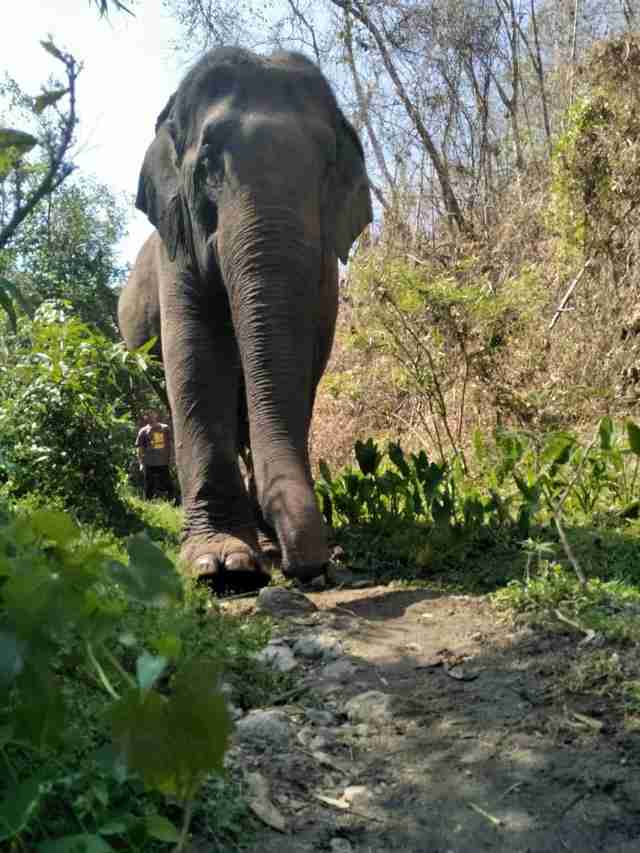
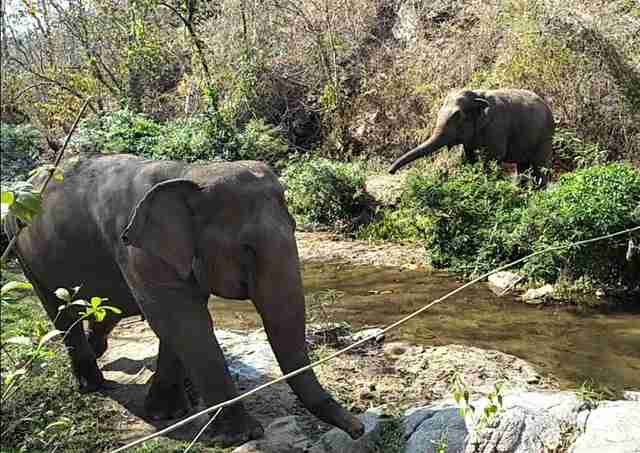
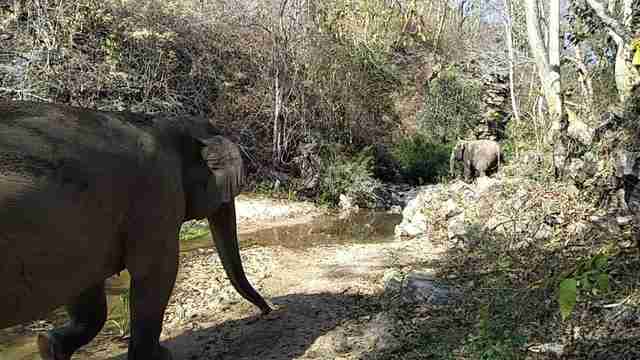
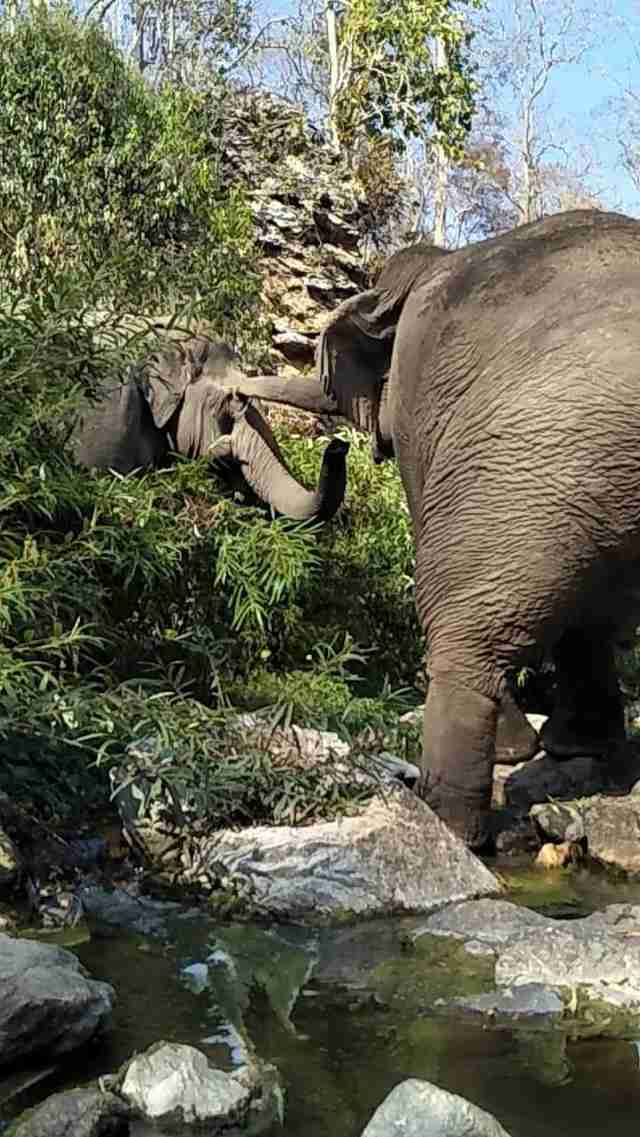
Rescued Elephant Immediately Snuggles With First Friend She Makes

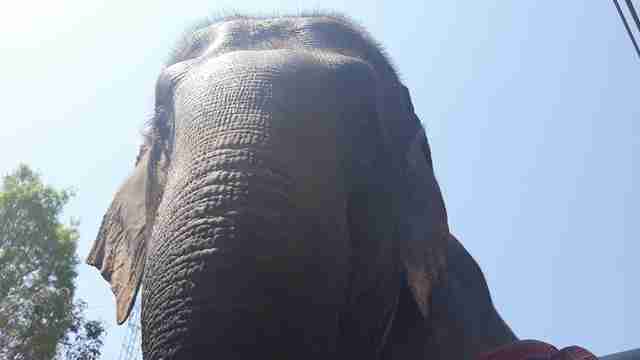
Retiring working elephant in Thailand
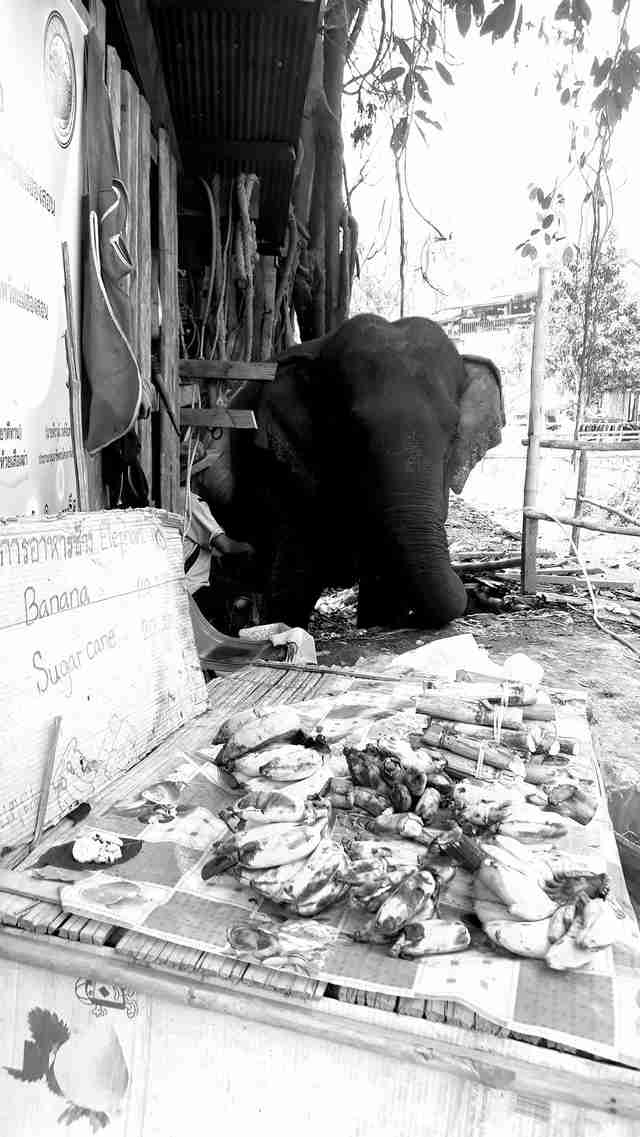
Elephant asking for food at bridge in Thailand
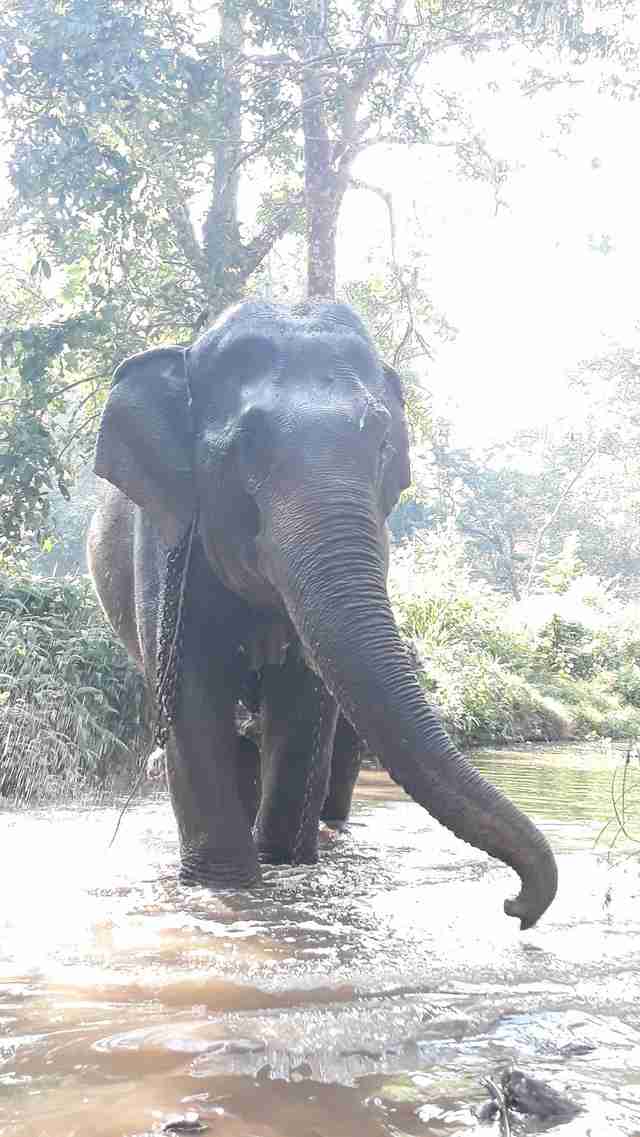
Elephant before retiring in Thailand
Retiring working elephant in Thailand
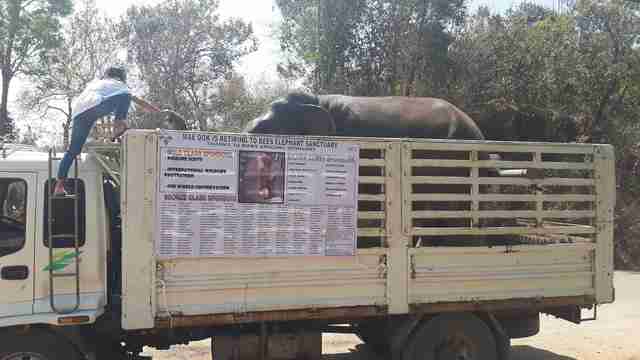
Retired elephant arriving at sanctuary
Retiring working elephant in Thailand meets first friend

Touching letter from the smartest gorrila Koko before passing away: “Man stupid”

http://feedytv.com/touching-letter-smartest-gorrila-koko-passing-away.html

Posted on 09-08-2018.

The smartest gorrila Koko in the world alerted human kind before the death.

Born in San Francisco Zoo in 1971, Koko began learning American Sign Language at the age of one, and, according to her trainers, was able to learn vocabulary at the same rate as a child with learning difficulties.

According to the Gorilla Foundation, Koko knows over 1,100 different signs, although many of these have been adapted in order to compensate for her inability to form the same complex hand shapes and movements as humans.

Koko has been filmed delivering a message to the humans of the world, encouraging them to become more conscious of their responsibility to protect the planet.

The message Koko wanted to send to human beings.

And she claimed that people should do something for nature right now or too late

Watch video:


Koko The Gorilla Dies; Redrew The Lines Of Animal-Human Communication

Koko, the gorilla who became an ambassador to the human world through her ability to communicate, has died. She’s seen here at age 4, telling psychologist Francine “Penny” Patterson (left) that she is hungry. In the center is June Monroe, an interpreter for the deaf at St. Luke’s Church, who helped teach Koko.

Bettmann Archive

“The Gorilla Foundation is sad to announce the passing of our beloved Koko,” the research center says, informing the world about the death of a gorilla who fascinated and elated millions of people with her facility for language.

Koko, who was 46, died in her sleep Tuesday morning, the Gorilla Foundation said. At birth, she was named Hanabi-ko — Japanese for “fireworks child,” because she was born at the San Francisco Zoo on the Fourth of July in 1971. She was a western lowland gorilla.

“Her impact has been profound and what she has taught us about the emotional capacity of gorillas and their cognitive abilities will continue to shape the world,” the Gorilla Foundation said.

Throughout her life, Koko’s abilities made headlines. After she began communicating with humans through American Sign Language, she was featured by National Geographic — and she took her own picture (in a mirror) for the magazine’s cover.

That cover came out in 1978, seven years after Koko was chosen as an infant to work on a language research project with the psychologist Francine “Penny” Patterson. In 1985, the magazine profiled the affectionate relationship between the gorilla and her kitten: Koko and All Ball.

In 2001, Koko made a fast friend in comedian Robin Williams, trying on his glasses, showing him around and getting him to tickle her. Then they made faces at each other — and the gorilla seemed to recall seeing Williams in a movie. Years later, in 2014, Koko was one of many who mourned Williams’ passing.

YouTube

Koko amazed scientists in 2012, when she showed she could learn to play the recorder. The feat revealed mental acuity but also, crucially, that primates can learn to intricately control their breathing — something that had been assumed to be beyond their abilities.

Her ability to interact with people made Koko an international celebrity. But she also revealed the depth and strength of a gorilla’s emotional life, sharing moments of glee and sadness with researchers Patterson and Ron Cohn.

As Barbara J. King wrote for NPR about the BBC documentary Koko: The Gorilla Who Talks, when it aired on PBS in 2016:

Famously, Koko felt quite sad in 1984 when her adopted kitten Ball was hit by a car and died. How do we know? Here is nonhuman primate grief mediated through language: In historical footage in the film, Patterson is seen asking Koko, “What happened to Ball?” In reply, Koko utters these signs in sequence: cat, cry, have-sorry, Koko-love. And then, after a pause, two more signs: unattention, visit me.”

YouTube

Now, it’s humanity’s turn to mourn Koko.

Thousands of people are commiserating on the Gorilla Foundation’s Facebook pageposting about Koko’s death. The top comment comes from Jess Cameron:

“Legit bawling like a baby right now. This news just breaks my heart. From an early age I was fascinated with Koko and she taught me so much about love, kindness, respect for animals, and our planet.”

With Koko’s passing, the Gorilla Foundation says it will honor her legacy, working on wildlife conservation in Africa, a great ape sanctuary in Maui, Hawaii, and a sign language app.

The foundation says those who want to share condolences can do so by emailing kokolove@koko.org.

Orca Learns to Say ‘Hello’

By Nathaniel Scharping | January 31, 2018 11:52 am
(Credit: By David Pruter/Shutterstock)

(Credit: David Pruter/Shutterstock)

“Hello!” says the human. “Hello!” pipes the orca right back.

It’s not a children’s movie, but an actual orca emitting human(ish) words. An international team of researchers has taught Wikie, a 14 year-old killer whale in France, to mimic certain simple bits of speech, a discovery that gives them insight into wild orca dialects.

Repeat After Me

In all, Wikie learned six words, in addition to five orca sounds that she didn’t know before. The phrases included “hello,” “ah ha,” “one, two,” “Amy,” and “bye, bye.” She even nailed a few on her first try, though one took as many as 17 attempts to get right. The researchers taught her to “speak” by using a “copy” command that she had learned previously, though it had always been used to indicate that she should imitate physical actions, not sounds.

Audio Player

In a paper published Wednesday in Proceedings of the Royal Society B, the researchers detail how they first refreshed her memory on the “copy” command, and then had her repeat sounds made by her three year-old calf Moana, before progressing to unfamiliar killer whale noises. When Wikie demonstrated her imitation abilities with those sounds, the researchers moved on to human words.

When asked to say both “hello” and “one, two, three,” Wikie was able to say the phrases right back on the first try. The other words gave her a little more trouble, though she was able to repeat them with some practice. Still, Wikie was better at producing some sounds than others, though the researchers were nevertheless impressed by her ability to make human sounds given that orcas’ vocal systems look very different than ours. When asked to repeat the sounds, there was a fair amount of variability in her vocalizations, something the researchers say could be due to the simple difficulty of producing the sounds or even different levels of motivation between sessions.

Audio Player

Say What?

After recording her speech, the researchers had six independent judges listen to Wikie’s vocalizations to confirm that she was imitating the human sounds well enough to be understood. While the sounds may be accurate, there’s no evidence that Wikie actually understands what any of it means. Instead, it’s simply a demonstration of orcas’ ability to learn and repeat new sounds, a skill that may be at the heart of some puzzling behavior observed in the wild.


Researchers have long tracked pods of killers whales by their dialects. Each pod produces unique calls, and this research reveals that these vocalizations are passed down through learning, rather than being a genetic trait. Researchers suspected this was the case, but hadn’t gathered enough evidence of orcas learning and mimicking sounds.

Some species, though not many, can learn to repeat human sounds. Belugas and bottlenose dolphins have been observed doing it, as well as elephants. How, and why they are able to do so varies, though the researchers do note that Wikie was producing the sounds in the open air, as opposed to under water as she normally would. This could add another layer of difficulty, though it also raises questions as to whether she would learn and repeat sounds differently underwater.

Coyotes howl to chat with their neighbors

http://www.sfchronicle.com/opinion/openforum/article/Coyotes-howl-to-chat-with-their-neighbors-12442786.php

December 19, 2017 Updated: December 19, 2017

A coyote. Photo: Christopher Gallello

A coyote.

Coyotes are more than an icon of the American West. They are probably your neighbors.

More and more people are routinely hearing coyotes yip, bark and howl in their backyards or in other urban and suburban settings. In fact, Canis latrans, the scientific name for coyotes, means “barking dog.”

When you watch coyotes throw their heads back and sing to their heart’s content, they seem to enjoy it. That was Marc’s impression when he and his students studied wild coyotes in the Grand Teton National Park for more than eight years. It’s fun, it feels good, so why not howl?

But what are they saying?

Researchers have identified around a dozen or so coyote vocalizations. Some coyote sounds are used to defend their territory and dens and to tell other coyotes they’re around, but some vocalizations give away much more information.

There’s little evidence that vocalizations are used to coordinate pack hunting. Some research shows the alpha, or high-ranking, males and females and pairs do most of the vocalizing.

Based on extensive and detailed research that involved recording and playing back howls and yips and observing the behavior of captive and free-ranging coyotes, wildlife researcher Philip Lehner 40 years ago placed coyote sounds into three general categories:

Greeting: Sounds include low-frequency whining, wow-oo-wowing (often called a greeting song), and group yip-howling (when reuniting and greeting).

Agonistic: These are vocalizations used during aggressive interactions and when coyotes display submission. They include woofing, growling, huffing (high-intensity threat), barking, bark-howling, yelping (submission and startle), and high-frequency whining (usually given by a subordinate coyote).

Contact: Sounds include lone howling (one of the most common vocalizations), group howling (when reuniting or in response to lone or group howls or yip howls), and group yip-howling (which may announce territory occupancy and may help regulate density of population).

Howling sounds can travel around 1,000 yards and can be used by coyotes to identify who’s calling, their gender and perhaps their mood. Transient coyotes don’t usually vocalize as much as resident animals in order to avoid interactions. Lone howls can also announce the location of an individual separated from their group.

One interesting and useful discovery is that humans aren’t very good at estimating how many coyotes are around by listening to their howls. Indeed, they usually overestimate the number of individuals actually present. So the melodious cacophony and symphony of sounds shouldn’t be used to claim that numerous coyotes are all over the place.

The more we understand all aspects of coyote behavior, the easier it will be to peacefully coexist with them. We should use what we know to protect them. State and local policies should embrace our understanding of coyote behavior.

We’re fortunate to share our homes with coyotes and other animals, and it’s important that we come to appreciate and understand the fascinating animals with whom we share our magnificent planet.

Marc Bekoff is professor emeritus of ecology and evolutionary biology at the University of Colorado, Boulder, and the author of the forthcoming “Canine Confidential: Why Dogs Do What They Do” (University of Chicago Press). Camilla Fox is founder and executive director of Project Coyote, a nonprofit organization that promotes compassionate conservation and coexistence of people and wildlife. Bekoff serves on the Project Coyote Science Advisory Board.

Can Prairie Dogs Talk?

Con Slobodchikoff and I approached the mountain meadow slowly, obliquely, softening our footfalls and conversing in whispers. It didn’t make much difference. Once we were within 50 feet of the clearing’s edge, the alarm sounded: short, shrill notes in rapid sequence, like rounds of sonic bullets.

We had just trespassed on a prairie-dog colony. A North American analogue to Africa’s meerkat, the prairie dog is trepidation incarnate. It lives in subterranean societies of neighboring burrows, surfacing to forage during the day and rarely venturing more than a few hundred feet from the center of town. The moment it detects a hawk, coyote, human or any other threat, it cries out to alert the cohort and takes appropriate evasive action. A prairie dog’s voice has about as much acoustic appeal as a chew toy. French explorers called the rodents petits chiens because they thought they sounded like incessantly yippy versions of their pets back home.

On this searing summer morning, Slobodchikoff had taken us to a tract of well-trodden wilderness on the grounds of the Museum of Northern Arizona in Flagstaff. Distressed squeaks flew from the grass, but the vegetation itself remained still; most of the prairie dogs had retreated underground. We continued along a dirt path bisecting the meadow, startling a prairie dog that was peering out of a burrow to our immediate right. It chirped at us a few times, then stared silently.

“Hello,” Slobodchikoff said, stooping a bit. A stout bald man with a scraggly white beard and wine-dark lips, Slobodchikoff speaks with a gentler and more lilting voice than you might expect. “Hi, guy. What do you think? Are we worth calling about? Hmm?”

Slobodchikoff, an emeritus professor of biology at Northern Arizona University, has been analyzing the sounds of prairie dogs for more than 30 years. Not long after he started, he learned that prairie dogs had distinct alarm calls for different predators. Around the same time, separate researchers found that a few other species had similar vocabularies of danger. What Slobodchikoff claimed to discover in the following decades, however, was extraordinary: Beyond identifying the type of predator, prairie-dog calls also specified its size, shape, color and speed; the animals could even combine the structural elements of their calls in novel ways to describe something they had never seen before. No scientist had ever put forward such a thorough guide to the native tongue of a wild species or discovered one so intricate. Prairie-dog communication is so complex, Slobodchikoff says — so expressive and rich in information — that it constitutes nothing less than language.

Continue reading the main story

That would be an audacious claim to make about even the most overtly intelligent species — say, a chimpanzee or a dolphin — let alone some kind of dirt hamster with a brain that barely weighs more than a grape. The majority of linguists and animal-communication experts maintain that language is restricted to a single species: ourselves. Perhaps because it is so ostensibly entwined with thought, with consciousness and our sense of self, language is the last bastion encircling human exceptionalism. To concede that we share language with other species is to finally and fully admit that we are different from other animals only in degrees not in kind. In many people’s minds, language is the “cardinal distinction between man and animal, a sheerly dividing line as abrupt and immovable as a cliff,” as Tom Wolfe argues in his book “The Kingdom of Speech,” published last year.

Slobodchikoff thinks that dividing line is an illusion. To him, the idea that a human might have a two-way conversation with another species, even a humble prairie dog, is not a pretense; it’s an inevitability. And the notion that animals of all kinds routinely engage in sophisticated discourse with one another — that the world’s ecosystems reverberate with elaborate animal idioms just waiting to be translated — is not Doctor Dolittle-inspired nonsense; it is fact.

Like “life” and “consciousness,” “language” is one of those words whose frequent and casual use papers over an epistemological chasm: No one really knows what language is or how it originated. At the center of this conundrum is a much-pondered question about the relationship between language and cognition more generally. Namely, did the mind create language or did language create the mind? Throughout history, philosophers, linguists and scientists have argued eloquently for each possibility. Some have contended that thought and conscious experience necessarily predate language and that language evolved later, as a way to share thoughts. Others have declared that language is the very marrow of consciousness, that the latter requires the former as a foundation.

In lieu of a precise definition for language, many experts and textbooks fall back on the work of the American linguist Charles Hockett, who in the 1950s and ’60s proposed a set of more than a dozen “design features” that characterize language, like semanticity — distinct sounds and symbols with specific meanings — and displacement, the ability to speak of things outside your immediate environment. He acknowledged that numerous animal-communication systems had at least some of these features but maintained that only human language boasted them all. For those who think that language is a prerequisite for consciousness, the unavoidable conclusion is that animals possess neither.

To many biologists and neuroscientists, however, this notion smacks of anthropocentrism. There is now a consensus that numerous species, including birds and mammals, as well as octopuses and honeybees, have some degree of consciousness, that is, a subjective experience of the world — they feel, think, remember, plan and in some cases possess a sense of self. In parallel, although few scientists are as ready as Slobodchikoff to proclaim the existence of nonhuman language, the idea that many species have language-like abilities, that animal communication is vastly more sophisticated than Hockett and his peers realized, is gaining credence. “It’s increasingly obvious just how much information is encoded in animal calls,” says Holly Root-Gutteridge, a bioacoustician at the University of Sussex. “There’s now a preponderance of evidence.”

In the 1990s, inspired in part by Slobodchikoff’s studies, the primatologist Klaus Zuberbühler began investigating monkey vocalizations in the dense and cacophonous forests of the Ivory Coast in Africa. Over the years, he and his colleagues discovered that adult male Campbell’s monkeys change the meaning of their screeches by combining distinct calls in specific sequences, adding or omitting an “oo” suffix. Krak exclusively warns of a leopard, but krak-oo is a generalized alarm call; isolated pairs of booms are a “Come this way!” command, but booms preceding krak-oos denote falling tree branches. Studies of songbirds have also uncovered similar complexity in their communication. Japanese great tits, for example, tell one another to scan for danger using one string of chirps and a different set of notes to encourage others to move closer to the caller. When researchers played the warning followed by the invitation, the birds combined the commands, approaching the speaker only after cautiously surveying the area. In the South Pacific, biologists have shown that humpback-whale songs are neither random nor innate: rather, migrating pods of humpback whales learn one another’s songs, which evolve over time and spread through the ocean in waves of “cultural revolution.” And baby bottlenose dolphins develop “signature whistles” that serve as their names in a kind of roll call among kin.

With the help of human tutors, some captive animals have developed especially impressive linguistic prowess. Dolphins have learned to mimic computer-generated whistles and use them as labels for objects like hoops and balls. A bonobo known as Kanzi communicates with a touch-screen displaying hundreds of lexigrams, occasionally combining the symbols with hand gestures to form simple phrases. And over the course of a 30-year research project, an African gray parrot named Alex learned to identify seven colors, five shapes, quantities up to eight and more than 50 objects; he could correctly pick out the number of, for instance, green wooden blocks on a tray with more than a dozen objects; he routinely said “no,” “come here” and “wanna go X” to get what he desired; and on occasion he spontaneously combined words from his growing vocabulary into descriptive phrases, like “yummy bread” for cake.

Slobodchikoff’s studies on prairie dogs have long hovered on the periphery of this burgeoning field. Unknown to Slobodchikoff, around the same time that he began recording prairie-dog alarm calls in Flagstaff, Peter Marler, the renowned animal-communication expert and one of Slobodchikoff’s former professors, was working on a similar study, one that would eventually redefine the field. In the spring of 1977, Marler sent Robert Seyfarth and Dorothy Cheney — a young husband-and-wife duo of primate scientists — to Amboseli, Kenya, to study the alarm calls of small silver-haired monkeys known as vervets. Earlier research had hinted that vervet monkeys produced different vocal warnings for different predators: a kind of bark to warn of a leopard; a low-pitched staccato rraup for a martial eagle; and a high-pitched chutter for a python. Seyfarth and Cheney decided to further investigate these findings in a controlled field experiment.

The two scientists hid a loudspeaker in the bushes near different groups of vervets and played recordings of their alarm calls, documenting the monkeys’ responses. Even in the absence of actual predators, the recordings evoked the appropriate escape strategies. Leopard-alarm calls sent monkeys scampering into the trees. When they heard eagle-alarm calls, they looked up and took cover in the bushes. In response to the warning for snakes, the primates reared up on their hind legs and scanned the ground. Contrary to the consensus of the time, the researchers argued that the sounds animals made were not always involuntary expressions of physiological states, like pain, hunger or excitement. Instead, some animals systematically used sounds as symbols. In both academia and the popular press, vervet monkeys became celebrated mascots for the language-like abilities of animals.

While the vervet research won acclaim, Slobodchikoff’s remained frustratingly sidelined. Marler, Seyfarth and Cheney worked for the well-staffed and moneyed Rockefeller University in New York; Slobodchikoff conducted his studies on a shoestring budget, compiling funds from the university’s biology department, very occasional grants and his own bank account. Slobodchikoff did not collect enough data to formally present his research at a conference until 1986. And it was not until 2006 that he published a study with the same kind of playback techniques that Cheney and Seyfarth used in Kenya, which are essential to demonstrating that an animal comprehends and exploits the variation in its calls. Although many scientists attended Slobodchikoff’s talks at conferences and spoke with him about his research in private, they rarely referenced his studies when publishing their own. And despite a few news stories and nature documentaries, prairie dogs have not secured a seat in public consciousness as a cognitively interesting species.

It did not take long for Slobodchikoff to master the basic vocabulary of Flagstaff’s native prairie dogs. Prairie-dog alarm calls are the vocal equivalent of wartime telegrams: concise, abrupt, stripped to essentials. On a typical research day, Slobodchikoff and three or four graduate students or local volunteers visited one of six prairie-dog colonies they had selected for observation in and around Flagstaff. They usually arrived in the predawn hours, before the creatures emerged from their slumber, and climbed into one of the observation towers they had constructed on the colonies: stilted plywood platforms 10 feet high, covered by tarps or burlap sacks with small openings for microphones and cameras. By waiting, watching and recording, Slobodchikoff soon learned to discriminate between “Hawk!” “Human!” and so on — a talent that he says anyone can develop with practice. And when he mapped out his recordings as sonograms, he could see clear distinctions in wavelength and amplitude among the different calls.

He also discovered consistent variations in how prairie dogs use their alarm calls to evade predators. When a human appeared, the first prairie dog to spot the intruder gave a sequence of barks, which sent a majority of clan members scurrying underground. When a hawk swooped into view, one or a few prairies dogs each gave a single bark and any animal in the flight path raced back to the burrow. (Slobodchikoff suspects that, because of a hawk’s speed, there’s little time for a more complex call.) The presence of a coyote inspired a chorus of alarm calls throughout the colony as prairie dogs ran to the lips of their burrows and waited to see what the canine would do next. When confronted with a domestic dog, however, prairie dogs stood upright wherever they were, squeaking and watching, presumably because tame, leashed dogs were generally, though not always, harmless.

Something in Slobodchikoff’s data troubled him, however. There was too much variation in the acoustic structure of alarm calls, much more than would be expected if their only purpose was to distinguish between types of predator. Slobodchikoff arranged for various dogs — a husky, a golden retriever, a Dalmatian and a cocker spaniel — to wander through a prairie-dog colony one at a time. The recorded alarm calls were still highly variable, even though the intruders all belonged to the same predator class. “That led me to think, What if they are actually describing physical features?” Slobodchikoff remembers. What if, instead of barking out nouns, prairie dogs were forming something closer to descriptive phrases?

To find out, he became a participant in his own experiment. Slobodchikoff and three colleagues paraded through two prairie-dog colonies dressed in either jeans and white lab coats, or jeans and variously colored shirts: blue, gray, orange, green. The prairie dogs produced highly similar alarm calls for each person in the lab coat, except for one especially short researcher. But they chirped in very different ways for most of the different colored shirts. In a related experiment, three slender women differing in height by just a bit meandered through a prairie-dog habitat dressed identically except for the color of their T-shirts. Again the animals varied their calls. And in another study, prairie dogs changed the rate of their chirping to reflect the speed of an approaching human.

If prairie dogs had sounds for color and speed, Slobodchikoff wondered, what else could they articulate? This time, he and his colleagues designed a more elaborate test. First they built plywood silhouettes of a coyote and a skunk, as well as a plywood oval (to confront the prairie dogs with something foreign), and painted the three shapes black. Then they strung a nylon cord between a tree and an observation tower, attached the plywood figures to slotted wheels on the cord and pulled them across the colony like pieces of laundry. Despite their lack of familiarity with these props, the prairie dogs did not respond to the cutouts with a single generalized “unknown threat” call. Rather, their warnings differed depending on the attributes of the object. They unanimously produced one alarm call for the coyote silhouette; a distinct warning for the skunk; and a third, entirely novel call for the oval. And in a follow-up study, prairie dogs consistently barked in distinct ways at small and large cardboard squares strung above the colony. Instead of relying on a fixed repertory of alarm calls, they were modifying their exclamations in the moment to create something new — a hallmark of language Hockett called “productivity.”

More: https://www.nytimes.com/2017/05/12/magazine/can-prairie-dogs-talk.html?_r=0