FISH-NL calls on federal government to reopen seal hunt

http://www.thetelegram.com/news/local/2017/3/21/fish-nl-calls-on-federal-government-to-reopen-seal-hunt.html

March 21, 2017

sealing-vessel-2059334.jpg

A sealing vessel moves along the edge of an icefield in the Gulf of St. Lawrence.

©TC Media file photo

Federation of Independent Sea Harvesters of Newfoundland and Labrador (FISH-NL) president Ryan Cleary says there’s no reason why the seal hunt shouldn’t be up and running again by this weekend.

In a news release on Monday evening, FISH-NL called on Ottawa to reopen the harp and hood seal hunt to all harvesters and all fleets in Newfoundland and Labrador by March 25.

The federal government closed the hunt on March 15 to allow time for seal whelping and nursing.

Sealers want to harvest the older seals for their meat and high fat content, but as more times passes, the animals lose their weight, according to the FISH-NL release.

“Word has it that the feds want to wait until after April 10 to reopen the hunt, but that means the sealers — many of whom are fish harvesters — will miss out on precious income, especially with so many fisheries on the downturn,” Cleary said.

Brad Rideout, owner of Phucolax International, a seal operation in Fleur de Lys with dozens of employees, said his business is looking for up to 5,000 animals immediately after March 25.

“Adult seals will still be in great shape then with the best meat and fat content,” Rideout said.

Seal oil is currently selling for $257 a barrel.

A reopening date was not given when the seal hunt was closed on March 15.

Let Outdated Attitudes Go Extinct

Text and Wildlife Photography ©Jim Robertson. All Rights Reserved

Text and Wildlife Photography ©Jim Robertson. All Rights Reserved

Some viewpoints need to go extinct, and the hate-speak espoused by Capt. Ron Malast in his opinion piece, “Let Steller sea lions go extinct,” is at the top of the list. So, the Steller sea lion population is starting to re-grow a little after the commercial seal trade, ruthless bounties and constant shooting as “competition” drove them, and just about every other pinniped species, to the brink of extinction.

The eastern pacific population of Steller sea lions may be up to 70,000 individuals now, but the human population of 7.2 billion grows by 350,000 per day. Let that sink in for a minute… 350,000 PER DAY!

350,000 is also the total number of all other great apes alive today—every chimpanzee, bonobo, gorilla and orangutan—combined. Why is that significant? Because scientifically speaking, that’s all we humans really are—just another species of ape, somewhere between chimps and gorillas. Homo sapiens share 98% of our DNA with Pan troglodytes, the chimpanzees.

But while seals and sea lions were evolving into self-sufficient sea mammals, adapting to pelagic life by perfecting the art of holding their breath for up to a half an hour and diving to depths of 600’ or more, human-types were busy developing a profoundly narcissistic sense of entitlement that took root early in Man’s prehistory. This feeling of privilege flourished as our species spread out and usurped every other species’ habitats and resources. From the mightiest bison of the plains to the flattest fish at the bottom of the ocean, we claimed the top of every food chain we could sink our teeth into.

The anthropogenic mass extinction following close on the heels of human’s surging population explosion already saw the end of the Steller sea cow and the Caribbean seal, both hunted to extinction in centuries past. Glibly calling for the extinction of wolves or Steller sea lions to snuff out the competition summons back an outdated attitude that should have long since been dead and buried.

EU court upholds seal fur ban!

524840_463568800387796_314270912_n
The EU’s three-year-old ban on seal fur will remain intact after the bloc’s highest court threw out a legal challenge by the Canadian Inuit and the country’s fur trade.
The case had been brought by Inuit community group, Inuit Tapiriit Kanatami (ITK), and the Fur Institute of Canada, with both organizations claiming that their livelihood depends on the trade.
Continuing reading here:
http://euobserver.com/economic/119959

5 Reasons Not to Eat Fish

Sea Lion Photo Copyright Jim Robertson

Sea Lion Photo Copyright Jim Robertson

5. Seals and sea lions are scapegoated and shot by commercial fishermen and their lackeys who blame the marine mammals for dwindling fish populations. It’s the same “all here for us” mentality that ranchers and trophy hunters use to justify killing wolves.


Painting by  Barry K. MacKay

Painting by Barry K. MacKay

4. Cormorants are culled by the thousands, by both commercial and sport fishing interests unwilling to share “their” resources. Last April, sport fishermen in South Carolina shot over 11,000 cormorants for the crime of eating fish; and the U.S. Government is currently planning $1.5 million-a-year program that would arm federal trappers with silenced rifles and night-vision scopes to shoot thousands of Columbia River cormorants during their nesting season .


Featured Image -- 62263. Live fish sequester carbon. The sea absorbs about half of the billions of tons of CO2 humans produce…, but only if there’s plenty of phytoplankton, fish and other organisms living in it.


imagesH3BR7A8G

2. Bykill, including pelagic sea birds, turtles, marine mammals, and non-target fish species, accounts for 50% or more of some fisheries’ take. Many fisheries around the world throw away more fish than they keep.


images1. Fish are sentient beings too, no less deserving of compassion than any other species humans claim as their food. Flying in the face of what is considered popular opinion, fish have good memories, build complicated structures and show behaviour seen in primates – as well as feel pain like any other vertebrates. 


When Humans are Gone, Who’ll be Around to Brand the Sea Lions?

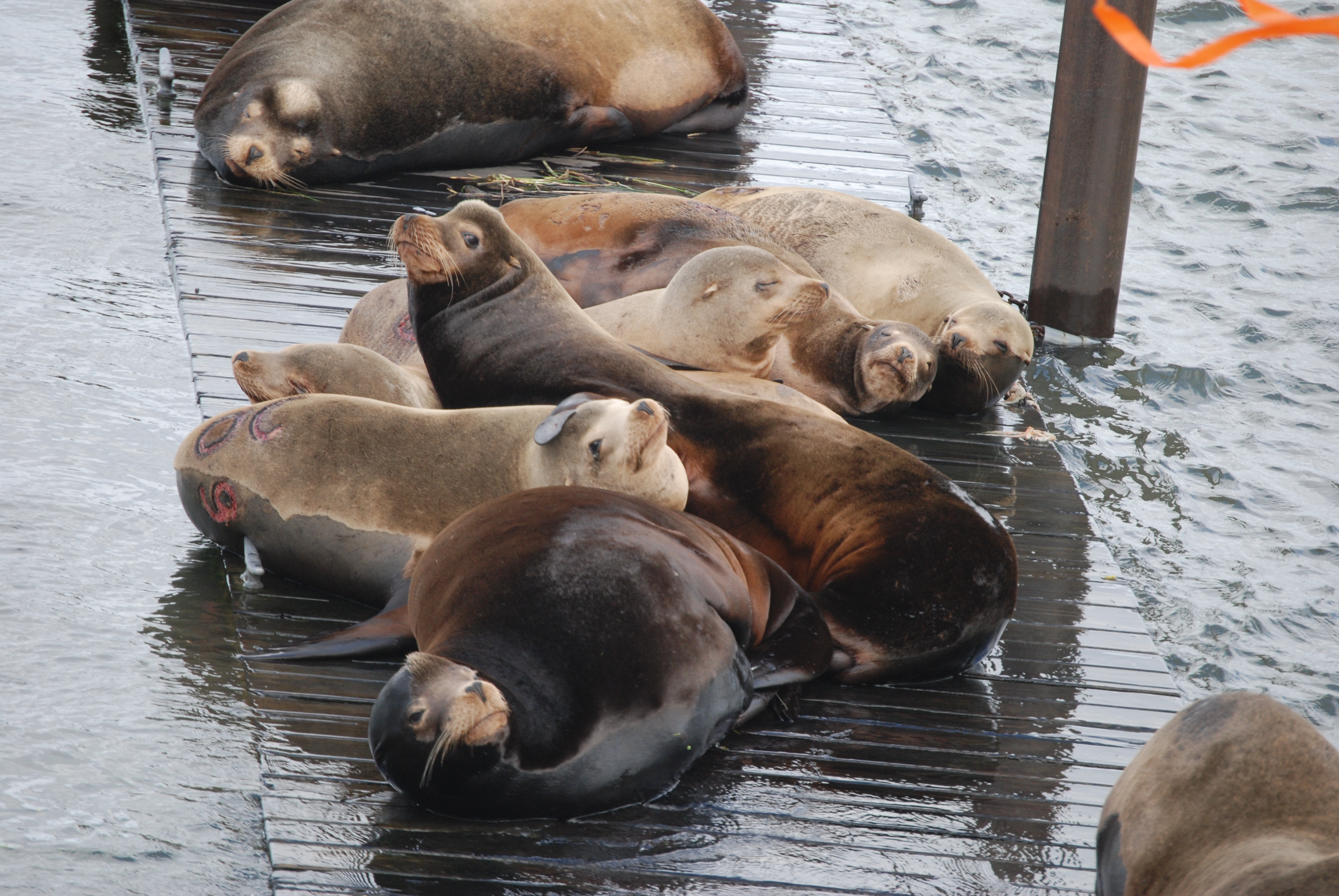
The hot iron is something right out of the Inquisition era. But while the Spanishlittleboyc09 Inquisition was a necessary evil to prevent heresy and extract confessions from witches, branding sea lions serves no real purpose. Oh sure, the modern day inquisitors will argue that the tortuous process helps them decide which individual sea lions are most responsible for the capital crime of eating salmon at the Bonneville dam upriver.

What you don’t hear them say is that sea lions have been eating fish for some 50 million years, ever since they left the land and evolved back into sea creatures. For the ensuing millennia, everyone got along just fine—until humans came by to fuck things up.

First, the humans strung nets and placed weirs out into the salmon’s migration path. Next they built canneries along the Columbia River; and while some people were busy killing off the salmon in droves, sealers murdered all the seals and sea lions and otters they could find, to fuel the booming, psychotic fur trade (for which the town of Astoria was first made famous). California sea lions were primarily rendered into oil by the equally-debased whaling industry.

The many dams built along the river were the coup de grace for any salmon still surviving the ever-advancing human onslaught. Not only do spawning salmon have to make it up past the massive new impediments, but warmer water behind the manmade reservoirs is hard on the young fish fry. And then there was the threat of the dam turbines…

Now, when a few sea lions are seen eating fish—as they’ve always done—they’re practically burned at the stake.

Text and Wildlife Photography© Jim Robertson

Text and Wildlife Photography© Jim Robertson

Violent Seal Killers Threaten Sea Shepherd UK Crew – Caught on Camera

[“The Scottish government issues companies such as the Scottish Wild Salmon Company with licenses to shoot seals, which they claim threaten fish stocks. However the legislation requires that seals may only ever be shot as a last resort after all other methods of control have been applied.”
Sound familiar? Just as the wolves are scapegoated for preying on elk, seals and sea lions are scapegoated for eating salmon. Yet another case of an overinflated sense of entitlement. 
This is a huge, worldwide problem for wildlife. Wherever there’s fish that humans want to exploit, the marine mammals pay the price for human greed.]


http://www.seashepherd.org/news-and-media/2014/04/21/violent-seal-killers-threaten-sea-shepherd-uk-crew-caught-on-camera-1576

Sea Shepherd crewmembers were being threatened with violence by the Scottish Wild Salmon Company’s seal killersSea Shepherd crewmembers were being threatened with violence by the Scottish Wild Salmon Company’s seal killers
Photo: Sea Shepherd UK
As predicted by Sea Shepherd on Good Friday, the killing team of the Scottish Wild Salmon Company escalated tensions in the Scottish seal killing grounds with an unprecedented attack on a member of Sea Shepherd UK’s campaign crew.

As residents of Gardenstown were preparing for breakfast on Easter Monday, Sea Shepherd crewmembers were already being threatened with violence by the Scottish Wild Salmon Company’s seal killers.

In a dramatic 8 a.m. confrontation which took place away from the Harbour in the town’s New Ground, three employees of the Scottish Wild Salmon Company, one carrying a rifle, cornered just one of our crewmembers, leaving him fearful of extreme violence.

The crewmember had the presence of mind to keep his camera running throughout, and the situation was saved when other members of the Sea Shepherd campaign crew arrived with their own cameras. Realizing that any further illegal acts on their part were being recorded, the thugs backed away and returned to their command base.

In a dramatic 8 a.m. confrontation which took place away from the Harbour in the town’s New Ground, three employees of the Scottish Wild Salmon Company, one carrying a rifle, cornered just one of our crewmembers, leaving him fearful of extreme violenceIn a dramatic confrontation, three employees of the Scottish Wild Salmon Company, cornered one of our crewmembers
Photo: Sea Shepherd UK
Sea Shepherd UK has now reported the situation and shown video footage to Police Scotland. Sea Shepherd UK is confident that charges can now be brought against the ringleader of the Scottish Wild Salmon Company’s out-of-control thugs.

Given the escalating situation, Sea Shepherd UK has now asked the Hunt Saboteurs Association to reactivate their undercover teams as well as introduce new covert operatives to the area. Other Sea Shepherd volunteers and specialist intervention teams are also now heading to Banffshire in order to defend Scottish seals from these violent people.

The Scottish government issues companies such as the Scottish Wild Salmon Company with licenses to shoot seals, which they claim threaten fish stocks. However the legislation requires that seals may only ever be shot as a last resort after all other methods of control have been applied. The actions of these companies themselves are drawing seals to the salmon. Seals in this area do not normally eat salmon, but when salmon netting companies trap wild fish in large numbers, it is only natural that the captured fish attract seals.  As we’ve seen with the sea lions on the Columbia River on the Oregon/Washington border here in the U.S., these animals are being targeted for the simple “crime” of eating fish. Moreover, the wild salmon that are heading up the coast are being caught by fishermen before they have a chance to spawn, so the fishing itself is killing this particular fishery and is therefore completely unsustainable.

The non-lethal solution is to deploy Acoustic Deterrent Devices (ADDs), which the Scottish Wild Salmon Company does have available to them.  Unfortunately, lethal bullets are cheaper than the non-lethal alternative, and so, without effective policing by Marine Scotland (the agency responsible for the seal killing licenses), it is left to Sea Shepherd to once again uphold national and international laws which governments neither can’t nor won’t enforce.

The Canadian government fantasy about the seal hunt is just not that widely shared

Canadian Blog

by Barry Kent MacKay,
Senior Program Associate

Born Free USA’s Canadian Representative

Barry is an artist, both with words and with paint. He has been associated with our organization for nearly three decades and is our go-to guy for any wildlife question. He knows his animals — especially birds — and the issues that affect them. His blogs will give you just the tip of his wildlife-knowledge iceberg, so be sure to stay and delve deeper into his Canadian Project articles. If you like wildlife and reading, Barry’s your man. (And we’re happy to have him as part of our team, too!)

Advice to Gail Shea and the Canadian Government: Here’s How to Impress the EU

The Canadian government fantasy is just not that widely shared

Published 04/18/14

You may wonder why I, a long time opponent of Canada’s east coast commercial seal hunt, would offer advice to those who fight people like me: the Canadian government. No fear. Anything not fitting the current Canadian government’s ideology is ignored, and yet I live in hope. Call it Canadian pride, or what is left of it, but I hate how we’re increasingly considered to be so backward and regressive on issues pertaining to the environment and animal welfare by so much of the rest of the world—including the European Union (EU), whose ban on the import of products from the east coast commercial seal hunt is opposed by Member of the Canadian Parliament, Gail Shea.

Recently, she was quoted as blaming the “the animal rights movement” for China’s apparent reticence to import products, claiming that we had “put a lot of pressure” on the Chinese. Think how that sounds in Europe or China. The so-called “animal rights movement,” whatever she thinks that may be, is supported by volunteered donations (not taxes), and has its hands full with multitudes of humanitarian and environmental concerns in China—from imports of endangered species through dwindling habitat for its own endangered fauna; to horrific zoo, fur, and livestock farm conditions; to a lack of laws providing animal protection; to the live skinning of dogs, cats, or other meat animals in street markets; to shark fin soup; to killer pollution that has caused birds to drop from the sky and marine life to go extinct; to there being virtually no local NGO (non-governmental organization) of its own dedicated to animal protection. And, compared to the resources available to the Government of Canada, what “pressure” do you think humanitarians have? Trade sanctions? Travel restrictions? Call in the ambassador? Mobilize military assets?

So, my first piece of advice to Shea and her colleagues: get real if you want the Europeans to take Canada seriously when it fights to lift the ban on products from the east coast commercial hunt. And to be fair, China is moving forward on environmental and animal protection issues, yes—but no western NGO influences China’s government policy.

Shea is fully in her right to claim that no “baby” seals are killed, but she should understand that, for it to be a truthful statement, a seal has to suddenly stop being a baby at about three weeks of age. But, redefining words does not change their meaning for the rest of the world.

The federal government (dominated by a party most Canadians did not vote for) has continually disgraced itself on many fronts, including the recently-announced (and ironically named) Fair Elections Act, which, if passed, will reduce the number of votes cast by citizens. (But, most foreigners don’t know about that sort of domestic issue.) However, because the issue is of global significance, they do know that former Minister of Natural Resources, Joe Oliver, referred to “environmental and other radical groups” as threatening “to hijack our regulatory system to achieve their radical ideological agenda.” Oh, the irony, coming from a government that has systematically cut funding to research that demonstrates the risk of over-fishing or global climate change. I’ve been a Canadian longer than the Prime Minister and have never seen a more ideological government—and part of the ideology is to ignore facts or expert opinion. It’s no wonder that the Conference Board of Canada ranked our environmental record 15th out of 17 industrial countries, with, a year later, Simon Frazer University ranking us 24th out of 25 Organization for Economic Co-operation and Development nations on environmental performance.

It is hard to reconcile the Canadian decision to contemptuously close, without a trace of consultation with the scientists affected, more than a dozen science libraries run by the Department of Fisheries and Oceans (DFO) and Environment Canada, including the then-newly refurbished, century-old St. Andrews Biological Station in New Brunswick—literally throwing hundreds of thousands of documents, including unpublished material with irretrievable baseline data, into dumpsters!

Just recently, Shea has made moves to reduce protection of breeding habitat of various fish stocks, and to ignore utterly scientific advice in order to support west coast salmon farming that puts native stocks at serious risk. In fact, there is a long history of bad decisions by a succession of fisheries ministers for both parties that have formed governments, resulting in numerous losses of valued fish stocks (but nothing like the anti-environmental fanaticism we now see). With such contempt for science, is it any wonder that claims that the commercial seal hunt is supported by “science” are taken with more than a grain of salt in Europe? People can judge for themselves by viewing video online, to which the government has responded by tabling a bill that would prevent observers from getting close enough to sealers to film how they do it. That’s just so typical. Never have I seen such opacity, such secrecy, and such contempt for openness and accountability as is displayed by this government.

In addressing the World Trade Organization, Leona Aglukkaq, Minister of the Environment (who once asked us to celebrate the killing of a polar bear), was miffed that the EU imported seals from Greenland. That’s because it’s an aboriginal hunt… but so is the hunt for seals in northern Canada, and products from it are also not banned: a point Canada ignores, to the detriment of northern “subsistence” sealers’ interests. They have a monopoly. Subsistence, yes, but Europeans know that trade with them is a function of European colonization. The real irony is that the Canadian government has continually ignored warnings about climate change that so profoundly puts northern traditions at risk from melting permafrost and diminishing ice, including the sea ice so essential to seals and polar bears.

It is ironic, too, that—again ignoring any science that shows that gray seals are not proved to be a threat to commercial fisheries (and could help them in their role as apex predators)—Canada claims that they should be culled, and claims that no seal is wasted, when there is no market. Again, the Europeans are informed on such matters.

Canada loves to mention foie gras, bullfights, and fox hunting as examples of European traditions equal to the seal hunt in cruelty. But, to compassionate (and logical) Europeans, two wrongs don’t make a right, and the fact is that the EU is far ahead of Canada in trying to set standards for increasingly humane treatment of animals. As the recent trial of Maple Lodge, our largest chicken producer, shows, we have a very long way to go. Meanwhile, the humane movement also fights these “traditions,” success dependent on public support. The trajectory, in Europe and many other regions, is forward, toward ever more animal welfare. Not so, sadly, here in Canada.
10264634_10152337495904586_9174164310757903244_n

Inuit use social media to post “sealfies,” standing beside freshly killed seals

http://www.cbc.ca/news/canada/north/humane-society-says-it-doesn-t-oppose-inuit-seal-hunt-1.2603306

Humane Society says it doesn’t oppose Inuit seal hunt

Donation to group by Ellen DeGeneres sparked #sealfie social media campaign

The Canadian Press Posted: Apr 08, 2014

Related Stories

Wildlife Photography © Jim Robertson

Wildlife Photography © Jim Robertson

A spokeswoman for the Canadian arm of the Humane Society International isclarifying the group’s position on the Inuit seal hunt, as a protest against TV star Ellen DeGeneres in the North gains support.

Rebecca Aldworth says recent reports on the protests are mixing up subsistence sealing in Canada’s North with the commercial hunt.

She says animal protection groups oppose commercial sealing in Atlantic Canada by non-aboriginal people.

Inuit in Nunavut have been engaged in a “sealfie” movement ever since DeGeneres took a celebrity selfie at the Oscars last month.

DeGeneres donated $1.5 million of the money raised by the star-studded picture to the Humane Society of the United States, an organization that fights seal hunting.

In response, Inuit are using social media to post pictures of themselves wearing sealskin clothes, standing beside freshly killed seals or looking forward to enjoying a seal meal.

“Commercial sealing advocates have long attempted to blur the lines between their globally condemned industry and the socially accepted Inuit subsistence hunt,” Aldworth said in a statement Tuesday.

“Unlike Inuit sealers, commercial sealers almost exclusively target baby seals who are less than three months old. Inuit hunters kill seals primarily for meat,” she said.

“Commercial sealers slaughter seal pups for their fur, dumping most of the carcasses at sea. Inuit sealers kill seals sporadically throughout the year, while commercial sealers often kill hundreds of thousands of seals in a matter of days or weeks.”

Inuit have long maintained that any opposition to the seal hunt, commercial or otherwise, harms Inuit by destroying the market for seal furs. That’s the reason Inuit launched a legal challenge against a European ban of seal products, even though that legislation included an exemption for seal products harvested by Inuit.

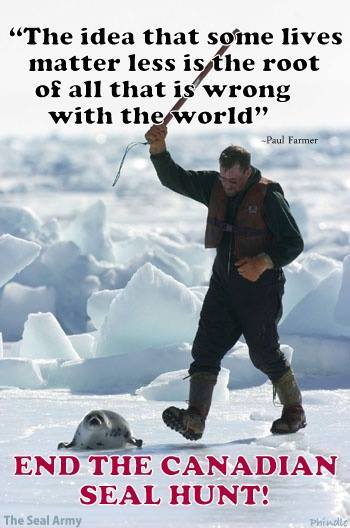
While it is true that most seals harvested in the commercial seal hunt are under three months old, all are independent animals. Hunting white coat baby seals has been outlawed in Canada since 1987.

To promote its own message, the Inuit land claims group Nunavut Tunngavik is supporting the sealfie movement and plans to operate a photo booth in its offices in Iqaluit this Thursday. It is also organizing a giant sealfie in Iqaluit on Friday afternoon.

The group says it wants to educate people about Nunavut’s sustainable and humane seal harvest.

During the Oscar broadcast on March 2, host, comedian and daytime TV star DeGeneres went into the audience and snapped a selfie that included luminaries such as Bradley Cooper, Meryl Streep and Kevin Spacey. Smartphone manufacturer Samsung, which made the phone DeGeneres used, promised to donate a dollar to charity for every time the photo was retweeted.

The selfie almost immediately crashed Twitter and became the most widely retweeted photo ever.

In statements on her website, DeGeneres, a vegan, calls the seal hunt “one of the most atrocious and inhumane acts against animals allowed by any government.”