Washington, DC—In defiance of a global moratorium on commercial whaling, Norway has again issued an annual kill quota of 1,278 minke whales for the 2021 whaling season.
On Friday, Odd Emil Ingebrigtsen, Norway’s Minister of Fisheries and Seafood, announced the quota, which remains unchanged from last year. Ingebrigtsen said he hopes the “upward trend in demand for whale meat will continue.”
Echoing Ingebrigtsen’s sentiment, the whaling industry claims that demand for whale meat has improved, especially during the COVID-19 pandemic. Yet, Norway has seen a continuous drop in domestic sales of whale meat in recent years. A survey commissioned by the Animal Welfare Institute (AWI) and others found that only 4 percent of Norwegians polled admitted to eating whale meat “often,” while two-thirds either have never eaten it or only did so “a long time ago.”
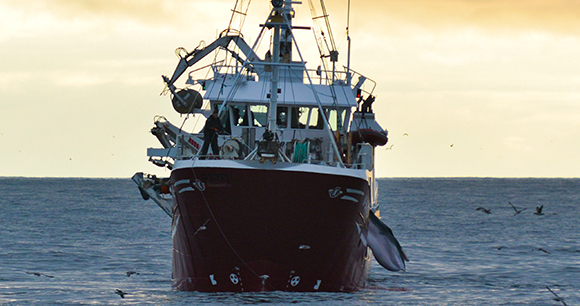
Norway’s 2020 whaling season ran from April 1 to September 30. Slightly more than 500 whales were killed, compared to 429 in 2019. This is the highest total since 2016, when nearly 600 whales were killed. Sixteen whaling vessels requested a permit to hunt whales last year, but only 13 participated.
Three whaling vessels were responsible for nearly two-thirds of the whales killed in 2020: the Kato (138 whales), the Reinebuen (102), and the Fiskebank1 (77). As in recent years, the vast majority of the minkes were killed in the Barents Sea (242) and off the coasts of Troms and Finnmark (176).
Last spring, the Norwegian Fisheries Directorate relaxed a number of whaling regulations to encourage additional vessels to engage in whaling. AWI joined with a number of other organizations in contesting the agency’s proposal — to no avail. The government also permitted whalers to forego qualifying tests for rifle shooting.
“Allowing whalers to skip these necessary tests is unacceptable, and could have serious repercussions for animal welfare,” said Kate O’Connell, AWI’s marine animal consultant. “Each year, dozens of whales who are shot by grenade-tipped harpoons do not die instantly; they must be shot by rifles to end their suffering.”
The International Whaling Commission (IWC) imposed a global moratorium on commercial whaling in 1982, yet Norway formally objected and resumed commercial whaling 11 years later. Since that time, the country has killed more than 14,000 minke whales.
In December, the Vestvågøy Fishing Association requested that the Norwegian government support the whaling industry in order to “make it more attractive to catch whales,” including offering whalers an increased cod quota.Media Contact
The islands see around 800 long-finned pilot whales killed every year as they often swim in close proximity to the shoresBy Akshay Pai Published on : 02:57 PST, Jul 19, 2020(Getty Images)
Animal rights activists have called for a ban of the Faroe Islands’ annual whale hunt, which they termed as an “insane blood sport” and which sees the waters turn a dark red as hundreds of the mammals are slaughtered.
The Grindadràp, which means slaughter in Faroese, has been practiced in the islands for more than a 1,000 years, as per some estimates, and involves the killing of schools of long-finned pilot whales that often swim in proximity to the islands’ shores.
The hunt involves the whales being surrounded by boats, who then drive them into a bay or to the bottom of a fjord, where they are killed by people lying in wait with knives. After the slaughter, the waters turn red, with pictures of the same shared around the world in recent times as calls to ban the “cruel” and “unnecessary” practice have increased in recent years.
It initially appeared as if the Grindadràp would not go ahead this year because of the coronavirus pandemic, but AFP reported that the hunt began this week with the killing of around 300 of the mammals.
Concern had been raised about fisherman proximity after the territory, located in the North Atlantic between Norway and Iceland and comprising of 18 islands, had logged 188 cases of Covid-19 despite having a population of just 55,000. However, on July 7, Fisheries Minister Jacob Vestergaard gave his approval for the hunt on the condition that people avoid large gatherings.
The Grindadrap is more than a 1,000 years old (Hulton Archive/Getty Images)
NGO Sea Shepherd, a non-profit marine conversation organization based in Washington state, said 250 long-finned pilot whales and some Atlantic white-sided dolphins were killed on Wednesday, July 15, off Hvalba, a village on the southernmost island of Suduroy.
“252 long-finned pilot whales and 35 Atlantic white-sided dolphins were killed in Hvalba last night after the huge pod was found off Sandvik,” they said in a statement. “This is the first organized Grindadràp hunt of 2020 with the meat from the hunt distributed first to the approximately 70 hunt participants from the boats and those killing on the beach – and then the remainder to villages on Suðuroy with all recipients then free to sell their share of the meat if they so wish.”
Sea Shepherd successfully managed to disrupt the hunt in 2014 but has since been banned from Faroese waters after legislation was passed to authorize Danish military vessels to stop them with force.
ORCA, another non-profit environmental conservation organization dedicated to protecting marine life, similarly condemned the practice and called it an “insane blood sport.”
“To the beautiful family of pilot whales that were brutally murdered in the Danish #FaroeIslands, we are so deeply sorry… We will keep fighting to end this insane blood sport. RIP beautiful family…” they tweeted. “Please Boycott the Faroe Islands! #GrindStop #Denmark #StopKillingWhales”
The Faroese have repeatedly defended the hunt by stating that it is sustainable since they catch just 800 whales out of the 100,000 that call the islands their home. But concerns have been raised about how these whales are killed.
Alastair Ward, a Cambridge University student who photographed the event in 2018, told the BBC that the hunt was not carried out humanely. “The squealing from the whales was horrible. They were putting hooks on ropes in their blowholes to pull them in and then hacking at them with knives,” he said. “They didn’t die in a very humane way.”If you have a news scoop or an interesting story for us, please reach out at (323) 421-7514
Bryan Adam often speaks about animal issues (Photo: Instagram/Bryan Adams)
Vegan musician and photographer Bryan Adams says killing animals for food is ‘f*cking up the planet’.
The rock icon made the statement in a recent Instagram post.
He shared an image of himself wearing a T-shirt saying ‘please stop killing whales’, and accompanied it with a caption talking about what he described as the ‘magnificent giants’.
‘F*cking up the planet’
“Just the fact that this T-shirt has to get printed blows my mind. I remember the save the whales campaign from the 1970s,” Adams wrote.
“Even after years of people campaigning to stop whaling, there are still countries that persist like Japan, St Vincent/Bequia, the Faroe Islands and Norway that consider it acceptable to kill these magnificent giants.
“There’s no need for it, despite any cultural or aboriginal claims of sustainability. The future is recognizing that killing animals for food is fucking up the planet.”
Vegan advocate
Adams, a longtime vegan advocate, has previously spoken out about the benefits of a plant-based diet for human health, the environment, and for animals.
“Being sympathetic to animal rights is just something that came very naturally to me,” he once told vegan charity PETA. “Perhaps because I used to have dogs growing up, and you know they became part of the family. And it never occurred to me growing up. I never put the whole thing of animal cruelty and that together as a youngster.
From today, Japan’s whalers are officially permitted to hunt and kill whales following Tokyo’s controversial decision to quit an international ban on commercial whaling. The move triggered upset among environmentalists worldwide.
According to a government decision announced last year, Tokyo is leaving the International Whaling Commission (IWC), which placed a ban on commercial hunting of the endangered species back in 1986. The withdrawal came into effect on June 30. This means that, from that day, Japanese whalers will be able to resume the killing of whales for meat. However, Japan will be restricted to hunting the mammals only in its exclusive economic zone and territorial waters.
ALSO ON RT.COM122 pregnant whales among the 300+ killed by Japan for ‘science’Tokyo’s withdrawal from the IWC takes effect right after the world leaders’ G20 Summit in Osaka. In an open letter published Friday, a number of environmentalist and global welfare organizations urged G20 leaders to condemn Japan’s “cruel assault on whales” and called for an “an immediate end to all commercial whaling.”
“Japan leaving the IWC and defying international law to pursue its commercial whaling ambitions is renegade, retrograde and myopic….” Kitty Block, president of Humane Society International, one of the contributors to the letter, said in a statement.
Whaling is a sensitive issue in Japan, where eating whale meat is a cherished cultural tradition. Japan is not the first country to resume commercial whaling – Iceland and Norway are also openly against the IWC’s ban as well.
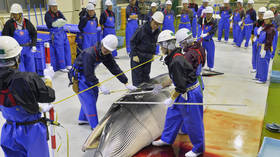
In this photo taken on Sunday, Jan. 5, 2014. three dead minke whales lie on the deck of the Japanese whaling vessel Nisshin Maru.
TIM WATTERS
Peter Singer is an author and professor of bioethics at Princeton University, Laureate Professor at the University of Melbourne and founder of the non-profit organization The Life You Can Save.
On Dec. 26, Japan announced that it was leaving the International Whaling Commission (IWC). Yoshihide Suga, Japan’s chief cabinet secretary, emphasized the cultural significance of the whaling industry for local Japanese communities and said that the IWC had focused too much on conserving whales and not on its stated goal of developing a sustainable whaling industry.
That the IWC has ceased to act in accordance with its original purpose is difficult to deny. The IWC was set up by the International Convention for the Regulation of Whaling, which was agreed to in 1946. The preamble of the convention describes whale stocks as “great natural resources” and indicates that the purpose of the convention is “to provide for the proper conservation of whale stocks and thus make possible the orderly development of the whaling industry.”
That is how the IWC operated for its first 25 years. From the 1970s on, however, attitudes toward whales began to change. Many governments that had previously been members of the IWC because they engaged in whaling and wanted to protect these “resources” from unsustainable overuse instead began to reflect the more positive attitudes to whales of their citizens. As a result, in 1986, the IWC passed a moratorium on commercial whaling, which has been maintained ever since, even though it is today difficult to argue that all stocks of all species of whales are so imperilled that no commercial hunting could be sustainable.
Japan has not openly breached the moratorium; instead, it has got around it by exploiting a loophole allowing the killing of whales for scientific research. Each year, Japanese whaling ships have killed about 300 whales, allegedly for this purpose. The carcasses of the whales were taken to Japan and their meat was sold to the dwindling minority of Japanese who continue to eat whale meat.
In 2010, Australia took Japan to the International Court of Justice, which found that Japan was in fact engaging in commercial whaling, in breach of IWC rules. But Japan simply tweaked the “research program” a little, and went back to killing the same number of whales it had been killing before.
The IWC’s change of purpose was made clear just last September, when at a meeting in Florianopolis, Brazil, member countries voted 40 to 27 for a Brazilian proposal to maintain the ban on commercial whaling, and assert that whaling is no longer a necessary economic activity. For Japan, which sees maintaining its whaling industry as a matter of national pride, that vote would have been the final straw that made continued membership of the IWC pointless.
What we cannot disregard, however, is the fact that the new attitude to whales that has led to the change in the IWC’s purpose is neither a purely emotional response to killing mysterious big animals nor the imposition of Western attitudes on other cultures. It has a solid basis in our improved scientific understanding of whales, and in the moral progress we are making in extending the circle of moral concern beyond our own species. That concern is very much in accord with Japan’s own Buddhist tradition, which teaches compassion for all sentient beings.
We have learned a lot about whales since 1946, We know that they are social mammals with big brains, capable of communicating with each other by various sounds. They bond with their children and with their social group. They live long lives – bowhead whales live much longer than any other mammal; some have been found with 200-year-old ivory spear tips embedded in their flesh. Many other whales live at least 40 years. They appear to be capable of both pleasure and pain – and not only physical pain, but very likely also distress at the loss of a child or one of their group.
Whales are therefore not stocks in the sense in which we as a country may have stocks of coal. Nor are they resources to be harvested like a field of wheat. They are individual beings, with lives of their own that may go well or badly.
In modern commercial whaling, whales are killed by an explosive harpoon fired from a moving vessel at a moving target. That makes it very difficult to hit the whale in the right spot for an instantaneous loss of consciousness. Nor are commercial whalers willing to use enough explosive to be sure of a quick kill, because they want an intact whale carcass, not one blown to bits. Hence harpooned whales typically die slowly and painfully. If we needed to eat whales to survive, inflicting that kind of death on a sensitive social mammal might be defensible. For well-fed people in Japan or other affluent countries, it is not.
Nor is the fact that there are areas of Japan in which whaling is an ancient cultural heritage a sufficient justification for killing whales. In China, the binding of girls’ feet was an ancient cultural heritage, but it maimed women. We should be glad that it is now firmly in the past. Whaling should go the same way.
And perhaps it will. Once Japan leaves the IWC, it will no longer be able to continue whaling in the Southern Ocean under the guise of “scientific research.” Recognizing this fact, Japan has said it will carry out commercial whaling only in its territorial waters and exclusive economic zone (EEZ), which means, roughly speaking, an area of 4.5-million square kilometres around its territory. That’s a large area, but it contains far fewer whales than the Southern Ocean, and if Japan wants to have a sustainable industry, that will place strict limits on the number of whales its ships can kill.
Perhaps instead of feeling dismay at Japan’s departure from the IWC, we should celebrate the fact that the Southern Ocean Whale Sanctuary, established by the IWC in 1994, will now be the true sanctuary for whales that it never could be while Japanese ships were conducting their brutal “scientific research.”
In leaving the IWC, Japan has put itself on the outside, as a nation that is oblivious to the legitimate moral concern of many countries and people, including, as polls in Japan show, its own people. The next generation of Japanese leaders will surely see this as a false step that they will want to reverse.
Japan is proposing a slew of rule changes at the International Whaling Commission (IWC) meeting in Florianópolis, Brazil this week that conservationists worry would ultimately lift a 1986 moratorium on commercial whaling.
Other commercial whalers include Norway, which has killed more than 14,000 minke whales, and Iceland, which has killed nearly 1,800 whales in defiance of the moratorium, according to the report.
Previous reports have revealed that the Japanese government has an ultimate goal to resume commercial whaling, even though most of its citizens no longer eat whales. Whaling proponents say that hunting the mammals is part of their culture.
Hideki Moronuki, Japan’s senior fisheries negotiator and commissioner for the IWC, told the BBC that the country is pushing for the “the sustainable use of whales.”
Among its proposals, Japan wants to set up a “Sustainable Whaling Committee” which would create catch-quotas for nations wishing to allow their citizens to hunt healthy whale populations for commercial purposes, according to AFP.
Japan, which says minke and other whale stocks have recovered, will propose setting new catch quotas for species whose stocks are recognized as healthy by the IWC scientific committee.
Japan is also seeking to lower the proportion of votes required to set rule changes to a simple majority of the 89-member IWC, rather than three-quarters.
IWC meeting host Brazil is trying to rally other anti-whaling nations, such ads the European Union, Australia and New Zealand, to sign the “Florianópolis Declaration” that states commercial whaling is a no longer economically necessary and would allow the recovery of all whale populations to pre-industrial whaling levels, according to AFP.
Conservation groups have highlighted significant welfare concerns regarding “inhumane” time to death (TTD) rates after the whales are caught.
Whalers typically use an exploding harpoon to try to kill the animal “instantly”—defined by the IWC as within 10 seconds of being shot.
However, the report from EIA and AWI found that the hunted whales have suffered up to 25 minutes before dying:
Iceland’s TTD data in 2014 claimed that 42 died “instantly” while eight whales had to be shot a second time and their median TTD was eight minutes.
Norway recently collected TTD data for 271 minke whales. The median TTD for the 49 whales not registered as instantaneous deaths was six minutes. One whale had to be shot twice, taking 20-25 minutes to die.
Japan’s minke whales taken in the offshore North Pacific hunt take an average of two minutes to die, while those in the coastal hunt take over five minutes. Antarctic minkes take an average of 1.8 minutes to die.
Whaling opponents are urging the IWC to reaffirm its international moratorium on commercial whaling.
“If Japan gets its way, it would be a massive victory for those rogue whalers who have time and again defied the international ban on commercial whaling and an absolute disaster for the world’s whales,” said Clare Perry, EIA’s Ocean Campaigns leader in a statement received by EcoWatch.
“Many whale species have not yet recovered from massive overhunting in the past, and they are also facing a wide array of mounting existential threats ranging from climate change to marine pollution by chemicals, plastics and noise,” Perry added.
Kate O’Connell, marine wildlife consultant for the Animal Welfare Institute had similar sentiments.
“We’re only just beginning to grasp the vital role whales play in maintaining the health of the world’s oceans,” O’Connell said. “Weakening the ban now would be a fatal mistake, and would open the doors to increased commercial whaling around the world. This cruel and unnecessary industry is a relic of the past that has no place in modern society.”
“All other contracting governments to the IWC must step up to vigorously defend the moratorium from this new assault by Japan and its allies,” O’Connell concluded.
a prominent animal rights group has expressed outrage at Japan’s
controversial whaling program after it emerged that more than 120 pregnant
whales were slaughtered last year during the country’s annual hunt in the
Antarctic Ocean.
Latest figures show that 333 minke Antarctic whales were killed last
summer, 181 of which were females and 122 of which were pregnant.
The annual summer hunt, which lasted 143 days, killed 61 immature males and
53 immature females or 114 in total, according to meeting papers from the
International Whaling Commission’s scientific committee.
Humane Society International senior program manager Alexia Wellbelove
criticized the “cruelty of Japan’s whale hunt.”
A Minke whale is trussed to the side of the Japanese whale hunter Kyo Maru
in this image from 1995 as the boat heads for the factory ship Nisshin Maru
in the Antarctic whale sanctuary. Japan is under fire after it emerged that
it had killed over 120 pregnant whales in the summer of 2017.REUTERS
Japan says the hunting is for scientific research which it describes as
“biological sampling” that allows examination of the Antarctic marine
ecosystem. Whale is allowed to be sold in Japanese food markets.
Harpoons loaded with a grenade are used to target one or two whales in a
school and the carcass is then taken to the Japanese research vessel
Nisshin Maru where the contents of the animal’s stomachs, body parts and
skull are examined.
In November, video showed the brutality of a Japanese whale hunt in an
Australian whale sanctuary, which was only released after five years, after
the Australian government feared that it would harm ties between Canberra
and Tokyo.
The Japanese Embassy has not yet commented and Tokyo insists its program is
carried out “in accordance with the International Convention for Regulation
of Whaling.”
Japan says it will hunt about 4000 whales over the next decade.
Australia’s shadow minister for the environment Tony Burke called on his
country’s government to stop the annual hunt.
“There is nothing scientific about harpooning a pregnant whale, chopping it
up and putting it on a plate. Japan’s position on this is absurd and the
Australian government must not be silent,” he said.
My objection to hunting, trapping and seal clubbing is colorblind as well as culture-blind. I oppose cruelty to animals, no matter who is doing the shooting, trapping or clubbing. A victim doesn’t suffer any less because of the ethnicity or cultural beliefs of their executioner. An animal’s right to a life, free from harm, trumps anyone’s right to exploit or kill them.
Originally posted on
Over the weekend I received the following question, which I’ll attempt to answer below…
Q:
Dear Mr. Robertson,
I was wondering your opinion on the subject of animal rights vs. the rights of indigenous people. What do you think about hunting by Native American tribes, or the hunting of seals by the Inuit? Also, of course, the various other tribes around the world that have their culture based off of hunting. What do you think about their participation in hunting, trapping, etc?
A:
Hmmm, one of those questions…one of those I-wouldn’t-touch-that-with-a-ten-foot-pole kind of questions. Do I risk being called a hypocrite, or “culturally elite?” I could spend all day tip-toeing around this—tap-dancing on egg shells—but here’s an answer just off the top of my head:
My objection to hunting, trapping and seal clubbing is colorblind as well as culture-blind. I oppose cruelty to animals, no matter who is doing the shooting, trapping or clubbing. A victim doesn’t suffer any less because of the ethnicity or cultural beliefs of their executioner. An animal’s right to a life, free from harm, trumps anyone’s right to exploit or kill them (unless someone is literally starving to death and has no other options, which is not the case for most who hunt, trap, club seals, harpoon whales or trade in bushmeat).
Why oppose the Japanese or the Faeroese for slaughtering dolphins or pilot whales and not the Makah for killing grey whales, or even the Inuit for hunting bowhead whales? We’re all part of the species, Homo sapiens, and our ancestors all used to live by hunting and trapping. For better or worse, we’re all moving forward technologically, so there’s no reason we shouldn’t all move forward in our treatment of non-human animals.
That’s my humble opinion, anyway. It might not be popular, but it’s ethically consistent.
For all of the people who hate me, criticize me, loathe me, troll me, threaten me and generally carry on like I really give a damn, all I can say is thanks for taking your time to say so. It is much appreciated.
Sometimes you’re amusing, but most of the time you’re simply boring. But it’s no bother, because I have this simple delete button and a cyber dungeon to conveniently drop your ass into the internet version of the phantom zone, where for all intents and purposes you simply no longer exist on my particular plane of existence.
However I must confess that I do love the fact that so many people get all hot and bothered and spend time talking, complaining, ranting, sharing and even going to the trouble of setting up websites and Facebook pages simply to attack me. How awesome and flattering is that!
People I don’t know and have never met, hate me and I think that’s pretty damn impressive.
I considerate it a disappointing day when I don’t receive at least one hate message. It’s good to know that they know that I’m still here, pissing them off.
A person without enemies is a person who does not do much. Give me a person without enemies and I can guarantee few people really know or care who they are.
All great people have enemies. Mahatma Gandhi, Nelson Mandela, Martin Luther King Jr., Dianne Fossey, John Kennedy, Malala Yousafzai, Russell Means, and so many others including even Jesus Christ. I can only aspire to have the number of enemies they have had. In fact the more enemies one has, the more one achieves. Everyone needs a legion of enemies to inspire them to greater and better deeds and to validate their achievements.
I am not in the business of pleasing everyone. In fact I’m not in the business of pleasing anyone. I’m in the business of defending biodiversity from the irresponsible actions of my own species and that guarantees me volumes of enemies.
I pick up enemies like a dog picks up fleas except that I can shake them off easier than the dog.
If I can please my wife, my daughter, my son, my family, supporters, and my friends, I’m happy. Everyone else is irrelevant.
Even allies become enemies at the slightest disagreement. The infighting within movements is hilarious, like when the People’s Front for the Liberation of Judea attacked the Judaean People’s Liberation Front in Life of Brian.
We really can be a silly assortment species of primates.
I often wonder if a person who sends me a vile or threatening message imagines the said message as being hurtful or damaging to me. Do they really think that I shed a tear with each word? Do they really think I care what they think? I suppose it’s a good thing if they feel a sense of satisfaction with the illusionary belief that they are threatening me. If they deprive some sort of pleasure from it, all I can say, is go for it and enjoy yourself.
Now although I don’t care what people say about me or to me, I am posting this really to help people who are sensitive to attacks from perfect strangers in the internet. It is easy for me to ignore bullying because I simply don’t give a damn but there are people, especially younger people who are indeed hurt by comments from strangers and sometimes such bullying has disturbing and sometimes tragic consequences.
So I would like to advise such people to treat offensive and threatening comments as nothing more than a momentary fart in a windstorm. You may get a whiff but the stench is gone in seconds. People only have power over other people when people allow other people to have power over them.
So my advice to anyone plagued by trolls, haters and critics is simple. Ignore them, block them and delete them. They and their opinions simply do not matter.
Words are not bullets. Words are harmless.
Hell even being called names can be flattering. Years ago I was at the home of a famous Hollywood personality when the phone rang. I picked it up and a familiar voice said “is Maurice there?”
I said no but would you like to leave a message. The voice answered, “yes tell him Orson called.”
“Orson who”” I replied.
“Orson Welles, you idiot.”
Was I offended? Hell no. Orson Welles called me an idiot because I did not recognize his voice. How awesome was that?



 (Getty Images)

/arc-anglerfish-tgam-prod-tgam.s3.amazonaws.com/public/JU5NB6XAQNBDBFTN26BEAKZDJY.JPG)



 Exposing the Big Game