Exposing the Big Game

Forget Hunters' Feeble Rationalizations and Trust Your Gut Feelings: Making Sport of Killing Is Not Healthy Human Behavior

Exposing the Big Game

2 more dead gray whales are found in Alaska, bringing the year’s toll to 75 along the US West Coast

By Jay Croft, CNN
water next to the ocean: POINT REYES STATION, CALIFORNIA - MAY 23: A dead Gray Whale sits on the beach at Limantour Beach on May 23, 2019 in Point Reyes Station, California. A thirteenth Gray Whale washed up dead on a San Francisco Bay Area beach as scientists try to figure what is killing the whales. Dozens of Gray Whales have been found dead along the Pacific Coast between California and Washington since the beginning of the year. (Photo by Justin Sullivan/Getty Images)© Justin Sullivan/Getty Images North America/Getty Images POINT REYES STATION, CALIFORNIA – MAY 23: A dead Gray Whale sits on the beach at Limantour Beach on May 23, 2019 in Point Reyes Station, California. A thirteenth Gray Whale washed up dead on a San Francisco Bay Area beach as scientists try to figure what is killing the whales. Dozens of Gray Whales have been found dead along the Pacific Coast between California and Washington since the beginning of the year. (Photo by Justin Sullivan/Getty Images)Two more gray whales were found dead this week in Alaska amid the mysterious surge of deaths within the species this year along the US West Coast, CNN affiliate KTUU reports.
 

That makes seven in Alaska and at least 75 total, in what the National Oceanic and Atmospheric Administration calls an “unusual mortality event,” the station reports.

https://www.msn.com/en-us/news/us/2-more-dead-gray-whales-are-found-in-alaska-bringing-the-years-toll-to-75-along-the-us-west-coast/ar-AACAhWi?ocid=spartandhp

One of the two found near Kodiak Island in the Gulf of Alaska showed signs of killer whale “predation,” KTUU reports.

Two more were discovered this week off Washington state.

Last month, ocean scientists said they were worried about the death rate, the highest in almost two decades. Some of the mammals were underweight, which may mean they could not find enough food in the water, a possible result of climate change, NOAA spokesman Michael Milstein said.

In all of last year, 45 gray whales were found onshore, NOAA said.

Gray whales do most of their eating during summers in the Arctic and migrate to spend half the year in Mexico.

They can reach 90,000 pounds. The species was endangered until 1994.

Should polar bear hunting be legal?

As hunters target bigger polar bears for their luxurious pelts, one researcher fears we are reversing natural selection.

Countries around the world agree that polar bears are in trouble: They’re considered threatened in the United States, of special concern in Canada, and vulnerable internationally. Yet in much of their icy habitat, it’s perfectly legal to pick up a gun and shoot one.

In Canada, home to nearly two-thirds of the world’s estimated 25,000 remaining polar bears, the animals are hunted both for their meat and for their thick, furry white pelts. The Canadian government and conservation groups alike have long held that polar bear hunting in Canada is sustainable. But in his new book, Polar Bears and Humans, Ole Liodden, a Norwegian polar bear researcher, argues that it’s not.

For decades, Canada has been the main hunting ground for polar bears. The Canadian government sometimes makes recommendations on how to hunt sustainably—for example, harvesting two males for every female—but Canada’s provincial and territorial governments establish their own annual hunting quotas.

Canada, home to nearly two-thirds of the world’s polar bears, is where most hunting occurs.

PHOTOGRAPH BY PAUL NICKLEN, NAT GEO IMAGE COLLECTION

Liodden believes that rationale is flawed because the polar bears in highest demand for the commercial pelt trade are the largest males—the strongest and healthiest animals. By removing those bears from the population, he says, hunters perpetuate what he calls “reverse selection”—the idea that instead of survival of the fittest, it’s survival of the weakest.

Polar bears use sea ice platforms to hunt for seals when they surface for air. But, Liodden says, as our warming planet melts more sea ice, perpetuation of the species may rest with the strongest bears—those that can swim farther, hunt better, or go longer without food.

By removing the biggest, healthiest bears from the population, researcher Ole Liodden worries that hunters perpetuate what he calls “reverse selection”—the idea that instead of survival of the fittest, it’s survival of the weakest.

Counting polar bears and assessing how well they’re doing is expensive and difficult. Of the 19 subpopulations that make up the worldwide estimate of 25,000 by the International Union for the Conservation of Nature (IUCN), the global authority on the conservation status of wild animals and plants, data on the number of bears, their health, or both are lacking for at least 10 of those populations. So it’s not surprising that experts disagree on the greatest threats facing polar bears.

Eric Regehr, a member of the IUCN’s polar bear specialist group, says “unequivocally” that climate change is their greatest threat. Iverson is more measured, saying that climate change could become a problem for polar bears in the future but that at present “the overall polar bear population in Canada is healthy.”

According to Iverson, evidence amassed over three decades shows that Canada’s hunting quota “is not endangering polar bears.” And because populations are assessed and quotas are adjusted every few years, future quotas will account for the effects of climate change. “It’s something that we have mechanisms in place to course correct, if in a given subpopulation there’s a concern.”

Drikus Gissing, director of wildlife management for Nunavut, Canada’s northernmost territory, agrees. He says that each subpopulation is evaluated by the relevant provincial or territorial government every five to 15 years and that hunt quotas are adjusted accordingly based on the best, most current research. “We can’t manage based on what might happen 50 years from now … If sea ice completely disappears in certain areas, the bears will disappear with it … We can’t change the ecosystem to accommodate those animals.”

“Like a Ferrari in your garage”

According to Liodden, between 1963 and 2016, an average of 991 bears were hunted worldwide every year, totaling about 53,500 bears. He calls that number “crazy high,” given how many polar bears are believed to be left and how slow they are to reproduce.

As the largest supplier of polar bear skins, Canada exports hundreds each year, which Liodden says often carpet customers’ floors or are mounted on the wall as the “ultimate status symbol … It’s like to have a Ferrari car in your garage … It’s an item you can have that not many other people have.”

Customers pay thousands of dollars for polar bear wall mounts or rugs as “the ultimate status symbol,” says researcher Ole Liodden.

PHOTOGRAPH BY OLE J LIODDEN

“It’s a status symbol, there’s no doubt about it,” says Calvin Kania, owner of FurCanada, a Canada-based company that sells polar bear rugs and taxidermied bears. “It’s no different than wearing a diamond or wearing a sable fur coat.” Customers pay thousands of dollars for a single pelt. Kania says his prices for a polar bear rug peaked between 2013 and 2015 at about $20,000 but that prices have since dropped to between $12,000 and $15,000 as demand has declined.

For decades, Japan had a big appetite for polar bear skins, but demand there fell during the mid-2000s after the Japanese economy crashed. In 2008, imports into the United States—formerly another major market for skins—became illegal after polar bears were listed as threatened under the Endangered Species Act.

Now it’s China: Between 2006 and 2010, the country imported 467 polar bear skins, but between 2011 and 2015, the number more than doubled, to 1,175, accounting for about 70 percent of Canada’s exports, according to Liodden.

In Liodden’s view, subsistence hunting—for meat and clothing—can be managed sustainably, but commercial trade is too risky and should be banned. “The market will always push for highest price and more killing,” he says.

“Endangered species should not be the subject of profit-driven commercial trade.”

ZAK SMITH, SENIOR ATTORNEY WITH THE NATURAL RESOURCES DEFENSE COUNCIL

Allowing commercial trade creates a system “inherently susceptible to corruption,” says Zak Smith, a senior attorney with the Natural Resources Defense Council, an international environmental advocacy group. Trading polar bear parts could influence the quota-setting process, he says, allowing the potential for profit to affect how many animals can be hunted in a given year. “This is a species that is threatened with extinction,” he adds. “Endangered species should not be the subject of profit-driven commercial trade.”

Lily Peacock, a former polar bear research and management biologist for Nunavut, says the indigenous Inuit in the upper reaches of Canada have hunted and eaten polar bears for thousands of years. Hunting should be regulated and studied, she says, but focusing on hunting—or even overhunting—ignores “the huge elephant in the room … In general, climate change is such a bigger issue than harvest, that it’s like, why take away part of someone’s culture?”

Jim Goudie is an Inuit. He’s also the deputy minister of land and natural resources for Nunatsiavut, a self-governing Inuit region. He says that when polar bears are in trouble, his people will be the first to sound the alarm—not researchers from far-off universities. “For me, if there’s no polar bears tomorrow, it’s part of my culture that just disappeared … We will be the ones to tell the world if we think there’s an issue with polar bear. We have the most to lose.”

“Just too many bears”

Nunavut’s Drikus Gissing says the situation for polar bears isn’t as dire as some make it out to be. With about 13,000 bears, he says, Nunavut, where more than 80 percent of Canada’s polar bear hunting takes place, now has more bears than ever before.

Bears and people sometimes cross paths disastrously: Last year two Nunavut men were mauled to death. One was unarmed. “We’re at a stage now where polar bears are basically overabundant,” Gissing says. “There are just too many bears.”

Indeed, shootings of so-called “problem bears” (animals killed in defense of life and property) have spiked during the past two decades, Liodden notes, up from 13 killings in 1999 to 91 in 2012—a 600 percent increase.

Nikita Ovsyanikov, a Russian behavioral ecologist and member of the IUCN’s polar bear specialist group, says that more sightings of bears doesn’t necessarily mean there are more bears but that the animals are losing sea ice and spending more time on land. “When we see many polar bears around us or close to us, close to our settlements and infrastructures in the Arctic, it is not an indication that polar bear numbers are increasing,” he says. “It is an indication that they’re in trouble.”

The IUCN’s Regehr says the claim that bears are encroaching more on humans because of sea ice losses may have validity, but it’s also a convenient explanation in the absence of precise numbers for the various bear populations. “It’s hard to know how many gophers are in your backyard,” he says. Similarly, “to count polar bears in an area of sea ice the size of Texas, I mean, that’s incredibly difficult and expensive.”

Looking to Svalbard

Liodden considers Svalbard, an archipelago between Norway and the North Pole, to be a model for the future. That’s because, despite its location on the Barents Sea, which has lost more than 50 percent of its ice since the 1980s, Svalbard’s polar bears are stable. Their numbers were estimated at 241 in 2004 and at 264 in 2015. The difference between Svalbard and other polar bear habitats, he says, is that hunting has been banned there since 1973.

Because polar bears depend on sea ice for hunting, some scientists say global warming is their greatest threat.

PHOTOGRAPH BY OLE J LIODDEN

Péter Molnár, a University of Toronto Scarborough researcher who forecasts the effects of climate change on polar bears, agrees that Liodden’s reverse selection theory is plausible. In western Hudson Bay, he says, there’s “clear evidence” that the bears are getting thinner as sea ice disappears. Polar bears rely on fat and protein reserves because they fast for months at a time, so when it comes to size, “the fatter your bear is, the better.” And, Liodden says, fatter, bigger bears are the ones hunters seek.

But according to Regehr, just because a polar bear is bigger or younger, it doesn’t mean it’s more fit. Studies have indeed shown that polar bears are getting smaller because of sea ice loss, but, he posits, it’s possible that smaller bears that don’t need to eat as much to survive may actually be better off.

For Molnár, though, the question is: “Can polar bears adapt to any of this?”

Recent estimates by U.S. Geological Survey scientists predict that because of melting sea ice, up to two-thirds of all polar bears will be lost by 2050. Even if polar bears are still around at the end of the century, Molnár says, that’s four or five generations at most, which is not enough time to evolve, whether it’s in response to climate change, hunting, or other threats.

“It doesn’t look like they’re going to be around for very much longer in most populations,” he says. “We have very strong evidence that these declines will just get worse as the climate changes. Unless we’re turning things around on that front, it’s a pretty grim and predetermined outcome.”

US warns China, Russia over Arctic amid environmental shifts

U.S. Secretary of State Mike Pompeo says the Trump administration is moving to assert America’s presence in the Arctic. He’s warning China and Russia that the U.S. won’t stand for aggressive moves into the region that’s rapidly opening up to development and commerce as temperatures warm and sea ice melts.

Pompeo says in a speech in Finland that the U.S. will compete for influence in the Arctic and counter attempts to make it the strategic preserve of any one or two nations. He says rule of law must prevail for the Arctic to remain peaceful.

The speech comes a day before Pompeo attends a meeting of the Arctic Council at a time of profound shifts in the region’s environment and widespread criticism of the Trump administration’s skepticism of climate change

Climate change made the Arctic greener. Now parts of it are turning brown.

Warming trends bring more insects, extreme weather and wildfires that wipe out plants

BY
7:00AM, APRIL 11, 2019
Alaska landscape

TUNDRA IN TROUBLE  In southern Alaska in 2012, geometrid moths and other insects heavily defoliated alder bushes and other shrubs (brown patches in this aerial photo).

The Chugach people of southern Alaska’s Kenai Peninsula have picked berries for generations. Tart blueberries and sweet, raspberry-like salmonberries — an Alaska favorite — are baked into pies and boiled into jams. But in the summer of 2009, the bushes stayed brown and the berries never came.

For three more years, harvests failed. “It hit the communities very hard,” says Nathan Lojewski, the forestry manager for Chugachmiut, a nonprofit tribal consortium for seven villages in the Chugach region.

The berry bushes had been ravaged by caterpillars of geometrid moths — the Bruce spanworm (Operophtera bruceata) and the autumnal moth (Epirrita autumnata). The insects had laid their eggs in the fall, and as soon as the leaf buds began growing in the spring, the eggs hatched and the inchworms nibbled the stalks bare.

Chugach elders had no traditional knowledge of an outbreak on this scale in the region, even though the insects were known in Alaska. “These berries were incredibly important. There would have been a story, something in the oral history,” Lojewski says. “As far as the tribe was concerned, this had not happened before.”

At the peak of the multiyear outbreak, the caterpillars climbed from the berry bushes into trees. The pests munched through foliage from Port Graham, at the tip of the Kenai Peninsula, to Wasilla, north of Anchorage, about 300 kilometers away. In summer, thick brown-gray layers of denuded willows, alders and birches lined the mountainsides above stretches of Sitka spruce.

Salmonberries are widely harvested during the summer in southern Alaska’s coastal regions. The shrubs have been hit hard by moth damage in recent years. 

 CINDY HOPKINS/ALAMY STOCK PHOTO

Two summers ago, almost a decade after the first infestation, the moths returned. “We got a few berries, but not as many as we used to,” says Chugach elder Ephim Moonin Sr., whose house in the village of Nanwalek is flanked by tall salmonberry bushes. “Last year, again, there were hardly any berries.”For more than 35 years, satellites circling the Arctic have detected a “greening” trend in Earth’s northernmost landscapes. Scientists have attributed this verdant flush to more vigorous plant growth and a longer growing season, propelled by higher temperatures that come with climate change. But recently, satellites have been picking up a decline in tundra greenness in some parts of the Arctic. Those areas appear to be “browning.”

Like the salmonberry harvesters on the Kenai Peninsula, ecologists working on the ground have witnessed browning up close at field sites across the circumpolar Arctic, from Alaska to Greenland to northern Norway and Sweden. Yet the bushes bereft of berries and the tinder-dry heaths (low-growing shrubland) haven’t always been picked up by the satellites. The low-resolution sensors may have averaged out the mix of dead and living vegetation and failed to detect the browning.

Scientists are left to wonder what is and isn’t being detected, and they’re concerned about the potential impact of not knowing the extent of the browning. If it becomes widespread, Arctic browning could have far-reaching consequences for people and wildlife, affecting habitat and atmospheric carbon uptake and boosting wildfire risk.

Growing greenbelt

The Arctic is warming two to three times as fast as the rest of the planet, with most of the temperature increase occurring in the winter. Alaska, for example, has warmed 2 degrees Celsius since 1949, and winters in some parts of the state, including southcentral Alaska and the Arctic interior, are on average 5 degrees C warmer.

An early effect of the warmer climate was a greener Arctic. More than 20 years ago, researchers used data from the National Oceanic and Atmospheric Administration’s weather satellites to assess a decade of northern plant growth after a century of warming. The team compared different wavelengths of light — red and near-infrared — reflecting off vegetation to calculate the NDVI, the normalized difference vegetation index. Higher NDVI values indicate a greener, more productive landscape. In a single decade — from 1981, when the first satellite was launched, to 1991 — the northern high latitudes had become about 8 percent greener, the researchers reported in 1997 in Nature.

The Arctic ecosystem, once constrained by cool conditions, was stretching beyond its limits. In 1999 and 2000, researchers cataloged the extent and types of vegetation change in parts of northern Alaska using archival photographs taken during oil exploration flyovers between 1948 and 1950. In new images of the same locations, such as the Kugururok River in the Noatak National Preserve, low-lying tundra plants that once grew along the riverside terraces had been replaced by stands of white spruce and green alder shrubs. At some of the study’s 66 locations, shrub-dominated vegetation had doubled its coverage from 10 to 20 percent. Not all areas showed a rise in shrub abundance, but none showed any decrease.

In 2003, Howard Epstein, a terrestrial ecologist at the University of Virginia in Charlottesville, and colleagues looked to the satellite record, which now held another decade of data. Focusing on Alaska’s North Slope, which lies just beyond the crown of the Brooks Range and extends to the Beaufort Sea, the researchers found that the highest NDVI values, or “peak greenness,” during the growing season had increased nearly 17 percent between 1981 and 2001, in line with the warming trend.

Brown among the green

As the Arctic warms up, it’s getting greener, but some pockets have been going brown instead. Satellite imagery and ecologists on the ground have observed browning in the circled areas on this map.

C. CHANG

Earth-observing satellites have been monitoring the Arctic tundra for almost four decades. In that time, the North Slope, the Canadian low Arctic tundra and eastern Siberia have become especially green, with thicker and taller tundra vegetation and shrubs expanding northward. “If you look at the North Slope of Alaska, if you look at the overall trend, it’s greening like nobody’s business,” says Uma Bhatt, an atmospheric scientist at the University of Alaska Fairbanks.

Yet parts of the Arctic, including the Yukon-Kuskokwim Delta of western Alaska, the Canadian Arctic Archipelago (the islands north of the mainland that give Canada its pointed tip) and the northwestern Siberian tundra, show extensive browning over the length of the satellite record, from the early 1980s to 2016. “It could just be a reduction in green vegetation. It doesn’t necessarily mean the widespread death of plants,” Epstein says. Scientists don’t yet know why plant growth there has slowed or reversed — or whether the satellite signal is in some way misleading.

“All the models indicated for a long time that we would expect greening with warmer temperatures and higher productivity in the tundra, so long as it wasn’t limited in some other way, like [by lower] moisture,” says Scott Goetz, an ecologist and remote-sensing specialist at Northern Arizona University in Flagstaff. He is also the science team lead for ABoVE, NASA’s Arctic-Boreal Vulnerability Experiment, which is tracking ecosystem changes in Alaska and western Canada. “Many of us were quite surprised … that the Arctic was suddenly browning. It’s something we need to resolve.”

Freeze-dried tundra

While global warming has propelled widespread trends in tundra greening, extreme winter weather can spur local browning events. In recent years, in some parts of the Arctic, extraordinary warm winter weather, sometimes paired with rainfall, has put tundra vegetation under enormous stress and caused plants to lose freeze resistance, dry up or die — and turn brown.

From 2002 to 2009, two moth species defoliated as much as a third of the mountain birch trees that stretch across northern Norway, Sweden and Finland. By 2014, some trees had recovered (top) while others had not (bottom).

JAKOB IGLHAUT

Gareth Phoenix, a terrestrial ecologist at the University of Sheffield in England, recalls his shock at seeing a series of midwinter timelapse photos taken in 2001 at a research site outside the town of Abisko in northern Sweden. In the space of a couple of days, the temperature shot up from −16° C to 6° C, melting the tundra’s snow cover.“As an ecologist, you’re thinking, ‘Whoa! Those plants would usually be nicely insulated under the snow,’ ” he says. “Suddenly, they’re being exposed because all the snow has melted. What are the consequences of that?”

Arctic plants survive frigid winters thanks to that blanket of snow and physiological changes, known as freeze resistance, that allow plants to freeze without damage. But once the plants awaken in response to physical cues of spring — warmer weather, longer days — and experience bud burst, they lose that ability to withstand frigid conditions.

Top: Healthy crowberry shrubs grow among mountain cranberry in Abisko, Sweden, in September 2005. Bottom: A 2013 midwinter warming event near Tromsø, Norway, melted the snow. By May, these crowberry plants turned reddish brown from severe stress. When this happens, the leaves eventually turn brown, then wilt, turn gray and fall off.

FROM TOP: J. BJERKE; HANS TØMMERVIK

That’s fine if spring has truly arrived. But if it’s just a winter heat wave and the warm air mass moves on, the plants become vulnerable as temperatures return to seasonal norms. When temporary warm air covers thousands of square kilometers at once, plant damage occurs over large areas. “These landscapes can look like someone’s gone through with a flamethrower,” Phoenix says. “It’s quite depressing. You’re there in the middle of summer, and everything’s just brown.”Jarle Bjerke, a vegetation ecologist at the Norwegian Institute for Nature Research in Tromsø, saw browning across northern Norway and Sweden in 2008. The landscape — covered in mats of crowberry, an evergreen shrub with bright green sausagelike needles — was instead shades of brown, red-brown and grayish brown. “We saw it everywhere we went, from the mountaintops to the coastal heaths,” Bjerke says.Bjerke, Phoenix and other researchers continue to find brown vegetation in the wake of winter warming events. Long periods of mild winter weather have rolled over the Svalbard archipelago, the cluster of islands in the Arctic Ocean between Norway and the North Pole, in the last decade. The snow melted or blew away, exposing the ground-hugging plants. Some became encrusted in ice following a once-unheard-of midwinter rainfall. In 2015, the Arctic bell heather, whose small white flowers brighten Arctic ridges and heaths, were brown that summer, gray the next and then the leaves fell off. “It’s not new that plants can die during mild winters,” Bjerke says. “The new thing is that it is now happening several winters in a row.”

Insect invasion

The weather needn’t always be extreme to harm plants in the Arctic. With warmer winters and summers, leaf-eating insects have thrived, defoliating bushes and trees beyond the insects’ usual range. “They’re very visual events,” says Rachael Treharne, an Arctic ecologist who completed her Ph.D. at the University of Sheffield and now works at ClimateCare, a company that helps organizations reduce their climate impact. She remembers being in the middle of an autumnal moth outbreak in northern Sweden one summer. “There were caterpillars crawling all over the plants — and us. We’d wake up with them in our beds.”

In northernmost Norway, Sweden and Finland in the mid-2000s, successive bursts of geometrid moths defoliated 10,000 square kilometers of mountain birch forest — an area roughly the size of Puerto Rico. The outbreak was one of Europe’s most abrupt and large-scale ecosystem disturbances linked to climate change, says Jane Jepsen, an Arctic ecologist at the Norwegian Institute for Nature Research.

Three effects

The Arctic is warming more than twice as fast as the rest of the world. The higher temperatures have led to browning in some areas due to:

Extreme weather
Midwinter warming awakens plants, which then freeze as temperatures dive.
Moth infestations
Insects thrive and move into new areas to eat plants.
Wildfires
Dry plants plus more lightning leads to blackened land.
C. CHANG

“These moth species benefit from a milder winter, spring and summer climate,” Jepsen says. Moth eggs usually die at around −30° C, but warmer winters have allowed more eggs of the native autumnal moth to survive. With warmer springs, the eggs hatch earlier in the year and keep up with the bud burst of the mountain birch trees. Another species — the winter moth (O. brumata), found in southern Norway, Sweden and Finland — expanded northward during the outbreak. The spring and summer warmth favored the larvae, which ate more and grew larger, and the resulting hardier female moths laid more eggs in the fall.

While forests that die off can grow back over several decades, some of these mountain birches may have been hammered too hard, Jepsen says. In some places, the forest has given way to heathland. Ecological transitions like this could be long-lasting or even permanent, she says.

Smoldering lands

Once rare, wildfires may be one of the north’s main causes of browning. As grasses, shrubs and trees across the region dry up, they are being set aflame with increasing frequency, with fires covering larger areas and leaving behind dark scars. For example, in early 2014 in the Norwegian coastal municipality of Flatanger, sparks from a power line ignited the dry tundra heath, destroying more than 100 wooden buildings in several coastal hamlets.

Sparsely populated places, where lightning is the primary cause of wildfires, are also seeing an uptick in wildfires. Scientists say lightning strikes are becoming more frequent as the planet warms. The number of lightning-sparked fires has risen 2 to 5 percent per year in Canada’s Northwest Territories and Alaska over the last four decades, earth system scientist Sander Veraverbeke of Vrije Universiteit Amsterdam and his colleagues reported in 2017 in Nature Climate Change.

In 2014, the Northwest Territories had 385 fires, which burned 34,000 square kilometers. The next year, 766 fires torched 20,600 square kilometers of the Alaskan interior — accounting for about half the total area burned in the entire United States in 2015.

In the last two years, wildfires sent plumes of smoke aloft in western Greenland (SN: 3/17/18, p. 20) and in the northern reaches of Sweden, Norway and Russia, places where wildfires are uncommon. Wildfire activity within a 30-year period could quadruple in Alaska by 2100, says a 2017 report in Ecography. Veraverbeke expects to see “more fires in the Arctic in the future.”

The loss of wide swaths of plants could have wide-ranging local effects. “These plants are the foundation of the terrestrial Arctic food webs,” says Isla Myers-Smith, a global change ecologist at the University of Edinburgh. The shriveled landscapes can leave rock ptarmigan, for example, which rely heavily on plants, without enough food to eat in the spring. The birds’ predators, such as the arctic fox, may feel the loss the following year.

The effects of browning may be felt beyond the Arctic, which holds about half of the planet’s terrestrial carbon. The boost in tundra greening allows the region to store, or “sink,” more carbon during the growing season. But carbon uptake may slow if browning events continue, as expected in some regions.

Treharne, Phoenix and colleagues reported in February in Global Change Biology that on the Lofoten Islands in northern Norway, extreme winter conditions cut in half the heathlands’ ability to trap carbon dioxidefrom the atmosphere during the growing season.

Yet there’s still some uncertainty about how these browned tundra ecosystems might change in the long-term. As the land darkens, the surface absorbs more heat and warms up, threatening to thaw the underlying permafrost and accelerate the release of methane and carbon dioxide. Some areas might switch from being carbon sinks to carbon sources, Phoenix warns.

On the other hand, other plant species — with more or less capacity to take up carbon — could move in. “I’m still of the view that [these areas] will go through these short-term events and continue on their trajectory of greater productivity,” Goetz says.

A better view

The phenomena that cause browning events — extreme winter warming, insect outbreaks, wildfires — are on the rise. But browning events are tough to study, especially in winter, because they’re unpredictable and often occur in hard-to-reach areas.

On Svalbard in the Arctic in 2015, extreme weather killed flowering mountain avens, but purple saxifrage survived.

RACHAEL TREHARNE

Ecologists working on the ground would like the satellite images and the NDVI maps to point to areas with unusual vegetation growth — increasing or decreasing. But many of the browning events witnessed by researchers on the ground have not been picked up by the older, lower-resolution satellite sensors, which scientists still use. Those sensors oversimplify what’s on the ground: One pixel covers an area 8 kilometers by 8 kilometers. “The complexity that’s contained within a pixel size that big is pretty huge,” Myers-Smith says. “You have mountains, or lakes, or different types of tundra vegetation, all within that one pixel.”At a couple of recent workshops on Arctic browning, remote-sensing experts and ecologists tried to tackle the problem. “We’ve been talking about how to bring the two scales together,” Bhatt says. New sensors, more frequent snapshots, better data access and more computing power could help scientists zero in on the extent and severity of browning in the Arctic.

Researchers have begun using Google Earth Engine’s massive collection of satellite data, including Landsat images at a much better resolution of 30 meters by 30 meters per pixel. Improved computational capabilities also enable scientists to explore vegetation change close up. The European Space Agency’s recently launched Sentinel Earth-observing satellites can monitor vegetation growth with a pixel size of 10 meters by 10 meters. Says Myers-Smith: “That’s starting to get to a scale that an ecologist can grapple with.”

‘Devastating’ Arctic warming of 9-16°F now ‘locked in,’ UN researchers warn

“A sleeping giant awakes” as carbon-rich permafrost starts to thaw.

A polar bear looks for food at the edge of the pack ice north of Svalbard, Norway. CREDIT: Wolfgang Kaehler/LightRocket via Getty Images.
A POLAR BEAR LOOKS FOR FOOD AT THE EDGE OF THE PACK ICE NORTH OF SVALBARD, NORWAY. CREDIT: WOLFGANG KAEHLER/LIGHTROCKET VIA GETTY IMAGES.


Rapid and “devastating” Arctic warming is now almost unstoppable, United Nations researchers warn in a major new report.

Unless humanity makes very rapid and deep pollution cuts, Arctic winter temperatures will rise 5.4° to 9.0°F (3° to 5°C) by 2050 — and will reach an astounding 9° to 16°F (5° to 8.8°C) by 2080 — according to a report by the U.N. Environment Program released Wednesday.

Even worse, the report, “Global Linkages: A graphic look at the changing Arctic,” warns that warming will in turn awaken a “sleeping giant” in the form of vast quantities of permafrost carbon. This carbon has been frozen in the permafrost for up to thousands of years, but as the atmosphere warms, the permafrost will thaw. This will release the trapped carbon, and trigger more planet-wide warming in a dangerous feedback loop.

As the report explains, warming in the Arctic is occurring at least twice as fast as warming across the planet as a whole, thanks to Arctic amplification. One reason for this amplification is that  when highly reflective snow and ice melts due to higher temperatures, it is replaced by the dark blue sea or darker land, both of which absorb more solar energy than they reflect, leading to more melting.

The Arctic warming and sea ice feedback loop. CREDIT: NASA.
THE ARCTIC WARMING AND SEA ICE FEEDBACK LOOP. CREDIT: NASA.

“Arctic amplification is most pronounced in winter and strongest in areas with large losses of sea ice during the summer,” researchers explain, so winter warming in the region is projected to rise three times faster than the world as a whole.

But as this feedback loop plays out, it also triggers another one: the thawing of the Arctic permafrost and the release of the carbon that it contains.

Thawing permafrost is an especially dangerous amplifying feedback loop because the global permafrost contains twice as much carbon as the atmosphere does today . The permafrost, or tundra, is soil that stays below freezing (32°F or 0°C) for at least two years. It acts like a freezer for carbon, but now humanity has decided to leave the freezer door open.

The thawing releases not only carbon dioxide but also methane — a far more potent greenhouse gas — thereby further warming the planet. And as the planet continues to warm, more permafrost will melt, releasing even more greenhouse gases in a continuous feedback loop.

“New evidence suggests that permafrost is thawing much faster than previously thought,” the report warns. Indeed, a recent study found that Siberian permafrost at depths of up to 30 feet warmed a remarkable 1.6°F (0.9°C) from 2007 to 2016.

The U.N. report quotes the saying: “What happens in the Arctic does not stay in the Arctic.”

For instance, the Arctic’s rapid warming is weakening the jet stream, which leads weather patterns to stall, and that drives more extreme weather in this country, such as heavy precipitation on the East Coast and extreme drought on the West Coast.

And the quicker the Arctic heats up, the quicker the land-based Greenland ice sheet melts and the quicker sea levels rise. One 2017 study concluded that Greenland ice mass loss has tripled in just two decades.

But the authors of the U.N. report explain that simply meeting the initial emissions reduction targets in the 2015 Paris Climate Accord will not be enough to stop “devastating” warming and the loss of nearly half the permafrost this century. Those initial targets would not limit total warming to 2°C (3.6°F), which is why the agreement calls for ratcheting down those targets over time in order to keep warming “well below 2°C.”

So, to avoid accelerated warming, massive permafrost loss, ever-worsening extreme weather, and multi-feet sea level rise, the nations of the world must not only make deep cuts in CO2 emissions over the next decade, but also they must then keep ratcheting down global emissions to near zero around mid-century.

Yet, President Donald Trump is taking the country in the dangerously wrong direction by starting the process of withdrawing from the Paris agreement and rolling back domestic climate efforts.

What humanity needs to avert catastrophe are the kind of rapid emissions reductions envisioned in the Green New Deal, which aims for a carbon-free power sector by 2030 and the decarbonization of all other sectors as fast as technically possible.

The Midwest is colder than Antarctica, Alaska, and Siberia right now

North American cities will be some of the coldest places in the world this week

Photo by Mario Tama / Getty Images

Saying that the upper half of North America is cold right now would be like saying that the Sun is hot. A polar vortex has caused extremely cold winds to sweep across the country, promising record-low temperatures, with highs still well below freezing.

How cold is that? Not that many places are likely to beat the coldest inhabited place on Earth, Oymyakon in Russia, which is expected to see lows in the negative 40s Fahrenheit this week. But plenty of Midwestern cities are going to be chillier than areas in the Arctic, Antarctic, and even other planets. Here is a list of places that will be warmer than the Midwest over the next couple of days.

ALASKA

While the Midwest shivers, Alaska has actually canceled its Willow 300 Sled Dog Racebecause it’s too warm. (The 300 Sled Race is a qualifier for the famous Iditarod.) Warm — which here means “above-freezing” — temperatures have led to pockets of open water on the trail, which would make the race dangerous. Similarly, the Yukon Quest race has been shortened because there’s just not enough snow.

SIBERIA

The low in Siberia is about 4 degrees Fahrenheit today. Milwaukee? Negative 20. Major bragging rights, but at what cost?

MOUNT EVEREST BASE CAMP

Early on Wednesday, Indianapolis was already negative 10 degrees Fahrenheit, according to the Indianapolis Star. In contrast, Everest’s base camp (which, to be clear, is not the peak of Everest) was a positively balmy negative 2 degrees.

ANTARCTICA

By Thursday morning, Chicago is likely to reach its coldest-ever temperature of negative 27 degrees Fahrenheit, with a high of negative 15 degrees Fahrenheit, according to CNN. In comparison, Antarctica’s Priestley Glacier, which is part of the continent’s Deep Freeze Range, will have a low of negative 7 degrees and a high of 6 degrees.

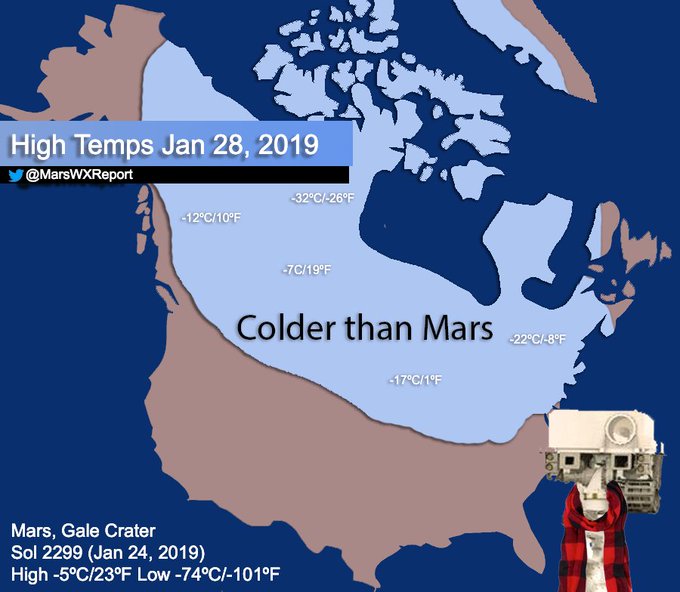
MARS

Mars Weather@MarsWxReport

High temps today across Canada and the upper midwest of the US didn’t reach Mars last reported high.

1,796 people are talking about this

To be fair, the Mars reading that Chicago and Madison are currently beating is a daily high, and it was recorded by one instrument on the Curiosity rover. Other places on Mars are probably colder. In fact, the last recorded low on Mars was negative 99.4 degrees Fahrenheit — way colder than the Midwest, but still pretty impressive.

The dramatic temperatures we’re seeing this week are not an indication that global warming has slowed. A study last year found that extreme winter weather events like these are linked to a warming Arctic. That means that even as average temperatures rise, people living in those areas need to adjust to sudden cold snaps.

The situation is so dire that experts who have worked in the Arctic and Antarctic are giving advice to Midwesterners on how to stay warm. Stay dry and combine layers of wool and silk, Akiko Shinya, an Antarctic researcher and the chief fossil preparator at Chicago’s Field Museum tells the Chicago Tribune.

But no matter how cold it is in Chicago, Minnesota, or Wisconsin — even if it’s colder than some places on Mars — we need to keep things in perspective: at least we’re not with the spacecraft New Horizons, which has been plunging farther and farther into the Solar System. It’s somewhere near the Kuiper Belt, which has a temperature hovering not above zero, but above absolute zero, which is the lowest theoretical temperature possible. Take notes, #PolarVortex 2020. Time to start setting goals.

‘Tipping point’ risk for Arctic hotspot

News.

‘Tipping point’ risk for Arctic hotspot

A rapid shift under way in the Barents Sea could spread to other Arctic regions, scientists attending a conference in Norway have warned. The Barents Sea is said to be at a “tipping point”, BBC News explains, changing from an Arctic climate to an Atlantic climate as the water warms. The Arctic Ocean has a surface layer of freshwater “which acts as a cap” on a layer of warmer, saltier water below. “But now in the Barents Sea there’s not enough freshwater-rich sea ice flowing from the high Arctic to maintain the freshwater cap,” BBC News reports.

BBC News Read Article
Scientists warn climate change could reach a ‘tipping point’ sooner than predicted as global emissions outpace Earth’s ability to soak up carbon

A new study warns that if greenhouse gas emissions continue at current rates, Earth’s vegetation may not be able to keep up. “Once plants and soil hit the maximum carbon uptake they can handle, warming could rapidly accelerate”, MailOnline writes. The study from Columbia University’s School of Engineering and Applied Science investigates how changes in soil moisture affect its capability to act as a “carbon sink”. Currently, “plants and soil around the world absorb roughly a quarter of the greenhouse gases that humans release”, the New York Times explains. But “when the soil is dry, plants are stressed and can’t absorb as much CO2 to perform photosynthesis”. And with warmer conditions microorganisms in the soil become more productive and “release more CO2”. The researchers found that although “plants and soil could absorb more CO2 during the wetter years, it did not make up for their reduced ability to absorb CO2 in the years when soil was dry”. Carbon Brief has also covered the study.

MailOnline Read Article
UK team drills record West Antarctic hole

Scientists have succeeded in cutting a 2km hole through the West Antarctic Ice Sheet to its base using a hot-water drill, BBC News reports. The team then collected sediment from the bottom of the hole and “deployed a series of instruments”. The researchers from the British Antarctic Survey hope that the data collected can help them determine how fast Antarctica might lose its ice in a warming world. Dr Andy Smith, who led the team, commented: “There are gaps in our knowledge of what’s happening in West Antarctica and by studying the area where the ice sits on soft sediment, we can understand better how this region may change in the future and contribute to global sea-level rise.”

BBC News Read Article
US coal retirements in 2019 to hit at least 6GW

2019 will see the retirement of nearly 6GW of coal power in the US, while 49GW of new power generation capacity will be added to the grid, according to the latest figures from S&P Global Market Intelligence, which is highlighted by CleanTechnica. In a related story, E&E News reports that a group of US utilities and other power producers say they may have to shut down their coal-fired power plants if a court rolls back a Trump administration extension to the deadline for closing some coal ash dumps. Their filing to the US Court of Appeals follows a legal challenge brought by environmental groups to the administration’s changes last July to the Obama-era regulations governing coal ash disposal, the article explains.

In other coal news, the Australian Financial Review reports that Jeremy Grantham, the “legendary British hedge fund manager” who founded GMO, has said that thermal coal is “dead meat”. Bloomberg investigates how a “loophole” lets Norway’s $1 trillion sovereign wealth fund boost its coal exposure. Meanwhile, Forbes says that China’s “coal reliance is not falling nearly as fast as some like to claim”. Chinese coal demand “hasn’t been falling in the absolute sense”, the piece argues, continuing: “China approved nearly $6.7bn worth of new coal mining projects in 2018, and production increased 5.2% to 3.55bn tonnes”.

CleanTechnica Read Article

The Arctic has lost 2.6 million reindeer over the past 20 years

The Arctic is changing — fast. That’s bad news for reindeer and caribou.

Archive Photos/Getty Images

Warning: This story may be upsetting to children who believe in Santa Claus.

Reindeer are perhaps best recognized by their magnificent antlers, the largest of any deer species in proportion to their bodies. They’re also notable for their epic thousand-mile journeys every year in search of food, in herds of 100,000 or more.

And they’re supremely important to the Arctic ecosystem as a source of food and livelihood for local people, and because of their power to reshape vegetation by grazing.

But the populations of reindeer, a.k.a. caribou, near the North Pole have been declining dramatically in recent years. Since the mid-1990s, the size of reindeer and caribou herds has declined by 56 percent.

That’s a drop from an estimated 4.7 million animals to 2.1 million, a loss of 2.6 million.

“Five herds,” out of 22 monitored “in the Alaska-Canada region, have declined more than 90 percent and show no sign of recovery,” according to the latest Arctic Report Card from the National Oceanic and Atmospheric Administration, out Tuesday. “Some herds have all-time record low populations since reliable record keeping began.”

Herds have lost hundreds of thousands of individuals, as measured by aerial photography of herds and counts in areas where caribou give birth. And their declines affect not just the landscape but the people who depend on it. The report explains that the declining number of animals are “a threat to the food security and culture of indigenous people who have depended on the herds.“

Arctic Report Card/NOAA

Big swings in population size aren’t a shock

Reindeer and caribou are the same animal. They are members of the species Rangifer tarandusThe Rangifer tarandus that live in North America are called caribou, and the ones in Europe and Siberia are called reindeer. Mostly they are wild creatures, but sometimes they are domesticated to pull sleds and carriages.

Ecologist Don Russell, the lead author of the report subsection on caribou, says it’s normal for herd sizes to fluctuate greatly. It’s part of a natural cycle: Herds can go from numbers in the hundreds of thousands to the tens of thousands in just a few decades, and then rebound.

“The fact that these herds are declining shouldn’t be a shock — they do it all the time,” Russell said by phone from the Yukon territory in Canada. “But they’re at such low levels, you start to be concerned. … If we return in 10 years and [their numbers] have gone down further, that would be unprecedented.”

The question now, he says, is “are their numbers so low they can’t recover?”

Climate change means the future of caribou, like that of so many other creatures, is uncertain

The herds have been declining in recent decades due to a complicated mix of factors including hunting, disease, diminished food availability, and climate change, the report explains.

On one hand, you’d think that with climate change, the Arctic would become a more favorable environment for these grazing animals. Longer, warmer summers mean more vegetation for them to nosh on. And according to the Arctic Report Card, the Arctic did grow greener between 1982 and 2017.

But it seems the warmer Arctic summers are also taking a toll on the reindeer. “Warmer summers also have adverse effects through increased drought, flies and parasites, and perhaps heat stress leading to increased susceptibility to pathogens and other stressors,” the report notes. Higher summer temperatures and wintertime freezing rain (as opposed to snow) seem to be correlated with adult caribou mortality.

Warmer summers have also meant that diseases, long locked in the Arctic permafrost, may thaw and spread among herds, though scientists aren’t completely sure how much of an impact this is having.

And warmer winters can hurt them too. When it rains in the Arctic, as opposed to snow, it can freeze over into ice. That makes it harder for the caribou to walk, and to eat. In 2013, 61,000 (61,000!) reindeer died of starvation in Russia due to excess ice. Currently, a lack of snow in Sweden is impeding reindeer migrations there.

As the climate warms, and as freezing rain replaces snow in the far north, this threat may increase.

Animal populations are shrinking worldwide

The change in caribou numbers also looks concerning when you factor in what’s happening to wildlife around the world.

In October, WWF, the international wildlife conservation nonprofit, released its biennial Living Planet Report, a global assessment of the health of animal populations all over the world. The topline finding: The average vertebrate (birds, fish, mammals, amphibians) population has declined 60 percent since 1970.

That eye-popping figure — a 60 percent decline in average populations — is not the same as saying the world has lost 60 percent of its animals. But most populations of animals, like particular herds, or schools of fish, have seen declining numbers.

There’s a bigger global story here that we must reckon with: Humans are a small part of the living world, yet we have an outsize impact on it. The WWF report stresses that wildlife faces multiple threats — climate change, habitat loss, pollution, hunting, and invasive species — which all trace back to us and our insatiable consumption patterns.

What we lose if we lose the caribou

Caribou don’t have the ability to fly. (Sorry, kids. Though, if you’re reading a science news article, you probably know this by now.) But they’re hugely important to the Arctic ecosystem as a source of food for predators like wolves and biting flies. “A lot of the ecosystem components are riding on their backs,” Russell says.

Moreover, they’re central to the traditions of indigenous people in the Arctic, like the Sami, as a source of food and clothing. “If you look at the [top] Northern resources, that shape the culture of northern communities and aboriginal people, what they have in common is caribou and or wild reindeer, no matter where they are in the circumpolar North,” he says.

The takeaway is that the Arctic landscape is changing — and it’s changing more dramatically than anywhere on the Earth. The temperature increase in the Arctic just since 2014, the report card also finds, “is unlike any other period on record.” And it’s not yet clear if the caribou can change and adapt with it.

https://www.vox.com/science-and-health/2018/12/11/18134411/christmas-reindeer-north-pole-populations-decline-agu-arctic-report-card?fbclid=IwAR1RQAyv0xMTNIF6HkJHTIXKzyXTjP-fRjN1o9UlYTDS_BYR28pdLjAsZNM

“Scary” warming in the Arctic at unusual times and places

WASHINGTON — Scientists are seeing surprising melting in Earth’s polar regions at times they don’t expect, like winter, and in places they don’t expect, like eastern Antarctica. New studies and reports issued this week at a major Earth sciences conference paint one of the bleakest pictures yet of dramatic warming in the Arctic and Antarctica.

Alaskan scientists described to The Associated Press Tuesday never-before-seen melting and odd winter problems, including permafrost that never refroze this past winter and wildlife die-offs.

The National Oceanic and Atmospheric Administration Tuesday released its annual Arctic report card, detailing the second warmest year on record in the Arctic and problems, including record low winter sea ice in parts of the region, increased toxic algal blooms, which are normally a warm water phenomenon, and weather changes in the rest of the country attributable to what’s happening in the far North.

“The Arctic is experiencing the most unprecedented transition in human history,” report lead author Emily Osborne, chief of Arctic research for NOAA, said Tuesday.

What’s happening is a big deal, said University of Colorado environmental science program director Waleed Abdalati, NASA’s former chief scientist who was not part of the NOAA report.

“It’s a new Arctic. We’ve gone from white to blue,” said Abdalati, adding that he normally wouldn’t use the word “scary” but it applies. That means other problems.

“Continued warming of the Arctic atmosphere and ocean are driving broad change in the environmental system in predicted, and, also, unexpected ways,” the NOAA report said.

https://www.cbsnews.com/embed/video/?v=8b3d2d0547fcbb708752845d8b0a6fe70dff4caf#1VdtU9tGEP4rN%2FrUzviw3mxLfAOSFFJCaEia0rjjOd2trANJp96dMCbT%2F949SQZMQ5tk2kzxF9t3%2B%2Frss6vVR%2B9KClDe7kdPtJpZqWpvN5xNR17VXL%2BB%2FEh4u97Lk3fnq%2BMXkW4udZH8sv%2Fq57c%2FzW72f1Wrm%2BOZ2mPeyLNFW2U1kyWKF9Y2Znc%2Bno95ZmpYmWgHf0hj0Tzf4aqaj4s2m4%2FlfKzn49APkvk4COdjfzofA4ujyE9yGsf%2BhMZJENGUhUCTDPLUz0IW5pP5%2BNbbfDyN%2Feto6s%2FHsYjTIPFRJYaJiESaTpKUx5lIs2mczLI%2BGpq3BnOkK6VLQTnTGf4RUl0jChQqadytoYW0VANXWtASrqCktx5pMAuTKAjp4Hjnolm6%2FFUjec0qwPwP9s9ONkenTENtz8p2iRcuALyARholUDIYeQaYcZB7gef%2BLCuU7i80d0UpSuO%2BMmmxOKgy8d1n5DXSFeZAQHh9Xlyoo9cr53HdOP9OZ%2BS1elOLrhSyYYIaq4FVsl7uDJXpq1GBkAy%2FmuuH5Qii1I%2BDWZrM0hCPXWaLHsHF52PHS1lh8JQXrF7CoiPcoocxWGBC%2F5XdnSpqE0QiVxrlEAzWNKXkHcnn42taNbB89%2BbY%2B2PkIFtcMS1ZbRdNoWrYAj24B7m%2Fnkbli%2BXRwc1b2IL8gf6TKUAX7ldCZVlWgn0Uq3ObHOqphubl66tPYzUYeDJg9fF%2BAVormcstfGbx%2FQY2NdP7b56%2FDs07dYdQp%2FQXTIRa1aVi4v%2BChr%2FAXHaqJr6PRCfgwokfckXZx4kSXiwWVZHw969vwk8TxWk%2FGZZgsF9AkWi5hUu4RZBze%2FD7mTw%2BP7o6fHaHTLR8CvQI%2F54emLppM8O1zEAcqNp2j76PKAMr12bertUt3BPS3m7OSoNH0kx9LHmuWc0LaWDr4vk1Irl1EienGpzZ4bTz3DQaDD5c67YsR31gVlrn1nvvlgPSo0AGFMgtCgRRID0KpENhqxb94rNarbbrMCT%2BtcjOx249GLaIr7Thwmw7UiWAHMsyoGnEMhpHDGjGeETzGPgkDIQPYe4NmAi4RI09gqlg0o3Slhi2NsQWQLolqoODbQDBSj8OnMVakTUwPSKaSYM9S7iqOWi8Y5lqbWdVVg3jlqCFIX7Sx79DkKPkBCF1WhYZ0VpnogILSqtSLXHFJC8hz8k%2BaKYFlKUkF0rWIJzqCdl7RawiGc6LS%2BLapXPXJ4Z7mObFzibrRqtKFdDtWJ9NA6RVU7J1iWGgHppirVWneOLtYj8jKfklxusoLs3z2lFcbDjONK7GJey1tlDa7dwfvMgXjIuM0ylLGA0CCGkqcO%2F0sYtzSBhW0Pd%2Be6B60m2gH7yBe%2BS7QgoBNckwqhq%2BvyffLfaJH8UiD3I6TTMkQpamlGVsQiORJOiCRWI6825VTtvsWTeiPDdJKMYShCSY4cTa9e%2BJvR26aO4ZZMJ67pEV025AE9kjjkijIGGWtHVrWlYSKytACtSCIIAczD1j%2FcDj%2FXhYDKd4z1VZAnfjtIfLnzJ%2F6k8zCuEEXxzSYEJZHmQ0hFmY8iTKRZ679O%2F0brHaYpmTETgs%2BMa1AHOJq7znRskzuHLZ4%2B%2BGLTcCDuiFtFC5FsXvQ%2Bkm1Qev6w5nzh2e9T7dw7077k8HC0i%2FBhklr7ClINu8OnQVmvqzSR77CZ1NEvEYCwaFPqFbB60BPThgtXIvHtnlGTp1diN8yRp5mLhEqsa3aJ%2BpVvNOweWb4XgVyF%2FrxncXzUCrhYt9cQeM%2Bzs4HyQ8B2Kllpo1heQ%2Fwto4RC5U9qKteyBG7t8B4r5Ueu3ArUWLj%2FJ1V9qqaS3oU61yySXUfHPK6vWZvHHlX0ItEGaMfAk%2FaNU2nURbOwsIuQVWyrZyvdY4K%2BW92Fy07i2sdrXEW%2BEat%2Bv6d99iinNXDNwEyn%2F05n6hs8FEP3xpjkAZatBJLahrLDCWuplKMaLBt6zxfRVo32edU0fXb%2B1vYMS%2FaleaQ9Dq9uHebTenCiuK8A9chwrXCdwu%2FgQ%3D

One of the most noticeable problems was a record low sea ice in winter in the Bering Sea in 2017 and 2018, scientists said. In February the Bering Sea “lost an area of ice the area of Idaho,” said Dartmouth College engineering professor Donald Perovich, a report card co-author.

This is a problem because the oldest and thickest sea ice is down 95 percent from 30 years ago. In 1985, about one-sixth of Arctic sea ice was thick multi-year ice, now it is maybe one-hundredth, Perovich said. University of Alaska Fairbanks marine mammal biologist Gay Sheffield not only studies the record low ice, but she lives it daily in Nome, far north on the Bering Sea.

“I left Nome and we had open water in December,” Sheffield said at the American Geophysical Union conference in Washington. “It’s very much impacting us.”

“Having this area ice free is having this massive environmental change,” Sheffield said, adding there’s been a “multi-species die off” of ocean life. She said that includes the first spring mass die off of seals along the Bering Strait.

Ornithologist George Divoky who has been studying the black guillemots ofCooper Island for 45 years noticed something different this year. In the past, 225 nesting pairs of the seabirds would arrive at his island. This past winter it was down to 85 pairs but only 50 laid eggs and only 25 had successful hatches. He blamed the lack of winter sea ice.

“It looked like a ghost town,” Divoky said.

With overall melting, especially in the summer, herds of caribou and wild reindeer have dropped about 55 percent — from 4.7 million to 2.1 million animals — because of the warming and the flies and parasites it brings, said report card co-author Howard Epstein of the University of Virginia.

University of Alaska Fairbanks researcher Vladimir Romanovsky said he was alarmed by what happened to the permafrost — ground that stays frozen years on end. This past year, Romanovsky found 25 spots that used to freeze in January, then February, but never froze this year.

Because of warming, the Arctic is “seeing concentrations of algal toxins moving northward” infecting birds, mammals and shellfish to become a public health and economic problem, said report card co-author Karen Frey.

The warmer Arctic and melting sea ice has been connected to shifts in the jet stream that have brought extreme winter storms in the East in the past year, Osborne said. But it’s not just the Arctic. NASA’s newest space-based radar, Icesat 2, in its first couple of months has already found that the Dotson ice shelf in Antarctica has lost more than 390 feet (120 meters) in thickness since 2003, said radar scientist Ben Smith of the University of Washington.

Another study released Monday by NASA found unusual melting in parts of East Antarctica, which scientists had generally thought was stable. Four glaciers at Vincennes Bay lost nine feet of ice thickness since 2008, said NASA scientists Catherine Walker and Alex Gardner.

Loss of ice sheets in Antarctica could lead to massive rise in sea level.

“We’re starting to see change that’s related to the ocean,” Gardner said. “Believe it or not this is the first time we’re seeing it in this place.”

Unexpected future boost of methane possible from Arctic permafrost

https://eurekalert.org/pub_releases/2018-08/nsfc-ufb081718.php

NASA/GODDARD SPACE FLIGHT CENTER

New NASA-funded research has discovered that Arctic permafrost’s expected gradual thawing and the associated release of greenhouse gases to the atmosphere may actually be sped up by instances of a relatively little known process called abrupt thawing. Abrupt thawing takes place under a certain type of Arctic lake, known as a thermokarst lake that forms as permafrost thaws.

The impact on the climate may mean an influx of permafrost-derived methane into the atmosphere in the mid-21st century, which is not currently accounted for in climate projections.

The Arctic landscape stores one of the largest natural reservoirs of organic carbon in the world in its frozen soils. But once thawed, soil microbes in the permafrost can turn that carbon into the greenhouse gases carbon dioxide and methane, which then enter into the atmosphere and contribute to climate warming.

“The mechanism of abrupt thaw and thermokarst lake formation matters a lot for the permafrost-carbon feedback this century,” said first author Katey Walter Anthony at the University of Alaska, Fairbanks, who led the project that was part of NASA’s Arctic-Boreal Vulnerability Experiment (ABoVE), a ten-year program to understand climate change effects on the Arctic. “We don’t have to wait 200 or 300 years to get these large releases of permafrost carbon. Within my lifetime, my children’s lifetime, it should be ramping up. It’s already happening but it’s not happening at a really fast rate right now, but within a few decades, it should peak.”

The results were published in Nature Communications.

Using a combination of computer models and field measurements, Walter Anthony and an international team of U.S. and German researchers found that abrupt thawing more than doubles previous estimates of permafrost-derived greenhouse warming. They found that the abrupt thaw process increases the release of ancient carbon stored in the soil 125 to 190 percent compared to gradual thawing alone. What’s more, they found that in future warming scenarios defined by the Intergovernmental Panel on Climate Change, abrupt thawing was as important under the moderate reduction of emissions scenario as it was under the extreme business-as-usual scenario. This means that even in the scenario where humans reduced their global carbon emissions, large methane releases from abrupt thawing are still likely to occur.

Permafrost is ground that is frozen year-round. In the Arctic, ice-rich permafrost soils can be up to 260 feet (80 meters) thick. Due to human-caused warming of the atmosphere from greenhouse gas emissions, a gradual thawing of the permafrost is currently taking place where the upper layer of seasonally thawed soil is gradually getting thicker and reaching deeper into the ground. This process wakes up microbes in the soil that decompose soil organic matter and as a result release carbon dioxide and methane back into the atmosphere. This gradual thaw process is accounted for in climate models and is thought to have minimal effect as thawed ground also stimulates the growth of plants, which counterbalance the carbon released into the atmosphere by consuming it during photosynthesis.

However, in the presence of thermokarst lakes, permafrost thaws deeper and more quickly. Thermokarst lakes form when substantial amounts of ice in the deep soil melts to liquid water. Because the same amount of ice takes up more volume than water, the land surface slumps and subsides, creating a small depression that then fills with water from rain, snow melt and ground ice melt. The water in the lakes speeds up the thawing of the frozen soil along their shores and expands the lake size and depth at a much faster pace than gradual thawing.

“Within decades you can get very deep thaw-holes, meters to tens of meters of vertical thaw,” Walter Anthony said. “So you’re flash thawing the permafrost under these lakes. And we have very easily measured ancient greenhouse gases coming out.”

These ancient greenhouse gases, produced from microbes chewing through ancient carbon stored in the soil, range from 2,000 to 43,000 years old. Walter Anthony and her colleagues captured methane bubbling out of 72 locations in 11 thermokarst lakes in Alaska and Siberia to measure the amount of gas released from the permafrost below the lakes, as well as used radiocarbon dating on captured samples to determine their age. They compared the emissions from lakes to five locations where gradual thawing occurs. In addition, they used the field measurements to evaluate how well their model simulated the natural field conditions.

Team members with the Alfred Wegener Institute (AWI) for Polar and Marine Research in Germany then used U.S. Geological Survey-NASA Landsat satellite imagery from 1999 to 2014 to determine the speed of lake expansion across a large region of Alaska. From this data they were able to estimate the amount of permafrost converted to thawed soil in lake bottoms.

“While lake change has been studied for many regions, the understanding that lake loss and lake gain have a very different outcome for carbon fluxes is new,” said co-author Guido Grosse of AWI. “Over a few decades, thermokarst lake growth releases substantially more carbon than lake loss can lock in permafrost again [when the lake bottoms refreeze].”

Because the thermokarst lakes are relatively small and scattered throughout the Arctic landscapes, computer models of their behavior are not currently incorporated into global climate models. However, Walter Anthony believes including them in future models is important for understanding the role of permafrost in the global carbon budget. Human fossil fuel emissions are the number one source of greenhouse gases to the atmosphere, and in comparison, methane emissions from thawing permafrost make up only one percent of the global methane budget, Walter Anthony said. “But by the middle to end of the century the permafrost-carbon feedback should be about equivalent to the second strongest anthropogenic source of greenhouse gases, which is land use change,” she said.

###

To learn more about ABoVE, visit: https://above.nasa.gov/

Disclaimer: AAAS and EurekAlert! are not responsible for the accuracy of news releases posted to EurekAlert! by contributing institutions or for the use of any information through the EurekAlert system.