Exposing the Big Game

Forget Hunters' Feeble Rationalizations and Trust Your Gut Feelings: Making Sport of Killing Is Not Healthy Human Behavior

Exposing the Big Game

B.C. wildlife struggles with summer heat and wildfires

By Cory Correia, CBC News
<http://www.cbc.ca/news/cbc-news-online-news-staff-list-1.1294364> Posted:
Aug 13, 2017 10:00 AM PT Last Updated: Aug 13, 2017 10:00 AM PT

This Virginia Rail was found in Sechelt and is one of the tiniest birds the
Wildlife Rescue Association of B.C. has taken into its Burnaby hospital.
<https://i.cbc.ca/1.4244895.1502506110%21/fileImage/httpImage/image.jpg_gen/
derivatives/16x9_620/wildlife-rescue-association-of-bc-virginia-rail.jpg>

This Virginia Rail was found in Sechelt and is one of the tiniest birds the
Wildlife Rescue Association of B.C. has taken into its Burnaby hospital.
(Wildlife Rescue Association of BC)

A summer heat wave and extensive wildfires in the B.C. Interior have been
abnormally hard on animals in the province, especially nestlings.

Burnaby’s Wildlife Rescue Association of B.C.
<https://www.wildliferescue.ca/> services the entire province, and says
it’s taking in 20 injured animals a day, with 95 percent suffering from
dehydration.

“The heat is overwhelming them, particularly the past couple weeks have been
really bad. We’ve had a lot of young nestlings, jumping out of nests to
avoid the heat,” said Sam Smith, communications coordinator at Wildlife
Rescue.

Smith says when young birds leave the nest too early, they end up falling on
the ground and start to waste away, because they don’t yet have the strength
to fly or move.

Wildlife Rescue Association of BC Pelagic Cormorant
<https://i.cbc.ca/1.4244901.1502506230%21/fileImage/httpImage/image.JPG_gen/
derivatives/original_620/wildlife-rescue-association-of-bc-pelagic-cormorant
.JPG>

This Pelagic Cormorant was taken into the Wildlife Rescue Association of
B.C. suffering from dehydration due to the summer heat. (Wildlife Rescue
Association of BC)

Smith says it’s mostly birds that he sees affected by the heat, including
songbirds, waterfowl, marine animals, crows and ravens.

“Sometimes, they’re just so out of sorts, they can’t even drink, let alone
open up their mouths to be given fluids,” he said. In those cases, he says,
they have to hydrate the animals with an injection.

People can help, though, says Smith. “Leave a little lid out with some water
in the shade, or, better yet, fill a small kiddie pool with water and place
some branches/stones inside to allow smaller birds a place to perch while
they drink.”

If anyone sees wildlife in distress, they can usher it into some shade, get
it water and call Wildlife Rescue at 604-526-7275.

Nestlings rescued from wildfires

The wildfires have claimed their own victims, with wildlife rescue an
afterthought.

Orphaned Wildlife Rehabilitation Society <http://www.owlrehab.org/> (OWL)
in Delta says they have been taking in young birds injured or left behind in
the wake of the wildfires.

OWL Orphaned Wildlife
<https://i.cbc.ca/1.4244903.1502506492%21/fileImage/httpImage/image.JPG_gen/
derivatives/original_620/owl-orphaned-wildlife.JPG>

The Orphaned Wildlife Rehabilitation Society says they currently have nine
rescued animals ready to go back into the wild, including four saw-whet
Owls, one long-eared owl, and four kestrel falcons. (OWL Orphaned Wildlife)

“Most of the adult birds at the time or adult animals would know to flee.
It’s just the young ones that are left behind . So a lot were probably burnt
up pretty good, and the ones that could survive, survived, and the ones that
were found, were found,” said Rob Hope, raptor care manager with OWL.

Hope says they have nine baby birds live tested, flight tested and ready to
get back to their communities, once the fires subside.

http://www.cbc.ca/news/canada/british-columbia/bc-animals-orphaned-summer-he
at-wildfires-1.4244882

Ranchers brace for ‘astronomical losses’ due to B.C. wildfires

Cattle ranchers in B.C. are bracing for massive damages to their land and
livestock as wildfires continue to rage across the Interior.

Kevin Boon, the general manager for the B.C. Cattlemen’s Association,
visited two areas this week in the ravaged Cariboo region.

“We know there’s going to be some astronomical losses,” Boon said.

It’s still too early to peg the total cost of damages – a question Boon says
he has been fielding from many ranchers – but the expenses are quickly
adding up.

“There’s hundreds of miles of fence out there that have been burnt up,” he
said.

“That’s all a huge cost when you stop and figure it costs somewhere in the
neighbourhood of $15,000 to $20,000 a kilometre of fence to replace.”

Costs will also be incurred in destroyed grass and hay, he said.

Volatile conditions

The B.C. Cattlemen’s Association has been liaising with RCMP to get ranchers
access through checkpoints so they can transport or tend to their livestock.

Boon is also calling on the province to keep tourists and recreational users
out of the backcountry because of the volatile conditions. Even ranchers are
restricting use on their own lands, he said.

“We’re recommending our guys take their horse shoes off their horses just so
they don’t create a spark of the shoe on the walk,” Boon said.

Boon estimates there are about 30,000 head of cattle in the wildfire
regions. Death tolls won’t be as high as ranchers anticipated, but he
expects it will affect the calf population next spring.

“A lot of these cattle are in their breeding season right now,” he said.
“They might be miscarrying those calves and aborting them naturally because
of the stress.”

Greg Nyman, a rancher who lives south of Clinton, B.C., has so far found 60
of his 120 cattle. They’re in varying degrees of health, he said.

“I saw quite a few that have burned feet,” he said. “They’ve been in a
burning fire for a week and heavy smoke for close to a month now.”

“More often than not, their lungs are scorched,” he added. “So they’re no
longer productive.”

http://www.cbc.ca/news/canada/british-columbia/ranchers-brace-for-astronomic
al-losses-due-to-b-c-wildfires-1.4233525

Hunter-Funded Wildlife Agency Quietly Announced Before BC Election

Steve Thomson, Former Minister of Forests, Lands and Natural Resource Operations announcing the new wildlife agency proposal on March 22, 2017.

By Judith Lavoie.  This article is from DeSmog Canada.

A plan to form a new, independent wildlife management agency in B.C., which would relieve the provincial government from managing contentious wildlife issues such as grizzly, wolf and caribou populations, is generating anxiety among some conservation groups who fear the structure of the new program could prioritize the interests of hunters over wildlife.

The proposal for the new agency, first announced in March, was scant on details, but Steve Thomson, then minister of Forests, Lands and Natural Resource Operations, set a fall start-up date and set aside $200,000 for consultations with conservation and hunting groups.

“Government is afraid to manage wolves, for example, or afraid to manage grizzly bears in some cases because of the politics of that,” then energy and mines minister Bill Bennett, an avid hunter and supporter of the controversial grizzly bear trophy hunt, told an East Kootenay radio station.

“Hopefully an agency that is separate from government can make decisions that are in the best long-term interest of wildlife and just forget about the politics and do what is best for the animals,” Bennett said.

According to Thomson, the agency would receive an initial government investment of $5 million and be further funded by hunting licence revenues to the tune of $9 to $10 million annually — money which currently goes into general revenue.

The plan was welcomed by hunters as a way to increase funding for cash-strapped conservation and management programs

The NDP previously tabled a bill calling for dedicated conservation funding, so, in the flurry of pre-election announcements, the plan didn’t get much attention, even though Thomson was flanked by representatives of pro-hunting groups as he made the announcement.

Then, days before the election, five of B.C.’s pro-hunting and trapping organizations — B.C. Wildlife Federation, Guide Outfitters Association of B.C, Wild Sheep Society of B.C, Wildlife Stewardship Council and the B.C. Trappers Association — announced they had signed a memorandum of understanding to work together.

“The collaborative efforts of our five organizations will help ensure the province follows through on its commitment to enhance wildlife management,” Jim Glaicair, president of the 50,000-member B.C. Wildlife Federation, said in a news release.

The organizations emphasized that the MOU was sparked by concern about the ongoing decline of wildlife.

“This is a great opportunity for our organizations to work together for the betterment of wildlife in the province,” said Michael Schneider, Guide Outfitters Association of B.C president.

Hunter-Funded Wildlife Management ‘Huge Step Backwards’

But to other groups and especially those waiting to see whether the new government will stop the grizzly hunt, the MOU appeared to indicate a pro-hunting team lining up to take over the new agency.

Alan Burger, president of B.C. Nature, which represents 53 clubs, with a total of more than 6,000 members, said in an interview that it is a major concern that the only people rooting for the new agency appear to be hunters and trappers.

“If they can dominate an agency like this it is going to be a huge step backwards,” Burger told DeSmog Canada.

“The last thing we need is greater emphasis on big game. We need to focus our attention on the ecosystem,” he said, questioning how the proposal could get so far without consultation.

“Hunting and fishing licences are an important source of revenue and B.C. Nature agrees that there should be a greater share contributed to wildlife management,” Burger said.

“But there is much greater input to the B.C. economy from the non-consumptive users of wildlife — the tourism and wildlife watching industry, people selling binoculars, camera gear, field guides, outdoor gear and, most importantly, the vast majority of British Columbians that spend money travelling and camping to simply enjoy seeing animals alive in the wild,” he said.

Valhalla Wilderness Society has come out swinging against the proposed agency, calling it a thinly disguised attempt by the B.C. government to privatize wildlife management and hand over responsibility to hunters, trappers and guide outfitters.

Funding for wildlife management should not be contingent on hunting licence revenue or special interest groups, a news release from Valhalla says.

“Notwithstanding the poor job the B.C. government has been doing in growing wildlife, wildlife should be managed by government,” it says. “The above-mentioned special interest groups lack the technical expertise to make wildlife decisions based on scientific evidence and are even unwilling to apply the precautionary principle, which, in the face of climate change, is needed more than ever.”

B.C.Wildlife Conservation Funds Desperately Needed

One lesson from the growing controversy is that conservation groups need to work together and find out whether a new model could provide desperately needed funds for conservation, said Val Murray of Justice for B.C. Grizzlies.

“We need to see animals as individuals within communities rather than numbers within a natural resource group,” she said.

“We need a cross-discipline panel of conservation biologists and scientists to bridge the values of consumptive and non-consumptive residents. There is no shortage of good science — what we lack is proper funding to implement what we know, plus good listening skills to apply the ideas.”

Letters asking for more information and setting out objections to the proposal have been sent to all three party leaders, but, until the outcome of the election is clarified, none are willing to jump into the fray.

A spokeswoman for the Forests, Lands and Natural Resource Operations Ministry said the previous government was looking at similar model to the agreement between the province and Freshwater Fisheries Society of B.C where revenue from fishing licences goes into research, conservation and education programs.

The intention is to hold public consultations before decisions are made, she said.

From DeSmog Canada, by way of the Rossland Telegraph.

http://rosslandtelegraph.com/news/hunter-funded-wildlife-agency-quietly-announced-bc-election-44589#.WVOD0jOZNmB

Relocated grizzly destroyed after returning to Fernie park

Cranbrook, BC, Canada / The Drive FM

Elk Valley WildsafeBC reports the animal was destroyed over the May long weekend in defense of property in a rural area west of the city.

This is the second bear to be destroyed this season in the area after one had to be removed from Lower Elk Valley Rd about two weeks ago.

Biologists returned to the Elk Valley recently to continue a study started last year that looks at the way grizzlies use the landscape and how they interact with people.

They plan to have radio collars on a sample size of approximately 10 grizzly bears and monitor their activity.

– Josh Hoffman

http://www.thedrivefm.ca/2017/05/26/relocated-grizzly-shot-after-returning-to-fernie-park/?sc_ref=facebook

BC Govt Plans a New Independent Wildlife Agency Managed by Guide Outfitters, Trophy Hunters, Trappers

Valhalla Wilderness Society

Box 329, New Denver, British Columbia, Canada V0G 1S0
Phone: (250) 358-2333, Fax: (250) 358-2748, E-mail: vws@vws.org, Web: http://www.vws.org

18 May 2017
Call for action

BC Government wants to establish a new independent wildlife agency managed by hunters, trappers and guide outfitters Valhalla Wilderness Society was appalled when the BC government announced in late March that it intends to establish a new independent wildlife agency (https://news.gov.bc.ca/releases/2017FLNR0037-000783 ) “as part of its long-standing commitment to healthy wildlife populations.” The proposed “independent” agency is a thinly disguised attempt by the BC government to privatize wildlife management. Equally concerning and outrageous is that this agency was cooked up with at least the following 5 organizations, the BC Wildlife Federation, the BC Guide Outfitters Association, the BC Trappers Association, the Wild Sheep Society of BC and the Wildlife Stewardship Council with whom the BC government has signed a memorandum of understanding (MOU). These organizations whose members include hunters, trappers and guide outfitters who guide (trophy) hunters fully support the proposed agency whose mandate appears ironically to be “the growth of wildlife in British Columbia.”

At the announcement, Bill Bennett, then MLA East Kootenay and Minister of Mines and Energy,
explained the need for a new agency as follows: “Government is afraid to manage wolves, for example,are afraid to manage grizzly bears in some cases because of the politics of that. Hopefully, an agency that is separate from government can make decisions that are in the best long-term interest of wildlife and just forget about the politics and do what is best for the animals.”

http://www.summit107.com/news/east-kootenay-news/new-independent-wildlife-group-to-takeover-

bc-government-operations/. Bill Bennett has left BC enough of a devastating legacy with the
Mount Polley mine tailing pond failure which continues to pollute Quesnel Lake.
2
The past president of the BC Wildlife Federation welcomed the announcement of the proposed agency by stating: “I think it’ll put more positive aspect into managing wildlife and getting away from the precautionary principles and get back to real numbers and managing wildlife the way it should be.” The government press release reports that the proposed agency will be funded with start-up funds of $5 million but “subsequently would be supported by hunting licence revenues of $9 million to $10 million each year.”
Valhalla Wilderness Society calls on all members to express their opposition to this outrageous scheme to not only privatize wildlife management in BC but to place it in the hands of hunters, trappers and guide outfitters. Notwithstanding the poor job the BC government has been doing in terms of “growing wildlife”, wildlife should be managed by government. The above-mentioned special interest groups lack the technical expertise to make wildlife decisions based on scientific evidence and are even unwilling to apply the precautionary principle, which- in the face of climate change -, is needed more than ever. The proposed agency can not be held accountable to the public like an elected government, especially as agency members will no doubt be gagged by mandatory confidentiality agreements. Nor can it be bound by the domestic and international legal obligations, such as the Canada-BC Species at Risk Agreement, that bind the Province directly or indirectly through the federal government`s signing of international legal treaties.
The proposed agency does not represent the majority of British Columbians and the fake “public
consultation” process that the BC government has set aside $200,000 for when the mandate,
stakeholders and funding have already been decided is an utter waste of tax payers’ money. Wild
management should not be reduced to the management of species which hunters, trappers and guide outfitters’ clients like to kill: a broad ecosystem approach is needed to ensure that BC’s “wildlife grows” and their habitat is protected. Last but not least, funding for wildlife management should not be contingent on hunting license revenue or on other funding from special interest groups. Please take the time to email John Horgan, leader of the NDP, Andrew Weaver, leader of the BC Green Party, and Christy Clark, leader of the BC Liberals, demanding that:
 this proposed agency be shelved and the MOU terminated with immediate effect. Wildlife
management must remain the responsibility of the BC government;
 all wildlife management decisions by government must be made on the basis of scientific evidence guided by the precautionary principle and on a broad ecosystem level, which would automatically remove politics from the decision-making process the $200,000 set aside for so-called “public” consultation on this proposed agency whose establishment has been set in motion by special interest groups be used for restoration of mountain caribou habitat;
documents and meeting minutes with the above-mentioned organizations and others involved in
the establishment of this proposed agency be immediately released to the public.

Contact details:
John Horgan, NDP Party leader
Room 201, Parliament Buildings
Victoria, BC, V8V 1X4
Tel: 250 387-3655
Email: oppositionleader@leg.bc.ca
Andrew Weaver, Green Party leader and MLA
Room 027C, Parliament Buildings
Victoria, BC, V8V 1X4
Tel: 250-387-8347
Email: andrew.weaver.mla@leg.bc.ca
Christy Clark, BC Liberal leader
Parliament Buildings
Victoria, BC, V8V 1X4
Tel: 250-387-1715
Email: Christy.clark.mla@leg.bc.ca

Family of girl snatched by sea lion lambasted for ‘reckless behavior’

“You wouldn’t go up to a grizzly bear in the bush and hand him a ham sandwich,” said an official suburban Vancouver’s Steveston Harbour, where the now-famous incident occurred over the weekend.

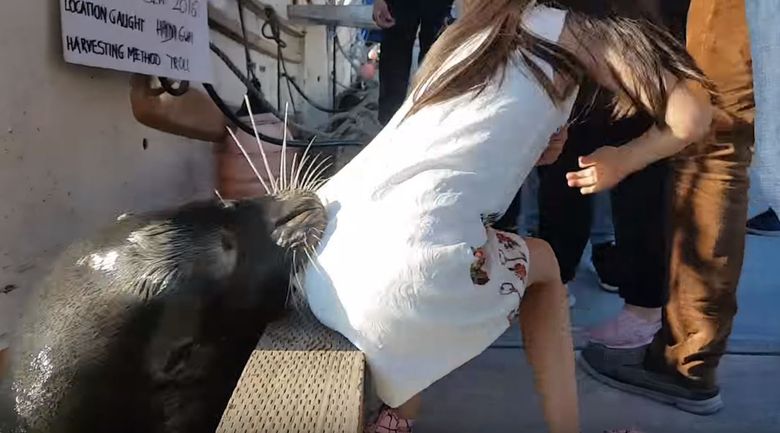
The terrifying video of a sea lion snatching a little girl off the edge of a dock and yanking her into murky British Columbia seawater last week is buzzing across the internet and social media today — and drawing some critical insights.

Michael Fujiwara, a college student from Vancouver, B.C., captured the video Saturday at the Steveston Fisherman’s Wharf in the Vancouver suburb of Richmond. It shows the large male sea lion suddenly lurching and pulling the girl into the water, with a man jumping in after the child to save her. There reportedly were no injuries.

Robert Kiesman, chair of the Steveston Harbour Authority, lambasted the girl’s family for reckless behavior, telling the CBC News that signs posted at the popular tourist destination warn people not to feed the sea mammals that frequent the area.

“You wouldn’t go up to a grizzly bear in the bush and hand him a ham sandwich, so you shouldn’t be handing a thousand-pound wild mammal in the water slices of bread,” Kiesman said.

“And you certainly shouldn’t be letting your little girl sit on the edge of the dock with her dress hanging down after the sea lion has already snapped at her once. Just totally reckless behavior.”

Danielle Hyson, a senior marine-mammal trainer at the Vancouver Aquarium, explained to The Vancouver Sun that the animal forewarned of his aggressive behavior.

“You saw him kind of initially lunge out of the water and give a little huff. That’s what we would call an aggressive precursor,” she told The Sun. “So he’s letting the people know that he’s starting to get frustrated. And in that situation, the people should have backed off right away.”

Hyson noted that male California sea lions are powerful animals that can weigh more than 200 kilograms — about 440 pounds.

The powerful animals have big eyes and whiskers that seem cute, she noted.

“They look like they’re water dogs, but they absolutely are not,” Hyson said. “They can do a lot of damage.”

Fujiwara, the college student who shot the video, said in a story carried by NBC News the girl and her family were dumbstruck by the attack.

“They were pretty shaken up,” he said. “Her family were just in shock.”

The family had been feeding the sea lion breadcrumbs, which is probably what attracted the animal to the crowd, Fujiwara said.

“It initially jumped up to the girl to read her, I guess,” he said. “And then it came back up a second time, but this time grabbing the girl by the waist and dragging her down into the water.”

In Washington, the state’s Department of Fish and Wildlife does not keep records on sea-lion attacks, department spokesman Craig Bartlett said in an email Monday.

Sea lions typically only bite when they feel threatened or cornered, according to various news reports. They sometimes also go after the same fish people do, resulting in close encounters.

“I’ve seen reports of sea lions stealing fish from anglers on the Columbia River, but I can’t recall anyone actually being injured,” Bartlett said.

While he knew of no known attacks of people in Washington, Bartlett pointed to a 2013 news report about sea lions that have attacked and eaten dogs at Westport.

But commercial and sports fishermen occasionally have reported attacks by sea lions and seals.

A sea lion caught in a Russian commercial fishing vessel’s net was videotaped tossing a fisherman across the boat deck.

In January, an Alaska fisherman was attacked by a Steller sea lion “heavier than a grand piano” when it jumped onto his fishing boat, slammed him into the deck and tried to drag him into the water, according to the Alaska Dispatch News.

And in 2015, a sea lion bit onto the hand of a sport fisherman as he posed with a yellowfin tuna on his boat off San Diego, pulling the man overboard.

“After 15 seconds, I thought I was going to die,” Dan Carlin, the fisherman, later said in an interview with The Associated Press. “I continued to struggle, but thought this is the way I was going to die. It was unbelievable to me.”

But deadly attacks by seals or seal lions are apparently rare.

The fatal attack of a British scientist snorkeling in Antarctica in 2003 was believed to be the first deadly leopard-seal attack on a human at the time, according to National Geographic.

On Monday, tourists and the curious crowded on to Steveston Fisherman’s Wharf to catch a glimpse of the child-snatching sea lion despite warnings to keep a safe distance.

Video shows sea lion drag girl into water near Vancouver, B.C.

http://komonews.com/news/local/video-shwos-sea-lion-drag-girl-into-water-near-vancouver-bc

(Screenshot of video Michael Fujiwara/CBC)

AA

RICHMOND, British Columbia (AP) — A college student has startling video of a sea lion snatching a girl off a dock and yanking her into the water on Canada’s West Coast.

It happened Saturday in Richmond, a Vancouver suburb. University student Michael Fujiwara tells CBC News that some people started feeding the animal breadcrumbs.

In Fujiwara’s video, the sea lion pops up toward the girl as bystanders laugh. Then she sits by the pier’s edge. In an instant, the massive mammal shoots up, grabs her dress and pulls her into the water as people scream.

The sea lion disappears as a man plunges into the water and helps the girl out. She doesn’t appear injured and walks away with adults.

Marine mammal expert Andrew Trites says the sea lion presumably thought the dress was food.

‘These bears are worth more alive’: New eco-tours aim to end B.C.’s grizzly hunt

Last Updated Wednesday, May 3, 2017 6:51PM PDT

A Victoria-based conservation group has B.C.’s grizzly hunt in its crosshairs – hoping a new type of eco-tour will help put an end to the controversial practice for good.

The Raincoast Conservation Foundation is readying the 20-metre research vessel “Achiever” as it prepares to offer photographic tours deep in the heart of the Great Bear Rainforest.

While photographic tours of the province’s iconic grizzlies are nothing new, the foundation says all four trips it’s offering this year will be strictly by donation.

“We’re taking guests up there to hunt bears with cameras,” said Nicholas Sinclair, marine operations coordinator with Raincoast. “It really gives them a chance to view these animals in their pristine habitats.”

But it’s the donations that are helping limit the grizzly bear hunt in the Great Bear Rainforest.

At a minimum suggested donation of $5,000 a pop, money from the tours is helping the foundation snap up guiding rights away from trophy hunters.

So far, Raincoast has purchased guiding rights for 32,000 square kilometres along B.C.’s Central Coast.

“We’re purchasing the exclusive guiding rights over large territories, and we’re partnered with coastal First Nations on this in order to gain control of the commercial hunting, non-residents of B.C. coming to kill grizzly bears for trophies,” said Brian Falconer, a guide outfitter coordinator with Raincoast.

The guiding rights require tour operators to go on hunts, but Falconer said with a smirk “our hunts haven’t been, to this point, successful.”

B.C.’s current government sanctions limited hunting, and grizzly bears aren’t considered endangered in Canada.

But Raincoast hopes its new revenue stream will mean more land for bears and less for hunters.

“The message is pretty simple,” said Sinclair. “These bears are worth more alive than they are dead.”

Trips aboard the “Achiever” will be offered in spring and fall, and will each last about nine days, according to Raincoast.

http://vancouverisland.ctvnews.ca/these-bears-are-worth-more-alive-new-eco-tours-aim-to-end-b-c-s-grizzly-hunt-1.3397266

The grisly truth about B.C.’s grizzly trophy hunt

http://theprovince.com/author/david-suzuki

by David Suzuki

Grizzly bears venturing from dens in search of food this spring will face landscapes dominated by mines, roads, pipelines, clearcuts and ever-expanding towns and cities. As in years past, they will also face the possibility of painful death at the hands of trophy hunters.

B.C.’s spring bear hunt just opened. Hunters are fanning out across the province’s mountains, grasslands, forests and coastline, armed with rifles and the desire to bag a grizzly bear, just to put its head on a wall or its pelt on the floor as a “trophy.”

According to B.C. government statistics, they will kill about 300 of these majestic animals by the end of the spring and fall hunts. If this year follows previous patterns, about 30 per cent of the slaughter will be females, the reproductive engines of grizzly populations.

Many grizzlies will likely be killed within B.C.’s renowned provincial parks and protected areas, where trophy hunting is legal. Government records obtained by the David Suzuki Foundation in 2008 show trophy hunters have shot dozens of grizzlies in places we would expect wildlife to be protected. We don’t know the exact number of bears killed in parks since 2008 because, in contravention of a B.C.’s privacy commissioner’s ruling, the government refuses to disclose recent spatial data showing where bears have been killed.

Much of this killing has occurred in northern wilderness parks, such as Height of the Rockies Provincial Park, Spatsizi Plateau Wilderness Park and Tatshenshini-Alsek Wilderness Park. Tatshenshini-Alsek Park forms a massive trans-boundary conservation zone with federal protected areas in the Yukon and Alaska. Trophy hunting is prohibited in most U.S. national parks and all Canadian national parks.

 Wild animals don’t heed political boundaries. Wide-ranging species like grizzlies move in and out of neighbouring jurisdictions. If a bear in Montana wanders a few kilometres north in search of a mate, it goes from being protected by the U.S. Endangered Species Act to being a possible target in B.C.

But now, in response to intense pressure from the trophy hunting industry, the U.S. administration wants to strip grizzly bears of federal protection. U.S. President Donald Trump also recently signed into law rules allowing trophy hunters to target grizzly bears around bait stations and from aircraft and to kill mothers and their cubs in Alaska’s national wildlife refuges, where they’ve been protected from these unethical hunting practices.

Grizzly bears face an ominous political climate under the Trump administration, along with growing human threats across their range, from trophy hunting to habitat destruction, precipitous declines in food sources like salmon and whitebark pine nuts and climate change impacts.

In parts of Canada, mainly in sparsely populated areas of northern B.C. and the territories, grizzly bear numbers are stable. But in the Interior and southern B.C. and Alberta, grizzlies have been relegated to a ragged patchwork of small, isolated and threatened habitats — a vestige of the forests and grasslands they once dominated. The B.C. government has ended grizzly hunting among highly threatened sub-populations in the Interior and southern parts of B.C. And, in response to pressure from local First Nations, it has promised to do the same in the Great Bear Rainforest. But the slaughter of B.C.’s great bears continues everywhere else.

That this year’s spring hunt coincides with a B.C. election could bring hope for grizzlies, possibly catalyzing the first change in government wildlife policy in close to two decades. The May 9 election will give B.C. residents the opportunity to ask candidates if they will end the grizzly hunt if elected. So far, the B.C. NDP and Green Party say they would ban grizzly trophy hunting (but allow grizzly hunting for food), whereas the B.C. Liberals continue to defend and promote the trophy hunt as “well-managed,” despite scientific evidence to the contrary.

The fate of B.C.’s grizzlies is too important to be a partisan issue. All politicians should support protection. Rough-and-tumble politics this election season might finally end B.C.’s cruel and unsustainable grizzly bear trophy hunt. It’s time to stop this grisly business.

David Suzuki is a scientist, broadcaster, author and co-founder of the David Suzuki Foundation. Faisal Moola is the David Suzuki Foundation’s director-general for Ontario and Northern Canada and an adjunct professor at the University of Toronto and York University.

Rural British Columbians Oppose Trophy Hunting of Grizzly Bears

http://www.insightswest.com/news/rural-british-columbians-oppose-trophy-hunting-of-grizzly-bears/#.WPW4ewgHs8M.twitter

pr-image-grizzly-bear

Practically three-in-four voters in five rural British Columbia constituencies are opposed to the practice.

Vancouver, BC – The majority of British Columbians living in rural ridings oppose trophy hunting of grizzly bears, a poll conducted by Insights West on behalf of the Commercial Bear Viewing Association has found.

The results, based on a telephone study conducted in late January, show that 74% of voters in five rural ridings with strong hunting traditions are opposed to the trophy grizzly hunt.

The results align with a 2015 Insights West survey, where 91% of British Columbians voiced opposition to trophy hunting. This is the first in-depth poll carried out to gauge attitudes towards this issue in the Interior.

The percentage of voters who are opposed to the trophy hunting of grizzly bears stands at 81% in Kamloops North Thompson, 79% in Boundary Similkameen, 78% in Fraser Nicola, 66% in Cariboo North and 65% in Kootenay East.

cbva_graphic

“This poll categorically shows that there is no urban-rural divide on the issue of grizzly trophy hunting, something that has been asserted endlessly by politicians,” says Julius Strauss of the Commercial Bear Viewing Association. “British Columbians want an end to trophy hunting by a clear majority, even in deeply rural ridings with strong hunting traditions. It’s time government policy reflected that reality.”

“Few voters who cast a ballot for either of the two major provincial parties in 2013 are satisfied with the status quo on grizzly trophy hunting,” says Mario Canseco, Vice President, Public Affairs at Insights West. “Voicing support for the current state of affairs is not bound to be a winner with voters at their doorstep.”

About the Commercial Bear Viewing Association:

The Commercial Bear Viewing Association represents the interests of bear-viewing operators in British Columbia. Its purpose it to develop guidelines and policies for the industry and make recommendations to government. It is calling for a ban on the hunting of grizzly bears in the province, a move that it believes would make environmental and economic sense.

About Insights West:

Insights West is a progressive, Western-based, full-service marketing research company. It exists to serve the market with insights-driven research solutions and interpretive analysis through leading-edge tools, normative databases, and senior-level expertise across a broad range of public and private sector organizations. Insights West is based in Vancouver and Calgary.

About this Release:

Results are based on a telephone study conducted by Insights West from January 24 to January 31, 2017 among 400 voters in Boundary-Similkameen, Caribou North, Fraser Nicola, Kamloops-North Thompson and Kootenay East provincial constituencies. The data has been statistically weighted according to Canadian census figures for age, gender and region. The margin of error – which measures sample variability – is +/- 4.9 percentage points. View the detailed data tabulations.

For further information, please contact:

Julius Strauss
Chairperson, Political Committee, Commercial Bear Viewing Association
250-505-4166 or 250-275-4856
julius@grizzlybearranch.ca

Mario Canseco
Vice President, Public Affairs, Insights West
778-929-0490
mariocanseco@insightswest.com

http://www.insightswest.com/news/rural-british-columbians-oppose-trophy-hunting-of-grizzly-bears/#.WPW4ewgHs8M.twitter