Bat-eating banned to curb Ebola virus

http://www.bbc.com/news/world-africa-26735118

Guinea Ebola outbreak: Bat-eating banned to curb virus

File photo of officials from the World Health Organization in protective clothing preparing to enter Kagadi Hospital in Kibale District, about 200 kilometres from Kampala, where an outbreak of Ebola virus started (28 July 2012) There is no known cure or vaccine for Ebola

Guinea has banned the sale and consumption of bats to prevent the spread of the deadly Ebola virus, its health minister has said.

Bats appeared to be the “main agents” for the Ebola outbreak in the remote south, Rene Lamah said.

Sixty-two people have now been killed by the virus in Guinea, with suspected cases reported in neighbouring Liberia and Sierra Leone.

Ebola is spread by close contact and kills between 25% and 90% of victims.

There is no known cure or vaccine.

Symptoms include internal and external bleeding, diarrhoea and vomiting.

‘Quarantine sites’

It is said to be the first time Ebola has struck Guinea, with recent outbreaks thousands of miles away, in Uganda and the Democratic Republic of Congo.

Mr Lamah announced the ban on the sale and consumption of bats during a tour of Forest Region, the epicentre of the epidemic, reports the BBC’s Alhassan Sillah from the capital, Conakry.

The medical charity Medecins Sans Frontieres said it had set up two quarantine sites in southern Guinea to try to contain the outbreak, the Associated Press news agency reports.

Health officials reported one more death on Tuesday, bringing the number of people killed by Ebola to 62, our correspondent says.

Sierra Leone’s health ministry said it was investigating two suspected cases of Ebola, the AFP news agency reports.

Medical supplies being loaded in Guinea's capital, Conakry (24 March 2014) Aid agencies and the government are taking medical supplies to the affected areas in Guinea

“We still do not have any confirmed cases of Ebola in the country,” its chief medical officer Brima Kargbo is quoted as saying.

“What we do have are suspected cases, which our health teams are investigating and taking blood samples from people who had come in contact with those suspected to have the virus,” he added.

Mr Kargbo said the one suspected case involved a 14-year-old boy who was thought to have died two weeks ago in Guinea and then brought to his village on the Sierra Leonean side of the border in the eastern district of Kono.

map

The other case was in the northern border district Kambia, he added, without giving further details.

“This is the first time such a national health threat has come to our borders. In any case, we are prepared and on the alert in readiness in case the disease is diagnosed in Sierra Leone,” Mr Kargbo was quoted as saying by AFPs.

Five people are reported to have died in Liberia after crossing from southern Guinea for treatment, Liberia’s Health Minister Walter Gwenigale told journalists on Monday.

However, it is not clear whether they had Ebola.

Outbreaks of Ebola occur primarily in remote villages in central and west Africa, near tropical rainforests, the World Health Organization says.
Philippine Cockfighters, Gamefowl Breeders Warned About Bird Flu

http://www.visayandailystar.com/2014/January/25/topstory7.htm

Gamefowl breeders warned vs. bird flu
BY CARLA GOMEZ

Provincial Veterinarian Renante Decena yesterday advised gamefowl breeders and cockfighting aficionados to take extra precautions against bird flu contamination that would gravely affect the province’s multi-billion industry.

Those engaged in the gamefowl industry should avoid bird flu positive areas, such as China, he said, pointing out that Avian influenza, commonly called bird flu, is a highly infectious viral disease of birds.

Gamefowl breeders and cockfighting aficionados and members of their families who travel to bird flu positive areas, should not visit their fighting cock farms immediately upon their return to the country, he said.

They should stay away from their gamefowls for about three days, he said, to prevent the transmission of any virus they may have picked up in their travels.

Bird flu virus particles may be transferred through clothing, shoes and other belongings, Decena warned.

He also said visitors should also be kept at a distance from game fowls as a precaution.

The gamefowl population in Negros Occidental is valued at about P4 billion while materials such as feeds for their upkeep are estimated at P2 billion, he added.

Negros Occidental annually exports about 200,000 fighting cocks and if valued at an average of only P5,000 each would be P1 billion in sales, he said.

That is on top of the fighting cocks used for cockfights in Negros, he added.

Decena said his office is also keeping a close watch on areas that migratory birds visit in Negros Occidental, such as San Enrique and Himamaylan, for possible contamination of the local poultry industry.

He added that they conduct serum sampling every six months as a precaution.*CPG

Photo ©Jim Robertson

Photo ©Jim Robertson

Bird flu cloud looms over Chinese New Year celebrations

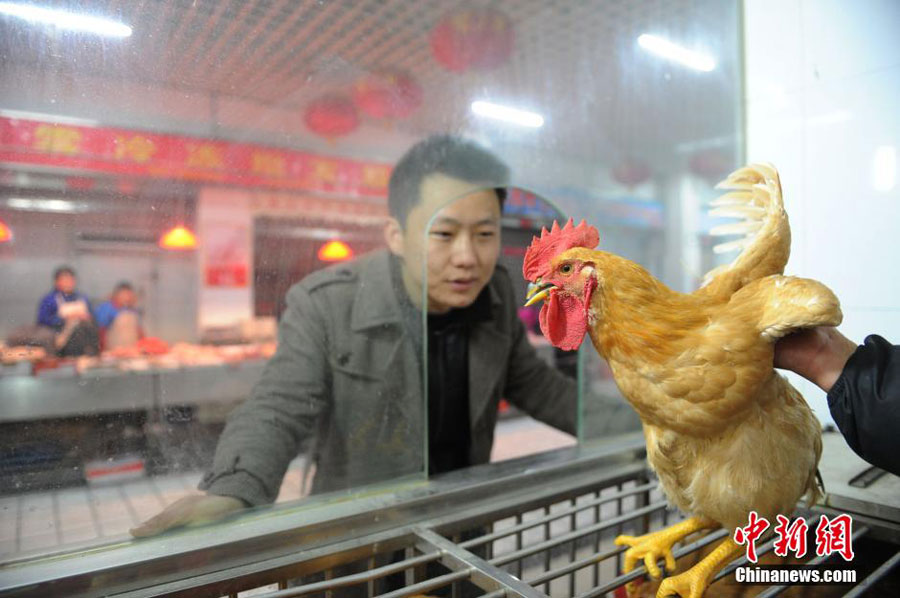
Live chickens at the Baixing Sanniao Wholesale Market in Guangzhou’s Baiyun district, Dec. 20, 2013. (Photo/CNS)

As millions of Chinese prepare to return to their hometowns for Spring Festival, the challenges of containing the latest H7N9 bird flu epidemic have come sharply into focus.

Health authorities are deeply concerned by the resurgent epidemic, with about twenty new cases reported in the first two weeks of 2014, mostly in the eastern costal regions. About 150 cases of H7N9 bird flu have been confirmed in China since the first case in March last year.

Li Lanjuan of the Chinese Academy of Engineering said the virus is more active in winter and spring, and that high density transportation in coaches, trains and aircraft could create favorable circumstances for the epidemic to spread.

Li is China’s leading researcher on bird flu and a member of the H7N9 prevention and control group. She warns that the virus might be spread by migrants returning to their, mainly rural, homes from developed eastern regions.

During the world’s biggest annual human migration in the 40 days around Spring Festival, about 3.62 billion trips will be made this year, according to Tuesday’s National Development and Reform Commission press release.

This year, the highlight of Spring Festival, Chinese Lunar New Year, falls on Jan. 31, which Chinese people traditionally celebrate as a family.

“We are worried about the risk brought by massive numbers of people gathering together in confined spaces,” said Dr Liang Weifeng of the medical college at Zhejiang University.

In Zhejiang, new H7N9 cases have been reported for six consecutive days. As of Tuesday, the eastern province had reported a total of 11, including some fatalities. Zhejiang was also the site of China’s first confirmed human-to-human transmission last November, when a man was infected while caring for his father-in-law.

More alarming still, Guizhou province in the remote southwest of the country confirmed its first H7N9 fatality on Saturday, that of a migrant worker who returned home from Zhejiang on Jan. 4.

Results of research by a Chinese team published in the Lancet, have established that the variation of an amino acid on the H7 gene has made the H7N9 strain more infectious to mammals.

“On the PB2 gene, we have found another variation in a key amino acid. One more variation of a specified amino acid, and human-to-human transmission will become much more likely,” said Liang, indicating his extremely high concern over the possibility.

The team recently identified a new partial variation in the virus, demonstrating its capacity to adapt to its environment.

“It has increased the risk of human-to-human transmission and brought more difficulty in treatment,” Liang added.

“In spite of this, there is no reason to panic. We can confirm that the H7N9 flu virus has not shown scaled variation and human-to-human transmission,” said Gao Hainyu, a member of the team drafting a thesis on the new results.

Another problem facing health authorities is that Spring Festival is also the peak season for poultry sales and consumption.

The Chinese have a long tradition of eating fresh food especially at important feasts and family reunions. Chinese people, especially those in eastern regions, like to buy live chicken and duck and slaughter them at home to serve fresh. Despite a government ban, live poultry markets are reemerging in some regions.

At an open-air market in Zhejiang, Cai, a local senior citizen, and his wife pick several live birds in preparation for cooking the city’s speciality, Hangzhou Roast Duck for the new year. “Dishes of chicken and duck are a must on New Year’s Eve. We can hardly change tradition,” said Cai.

“There is no problem after cooking, and the duck and chicken sold here have been quarantined,” said Zhu Linying, a housewife at Xianlinyuan market in Hangzhou.

Zhejiang and other provinces are cranking up H7N9 control with more inspections and tougher quarantine measures wherever live birds are sold.

Poultry are easily infected by H7N9, and the risk cannot be contained simply by closing live poultry markets, said Li Lanjuan.

“Some deaths were caused by delays in seeking medical advice, as the virus quickly attacks the lungs,” said Li, alerting people to mind their health during the holiday and go to hospital if they have fever or a cough.

And We Call Ourselves Civilized?

In agreeing with President Obama’s plan to strike Syria, Representative Nancy Pelosi was quoted as saying we must respond to actions “outside the circle of civilized human behavior.” Nice to hear that the U.S. Government thinks it has the moral authority to respond to such actions. While they’re at it, I can think of a whole lot of other actions which should be considered “outside the circle of civilized human behavior” that are desperately in need of responding to.

I’m referring, of course, to the innumerable abuses of non-human animals by humans—many that go on every day right here in the U.S. of A. I’m afraid if I were to try to list all the instances of human mistreatment of other animals which should fall outside the “circle of civilized human behavior,” the pages would fill the halls of justice, spill out onto the streets and overflow the banks of Potomac River in an unending tsunami of savagery.

So here’s just a partial list…

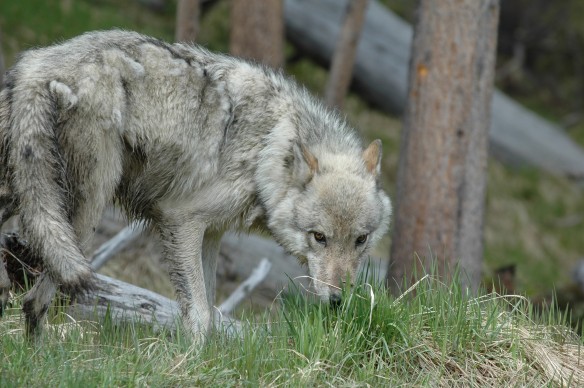
Wolf Hunting—No sooner did grey wolves begin to make a comeback in the Lower 48 than did the feds jerk the rug out from under them by lifting their endangered species protections and casting their fate into the clutches of hostile states. Now, hunters in Wyoming have a year-round season on them while anti-wolf fanatics in Montana have quadrupled their per person yearly kill quota.

Trapping—Only the creepiest arachnid would leave a victim suffering and struggling for days until it suits them to come along for the “harvest.” Yet “law abiding trappers” routinely leave highly sentient, social animals clamped by the foot and chained to a log to endlessly await their fate.

Hound-Hunting—“Sportsmen” not content to shoot unsuspecting prey from a distance of a hundred yards or more sometimes use hounds to make their blood-sport even more outrageously one-sided.

Bowhunting—Those who want to add a bit of challenge to their unnecessary kill-fest like to try their luck at archery. Though they often go home empty-handed, they can always boast about the “ones that got away”… with arrows painfully stuck in them.

Contest Hunts—Prairie dogs, coyotes, and in Canada, wolves, are among the noble, intelligent animals that ignoble dimwits are allowed to massacre during bloody tournaments reminiscent of the bestial Roman Games.

Horse Slaughter—After all that our equine friends have done for us over the centuries, the administration sees fit to send them in cattle trucks to those nightmarish death-camps where so many other forcibly domesticated herbivores meet their tragic ends.

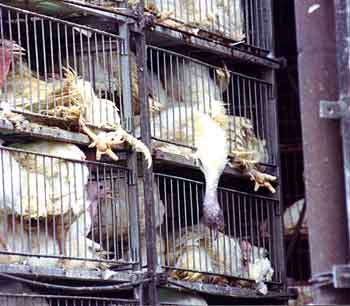
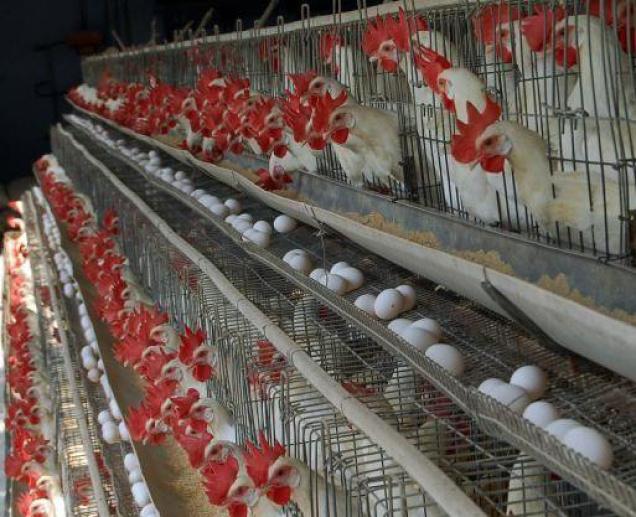
Factory farming—Whether cows, sheep, pigs, chickens or turkeys, the conditions animals are forced to withstand on modern day factory farms fall well outside even the narrowest circle of civilized human compassion. To call their situations overcrowded, inhumane or unnatural does not do justice to the fiendish cruelty that farmed animals endure each and every day of their lives.

Atrocious conditions are not confined to this continent. Chickens in China (the ancestral home of some new strain of bird flu just about every other week) are treated worse than inanimate objects. Bears, rhinoceros and any other animal whose body parts are said to have properties that will harden the wieners of hard-hearted humans are hunted like there’s no tomorrow. And let’s not forget the South Korean dog and cat slaughter, or Japan’s annual dolphin round up…

Far be it from me to belittle the use of chemical weapons—my Grandfather received a purple heart after the Germans dropped mustard gas on his foxhole during World War One. I just feel that if we’re considering responding to actions “outside the circle of civilized human behavior,” we might want to strike a few targets closer to home as well. Or better yet, reign in some of our own ill-behaviors so we can justifiably call ourselves “civilized.”

Text and Wildlife Photography ©Jim Robertson, 2013. All Rights Reserved

Text and Wildlife Photography ©Jim Robertson, 2013. All Rights Reserved

Newsflash: Chickens Are Sentient Beings, Not Future Nuggets

Was Your Chicken Nugget Made In China? It’ll Soon Be Hard To Know

September 5, 2013

Here’s a bit of news that might make you drop that chicken nugget midbite.

Just before the start of the long holiday weekend last Friday, the U.S. Department of Agriculture quietly announced that it was ending a ban on processed chicken imports from China. The kicker: These products can now be sold in the U.S. without a country-of-origin label.

For starters, just four Chinese processing plants will be allowed to export cooked chicken products to the U.S., as first reported by Politico. The plants in question passed USDA inspection in March. Initially, these processors will only be allowed to export chicken products made from birds that were raised in the U.S. and Canada. Because of that, the poultry processors won’t be required to have a USDA inspector on site, as The New York Times notes, adding:

“And because the poultry will be processed, it will not require country-of-origin labeling. Nor will consumers eating chicken noodle soup from a can or chicken nuggets in a fast-food restaurant know if the chicken came from Chinese processing plants.”

That’s a pretty disturbing thought for anyone who’s followed the slew of stories regarding food safety failures in China in recent years. As we’ve previously reported on The Salt, this year alone, thousands of dead pigs turned up in the waters of Shanghai, rat meat was passed off as mutton and — perhaps most disconcerting for U.S. consumers — there was an outbreak of the H7N9 bird flu virus among live fowl in fresh meat markets.

What’s more, critics fear that the changes could eventually open the floodgates for a whole slew of chicken products from China. As the industry publication World Poultry notes:

“It is thought … that the government would eventually expand the rules, so that chickens and turkeys bred in China could end up in the American market. Experts suggest that this could be the first step towards allowing China to export its own domestic chickens to the U.S.”

The USDA’s decision comes with a backdrop of long-running trade disputes over meat between the U.S. and China. In a nutshell: China banned U.S. beef exports in 2003 after a case of mad cow disease turned up in a Washington state cow. Then, when the bird flu virus broke out widely among Asian bird flocks in 2004, the U.S. blocked imports of Chinese poultry. China challenged that decision in front of the World Trade Organization, which ruled in China’s favor in 2010.

And, chicken lovers, brace yourselves: There’s more. A report suggests chicken inspections here in the U.S. might be poised to take a turn for the worse. The Government Accountability Office said this week it has serious “questions about the validity” of the new procedures for inspecting poultry across the country.

Basically, these changes would replace many USDA inspectors on chicken processing lines with employees from the poultry companies themselves. The USDA has been piloting the new procedures, which will save money and significantly speed up processing lines, in 29 chicken plants. As The Washington Post reports, the plan is to roll out the new procedures eventually to “most of the country’s 239 chicken and 96 turkey plants.”

The problem? According to the GAO, the USDA did a poor job of evaluating the effectiveness of the pilot programs it has in place.

As a result, the report concludes, it’s hard to justify the USDA’s conclusions that the new procedures will do a better job than current approaches at cutting down on the number of dangerous bacteria like salmonella that pop up on the birds that will later end up on our dinner tables.

Still, the USDA maintains that the changes will, in fact, boost food safety. In a commentary published on Food Safety News, USDA food safety and inspections administrator Alfred Almanza writes, “If finalized and implemented broadly, this new inspection system would enable [USDA inspectors] to better fulfill our food safety mission. Nothing in the GAO’s report contradicts this basic fact.”

Copyright 2013 NPR. To see more, visit http://www.npr.org/.

DSC_0140

China’s Poultry Industy is Losing One Billion Yuan PER DAY

While an article in the Hindu Business Line tells us that China’s poultry industry has  lost 65 BILLION Yuan since the end of March, what I found shocking is that the industry has been losing an average of one billion Yuan a day for the past two months! What I want to know is, how many millions of birds does it take to raise one billion Yuan and what kind of horrendous living conditions must that many birds be forced to endure? How miserably confined, overcrowded and devoid of any semblance to natural bird life must it be like (for the short time their allowed to live).

The article (inadvertently) points out some shocking facts, which I’ve highlighted incage_1 bold

Bird flu costs China’s poultry industry $65 bn: State media

Beijing, May 21:

China’s human H7N9 bird flu outbreak has cost the country’s poultry industry more than $65 billion as consumers shun chicken, government officials said according to state media yesterday.

The sector has been losing an average of one billion yuan a day since the end of March, the Beijing Times said, citing Li Xirong, head of the National Animal Husbandry Service.

H7N9 avian influenza has infected 130 people in China, killing 35, since it was found in humans for the first time, according to latest official data.

Poultry sales have tumbled and prices plunged, Li said, causing major financial problems and job losses as a result.

Another agriculture ministry official, Wang Zongli, said government agencies should set a good example for the public by treating “poultry products in a correct way”, the report added.

In a stunt to boost confidence, officials and poultry business leaders in the eastern province of Shandong held a widely reported all-chicken lunch last week, according to Chinese media.

China has seen several food safety scares in recent years, including one in which the industrial chemical melamine was added to dairy products in 2008, killing at least six babies and making 300,000 ill.

poultry_845904f_jp_1463316f

Chronicling the End, Part 2

Today’s installment of Chronicling the End is also centers on the new strain of bird flu, which could play a major role in the bringing on an early demise for the species since, as Jim Pipas, virologist at the University of Pittsburgh, said: “…H7N9 is so different from influenza viruses currently circulating in the human population, humans are likely to lack an effective immune response to the virus…”

But this crisis actually has a solution—if only people are willing to forgo one of their longest-held vices—eating birds.

As CNN reports: Anne Kelso, the director of a WHO-collaborating research center, said researchers had seen a “dramatic slowdown” in human cases in Shanghai after the city’s live poultry market was shut on April 6. Describing the finding as “very encouraging,” she said evidence suggests the closure of live poultry markets is an effective way to stop the spread of the virus.

The joint inspection team from China’s National Health and Family Planning Commission and the World Health Organization also found that, so far, no migratory birds have tested positive for the virus. It said the H7N9 virus is only being found in chickens, ducks and pigeons at live poultry markets. So far there is no evidence of sustained human-to-human transmission, the authorities say.

This doesn’t have to become a pandemic, people. Let’s think outside the bucket here. The simple solution is, close the poultry markets, give up meat, and stop confining birds by the billions.

On a related not, CNN Money reports: Bird flu eats up Yum profits in China…

130423215630-yum-china-620xa

Sick Minds Think Alike

Well, the Boston bombers are finally caught or killed and the streets are safe to jog on once again. Now, the only questions that remain are, what kind of people use gunpowder and ball bearings to kill their fellow sentient beings, and why? Well, I ask those questions every day—at least during waterfowl hunting season.

Maliciously spraying lead into a flock of migratory birds may not seem like terrorism to you, but to the ducks and geese on the receiving end of the shrapnel, it certainly does. Don’t get me wrong and somehow think I’m in any way trying to belittle or brush off the horrendous cruelty inflicted on others by the Boston bombers. No, quite the opposite—I want to get to the root of this kind of evil and weed it out of our species, if possible.

So why do people do it? What could possibly motivate someone to bury any scrap of compassion they might have and prey on the innocent? How do they justify the act of killing so many and how can they rationalize away the cruelty they’ve inflicted?

Perhaps the answer can be found in a recent quote from filmmaker Jennifer Siebel Newsom, in this case talking about the growing menace of violence against women: “…it’s about a culture that views women as objects to be acted upon rather than fully realized human beings,”

Objectification—now, isn’t that just what we’re talking about when someone kills, bullies or otherwise victimizes another to further an agenda or satisfy their own self interests? Just as the abuser objectifies women and the bomber objectifies innocent bystanders, hunters view their non-human targets as objects to be acted upon, rather than as fully realized beings.

And speaking of objectifying birds, here’s Huffington Post travel blogger William D. Chalmers’ idea of a joke in the face of a potential global pandemic: an article entitled, “Avoiding Avian Flu While Traveling in China,” wherein he lists the “…top 10 things to avoid in Shanghai as a traveler during the recent avian flu outbreak:

1. No wet markets where chickens are “processed” for dinner. They do things different here in China, no plastic-wrapped boneless chicken breasts in aisle three… they eye-ball their dinner.

2. No squab on a stick as pigeons may be a migratory transmitter. Oh, sorry, you didn’t know squab was pigeon! The things you learn traveling.

3. No less-than-over-hard runny eggs for breakfast. And push away that soft boiled egg too.

4. Avoid alternative modes of popular transportation used by farmers, such as chicken buses!

5. Attracting and posing for pictures with flocks of pigeons in local parks and gardens is probably not a good use of your time.

6. Although well-cooked poultry is fine, you might want to rethink that kung pao chicken or chicken satay. And chicken soup may not be the cure for what ails you.

7. Look on the bright side: eating out in Shanghai is cheaper as KFC is offering super special promotions.

8. While visiting China and jet-lagged up at 3 a.m., maybe you should change the channel when Alfred Hitchcock’s Birds comes on.

9. Try to forget the menacing virus; odds are you’ll probably succumb to the smog or a traffic accident.

10. Three words: designer surgical masks! They are all the rage among fashionistas here.”

Okay, well I’ve got another point to add to his list:
11. Forget the KFC or other over-cooked poultry products—try the tofu; that way you won’t bring the bird flu back home with you to spread among the rest of us…

DSC_0035

Factory Farming is Inherently Evil

Humankind may or may not be inherently evil, but sometimes it seems the species is fundamentally stupid. Take bird flu, for instance. The fact that a new strain has cropped up in China, sickening or killing people in the poultry industry (i.e. chicken chopping), has led to “significant” profit losses for Yum Foods, the parent company of Kentucky Fried Chicken.

Yet, after a campaign to reassure customers that KFC is “high-quality food,” Yum is STILL planning to open seven hundred new KFCs across China this year. I shudder to think just how many birds will suffer miserable lives and horrible deaths to provide buckets full of extra-crispy flesh for SEVEN HUNDRED new KFCs there!

In case you hadn’t heard about H7N9, the new strain of bird flu that has now killed 16 people and infected 77 in 11 different places across China, it differs from other avian influenzas in that not everyone who carries the virus shows signs of illness. That means people could be unwittingly spreading it from place to place, if not infecting other humans, at least infecting other bird populations. Although 40% of those infected with N7H9 have had no contact with “poultry,” we’re still being told there is “no evidence of sustained human-to-human transmission,” so by all means, build more KFCs (sarcastic edge included for emphasis).

But before you decide to grab your shotgun and take out avians for as far as lead can spray, consider the fact that modern strains of bird and swine flu are just cases of friendly neighborhood factory-farm-cruelty coming home to roost.

A cursory glance at PETA’s KFC Cruelty.com reveals:
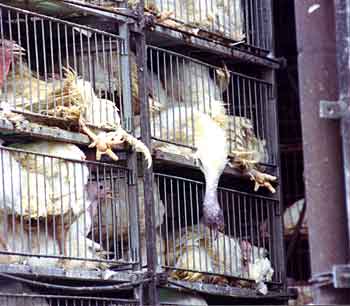
•The roughly 1 billion chickens killed each year for KFC’s buckets are crammed by the tens of thousands into excrement-filled sheds that stink of ammonia fumes.
•The birds’ legs and wings often break because they’re bred to be too top-heavy and because workers carelessly shove them into transport crates and shackles.
•Chickens’ throats are slit and the animals are dropped into tanks of scalding-hot water to remove their feathers, often while they are still conscious and able to feel pain.
•KFC lets frustrated factory-farm and slaughterhouse workers handle live birds, so many of the animals end up being sadistically abused.

The extreme insanity inherent in the ever-growing blight of modern factory farms—as well as the fact that most of the world’s 7 billion people still defend meat-eating and actively shun veganism— casts new light on the question of whether or not humans are inherently evil.

The former director of the CDC called the new strain of bird flu “a truly nasty virus” because, unlike previous strains, this one doesn’t seem to harm birds and can spread among flocks silently, making tracking its movement quite difficult.

I’m sure the birds would have a different opinion of a virus that doesn’t bother them, but instead affects the mammalian species which causes birds to suffer by the billions.

cage_1