Hello Mass Extinction

In yesterday’s post, “Bye Bye Biodiversity,” I mentioned the hundreds of miles of Iowa cornfields where nothing else grows or lives. Humans have seen to it that nothing else lives in that region, at first by physically killing off the birds and mammals through hunting and trapping, and next with poisons to eradicate those species they deemed “pests:” the insects and burrowing mammals, along with any competing plants, collectively known as “weeds.”

To see to it that only the resultant monoculture thrives, their chosen plants are genetically modified to repel any other life that might find its way into the wasteland 524958_3325028303604_654533903_n(also so they won’t reproduce on their own without the parent corporation’s seed stock). Much of the corn is grown to serve as feed for those other monoculture “crops:” cows, pigs and chickens stuck on factory farms.
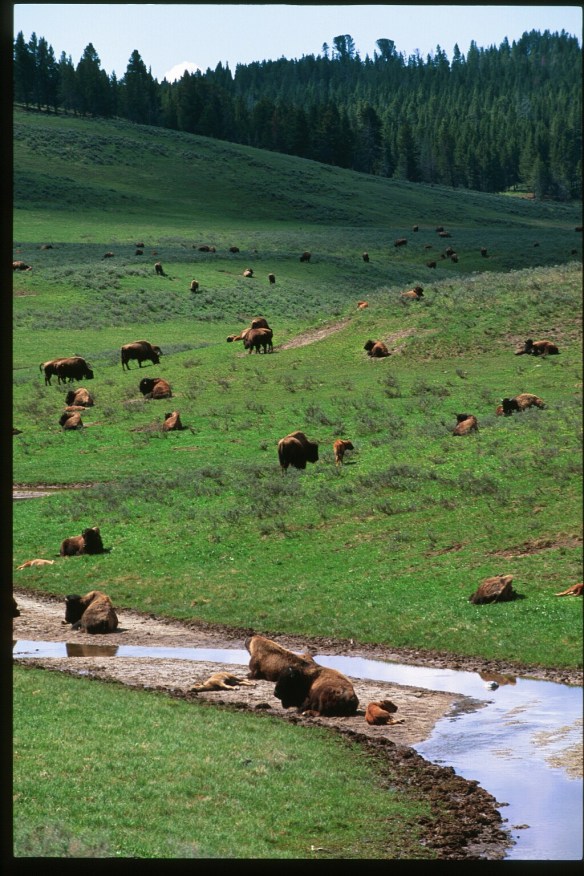
It requires huge tracts of open, flat land to allow for this kind of whole-Earth manipulation to go on, and the Midwest, once known as The Great Plains—the former home to vast herds of migratory bison and elk, pronghorn and prairie dogs, wolves, grizzly bears and more—was just the ticket.

As long as there are still miles of farm roads to speed their pickup trucks along and an occasional deer, coyote or “planted” pheasant to hunt, folks growing up there consider it to be the “country,” blissful in their ignorance of the biological diversity that thrived across the once wild land they call home.

It’s a similar story out west, where so much of the ancient forests have been removed and replanted with single-species tree plantations. Though the slopes are still mostly green, much of the wondrous diversity of life has been lost, along with the memory of whom and what once lived there.

By the same token, anyone arriving by transatlantic schooner would have no way of knowing that mass extinction in North America had already begun with the arrival of the first human hunters to cross the Bering land bridge a dozen centuries before. The megafauna which evolved on the Western Hemisphere—in glorious isolation from predacious human primates, whose greatest achievement may well be the complete undoing of all that evolution has created during this, the tail end of the age of mammals—would have brought to mind the African savanna; an American Serengeti.

Futuristic films, such as Soylent Green and Silent Running, suggest that when humans inevitably destroy the planet, there will be absolutely nothing left. But mass extinction does not necessarily equate to a totally denuded planet. The otherwise lifeless Midwest monoculture cropland, where one or two dominant species have displaced all others, is closer to what a mass extinction looks like.

In other words, we aren’t on the “verge of causing” a mass extinction, as the mainstream media (loath to report on anything that might affect the stock market) would tell you; we are among the living-dead in the midst of a human-caused mass extinction. It may not be the “Zombie Apocalypse,” but as far as life on Earth is concerned, it’s pretty damned scary.
Text and Wildlife Photography© Jim Robertson
Text and Wildlife Photography© Jim Robertson
Chapter Titles

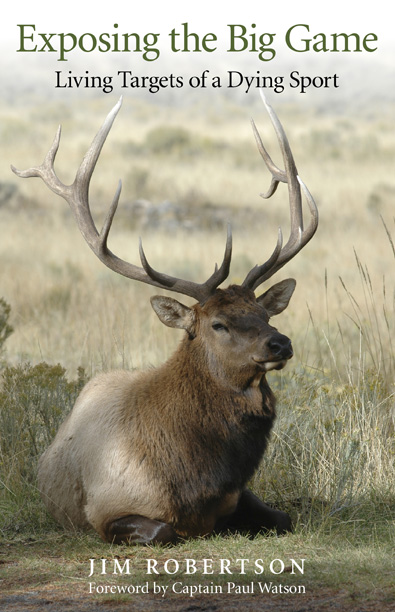
Here’s the Table of Contents for Exposing the Big Game?
Foreword by Captain Paul Watson

Introduction

Chapter 1) Hide-hunting Holocaust Survivors Still under Fire

Chapter 2) An Act of Bison Altruism

Chapter 3) War on Coyotes an Exercise in Futility and Cruelty

Chapter 4) Time to End a Twisted Tradition

Chapter 5) Avian Superstar Both Athlete and Egghead

Chapter 6) From the Brink of Oblivion and Back Again?

Chapter 7) A Day in the Sun for the Hayden Wolves

Chapter 8) Critical Cornerstone of a Crumbling Castle

Chapter 9) Bears Show More Restraint than Ursiphobic Elmers

Chapter 10) The Fall of Autumn’s Envoy

Chapter 11) Inside the Hunter’s Mind

Chapter 12) A Magical World of Oneness

Chapter 13) Living Targets of a Dying Sport

Chapter 14) A Few Words on Ethical Wildlife Photography

In Closing

Acknowledgements:

Looking back, this was not, at the outset, planned as a podium from which to lambaste anyone’s hobby or heritage, but was originally intended as a venue for relating some of the behaviors and capabilities I’d observed among animals living in the wild, and as a celebration of life along the compassion continuum. However, after delving deeper into the histories of the species covered here—thanks in part to the invaluable references listed below—I found it impossible to simply depict their natural activities without also chronicling the shocking stories of abuse they have suffered at the hands of man. It would have been doing the animals a disservice to merely record how they naturally lived without at least alluding to the far-reaching and pervasive ways that human actions have altered their lives and sometimes their very natures. And the facts are clear: there has been no greater direct human impact on wildlife than the ongoing threat of hunting. As with the other pertinent and profound quotes from a variety of enlightened sources, this one from Edward Abbey proficiently puts it in a nutshell, “It is not enough to understand the natural world. The point is to defend and preserve it.”

Over 7 Billion Served

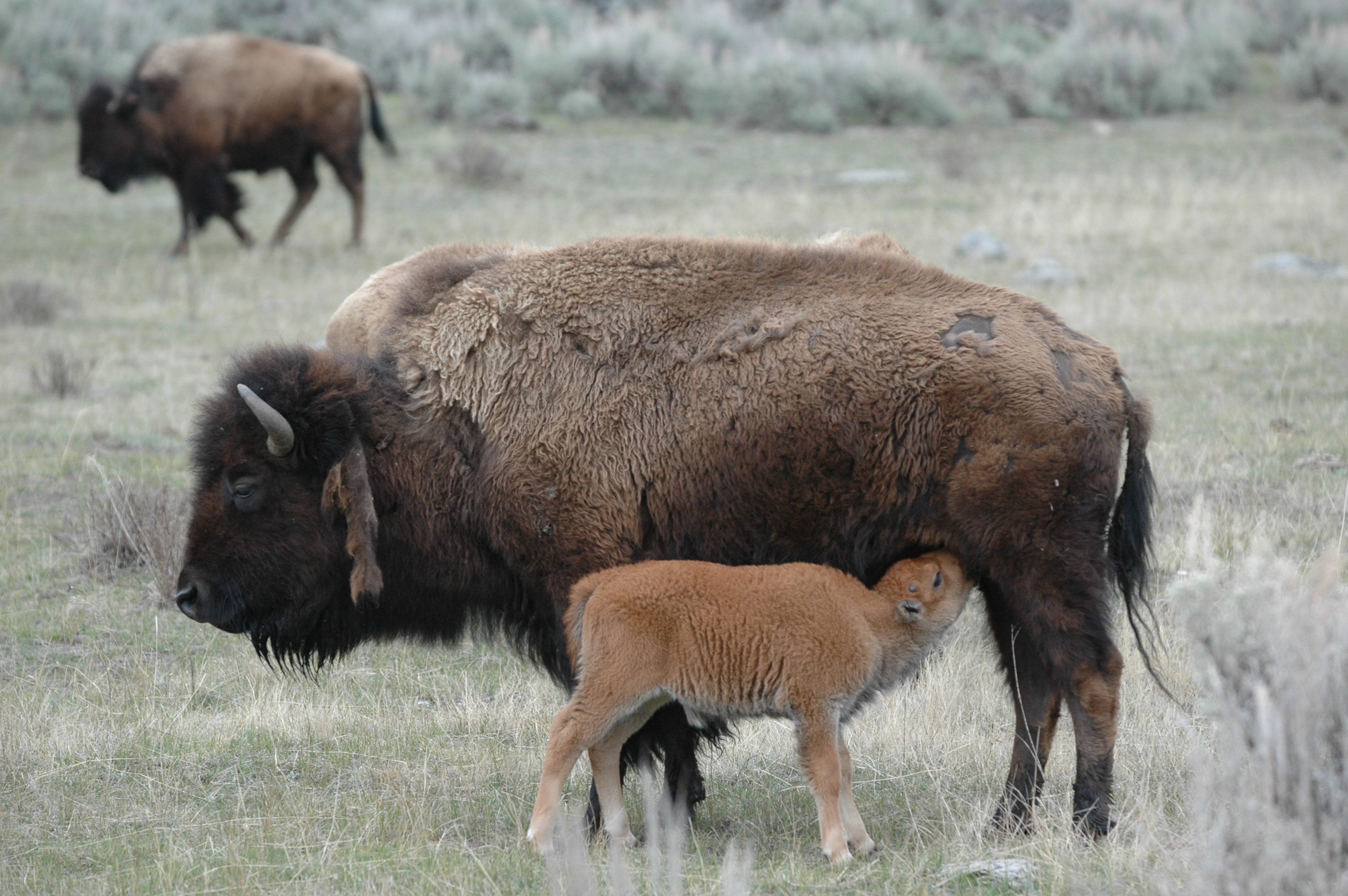
Bison calves are normally born in the spring or early summer. For the first few months of their lives they’re coat is an orange-ish color, turning progressively darker through the warm summertime, until by late August they are as dark as their parents and the other adult and sub-adult members of their herd.

So I was surprised to hear from my wolf-watching friend and former neighbor in southwest Montana that an orange bison calf was just seen in Yellowstone trailing an umbilical cord, a sure sign he was born within the past few days.

Not good timing, as nighttime temperatures hover in the teens now, and snow has already begun falling in the park. The snows will only get deeper and the temps colder for months to come. Life will be tough for the poor little calf this first winter; chances are good he won’t survive.

This is precisely the reason bison have evolved, as a rule, to being receptive to breeding exclusively in August. The ensuing gestation period assures that newborn calves are greeted with a full summer ahead of them. Nearly every animal species living above or below the equatorial belt has adapted to Earth’s changing seasons by only ovulating during a brief window of opportunity, thereby naturally limiting their populations.

Conversely, Homo sapiens can impregnate one another year-round. Our species has had it easy for so long—starting fires for warmth and skinning animals for clothes and shelter—that now human babies are  brought forth continuously, 24-7. At last report, 490,000 new humans per day are born to add to the 7 billion mostly carnivorous hominids already here.

Meanwhile, whenever bison herds in Yellowstone thrive enough to reach the arbitrary number of 3,000 total “head,” the park service and the Montana Department of Livestock implement a longer “hunting” (read: walk up and blast the benign, grazing, half-tame bison) season on them, or truck them off to the slaughterhouse—those nightmarish death camps where so many of the bison’s forcibly domesticated bovine cousins meet their ghastly ends in the name of human hedonism.

And people think we need to control their population?

Text and Wildlife Photography © Jim Robertson