Exposing the Big Game

Forget Hunters' Feeble Rationalizations and Trust Your Gut Feelings: Making Sport of Killing Is Not Healthy Human Behavior

Exposing the Big Game

Hunter gets death threats after posting picture of grizzly bear he just killed

Rob WaughMonday 17 Sep 2018 11:48 am Share this article via facebookShare this article via twitterShare this article via messenger A hunter has received death threats after posting images where he posed with a dead grizzly bear he had just killed. Former professional hockey player Tim Brent, 34, posted the images after killing the bear in Yukon, Canada. Brent said, ‘Alright folks, here is my Mountain Grizzly! We put an awesome stalk on him but he spotted us at about 75 yards. ‘Instead of taking off he turned and came right at us. It was very easy to tell this bear owned the valley we were hunting in and wasn’t scared of anything!’ 999 operator describes harrowing 40 minute call with mother she couldn’t save in Grenfell In another photo, Brent poses holding up the dead animal’s paw saying, ‘Did you know on average a single Grizzly eats around 40 Moose and Caribou calves during each calving season?’ The posts provoked a flood of anger and revulsion when he shared them on Instagram – with some commenters posting death threats. Some posters said they hoped he would be mauled to death by a bear – and one suggested they would call in a ‘Mexican cartel’ to kill him. In response, a defiant Brent posted images of his fridge filled with meat from animals he has killed. Share this article via facebookShare this article via twitterShare this article via messenger


Read more: https://metro.co.uk/2018/09/17/hunter-gets-death-threats-after-posting-picture-of-grizzly-bear-he-just-killed-7952015/?ito=cbshare

Twitter: https://twitter.com/MetroUK | Facebook: https://www.facebook.com/MetroUK/


A former Canadian pro-hockey player has come under fire after tweeting about hunting and killing a grizzly bear earlier this week.

Posting on Twitter a photo of himself posing with the bear, 34-year-old Tim Brent said they’d ‘put an awesome stalk on him’.
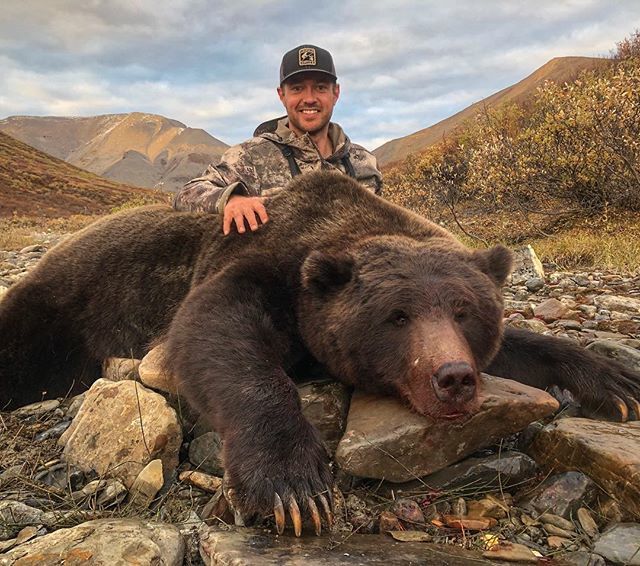
Explaining that the animal had spotted them at about 75 yards, he added: “Instead of taking off he turned and came right at us. It was very easy to tell this boar owned the valley we were hunting in and wasn’t scared of anything!”

Brent, who used to play for the Toronto Maple Leafs in Canada’s National Hockey League, has since also posted photos of ‘his’ Yukon moose, which he said ‘absolutely humbled’ him.
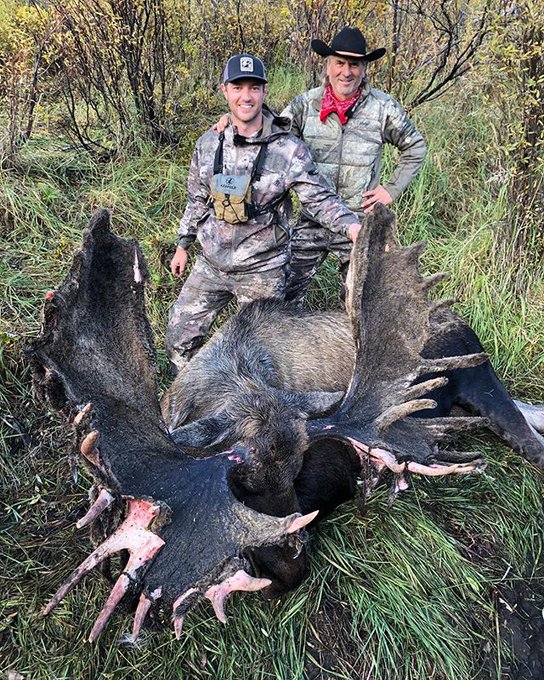
Brent has since received backlash for both his hunting habits and openly boasting about them. His tweet where he poses with the dead bear has racked up 20,000 comments.

It’s even caught the attention of several big names, including comedian Ricky Gervais, who regularly speaks out about animal rights. He tweeted: “I bet killing this beautiful bear put ‘an awesome stalk’ on Tim too.”

Sherlock actor Amanda Abbington also condemned Brent’s actions – and was clearly not holding back, writing: “You are a c***. A stupid, inbred, unfeeling piece of s*** c***.”

Others said the photo and caption were ‘disgusting’, ‘horrible’ and ‘nauseating’.

Brent later tweeted to say he’d even received death threats, writing: “These are the types of messages I am getting on twitter in response to my moose and bear hunts.

“I would love to know what constitutes a threat or abuse for Twitter? This is what we are up against as Hunters.”

Featured Image Credit: Twitter/Tim Brent

Canadian Burger Chain Sells Out of Plant-Based Patties

https://www.bloomberg.com/news/articles/2018-09-14/hold-the-beef-canadian-burger-chain-sees-new-growth-in-plants
 Updated on 
  • A&W offering of Beyond Burger exceeded expectations, CEO says
  • More consumers seeking alternatives for health, environment
An A&W restaurant in Toronto.

Photographer: Andrew Francis Wallace/Toronto Star via Getty Images

After more than 60 years of dishing out beef burgers, a Canadian fast-food chain has found new success in an unexpected product: a patty made from peas, mung beans and beets.

A&W Food Services of Canada Inc., the country’s second-largest hamburger chain, is tapping into growing demand for plant-based protein by becoming the first national burger chain to offer California-based Beyond Meat’s burger on its menu in July.

The Beyond Meat burgers sold out nationwide in a matter of weeks, said Chief Executive Officer Susan Senecal. The veggie burgers will be back in stock across Canada Oct. 1.

“It became even more popular than we had expected,” Senecal said in a telephone interview from Vancouver. “Plant-based protein has gained in popularity and it really is something people are very interested in.”

A&W is the latest meat-focused company that sees growing opportunities in plants as some consumers turn away from traditional protein amid concerns about environmental impact, animal welfare and maintaining a healthy diet. Tyson Foods Inc., the largest U.S. meat producer, in 2016 acquired 5 percent of Beyond Meat, which has also gotten the backing of billionaire investor Bill Gates. Maple Leaf Foods Inc., Canada’s largest packaged meat company, is now stocking shelves with plant-based imitators after acquiring vegetarian producer Lightlife Foods.

Five years ago, A&W started to home in on growing consumer demand for more information and transparency about their food, said Senecal, noting the chain now offers beef raised without any added hormones or steroids and chicken raised without antibiotics. The plant-based burger builds on consumer desire for more natural foods and the company is constantly monitoring how the trend develops, she said.

Youths aged 16 and older can now join in the moose hunt, which begins this weekend

For the Buckle family of Corner Brook, hunting is a family affair — one that goes back decades.

Matthew Buckle was waddling through snow to bring partridges back to his father almost as soon as he could walk. His wife, Tammy Buckle, also started hunting and fishing as a child, going out as a family with her 16 siblings. [!!]

“All my fondest memories of spending time with my father, it’s always been hunting and fishing,” Matthew Buckle said.

“It’s what I grew up doing. It’s what I love doing.”

Now the couple brings their own three children out hunting as well and this year their daughter Emily, who just started Grade 12, hopes to shoot her first moose.

Emily’s goal is possible this year due to recent changes in hunting regulations in Newfoundland and Labrador. One of the most significant changes is the new minimum ages of 16 for big game hunting and 12 for small game hunting, Fisheries and Land Resources Minister Gerry Byrne told CBC’s Corner Brook Morning Show on Friday.

Watch out, moose: hunting season starts Saturday. (CBC)

“We’ve taken a number of very deliberate actions to increase access to our outdoor heritage,” Byrne said.

Minimum hunting ages were previously 18 for big game and 16 for small game.

‘I want them to learn what I know’

The reduction in hunting age will give young people more opportunities to spend time in nature, Byrne said.

“One of the big considerations in this was when you provide an opportunity for our young people to get access to the outdoors, to get access to hunting, they learn very, very important skills at an early age,” he said.

“Not only do they learn better safety skills that they retain for a lifetime, but they also retain important conservation principles and values.”

Young hunters have to fulfil the same safety requirements as adults. (Ashley Taylor/Labrador Hunting and Fishing Association )

That’s a key motivation for the Buckles.

“I want them to learn what I know,” said Matthew.

“I want them to learn about nature and the ethics of hunting. I want them to know where our food comes from and how to get clean, organic, free-range meat for your future.”

Those lessons have resonated with daughter Emily, who says she enjoys time spent hunting with her family and values the food from their hunts.

“When you kill something, you get to eat it and you get to know where it comes from,” she said.

The shared experience is a source of pride and enjoyment for the whole family, Matthew said.

“It definitely makes me proud to see my own kids involved in the things that I love to do. It’s so enjoyable just to see them in nature, to see them interacting without their iPhones, without their Xbox.”

Training requirements same for youth and adults

The eligible age for hunting licences has been lowered, but the safety restrictions are just as stringent as they are for adult hunters, Byrne said.

“There will be no 16-year-olds that will be hunting big game without adult supervision,” said Byrne, who said the same is true for small game.

‘There are very, very strict requirements that are in place to be able to receive a licence and participate in the hunt, and safety and training are part of those requirements.”

Eligible hunters of all ages must complete a hunting test for firearm safety and a hunter education program, and the province is offering youth hunter skills workshops a few times a year in different locations around the province. A recent workshop in Deer Lake had about 50 attendees, Byrne said, and another will be held in Happy Valley-Goose Bay this weekend.

There will be no 16-year-olds that will be hunting big game without adult supervision.– Gerry Byrne

Safety is a key consideration for the Buckle family as well, and Tammy is a hunting safety instructor.

“‘When it does come to the firearms component, safety is of the upmost importance to us,” she said.

The couple have worked to instill a respect for and knowledge of hunting safety in their children from a young age, she said, including not just firearms but also rabbit snares and fish hooks.

Emily Buckle completed her firearms safety training before obtaining her first moose licence, and plans to practise before she goes out to hunt herself.

Such experiences, when done safely, are a valuable way to preserve both provincial and family traditions, Byrne said.

“It’s a great experience for a mother and a son, or a father and a daughter, to be out in our Newfoundland and Labrador outdoor heritage to participate in this.”

Read more from CBC Newfoundland and Labrador

With files from The Corner Brook Morning Show

How the killer whale became the Achilles heel of Trans Mountain pipeline approval

Southern resident killer whales are designated under the Species At Risk Act, which means federal prohibitions exist against anything that would harm them or habitat considered critical to their survival.(Valerie Shore/Shorelines Photography)

It’s been a summer of dramatic killer whale news — from a mother holding up her dead calf for 17 days in a gut-wrenching display of grief, to a boatload of scientists shooting a sick whale with a dart full of antibiotics.

Now, B.C.’s ailing southern resident killer whale population is proving itself a wedge in one of the most headline-grabbing issues in the province.

In the 200-page decision released by the Federal Court of Appeal Thursday morning, effectively quashing the government’s approvals to build the Trans Mountain expansion project, B.C.’s southern resident killer whales are mentioned no fewer than 57 times.

The court ruled that the National Energy Board (NEB) review failed to assess the impacts of marine shipping — saying it was so flawed, it should not have been relied on by the federal cabinet when it gave final approval to proceed in November 2016.

Activists, lawyers and academics say the decision demonstrates environmental corners cannot be cut when governments seek social licence for major infrastructure projects — especially in a case where increased tanker traffic and vessel noise are known to be key threats to killer whales.

“It’s very clear from this decision that environmental assessment considerations and Species At Risk Act decisions aren’t optional, and they need to be taken seriously,” said Dyna Tuytel, a lawyer with Ecojustice, who represented conservation groups that filed a court challenge to the federal government’s approval for a pipeline expansion.

“There’s a risk in taking shortcuts,” said Eric Taylor, a professor of zoology at the University of B.C., and the chair of the Committee on the Status of Endangered Wildlife in Canada.

“It’s going to come back and bite you, as it’s done here.”

Narrow reading of the law

According to the ruling, the shortcut, or “critical error” made by the NEB, was to define the scope of the project as only the pipeline and the marine terminal for the purposes of its environmental assessment.

So although the project looked at marine shipping during the review, it did not assess it to environmental standards, nor did it apply the Species At Risk Act to the effects of marine shipping on endangered species.

B.C.’s southern resident killer whales are considered at risk because of their small population, low reproductive rate and threats including marine traffic and lack of food. (Dave Ellifrit/Center for Whale Research)

“The NEB acknowledged that on the facts there were significant adverse effects of the project on southern resident killer whales — but the board, by defining the project narrowly, was able to say that the project was not likely to cause significant adverse effects,” said Tuytel.

Taylor called the decision to leave out the project-related tanker traffic in the review “unfathomable.”

“The oil is not going to sit there in barrels, it’s got to move out by ships. And ship traffic has clearly been identified as a threat to this endangered species. So it’s unconscionable that they ignored it,” he said.

Cutting corners

Tuytel called the ruling “fairly unusual.” But Taylor said he wasn’t surprised, given the threats to southern resident killer whales have been clear for over a decade.

“I think the court really had no other choice than to do this,” he said.

The whales, which are also threatened due to toxic contamination levels and low supplies of Chinook salmon, are designated under the Species At Risk Act, which means federal prohibitions exist against anything that would harm them or habitat considered critical to their survival.

In June, the federal Department of Fisheries and Oceans pledged measures to slow down vessel traffic, noting the population was facing an imminent threat to survival.

Fuel spills and underwater noise from tankers are just some of the threats that have endangered the southern resident killer whale population. (Michael Mcarthur/CBC)

Since the time the NEB reviewed the project, B.C.’s southern resident population has declined from about 82 to 75.

The project would increase capacity from five ships a month through Burrard Inlet to a maximum of 34 oil tankers capable of carrying 120,000 tonnes of diluted bitumen at a time.

According to the NEB report, Trans Mountain acknowledged the additional noise the project would create, but argued that the shipping lanes “will continue to host marine vessel traffic with or without the project, and that the impacts to the southern resident killer whales will continue to exist with or without the project.”

Killer whales a ‘flare’ for other issues

This is not the first time whales have played a role in halting a major Canadian infrastructure project.

Last year, energy giant TransCanada scrapped plans for a port for its proposed Energy East pipeline after protesters raised alarms about impacts on the calving grounds of the vulnerable beluga population in the St. Lawrence Estuary.

Taylor said the pipeline and its associated infrastructure are likely to have impacts on many species, but because of the popularity of killer whales, they tend to act as a “flare” for many of the issues associated with the project.

“If this was a lichen, many, many fewer people would be paying attention,” he said.

Nunavut hunter killed by polar bear and cub; 5 bears destroyed following attack


A polar bear walks over sea ice floating in the Victoria Strait in the Canadian Arctic Archipelago. RCMP say a hunter died after a polar bear attack near Naujaat, Nunavut. (David Goldman/Canadian Press)

A man from Nunavut has been killed in a polar bear attack, according to officials.

He was attacked by a mother polar bear and her cub, said Solomon Malliki, the mayor of Naujaat, the northern community from which the man and two other hunters set out last week.

The other hunters were injured in the attack.

The mother and cub were destroyed at the scene, Malliki said, as were three other bears who were attracted to the area in the following days.

The hunters were victims of a polar bear attack.– RCMP news release

“It was a heavy burden to share the sad news with our community,” Malliki told CBC News, in Inuktitut.

It was not immediately clear when the attack happened.

“One of the hunters was deceased and the two others had minor injuries,” the RCMP said in a statement. “The initial investigation has revealed that the hunters were victims of a polar bear attack.”

The three hunters left Naujaat last week to go caribou and narwhal hunting, according the RCMP. They didn’t return on Thursday as planned and were reported overdue on Sunday.

Malliki said they’d been hampered by bad weather and mechanical problems.

On Monday, the Canadian Armed Forces Joint Rescue Co-ordination Centre in Trenton, Ont., organized a search and rescue mission with Nunavut authorities and local community searchers.

A Hercules aircraft and multiple boats from Naujaat began searching, the statement said, but the team was not able to reach the location where they believed the hunters were, because ice was blocking their path.

Earlier Tuesday, a second Hercules aircraft and a coast guard icebreaker, CCGS Louis S. St-Laurent, joined the search effort.

The hunters were found on White Island, near Naujaat. Naujaat, formerly known as Repulse Bay, is a community of about 1,080 on the shores of Hudson Bay. (CBC)

The men were located on White Island, some 100 kilometres southeast of Naujaat, by the icebreaker’s helicopter, according to a spokesperson for the coast guard and Fisheries and Oceans Canada.

“We are saddened by this incident and send our thoughts and condolences to the families involved,” said Lauren Solski in an email.

The name of the dead man has not been released.

2nd fatal attack

The RCMP said they’re investigating with the assistance of the chief coroner, and the Nunavut Department of Environment has been notified of the attack.

Naujaat, formerly known as Repulse Bay, is a community of about 1,080 on the shore of Hudson Bay.

This is the second fatal polar bear attack in Nunavut this summer. Aaron Gibbons, 31, was unarmed when he encountered a bear near Arviat in July. Community members said Gibbons was with his children at the time and put himself between them and the bear.

Donald Trump Jr. back in Canada for his annual hunting trip

https://vancouversun.com/news/local-news/donald-trump-jr-back-in-canada-for-his-annual-hunting-trip

The eldest son of U.S. President Donald Trump posted photos over the weekend of him boarding an expedition plane out of Whitehorse, Yukon.

SHAREADJUSTCOMMENTPRINT

Donald Trump Jr. is back in Canada to hunt.

The eldest son of U.S. President Donald Trump posted photos to his social media accounts over the weekend of him boarding an expedition plane out of Whitehorse, Yukon. The plane is believed to be an Alkan Air plane, a Yukon-based private aircraft charter.

“Mountain time. See you all in a week. Won’t have cell or anything else for that matter. #goodtimes #outdoors,” Trump posted.

Donald Trump Jr. posted to social media that he was on a hunting trip this weekend. INSTAGRAM

In his Instagram photo, Trump is accompanied by five others, including a videographer and a photographer, all of whom are dressed in outdoors gear and swag emblazoned with Kuiu, the name of a hunting gear and apparel company.

Last fall, Trump was spotted at a Prince George airport, on a layover while returning from a trip up north. He is a frequent hunter and regularly visits Canada on annual hunting trips.

Donald Trump Jr. Ditched Secret Service to Go Moose Hunting

Bears’ dip in pool caught on camera in Sudbury

https://www.thesudburystar.com/news/local-news/bears-dip-in-pool-caught-on-camera-in-sudbury
SHAREADJUSTCOMMENTPRINT

Sunday in Sudbury was hot. How hot? A momma bear and a cub felt compelled to take a quick dip in Vip Palladino’s pool.

Palladino, vice president of Palladino Honda, located on the 990 Kingsway Sudbury, said the bears used his backyard in-ground pool Sunday afternoon.

“Even bears need to cool off on a hot day,” Palladino joked.

Palladino said he was inside his house reading a new novel in his south end home when he heard his neighbour knocking on the door Sunday.

His neighbour asked if he knew he had two bears swimming in his pool. Palladino said no, ran to the window, but the bears had already left. Thankfully, his neighbour took some shots of the momma bear and cub swimming in his pool.

The bears didn’t wreck the lining in the pool and must had only been swimming for five minutes before they decided to leave, Palladino said.

Bears sighting, of course, are not that unusual here, the City of Greater Sudbury said on it website, the city said. The city’s website provides a link for residences who are curious to learn and understand bear behaviour, as well as take steps to avoid any encounters.

According to Ontario.ca, if you feel a bear poses an immediate threat to personal safety, and either enters a school yard when school is in session, enters or tries to enter a home, wanders into public gathering, kills livestock or pets, and stalks people, you should call the local police service.

“Generally bears want to avoid humans. Most encounters are not aggressive and attacks are rare,” the province said on its website.

Non-emergencies should be reported to Bear Wise between the months of April and November at 1-866-514-2327.

Non-emergencies include bears roaming around, checking garbage cans, breaking into a shed where garbage or food is usually stored, in a tree and moving through a backyard or field, but is not lingering.

During December to March, contact your local Ministry of Natural Resources and Forestry if you have a concern.

If you want to avoid bear encounters, the website gives you the following steps:

– Do not put your garbage out at night.

– Fill your bird feeders during the winter months.

– Do not leave pet food outdoors or near screened-in areas.

– Pick up fallen and rotten fruit off your property.

– Lastly, make sure your barbecue has burned off any food residue, empty grease trap and remove all dishes after eating if you want to eliminate any possible bear encounters.

If you do happen to encounter a bear, the website said not to panic and assess the situation as a sighting, a surprise or a close encounter.

“When bears are caught off guard, they are stressed and usually just want to flee. Generally the nosier the bear is the less dangerous it is, provided you do not approach the bear. The noise is meant to ‘scare’ you off as a warning signal,” according to the website.

Do not scream, turn your back on the bear, run, kneel down, and make direct eye contact. Also don’t try to climb a tree or retreat into water — a bear can swim much better than you.

New Study Sheds Light on Suffering of Canadian Dairy Cows

Grande Cache animal lover ‘devastated’ after bear cub euthanized by provincial officials

Groot, a grizzly bear cub discovered by a highway near Grande Cache, was destroyed after a local animal advocate turned it over to provincial wildlife officials. ORG XMIT: nkDgueFEGHZbedIRnR4d EDMONTON

SHAREADJUSTCOMMENTPRINT

A Grande Cache animal advocate is distraught after an abandoned grizzly bear cub she nursed back to health was destroyed by provincial wildlife officials.

“I was absolutely devastated,” said Brandy Gienger of the Grande Cache Animal Society. “I was heartbroken when I passed him over to the fish and game officers because I knew that he was going to be euthanized.

“I knew that (they) were just telling me what I wanted to hear so they didn’t have to create a scene with someone.”

On May 3, a work crew informed Gienger of an abandoned bear cub along Highway 40 near the Sheep Creek Bridge. The animal society called Alberta Fish and Wildlife, who told Gienger to leave the animal because its mother was probably out hunting.

The bear was still there among the rocks three days later. On the fourth day, the cub was gone, so Gienger assumed it had been picked up by its mother or fish and wildlife.

One day later though, someone called to say the bear was still in the same area by the highway. That evening, they went to collect the cub, who they decided to call Groot.

An Alberta wildlife rescue organization said it would work to rehabilitate the starving animal, and instructed Gienger how to care for him. Gienger kept him in a dark kennel to keep him from becoming habituated to humans, and fed him goat’s milk, which the famished bear cub loved.

Groot, a grizzly bear cub discovered by a highway near Grande Cache, was destroyed after a local animal advocate turned it over to provincial wildlife officials.  EDMONTON

By Thursday, they were ready to send the bear to the rescue centre when they got a call that conservation officers were on their way to collect him.

Gienger said she was reluctant because the bear was hours away from heading to a rescue. But she was assured the officials would “take the best interests” of the bear cub and take care of it.

On Friday morning, an apologetic provincial official told Gienger that the bear had been destroyed because he was severely dehydrated and his organs had stopped functioning properly. That ran counter to what Gienger had seen.

In a statement, Alberta Environment and Parks officials said steps were taken to find a facility that would accept a grizzly bear for permanent care, such as a zoo. However, they were unsuccessful, and said they had no choice to euthanize the “emaciated, dehydrated, lethargic” bear which was “near death.”

“This was a very sad situation, but unfortunately, officials felt the most humane thing to do was to limit the animal’s suffering,” the statement reads. “The decision to humanely euthanize this grizzly bear cub was not made lightly.”

Alberta recently approved a rehabilitation protocol for orphaned black bears, the statement added. However, the “rehabilitation requirements for grizzly bears are different, often requiring specialized care for a longer period of time.”