Fort Nelson residents want grizzly bear gone but conservation officer says it’s ‘not too much of a concern’

‘It’s just sightings; there’s no conflict involved that we’ve been made aware of,’ says officer

The grizzly bear seen in Fort Nelson, not pictured here, is around three years old, weighs 300 pounds and has a brown coat with silver tips. (Jacques Boissinot/The Canadian Press)
28
comments

Fort Nelson resident Linda Mould wants to see the B.C. Conservation Officer Service take action because of a grizzly bear that’s been spotted over the past few weeks.

She’s not the only one either. Social media in the northern Interior community has been abuzz with bear sightings and conservation officer Jeff Clancy said he’s been getting upwards of three phone calls a day about it.

“Right now, it’s just sightings. There’s no conflict involved that we’ve been made aware of,” he said.

However, Mould, 66, who has lived in the area for more than 60 years, said bears are not common in the community and she is worried about the danger the grizzly poses to children.

Social media in Fort Nelson has been abuzz with grizzly bear sightings. Collet Nadon snapped this photo on September 2 of a bear footprint on a trail near Fort Nelson Secondary School. (Photo by Collett Nadon)

“There are numerous people that have their children in school that they are not allowing them to stand outside to take the bus,” said the grandmother of nine.

“They’re severely limited as to what they’re able to do outside right now, because the parents are afraid of this grizzly bear that’s lurking on the outskirts. So, if something’s not done, which I’m quite confident nothing will be done, these kids are basically being held hostage prior to winter even starting.”

People in the area have been talking about bear sightings since the end of August. Mould believes that if a grizzly bear was wandering in a larger city like Vancouver, it would have been removed by now.

“Grizzly bears are not normal to Fort Nelson and all we’re doing is just keeping an eye on them,” she said.

“I just really wish that the COs would take us a little bit more seriously and understand and appreciate that our fear is honest. Just because we have not been educated in the way of the bear does not mean that we don’t have respect for them and are afraid of them,” she added.

Monitoring the situation, says conservation officer

Clancy has seen the bear and describes it as a 300 pound, three-year-old grizzly with a brown coat and silver tips on its back.

Up until now, the bear has mostly been seen on large rural properties on the outskirts of the community, chowing down on fruit and grass, he said.

When Clancy saw the bear and approached, he said it took off.

“It still has its fear of humans which is good. You know it doesn’t show any signs of habituation,” said Clancy.

“It does seem to have some sort of food condition habits right now. It is coming back to the same location, but nothing that’s causing any concern.”

They are currently monitoring the bear and have set out traps for it. “If we can capture it, then we will relocate,” said Clancy.

He added that for those who are concerned it is just him monitoring a large area of northern B.C. as a conservation officer, RCMP officers in the area are also trained to respond if there is an incident with the bear.

However, they have no plans to put it down.

“A unique sighting of a grizzly bear hanging around some rural properties is not enough to euthanize a bear. And I am pretty sure the majority of the public in British Columbia would agree with me on that,” said Clancy.

“It’s just unfortunate that he’s kind of found a nice comfy home next to some residences close to Fort Nelson.”

Daybreak North
Roaming grizzly bear not a threat to Fort Nelson residents, CO says
00:00 10:08

A 300-pound grizzly bear has been seen wandering around a rural Fort Nelson neighbourhood for nearly a month, eating apples and lawn cuttings. The local conservation officer says it’s not a threat, but not everyone feels safe. 10:08

Subscribe to Daybreak North on CBC Listen or your favourite podcast app, and connect with CBC Northern British Columbia on FacebookTwitter and Instagram.

Male grizzly bear killed on Trans-Canada Highway

https://www.cochranetoday.ca/local-news/male-grizzly-bear-killed-on-trans-canada-highway-1674171

A 275-kg male grizzly bear was struck on killed on the Trans-Canada Highway.

A large male grizzly bear was struck and killed on the Trans-Canada Highway on provincial lands last week.

Provincial wildlife officials say a large 275-kg male grizzly was reported dead in the highway ditch on Wednesday evening (Aug. 28) near Jumpingpound Creek – the third large male grizzly to be killed in that area in the past five years.

“It’s a real drag because we’re trying to reduce mortality, and highway mortality is problematic,” said Jay Honeyman, human-wildlife conflict specialist with Alberta Environment and Parks.

“The volume of traffic these days on the Trans-Canada is quite heavy, even during the week and in the evenings,” he added.

“It’s really challenging for bears to cross that highway without having some kind of an incident. I guess it’s not a surprise that we’re having these incidents with all the traffic.”

Historically, Alberta is estimated to have had between 6,000 and 9,000 grizzly bears. Grizzlies once ranged across the whole of Alberta, across Saskatchewan and into Manitoba.

When extensive DNA research determined Alberta’s population had dipped to about 700 individuals, the grizzly bear was declared a threatened species in Alberta in 2010. The count is being updated.

Most grizzly bear deaths are caused by humans, including poaching, being mistaken for a black bear during the black bear hunting season, self-defense and accidents such as being struck on roads.

In those years, more than half of the human-caused grizzly bear deaths were due to poaching and accidental deaths on roads and railway. There have been 57 known poaching cases and 63 accidental in the past 10 years.

The Alberta Wilderness Association has concerns about the ongoing high numbers of human-caused grizzly bear deaths.

“Human-caused mortality continues to be a problem,” said Joanna Skrajny, a conservation specialist with AWA.

“Human contact and human incursion into grizzly bear wildlife habitat is the main reason why they are dying.”

Skrajny said the fact that three large make grizzlies have died in that area of the Trans-Canada Highway in the last few years suggests an obvious start is a study to determine if a crossing structure may be warranted.

“In situations where we keep coming into contact with grizzlies and they keep dying, we have to reassess what we’re doing,” she said.

AWA is waiting on an update of the status of the grizzly bear population in Alberta, as well as updated grizzly bear mortality numbers for 2018 and 2019.

Skrajny said high numbers of human-caused mortality could mean it’s hard for a grizzly bear population to regulate itself.

“It means we’re not doing a good job of keeping their habitat safe,” she said.

“Even if grizzly bears are coming in from B.C. where some of the numbers are higher, they’re coming here to die in the end and that means we’re not doing our job properly.”

In addition to bears dying on provincial lands, two grizzly bears have died in Banff National Park this summer.

A male grizzly was struck and killed by a semi-trailer on Highway 93 South just after midnight on June 4, about one kilometre south of the Trans-Canada Highway heading up the hill towards Storm Mountain.

On June 22, Parks Canada was forced to kill an injured and emaciated young female grizzly bear. It’s believed a vehicle struck the bear on the highway 10 days earlier. The yearling, its sibling and mother were on the wrong side of the fence meant to keep wildlife off the highway.

“We’ve also had a couple of confirmed strikes where we don’t know if the bear survived or not,” he said.

‘I can’t believe I killed a wolverine with an ax’: North Idaho native wins reality wilderness survival show, $500,000

UPDATED: Thu., Sept. 5, 2019, 11:05 a.m.

Janahlee Jonas sneaks up on her husband, Jordan Jonas, on the final day of the reality TV show, “Alone.” Jordan Jonas, originally from Athol, Idaho, won the sixth season of the show. (Janahlee Jonas / COURTESY)

When Janahlee Jonas stepped off the helicopter in Canada’s northern backcountry, she didn’t know what to expect.

She hadn’t seen her husband, Jordan Jonas, in 77 days. She wondered if Jordan, who is naturally lean, would be emaciated. Or sick. Or injured. Or all three. After all, he’d been living in the subarctic wilderness for nearly three months, eating only what he could hunt or scavenge.

But when the helicopters’ engines cut out, her worries dissipated in the frigid Canadian air.

“The first thing I heard was his laugh, and I was like ‘Oh, he’s fine. He’s totally fine,’ ” she said in an interview Wednesday. “He didn’t suffer at all out here.”

While others struggled in the harsh Canadian subarctic, Jordan Jonas, a native of Athol, Idaho, thrived.

For that, he won $500,000.

Jonas, 36, spent 77 days living near Canada’s Great Slave Lake for the sixth season of the History Channel’s reality television show “Alone.” Unlike other reality shows, camera crews didn’t follow his every movement. Instead, Jonas was given three cameras and tasked with filming himself.

His goal? Outlast nine other contestants.

1 / 4

Janahlee Jonas sneaks up on her husband, Jordan Jonas on the final day of the reality TV show, Alone. Jordan Jonas, originally from Athol, Idaho, won the sixth season of the show. (Janahlee Jonas / COURTESY)

Each contestant was allowed to bring 10 items. Jonas brought paracord, a saw, an ax, a sleeping bag, a frying pan, a ferro rod, fishing line and hooks, bow and arrows, trapping wire and a multitool. With those tools, he built a shelter and thrived in the punishing conditions.

When he shot a moose, he became the first person in the show’s history to kill a large animal. He also made a fishing net out of the paracord and caught a 25-pound pike on his final day.

Contestants don’t know when others have dropped out, making it both a physical and psychological challenge. Contestants’ health is checked regularly, though. If they lose too much weight, they can be pulled by the show’s doctors. Or they can choose to tap out at any time.

And so, on the 77th day, in late November 2018, when the crew came to check on Jonas, he had no idea he was the last person standing. Instead, he thought it was just another health check.

“I wasn’t ready for it to end,” he said. “At 77 days, I had zero hope of winning yet. I was completely surprised.”

Instead, he’d mentally prepared to be out there at least 90 days. When his wife stepped off the helicopter, he estimated he still had 200 pounds of moose meat, 60 pounds of fish, an entire wolverine (which he killed with an ax), hares and a squirrel.

Just days prior, other contestants were choking down boiled hare feet and reindeer moss.

“I actually had a lot of fun,” Jonas said.

The sixth season aired this past summer, with the season finale shown in late August. That’s when Jonas was announced as the winner.

His success is a testament to an adventurous life. Jonas grew up on a farm near Athol. After graduating from Sandpoint High School, he attended North Idaho College and worked at Lighthouse Foods in Sandpoint. Then he spent the “better part of a year” riding freight trains around the country with his brother.

“It felt like a good coming-of-age type thing to do,” he said. “You get exposed to a mode of life that is not scheduled, and it feels a lot more free.”

After hopping trains, he headed to Russia to help build orphanages. There he met, and eventually lived with, nomadic Evenki reindeer herders. They taught him how to live with, and off, the land.

“To be honest with you, when I went to Russia I didn’t know people still lived like that,” he said.

The rhythm of nomadic hunter-gatherers reminded Jonas of his time on the trains. Free and unstructured. A day determined only by the most immediate of needs.

“When you’re in the forest, you wake up in the morning and there are things that need to be done. You might need to fish or get food,” he said. “But you do it on your own time, according to your own wisdom.”

Jonas traveled to Russia and Siberia a half-dozen times over the next few years. Eventually, he met Janahlee. The two married and had two children, Ilana, 3, and Altai, 2. A third child is on the way.

Now, the family lives in Lynchburg, Virginia.

And then they called in the spring of 2018.

“I definitively knew it is what I’m good at,” he said. “It would be crazy to say no.”

He didn’t prepare much, although he said he practiced shooting with his recurve bow and tried to gain weight.

“In the history of the show, most people that have won have been pretty chubby,” said the 6-foot-2, , 175-pound Jonas. “And part of me was thinking I might be too thin for this sport.”

In August, he found out he’d be heading to northern Canada, a climate perfect for his Siberian experience. A month later, he watched a helicopter fly off. He was alone.

“It’s really surreal,” he said. “The helicopter flies away and you have your 10 items and you don’t know anything about your area.”

He didn’t waste time. Within an hour of being dropped off, he’d shot a rabbit. The pursuit of food dominated his mind – and his time.

“It was all about food,” he said. “I threw up a shelter in less than a day. Then 100% of my energy was get food. Get food.”

He set snares for rabbits, fished and hunted moose. A steady supply of rabbit meat and fish kept him moving, but he knew he’d need more if he was going to go the duration.

He’d built a series of fences to funnel any passing moose into a particular area, and he had hung a number of cans to warn him when they were there. On day 20, it all came together. A bull moose wandered in, possibly responding to Jonas’ call from the night before. Jonas shot, then tracked the animal, eventually finding it dead near the lake shore. He skinned and gutted it with his Leatherman.

“It was like this whole burden off your back,” he said. “You’re gonna starve, you’re gonna starve. Finally, I’d gotten that off my back for a while.”

But his success brought new challenges, including the question of how to store the meat. At first, he stored it in trees and on a shelf he’d made in his shelter. But he forgot about the resident wolverines. One morning he woke up and found a store of moose fat gone.

So he set out more tin cans, and a few days later he heard – then saw – a wolverine return. The animal was behind a bush, but Jonas decided to risk a shot anyway.

The arrow ricocheted through the bush and pierced the animal through its back leg, pinning it to the ground. Jonas charged the snarling creature and killed it with his ax.

“That was super intense,” he said. “I can’t believe I killed a wolverine with an ax.”

No other major obstacles appeared for Jonas. In fact, he enjoyed nearly his whole experience. The worst part, he said, was worrying about things that might happen. Like missing Christmas with his family. Or running out of food.

“I had stressors,” he said. “But they were all things that were far off in the future. Had I been completely focused on the present, I don’t think I would have had any issues at all.”

Day-to-day, he enjoyed being alone, in the woods hunting and fishing for a living. Worrying about simple things. Food. Dry clothes. Warmth.

In fact, in many ways the whole experience was more difficult for his wife. She had support from her extended family through the 77 days, but it was hard for her and the two children.

“Both kids were pretty much on me the whole time,” she said. “I think what ended up happening was they didn’t want me to leave. So they ended up circling around me and making sure I didn’t leave, too.”

Plus, she had no idea how her husband was doing. All the show producers would tell her was that he was still out there. Nothing about his condition.

“I felt like I ended up worrying and losing weight,” she said, “And he was totally fine.”

That made the reunion all the more sweet. And the $500,000 prize gives the family some breathing room and a chance to reconnect.

They plan to move back to North Idaho, at least part time, and Janahlee will likely study nursing at North Idaho College.

“I’m glad it went as well it as did,” she said. “Obviously, I was worried about him. I didn’t realize how well he’d done until I saw everything and heard everything.”

‘Terrible way to go’: Humane society wants changes after hundreds of cows killed in blaze

Animal welfare group says barns no longer are mandated to have certain safety requirements

Firefighters battling a barn fire northeast of Steinbach on Monday morning. (Steinbach Online)
7
comments

An animal welfare group is calling on Manitoba’s provincial government to review how animals are being housed, after 800 cows were killed in a barn fire northeast of Steinbach, Man.

Brittany Semeniuk, an animal welfare consultant for the Winnipeg Humane Society, spoke on CBC Radio’s afternoon show Up To Speed, one day after the devastating blaze at Pennwood Dairy. She said the prevalence of such events drives home the need for changes.

“They do occur in a very high frequency and I mean I don’t need to convince anyone that perishing within a fire where you’re trapped in a building is a terrible way to go,” Semeniuk told host Ismaila Alfa.

Pennwood Dairy was one of Manitoba’s largest dairy producers. Of its 1,000 cattle, only 200 lived through the blaze, according to the Steinbach Fire Department.

Fire chief Kelvin Toews said the fire was the “probably the largest barn fire” the department has ever had to deal with.

“We’ve had barn fire where we’ve lost one or two barns, but this is quite a sizeable loss,” he said.

Manitoba previously had its own farm building code, but Semeniuk said in 2017 the general Manitoba building code replaced it.

She said the problem started with recent repeals and amendments of security and fire protection requirements in low-occupancy buildings, which are recommended in the dairy industry, but not always practised.

“They follow the codes of practice for their own industry which is governed through the National Farm Animal Care Council, but within these codes of practice none of these codes are mandatory,” she said.

Semeniuk said in the past 10 years about 40,000 hogs have bee killed in barn fires, and just a few months ago almost 27,000 chickens were burned alive.

“A thousand pigs or a thousand chickens could still be qualified as low human occupancy, despite having a large number of animals, but because barns proved to be a lower safety hazard than human health, it was generally accepted to remove a lot of those previous precautions,” she said.

Semeniuk says protecting animals from fires isn’t the only reason for such precautions — allowing them to enjoy a certain quality of life is also important.

“They can’t perform their basic behavioural needs like foraging and flying and rooting and things like that,” she said. “It is currently not required to provide dairy cows with any sort of access to the outdoors.”

Simply put, Semeniuk said the humane society wants better living conditions for animals and to provide them basic welfare requirements.

Regulations for barn standards are put into place by the fire commissioner, who will routinely provide updates and necessary changes to how new barns need to be constructed, according to David Wiens, a member of the board of directors for the Dairy Farmers of Manitoba.

“As we go along, there’s new regulations that come in place. New barns that are being now have fire barriers within the barn to prevent the rapid spread of the fire,” he said.

Wiens isn’t entirely sure of the makeup of the barn that caught fire, but said four barns were attached to one another.

The Officer of the Fire Commissioner of Manitoba said they do not keep track of livestock losses. The fire is still under investigation.

Banff bull bison relocated to Rocky Mountain House after wandering out of park

Parks Canada says a bison has been relocated to Rocky Mountain House National Historic Site after it wandered out of Banff National Park. Wild plains bison cross the Panther River in Banff National Park in this recent handout photo. DAN RAFLA / THE CANADIAN PRESS

SHAREADJUSTCOMMENTPRINT

BANFF, Alta. — Parks Canada says a third bull bison has wandered out of Banff National Park.

A herd of wild plains bison has been free to roam a 1,200 square-kilometre area in the backcountry for the past year as part of a pilot project to determine whether they can be restored in the country’s first national park.

Blair Fyten, a human-wildlife conflict specialist with Parks Canada, said they got a report on Aug. 1 that one of the animals had left the park.

“On Aug. 2 and 3, Parks Canada resource conservation staff took immediate action to investigate the report using aerial searches, ground patrols and remote cameras,” he said during a conference call Friday afternoon.

Fyten said they received another report from a member of the public on Aug. 4 and kept searching.

“Parks Canada located the bison approximately 15 kilometres northwest of Sundre on Aug. 4,” he said. “This was approximately 44 kilometres east of the previous sighting.”

He said they don’t know how the five-year-old bison ended up there, but decided to immobilize and relocate the animal because of its proximity to agricultural areas and its continued eastward movement.

“We are pleased to report that the bison is safe and healthy, however, it will no longer be part of the Banff Bison Reintroduction Project and will not be returned to Banff National Park,” said Fyten, reading from a statement.

He said the bison will join a small herd of plains bison managed by Parks Canada at Rocky Mountain House National Historic Site, which has a 24-hectare fenced-in pasture.

It’s not the first time a bison has wandered out of Banff National Park since the herd was allowed to roam free.

Last August, two bison bulls were removed from the herd because they posed a safety risk to the public and to livestock. One of the bulls was killed by park wildlife staff, while the second was captured and relocated to Waterton Lakes National Park’s bison paddock.

The rest of the herd, which is 35 animals, remains within Banff National Park.

“The main group — it would be 33 animals — are currently in the northwest section of the park within the reintroduction zone,” said Saundi Stevens, acting lead on the bison project. “The remaining two bulls, at last known location, they were apart from that main group.

“Adult males do have a tendency to wander further.”

3 black bears hit and killed in Banff in span of a week

Parks Canada says ‘unfortunate circumstances’ at play but deaths a reminder to be aware of wildlife

A black bear eats weeds at the side of a highway in this file photo. (Robson Fletcher/CBC)

Three black bears have been hit and killed by vehicles in Banff National Park in the span of a week, in what a wildlife expert describes as a series of “unfortunate circumstances.”

Dan Rafla, a human-wildlife conflict specialist with Parks Canada, says the first death happened on July 29, when a sub-adult black bear was struck and killed on the CP Rail tracks near the Banff townsite.

Then on Aug. 1, a black bear cub was hit by a transit bus on Mountain Avenue in the town.

“That was later in the night, around 11 o’clock in the evening, so it was dark,” Rafla said.

And in the early morning of Aug. 5, a vehicle hit and killed an adult black bear on the Trans-Canada Highway, just west of the Town of Banff.

Rafla said the bear had likely climbed over the wildlife fence meant to keep animals off the highway.

“Black bears are quite adept at climbing, so we assume it climbed over and unfortunately got hit when it was crossing the Trans-Canada,” he said.

‘A lot of animals on the landscape’

Bear-human conflicts tend to be more common around this time of year, Rafla added.

“We have a lot of animals on the landscape and there’s a lot of movement right now. We’re in the berry season and bears are voraciously looking for food to feed on and to put on enough weight for the winter, and they’re maybe not as attentive,” he said.

“It was maybe a bit of unfortunate circumstances to have a flurry of collisions and mortalities all within a week.”

That said, Rafla added the deaths should serve as a reminder to obey speed limits through the national park.

“There’s a reason why it’s 90 km/h and you can have wildlife on the road, despite having a fence there,” he said.

“Slowing down allows for better detection of wildlife and also better reaction time.”

Ducklings keep getting stuck in fish ladder at Sullivans Pond

‘Ducklings in the river can’t be Dartmouth’s cat-up-a-tree call for the fire department’

The ducklings were staying close to their mother and away from the fish gate on Friday morning. (Emma Davie/CBC)
8
comments

Halifax Regional Fire and Emergency is calling it Duckgate.

Baby ducks have been getting stuck in a fish ladder at Dartmouth’s Sullivans Pond — and people are calling Station 13 on King Street to come to the rescue.

“Ducklings in the river can’t be Dartmouth’s cat-up-a-tree call for the fire department all the time,” said Coun. Sam Austin.

Firefighters from Station 13 attempt to help ducklings caught in the fish gate at Sullivans Pond last month.(Submitted by Stephanie Keddy)

The fish ladder provides a pathway for fish to travel easily to other bodies of water. It’s also a beautiful addition for those who frequent the park.

“Through practice you discover your design flaws and one of the pieces in the fish ladder that no one thought about fully is what would happen to ducklings when they get to the other side,” Austin said.

He said the lip of the fish ladder is too high for the ducks to hop over, plus there is a strong current. “It’s perfect for fish, but it’s too strong for ducklings,” said Austin.

The ducklings appear to be unable to get back out of the fish gate once they’ve gone into it. (Submitted by Stephanie Keddy)

But while passersby are calling with concerns about the ducks, it’s the people that the city and fire department are worried about.

“We’ve witnessed the ducks going down over the slide,” said Chuck Bezanson, a Halifax Fire assistant chief. “I think it’s almost like a fun park for them and they come running right back up.

“So, we respond because we’re more concerned residents will try to rescue the ducks and maybe … hurt themselves in the process.”

Bezanson said the fire department has been in touch with Hope for Wildlife to try to find a solution because it can’t be left up to the firefighters.

“Anytime that you take a firefighter and occupy him with a non-essential duty, you run the risk that the firefighter won’t be available to respond to someone when they do need them for a life-safety type of event,” he said.

Coun. Sam Austin says the city is looking at possible solutions to make the fish gate more duck friendly.(Robert Short/CBC)

A spokesperson for Halifax Water said potential solutions are being reviewed.

Austin said it’s still in the early stages, but he doesn’t think netting would work because debris from the river would get caught.

He said someone would have to regularly check to make sure it wasn’t clogged. But he said retrofitting may be an option.

“It’s not an easy fix because it’s already built,” Austin said.

The city and the fire department are urging citizens to stay out of the water.

“We all love the ducklings, but do not go in the river yourself,” Austin said. “The fire department is the appropriate one to call.”

Bezanson said the department isn’t worried about the ducklings — their mother, or Mother Nature, will figure it out.

But for now the firefighters are taking the calls like water off a duck’s back.

A hiker in Canada was approached by a cougar. She blasted Metallica to scare it off

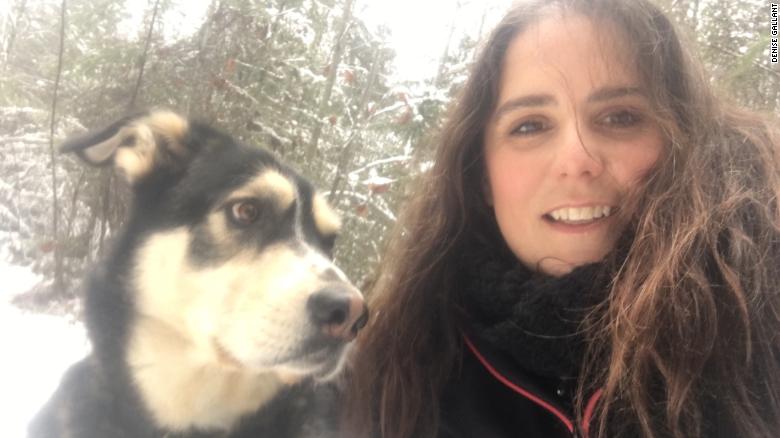
Dee Gallant and Murphy had an exciting run-in during a hike.

(CNN)It’s no secret that Metallica’s music can be kind of intense — so much so, one hiker says, that it scared off a curious cougar on Vancouver Island.

Dee Gallant, 45, was on a hike in South Duncan with her dog, Murphy, on July 23.
She said she was only a few miles into the woods when she turned around and realized that they had company: They were being stalked by a cougar.
At first, she was intrigued; she’d never seen one that close before. But then she realized that the animal was approaching her.
She yelled, and the cougar stopped moving. But it didn’t retreat.
Gallant tried waving her arms and yelling at the cat, saying things like “bad kitty!” and “get out of here!” but the cougar stood its ground.
That is, until Gallant opened her phone and chose the loudest band she could think of: Metallica.
The song: “Don’t Tread On Me.”
It was both a warning and an appeal.
And that, apparently, was what did it. The cougar scurried off after the first few notes, the combination of heavy drums and James Hetfield’s vocals apparently too much to handle.
The incident lasted a total of five minutes, but Gallant said she wasn’t scared.
“I actually thought it was really cool that I got to see a cougar for so long,” she said. “I thought it was exciting.”
Gallant kept the song on loop for the rest of her hike, making sure to stay in the middle of the road and keeping Murphy close.
“I definitely think Metallica saved the day there, for sure,” she said.

Report confirms ship strike caused death of killer whale J34

Final necropsy report released upon request, 2½ years after whale’s dead body found near Sechelt

Officials with the Department of Fisheries and Oceans inspect the carcass of killer whale J34 near Sechelt, B.C., on Dec. 21, 2016. (Graham Moore)
41
comments

The final report into the death of a southern resident killer whale over two and a half years ago confirms that it died from blunt force trauma, likely inflicted in a ship strike.

J34, an 18-year-old male nicknamed Doublestuff, was found dead near Sechelt on Dec. 20, 2016.

At the time of his discovery, Fisheries and Oceans Canada said initial examinations of the seven metre orca indicted that it was alive when struck and died sometime later.

J34’s necropsy report was last updated on May, 23, 2017, however, according to a DFO spokesperson, the report wasn’t made public and is only available upon request, as per policy.

CBC requested the report July 22.

“There were no requests for this information at the time the report was finalized. There had been significant media coverage at the time, reporting the cause of death was blunt force trauma, consistent with a ship or boat strike. The final report came to the same conclusion, ” said DFO’s Dan Bate.

The final necropsy report for J34 confirmed the original evaluation of researchers that the whale was killed by a ship strike. (Fisheries and Oceans Canada)

Shari Tarantino of Orca Conservancy, a Washington state non-profit, said there is a lack of transparency around the DFO’s reporting on J34.

According to Tarantino, her group and Washington state orca researcher Scott Veirs had been asking DFO for the final J34 necropsy report for months. Tarantino received a copy of the report late last week, but only after petitioning the office of Fisheries and Oceans Minister Jonathan Wilkinson directly.

“It should not have taken two and a half years to release a report,” said Tarantino.

“There’s nothing new in this report. It’s basically what we had already been told. But it’s hard not to wonder if it was withheld because Kinder Morgan or because of Roberts Bank Terminal 2 (the proposed container terminal in Delta, B.C.) was waiting on comments.”

Fisheries and Oceans Canada media advisor Lara Sloan said the delays in sending the report were due to administrative problems and miscommunication within DFO.

“There was no intention not to provide that report,” said Sloan.

The precarious state of the 76 remaining southern resident killer whales is a major concern in the Trans Mountain expansion project which will increase tanker traffic through the animals’ territorial waters once completed.

A report released this year by the National Energy Board backed up those concerns, suggesting the project would have “significant adverse effects” on the whales.

The federal government approved the Trans Mountain expansion project last month.

Woman accused of using live trap to capture cat: police

20160816 Barrie Police Station Sign KA 01

File photo. Kenneth Armstrong/BarrieToday

NEWS RELEASE
BARRIE POLICE SERVICE
*************************
Earlier this week, the Barrie Police Service was contacted regarding a cat that was reported stolen.

Officers attended on July 25, and after considering all avenues of investigation, it was determined that the most appropriate path to take was to lay charges under the City of Barrie’s Animal Control By-law. (By-law 2010-035)

As a result, a 54-year-old Barrie woman has been issued notices of:

  • Use live trap to capture cat (Contrary to S. 15.5.0.0.0 of By-Law 2010-035)
  • Fail to ensure cat is provided with food/water/shelter while captured (Contrary to S. 15.6.0.0.0 of By-Law 2010-035)

While the Barrie Police Service understands the concern of the public when investigations involving animals are involved, the public is reminded that making threats and harassing others is unacceptable and could be considered a criminal act.