B.C. wildlife struggles with summer heat and wildfires

By Cory Correia, CBC News
<http://www.cbc.ca/news/cbc-news-online-news-staff-list-1.1294364> Posted:
Aug 13, 2017 10:00 AM PT Last Updated: Aug 13, 2017 10:00 AM PT

This Virginia Rail was found in Sechelt and is one of the tiniest birds the
Wildlife Rescue Association of B.C. has taken into its Burnaby hospital.
<https://i.cbc.ca/1.4244895.1502506110%21/fileImage/httpImage/image.jpg_gen/
derivatives/16x9_620/wildlife-rescue-association-of-bc-virginia-rail.jpg>

This Virginia Rail was found in Sechelt and is one of the tiniest birds the
Wildlife Rescue Association of B.C. has taken into its Burnaby hospital.
(Wildlife Rescue Association of BC)

A summer heat wave and extensive wildfires in the B.C. Interior have been
abnormally hard on animals in the province, especially nestlings.

Burnaby’s Wildlife Rescue Association of B.C.
<https://www.wildliferescue.ca/> services the entire province, and says
it’s taking in 20 injured animals a day, with 95 percent suffering from
dehydration.

“The heat is overwhelming them, particularly the past couple weeks have been
really bad. We’ve had a lot of young nestlings, jumping out of nests to
avoid the heat,” said Sam Smith, communications coordinator at Wildlife
Rescue.

Smith says when young birds leave the nest too early, they end up falling on
the ground and start to waste away, because they don’t yet have the strength
to fly or move.

Wildlife Rescue Association of BC Pelagic Cormorant
<https://i.cbc.ca/1.4244901.1502506230%21/fileImage/httpImage/image.JPG_gen/
derivatives/original_620/wildlife-rescue-association-of-bc-pelagic-cormorant
.JPG>

This Pelagic Cormorant was taken into the Wildlife Rescue Association of
B.C. suffering from dehydration due to the summer heat. (Wildlife Rescue
Association of BC)

Smith says it’s mostly birds that he sees affected by the heat, including
songbirds, waterfowl, marine animals, crows and ravens.

“Sometimes, they’re just so out of sorts, they can’t even drink, let alone
open up their mouths to be given fluids,” he said. In those cases, he says,
they have to hydrate the animals with an injection.

People can help, though, says Smith. “Leave a little lid out with some water
in the shade, or, better yet, fill a small kiddie pool with water and place
some branches/stones inside to allow smaller birds a place to perch while
they drink.”

If anyone sees wildlife in distress, they can usher it into some shade, get
it water and call Wildlife Rescue at 604-526-7275.

Nestlings rescued from wildfires

The wildfires have claimed their own victims, with wildlife rescue an
afterthought.

Orphaned Wildlife Rehabilitation Society <http://www.owlrehab.org/> (OWL)
in Delta says they have been taking in young birds injured or left behind in
the wake of the wildfires.

OWL Orphaned Wildlife
<https://i.cbc.ca/1.4244903.1502506492%21/fileImage/httpImage/image.JPG_gen/
derivatives/original_620/owl-orphaned-wildlife.JPG>

The Orphaned Wildlife Rehabilitation Society says they currently have nine
rescued animals ready to go back into the wild, including four saw-whet
Owls, one long-eared owl, and four kestrel falcons. (OWL Orphaned Wildlife)

“Most of the adult birds at the time or adult animals would know to flee.
It’s just the young ones that are left behind . So a lot were probably burnt
up pretty good, and the ones that could survive, survived, and the ones that
were found, were found,” said Rob Hope, raptor care manager with OWL.

Hope says they have nine baby birds live tested, flight tested and ready to
get back to their communities, once the fires subside.

http://www.cbc.ca/news/canada/british-columbia/bc-animals-orphaned-summer-he
at-wildfires-1.4244882

Ranchers brace for ‘astronomical losses’ due to B.C. wildfires

Cattle ranchers in B.C. are bracing for massive damages to their land and
livestock as wildfires continue to rage across the Interior.

Kevin Boon, the general manager for the B.C. Cattlemen’s Association,
visited two areas this week in the ravaged Cariboo region.

“We know there’s going to be some astronomical losses,” Boon said.

It’s still too early to peg the total cost of damages – a question Boon says
he has been fielding from many ranchers – but the expenses are quickly
adding up.

“There’s hundreds of miles of fence out there that have been burnt up,” he
said.

“That’s all a huge cost when you stop and figure it costs somewhere in the
neighbourhood of $15,000 to $20,000 a kilometre of fence to replace.”

Costs will also be incurred in destroyed grass and hay, he said.

Volatile conditions

The B.C. Cattlemen’s Association has been liaising with RCMP to get ranchers
access through checkpoints so they can transport or tend to their livestock.

Boon is also calling on the province to keep tourists and recreational users
out of the backcountry because of the volatile conditions. Even ranchers are
restricting use on their own lands, he said.

“We’re recommending our guys take their horse shoes off their horses just so
they don’t create a spark of the shoe on the walk,” Boon said.

Boon estimates there are about 30,000 head of cattle in the wildfire
regions. Death tolls won’t be as high as ranchers anticipated, but he
expects it will affect the calf population next spring.

“A lot of these cattle are in their breeding season right now,” he said.
“They might be miscarrying those calves and aborting them naturally because
of the stress.”

Greg Nyman, a rancher who lives south of Clinton, B.C., has so far found 60
of his 120 cattle. They’re in varying degrees of health, he said.

“I saw quite a few that have burned feet,” he said. “They’ve been in a
burning fire for a week and heavy smoke for close to a month now.”

“More often than not, their lungs are scorched,” he added. “So they’re no
longer productive.”

http://www.cbc.ca/news/canada/british-columbia/ranchers-brace-for-astronomic
al-losses-due-to-b-c-wildfires-1.4233525

Cat alerts Tennessee man to Gatlinburg fires

http://www.usatoday.com/story/news/nation-now/2016/12/05/gatlinburg-fires-cat-alerts-man/94983594/

KNOXVILLE, Tenn. — A Tennessee man who owns a store in Gatlinburg is so naturally laid back, the first word that wildfires were near the communitydidn’t unnerve him.

Mark Burger, 60, figured his cellphone would get an evacuation alert if the situation became dangerous, he said.

After inquiries, officials have since said no evacuation alert was sent to mobile devices.

Tennessee’s monthslong drought and wildfire emergency culminated Nov. 28 when hurricane-force winds sent unpredictable fires racing through the Gatlinburg area.

On Nov. 28, Burger was relaxing in his mountainside Gatlinburg condo with Tiger, his Siamese cat, for company. Burger’s son, Tanner, found Tiger as a kitten abandoned. Tanner rescued Tiger and gave him to Burger as a gift.

Now, it seems Tiger has repaid Burger for his life.

More: http://www.usatoday.com/story/news/nation-now/2016/12/05/gatlinburg-fires-cat-alerts-man/94983594/

The West Is Burning, And Climate Change Is Partly To Blame

So far this year, wildfires have scorched nearly 5 million acres in the U.S. That sounds like a lot, but compared to 2015, the season has been downright tame. Last year at this time, more than 9 million acres had already burned, and by the end of the year, that number would rise to more than 10 million — the most on record. In 2015, the Okanogan grew into the largest fire Washington had ever seen, breaking a record set just the year before. California recorded some of its most damaging fires, including the Valley Fire, which torched around 1,300 homes. More than 5 million acres burned in Alaska alone. But that’s not to say that this year has been without drama. For instance, California’s Soberanes Fire, which was sparked by an illegal campfire in July, is still smoldering. The effort it took to contain that blaze is believed to be one of the most expensive — if not the most expensive — wildfire-fighting operations ever.

With wildfire, such superlatives have, paradoxically, become normal. Records are routinely smashed — for acreage burned, homes destroyed, firefighter lives lost and money spent fighting back flames. A study published earlier this year found that, between 2003 and 2012, the average area burned each year in Western national forests was 1,271 percent greaterthan it was in the 1970s and early 1980s.

Like the extreme hurricanes, heat waves and floods that have whipped, baked and soaked our landscape in recent years, such trends raise the question: Is this what climate change looks like?

In the Proceedings of the National Academies of Science this month, two researchers took on the tricky task of apportioning blame. “People have sort of thrown conjecture out there, saying that the big fire seasons we’ve had since 2000 are attributable to climate change,” said John Abatzoglou, the lead author of the new study and a climatologist at the University of Idaho. “But we wanted to go out and make an effort to try to quantify it.” How much of the recent uptick in fire activity is due to climate change versus other factors, like the natural drought cycle?

Abatzoglou and his co-author, Park Williams, a bioclimatologist at Columbia University’s Lamont-Doherty Earth Observatory, estimate that human-caused climate change was responsible for nearly doubling the area burned in the West between 1984 and 2015. If the last few decades had been simply dry, instead of some of the hottest and driest on record, perhaps 10.4 million fewer acres would have burned, they say.

Wildfire is particularly responsive to temperature increases because heat dries things out. It sucks moisture from twigs and needles in the forest the same way it does from clothes in a dryer, turning this vegetation into the kindling, or “fine fuel,” that gets wildfires going. In arid environments, small increases in temperature dramatically hasten this process, helping to prime the forest for a spark. Abatzoglou and Williams’s models simulated the relationship between temperature and the dryness of forest fuels under multiple scenarios, including ones that reflected the uptick in temperature that humans have caused according to climate models and ones that factored out human-caused changes.

To shore up confidence in their estimates, they repeated the analyses in their study using eight different fuel-aridity metrics and then averaged the results. “One thing that gives me confidence is that all eight of these essentially lead to the same conclusion,” Williams said. “All eight have been increasing. All correlate well with fire.”

In the end, they found that more than half of the observed increase in the dryness of fuels could be attributed to climate change. Fuel aridity, in turn, correlated very closely with fire activity for the time period they looked at — it explained about 75 percent of the variability in acreage burned from year to year. “That means that it is a top dog,” Williams said. “Correlation is not causation, but the correlation is so strong that it’s very hard to get a relationship like this if it’s not real.”

Williams added that as aridity increased, wildfire activity increased exponentially. “This isn’t a gradual process. Every few years we’re kind of entering a new epoch, where the potential for new fires is quite a bit bigger than it was a few years back.”

This isn’t the first study to warn that climate change is increasing the risk of wildfires, and fire scientists generally agree on that point. What’s still up for debate is exactly how much climate change has influenced recent fire activity, and this study is the first attempt at a hard answer. Bob Keane, a research ecologist with the U.S. Forest Service in Missoula, Montana, says the methods are solid and represent the best available science for tackling the question. The basic takeaway is also sound. “It’s a big proportion,” said Keane, who was not involved in the research. But the precise numbers Abatzoglou and Williams produced? Keane wouldn’t take them to the bank.

Fire modeling is full of uncertainty because “fire is a complex process,” Keane said. “It’s hard for any of us to wrap our heads around it and say something that’s meaningful.” Actual fire behavior is influenced by both large-scale processes, such as climate, and smaller factors, such as the slope of a hillside or the strength of the wind on a given day.

And then there’s Smokey Bear. Smokey was the public face of a longstanding and ecologically backward federal fire policy. “Only you can prevent forest fires,” Smokey told us. Some of those ads even characterize wildfire as “shameful waste” that “weakens America.” In fact, fire is a natural and essential process in Western forests. Certain trees, including many lodgepole pine, even need fire to reproduce — their cones only open and release their seeds when heated by flames. But for decades, land managers did their damnedest to prevent and suppress fire, allowing many forests to become overstocked with trees. Those trees became the fuels that set the stage for larger blazes. They also influence a fire’s severity, which can affect the ability of some types of forests to recover from fire.

More: http://fivethirtyeight.com/features/the-west-is-burning-and-climate-change-is-partly-to-blame/

Washington State Wildfire Destroys Sensitive Habitat On National Land

http://www.wbur.org/hereandnow/2016/09/06/washington-wildfire

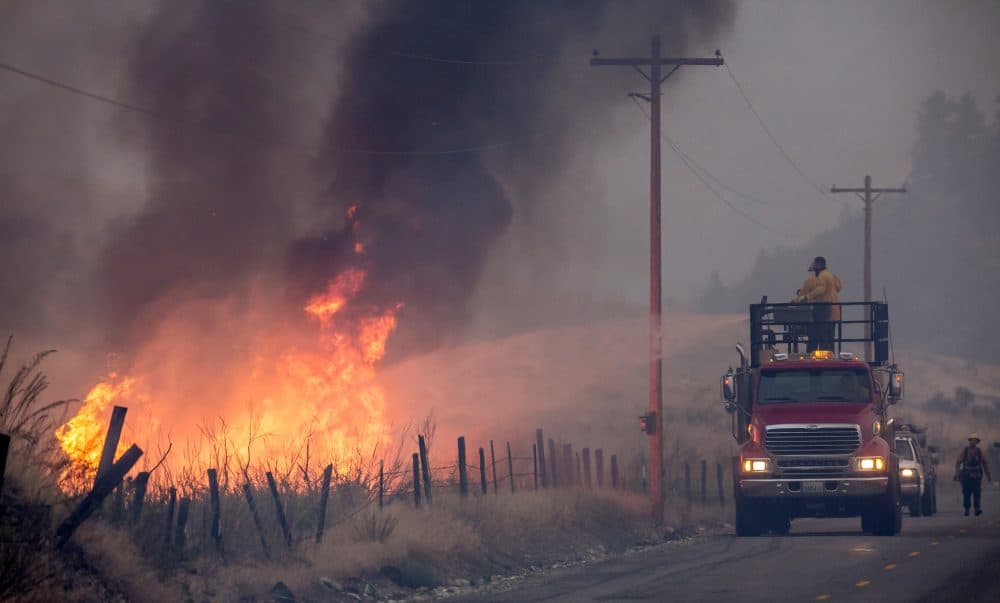
A makeshift fire truck puts water on a wildfire, which is part of the Okanogan Complex, as it burns through brush on Aug. 22, 2015 near Omak, Washington. (Stephen Brashear/Getty Images)closemore

The Range 12 wildfire in Washington State began July 30 and burned for days, blackening 176,600 acres of valuable habitat on the Hanford Reach National Monument. The land was set aside in 2000 by President Bill Clinton, and it’s home to desert species including the Greater Sage-Grouse, sagebrush sparrows and tiny burrowing owls.

Anna King of Here & Now contributor Northwest News Network took a look at what was lost — and what remains.

Read more on this story via Northwest News Network.


The Beast that Burns; the Saviors We Kill

Canadian Blog

by Barry Kent MacKay,
Senior Program Associate

Born Free USA’s Canadian Representative

Jardine man shoots bull bison

Barry is an artist, both with words and with paint. He has been associated with our organization for nearly three decades and is our go-to guy for any wildlife question. He knows his animals — especially birds — and the issues that affect them. His blogs will give you just the tip of his wildlife-knowledge iceberg, so be sure to stay and delve deeper into his Canadian Project articles. If you like wildlife and reading, Barry’s your man. (And we’re happy to have him as part of our team, too!)

The Beast that Burns; the Saviors We Kill

Published 05/19/16

Beaver© U.S. Department of Agriculture

May 19, 2016. Last night, The Beast was headed toward the border, with about three miles to go.

“The Beast” is the name of the giant wildfire that erupted in northern Alberta and, growing as I type, has now consumed some 423,000 hectares (1,633 square miles) of boreal forest. It has forced the evacuation of nearly 90,000 people. We’re seeing massive destruction of infrastructure and the deaths of uncounted thousands of wild animals, toxifying the air and defying Herculean efforts to bring it under control.

And it is, tragically, only one of hundreds of fires raging in forests throughout so much of the continent, their numbers increasing as global climate change results in an ever warmer climate—drier in some places and wetter in others, but heating up the planet more rapidly than even the most pessimistic research indicated.

What is of great value, what is needed in our woods and forests, is water: reservoirs of water, high water tables, ponds, and impoundments.

But, we are not a rational species. If we were, we’d listen to scientists like Glynnis Hood and Suzanne Bayley, whose published research* (and that of other scientists and studies) shows us that there is a hedge against the drying effects of global climate change and its ability to trigger massive, deadly fires…

And, that is the beaver!

When beaver fur was widely used by the fur industry, populations of the species were supressed by trapping. With decline in fur values, beavers are repopulating. This can cause problems, as when, building dams, beavers block culverts, cause flooding, or even chew down valuable trees. Most such conflicts can be easily resolved without harming the beavers: valuable allies in protecting the environment.

So, what did the province of Saskatchewan do? It allowed a “beaver derby”: a 40-day contest in which 601 beavers were killed (out of an annual, province-wide kill of about 38,000). It is Saskatchewan’s border that The Beast was approaching last night.

The argument was made that these were beavers who would have otherwise been killed and wasted, and that many carcasses are left to rot. I don’t doubt that, but this is the 21st Century and it’s past time for us to stop demonizing wildlife and start learning to co-exist.

The work by Hood and Bayley, in 2008, showed that the beaver was the single most important factor in the amount of open water in the very place where it is most needed—the place where the hot Beast prowls, burning its way through our staggering wall of willful ignorance, illuminating our base, self-destructive ways.

There have always been beavers, fires, and forests. What’s new is our levels of technology, connected to unbearable hubris, as we impose our collective madness onto a world increasingly under siege (ironically, a world that is also increasingly losing its ability to support us and our demands upon it).

As we look into the glowing eye of The Beast, it is our reflection that stares back.

Keep wildlife in the wild,
Barry

Wildfires leave Okanogan Co. wildlife hungry

I remember back (not long ago) when wildfires were just a natural events that left the forest refreshed and renewed. Now, human manipulation and ultimately, anthropogenic climate change, have made fires more and more catastrophic for all–including the wildlife.

http://www.krem.com/news/local/okanogan-county/many-animals-left-hungry-after-okanogan-wildfires/45064888

Whitney Ward and KREM.com 6:14 PM. PST February 16, 2016

OKANOGAN COUNTY, Wash. – Okanogan residents said today a bear that died last week in their area likely woke up from hibernation too early from a lack of food before winter.

2 On Your Side found it the same problem is affecting animals across Central Washington. It was all thanks to two years of historic wildfires that caused massive amounts of land damage.

“A lot of animals were killed in the fire itself last summer,” Okanogan resident Jon Wyss said. “And many more died shortly after from burns and other injuries. But now, 6 months later, there is plenty of wildlife still suffering.”

The fires destroyed many of the habitats for the animals which meant no food and little shelter. Thousands of deer were left without food after trees and grass were burned.

“When you burn 250,000 acres in 2014 and 500,000 acres in 2015, there’s not a lot of forage,” Wyss said.

Washington Department of Fish and Wildlife officials told 2 On Your Side it could take up to a decade for all the foliage to regrow. That could lead to many animal populations to struggle for years and farmers could carry the burden.

“There’s 11,000 deer without food,” Wyss said. “They’re struggling and they’re competing against our agriculturalists, eating limbs off the trees, the buds, the hay.

2 On Your Side learned that with so many deer going on to farmland for food, it can bring predators like wolves and cougars closer to homes.

Washington Department of Fish and Wildlife officials also said the harder it is for deer means it’s easier for predators. But officials also said that nature will correct itself and the wildlife population will rebound eventually.

The Real Climate Change Hoax‏

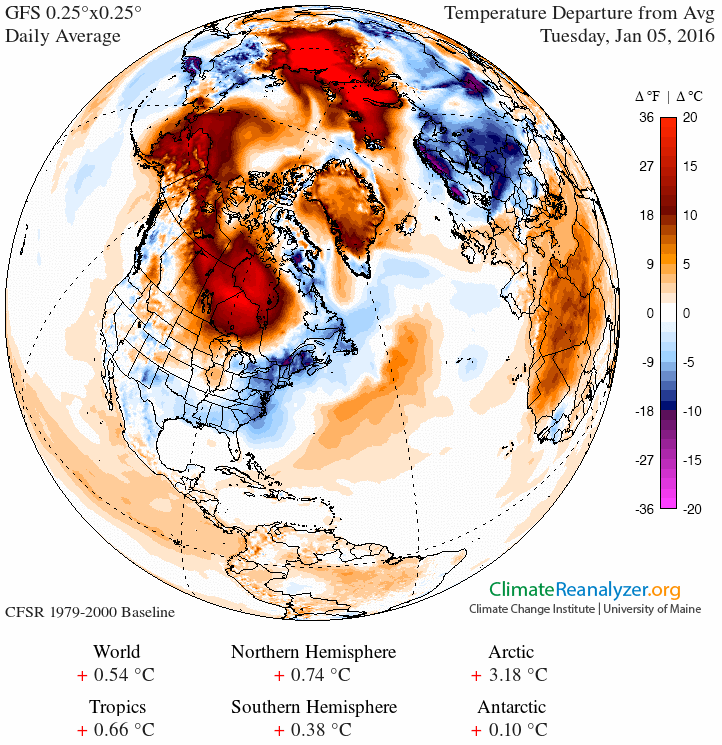
Extreme Arctic Warmth on January 5 2016

http://www.huffingtonpost.com/john-sanbonmatsu/the-real-climate-change-hoax_b_8920048.html

As a performing magician, I naturally take a keen interest in deception. So it was also with a professional, not merely personal, interest that I watched the spectacular fraud perpetrated on the world’s public in Paris last month, as political leaders from nearly 200 nations signed the first universal treaty to limit the carbon gases causing global warming.

Politicians described the agreement in triumphal terms, as a “turning point” in history. Humanity had dodged a bullet, they said. Now, we could all breathe easier. “Climate justice has won & we are all working towards a greener future,” as President Modi of India put it in a Tweet.

In reality, the happy talk by elites in Paris resembled a skilled magician’s use of patter to misdirect his audience, only on a global scale. A top stage illusionist like David Copperfield can make a Lamborghini vanish right under the noses of his audience. But that is nothing compared to what played in Paris, where the world’s political elites made the global warming crisis itself disappear — by creating the illusion of decisive action, where in fact there was nothing.

Ostensibly, the Paris agreement commits its signatories to hold warming of the earth’s atmosphere to 1.5% degrees Celsius above preindustrial levels. But as Bill McKibben recently pointed out, even if the signatories stay true to their promises — and the agreement has no enforcement mechanism to ensure that they do — the earth’s atmosphere is still expected to warm to at least 6.3 degrees Fahrenheit above preindustrial levels.

How bad would that be? Consider that today we are at just one degree Celsius, or about 1.5 degrees Fahrenheit, above preindustrial levels. That one degree has already melted many of the world’s glaciers, turned the North Pole into a temperate zone, and produced droughts, floods, and wildfires of Biblical proportions across the globe. One degree has radically increased the acidity of the world’s oceans — by 30% — and imperiled the planet’s fresh water resources.

Here in Boston, I spent a surreal Christmas Eve bicycling around my neighborhood clad in jeans and a T-shirt. It was the same story throughout much of the US, where nearly 6,000 temperature records were shattered over the holidays. Tornadoes ravaged parts of Texas, Arkansas, Mississippi, and Tennessee, rivers flooded their banks throughout the Midwest. Meanwhile, portions of England, Ireland, Scotland, Wales, Argentina, Brazil, and Uruguay lay submerged under floodwaters.

The most frightening news, though, came out of the Arctic, where temperatures on New Year’s Day were projected to be more than 60 F. degrees above normal. That made the North Pole, as one reporter observed, “hotter than Chicago, Vienna or Istanbul.”

Such radical gyrations in the climate are already causing unseen suffering and hardship for countless of the earth’s inhabitants. Millions of people have been displaced from their homes or lost their livelihoods as a result of one degree of warming. Farmers in Bangladesh have watched helplessly as ocean water inundates their rice fields. Whole Inuit communities had to be relocated after melting permafrost caused their homes to sink into the ground. In Iraq this summer, the temperature soared to 120 degrees Fahrenheit — 159 degrees with humidity factored in — and remained there for days. Scientists believe that large portions of the Middle East, currently home to 200 million people, will be inhospitable to human life by the end of the century.

But it is the other beings we share the earth with who are losing the most. Everywhere, animals are struggling in vain to adapt to the rapidly changing climate. In Europe and Asia, bears have stopped hibernating. In Alaska, walruses are crowding on shore, and trampling each other, because the sea ice they depend upon to survive has vanished. Whales and dolphins are dying in droves. Sea lions in California are starving. Penguins, lost and disoriented, have washed up on the beaches of Rio de Janeiro. Tens of millions of bats have perished from white nose fungus. Hundreds of monkeys in Costa Rica starved to death, or succumbed to illness, when ceaseless winter rains kept them from coming down from their trees to forage.

And on and on, across the phylogenetic spectrum. Homo sapiens is causing the greatest mass species extinction event in over 60 million years. And global warming is radically accelerating the process.

All of this, and much more, from atmospheric warming of less than 1.5 degrees Fahrenheit. Now, imagine ratcheting that up by an additional five, or six, degrees. Or, in all likelihood, more than that. Because there is no reason to believe that the countries that signed the Paris agreement will fulfill even their existing inadequate promises.

What will so hot a world look like? Which of the many thousands of species clinging today to the knife’s edge of survival will survive?

In the absence of decisive international action, clearly, we are going to turn the planet into a living Hell. Meanwhile, the closer one looks at the details of the Paris accord, the more the latter resembles a stage illusion — a hollow shell carefully constructed to resemble something solid.

Much has been made of the pledge of the wealthy nations to help poorer ones offset the cost of shifting to renewable energy sources. But the same promises have been made by the wealthy countries before, and they have not been kept. Though vague about how they are going to help the peoples of the global South, wealthy nations were nonetheless careful to include language in the treaty allowing them to offset future C02 emissions through so-called “carbon sinks” — planting trees to recapture CO2. However, since it takes decades for forests to mature, such “sinks” are viewed by most experts as the equivalent of the magician’s legerdemain, a clever manipulation to create the appearance of something out of nothing.

The agreement also says nothing about animal agriculture — the second leading cause of global warming, responsible for more emissions than all cars and trucks combined. The absence of any recommendation to reduce or eliminate animal agriculture is a clear concession to the factory farming and cattle ranching lobbies, which doubtlessly worked hard to keep animal agriculture off the table in climate negotiations.

And so on. Such omissions led James Hansen, the former NASA scientist and a leading authority on climate change, rightly to denounce the Paris agreement as a “fraud” and a “fake.” As Hansen and others suggest, the illusion of action in Paris may in fact prove worse than no action at all. For it has left the public with the mistaken impression that the climate crisis is now going to be dealt with, perhaps even solved, on the cheap, in half-measures, and without disturbing the powerful economic and social forces that profit from ecological destruction. And that is the greatest deception of all.

CORRECTION: This post has been updated to clarify the language used to describe the role of animal agriculture in reference to climate change.

Cows Killed in Washington Fires

SUNDAY, AUG. 30, 2015

Ranchers face loss of livestock, livelihoods in Washington fires

Doug Grumbach, a fourth-generation Ferry County rancher, stands Wednesday in the charred Colville National Forest near the Canadian border, where the Stickpin fire killed 12 head of his cattle. This cow became wedged between two trees trying to flee the flames. (Tyler Tjomsland)

DANVILLE, Wash. – The burned carcasses blend into the scorched landscape, just more black and ash among the haunting outline of trees. “There she is,” rancher Doug Grumbach says, pointing up the steep slope near his ranch. “It looks like she was trying to run and froze in that mode.”

The cow is now obvious: A perfectly shaped head, a body covered in skin that’s become cured leather – taut and solid like a drumhead. She’s upright, wedged between two burned trees, ribs exposed, a flurry of maggots working furiously. Her calf lies in a heap nearby.

Grumbach is silent. He rubs his jaw and points to another carcass farther up the hill on the grazing land in the Colville National Forest, just south of the Canadian border. The land recently burned in the Stickpin fire.

Grumbach, like cattle ranchers across fire-ravaged north-central Washington, isn’t sure of his total losses. The devastation includes not only body counts but hundreds of miles of fence, grazing land and water sources on his family’s fourth-generation ranch. So far, he knows of eight dead cows and four calves, a loss of about $35,000. Thirty more of his Angus herd is missing. In his corrals at home are a cow and several calves with burned hooves.

Livestock toll still ‘a wild guess’

For some ranchers, this is the second year of hardship – first stemming from drought and now another round of deadly fire.

Chris Bieker, of the federal Farm Service Agency in Spokane, doesn’t know how many cattle died in the fires. There are places livestock owners haven’t been able to get into because of fire and road closures.

“At this point, anything is just a wild guess,” he said.

That’s especially true about the numerous ranches located in the Okanogan Complex of fires in north-central Washington. Together, the Okanogan Complex has burned about 475 square miles and is considered the largest wildfire in state history.

Cattle production is Washington’s fifth-largest commodity with about 1.1 million cows and calves valued at $706 million in 2013, according to the Washington state Department of Agriculture. Behind wheat, hay is the state’s second-most-productive field crop.

Bieker said the Farm Service Agency still is trying to process payments for lost livestock from last year’s brutal Carlton Complex fires in the Methow Valley, which was until this year the largest wildfire recorded in Washington. More than 1,000 cattle burned along with 500 miles of fencing. Some fear this year’s losses are worse.

Bieker added that it’s important for ranchers to report their losses within 30 days, under the federal Livestock Indemnity Program – an often difficult task when they still are digging fire lines and trying to rescue cows. That program, part of the 2014 Farm Bill, allows cattle owners and others to recoup 75 percent of the market value of livestock that died because of “adverse weather.”

Record-Breaking Wildfires, Greenland Melting and Earth’s Hottest Month Ever

The following article from Truthout.org covers all that I was going to go over in Part 2 of Global Warming: the Future is Now, so here’s this instead:
Featured Image -- 10312

Dahr Jamail | The World on Fire:

The US is now officially in the worst wildfire season in its history, as almost 7.5 million acres across the country have burned up since spring.

Articles about ACD’s impacts are now being published in more mainstream outlets, carrying titles that include verbiage like “the point of no return,” and it is high time for that, given what we are witnessing.

A recently published study by the UK-US Taskforce on Extreme Weather and Global Food System Reliance revealed that “major shocks” to worldwide food production will become at least three times more likely within the next 25 years due to increasingly extreme weather events generated by ACD. One of the coauthors of the report warned of a “very frightening” future due to the synthesis of ACD and food demands from a constantly growing global population.

Meanwhile, July officially became the hottest month ever recorded on the planet, setting 2015 on course to easily become the hottest year ever recorded.

This month’s dispatch is replete with evidence of our growing crisis, including record-breaking amounts of ice being released from Greenland, more species under threat of extinction, and millions of acres of the planet burning up in wildfires across North America alone.

Earth

A trove of papers recently released in the journal Science have warned that the planet’s forests are all under major threat of being annihilated, due to the ever-expanding human footprint, coupled with ACD. The introduction to the studies reads: “These papers document how humans have fundamentally altered forests across the globe and warn of potential broad-scale future declines in forest health, given increased demand for land and forest products combined with rapid climate change.”

Speaking of which, another recent report, this one coming from the Center for Global Development, showed that the planet is on a trajectory to lose an amount of tropical forest land equivalent to the size of India by 2050.

Meanwhile, geologists with the US Geological Survey and researchers from the University of Vermont recently showed that Washington DC is, quite literally, sinking into the sea. “It’s ironic that the nation’s capital – the place least responsive to the dangers of climate change – is sitting in one of the worst spots it could be,” senior author of the paper, Paul Bierman, said. “Will the Congress just sit there with their feet getting ever wetter?”

At the moment, the answer to his question is obvious: The lawmakers that frequent our capital city are making no bold moves to address that city’s flooded future.

Food production, as aforementioned, is being dramatically undermined by ACD. In Nigeria, the country’s ability to feed itself is rapidly diminishing due to higher temperatures and shifting rainfall patterns. At least half the farmers there had been unable to even plant their crops at the time of this writing.

Animal species continue to bear the brunt of ACD all over the globe as well.

A recent study showed that in the UK, ACD is generating severe droughts that have placed several species of butterflies there at risk of extinction.

Another report showed how a disease spreading rapidly across the planet’s tadpole populations is now threatening the global frog population. Scientists who authored the report warn that this is further evidence of the sixth great extinction event the earth is now experiencing.

Another dismaying development: The ever-shrinking area of sea ice is deleteriously impacting the Arctic’s walrus population. This season could see another dramatic beaching event like that of last summer, in which 35,000 walruses dragged themselves out of the sea and onto a beach due to lack of sea ice.

Meanwhile, the ongoing drought in California has caused an “emergency situation” for trees in that state, as lack of water is causing unprecedented die-offs. The drought there is also wiping out several of the native fish populations, of which many are expected to disappear within the next two years if the drought persists.

Lastly in this section, unprecedented heat coupled with an intense drought has caused “glacial outbursts” on Washington State’s Mount Rainier. “Outbursts” occur when large pools of ice-melt form within the glaciers, then plunge from within the glacier, sending torrents of silt-filled water, boulders and trees down the slopes of the mountain, wiping out anything in its path.

While these outbursts have happened periodically throughout history, they are expected to increase in both frequency and severity as ACD progresses.

Water

As usual, circumstances on the water front continue to worsen around the planet.

In the Pacific Northwestern region of the US, over a quarter million sockeye salmon heading up the Columbia River have either died or are in the process of dying due to warmer water temperatures. Biologists warn that at least half of this year’s returning fish will be wiped out, and ultimately as much as 80 percent of the total fish population could perish. Both Oregon and Washington states have already instituted closures of sport fishing due to the warmer waters and drought conditions persisting in both states.

In the Eastern Pacific Ocean, a giant bloom of toxic algae that is a threat to the health of both ocean species and humans alike spans from southern California all the way up to Alaska. Researchers are linking the size and intensity of the bloom to ACD. The bloom is already killing off sea lions that inhabit the coast and is still not showing signs of going away. Researchers said it was the largest bloom they had ever seen.

A report showed how ACD is in the process of rapidly reversing a natural phenomenon of 1,800 years of ocean cooling, while another study revealed that ocean acidification will continue and likely worsen, even if carbon sequestration and cleanup efforts were to begin in an immediate and dramatic fashion.

Back on land, droughts around the globe continue to make headlines.

One in Puerto Rico, that continues to worsen, has caused that country’s government to extend its dramatic water rationing measures, which have now been ongoing for weeks.

A study published in Geophysical Research Letters unequivocally linked California’s severe drought to ACD, saying that ACD has already “substantially increased” both the frequency and intensity of future droughts.

More news around the California drought emerged, showing that the river that runs through San Jose, the 10th largest city in the US, has dried up completely, severely harming fish and wildlife dependent on the water for their survival.

NASA released findings showing that California’s Central Valley, where the bulk of all the farming in the state takes place, is literally sinking, due to how much groundwater is being drawn out to compensate for the drought conditions. It is yet another destructive feedback loop: ACD has caused the drought to be far more severe than normal, which has caused humans to over-pump groundwater, leading to the sinking of the land.

The world’s glaciers are in peril. A disturbing report has shown that they have shrunk to their lowest levels ever witnessed in the history of record-keeping. They are melting at an accelerating rate – two to three times faster than the 20th century average melt rate.

As if to punctuate the findings of the report, the world’s fastest-melting glaciers, located in Greenland, recently lost the largest amount of ice on record in just a 48-hour period.

As a result of the incredible melting rates of glaciers, snowpack and ice fields around the globe, sea levels are now rising faster than ever.

Thus, as recently released research shows, global communities and cities located on river deltas – which includes over a quarter of a billion people – are at risk and will have to relocate.

Fire

Given the extensive record-breaking drought that has afflicted most of the western US, the fact that this summer’s fire season came in with a roar came as little surprise. Hardly halfway through the summer, fires across California, Washington, Colorado and in Glacier National Park in Montana were making headlines.

By early August, nearly 10,000 firefighters in California alone were battling at least 20 wildfires that had already forced more than 13,000  people to evacuate their homes.

Shortly thereafter, thousands of wildfires were raging across drought-plagued California, and before the middle of the month, a staggering 300,000 new acres were burning each day up in Alaska, where fires had scorched over 6 million acres thus far in the year, and hundreds of fires continued to burn. That makes this year already the second-largest wildfire season in Alaska’s history, with more of the summer remaining.

Reports have emerged warning of the impact of the fires upon Alaska’s permafrost: They have removed millions of acres of the tundra and forest that previously protected the frozen ground.

In early August, the US Forest Service announced that for the first time in the history of that department, it needed to spend over half of its entire budget on fighting wildfires.

Despite this, given the record-breaking drought conditions across the west, large numbers of the fires were left to burn out of control, due to high winds, dry conditions, and lack of fire-fighting capabilities and resources.

Air

In case anyone had any doubt about how hot the planet is already becoming, the Iranian city of Bandar Mahshahr experienced a heat index of 165 degrees in August, nearly setting a world record for heat index measurements, which factor in humidity along with temperature.

In July, incredibly hot temperatures in Tajikistan caused a rapid melting of glaciers, which triggered flooding and mudslides that generated nearly 1,000 ACD refugees.

Meanwhile, across the Middle East in August, more than 20 people died and nearly 100 had to be hospitalized due to incinerating heat that baked the region, along with intense humidity levels. Basra, Iraq, saw 123 degrees, and the Iraqi government had to instate a four-day “holiday” so people wouldn’t feel obliged to work in the stifling heat.

Lastly in this section, a recent report stated that Texas will likely see a dramatic escalation in heat-related deaths and coastal extreme storm-related losses in the upcoming decades due to escalating ACD impacts.

Denial and Reality

There is never a dull moment in the “Denial and Reality” section.

Democratic Party candidate Hillary Clinton’s stated plan to address abrupt ACD, which amounts to federal subsidies for solar panels, was immediately labeled as “silly” in early August, just after Clinton’s plan was announced, by leading climate scientist James Hansen, who headed NASA’s Goddard Institute for Space Studies for more than three decades.

“You cannot solve the problem without a fundamental change, and that means you have to make the price of fossil fuels honest, “Hansen said of her plan. “Subsidizing solar panels is not going to solve the problem.”

During a recent forum, Republican presidential candidate Ted Cruz went on the record expressing full-on denial of ACD, saying that the debate about ACD was a “device” used by liberals to appeal to “environmentalist billionaires and their campaign donations.”

On another front, builders in San Francisco are moving forward with plans to construct major bay-front developments of office space and homes worth more than $21 billion, in areas that are extremely susceptible to flooding – despite dire warnings of imminent sea-level rise.

On the bad news front for the deniers, however, a recent study showed there is absolutely no link between sunspot activity and ACD … a fabricated argument the deniers enjoy trotting out to try to “disprove” reality.

More bad news for the deniers comes, once again, from the Pope, who set up an annual Catholic Church “day of care” for the environment. The Pope said the day would be a chance for the world’s 1.2 billion Catholics to “thank God for the wonderful handiwork which he has entrusted to our care, and to implore his help for the protection of creation as well as his pardon for the sins committed against the world in which we live.”

And Catholics aren’t the only faith leaders working to do something to address ACD.

Islamic religious and environmental leaders from around the world recently issued a call to rich countries, along with those that are oil producers, to end all fossil fuel use by 2050 and to begin rapidly ramping up the institution and use of renewable energy sources.

The Islamic leadership, which issued “The Islamic Climate Declaration,” said the world’s 1.6 billion Muslims have “a religious duty to fight climate change.”

The final blow to ACD deniers in this month’s dispatch comes from none other than the US Department of Defense, which issued a report to Congress that said that ACD poses a “present security threat” that is not only a “long-term risk,” but poses immediate short-term threats as well.

http://www.truth-out.org/news/item/32556-the-world-on-fire-record-breaking-wildfires-greenland-melting-and-the-hottest-month-ever-recorded-on-earth