By Maria Cheng AP Medical Writer | Thursday, March 2, 2017 6:03 PM
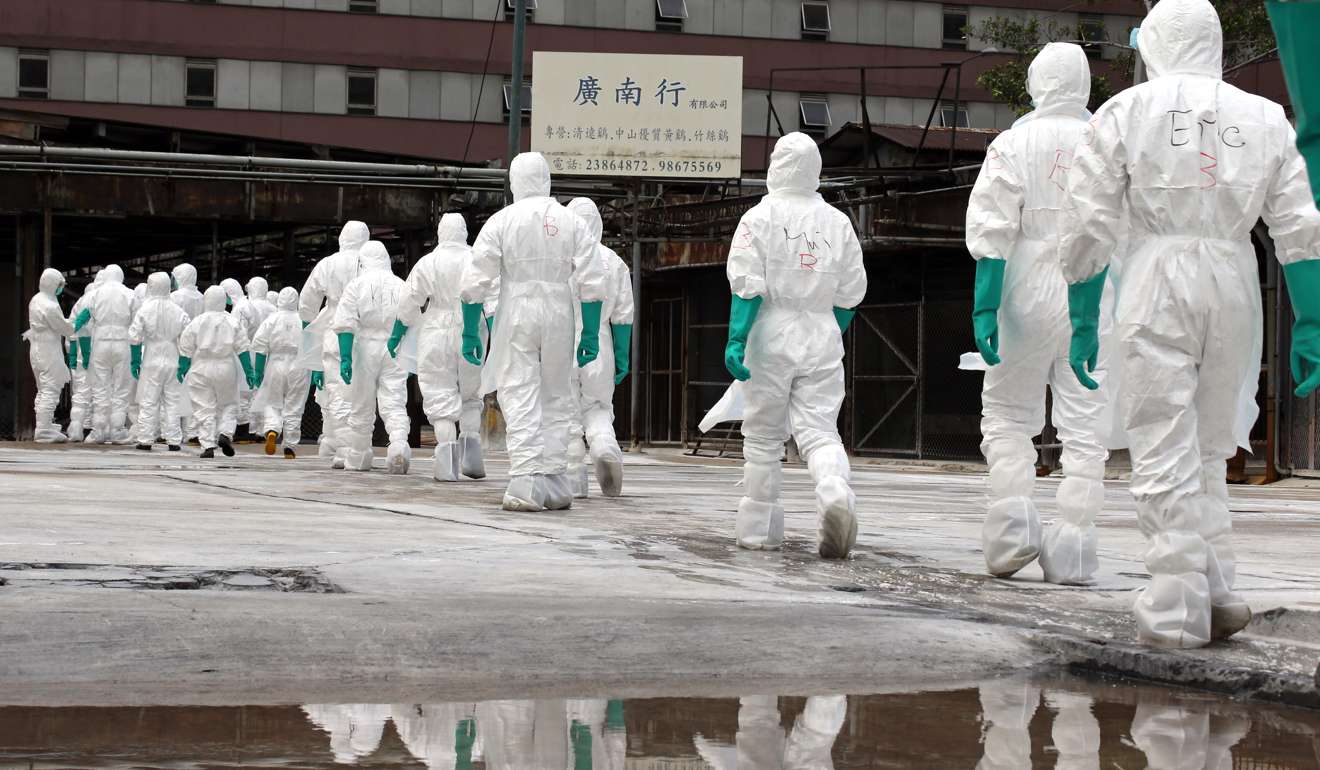
Health workers in full protective gear collect dead chickens killed by using carbon dioxide, after bird flu was found in some birds at a wholesale poultry market in Hong Kong. The World Health Organization says it has noticed mutations in the bird flu virus that is now spreading in China, but says the risk of the disease spreading easily between people still remains low.
LONDON – The World Health Organization says it has noticed changes in the bird flu virus now spreading in China, but says the risk of the disease spreading easily between people remains low.
The genetic mutations have been seen from birds and infected people, but because flu viruses change constantly, experts aren’t exactly sure how significant the differences may be.
The H7N9 strain of bird flu showed up in China in 2013 and has mainly sickened people in close touch with chickens or other infected people.
In a press briefing Wednesday, the U.N. health agency said in about 7 percent of recent cases, scientists have identified genetic changes suggesting the viruses are resistant to Tamiflu, the recommended treatment for the illness. The drug is being stockpiled worldwide in case there is a flu pandemic, possibly triggered by a mutated bird flu virus.
Wenqing Zhang, head of WHO’s flu department, said the rate is similar to what has been picked up in previous years.
“Constant change is the nature of all influenza viruses,” she said.
Zhang said the mutations in the H7N9 virus have made it more deadly to birds, but she said it’s unclear what that might mean for humans.
“The question is, does this change in the virus’ lethality make it any more lethal for humans? The jury is still out on that,” said Wendy Barclay, a professor at Imperial College London.
Although bird flu cases in China have surged this year – and spilled over to Hong Kong and Taiwan – Barclay said there was no suggestion the virus is spreading more easily, particularly among people.
Since October, 460 people in China have been infected, WHO said. That’s more than one-third of the 1,250 infections reported since 2013.
Some scientists worry that China isn’t sharing enough information. Earlier this year, the country suddenly announced about 100 cases, a lag that could compromise efforts to track any changes in the virus’ spread.
“We always need more and better information faster,” said Michael Osterholm of the University of Minnesota, adding that the continuing bird flu worries underline the world’s vulnerability to the next flu pandemic.
ATLANTA — Scientists and public health authorities are expressing alarm about an extraordinary surge in bird flu infections among humans.
The H7N9 bird flu virus, which has sickened and killed several hundred people in China for the past four winters, had seemed over the past couple of years to be diminishing as a threat.
But a resurgent wave of activity this winter has produced more than a third of all infections recorded since the first human case was hospitalized in February 2013. And with this large burst of cases, H7N9 has overtaken another bird flu, H5N1, which has been causing sporadic human infections at least a decade longer than H7N9.
Changes in the virus are also worrying, said Dr. Daniel Jernigan, director of the Centers for Disease Control and Prevention’s influenza branch. Jernigan noted Tom Price, the new health and human services secretary, has been briefed on the situation.
“We’re concerned about the uncertainties here and the number of changes that are happening at this point. We are monitoring this closely,” Jernigan told STAT.
To date, all of the infections have been contracted in China, although a few cases involved tourists from elsewhere who were infected there.
Overall, 460 of the 1,258 H7N9 cases have been recorded in the latest wave of cases. About a third of people who have been diagnosed with H7N9 have died from their infections — though experts note undetected mild cases are probably occurring, which would lower that case fatality rate.
WHO
“The situation is not particularly reassuring at the moment in the field,” said Professor Malik Peiris, a virologist in the school of public health at the University of Hong Kong. Peiris, a veteran bird flu researcher, called H7N9 “the most significant pandemic threat currently.”
A CDC risk assessment concurs, placing H7N9 at the top of the list of pandemic threats from among a dozen bird and animal flu viruses.
The way in which the virus has evolved undermines the usefulness of a 12 million-dose emergency stockpile of H7N9 vaccine made for the United States several years ago. That vaccine is now less effective at targeting the strains of the virus that are circulating.
Influenza experts who advise the World Health Organization are meeting this week in Geneva to make recommendations on the flu viruses that should be in next winter’s seasonal flu vaccine for the Northern Hemisphere. They are also likely to recommend that the H7N9 vaccine seed strain — the virus used as a target for companies that make vaccine stockpiles — should be changed due to this evolution.
While the vaccine in the emergency stockpile would likely still offer some protection, “we think that there could be a better vaccine match,” acknowledged Todd Davis, principal investigator on the CDC team that studies flu viruses that infect other mammals and birds.
Another genetic change is also amplifying the sense of anxiety about this virus. The genetic sequences of about a dozen H7N9 viruses from the southern Chinese province of Guangdong have mutated in a way that makes them more dangerous for chickens — and perhaps people.
Like all bird flu viruses, H7N9 originated in wild aquatic birds such as ducks. These viruses occasionally make their way into domestic poultry flocks, as H7N9 did. And from there, the viruses can trigger sporadic human infections — generally among people who work in poultry production or who sell or buy live chickens at Asia’s popular so-called wet markets.
Most bird flu viruses don’t kill poultry. They are of low pathogenicity — better known in the flu world as low path viruses. But viruses that carry an H5 or an H7 hemagglutinin protein on their outer shell can be deadly to chickens. The ones that do are called highly pathogenic or high path viruses.
H7N9 has, until now, been a low path virus. But it has long been known that low path H5 and H7 viruses can evolve to become highly pathogenic if they are allowed to circulate among poultry for too long.
The genetic sequences from Guangdong, recently posted in a flu virus database, suggest that has happened there.
While the designations high path and low path relate specifically to how bird flu viruses behave in chickens, it is known that high path viruses, when they infect people, can cause more disseminated disease than human flu viruses, involving organs other than the lungs, Davis said.
Flu experts find these changes unsettling.
“It certainly introduces uncertainty into the mix,” Jernigan said. “Where we kind of thought things were under control and going away, they’ve increased. We thought we had a low path [virus] and it’s now become high path. And so we do want to make sure that all mitigations that can be done will get done.”
In the early days of the H7N9 outbreak, authorities in China enacted strict rules to try to bring spread under control. Markets were ordered to institute clean days, when no chickens could be stored in or brought in. The idea was to stop the virus from circulating among the birds in the markets.
But in parts of the country, enforcement of containment efforts has become more lax as human cases declined in 2015 and 2016, Peiris said.
News that the virus may be evolving to high path status may actually have a beneficial effect, he noted. “Because this would now mean that the agriculture sector would take this much more seriously. Although I must say that the horse is now bolted from the barn and I doubt exactly what can be done to contain it at this stage.”
To date H7N9 has restricted itself to China, though experts fear that may soon change with word that the virus has been found in provinces bordering Vietnam. “I think now Vietnam is under very severe risk,” said Peiris.
There have also been reports that some of the viruses may no longer be susceptible to oseltamivir — sold as Tamiflu — and other flu drugs of the same class. There are few drugs that treat influenza, and if H7N9 became resistant to these drugs, it would be a highly unwelcome development. But the CDC’s Davis said so far it appears that the cases of resistance have involved hospitalized people who were taking the drugs for protracted periods.
Resistance can evolve during treatment, but resistance among viruses that haven’t yet been exposed to the drug would be more alarming, he and Jernigan said.
Scientists at the CDC would like to test virus samples from China to ensure that the flu drugs are still effective. But a disease diplomacy problem is getting in the way of that work.
While China has been reporting cases and sharing the genetic sequences of viruses, it has not shared actual virus samples with the United States since the early days of the H7N9 outbreak, Jernigan said.
Thanks to developments in synthetic biology, genetic sequences can be used to make sample viruses that can tell scientists a lot about how a virus behaves. Still, viral samples would be useful. “Synthetic biology is amazing. But it still takes time,” said Davis.
Jernigan said scientists at the China CDC collaborate openly with their international colleagues. But a green light to share viruses would need to come from other parts of the government. He said efforts are underway to try to open those doors.
Guangdong housewife Zhang Yi makes no compromises on the quality of chicken for her Sunday family feasts.
Once a week, Zhang scours the narrow alleyways near the Wancongyuan wet market in Guangzhou’s Haizhu district.
The market has four poultry stalls but she disregards them all because she, like many other cooks in the city, is a diehard devotee of freshly slaughtered chicken – something that even the deadly H7N9 bird flu outbreak has failed to dampen.
Freshly slaughtered chicken has been off the official menu in downtown Guangzhou for more than a year but Zhang combs the alleys looking for signs of black market poultry on offer. One signal could be a temporary boiler set up on a quiet side street.
“These mobile vendors are always on the move. They don’t stay in the same spot to avoid being caught,” Zhang said.
“Some operate from a van so they can drive away the moment inspectors turn up.”
Guangzhou introduced a five-year live poultry ban in 2015, with the restrictions applying to various downtown districts, including Yuexiu and parts of Haizhu, Tianhe, Baiyun and Liwan.
Under the ban, wet market vendors are only allowed to sell chilled chickens killed at a central slaughterhouse – a deeply unappetising prospect for the city’s “Lao Guang”, or long-time residents.
The poultry trade has also been banned at wet markets citywide for cleaning between the 16th and 18th days of January, February and March.
The aim of the bans is to contain the spread of bird flu. Since January, the H7N9 strain of the virus has killed at least 94 people across the country – the highest death toll since the first known case of human infection in 2013.
Most of the fatalities have been in the Pearl and Yangtze river delta areas.
In January alone, Guangdong reported 21 cases of H7N9, 10 of them fatal. That compares with 10 in the first two months of 2015 and 16 a year earlier.
Since January, human deaths and infections from H7N9 have been reported in 16 provinces and municipalities, according to the National Health and Family Planning Commission. Elsewhere in Asia, Taiwan, Japan and South Korea are battling bird flu outbreaks.
Analysts said the spike was probably partly caused by greater human exposure to infected poultry before and during the Lunar New Year festive season, with more people shopping for poultry, especially live birds. The H7N9 virus shows little or no clinical symptoms in poultry, complicating detection.
The spread of the strain has prompted authorities throughout the country to step up containment efforts going into the peak season for the virus.
Some Guangzhou wet markets, like the ones in Yuexiu district, have been banned from trading in poultry for the rest of this month. Live poultry markets have also been shut down in Zhejiang and various cities in Jiangsu. Parts of Guangdong, including Shenzhen, Zhuhai, Foshan, Dongguan and Zhongshan in the Pearl River Delta, have made similar prohibitions.
In some other high-risks areas such as Anhui province, where 23 deaths have been reported this winter, various cities and counties were ordered to restrict the live poultry trade.
Shanghai authorities have gone a step further by suspending the live poultry trade from January 28 until the end of April. Despite occasional reports suggesting the black market live poultry trade has been spotted in the city, the city’s health department reported only five cases of human infection last month.
But in Guangzhou, the fresh chicken black market is well and alive, with customers prepared to take the risk and pay around 60 yuan (HK$68) per kilogram for the illicit product. That compares to the 80 or so yuan more demanding customers will pay at the Wancongyuan wet market for the best chilled chicken processed by a slaughterhouse.
Zhang said she knew the black market was a health risk and tried to minimise her chances of contracting the virus. “It’s always dirty in the alleyways. Guts and feathers are scattered everywhere – you can’t expect much hygiene. We usually just point at the chicken we want and come back for it after the vendor was done processing it,” she said. “It’s OK as long as we don’t touch it.”
Zhang said she was not convinced that a sweeping ban on the live trade could ever be effectively implemented.
“Guangzhou, let alone the entire Guangdong province, is too big for a blanket ban,” she said.
“Guangzhou has been trying to sort out its rubbish problem for the past seven years and has failed miserably. They can’t ban live chickens.”
The answer to whether industrial-scale poultry farming is responsible for bird flu differs depending on who you ask – a virologist or a geographer.
In a book published last month, Stephen Hinchliffe, a professor of human geography at the University of Exeter in Britain, argues that mass livestock production is driving molecular changes in diseases that could lead to human pandemics.
According to the United Nations Food and Agriculture Organisation (FAO), the world raised more than 21 billion chickens in 2014, up from 19 billion in 2011, or about three fowls for every person on the planet. The bulk of that production came from the United States, China and Europe.
Rapidly rising global poultry numbers, along with selective breeding and production techniques that have dramatically altered the physiology of chickens and other poultry, have made the planet more “infectable”, Hinchliffe and three co-authors argue in their book, Pathological Lives: Disease, Space and Biopolitics.
A combination of factors ranging from virus evolution to economics places humans and animals at risk, they say.
But other researchers say poultry farms are just victims. The biggest culprits in the spread of bird flu viruses, they say, were the live poultry markets in China and Southeast Asia, which should be reformed if not eliminated.
More than 90 people on the mainland have died in the latest seasonal outbreak of H7N9 bird flu. Taiwan has also began culling hundreds of thousands of domestic birds to contain the spread.
Hinchliffe argues that the bird flu crisis stems from “our economies and modes of organising life”.
“We question the sustainability and security of the kinds of intensive protein production that are being rolled out across the planet,” Hinchliffe said.
Some current forms of bird flu can infect people. Some scientists warn that the current “swarm” of flu viruses in circulation are cause for heightened concern.
“Avian flu has been around for a long time, circulating in wild birds without being too much of an issue. But as inexpensively produced protein-rich diets become a worldwide norm, poultry populations, growth rates and metabolisms have changed accordingly,” Hinchliffe said.
Economic considerations were driving selective breeding, feed and dietary supplements, and sometimes the inappropriate use of pharmacueticals, especially antibiotics.
“Raising a bird to market weight takes a third of the time it did 30 or so years ago, with the result that disease tolerance is often compromised,” he said.
“Between that and sheer numbers, flock densities and global connectivity, humans have created a new set of conditions for viral selection and evolution.
“As any epidemiologist will tell you, a microbe can only become deadly or pathogenic if there are the right environmental and host conditions.
“Bird numbers and altered bodies have, in short, made the planet more ‘infectable’,” Hinchliffe said.
Dr Chen Quanjiao, associate researcher of bird flu epidemiology at the Wuhan Institute of Virology, under the Chinese Academy of Sciences, disagreed.
The detection rate of bird flu at poultry farms was usually “very low”, she said. Farmers regularly jabbed birds with vaccines and erected nets to fence out wild species.
The outbreak of bird flu happened in live poultry markets where birds from different places were kept in the same cages, sometimes for days, which gave the virus a chance to mutate and spread to humans.
“Hong Kong has implemented a very effective method to regulate its live poultry market. If other places in China and Asia can follow Hong Kong’s practice, we can significantly reduce the risk,” Chen said.
Threatwatch is your early warning system for global dangers, from nuclear peril to deadly viral outbreaks. Debora MacKenzie highlights the threats to civilisation – and suggests solutions
STR/AFP/Getty
By Debora MacKenzie
Another bird flu is on the rampage in China. Already this winter there have been 424 cases in humans, more than a third of all those identified since the virus emerged in 2013. And it is spreading. This week it was announced that it seems poised to acquire mutations that could make it a much worse problem.
H7N9 first started infecting people in China in 2013. Like its cousin H5N1, the virus that drew attention to bird flu in 2004, it mainly infects birds and doesn’t readily pass from human to human – but should it acquire this ability a deadly pandemic could ensue.
H7N9 seems to jump to people from poultry more easily than H5N1, staging regular winter outbreaks in the last 4 years. By mid-2016 there were 798 known cases, and around 40 per cent of the people died. But since last October alone, there have been 424, the most ever seen in one season – and it isn’t over yet.
“I suspect the spike in cases of H7N9 is real,” says Malik Peiris of Hong Kong University, and not due to better diagnosis. He thinks the jump is due to an increase in poultry infections. Tests in poultry markets are finding H7N9 more often, he says, and it is spreading: this winter has seen human cases in 18 provinces of mainland China, including for the first time in southern Yunnan province, and it could spread to Vietnam from there.
When people fall ill
But we only know this because someone in Yunnan became severely ill with the virus. H7N9 spreads in poultry without making birds visibly sick. It is often only discovered when people fall ill.
Most were exposed to the virus in live poultry markets. Despite calls to close them, public demand for freshly killed chicken keeps markets open – although four of the hardest-hit provinces in China have now temporarily closed some markets.
But H7N9 could be coming out of hiding. This week both mainland China and Taiwan reported human cases in which the virus’s haemagglutinin surface protein had a mutation that makes it lethal to chickens. This would make it a “highly pathogenic” bird flu like H5N1 and its descendants such as H5N8, which is killing birds across Eurasia.
While the mutation doesn’t affect illness in people, it allows the virus to replicate much faster in chickens. If the mutation spreads in poultry, as it has with other kinds of bird flu, H7N9 will rip through flocks, making its presence much easier to spot.
But the trouble is these sick birds will shed much more of the virus, meaning more cases in people and perhaps other mammals such as pigs, each an opportunity for H7N9 to adapt to mammals and learn to spread from person to person. H7N9 already has some of the mutations thought to be required before bird flu can do this, and it is already capable of limited spread between ferrets, the best animal model for human flu.
There could also be more cases of H7N9 in people than we think, says Ab Osterhaus of the Research Centre for Emerging Infections and Zoonoses in Hannover, Germany. Usually, only people sick enough to require a trip to hospital are tested to see which virus they have. Two of the cases reported by the World Health Organisation this week were mild, but the individuals were tested because of exposure to known cases. There could be many more mild cases.
Our only real defence, say the virologists, is a vaccine. The WHO has approved eight vaccine strains of H7N9, and last week China launched clinical trials of four strains by a state-owned vaccine company.
But even if the trials are successful, WHO officials admit that we still have no means of making enough flu vaccine in time to protect large numbers of people, should H7N9, or any other flu virus, go pandemic.
As many as 79 people died from H7N9 bird flu in China last month, the Chinese government said, stoking worries that the spread of the virus this season could be the worst on record.
January’s fatalities were up to four times higher than the same month in past years, and brought the total H7N9 death toll to 100 people since October, data from the National Health and Family Planning Commission showed late on Tuesday.
An Iowa-based chicken broiler breeding farm has initially tested positive for the highly pathogenic h5 bird flu. AP
Authorities have repeatedly warned the public to stay alert for the virus, and cautioned against panic in the world’s second-largest economy.
But the latest bird flu data has sparked concerns of a repeat of previous health crises, like the 2002 outbreak of Severe Acute Respiratory Syndrome (SARS).
“It’s mid-February already and we are just getting the January numbers. With the death rate almost catching up with SARS, shouldn’t warnings be issued earlier?” said one user of popular microblog Sina Weibo.
Other netizens in the Chinese blogosphere worried about the pace of infections, and called for even more up-to-date reports.
The People’s Daily, the official paper of the ruling Communist Party, warned people in a social media post to stay away from live poultry markets, saying it was “extremely clear” that poultry and their excrement were the cause of the infections.
“The situation is still ongoing, and our Chinese counterparts are actively investigating the reported cases,” the World Health Organization’s China Representative Office said in an emailed statement to Reuters.
“As the investigation is ongoing, it is premature to conclusively identify the cause for the increased number of cases. Nevertheless, we know that the majority of human cases got the A(H7N9) virus through contact with infected poultry or contaminated environments, including live poultry markets.”
China, which first reported a human infection from the virus in March 2013, has seen a sharp rise in H7N9 cases since December. The official government total is 306 since October, with 192 reported last month.
But others believe the number of infections is higher.
The Center for Infectious Disease Research and Policy (CIDRAP) at the University of Minnesota last week estimated China had at least 347 human infections so far this winter, eclipsing the record of 319 seen three years ago.
“An important factor in the past waves of H7N9 cases among humans in China has been rapid closure of live poultry markets,” said Ian Mackay, a virologist at the University of Queensland in Australia.
“This season there seems to have been a slower response to the outbreak, which may be leading to greater numbers of human exposures to infected birds.”
The National Health and Family Planning Commission has yet to respond to a request from Reuters seeking comment on the recent bird flu deaths.
Most of the H7N9 human infections reported this season have been in the south and along the coast.
In Hong Kong, where two of the four patients infected with H7N9 this winter have died, health officials said they would step up checks at poultry farms.
H7N9 had spread widely and early this year, but most cases were contained in the same areas as previous years, including the Yangtze River Delta and Guangdong, Shu Yuelong, head of the Chinese National Influenza Center, told state radio.
Beijing on Saturday reported its first human H7N9 case this year. The patient is a 68-year-old man from Langfang city in neighbouring Hebei province.
A second human case was reported on Tuesday.
“It is highly likely that further sporadic cases will continue to be reported,” the WHO said.
“Whenever influenza viruses are circulating in poultry, sporadic infections or small clusters of human cases are possible.”
Animal rights group filing appeal http://www.thecalifornian.com/story/news/my-safety/2016/07/19/animal-rights-group-filing-appeal/87321186/
“An animal rights group alleging that the California Salinas Rodeo
underreports animal injuries plans to file an appeal in a lawsuit
against the rodeo that was dismissed earlier this year.
“Showing Animals Respect and Kindness, also known as SHARK, sued the
California Salinas Rodeo in 2014, and last months, Monterey County
Superior Court Judge Susan Matcham dismissed the suit in court.”
Humane Society International has condemned the Yulin Dog Meat festival, which is set to take place in China’s southern province of Guangxi on June 21.
During the 10-day event, dogs are paraded in cages on their way to be slaughtered and then cooked for eating by festival attendees and local residents.
Protesters presented a petitionwith 11 million signatures to the representative office of Yulin city on Friday.
File image from the 2015 festival showing a butcher preparing cuts of dog meat for sale in Yulin (Getty)
This picture taken on June 17, 2015 shows a butcher preparing cuts of dog meat for sale in Yulin, in southern China’s Guangxi province. (Getty)
The petition, which was created by Humane Society International and addressed to China’s president Xi Jinping, asks for the end of the festival where animals “suffer enormously”.
“With the dog meat festival in Yulin causing such severe animal suffering, risking human health, damaging China’s global reputation, and involving widespread illegal behaviour, as well as breaching China’s own food safety laws, it is time for the Chinese Government to take firm action to end this event for good,” the petition stated.
In 2014, the Yulin government distanced itself from the festival, saying it was staged by private business people and did not have official backing.
File image of dogs in cages sold by vendors at the 2015 edition of the festival (AAP)
File image of dogs in cages sold by vendors at the 2015 edition of the festival (AAP)
Humane Society International’s China policy specialist Peter J. Li told SBS the festival was a liability for the Asian country.
“Modern governments are fully aware that they cannot endorse social and morally questionable acts,” he said.
“Instead, the Yulin government has the responsibility to foster new culture and to build the city into a truly modern society.
“Endorsing mass dog slaughter and dog eating as a festival shows that the local officials are out of touch with the changes in China.”
Launched in 2009 to celebrate the summer solstice, the festival celebrates the consumption of dog meat, which reached its height in China during the Han Dynasty (202 – 220 AD).
Mr Li said dog eating had been rejected as an indecent habit during the Sui-Tang dynasties (581 -907 AD) and that subsequent dynasties valued canines as hunting buddies.
File image from the 2015 festival of vendors restraining a dog (AAP)
endors tie a dog in preparation to butcher it at the Yulin Dog Meat Festival, in Yulin, in southern China’s Guangxi province, 22 June 2015. (AAP)
He noted that dog eaters represented a minority of China’s 1.3 billion population and the dog meat industry constituted “an insignificant part of the Chinese economy”.
“It is an eating habit limited to older males of lower social and economic status,” he said.
“It is a dying eating habit and a distasteful business.”
The campaign against the festival has received celebrity backing from British comedian Ricky Gervais and US actor Ian Somerhalder.
The hashtag #StopYulin2016 has been popular on social media.
Claire Fryer, from People for the Ethical Treatment of Animals Australia (PETA), told SBS any situation where animals were slaughtered was unacceptable.
“The thought of killing, cooking, dismembering and eating dogs is enough for most of us to lose our lunch, but there’s no rational reason why that same revulsion shouldn’t exist at the thought of eating a pig,” she said.
“All animals about to be slaughtered feel terrified, and none want to die.”
Ms Fryer said Australians needed to take note of all animals that are slaughtered.
“Right here in Australia, sensitive, scared lambs, chickens, cows and pigs are killed as we willfully turn a blind eye to the fact that they are no different from the dogs we cry for,” she said.
“It’s easy to point the finger at other cultures, but let’s be honest enough and decent enough to question our own cruel habits.
In The Wall Street Journal of August 20, 2014, Justin Yifu Lin, an economist and close adviser to senior leaders in Beijing, stated that he’s confident China can sustain its recent 8 percent per year growth rate for the foreseeable future. He predicts “20 years of roaring growth” for China. Really? Where does Yifu think the resources are going to come from for this scale of consumption? As it happens, in 2011, the Earth Policy Institute at Columbia University calculated that if China keeps growing by around 8 percent per year, Chinese average per capita consumption will reach the current US level by around 2035. But to provide the natural resources for China’s 1.3 billion to consume on a per capita basis like the United States’ 330 million consume today, the Chinese – roughly 20 percent of the world’s population – will consume as much oil as the entire world consumes today. It would also consume more than 60 percent of other critical resources.
Production Consumption* Commodity
Unit
Consumption Latest Year
Projected Consumption 2035
U.S.
China
China
World
Grain
Million Tons
338
424
1,505
2,191
Meat
Million Tons
37
73
166
270
Oil
Million Barrels per Day
19
9
85
86
Coal
Million Tons of Oil Equivalent
525
1,714
2,335
3,731
Steel
Million Tons
102
453
456
1,329
Fertilizer
Million Tons
20
49
91
214
Paper
Million Tons
74
97
331
394
*Projected Chinese consumption in 2035 is calculated assuming per-capita consumption will be equal to the current US level, based on projected GDP growth of 8 percent annually. Latest year figures for grain, oil, coal, fertilizer and paper are from 2008. Latest year figures for meat and steel are from 2010. Source: Earth Policy Institute, 2011
How can this happen? What would the rest of the world live on? Already, as resource analyst Michael Klare reviews in his latest book, The Race for What’s Left (2012), around the world existing reserves of oil, minerals and other resources “are being depleted at a terrifying pace and will be largely exhausted in the not-too-distant future.”
B. Airpocalypse Now
Decades of coal-powered industrialization combined with the government-promoted car craze since the 1990s have brought China the worst air pollution in the world. Scientists have compared north China’s toxic smog to a “nuclear winter” and the smog is also sharply reducing crop yields. Lung cancer is now the leading cause of death in Beijing and nationally pollution-induced lung disease is taking the lives of more than 1.2 million people a year. With 20 percent of the world’s population, China now burns as much coal as the rest of the world put together. Twenty of the world’s 30 smoggiest cities are in China.
As domestic food grows increasingly unsafe, alarmed middle-class Chinese strip supermarkets of imported food.
Ironically, China is also a “green technology” leader, the world’s largest producer of both windmills and solar panels. Yet in China these account for barely 1 percent of electricity generation. Coal presently supplies 69 percent of China’s total energy consumption; oil accounts for 18 percent; hydroelectric, 6 percent; natural gas, 4 percent; nuclear, less than 1 percent; and other renewables including solar and wind, 1 percent. (27) China currently burns 4 billion tons of coal a year; the US burns less than 1 billion; the European Union, about 0.6 billion. China has marginally reduced the carbon intensity of production in recent years by installing newer, more efficient power plants but these gains have been outstripped by relentless building of more power plants. To make matters worse, even when power plants are fitted with scrubbers to reduce pollution, operators often don’t turn on the scrubbers because these cut into their profits.
While government plans call for reducing coal’s share of the energy mix from 69 percent to 55 percent by 2040, it projects that China’s absolute coal consumption will still rise by more than 50 percent in the same period in line with China’s projected economic growth of around 7.7 percent per year. The World Health Organization considers air pollution above 25 micrograms of particulate matter per cubic meter (PM2.5) to be unsafe. China’s current national average is 75 micrograms but particulate levels in many cities average in the hundreds.
In the winter of 2013, China suffered from the worst air pollution in its history as half of the country, nearly the whole of northern and eastern China, was smothered in dense smog for weeks at a time. Smog alerts were called in 104 cities in 20 of China’s 30 provinces as schools and airports closed in Beijing, Shanghai and other cities. In January, PM2.5 levels in Beijing reached 900 micrograms per cubic meter. As Beijing was choking in smog in the winter of 2013, Deutsche Bank analysts gloomily concluded that even if China’s economy slowed to 5 percent growth per year from it’s current 7.6 percent rate, coal consumption would still nearly double and China’s smog could increase by as much as 70 percent by 2030. (28)
China’s leaders thus face an intractable dilemma. They can’t keep growing the economy without consuming ever more coal, oil and gas. Yet the more fossil fuels they burn, the more uninhabitable China’s cities become, the more Chinese people flee the country, and the faster China’s emissions are driving global warming.
Report condemns widespread abuse of tigers in zoos By
Wang Qian (China
Daily) 2014-11-18
Tigers are being widely abused in many of the country’s zoos, according to a
report issued by an animal rights group.
The claim comes after pictures of an emaciated tiger in Tianjin Zoo
triggered public concern in August.
On Sunday, China Zoo Watch issued a report that highlighted abuse including
the tigers’ poor and crowded living conditions. About 35 volunteers from the
group visited zoos nationwide and highlighted the lack of animal welfare and
protection.
Some of the tigers were raised in cages so small that the animals could not
turn around, volunteer Long Yuanzhi said. Some of the big cats were kept in
concrete enclosures with no natural light, making them extremely anxious.
A wildlife park in Beijing’s Daxing district was found to be using electric
fences to contain tigers in October, and the animals were shaking in their
enclosure, the group reported.
Hu Chunmei, an animal rights activist with Nature University, an
environmental protection project, agreed that the living conditions of
tigers in Chinese zoos are deplorable.
Other than the poor living conditions, the tigers are also widely used in
animal shows although the Ministry of Housing and Urban-Rural Development
issued a circular in 2010 banning animal performances nationwide, she said.
Report condemns widespread abuse of tigers in zoos
China Zoo Watch reported that displays involving tigers are still being
staged in many zoos, where the beasts are made to jump through flaming hoops
and do other acrobatics.
These shows not only abuse the animals physically and psychologically, but
also mislead children and youngsters who may think the endangered animals
can be used for performances against their nature, Hu said.
Jumping through flaming hoops is the most traumatic trick for tigers because
they are by nature terrified of fire, Long said.
But Xu Linmu, former chief engineer from a zoo in Nanjing, Jiangsu province,
said raising a tiger costs more than 50,000 yuan ($8,150) a year, which is
too much for zoos across the country.
“Zookeepers have to make money, but selling tickets cannot cover the
maintenance and management of zoos,” Xu said.
In Chimelong Safari Park in Guangzhou, capital city of South China’s
Guangdong province, a ticket for an animal circus costs about 280 yuan per
person, with white tiger shows one of the most popular acts.
Legislation on animal welfare is essential to stamp out increasing animal
abuse, said Zhou Ke, an environmental protection law professor at Renmin
University of China.
The country has laws to protect animals in the wild but lags behind when it
comes to protecting animals in captivity, activists and experts said.






 Exposing the Big Game


