Sorry Mother Nature, you’ll have to come up with something better if you want to stop humans


Image may contain: bird, possible text that says 'Its not Corona, its Karma'


Coronovirus, climate change and anything else Nature has thrown at them, so far, has failed to put the species Homo sapiens in their place. The reasons for her (inadequate) efforts are clear to see for anyone willing to look: humans have taken over the entire planet and driven all her other special children to the brink of extinction. Humans simply don’t care about anything outside themselves and their own species to do what it takes to keep this diverse, once-thriving planet alive…

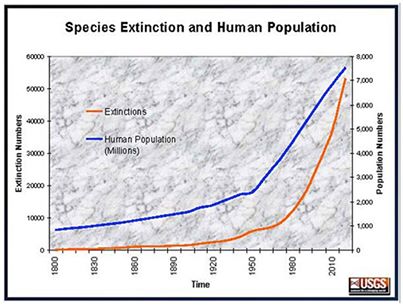
While most species are hovering at the precipice of existence, humans are increasing at the rate of 227,000 births per day! And that’s even with the perils of a warming planet and an emerging pandemic to put them in their place. No Mam, it’ll take more than that if you want to rid the world of and save the Earth from arguably the most successful and clearly the most destructive and in-grateful beings you’ve ever brought into this world. Just look at how they treated all the other species who dared to share their genus in centuries past. Bred them to extinction my eye—humans forced themselves on the others just as surely as Harvey Weinstein or Koby Bryant didn’t simply ‘bred’ with their unwilling victims.


Here’s some light reading on overpopulation, for those who want to take a look at the bigger and bigger picture: http://www.biologicaldiversity.org/programs/population_and_sustainability/

There are more than 7 billion people on the planet, and we’re adding 227,000 more every day. The toll on wildlife is impossible to miss: Species are disappearing 1,000 to 10,000 times faster than the natural rate. It’s clear that these issues need to be addressed before it’s too late…

1451324_650954518277931_1616731734_n

What’s tangling up the humpback whales? A food chain snarled by climate change

Humpback whale

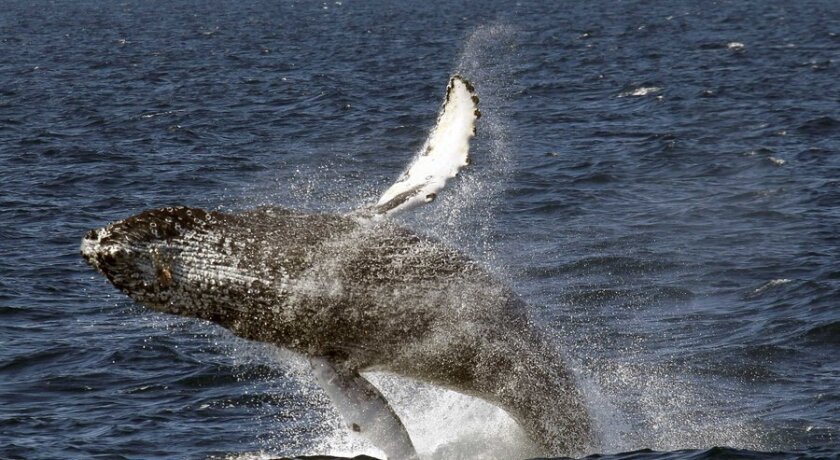
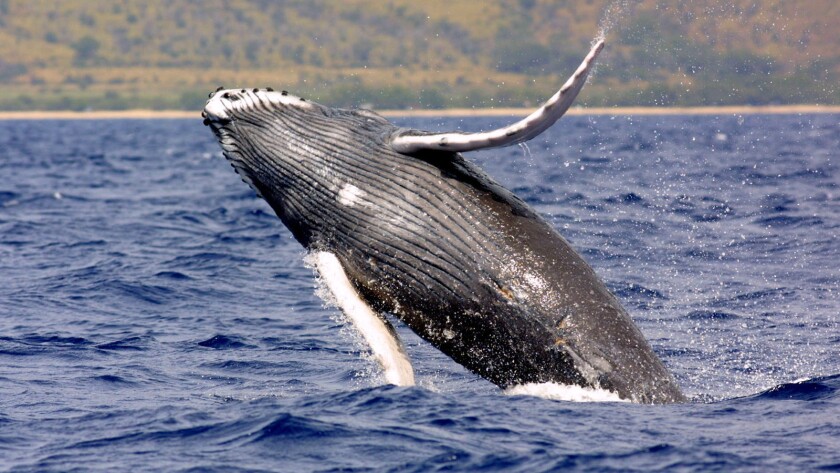
A humpback whale breaches off the coast of Long Beach.
(Nick Ut / Associated Press)

Karin Forney still remembers when an unusual number of humpback whales started showing up in Monterey Bay a few winters ago. She could see them out her window — so close to the surf that kayakers could literally paddle up to them.

But with this delightful arrival came an alarming number of humpbacks getting entangled in fishing gear that cut into their flesh and often led to death. This sudden crisis confounded scientists, fishermen and animal rights groups.

“We went from virtually no humpback whale entanglements to one every other week — and then during peak, in the spring of 2016 … we were basically on call every single day,” said Forney, an applied marine ecologist at the NOAA Fisheries who scrambled to help the rescue efforts.

“The whales just kept coming.”

In a study published Monday, a team of scientists solved the mystery. They showed how one dramatic shift in the marine ecosystem, exacerbated by an ever-warming planet, could set off a domino effect across California.

An unprecedented heat wave in the Pacific Ocean, dubbed “the blob,” had pushed anchovies and other humpback food closer to shore — right where most Dungeness crab fishermen tend to set their gear. The crab season, in turn, had been unusually delayed by the blob, so fishing did not peak until the whales started coming into town.

“The timing of everything is so sensitive from an ecosystem perspective,” said Jarrod Santora, lead author of the study and an ecosystem oceanographer with NOAA Fisheries and UC Santa Cruz. “We could have prevented this perfect storm from happening in 2016 — if we had this ecosystem science and a communication system in place.”

Bay Area crab fishing

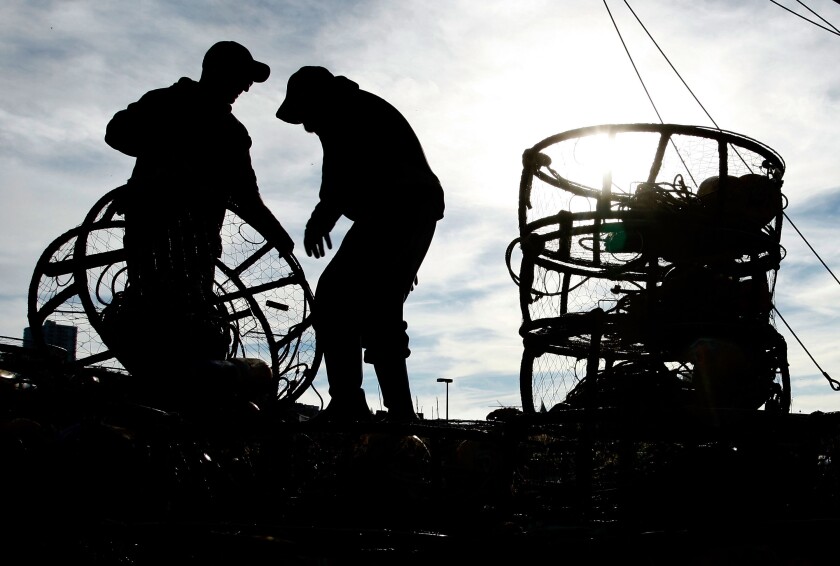
Crab fishermen load traps onto their boat at Fisherman’s Wharf in San Francisco.
(Justin Sullivan/ Getty Images)

The ocean is already a complicated place to live, and it’s not getting easier. Marine heat waves have doubled in frequency since 1982, and recent reports declared that global ocean temperatures in 2019 were the warmest on record — a trend that has continued for the last decade.

The chemistry of the water itself is acidifying at alarming rates — the cost of relying on our oceans to absorb so much of the world’s heat and carbon emissions.

Following the blob, which took hold in 2014 and overwhelmed marine life for three years, scientists documented the largest toxic algae bloom in the West Coast. Malnourished sea lions washed ashore, another study confirmed, and more than half a million seabirds starved to death — strewn across the coast from California to the Gulf of Alaska.

Monday’s study, published in the journal Nature Communications, brought together different scientists and data sources to piece together a bigger ecosystem picture in California.

Humpback whales eat both krill and anchovies, depending on what’s available. Krill tend to thrive in deeper and colder waters — and well up with the typical currents along the California coast.

But during the blob years, there was very little krill for the whales to eat, and what few anchovies were available were being squeezed into areas closer to shore in what scientists call a habitat compression. Humpbacks followed these clusters of anchovies to shallower and shallower waters, especially in Monterey, Point Reyes and Half Moon Bay.

Rescuers free entangled whale

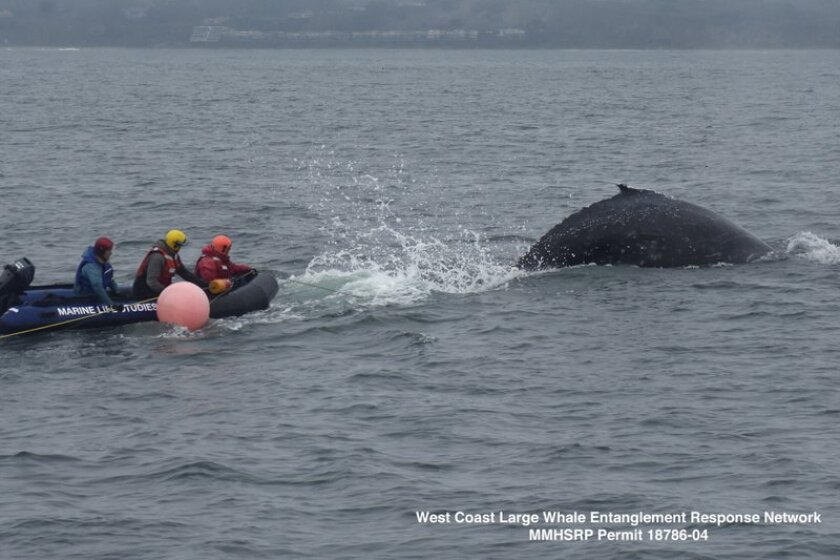
A young humpback whale entangled in fishing gear is freed in Monterey Bay, days after it was first spotted by a fisherman.
(Marine Life Studies Whale Entanglement Team via Associated Press)

The entanglements with fishing gear soared starting in 2014 and 2015, but then in 2016, a domoic acid outbreak (also thanks to the blob) kept the crab fishery shut until the first week of April — instead of its usual start date in mid-November.

This amplified the co-occurrence, as Santora calls it, of the whales being forced to feed in smaller concentrations closer to shore — right where the prime crab fishing areas tend to be. By 2016, there were more than 50 recorded entanglements, he said, “and that is just astonishing.”

“Historically, we always said: ‘My, aren’t we lucky that the crab fishery operates mostly from November through February, maybe March, and the whales are here from only March to November,” said Forney, the NOAA researcher in Monterey Bay, who was also an author on the study.

But more and more fishermen, she said, are sticking with crab through June. Salmon fishing, which many used to switch to around February, has become less reliable in this changing world.

John Mellor, who fishes mostly for crab out of San Francisco, said he’s eager for more science and coordination to protect all the marine life that makes California special.

“I’ve been fishing for 40 years, and things changed so drastically starting about 2013, 2014 … it was profound,” he said. “Suddenly the water was 10 degrees hotter, the forage was disrupted and whale patterns were disrupted, and it caused this whole chain reaction.”

The industry — the most valuable fishery in California — has been taking this very seriously, he said. “People are using best practices, like not using a bunch of slack rope or extra buoys on the surface.”

Tension was high in light of a recent lawsuit by the Center for Biological Diversity, which threatened to restrict crab fishing. A conservation plan is now being developed to address these marine interconnections.

The crab fishermen are treading cautiously and decided to start this season a little later, Mellor said, because there were still whales popping up in San Francisco. If we entangled even one or two, it could’ve resulted in the season being closed all year.”

They lost the profitable Thanksgiving rush and the most productive time to fish for crabs — when they’re just coming out of their molt. But taking care of and minding the balance of the ocean, Mellor said, is in everyone’s best interest.

Humpback whale

Humpback whales, known for their energetic leaps out of water, are popular among whale watchers along the iconic California coast.
(National Oceanic and Atmospheric Administration)

Mellor is part of what he calls a dedicated “hotshot crew” of scientists, fishermen, environmentalists and wildlife officials who got together when the entanglements first increased. Santora and Forney’s study provided the scientific baseline needed for this working group, which has been developing tools to better anticipate and avoid entanglement.

Many say this group, which was urgently convened in 2015 by the state’s Ocean Protection Council and wildlife and fisheries officials, is the future of ocean management: Setting aside differences, sharing field notes, compiling all the different data streams and figuring out how these multiple issues overlap. Reported entanglements have since dropped off but still remain higher than before the spike.

The scientists are now developing a website that will use all this data to forecast the areas where whales are most likely to be feeding off the West Coast. Crab fishermen could then decide where — and where not — to set their traps. Regulators could make calls on when to open or close a fishery.

Using these new tools and thinking about the ecosystem as a whole — rather than the traditional approach of focusing on one type of fish or species at a time — will help everyone adjust to more rapid and frequent changes in the marine environment.

They’ve created a framework, said Paige Berube of the Ocean Protection Council, to assess and manage risk in a way that can protect both ecological and economic imperatives.

“We can protect biodiversity, protect whales and sea turtles,” she said, “and also ensure that we continue to have thriving commercial fisheries that are iconic to our coastal identity as Californians.”

Trump’s Presidency Brings Us Closer to Midnight on the Doomsday Clock


The legendary Bulletin of the Atomic Scientists (BAS), which tracks issues related to technology and global security, has issued a terrifying warning: We are less than two minutes to midnight on the Doomsday clock. It’s very bad news, representing “the most dangerous situation that humanity has ever faced.”

What makes this moment so perilous? The scientists’ statement includes warnings over the cyber-weaponization of information, the spread of artificial intelligence (AI) in making military decisions, the destruction of treaties meant to limit the spread of nuclear weapons, the abandonment of global agreements to limit climate chaos, the spread of genetic engineering and synthetic biology technologies, and more. It does not account for the escalated likelihood of atomic reactor disasters, but based on at least one BAS publication, it should.

Since 1947, this prestigious band of elite scientists and global thinkers has been putting out a “clock” meant to time the peril of a global apocalypse. First issued at the dawn of the Cold War, it has mostly focused on the dangers of atomic warfare. Its countdown to Armageddon has been set as far away as 17 minutes from midnight, a hypothetical time of human extinction. That relatively optimistic assessment came in 1991, with the fall of the Soviet Union and the definitive end of the Cold War.

In 2018, the BAS set it at two minutes, the closest to catastrophe it had ever been. They repeated that estimate in 2019. But this year’s announcement has taken us inside the two-minute warning with a hair-raising litany of likely lethal catastrophes set to occur within 100 theoretical seconds.

Donald Trump is mentioned only once by name, in conjunction with his decision to trash the Paris Accords on climate change and greenhouse gas emissions. The scientists urge “whoever wins the 2020 election” to reinstate the U.S. commitment limiting carbon and other climate-destroying emissions. The BAS also cites Brazilian dictator Jair Bolsonaro for his decision to allow the destruction of the Amazon, with huge impacts on climate.

The BAS strives to maintain a non-partisan image. But Trump’s presence in the White House clearly hangs over any assessment of humankind’s survivability. The specter of his finger on the nuclear, ecological and financial buttons for the next four years hangs over humankind like a pall but goes otherwise unmentioned in this Doomsday assessment.

Also unmentioned is the question of more than 450 atomic power reactors worldwide. A small but vocal outlier coterie has argued that nuclear energy combats global warming by emitting less carbon that coal burners. But the Bulletin recently enshrined a major assessment by the esteemed Dr. Robert Jay Lifton, warning that commercial reactors pose a serious threat to human survival on this planet.

Published in August 2019, “The false promise of nuclear power in an age of climate change” argues that the 450 atomic reactors now deteriorating worldwide pose an existential threat to our survival. Writing with Professor Naomi Oreskes, Lifton warns that atomic energy “is expensive and poses grave dangers to our physical and psychological well-being.” Citing costs of nuclear juice at $100 per megawatt-hour versus $50 for solar and $30-40 for onshore wind, the authors say that the industry suffers from a “negative learning curve,” driving nuke costs constantly higher while those for renewables head consistently down.

Citing the unsolved problem of radioactive waste management, the BAS article warns of the ongoing impacts of major disasters like Fukushima and Chernobyl (and potentially more to come), whose fallout kills humans and does untold damage to the global ecology. Lipton and Oreskes say we need to free ourselves “from the false hope that a technology designed for ultimate destruction” can lead to our salvation. They favor making “renewable energies integral to the American way of life.”

In addition to nuclear and climate issues, the 2020 Doomsday assessment emphasizes some relatively new concerns. “In the last year,” it says, “many governments used cyber-enabled disinformation campaigns to sow distrust in institutions and among nations, undermining domestic and international efforts to foster peace and protect the planet.”

By attacking both science and the fabric of international peace accords, some global leaders have created “a situation that will, if unaddressed, lead to catastrophe, sooner rather than later.”

That situation includes AI and hypersonic warfare, both escalating “at a frenzied pace.” Now used in ultra-fast attacks, AI is dangerously vulnerable to “hacking and manipulation” while making “kill decisions without human supervision.” In nuclear command and control systems, the BAS warns, research and experience have demonstrated the vulnerability of these systems to “hacking and manipulation.”

This is an absolutely terrifying brew. The spread of disinformation, the contempt for science and expert opinion, the undermining of global agreements on arms control, and climate change are all deadly. Add in the new world of AI and hyper-sonic warfare, then pile on autocrats like Trump and Bolsonaro, and finish with the certainty of more disasters from 450 crumbling, obsolete atomic reactors.

All in all, it’s small wonder the Bulletin has taken us past the two-minute warning. It will clearly take every ounce of our activist strength to save our species from the final


whistle.


Drought ignites human-wildlife conflict in Zimbabwe

https://phys.org/news/2020-01-drought-ignites-human-wildlife-conflict-zimbabwe.html

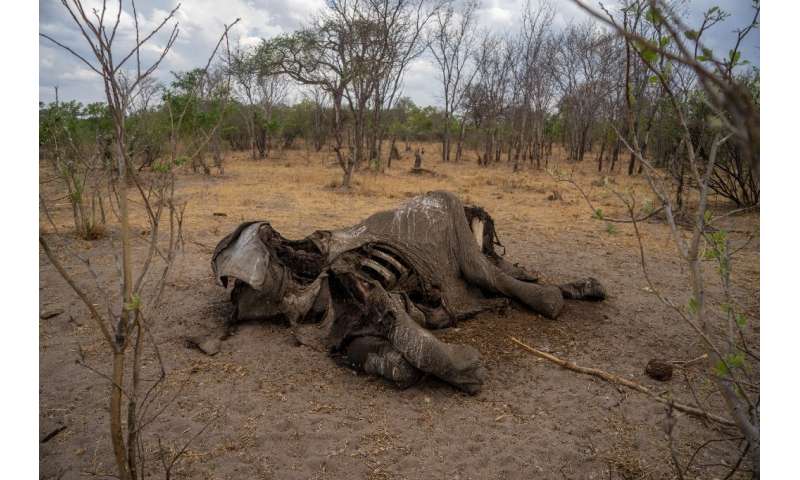
Taken on November 12, 2019 it shows the carcass of an elephant that succumbed to drought in the Hwange National Park, in Zimbabw
Taken on November 12, 2019 it shows the carcass of an elephant that succumbed to drought in the Hwange National Park, in Zimbabwe.

Zimbabwean villager Dumisani Khumalo appeared to be in pain as he walked gingerly towards a chair under the shade of a tree near his one-room brick shack.

Wild  in Zimbabwe were responsible for the deaths of at least 36 people in 2019, up from 20 in the previous year.

“I thank God that I survived the attack,” said Khumalo with a laugh, making light of the fact that the buffalo almost ripped off his genitals.

Authorities recorded 311 animal attacks on people last year, up from 195 in 2018.

The attacks have been blamed on a devastating drought in Zimbabwe which has seen hungry animals breaking out of game reserves, raiding  in search of food and water.

“The cases include attacks on humans, their livestock and crops,” said national parks spokesman Tinashe Farawo.

He said elephants caused most fatalities, while hippos, buffalos, lions, hyenas and crocodile also contributed to the toll.

Hwange National Park, which is half the size of Belgium, is Zimbabwe’s largest game park and is situated next to the famed Victoria Falls. The park is not fenced off.

Animals breach the buffer and “cross over to look for water and food as there is little or none left in the forest area,” Farawo said

Starving animals

Khumalo vividly remembers the attack.

More than 200 elephants starved to death over three months last year

He was walking in a forest near his Ndlovu-Kachechete village to register for food aid, when he heard dogs barking.

Suddenly a buffalo emerged from the bush and charged, hitting him in the chest and tossing him to the ground.

It went for his groin and used its horn to rip off part of the skin around his penis.

Khumalo grabbed the buffalo’s leg, kicked it in the eye and it scampered off.

Villagers in Zimbabwe’s wildlife-rich but parched northwestern region are frequently fighting off desperately hungry game.

More than 200 elephants starved to death over three months last year.

Despite suspecting that Khumalo was hunting illegally when he was attacked, Phindile Ncube, CEO of Hwange Rural District Council admitted that  are killing people and that the drought has worsened things.

“Wild animals cross into human-inhabited areas in search of water as … sources of drinking water dry up in the forest,” said Ncube.

He described an incident that took place a few weeks earlier, during which elephants killed two cows at a domestic water well.

Armed scouts have been put on standby to respond to distress calls from villagers.

But it was while responding to one such call that the scouts inadvertently shot dead a 61-year-old woman in Mbizha village, close to Khumalo’s.

“As they tried to chase them off one (elephant) charged at them and a scout shot at it. He missed, and the stray bullet hit and killed Irene Musaka, who was sitting by a fire outside her hut almost a mile away.”

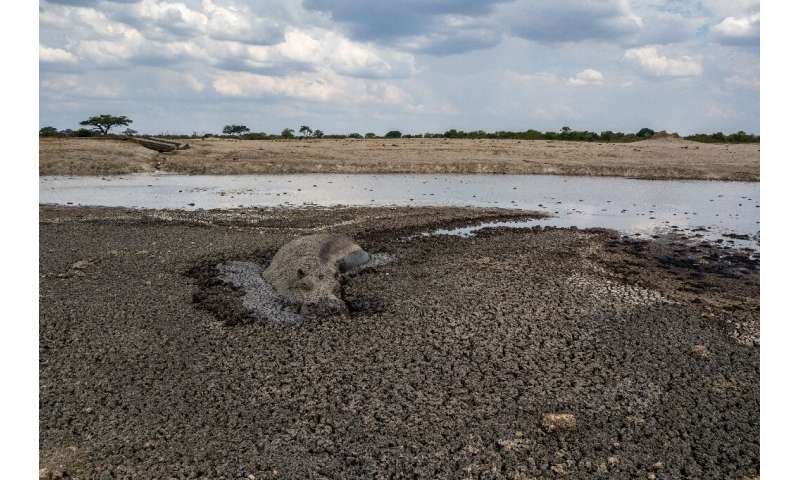
In this file photo taken on November 12, 2019 a hippo is stuck in the mud at a drying watering hole in the Hwange National Park,
In this file photo taken on November 12, 2019 a hippo is stuck in the mud at a drying watering hole in the Hwange National Park, in Zimbabwe.

Chilli cake repellant

Locals are encouraged to play their part to scare off animals. One way is to beat drums.

But the impact is limited.

“Animals, such as elephants get used to the noise and know it… won’t hurt them, so it does not deter them in the long term,” said George Mapuvire, director of Bio-Hub Trust, a charity that trains people to respond to .

Bio-Hub Trust advocates for a “soft approach” that encourages peaceful co-existence between humans and wildlife.

Mapuvire suggested burning home-made hot chilli cakes to repel wildlife.

“You mix chilli powder with cow or elephant dung and shape it into bricks, once the bricks dry, you can burn them when elephants are approaching. They can’t stand the smell!”

Villagers have created an elephant alarm system by tying strings of empty tin cans to trees and poles.

When the cans click, they know an elephant is approaching and they light chilli cakes to keep it away.

Another way of keeping  at bay is the chilli gun, a plastic contraption loaded with ping-pong balls injected with chilli oil.

“When it hits an elephant, it disintegrates, splashing the animal with the chilli oil,” Mapuvire explained.

Grizzlies, black and polar bears found together for 1st time

Polar bears, black bears, and grizzlies have been found together for the first time during a University of Saskatchewan research project in northern Manitoba.
 Polar bears, black bears, and grizzlies have been found together for the first time during a University of Saskatchewan research project in northern Manitoba. University of Saskatchewan / Supplied
University of Saskatchewan researchers said they made an unprecedented finding – all three species of North American bears in the same subarctic region.

The researchers documented polar bearsblack bears, and grizzlies in Wapusk National Park on the west coast of Hudson Bay near Churchill, Man.

READ MORE: Draft plan says Nunavut has too many polar bears and climate change isn’t affecting them

“These sightings are consistent with expected ecological responses to the amplified effects of climate change on high-latitude ecosystems,” said Douglas Clark, a conservation scientist at the U of S School of Environment and Sustainability.

“Our observations add to growing evidence that grizzlies are substantially increasing their range in northern Canada.”

Researchers said they observed the bears between 2011 and 2017 using motion-activated cameras.

WATCH BELOW: Grizzly bears at Saskatoon zoo to begin 3rd hibernation

5 fun facts about grizzly bear hibernation at Saskatoon zoo

5 fun facts about grizzly bear hibernation at Saskatoon zoo

What was new in the observations, said Clark, were the grizzlies.

“It’s likely that they will benefit the most because they have been known to dominate the other two species elsewhere, for instance eating both black bears and polar bears, or displacing them,” he said.

However, Clark said, large black bears could have the upper hand when encountering a young grizzly, while smaller species of bears will modify their behaviour to avoid grizzlies.

Clark said the big question is how the interactions will affect bear conservation and management efforts.

He said the overlap could be due to climate change as bears seek out new or expanded habitats for food sources.

“This range overlap shouldn’t be viewed as a threat to any of these bears, but should be understood as an ecological response to environmental change.”

He added Wapusk is at the convergence of the boreal forest, tundra, and ocean ecosystems that are all changing quickly with climate change.

As the lab-grown meat industry grows, scientists debate if it could exacerbate climate change

KEY POINTS
  • Companies are moving quickly to bring to market meat products that are grown from animal cells in a lab.
  • Similar to companies like Beyond Meat and Impossible Burger, cultured meat will replicate the taste and consistency of traditional meat.
  • The move to the lab will appeal to people concerned about land-based animal agriculture and its role in accelerating climate change.
  • Some researchers speculate the rise of the cultured meat could actually make climate change worse.
GP: Lab grown meat, Laboratory Meat
Startup founder Didier Toubia holds a petri dish and a plate with a steak in his hands. The Petri dish contains certain stem cells of a cow from which a steak will be bred in the laboratory in three to four weeks.
Ilia Yechimovich | picture alliance | Getty Images

Companies across the world are moving quickly to bring to the market hamburgers and other meat products that are grown from animal cells in a lab.

This month, Israeli-based company Future Meat Technologies raised $14 million to build a production plant for its cultured meat products, joining several dozen other start-ups poised to launch their first commercial products within the next couple years.

Lab-grown meat will replicate the taste and consistency of traditional meat. Many expect the move to the lab will especially appeal to people concerned about the role land-based animal agriculture has in accelerating climate change.

But as investments and research ramp up for lab-grown meat, more people are debating the environmental and health implications of widespread production of alternatives.

Some researchers speculate that depending on the efficiency of the production process, the rise of the cultured meat industry could actually make climate change worse than traditional beef production. One issue is the longer lasting impact of carbon pollution versus methane gas pollution.

“Lab meat doesn’t solve anything from an environmental perspective, since the energy emissions are so high,” said Marco Springmann, a senior environmental researcher at the University of Oxford.

“So much money is poured into meat labs, but even with that amount of money, the product still has a carbon footprint that is roughly five times the carbon footprint of chicken and ten times higher than plant-based processed meats,” he said.

Despite these findings, commitment to protecting the environment is at the forefront of marketing efforts by plant-based protein and lab-created meat companies. Analysts project the market could be worth as much as $85 billion by 2030.

Animal agriculture remains a giant global economic force. It’s responsible for nearly 15% of global greenhouse emissions, according to United Nations estimates. Roughly 65% of those emissions come from beef and dairy cattle.

Companies say cultured meat is the future

Dozens of start-ups are racing to be the first to sell their lab-grown beef within the year. So far, the U.S. has at least nine cell-culturing companies out of the several dozen worldwide. The leading industries plan to release the first products, including like ground beef and chicken nuggets, by the end of this year.

Proponents of cultured meat say that producing it in a lab helps preserve endangered species and other animals, reduces greenhouse gas emissions and significantly curbs land and water use. Most of the cultured meat start-ups boast a firm commitment to protecting the environment.

MosaMeat in the Netherlands says that cultured meat generates up to 96% lower greenhouse gas emissions, and the company predicts that once cultured meat becomes a mass-market food, there will be no need for industrial farms.

In the U.S., San Francisco-based Memphis Meats says its businesses use significantly less land, water energy and foot inputs. Tyson Foods and Cargill have both invested in the company.

Future Meat Technologies says its cultured products will take up 99% less land, 96% less freshwater and emit 80% less greenhouse gases than traditional meat production, according to its Life Cycle Assessment.

“One of the reasons that Future Meat Technologies stands out in the cultured meat field is that our proprietary high yield production process lends itself naturally to distributive manufacturing,” said the company’s founder Koby Nahmias. “Because it’s so efficient, I think we’ll see more than an add-on to cattle production, but that it will start replacing it.”

The company’s process will allow farmers to shift production to a more sustainable, lower-risk and high-efficiency process, Nahmias said, and the small size of the company’s production modules can also be powered by renewable energy.

Production a work in progress

Since the cultured-meat industry is in such an early stage, it’s difficult to assess the actual carbon footprint of producing on a large scale without clear data on production processes.

As companies continue to develop their alternative meat products they’ll likely face increasingly climate-conscious consumers or stricter regulations on emissions as the planet warms. This could encourage the growing industry to use cleaner energy and technologies for cultured meat, researchers say.

However, if large-scale cultured meat industries start producing a lot of carbon dioxide pollution, it could be as damaging for the planet as the beef and cattle emissions, according to the research published in the journal Frontiers in Sustainable Food Systems.

The impact would depend on decarbonized energy generation and the production systems cultured meat companies use, the study says. The research points out that emissions from a meat lab produce energy made up of carbon dioxide, which persists in the atmosphere for hundreds of years. In contrast, methane, a potent greenhouse gas produced by raising and killing cattle, disappears from the atmosphere in about 12 years.

“In the past year, we’ve seen more hype and investment around cultured meat,” said John Lynch, a researcher at Oxford University and co-author of the report.

VIDEO00:36
How ‘cultured meat’ can turn one cow into 175M burgers

“If these companies want to sell cultured meat as an environmental alternative, they will need to look at renewable energy resources for production. They need to have the drive to do it,” he said.

Of course, that research is based on speculating about how labs will produce their products and contain emissions. The companies are not yet producing on a commercial scale and are still trying to cut costs as they compete to bring the product to the market.

“We’ll need to take a step back and urge a bit more caution if environmental messaging continues to be a big part of advertising for cultured meat,” Lynch said. “The interest of the companies is making it clear how will they produce in an environmentally sustainable way.”

In a similar movement away from eating animals, companies like Beyond Meat and Impossible Burger have gained popularity over the past few years. They produce fake meat products made from pea protein or genetically modified soy for consumers who want the taste to imitate a real burger, and market the environmental benefits of their products.

However, those fake meat products have also been debated by scientists, who argue that it’s healthier and better for the environment to consume plant foods rather than processed alternatives.

Future Meat’s Nahmias said that the research indicating that lab-grown meat could be worse for the environment than regular beef was widely “mischaracterized” as a claim against cultured meat.

“Under extreme cases, if you’re using polluting energy, you can get to parity with traditional meat,” he said. “We’re far away from that extreme case, so I don’t see that as a problem.”

Future Meat’s efficiency is expected to improve 10 times more in their new pilot production facility, he added, and the distributive manufacturing model will allow producers to couple each small facility to local renewable energy production.

“We are working in an industry with tight margins and thus a necessity for efficiency,” said Cai Linton, founder of London-based start-up Multus Media, a group that’s working to reduce the cost of lab-grown meat.

“As a company, our biggest environmental policy will be minimizing waste, particularly with regard to single-use plastics and fresh-water, and ensuring the electricity we use is produced sustainably and in a clean way.”

Linton said that by the time his start-up is ready to scale up, he’s confident the facilities will have net-zero carbon emissions.

“At this early stage, our estimations on efficiency and environmental impact will always be open to scrutiny since they are only projections,” he said. “We must also consider that although the research and development required to create a commercially viable product may not have environmental protection at its core, the long term benefits of this technology far outweigh the short-term cost.”

Why we must cut out meat and dairy

Jonathan Safran Foer: why we must cut out meat and dairy before… https://www.theguardian.com/books/20 19/sep/28/meat-of-the-mat. c#ftian Jonathan Safran Fo€r: why we must cut out meat and dairy before dinner to save theplanet Animal products create more greenhouse gas emissions than the entire transportation sector, but we don’t want to confront this inconvenient truth: our eating habits are a problem

The Guardian

Jonathan Safran Foer

Sat 28 Sep 2019 03.00 EDT

Our planet is facing a crisis. But even when we know that a war for our survival is raging, we don’t feel that it is our war. Although many of climate change’s accompanying calamities – extreme weather events, floods and wildflres, displacement and resource scarcity chief among them – are vivid,

1of 8 912812019,1:00 PM

Jonathan Safran Foer: why we must cut out meat and dairy before https ://www.theguardian. com lbooks/2019 / sep 128 I meat-of-the-mat.

personal and suggestive of a worsening situation, they don’t feel that way in aggregate. The distance between awareness and feeling can make it very difficult for even thoughtful and politically engaged people – people who want to act – to act.

So-called climate change deniers reject the conclusion that97% of climate scientists have reached: the planet is warming because of human activities. But what about those of us who say we accept the reality of human-caused climate change? We may not think the scientists are lying, but are we able truly to believe what they tell us? Such a belief would surely awaken us to the urgent ethical imperative attached to it, shake our collective conscience and render us willing to make small sacrifices in the present to avoid cataclysmic ones in the future.

In zot8, despite knowing more than we have ever known about human-caused climate change, humans produced more greenhouse gases than we’ve ever produced, at a rate three times that of population growth. There are tidy explanations – the growing use of coal in China and India, a sttong global economy, unusually severe seasons that required spikes in energy for heating and cooling. But the truth is as crude as it is obvious: we don’t care. So now what?

Of course there are some moments when the planetary crisis is acutely felt. Watching Al Gore’s An Inconvenient Truth was an intellectual and emotional revelation for me. When the screen went dark after the final image, our situation seemed perfectly clear, as did my responsibility to participate in the struggle. And when that film’s credits rolled, at the moment of greatest enthusiasm to do whatever was asked to work against the imminent apocalypse that Gore had just delineated for us, suggested actions appeared on the screen. ‘Are you ready to change the way you live? The climate crisis can be solved. Here’s how to start.”

Among the suggestions were: tell your parents not to ruin the world that you will live in; if you are a parent, join with your children to save the world they will live in; switch to renewable sources of energy; plant trees, iots of trees; raise fuel economy standards; require lower emissions from automobiles.

A[ Gore in An inconvenient Sequel: Truth to Power. Photograph: Participant Media/Paramount Pictures

2 of 8 912812019, 1:00 PM

Jonathan Safran Foer: why we must cut out meat and dairy before.. https ://www.theguardian. com,/books/20 19 / sep 128 I meat-of-the-mat..

There is a glaring absence in Gore’s list, and its invisibility recurs in 2017’s An Inconvenient Sequel: Truth to Power, with one minuscule exception. It is impossible to explain this omission as accidental without also accusing Gore of a kind of radical ignorance. In terms of the scale of the error, it would be equivalent to a doctor prescribing physical exercise to a patient recovering from a heart attack without also telling him he needs to quit smoking, reduce his stress and stop eating burgers and fries twice a day.

So why would Gore deliberately choose to leave this particular issue out? Almost certainly for fear that it would be distractingly controversial and dampen the enthusiasm he had just worked so hard to ignite. It has also been largely absent from the websites of leading environmental advocacy organisations – although this now seems to be changing. It is unmentioned in the celebrated book Dire Predictions, written by the climate scientists Michael E Mann and Lee R Kump. After forecasting existential climate disasters, the authors recommend that we substitute clotheslines for electric dryers and commute by bicycle. Among their suggestions, there is no reference to the everyday process that is, according to the research director of Project Drawdown – a collection of nearly zoo environmental scientists and thought leaders dedicated to identifying solutions to address climate change – “the most important contribution every individual can make to reversing global warming”.

What I am thinking of is the fact that we cannot save the planet unless we significantly reduce our consumption of animal products. This is not my opinion, or anyone’s opinion. It is the inconvenient science. Animal agriculture produces more greenhouse gas emissions than the entire transportation sector (all planes, cars and trains), and is the primary source of methane and nitrous oxide emissions (which are 86 and 3ro times more powerful than CO2, respectively). Our meat habit is the leading cause of deforestation, which releases carbon when trees are burned (forests contain more carbon than do all exploitable fossil-fuel reserves), and also diminishes the planet’s ability to absorb carbon. According to a recent report from the Intergovernmental Panel on Climate Change, even if we were to do everything else that is necessary to save the planet, it will be impossible to meet the goals of the Paris Climate Accord if we do not dramatically reduce our consumption of animal products.

Why is this subject avoided? Conversations about meat, dairy and eggs make people defensive. They make people annoyed. It’s far easier to vilify the fossil fuel industry and its lobbyists – which are without a doubt deserving of our vilification – than to examine our own eating habits. No one who isn’t a vegan is eager to go there, and the eagerness of vegans can be a further turnoff. But we have no hope of tackling climate change if we can’t speak honestly about what is causing it, as well as our potential to change in response.

It is hard to talk about our need to eat fewer animal products both because the topic is so fraught and because of the sacrifice involved. Most people like the taste of meat, dairy and eggs. Most people have eaten animal products at almost every meal since

3 of 8 9/2812019,1:00 PM

Jonathan Safran Foer: why we must cut out meat and dairy before… https://www.theguardian.com/books/2019/sepl28/meat-of-the-mat

they were children, and it’s hard to change lifelong habits, even when they aren’t freighted with pleasure and identity. Those are meaningful challenges, not only worth acknowledging but necessary to acknowledge. Changing the way we eat is simple compared with converting the world’s power grid, or overcoming the influence of powerful lobbyists to pass carbon-tax legislation, or ratifying a significant international treaty on greenhouse gas emissions – but it isn’t simple.

I certainly haven’t found it to be effortless. In my early 3os, I spent three years researching factory farming and wrote a book-length rejection of it called Eating Animals.I then spent nearly two years giving hundreds of readings, Iectures and interviews on the subject, making the case that factory-farmed meat should not be eaten. So it would be far easier for me not to mention that in difficult periods over the past couple of years – while going through some painful personal experiences, while travelling the country to promote a novel when I was least suited for self-promotion – I ate meat a number of times. Usually burgers. Often at airports. Which is to say, meat from precisely the kinds of farms I argued most strongly against. And my reason for doing so makes my hypocrisy even more pathetic: they brought me comfort. I can imagine this confession eliciting some ironic comments and eye-rolling, and some grddy accusations of fraudulence. I wrote at length, and passionately, about how factory farming tortures animals and destroys the environment. How could I argue for radical change, how could I raise my children as vegetarians, while eating meat for comfort?

I wish I had found comfort elsewhere but I am who I am. Even as my commitment to vegetarianism, driven by the issue of animal welfare, has been deepened by a full awareness of meat’s environmental toll, rarely a day has passed when I haven’t craved it. At times I’ve wondered if my strengthening intellectual rejection of it has fuelled a strengthening desire to consume it.

Confronting my hypocrisy has reminded me how difficult it is to even try to live my values. Knowing that it will be tough helps make the efforts possible. Efforts, not effort. I cannot imagine a future in which I decide to become a meat-eater again, but I cannot imagine a future in which I don’t want to eat meat. Eating consciously will be one of the

‘Rarely a day has passed when I haven’t craved meat’ Jonathan Safran Foer. Photograph: Christopher Lane

4 of 8 912812019,1:00 PM

Jonathan Safran Foer: why we must cut out meat and dairy before… [https://www.theguardian.com,/books/2019lsepl28lmeat-ofthe-mat]https://www.theguardian.com,/books/2019lsepl28lmeat-ofthe-mat.

struggles that span and define my life.

We do not simply feed our bellies, and we do not simply modify our appetites in response to principles. We eat to satisfy primitive cravings, to forge and express ourselves, to realise community. We eat with our mouths and stomachs, but also with our minds and hearts. All my different identities – father, son, American, New Yorker, progressive, Jew, writer, environmentalist, traveller, hedonist – are present when I eat, and so is my history. When I first chose to become vegetarian, as a nine-year-old, my motivation was simple: do not hurt animals. Over the years, my motivations changed because the available information changed, but more importantly, because my life changed. As I imagine is the case for most people, ageing has proliferated my identities Time softens ethical binaries and fosters a greater appreciation of what might be called the messiness of life.

There is a place at which one’s personal business and the business of being one of seven billion earthlings intersect. And for perhaps the first moment in history, the expression “one’s time” makes little sense. Climate change is not a jigsaw puzzle on the coffee table, which can be returned to when the schedule allows and the feeling inspires. It is a house on fire. The longer we fail to take care of it, the harder it becomes to take care of, and because of positive feedback loops – white ice melting to dark water that absorbs more heat; thawing permafrost releasing huge amounts of methane – we will very soon reach a tipping point of “runaway climate change”, when we will be unable to save ourselves, no matter how much effort we make.

We do not have the luxury of living in our time. We cannot go about our lives as if they were only ours. In a way that was not true for our ancestors, the lives we live will create a future that cannot be undone. The word “crisis” derives from the Greek krusls, meaning “decision”.

Future generations will almost certainly look back and wonder why on earth – why on Earth – did we choose our suicide? Perhaps we could plead that the decision wasn’t ours to make: as much as we cared, there was nothing we could do. We didn’t know enough at the time. Being mere individuals, we didn’t have the means to enact consequential change. We didn’t run the oil companies. We weren’t making government policy. The ability to save ourselves, and save them, was not in our hands. But that would be a lie.

Our attention has been fixed on fossil fuels, which has given us an incomplete picture of the planetary crisis and led us to feel that we are hurling rocks at a Goliath far out of reach. Even if they are not persuasive enough on their own to change our behaviour, facts can change our minds, and that’s where we need to begin. We know we have to do something, but “we have to do something” is usually an expression of incapacitation, or at least uncertainty. Without identifying the thing that we have to do, we cannot decide to do it.

5 of 8 912812019, 1:00 PM

Jonathan Safran Foer: why we must cut out meat and dairy before… htps ://www.theguardian. com/books/20 19 I sep 128 I meat-of-the-mat.

Forest fires in A[tamira, Para state, Brazil[ … ‘Our meat habit is the leading cause of deforestation, which releases carbon when trees are burned’ Photograph: JoSo Laet/AFP/Getty images

Climate change is a crisis that will always be simultaneously addressed together and faced alone. The four highest impact things an individual can do to tackle the planetary crisis are: have fewer children; live car-free; avoid air travel; and eat a plant-based diet. Most people are not in the process of deciding whether to have a baby. Few drivers can simply decide to stop using their cars. A sizable portion of air travel is unavoidable. But everyone will eat a meal relatively soon and can immediately participate in the reversal of climate change. Furthermore, of those four high-impact actions, only plant-based eating immediately addresses methane and nitrous oxide, the most urgently important greenhouse gases.

Some argue that plant-based eating is elitist. They are either misinformed, or knowingly taking the favorite emergency exit of privileged, performatively thoughtful people who don’t want to change what they eat. It is true that a healthy traditional diet is more expensive than an unhealthy one – about $SSo (f44o) more expensive over the course of a year. And everyone should, as a right, have access to affordable healthy food. But a healthy vegetarian diet is, on average, about $ZSo (f6oo) Iess expensive per year than a healthy meat-based diet. In other words, it is about $2oo (f16o) cheaper per year to eat a healthy vegetarian diet than an unhealthy traditional diet. Not to mention the money saved by preventing diabetes, hypertension, heart disease and cancer – all associated with the consumption of animal products. Nine per cent of Americans making less than $3o,ooo per year identify as vegetarian, whereas only 4% of those making more than $75,ooo are. People of colour are disproportionately vegetarian. It is not elitist to suggest that a cheaper, healthier, more environmentally sustainable diet is better. But what does strike me as elitist? When someone uses the existence of people without access to healthy food as an excuse not to change, rather than as a motivation to help those people.

Different studies suggest different dietary changes in response to climate change, but the ballpark is pretty clear. The most comprehensive assessment of the livestock industry’s environmental impact was published in Nature in October 2018. After analysing food-production systems from every country around the world, the authors

6 of 8 9/2812019,1:00 PM

Jonathan Safran Foer: why we must cut out meat and dairy before… htps://www.theguardian.com/books/2019lsepl28lmeat-of-the-mat…

concluded that while undernourished people living in poverty across the globe could actually eat a little more meat and dairy, the average world citizen needs to shift to a plant-based diet in order to prevent catastrophic, irreversible environmental damage. The average US and UK citizen must consume 90% less beef and 6o% less dairy.

No animal products for breakfast or lunch would come close to-achieving that. It might not amount to precisely the reductions that are asked for, but