Protestors of Squirrel Slam say hunting contest ‘is a crime against nature’

By Tom Rivers, editor 19 February 2014

HOLLEY – Edita Birnkrant doesn’t want to take away anyone’s Second Amendment rights. But she does want to make shooting animals illegal when it’s part of a fund-raiser.

Birnkrant is director of Friends of Animals in New York. She will be in Holley on Saturday for the 8th annual Squirrel Slam. She may be joined by hundreds of FOA supporters from several states.

“We share the landscape with wildlife,” Birnkrant said by phone this afternoon from New York City. “I see this as a crime against nature.”

Friends of Animals plans a peaceful protest near the Holley Firehall from 4:30 to 6 p.m. on Saturday. Birnkrant was in Holley last year for the Squirrel Slam and she said some of the hunters taunted her with dead squirrels, holding them out towards her as they passed by for the weigh station at the firehall.

Police have told Birnkrant the Friends of Animals will be separated from the hunters on Saturday. Police don’t want the hunters walking through a pack of protestors.

This year’s event has the added dimension of the New York Revolution, a group that formed last year after the state passed the controversial gun control measure known as the SAFE Act. The group is expected to be in Holley on Saturday, showing its support for the Second Amendment.

Birnkrant said she doesn’t want to infringe on the Second Amendment.

“We’re not trying to take guns away,” she said. “We think wildlife killing contests should be unlawful. As a society we have to evolve from this.”

The Holley event isn’t the only fund-raiser where participants hunt wildlife. Other events target crows and coyotes. But Birnkrant said Holley’s Squirrel Slam is unusual because it has a fire department as its sponsor and
welcomes children as young as 12 to participate.

Participants bring up to five squirrels to the weigh station and prizes go to the heaviest cumulative entry. The event on Saturday, despite little advertising, quickly was a sellout and capped at 650 participants.

The Squirrel Slam generates about $6,500 in revenue for the Fire Department. After it pays out $1,500 for prizes, $500 for food and $440 to Holley for police overtime, Fire Department President Fran Gaylord said the event nets about $4,000.

Friends of Animals plans to present a petition to village and fire department officials, asking that the event be cancelled in the future. Friends has offered to make up the fund-raising loss for the fire department, Birnkrant said.

Bills in both the State Assembly and Senate call for banning wildlife hunting contests. That doesn’t include fishing derbies. Birnkrant said that her goal is to stop the contests that call for killing of land animals. She
doesn’t see the contests as hunting in the traditional sense.

“Most people would be horrified by a dog or cat killing contest because they are pets,” Birnkrant said. “I’m horrified by a squirrel killing contest. They feel pain.”

Friends of Animals is actually against all hunting, but the group’s immediate goal is to see state legislation approved to ban wildlife hunting contests.

Birnkrant said her group hopes to show its opposition to the Holley event on Saturday, and doesn’t want to get into any confrontations with supporters of the Squirrel Slam.

“I would hope it would be pretty uneventful,” she said.

Holley police expects to have at least five officers on duty Saturday afternoon with additional support from the Albion Police Department and New York State Police.

Photo copyright Jim Robertson


Photo copyright Jim Robertson

High School Class Sponsoring Crow Hunting Tournament…

…and other weekly hunting news from Oklahoma.

The senior class of Sasakwa High is sponsoring a crow hunting tournament
on March 1st. [Watch for the next big school shooting to happen there, sometime after March 1st.]

[Crow] “hunters” can register for the tournament as individuals or
three
person teams.
The deadline to enter is Feb. 17th. The cost is $20 per person. The
first
place will pay 35 percent of the entry fees. The second place will be
awarded
15 percent.

The Okla. Station Chapter of the Safari Club International is holding its
29th
annual convention banquet and fundraiser on March 1st at the Okla.
Cowboy and Western Heritage Museum.
In 2010 and 2012, the chapter’s banquet program won best-in-class among
all the organization’s chapters across the world.
The 2014 banquet will feature much more. This includes more than
$500,000
worth of auction items such as big-game hunts around the world, bird hunts,
fishing trips, guns, gear, jewelry, sculptures and more.
Auction items can be viewed on line and the tickets are $75 in advance or
$95 at the door

Photo Copyright Jim Robertson

Photo Copyright Jim Robertson

.

Okla. is now debating whether to hunt a young deer buck or shoot a trophy
deer. Now, deer associations and landowners work together to manage
deer and other wildlife on their properties, with a common goal, such as
protecting young bucks and increasing the buck age structure.
A bill has been introduced in the Okla. House of Representatives that
proposes a 6-point antler restriction on bucks for hunters ages 17 or
older.
This is an attempt to protect young bucks. They can’t grow into trophy
bucks if they keep getting killed as yearlings.
Other states have similar restrictions. However, some wildlife officials
don’t think it would work in Okla.
Because so many deer hunters voluntarily do not kill young deer, wildlife
officials believe that the trend in Okla. is that more hunters keep passing
on young bucks.
One official notes “Hunters are better educated, and they are more
selective about what they harvest.”
Four of the top five states that had the lowest percentage of yearling
bucks
harvested were states that did not have any antler regulation.
Depending on which side of the deer management debate often depends
on whether you primarily hunt for meat or hunt for horns.
The Okla. Wildlife Dept. tries to please both groups thru liberal hunting
seasons and Deer Management Assistance Programs for landowner
interested in managing for bigger bucks.

The Hummingbird Is Getting to be a Pest

DSC_0272Humans aren’t all bad—not all the time, anyway. We may be the most parasitic plague and destructive mutants ever to evolve on Earth, but occasionally our actions can actually help certain other animals.

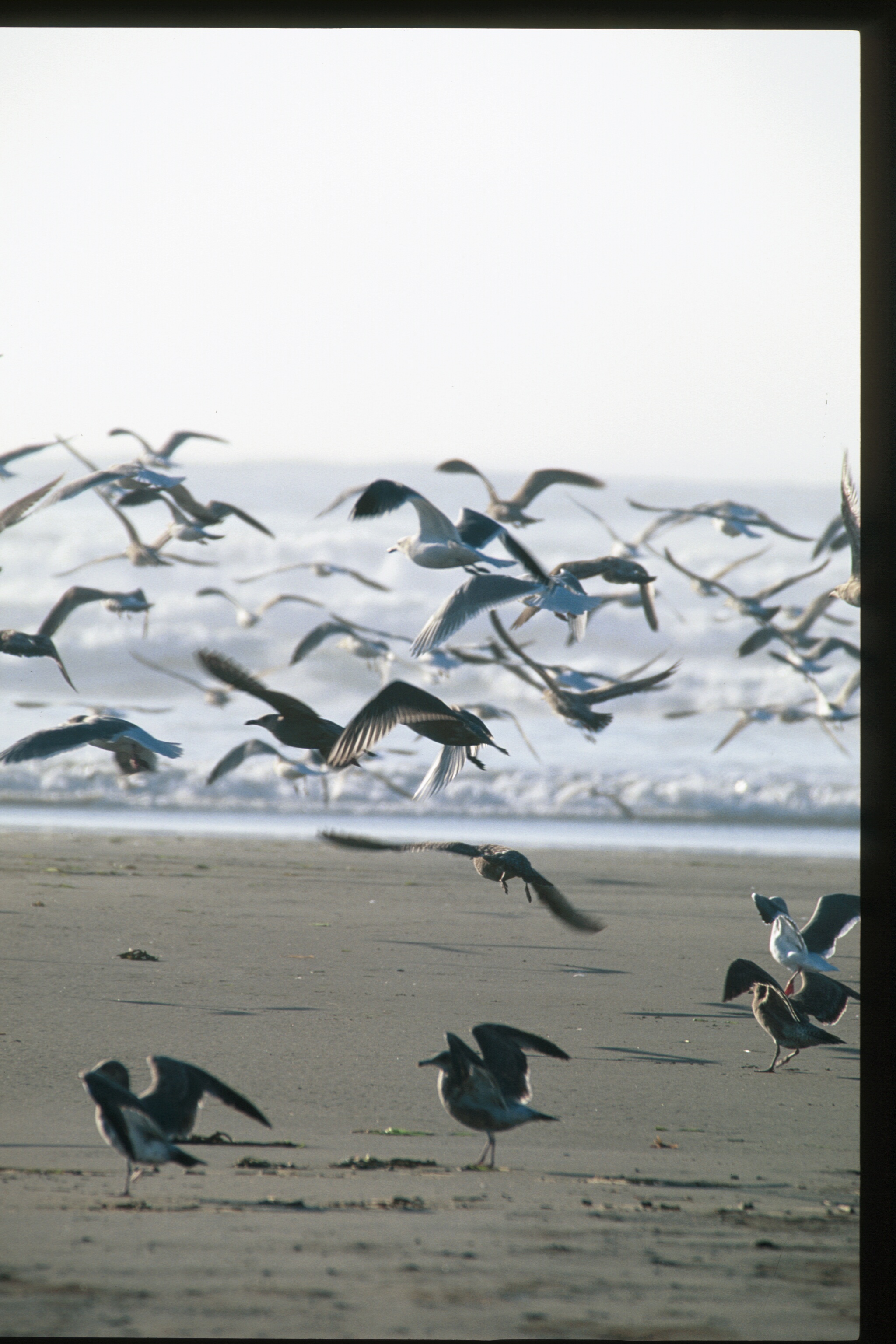
Sometimes it’s unintentional, such as when people are driving the sandy beaches here030 on the Pacific coast. Vehicles on the soft, upland sand can disrupt or damage endangered snowy plover nests, and when people drive too fast right along the surf they’ve been known to run over migratory shorebirds feeding there. But on exceptionally windy days, while driving the beach in search of pelagic birds, like murres or grebes, washed up after brutal storms and now in need of rehabilitation, I’ve noticed that the shorebirds take refuge in deep tire tracks, hunkering down in the only cover they can find (especially if beachcombers have trucked off all the driftwood logs).

While leaving deep tire tracks in the sand can’t really be considered a direct, intentional act of kindness for an animal, keeping fresh, thawed sugar-water out for the straggler humming bird we’ve had here all winter surely can. The poor bird must have stuck around this normally mild, coastal region, rather than migrating further south, because of the late-blooming honeysuckle and early blossoming salmonberry shrubs. But now an arctic air mass has encroached for a week, bringing with it temperatures in the teens and wind-chills in the single digits. Frozen ponds and snow coating on the Sitka spruces and western hemlock complete this late Christmas-card scene, but I can imagine, to a high strung hummingbird, it must feel like the ice age is back to stay.

Photo Thanks to Linda Delano

Photo Thanks to Linda Delano

My wife has been the one diligently keeping watch over the feeder, being sure to exchange it for a thawed one every other hour on these iciest of days. But at first light this morning, while the coffee was brewing, I went out in my bathrobe before filling the other birds’ feeders and replaced his liquid refreshment. As it was, the hummingbird didn’t show up at until after 8:00.a.m. It must have been hard to leave the thicket he was crouched in and face the frozen wasteland to find out whether or not the human handout had turned into a sugar-water popsicle. He was lucky this morning. Hardly a steaming cup of hot coffee, but it must have seemed like the nectar of the gods to someone with such a high metabolism—especially after a long night spent burning precious energy trying to stay warm.

Were I of a different mindset (i.e., not an animal lover) I might say, “That hummingbird is becoming a pest. It could be considered a safety hazard, or maybe even a road hazard. It could be an exotic or even an invasive species. It might be time to call for a cull, or even a contest hunt on him.” But, fortunately for him, I’m not like that.

DSC_0022


ACTION ALERT: Coyote Killing Contest ~ Jan. 18-19 Crane, OR


“A society that condones unlimited killing of wildlife for fun and prizes is morally bankrupt.”  ~ Dave Parsons, Project Coyote Science Advisory Board

Please join Project Coyote to take immediate action to stop a brutal coyote killing contest scheduled for January 18-19th in Crane, Oregon.  There is no place for a wildlife killing contest in our civilized society.
Contest participants, in teams of two, with no geographical restrictions will slaughter coyotes for thrills and compete for cheap prizes (including cash). Awards will be given for the most coyotes killed, the largest coyote, and other categories including a calcutta. This is not hunting but a gratuitous massacre that is legal in Oregon and across the country. Children under the age of 16 are encouraged to participate with free entry on Saturday.
Specific details:
What: Eighth Annual Coyote Killing Contest Where: Crane, Oregon                          When: Saturday, January 17th through Sunday January 19th, 2014

JMK_2014

Pl. share this image from the recent Salmon, ID coyote/wolf “derby” (95,360 views & 1,749 shares to date) & help spread the messageCoyote Wolf Holiday Killing Contest Salmon Idaho_copyright Project Coyote

“The non-specific, indiscriminate killing methods used in this commercial and unrestricted coyote killing contest are not about hunting or sound land management. These contests are about personal profit, animal cruelty…It is time to outlaw this highly destructive activity.” ~ Ray Powell, New Mexico Land Commissioner

Talking Points (please personalize your letter and if you recreate in Oregon please mention this):
1.  Wildlife killing contests are ethically indefensible events allowing participants to kill wildlife to win prizes. They are biologically and ecologically reckless, not only harming individual animals, but also altering predator-prey dynamics, disrupting the social dynamics of predatory species, and increasing threats to public safety, all for fun and prizes. They have no beneficial management purpose but, rather, promote gratuitous violence against wildlife. They demean the immense ecological and economic value of predators in an ecosystem while teaching children to hate and trivialize the lives of predators.
2.  Killing contests have nothing in common with fair chase, ethical hunting. Technology, baiting, and “calling” place wildlife at an even greater and unfair disadvantage. Killing predators, or any wild animal, as part of a ‘contest’ is ethically indefensible and ecologically reckless.    3.  Bloodsport contests are conducted for profit, entertainment, prizes and, simply, for the “fun” of killing. No evidence exists showing that predator killing contests control problem animals or serve any beneficial management function. Coyote populations that are not exploited (that is hunted, trapped, or controlled by other means), form stable “extended family” social structures that naturally limit overall coyote populations through defense of territory and the suppression of breeding by subordinate female members of the family group.
4. The importance of coyotes and other predators in maintaining order, stability, and productivity in ecosystems has been well documented in peer-reviewed scientific literature. Coyotes provide myriad ecosystem services that benefit humans including their control of smaller predators, rodents, and jack rabbits, which compete with domestic livestock for available forage.    5.  Wildlife killing contests perpetuate a culture of violence and send the message to children that life has little value and that an entire species of animals is disposable.   6.  Wildlife killing contests put non-target animals, companion animals, and people at risk. Domestic dogs are sometimes mistaken for coyotes and wolves.

Immediately contact the following to voice your firm but polite protest:

Oregon Department of Fish and Wildlife
4034 Fairview Industrial Drive SE
Salem, OR 97302
(503) 947-6000
odfw.comments@state.or.us

Oregon Governor John Kitzhaber
900 Court Street NE, 160, Salem, OR 97301
(503) 378-3111

Harney County Chamber of Commerce
Chelsea Harrison, Executive Director
484 North Broadway, Burns, OR 97720
(541) 573-2636
director@harneycounty.com

Please post polite comments on the Facebook pages of Travel Oregon and the Eastern Oregon Visitors Association:

Travel Oregon/Oregon Tourism Commission
Judiaann Woo, Director, Global Communications
1(800) 547-7842
info@traveloregon.com
https://www.facebook.com/TravelOregon

Eastern Oregon Visitors Association
Phone: 1 (800) 332-1843
eova@eoni.com
https://www.facebook.com/VisitEasternOregon

2013: The Year of the Big Backslide?

The year of our lord, 2013, could be known as the year of the big backslide, at least in terms of attitudes toward animals and the environment, as well as the general acceptance of scientific fact.

For example, CBS News reports that the number of Republicans who believe in evolution today has plummeted compared to what it was in 2009, according to new analysis from the Pew Research Center. A poll out Monday shows that less than half – 43 percent – of those who identify with the Republican Party say they believe humans have evolved over time, plunging from 54 percent four years ago. Forty-eight percent say they believe “humans and other living things have existed in their present form since the beginning of time,” up from 39 percent in 2009.

I can’t help but think this is because many people still aren’t comfortable admitting they’re animals. And this supremacist attitude is reflected in everything they do in regard to our fellow species.

Anyone who has been following the wolf issue since gray wolves were removed from the Endangered Species List in a handful of backward states has certainly noticed a rapid backslide pertaining to how wolves are perceived, treated and “managed” by those bent on dragging us back to the dark ages for animals—the Nineteenth Century—when concepts like bounties, culls and contest hunts were commonplace. Hunters and ranchers in the tri-state area surrounding Yellowstone National Park, as well as in the Great Lakes region, are doing everything they can to resurrect the gory glory days of the 1800s, and wolves are paying the ultimate price.

Meanwhile, in spite of great efforts to educate people about the myriad of problems associated with factory farming and the dependence on meat consumption in an ever more crowded human world, the number of ruminants raised for food on the planet today is at an all-time high of 3.6 billion, double what is was 50 years ago. Regardless of or our burgeoning human population, not only do we have a chicken in every pot in this country, we now have cow and sheep parts in every freezer and pig parts in practically every poke. This, of course, is all thanks to ever-worsening living conditions for farmed animals.

Professor William Ripple and co-authors of a research paper, “Ruminants, Climate Change, and Climate Policy,” prepared in Scotland, Austria, Australia and the United States, noted that about 25 percent of the earth’s land area is dedicated to grazing, and a third of all arable land is used to grow food for livestock, according to the report. Reducing the number of cattle and sheep on the planet, and thereby reducing the methane gas emissions they produce, is a faster way to impact climate change than reducing carbon dioxide alone, the report concluded. The researchers concluded that greenhouse gas emissions from cattle and sheep are 19 to 48 times higher per pounds of food produced than the gas emitted in the production of plant protein foods such as beans, grains or soy.

To get an idea of how unnatural and unsustainable 3.6 billion large ruminants is, think back to when vast bison herds blackened the plains. At that time there were only 50 million bison in all of North America. There are over 300 million human beef-eaters in the United States, every one of them expecting to see a fully stocked steak house, Subway or McDonald’s on every street corner.

Meanwhile, the media’s busily cooking up a spin to answer to meat’s culpability in this planet’s climate crisis. Articles on how methane from grass-eaters is a primary greenhouse gas are often accompanied by the suggestion that pigs and chickens don’t produce as much. In other words, don’t worry your little meat-addicted heads if this beef-cow-causing-global-warming thing becomes a recognized issue, you can just switch over to other non-ruminants’ carcasses—no one really expects you to become a vegetarian, after all.

One of the most outrageous spins ever concocted aired on a “Ted Talk” just last March. Allan Savory, a former Rhodesian provincial Game Officer, has been spreading the counterintuitive notion that to control desertification and stop global warming we need to turn even more cattle out onto arid land. This notion comes from a man who, as late as 1969 advocated for the culling of large populations of elephants and hippos because he felt they were destroying their habitat. Savory participated in the culling of 40,000 elephants in the 1950s, but he later concluded it did not reverse the degradation of the land and called the culling project “the saddest and greatest blunder of my life.” Now he’s trying to sell us on another blunder with even more destructive consequences. What will this guy do for an encore? Never mind, I don’t want to know.

Speaking of Africa, 2013 saw the fastest growing and second most populous continent on its way to adding another billion people to the planet. By the end of this century, 3/4 of the world’s growth is expected to come from Africa, and projections put its population at four billion—one billion in Nigeria alone. Most African countries will at least triple in population, as there are very high fertility rates and very little family planning in most regions. No one is quite sure how the continent will provide for that many hungry humans; only time will tell.

And even though China’s overwhelming population is already well past a billion, in 2013 they abandoned their one child policy and affectively doubled it by implementing a two child policy at the stroke of a pen.

Sorry, but this shit is scary, at least if you care about the plight of non-human species on this planet. Sure, cultural diversity is important—to people. But it sure as hell doesn’t trump biological diversity in the scheme of things. Regardless of what you may or may not believe about whether we were created in the image of a god, life on Earth as we know it will not go on if we humans are one of the only species left around.

The coming decades are going to test just what Homo sapiens are made of. Are we progressive and adaptable enough to learn to share the planet with others and become plant eaters, as some people have? Or is our incessant breeding and meat consumption going to put us into an all new classification—planet eater?

1535443_10151792030721493_1254752217_n

Back to the Dark Ages: What’s Next, Bald Eagle Blasting?

The New York Times’ editorial, “Wolf Haters” (December 29, 2013), brought up two prime examples of how anti-wolf fanatics in states like Idaho are trying to drag us back to the dark ages of centuries past, when predators were hunted and trapped to extinction by ignorant people claiming all of nature’s bounty for themselves.

Most Americans nowadays understand natural processes well enough to know that apex species, like wolves, will find equilibrium with their prey if given a chance. Perhaps the only ones who won’t accept that fact are trophy hunters who still claim the elk in Idaho’s wilderness areas as a commodity exclusively for them. It goes beyond the absurd that the US Forest Service would permit a state game department to bring in a bounty hunter because the land is too rugged for the average wolf hunter. To me that seems like the perfect kind of place for predator and prey to return to some semblance of the order that existed before the spread of Manifest Destiny.

I’m sure the enlightened lawmakers who crafted the Endangered Species Act (exactly 40 years ago) never imagined recovering species would be used as targets for some hair-brained “hunters’ rights” groups’ “derby hunt,” as is going on in Salmon, Idaho. Yet this brand of disregard is not without precedence—endangered prairie dogs are routinely targeted by “shooting sports” enthusiasts across the West. What’s next—contest hunts on Yellowstone Bison reminiscent of Buffalo Bill’s reckless era? Or, perhaps a Sunday afternoon of blasting bald eagles?


Text and Wildlife Photography ©Jim Robertson, 2013. All Rights Reserved

Text and Wildlife Photography ©Jim Robertson, 2013. All Rights Reserved

Salmon residents receive death threats over wolf derby

http://www.localnews8.com/news/salmon-residents-receive-death-threats-over-wolfhunting-contest/-/308662/23616330/-/lin9re/-/index.html

SALMON, Idaho –

Ask any of the people in Salmon and they’ll tell you there’s nothing they like more than a good hunt.

“It is really a way of life,” said Salmon resident Billijo Beck.

But lately that way of life has come under scrutiny after a local outfitter announced a wolf derby in which hunters will be given cash prizes for killing wolves.

Several in the town of 3,000 say they’ve received threatening e-mails and Facebook messages from all over the world.

“There was one that they were gonna hang our entire family by a noose,” recalls Jen Larson, who says she began receiving threats after she and her husband’s diner, the Savage Grill, became a derby sponsor.

“Wanted to burn the business down with us in it. Make sure we were in it,” said Dave Larson.

“Some rock and a flaming arrow needs to fly through that sign,” reads one message, referring to the Savage Grill’s Native American logo.

Another reads, “Sick [expletives] like you need to be removed from the planet. I hope a pack of wolves eviscerates you and leaves your worthless carcass to die slowly, painfully and alone.”

We tracked down one of the people behind one of the threats—a man living in Canada who identified himself as a Native American elder but wouldn’t give his name.

He insists he didn’t cross any line by sending the messages.

“They’re beautiful and you can’t eat the meat. Why do they want to shoot them?” he asked.

But hunters say they’re doing nothing wrong.

“If you look up the definition of murder, it’s defined in human terms. Not in animal terms,” said Beck.

They say the wolf derby will continue despite the negative response.

“It’s mostly out-of-state people who don’t have a clue what we do here or how we live here,” said Dave Larson.

The Lemhi County Sheriff’s Office would not confirm whether they’re investigating the threats.

The wolf derby will take place Dec. 28 and Dec. 29 in Salmon.

Copyright 2013 NPG of Idaho.

copyrighted Hayden wolf in lodgepoles

Two-Day Holiday Killing ‘Derby’ in Idaho Targets Wolves and Coyotes

http://www.huffingtonpost.com/camilla-fox/twoday-holiday-killing-de_b_4471553.html

by Camilla Fox 12/23/2013

This holiday, a killing contest takes aim at two of the most persecuted predators in North America: wolves and coyotes. The contest, scheduled in the Salmon-Challis area and hosted by the anti-predator organization Idaho For Wildlife, is billed as fun and wholesome entertainment for the entire family. Children as young as 10 can participate in the kill-fest and entrants who bag the largest wolf and the most female coyotes will win trophies and cash prizes.

The “1st Annual 2 Day Coyote & Wolf Derby,” is scheduled to begin December 28 — ironically on the 40th anniversary of the passage of the Endangered Species Act (ESA), our nation’s safety net for wildlife, that brought wolves back from the brink of extinction. On this very day, teams of hunters will enter public lands to kill as many wolves and coyotes as they can. They will use bait, calling devices and high-tech rifles. Is this fair chase? Or is it wanton blood-sport?

Idaho is not alone in this carnage. More than 15 other predator-killing contests are scheduled throughout the country in January and February 2014. Species targeted include coyotes, foxes and bobcats. Many of these species are classified as “non-game” by state wildlife agencies; this means they can be killed 24-7 by almost any method imaginable. Moreover, the populations of the targeted species and the scheduled mass killings are often not even monitored by the state wildlife agencies.

Regarding the Idaho “Coyote and Wolf Derby,” Blaine County, Idaho, Commissioner Larry Shoen said, “Shooting contests conducted in the name of killing animals for fun, money and prizes is just not consistent with the values of most people in the modern world,” as reported in the Jackson Hole News & Guide.

Agreeing with Schoen’s position, Ted Chu, an Idaho Fish and Game supervisor, wrote on his Facebook page:

“I have hunted all of my adult life. Hunting is not a contest and it should never be a competitive activity about who can kill the most or the biggest animals. The supporters of these sorts of activities would no doubt claim to be great defenders of hunting, yet they go out of their way to publicly present the worst possible image of hunting. If we hunters don’t clean up our own act, someone else will do it for us and we won’t like the results, but when that time comes, and it surely will, these ‘hunters’ will have only themselves to blame.”

Let’s start with wolves. Economically, a killing contest strips money away from Idaho. A wolf tag can be purchased for as little as $11.75, permitting each hunter to shoot four to 10 wolves, depending on region. Wolf watching generates approximately $30 million annually to the towns around Yellowstone. This does not include the ecological benefits that accrue as wolves help restore balance and biodiversity to the to the ecosystem — services unaccounted for by state and federal wildlife agencies. What is the value of a wolf alive — over the course of his or her lifetime — compared to one shot dead for a $11.75 wolf-hunting license? The ethics of recreational killing of wolves aside, the economics does not justify this insanity.

Coyotes are the other target species included in this killing contest. Too often, the justification used for mass killing of coyotes is that their populations need to be reduced and controlled to help ranchers and game hunters. However, science has shown indiscriminate coyote killing is not effective at reducing their populations; they quickly rebound and fill any vacancies. Coyotes, like other predators, self-regulate their population based on the biological carrying capacity of an area. Unexploited, coyote family groups establish territories which they defend from transient coyotes seeking new territories and mates, and will thus keep the local population stable. Lethal coyote removal, including killing contests, disrupts this stable social structure, allowing for vacant territories to be filled by outside coyotes.

The importance of wolves, coyotes and other predators in maintaining stability and productivity in ecosystems has been well-documented in peer-reviewed scientific literature. Coyotes provide many ecosystem services that benefit people including their control of smaller predators, disease-carrying rodents and jackrabbits, which compete with domestic livestock for available forage. As apex predators, wolves increase biodiversity and ecological integrity.

Even the contest sponsors are unwilling to defend their contest. When contacted by Reuters, “organizer and Idaho big-game outfitter Shane McAfee said media inquiries were not welcome.” Reuters reports that the sponsor, Idaho for Wildlife, according to the group’s website is “a nonprofit whose aim is ‘to fight against all legal and legislative attempts by the animal rights and anti-gun organizations’ to impose restrictions on hunting or guns.” An examination into the charitable status of Idaho for Wildlife, Inc. found no listing of the organization as a tax-exempt entity with the IRS.

What are we teaching our children by allowing killing sprees like this — and inviting children to participate? Wildlife killing contests desensitize children, sending dangerous messages that killing for fun is acceptable, that an entire species is disposable, and that life is cheap.

And what about the public safety hazards for the many families and their dogs who will be out in the Salmon-Challis region during the two-day predator blitz? Earlier this month USA Today reported that a pet malamute was shot dead by a wolf hunter in Lolo National Forest’s Lee Creek campground in Montana. According to the report: “Spence said he looked up just as Little Dave’s hind leg was struck by a bullet… Spence said a man, dressed mostly in camouflage, was standing on the road approximately 30 yards ahead of him and was aiming a semiautomatic assault rifle in his direction.”

It is time we decide as a nation that gratuitously slaughtering wildlife as part of killing contests or “derbies” is not acceptable in the 21st century. “A society that condones unlimited killing of any species for fun and prizes is morally bankrupt,” stated Dave Parsons, a Project Coyote Science Advisory Board Member who led the U.S. Fish and Wildlife Service’s effort to reintroduce the endangered Mexican gray wolf to portions of its former range in Arizona and New Mexico.

Please help Project Coyote and allies stop this barbarity. Take action here and here.

Project Coyote is a national non-profit organization based in Larkspur, California that promotes compassionate conservation and coexistence between people and wildlife. More info. here.

Follow Camilla Fox on Twitter: http://www.twitter.com/projectcoyote

528624c939a88_preview-620

Conservationists Sue to Stop Wolf and Coyote Killing Contest on Public Lands

copyrighted Hayden wolf walking

By Ken Cole On December 23, 2013 · 19 Comments · In Coyotes, Forest Service, Idaho, Idaho Wolves, Press Release, Public Lands, Western Watersheds Project, Wolf Hunt, Wolves
… .

For Immediate Release: December 23, 2013

Conservationists Sue to Stop Wolf and Coyote Killing Contest on Public Lands

Groups Challenge Federal Agency’s Failure to Regulate Highly Controversial Contest

Pocatello, ID – Today a coalition of conservation organizations sued the U.S. Forest Service for failure to require permits and environmental impacts analysis for the advertised “Coyote and Wolf Derby” in Salmon, Idaho, December 28 and 29. The lawsuit seeks an order requiring the agency inform the killing contest sponsors and participants that shooting wolves and coyotes on public lands as part of the contest is illegal without the required environmental analyses and permits.

“Killing contests that perpetuate false stereotypes about key species like wolves and coyotes that play essential roles in healthy ecosystems have no place on public lands.” Said Bethany Cotton, wildlife program director at WildEarth Guardians. “The Forest Service is abdicating its responsibilities as steward of our public lands. We are asking the agency to comply with the law: require a permit application and do the necessary environmental analysis, including providing a public comment process, to ensure our public lands and wildlife are protected.”

The killing contest is charging an entry fee, advertising prizes for the largest wolf and the most coyote carcasses, among other award categories, and specifically offering opportunities for children as young as 10 to kill for prizes. Commercial activities like the killing contest are prohibited on public lands without a special use permit. An application for a special use permit triggers application of the National Environmental Policy Act. Highly controversial activities are exempted from fast track permitting. In contrast to the Forest Service, the Bureau of Land Management (BLM) informed the killing contest sponsors that a special use permit is required. To date, BLM has not received an application. Hunting on BLM administered public lands as part of the killing contest is therefore illegal.

“Predator killing contests have no place in the 21st Century,” said Camilla Fox, founder and executive director of Project Coyote. “Killing coyotes and wolves for fun and prizes is ethically repugnant, morally bankrupt, and ecologically indefensible. Such contests demean the immense ecological and economic value of predators, perpetuating a culture of violence and sending a message to children that life has little value.”

Lynne Stone, director of the Boulder-White Clouds Council, who has lived and worked in central Idaho for over three decades, said, “killing contests like this have no place in a civilized society and are an embarrassment to our state. Shame on the agencies for allowing these events on our public lands. It’s no wonder so many people view Idaho as like something out of Deliverance.”

Since 2011 when Congress stripped Endangered Species Act protections from gray wolves in Idaho, the state has allowed nearly half of Idaho’s wolf population to be hunted and trapped each year. Since 2011, nearly 1,000 wolves have died at the hands of hunters and trappers. Science shows that wolves play a key role as apex carnivores, providing ecological benefits that cascade through an ecosystem. Wolves bring elk and deer populations into balance, allowing riparian vegetation to regrow, in turn creating habitat for songbirds and beavers and shade for fish.

“That the US Forest Service allows a commercial event that glorifies the killing of wildlife for killing’s sake without a special use permit on public lands is unconscionable.” Said Ken Cole, NEPA coordinator for the Western Watersheds Project.

Coyotes, like wolves, serve a valuable ecological function by helping to control rodent populations and to maintain ecological integrity and species diversity. Unlike wolves, coyotes quickly rebound when they are killed indiscriminately. Coyotes have no protection under Idaho state law.

“Such killing contests reveal a larger flaw in our nation’s wildlife management strategies where predators continue to be treated as vermin, including by those very state agencies responsible for their management,” explains DJ Schubert, wildlife biologist at the Animal Welfare Institute. “The scientific reality is that predators are immensely important members of any healthy ecosystem and their ecological role should be celebrated, not condemned.”

The organizations are represented by WildEarth Guardians Senior Attorney Sarah McMillan and the Law Office of Dana Johnson.

WildEarth Guardians envisions a world where wildlife and wild places are respected and valued and our world is sustainable for all beings. We work to protect and restore wildlife, wild places, and wild rivers in the American West. Visit http://www.wildearthguardians.org to learn more.

Project Coyote (ProjectCoyote.org) is a national non-profit organization promoting compassionate conservation and coexistence between people and wildlife through education, science, and advocacy. Join our community on Facebook and Twitter.

Boulder-White Clouds Council has worked for over two decades to protect and defend wild lands and wildlife in Idaho’s upper Salmon River Country. Our website has extensive information and rare photos of Idaho’s gray wolves: http://www.wildwhiteclouds.org.

Animal Welfare Institute is a national non-profit charitable organization founded in 1951 and dedicated to reducing animal suffering caused by people. AWI engages policymakers, scientists, industry, and the public to achieve better treatment of animals everywhere—in the laboratory, on the farm, in commerce, at home, and in the wild. For more information, visit http://www.awionline.org.

Western Watersheds Project is a regional non-profit conservation group that works to influence and improve public lands and wildlife management throughout the West with a primary focus on the negative impacts of livestock grazing on 250,000,000 acres of western public lands. http://www.westernwatersheds.org

Idaho hunter pushes for wolf derby; opponents say it’s inhumane

by Seattle Times staff
By JOHN MILLER
Associated Press

BOISE, Idaho — An Idaho outfitter is organizing a post-Christmas contest where two-person teams of hunters will be awarded $2,000 in cash prizes and trophies for shooting wolves and coyotes, angering animal advocates who brand it as a “wolf slaughter.”

Shane McAfee, who guides clients on hunts around Salmon, Idaho, downplays the bloodlust angle of this hunting derby, which encourages kids to participate. He expects relatively few predators to be shot during the event Dec. 28-29.

McAfee contends he’s mostly aiming to boost local business — 300 hunters might participate, he said — and raise awareness about a parasite he believes could be transmitted from wolf feces to domestic dogs and possibly humans.

By contrast, the Humane Society of the United States labels the derby as inhumane. Lisa Kauffman, its Idaho director, said the tapeworm angle is a red-herring, too, as foes “use every excuse they can come up with” as they seek to reduce predator numbers and turn public opinion against wolves reintroduced to the state in 1995.

“This is a wolf massacre,” wrote Wayne Pacelle, the Washington, D.C.-based animal-rights group’s president, in a letter to members Thursday. “Rewarding shooters (including young children) with prizes takes us back to an earlier era of wanton killing that so many of us thought was an ugly, ignorant and closed chapter in our history.”

McAfee counters that Pacelle’s group is blowing his event out of proportion to appeal to deep-pocketed donors. “We might harvest two or three wolves in the derby. It’s mainly for coyote control,” McAfee said.
He also hopes the derby succeeds in publicizing Echinococcus granulosis, a tapeworm whose hosts include elk, wolves and domesticated dogs. He worries dogs infected by sniffing or eating wolf feces could transmit the tapeworm to humans, where they could cause cysts.

“The people of our town are tired of the threat of the disease,” McAfee contends.

In fact, human infections are rarely reported in Idaho. A firm link between humans and wolves isn’t established.

A 2011 report produced by Mark Drew, a wildlife veterinarian with the Idaho Department of Fish and Game, found just a few documented human cases that may have originated in Idaho. All were reported before wolves were re-introduced 18 years ago.

In 2011, state epidemiologist Dr. Christine Hahn issued a call to Idaho’s medical community for possible cases as concerns surfaced about the parasite being transmitted to humans.

In an interview Thursday, however, Hahn said that effort uncovered no evidence of such cases. People concerned about the parasite should take appropriate precautions, she said: Treat their dogs and cats for tapeworm, practice good hygiene, avoid harvesting sick animals, and wear rubber gloves when field dressing wild game, among other things.

“Echinococcus granulosis is one of many naturally occurring parasites that occur in wildlife,” she said. “Precautions for Echinococcus are really no different than for a host of other diseases that occur naturally in the environment and can infect humans.”

Wolves are game animals in Idaho, Montana and Wyoming after federal Endangered Species Act protections were lifted starting in 2011. There are annual hunting and trapping seasons.
Idaho has about 680 wolves, according to 2012 estimates.

The Department of Fish and Game isn’t promoting McAfee’s predator derby. But its wildlife managers also won’t intervene to stop it, provided participants follow state regulations and secure the requisite tags to hunt wolves. “That’s the key,” said spokesman Mike Keckler.

Contests where hunters target predators aren’t unusual in the West. In northeastern Washington last year, derby hunters shot nearly 300 coyotes over a two-month span in three counties. Similarly, an Idaho group held a “Predator Derby” coyote shoot in 2007.

But Keckler can’t recall the West’s last wolf derby.

“I’ve not heard of one — outside of this one,” he said.

copyrighted Hayden wolf in lodgepoles