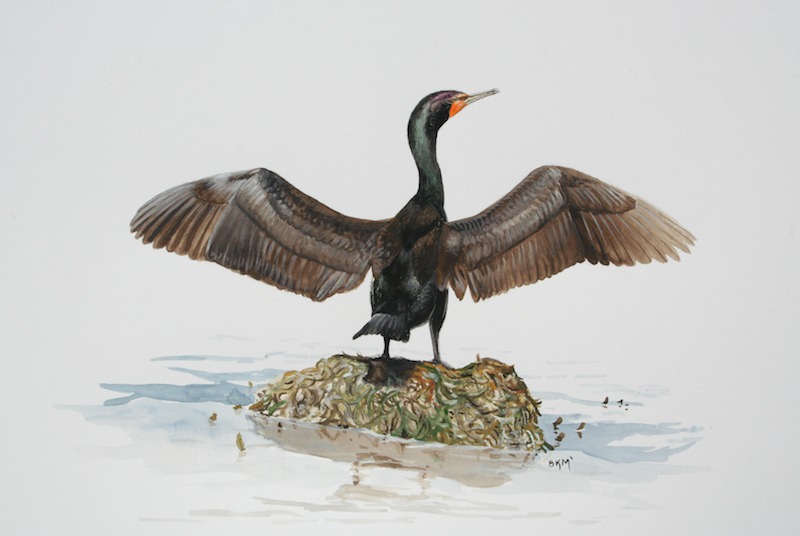
Feds Planning Mass Killing of Columbia River Cormorants

Paintings Courtesy Barry Kent MacKay

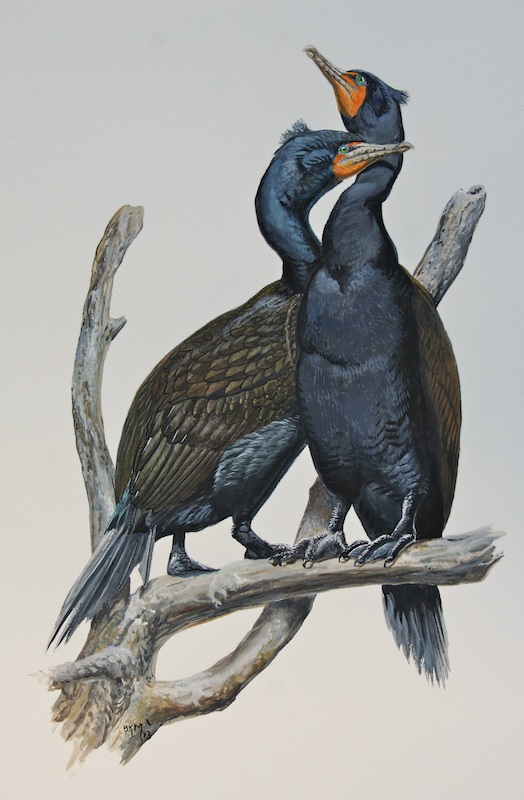
Paintings Courtesy Barry Kent MacKay

[Remember the birds next time you buy salmon or fish oil.]

Fri Jun 13, 2014.

Feds plan: Kill salmon-eating Sand Island seabirds

PORTLAND (AP) — Federal officials are proposing to kill half the large colony of cormorants in the Columbia River estuary because the large black seabirds eat too many young salmon and steelhead.

The proposal is the preferred action in a draft management plan released Thursday by the U.S. Army Corps of Engineers.

The colony of double-crested cormorants on East Sand Island near the mouth of the Columbia consumes about 11 million juvenile salmon per year as it migrates through the river to the Pacific Ocean. The fish are listed as endangered.

Officials say despite reductions in nesting habitat, the cormorant population has continued to thrive. It has increased from 100 breeding pairs in 1989 to about 15,000 breeding pairs today. That makes it the largest cormorant colony in western North America, representing over 40 percent of the region’s cormorant population.

The Corps has been studying the impact of avian predation on juvenile salmon in the Columbia since 1997. Officials also have looked into methods such as hazing with lights and using human presence to flush cormorants off potential nesting sites.

Now federal officials are proposing to reduce the colony to 5,600 breeding pairs by killing half of them, trying to scare off the others and taking their eggs.

The $1.5 million-a-year program, planned over four years, would arm federal trappers with silenced rifles and night-vision scopes to shoot the birds during their nesting season. They’d also cover eggs in oil to prevent them from hatching and inundate part of the island once the cormorant population reaches a target to limit nesting.

Once the target colony size is attained, the Corps also is proposing to modify the terrain of East Sand Island to inundate some nesting habitat.

The Corps passed over an alternative that would only use nonlethal methods, saying it would be less effective and push cormorants to nest elsewhere in the Columbia River estuary or in other coastal areas with endangered fish.

“That is a significant concern,” said Sondra Ruckwardt, the Army Corps’ project manager overseeing the plan. “We’re trying not to move the problem.”

Double-crested cormorants have orange faces and long necks, and are masters at diving to catch small fish. They are protected under the Migratory Bird Treaty Act and are native to the Columbia.

Federal officials also are trying to protect salmon by killing off sea lions — another protected species that has also proved too difficult to scare off with non-lethal methods.

The public has through Aug. 4 to comment on the cormorant plan.

The Double-Crested Cormorant: Plight of a Feathered Pariah

Paintings Courtesy Barry Kent MacKay

Paintings Courtesy Barry Kent MacKay

First, I want to thank my friend Barry MacKay for the use of his wonderful cormorant paintings in this and the previous blog post, and for alerting us about the cormorant-kill crisis (through another list).

An avid birder, wildlife advocate and Canadian blogger for Born Free USA, Barry writes, “I don’t really understand the U.S. animal protection movement’s indifference to the mass slaughtering of cormorants that has been underway for so many years, while we are stopping it in Canada, but I strongly urge anyone who cares to read a book just published: “The Double-crested Cormorant: Plight of a Feathered Pariah, by Linda R. Wires, Yale University Press, 2014. It came a week or two ago and gives you all the arguments you
need to help protect these wonderful birds from myth-based fear and loathing by “sportsmen” who just like to kill (the birds are inedible).”

http://www.openlettersmonthly.com/book-review-the-double-crested-cormorant/

Book Review: The Double-Crested Cormorant

The Double-Crested Cormorant: Plight of a Feathered Pariahthe double-breasted cormorant cover

By Linda R. Wires

Illustrated by Barry Kent Mackay

Yale University Press, 2014


Conservation biologist Linda Wires, in an utterly remarkable new volume from Yale University Press, takes up the cause of the persecuted Phalacrocorax auritus, the double-crested cormorant, a sleek, black-plumed aquatic bird from a family thirty-five or forty species found on every continent on Earth (although the double-crested is found only in North America). “More than just an account of a maligned and persecuted animal,” Wires writes, “the cormorant’s story reflects a culture still deeply prejudiced against creatures that exist outside the boundaries of human understanding and acceptance.”

The persecution she’s alluding is a deeply-ingrained cultural thing that’s almost certainly rooted in simple commerce: for almost as long as humanity has cast its nets into bays, harbors, inlets, estuaries, rivers, wetlands, and even ponds, humanity has also labored under the conviction that it has a cutthroat competitor in the double-crested cormorants twocormorant. As a result, even though cormorants in ancient China and Japan were for centuries domesticated into allies by fishermen themselves, they’ve been extensively persecuted virtually everywhere else. Wires stresses throughout her book (which is an absorbing combination natural history monograph and passionate manifesto) that this persecution continues today, and she’s very insightful on the cultural roots of it all:

When observed in its conspicuous spread-winged pose, common to several cormorant species, the cormorant acquires another potent aspect. In this notably bat- or vulture-like posture, the cormorant stands still and upright with both wings held out wide from the sides of its body. In this stance, frequently taken up after fishing, birds typically orient themselves toward the sun or the wind, presumably to dry their feathers or regulate heat loss and gain; some researchers have suggested that wing spreading occurs to heat up the bird’s food and facilitate digestion. Whatever the exact reason, the mysterious stance has an eerie, evocative quality, conjuring up images of crucifixion and vampires, and has fueled impressions about the bird’s dark nature.

“At the heart of the cormorant’s story,” she elaborates, “is the extent to which its current treatment is (or is not) based on sound science, especially relative to its management for fisheries.” No study past or present has ever demonstrated that double-crested cormorants are true rivals to any kind of commercial fishing, and yet, largely as a result of blind prejudicial momentum, near-extinction policies persist even into the 21st century. Wires lays out in cormorants onedetail the wrong-headed U.S. federal policies – several of which are up for renewal in June of this year – that allow for the wholesale slaughters of cormorant populations under the guise of “culling.”

The calamity of this kind of policy is leant all the more weight The Double-Crested Cormorant by Wires’s skill at describing the natural history of these birds, which are awkward on land (Wires notes their particularly their ungainly habit of hooking their beaks onto rocks and branches in order to pull themselves lurchingly forward, a sight I’ve seen and laughed at myself) but beautifully graceful in their natural underwater environment. They hunt by sight (they have flat corneas, which help in achieving a condition unknown to life-long book-readers: emmetropia, perfect vision) except when the water is too dark or turbulent, in which case they hunt by means as yet unknown. They nest in all manner of locations, and they’re doting parents. They’re deep divers, and although they’ll eat virtually any kind of fish they can catch (including some only a little smaller than themselves), they seem to prefer just the kind of smaller ‘junk’ species that are of no interest to commercial fisherman in any case.

It’s a quietly stunning double performance: Wires is equally proficient as both the Roger Tory Peterson of the double-crested cormorant and its Rachel Carson. Her preservationist advocacy is unflinching, and her nature-writing is eloquent – and the whole book is enlivened by gorgeous illustrations by Barry Kent Mackay, who not only captures the cormorant in all its moods and actions but also offers accompanying pictures of many of the cormorant’s fellow estuarine birds, including an especially ominous drawing of a bald eagle, and a haunting illustration of a great heron.

The result of all this is an important work, a benchmark popular study of a bird species that needs enlightened help in order to survive. The Double-Crested Cormorant: Plight of a Feathered Pariah ought to be for sale in the gift shops of every national park in the United States at the very least – and from the sound of Wires’s conclusions, several copies sent to Congress might help too.


SC hunters kill more than 11,000 cormorants

Painting Courtesy  Barry Kent MacKay

Painting Courtesy Barry Kent MacKay

EXCLUSIVE: SC hunters kill more than 11,000 cormorants

BY JOEY HOLLEMAN

THE ASSOCIATED PRESS – ROBERT F. BUKATY

COLUMBIA, SC – South Carolina hunters killed 11,653 double-crested
cormorants on Lake Marion and Lake Moultrie in one month this winter in an
effort to reduce the number of the fish-eating birds on the lakes.

One hunter, whose name was not made public, reported killing 278 himself,
according to the S.C. Department of Natural Resources, which released the
information to The State newspaper on Friday.

While hunters jumped at their first chance to shoot the long-necked, black
birds, the Audubon Society screamed in protest at the results.

“That’s a horrific number,” said Norman Brunswig, Audubon’s South Carolina
director. “It’s not a defensible action. I think DNR got bullied into doing
this and didn’t know how to get out of it, and a whole lot of birds died.”

Longtime anglers on the lake pushed their state representatives to convince
DNR to do something about the rising populations of cormorants, who they
claim eat enough bait fish to impact the game fish populations. Only one
small scientific study has been done on the impact of cormorants on the
Santee Cooper lakes, and it was done during a severe drought. That study
found an average of eight fish in the gut of cormorants.

That study estimated there were 6,000 cormorants on the lakes in 2008, but
anglers say the number has grown to closer to 25,000 in recent years.

A proviso in last year’s agency budget made it difficult for DNR to turn
down the request to set up a special cormorant hunting season.
Traditionally, cormorants are a non-game, migratory species, and hunting
them has been illegal. But the U.S. Fish and Wildlife Service in recent
years has approved special programs to reduce the cormorant

Painting by  Barry K. MacKay

Painting by Barry K. MacKay

population if
states requested permission.

In most other states, those programs allow only wildlife officers and
American Indians to shoot the birds.

In South Carolina, DNR didn’t have the manpower to make a dent in the
cormorant population, so it tried a different approach. Hunters who went
through a short training program and agreed to strict regulations were
allowed to kill the birds only on Lake Marion and Lake Moultrie, and only
from Feb. 2-March 1.

DNR leaders were stunned when nearly 800 people showed up at the first
training session. The 1,225 people who eventually were issued permits
surpassed agency estimates “by three- or four-fold,” according to Derrell
Shipes, chief of wildlife statewide projects for the agency.

Many anglers seemed eager to help reduce the cormorant numbers, but only 40
percent of the permit-holders returned the required hunt record documents by
the March 31 deadline, Shipes said. Those who didn’t record their hunting
hours and success rate won’t be allowed to get permits if there’s another
hunt next year.

Another proviso by Rep. Phillip Lowe, R-Florence, in the 2014-15 budget
compels DNR to allow a cormorant hunt next year. If there is a 2015 hunt,
Shipes expects it will be set up differently. The agency staff has to look
at what about the first season worked well, and what didn’t.

More importantly, wildlife biologists will try to determine “how significant
is that number (of birds being killed), and what will be its impact,” Shipes
said.

Brunswig wishes someone would do a large scientific study on the impact of
cormorants on the fishery. He’s certain it would prove “they’re slaughtering
a non-game species for no good reason.”

The 496 hunters who returned information forms spent 42,748 hours in the
field and averaged killing 23.5 cormorants in the one-month season.

The South Carolina numbers are much higher than in specially permitted hunts
in other states which rely on wildlife officers and American Indian tribes.
Hunts in Indiana, Michigan, Minnesota, New York, Ohio, Vermont and Wisconsin
combined killed 21,312 cormorants in 2013, according to the U.S. Fish and
Wildlife Service.

Wildlife officials in Oregon and Texas already have contacted South Carolina
to ask about details of the local hunt as they consider how to set up hunts
in their states, Shipes said.

Cormorant hunt in South Carolina Must Be Stopped

[This cormorant cull is just the kind of thing that the infamous Time Magazine piece on the resurgence of hunting was meant to prepare us for. As with so many articles from the mainstream media, this one saves the real story for the end (where they know many readers won’t see it).

Here, then, are the last lines first:  …The cormorant population went into serious decline with the use of the now-banned DDT. The increase of birds on the lakes means the population is re-establishing itself.

“We should be celebrating that, it seems to me,” he said. The removal “is a sad thing.”

http://www.postandcourier.com/article/20140125/PC16/140129561/cormorant-hunt-in-marion-moultrie-lakes-rouses-controversy

Cormorant hunt in Marion-Moultrie lakes rouses controversy
by Bo Petersen

Saturday, January 25, 2014

Cormorants aren’t a favorite bird for very many people. They are snaky necked, ravenous fish eaters that can kill a tree with their acidic feces if they roost there thickly enough.

Cormorant facts

The double-crested cormorant

One of 38 species worldwide, one of 6 in the U.S.

Found in waterways from Alaska to Florida.

Long-lived waterbird, nests in colonies that can be as large as a few thousand.

An estimated 2 million in North America. Population increased rapidly 1970s-1990, slowed in the 1990s.

States permitted to conduct cormorant depredation removals include Alabama, Arkansas, Florida, Georgia, Kentucky, Louisiana, Minnesota, Mississippi, North Carolina, Oklahoma, South Carolina, Tennessee, and Texas.

Sources: U.S. Fish and Wildlife Service, U.S. Department of Agriculture.

And this time of year they descend on the Marion-Moultrie lakes by the “thousands and thousands and thousands,” according to one fishing guide, ready to feast on the shad and herring runs that provide food for the lakes’ trophy game fish.

That’s why anglers and state legislators have been pushing for a cormorant removal hunt scheduled to start Feb. 2 on the lakes. Avian conservationists oppose it. As a migratory bird, the cormorant, craw and all, is a protected species, meaning federal regulations restrict harassment or taking of the birds.

“These are native birds. They have always been here. Someone now perceives that to be a problem,” said Norman Brunswig, Audubon South Carolina state director. The S.C. Department of Natural Resources has no credible scientific evidence that the onslaught of winter migrating birds does any substantive damage to the fishery, he said. “To kill a bird without a really, really good reason to do it is kind of barbaric.”

‘Look at the flocks’

DNR is holding the removal “event” after years of angling groups seeking it, and after a proviso was tacked onto the 2013-2014 budget directing the agency “through the use of existing funds” to manage public participation in “cormorant control activities.”

Truman Lyon, the South Carolina Guides Association representative for Berkeley County, makes no bones about it.

“We definitely need to have this hunt,” he said. “Look at the roosts. Look at the banks. Look at the flocks and flocks of (cormorants) on the lakes. There are many, many more than there ever were. There’s nothing to kill them,” he said.

Studies have shown that the birds eat a tremendous amount of fish. But that’s alongside other birds and, of course, the fish themselves.

How much the feasting might be depleting the game fish isn’t clear. The lakes – relatively shallow, stagnant and heavily fished – have long been a problematic fishery to manage. Previous declines in game fish species have been blamed on factors such as overfishing, aquatic cover removal and drought, as well as competition for food. The recent cold snap killed bait fish.

Striped bass, or stripers, were the trophy fish that turned the lakes into what has been touted as a $300 million-per-year tourism destination. In the early 2000s the striper numbers went into a precipitous decline, but aggressive stocking and tighter catch restrictions, among other measures, brought them back.

“There’s loads of stripers,” Lyon said, but crappie and bream numbers are not where they should be, he said, and catfish have depleted to the point where DNR is now imposing a limit of 20 fish per day per person in the boat.

Cormorants increasing

How many cormorants there actually are around the lakes isn’t clear, although observers generally agree there are a lot, and they are increasing.

The removal hunt was given a depredation permit “to protect public resources” by the U.S. Fish and Wildlife Service, the federal agency in charge of managing protected species. The permit doesn’t require population numbers to be reported, just the harvest, said Tom McKenzie, Southeast region media relations chief.

Santee Cooper, the quasi-state utility that manages the lakes, officially is staying hands-off.

DNR manages the fish and game for Lake Marion and Lake Moultrie, said Santee Cooper spokeswoman Nicole Aiello; it is the agency’s role to make decisions such as this one.

DNR staff have concerns about the “event.” Staff will fly over the lakes before and afterward to do counts of cormorants, along with other protected bird species such as bald eagles, anhingas and wood storks. That data will be reviewed to decide – among other things – whether to hold the hunt again.

800 hunters qualified

“We’re not concerned about the future of the migrating cormorant population, because it has grown so much,” said Derrell Shipes, DNR Wildlife Statewide Projects, Research and Survey chief. The birds are now so numerous they routinely are caught in the lakes’ fish passage, he said.

More than 800 people have qualified to hunt the birds, making the “public removal” so labor-intensive that the agency doesn’t have the staff to enforce bag limits. The hunters each have taken part in a training session that includes warnings not to mistakenly shoot other similar-looking, protected species such as anhingas and wood ducks or face arrest.

The scheduled two-month “event” can be stopped at any time by DNR, Shipes said.

“All of us should pay attention to what we’re doing,” he said. “When we have the harvest information, we’ll step back, look at the problems and issues and go from there.”

Brunswig isn’t buying it. DNR wouldn’t hold this hunt if it wasn’t being pressured to, he said. The cormorant population went into serious decline with the use of the now-banned DDT. The increase of birds on the lakes means the population is re-establishing itself.

“We should be celebrating that, it seems to me,” he said. The removal “is a sad thing.”

1459861_559462450790007_563882710_n