Exposing the Big Game

Forget Hunters' Feeble Rationalizations and Trust Your Gut Feelings: Making Sport of Killing Is Not Healthy Human Behavior

Exposing the Big Game

Beef-eating ‘must fall drastically’ as world population grows

https://www.theguardian.com/environment/2018/dec/05/beef-eating-must-fall-drastically-as-world-population-grows-report

Current food habits will lead to destruction of all forests and catastrophic climate change by 2050, report finds
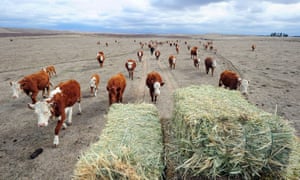
Cattle farming in California.
 Cattle farming in California. Photograph: Frederic J Brown/AFP/Getty Images

People in rich nations will have to make big cuts to the amount of beef and lamb they eat if the world is to be able to feed 10 billion people, according to a new report. These cuts and a series of other measures are also needed to prevent catastrophic climate change, it says.

More than 50% more food will be needed by 2050, according to the World Resources Institute (WRI) report, but greenhouse gas emissions from agriculture will have to fall by two-thirds at the same time. The extra food will have to be produced without creating new farmland, it says, otherwise the world’s remaining forests face destruction. Meat and dairy production use 83% of farmland and produce 60% of agriculture’s emissions.

Increasing the amount of food produced per hectare was the most critical step, the experts said, followed by cutting meat-eating and putting a stop to the wasting of one-third of food produced.

“We have to change how we produce and consume food, not just for environmental reasons, but because this is an existential issue for humans,” said Janet Ranganathan, vice-president for science and research at the WRI.

Tim Searchinger, of the WRI and Princeton University, said: “If we tried to produce all the food needed in 2050 using today’s production systems, the world would have to convert most of its remaining forest, and agriculture alone would produce almost twice the emissions allowable from all human activities.”

The new report, launched at the UN climate summit in Katowice, Poland, follows other major scientific analyses showing that huge reductions in meat-eating are “essential” to avoid dangerous climate change. Another found that avoiding meat and dairy products was the single biggest way to reduce an individual’s environmental impact on the planet, from slowing the annihilation of wildlife to healing dead zones in the oceans.

The world’s science academies concluded last week that the global food system was “broken”, leaving billions of people either underfed or overweight and driving dangerous global warming. Another new reportconcluded that the global food system required “radical transformation” if climate change and development goals were to be met, including “widespread dietary change”.

After increased productivity, the WRI report focuses on meat from ruminant animals. The digestion of cattle and sheep produces methane, a potent greenhouse gas. Beef provided 3% of the calories in the diet of US citizens but was responsible for half the emissions, the WRI said.

The report recommends that 2 billion people across countries including the US, Russia and Brazil cut their beef and lamb consumption by 40%, limiting it to 1.5 servings a week on average. Most of the world’s citizens would continue to eat relatively little beef in the WRI scenario.

But Searchinger said: “The world’s poor people are entitled to consume at least a little more.” The 40% reduction is a smaller cut than in other studies. “We think that is a realistic goal,” he said. “In the US and Europe, beef consumption has already reduced by one-third from the 1960s until today.”

Tobias Baedeker, of the World Bank, said farmers would require a lot of support to make the changes required but that redirecting the world’s huge subsidies could be a “game-changer”. Subsidies of more than $590bn (£460bn) a year are given to farmers in 51 nations, representing two-thirds of global food output, according to the OECD. In the US, these subsidies halve the current price of beef, the WRI says.

The sophisticated marketing and behaviour-change strategies that food companies already used to influence customers could help shift diets, said Ranganathan, as could governments encouraging less meat in schools, hospitals and other public institutions.

Other changes to farming that are needed, according to the WRI, include better feed to reduce methane production from cows, limiting biofuels made from food crops, managing manure and fertiliser better and cutting energy use by farm machinery. It also said the overall demand for food could be cut, with policies to curb population growth such as “improving women’s access to education and healthcare in Africa to accelerate voluntary reductions in fertility levels”.

The WRI report was launched at the UN climate summit in Poland where almost 200 nations are aiming to turn the carbon-cutting vision set out in Paris in 2015 into reality. The rapid ramping up of action is another key goal. Climate action must be increased fivefold to limit warming to the 1.5C scientists advise, according to the UN.

Cows exude lots of methane, but taxing beef won’t cut emissions

https://phys.org/news/2018-01-cows-exude-lots-methane-taxing.html

January 15, 2018 by Michael Von Massow And John Cranfield,
Cows exude lots of methane, but taxing beef won't cut emissions
Cows produce a lot of methane. But there’s not much evidence a tax on beef would be effective in fighting greenhouse gas emissions. Credit: Shutterstock

Will taxing meat products based on their carbon footprint reduce greenhouse gas (GHG) emissions and improve public health? The answer is maybe, but not notably —and it will come with significant costs.

recent study in the journal Nature Climate Change advocates applying taxes to the  of  as a means of lowering GHG emissions.

The idea is that if meat is more expensive, consumers will buy less of it. In turn, when faced with reduced consumption, farmers will produce less .

Not all meat production produces the same volume of emissions. Since cows produce a lot of methane (a ), fewer cows should mean less methane, which in turn should help lower GHG emissions. Pigs and chickens don’t spew methane the way cows do, but there are also the emissions associated with feeding them, as well as with the decomposition of manure.

While it’s clear we need to proactively reduce GHG emissions globally, we believe the emissions tax approach is unlikely to achieve success.

It will likely increase food  for consumers and decrease the prices farmers charge for their products, but it’s unlikely to lower meat consumption significantly and therefore unlikely to lower GHG emissions from the livestock sector. There may be other detrimental impacts to taxation too.

Price hikes don’t usually curb consumption

Food consumption is not as strongly linked to price as one might think. Changes in consumption of food are typically much smaller than changes in the price consumers face in the grocery store. This is a phenomenon that has been recognized and measured for decades.

We would need to implement huge taxes to achieve a small decrease in consumption. As an example, the study in the Nature Climate Change journal suggests a 40 per cent tax on beef would only reduce beef consumption by 15 per cent.

Because taxes on food at the retail level tend to raise the prices paid by consumers, it’s also worth noting that any increase in the price of meat would tend to affect low-income consumers more than more affluent consumers. Low-income consumers would pay relatively more than the rich.

We also need to consider substitution effects. While a high tax on beef and other meats will lower beef consumption somewhat, it may also lead to economizing by consumers through increased consumption of lower quality or more highly processed cuts of meat.

This could actually increase the relative prices of these cuts, making the negative impact of the tax on lower-income consumers even stronger, and would undermine some of the suggested health benefits.

It’s worth noting that beef consumption is generally falling in Canada and the U.S., independent of price. Other factors are likely to be more effective at reducing beef consumption than taxation.

All cattle are not raised equally

It’s also important to recognize that different types of cattle production create different volumes of emissions.

There is a suggestion that any tax on meat should reflect the production system. Those that raise cattle on grasslands or in pastures, for example, would have lower taxes than cattle raised using intensive production systems, like those used throughout North America, which create higher emissions.

While cattle in North America spend their early life on pasture, most beef cattle are finished in feedlots where they are grouped and fed high-energy grain rations to efficiently produce the preferred texture and taste of beef.

A tax based on how cattle are raised, however, would be both politically and logistically difficult.

If grassland and pasture rearing of cattle is favoured because of lower GHG emissions, we could see significant deforestation in those countries that produce beef extensively, but not a substantial reduction in consumption as desired.

We could end up in a situation where many differences in production practices, even within countries, create different emissions estimates and therefore cattle producers would seek different tax levels.

Unintended consequences

There’s also a risk that a meat tax would reduce the incentive to initiate research and development that could help cut emissions within the sector.

Examples of such R&D include efforts to improve the feed efficiency in cattle production. At the farm level, feeding more cattle on a forage-heavy pasture diet could increase the costs of producing cattle and change the characteristics of the while eroding the incentive to adopt climate-friendlier production practices.

It’s worth noting that the United Nations Food and Agriculture Organization has said that emissions could be reduced by 30 per cent today if current best practices were broadly implemented. This is beyond the impact of a 40 per cent tax. The incentive to adopt these best practices would be removed by the implementation of a tax.

Progress can be made

As experts in food and agriculture economics, we agree that reduced GHG emissions are important for the future of humanity. We also believe that we are likely to substitute plant or insect proteins or cultured meats for traditional meat products over time.

Even if it were possible to get broad-based agreement for a global (or even just a Canadian) tax on meat, however, it is important to look not only at whether these efforts would reduce GHGs, but also at the unintended consequences of these efforts.

In the case of the proposed meat tax, it is not only unlikely to achieve the intended outcome, it is equally likely to create a spate of unintended consequences that would negatively affect not just cattle producers, but also .

 Explore further: Eating less meat might not be the way to go green, say researchers

Read more at: https://phys.org/news/2018-01-cows-exude-lots-methane-taxing.html#jCp

COWS ARE INTELLIGENT, EMOTIONAL AND THEY HAVE EUREKA MOMENTS—SO SHOULD WE BE KILLING THEM?

http://www.newsweek.com/cow-cattle-animal-intelligence-science-personalities-emotion-697979

There are brains in the barnyard, according to a literature review published this week about cattle intelligence. The paper summarized a selection of peer-reviewed research that demonstrated bovine cognition, and determined that the animals can have “Eureka” moments, can be optimistic or pessimistic, are affected by painful experiences, protect their calves, and can recognize their friends.

The peer-reviewed paper, called The Psychology of Cows, was published in the journal Animal Behavior and Cognition and was funded by the animal-welfare-education endeavor The Someone Project. The Someone Project describes itself as “Farm Sanctuary’s latest effort to introduce people to who farm animals are.”

Dexter Cattle, a heritage breed, at a farm in Massachusetts.KRISTIN HUGO
The goal of publishing the paper was to improve the general understanding of cow intelligence.

“We wanted to dig into the objective scientific literature [on cattle] and say, ‘What do we know, who are they?’ and then put that back out to the public domain,” said Lori Marino. Marino is a neuroscientist and former faculty member in Neuroscience and Behavioral Biology at Emory University, and is also one of the authors of the paper.

CattleCattle in the foothills of Mount Diablo.KRISTIN HUGO

Marino and Florida State University PhD student Kristin Allen cited more than 200 papers from 22 major journals and summarized indications of cow psychology, personalities, and intelligence. For example, dairy calves run around and play less after they have endured the procedures of disbudding, or having the buds of horns cut out of their head with a hot iron and without anesthesia, according to the journal Applied Animal Behaviour Science. The review paper considers the less active, dehorned cattle are pessimistic, whereas the more playful animals are optimistic.

Cattle also can discriminate between people who handle them roughly and who are gentle with them, preferring to stand closer to those who had been gentle with them before. (However, the study indicated that their actions are also partially influenced by the color of the overalls that people are wearing, if they are the color that the gentle or rough person was wearing as well.) When a mother cow sees an unfamiliar vehicle approach, she will also put her body between the vehicle and her calf, presumably to protect it.

Marino also says that cattle can experience “Eureka” moments. In research published in Applied Animal Behaviour Science, researchers observed cattle who were given a reward after completing a task, and gave the same reward to other cattle who had no control over their rewards. By measuring heart rate, they determined that the cattle who could control their own fate got more excited than the ones who were rewarded passively. This could be interpreted as cattle having an emotional reaction to finishing a puzzle, not just getting food.

CalfA calf approaches a photographer.KRISTIN HUGO

It’s notable that, while the literature review cites peer-reviewed research, the paper itself could be influenced by a desire to improve the welfare of farm animals. The Someone Project, which funded the paper, is a joint endeadvor between Farm Sanctuary, a farm animal protection organization that runs three shelters for farm animals like cattle, and the Kimmela Center for Animal Advocacy.

Furthermore, in the same issue of Animal Behavior and Cognition, several other authors published their commentaries on the paper, with positive and negative takes. One called it “ a case of over-interpretation and personification,” stating that the authors anthropomorphize the animals, or compared them to humans when they shouldn’t have.

Goliath the former dairy calf sucks on the fingers of animal rescuer Christine Hubbs.KRISTIN HUGO

Another commentary, however, called, Evidence for Cows’ Minds and Hearts: Why Cows Are Far More than Biological Machines, voiced support for the review paper. None of the commentaries suggested that cattle were simply unintelligent, though.

Heather Hill, an associate professor of psychology at St. Mary’s University and an editor of the International Journal of Comparative Psychology, “was very unhappy” when she reviewed the paper. “It’s nice to have this sort of information gathered together, but what was very frustrating was their choice of information that they included, and how they chose to present it,” Hill said. “It was not in my opinion the best representation or the most objective representation.” Furthermore, she noted that any research about things that cattle can’t do isn’t likely to get published at all.

Allen and Marino responded to the commentaries in the same issue of Animal Behavior and Cognition, saying that “a false pretense of scientific objectivity does a disservice to the cow literature.” They agreed that some concerns were valid, but disagreed on others.

BellowA bovine calling at Macedo Ranch in Alamo, California.KRISTIN HUGO

All of the papers mentioned the importance of studying bovine cognition and intelligence, though. Allen and Marino noted that there is much more research done on animals that are not commonly food animals, such as dogs, primates, and dolphins. The animals that we breed, raise, take care of , and eat by the millions should be understood as well. Hill said that it would be nice to have a literature review of cow cognition that was from independent researchers, without a preference for or against animal welfare.

“It’s important for people to understand who [cattle] are and then go on to make a choice about how they want to treat them based upon real evidence,” Marino said. “Not based on impressions, assumptions, biases one way or the other, but to get out there, read the objective scientific data on who these animals are put it in a form that’s interesting and then leaving it up to the public to decide if this information changes how they view and treat these animals either way.”