COURTESY OF MARY KATHERINE RAY, A VOLUNTEER FOR TRAP FREE NEW MEXICO
Listen
Listening…
0:48
New York Congresswoman Nita Lowey has reintroduced a bill that would prohibit body-gripping traps in the National Wildlife Refuge system.
Lowey, Democratic chairwoman of the House Appropriations Committee, reintroduced the Refuge From Cruel Trapping Act Friday, that would ban from public land traps where animal endure hours or even days of pain. Lowey says that, each year, thousands of bobcats, otters, foxes, beavers and other wild animals are trapped in this manner across the nation’s refuges. She says more than 50 percent of the 566 refuges allow trapping. Steel-jaw leghold traps; conibear traps: and neck snares would be banned if the measure is enacted. Lowey says it’s time to restore the true meaning of “refuge” to the National Wildlife Refuge system
Buckingham Palace says new outfits designed for the Queen won’t use real fur. (Johnny Green/AP)
From August to January, it’s hard to find a trapper in the North.
Most are deep in the bush, working traplines that, in some cases, have been in use for hundreds of years.
So they probably haven’t heard the news yet: they’ll have one less customer for their furs this year — and she’s a big one.
Queen Elizabeth, Canada’s head of state, announced last week she would no longer purchase fur.
“Our only comment on this story is as follows: As new outfits are designed for the Queen, any fur used will be fake,” wrote her communications secretary.
The palace said that doesn’t mean fur on existing outfits will be replaced or that the Queen would never wear fur again. “The Queen will continue to re-wear existing outfits in her wardrobe.”
Gordon Zealand, executive director of the Yukon Fish and Game Association, said, “The trappers I know are all out on their lines currently.
“At the same time all would be disappointed with the decision.”
Rosemarie Kuptana, an Inuk former politician and cultural advocate, said she was “somewhat shocked, and then disappointed.
“I think it’s a real departure from the commitment to Inuit as a people … because fur is important to our way of life.”
Decision follows public opinion
The Queen’s decision follows those made by the world’s biggest fashion houses to ditch using fur in their designs — Gucci, Prada and Armani among them.
D’Arcy Moses, a Dene fashion designer with a workshop in Enterprise, N.W.T. who uses fur in some of his work, said the shift has been the result of “pressure … from the really strong anti-fur movement in Europe and the U.K.
“The whole gamut of the industry has done an about-face,” said Moses. “No one wears mink coats anymore.”
Financially, it’s another blow to a Canadian fur industry that appears to be in terminal decline.
Just last month, the world’s second largest fur auction house, North American Fur Auctions — a former subsidiary of the Hudson’s Bay Company with over three centuries of history — went into creditor protection.
It now says wild and farmed fur auctions planned for 2020 are unlikely to go ahead.
Industry assessments show some tanned and taxidermied products remain in high demand at auctions, and Jackie Yaklin, secretary treasurer for the Yukon Trappers Association, said wild trappers are responding by increasingly sending pelts to be tanned out of territory.
But Mark Downey, chief executive officer of Fur Harversters, Canada’s other major fur auction house, wrote in his 2019 wild fur market forecast that “many fur species are selling below acceptable levels” — even if a surge in Chinese interest led to a moderate recovery in prices this summer.
Even beyond the industry impact, the Queen’s rejection of new fur carries an important symbolic weight, ending a centuries-long relationship with northern Indigenous trappers.
It’s a real departure from the commitment to Inuit as a people … because fur is important to our way of life.– Rosemarie Kuptana, Inuk former politician and cultural advocate
“What she wears is very important,” said Kuptana. “She is, after all, a world leader, a monarch” of 16 Commonwealth countries, “and in these … countries, there are Indigenous people who [have a] relationship with the land that requires them to hunt and trap.”
“The fur trade was how Canada was made,” she said. “It’s how Canada was built…. So fur was always a very important aspect of our relationship with the royalty.”
Trading fur ‘to the liking of the colonizers’
Francois Paulette helped found the Indian Brotherhood of the Northwest Territories, the precursor to today’s Dene Nation. He also sued the Crown over the treaty rights of Indigenous people in 1972 in a famous case known as the “Paulette caveat.”
Paulette said what the Queen decides to wear is “her business.” But he added that the failure of the fur industry could be grounds for another lawsuit against the Crown.
Francois Paulette, who sued the Crown over treaty rights in 1972, says colonialism built the fur industry, and the Crown could be liable for its failure. (Pat Kane/CBC)
“It was the Hudson’s Bay [Company] … that initiated trapping into our part of the world,” said Paulette. “Trapping became a way of life that never existed.”
Paulette said the meteoric rise of the fur trade fundamentally altered northerners’ relationship to the land and animals.
“Before that … our people, the Dene, lived in balance with nature, and we took what we needed,” he said.
“But something changed, and that was when the Hudson’s Bay [Company], along with the British Crown, came to our lands. From there on, our whole civilization, our way of life began to change to the liking of the colonizers.”
Now, Paulette said, with the bottom falling out of the fur trade, Dene people are left at loose ends, with a marred relationship to nature.
Jessica Scott-Reid | Special to The Globe and Mail
Published 6 hours ago
Updated October 20, 2019
From October 19-21, The Globe and Mail is offering complimentary access to
all our election, news and business coverage. Learn more | Open this photo
in gallery
[At Newfoundland’s Northern Harvest Sea Farms, as many as 1.8 million salmon
suffocated to death in early September owing to lack of oxygen in the water.
A ship is seen in Fortune Bay, off the Newfoundland coast, on Oct. 2
disposing the decomposing remains of salmon into the water after the mass
die-off. The layer of rotten fish sludge sitting on the bottom of bay is
said to be more than 15 metres thick in some areas.]
Atlantic Salmon Federation/Bill Bryden/The Globe and Mail
Jessica Scott-Reid is a Montreal-based freelance writer and animal advocate.
It’s a notion that has made headlines several times over the past few years:
Fish feel pain, and the way we catch and kill them for food may actually be
cruel. This evolution in understanding of the sentience of an animal
long-considered too simple has caused some controversy and discomfort. And
as Newfoundland copes with a massive fish-farm die-off, concerns about the
well-being of the fish in crowded farms are being added to this mounting
conversation.
At Newfoundland’s Northern Harvest Sea Farms, as many as 1.8 million salmon
suffocated to death in early September, due to lack of oxygen in the water.
As The Globe and Mail reported two weeks ago, concerned marine biologists
noted the fish would have been stressed and fighting for oxygen in the
cramped, warm waters. Workers have also been struggling to deal with the
decomposing remains, which are being vacuumed out of the cages, processed on
land and dumped back into the sea. The layer of rotten fish sludge sitting
on the bottom of bay is said to be more than 15 metres thick in some areas,
and marine biologists worry this sludge could create algae blooms that steal
oxygen from the water and choke out other wild marine life.
Fish farming is a rapidly growing sector within Canada’s fishing industry,
with salmon being the most commonly farmed fish, and worth about $1-billion.
There are concerns, however, about a lack of government oversight of these
farms and about the damage they can cause to surrounding environments.
Deterioration of water quality owing to waste production and the spread of
disease to wild fish populations (and of drugs used to treat those
diseases), are included in these concerns. Last year, member of Parliament
Fin Donnelly told CBC News that open-net fish farms are essentially “using
the ocean as a toilet.”
For a food source typically touted as environmentally sustainable, and
perhaps less ethically fraught than their land-bound counterparts, fish may
actually be more complicated than we once thought.
Growing research now points to the fact that fish have the ability to
experience sensations, including pain and suffering. In a 2018 article in
Smithsonian Magazine, It’s Official: Fish Feel Pain, author Ferris Jabr
explains that at the anatomical level, fish have neurons known as
nociceptors, “which detect potential harm, such as high temperatures,
intense pressure, and caustic chemicals.” Fish bodies also produce the same
innate painkillers (that is, opioids) that mammals do.
Mr. Jabr details several studies, which show fish demonstrating atypical
behaviours when inflicted with pain and returning to typical behaviours when
given painkillers.
In more recent research, biologist Lynne Sneddon of the University of
Liverpool told The Independent, “When the fish’s lips are given a painful
stimulus they rub the mouth against the side of the tank much like we rub
our toe when we stub it.” She added: “If we accept fish experience pain,
then this has important implications for how we treat them.”
Although evidence is growing about the sentience of fish, they still lack
legal protection in Canada regarding their welfare or humane handling, and
are legally considered property when caught or farmed. Fishing is exempt
from most provincial animal-care acts as an accepted activity in which an
animal may be permitted to suffer (much like the farming and slaughtering of
other animals for food).
And though there are no statistics on the number of fish killed for food in
Canada each year, we know the industry is worth several billion dollars,
with exports of $6.6-billion worth of fish and seafood in 2015 putting
estimates in the hundreds of millions of fish permitted to suffocate to
death each year. The potential suffering associated with that number of
animals is hard to comprehend.
Ethical and environmental concerns surrounding the way we farm, catch and
kill fish for food are increasing. Allowing sentient animals capable of
suffering to be crammed into cages where they are unable to escape harmful
conditions, or to be pulled out of their environments, allowed to suffocate
to death, no longer aligns with the values of many Canadians who care about
the humane treatment of animals.
Compounding environmental stress upon already vulnerable ecosystems and
biodiversity only exacerbates this very obvious problem.
It’s time to care about fish, and perhaps that means leaving them alone.
‘Go eat a couch if you want’ (Photo: Instagram / Whoopi Goldberg)
American actor and TV personality Whoopi Goldberg has been slammed for having a ‘triggered fit’ over plant-based meat.
The celebrity featured on talk show The View earlier this month, where she defended her right to consume bacon.
“What I don’t want is no choice…,” the star said. “I like the bacon, I want the bacon, you don’t have to eat it… No one should tell you that you can’t have something.”
The comment received backlash from animal-rights charity PETA, who said it couldn’t help but ‘call-out’ Goldberg for her ‘rant on The View’.
‘Enormous suffering’
“Really, Whoopi? Eating bacon is your Friday cause? Your ‘choice’ really hurts. Be kind,” PETA said. “Animals should have a choice though. Eating bacon causes enormous suffering and ends a pig’s life.
“It’s so easy to make choices that don’t support suffering and death. We urge you to consider that.”
‘Making a fuss’
“Hey I understand PETA is making a fuss because I like bacon,” Goldberg tweeted to her 1.5 million followers.
“I never said I was a vegan, and just like I want choice over my body, I want the same for what goes into my body. I would NEVER suggest that ANYONE pressure any one of YOU to change your vegan habits. Go eat a couch if you want.”
‘Animals are not property’
The star’s response added to the controversy, with a plethora of vegans highlighting the cruelty of bacon.
“You spoke a truth in you that you didn’t realize you had, Whoopi,” one user tweeted.
“Animals are not property just as human beings are not property. They don’t belong to us. They deserve to have control over what happens to their bodies just as we do.”
This video includes graphic images some readers may find disturbing.
The meat industry depends, more than anything else, on walls. The walls of farms and slaughterhouses prevent consumers from seeing what the production of their food really looks like. They prevent journalists and activists from exposing unethical, even criminal acts within. They enable corporations to paint happy, bucolic pictures of their operations that bear no resemblance to the reality of modern-day factory farming.
To get inside those walls, over the last two decades, dozens of activists have gone undercover, finding employment on factory farms and wearing concealed cameras, shooting hundreds of hours of footage over the course of months on the job. They have documented the routine acts of mistreatment and abuse of animals that are an inherent part of raising livestock for slaughter with maximum profit in mind.
The videos they have produced have made an enormous impact on the industry, grabbing headlines, pushing consumers away from meat, compelling retailers to pull products from shelves, and even causing government regulators to temporarily shutter some farms.
In response, the industry has pushed to criminalize undercover investigations, through legislation known informally as “ag-gag.” Ag-gag laws target activists in a variety of ways, from imposing criminal penalties on investigators for misrepresenting themselves on employment applications to outright banning the collection of footage on the premises of animal agriculture operations without the owners’ permission.
In Iowa, an ag-gag law passed in 2011 was struck down earlier this year by a federal judge. But thanks to the political power it wields in the state, the meat industry did not have to wait long to see the law resurrected. Just two months after the court’s decision, Iowa’s legislature passed a brand new ag-gag bill, and its newly elected governor, Kim Reynolds, signed it into law.
Our short documentary tells the story of one undercover investigator whose footage is at the center of Iowa’s ag-gag backlash.
October 2 is World Day for Farmed Animals. On the website for the annual recognition of what these billions of nonhuman animal (animal) beings go through at the hands of humans before they’re brutally killed for unnecessary meals we read:
“Each year, an estimated 70 billion cows, pigs, chickens, turkeys, and other sentient land-based animals are caged, crowded, deprived, drugged, mutilated and macerated in the world’s factory farms. Then they are brutally slaughtered for our dinner table. Countless aquatic animals are caught and suffocated by vast trawler nets, so we can have our fish fillet or tuna fish salad.”
Slaughtering sentience: How much pain per pound do these animals suffer?
“…the question is not, Can they reason? nor, Can they talk? but, Can they suffer? Why should the law refuse its protection to any sensitive being?… The time will come when humanity will extend its mantle over everything which breathes…” —Jeremy Bentham
It’s a sad fact that the amount of pain and suffering these animals endure before they’re killed truly is incalculable. So-called “food animals,” including fishes and other aquatic animals, are intelligent and sentient, feeling beings. (See “It’s Time to Stop Pretending Fishes Don’t Feel Pain.”) When someone eats animals and animal products, they’re consuming a good deal of pain and suffering. While many people are led to believe that consuming dairy is OK, because the animals are kept alive, dairy animals also deeply suffer when they’re used and abused as “milk machines.” (See “The Scary Facts of Dairy Violate the Five Freedoms” and “The Mistreatment of Female ‘Food Cows’ Includes Sexual Abuse.”)
It’s also important to recognize that “being smart” really isn’t a factor in how much animals, including humans, suffer. It’s what they feel that’s important. (See, for example, “Are Pigs as Smart as Dogs and Does It Really Matter?” and references therein.) A young girl once asked me if so-called “food animals” suffer like her companion dog suffers when he’s in pain. When I said, “Yes, they do,” she blanched and almost started crying.
At another talk I was asked, “How much pain per pound do these animals suffer?” and I said that it was really impossible to calculate any meaningful number, but it’s a good question to get discussions going about what these animal beings endure in their relatively short and horrific lives.
I often hear people say that farmed animals aren’t treated all that bad and that there are regulations and laws that adequately protect them. However, it’s a fact that the regulations and laws that supposedly protect farmed animals are incredibly weak and weakly enforced, and egregious violations are very common.
Far too much lip service is given to protecting these amazing and fascinating animals. And it’s because people—including those who use them and eat them—know that there is incredible and inexcusable suffering among the trillions of food animals who wind up in humans’ mouths that regulations and laws exist in the first place. If these animals didn’t suffer, there would be no reason to protect them. Current regulations allow for more than 1,100 pigs to be slaughtered per hour.
Even with iconic animal welfarist Dr. Temple Grandin’s work to help farmed food animals along, the amount of pain and suffering farmed food animals endure is reprehensible, and, of course, avoidable. Only an extremely tiny percentage of these sentient beings may, in fact, benefit, as they trod along her so-called “stairway to heaven” on their way to the killing floor while hearing, seeing, and smelling the slaughter of others. Their lives before their death sentence are actualized—right after birth, as they mature, and when they’re shipped to slaughterhouses as if they’re unfeeling objects—and are inarguably, brutally horrific. (See “Stairways to Heaven, Temples of Doom, and Humane-Washing” and “My Beef With Temple Grandin: Seemingly Humane Isn’t Enough.”)
The language we use to refer to other animals really matters. On World Day for Farmed Animals, let’s honor all nonhumans who are used for food. It’s really a matter of who we eat, rather than what we eat, when it comes to the sentient nonhumans who wind up in our mouths. A few years ago, after I gave a talk and asked people to consider who they are choosing to eat rather than what they were eating, I learned that five people changed their meal plans because the word who made them realize “they were eating pain and suffering.”
Asking people to change their meal plans isn’t some sort of “radical animal rights” move, as some claim it to be. In fact, it’s all about decency. It’s about showing respect and compassion and honoring who these individuals really are: namely, deeply feeling sentient beings. We need a Golden Rule for how we treat other animals based on decency. Silence isn’t golden; it’s deadly.
It’s high time to phase out food animals and animal products once and for all. All of these animal beings need all the help they can get and then some. World Day for Farmed Animals is a perfect time to honor and to respect who these fascinating beings truly are.
“Just as ships’ bottoms pick up layers of barnacles over time, so, through their lives, human societies and individuals become encrusted with layers of cultural and ideological sediment. … The cemented coating clings as though chemically bonded to me and screams bloody bloody murder at my slightest advance…”~John Livingston
Awar on wildlife in British Columbia never ends; cruelty goes on, unabated. We cannot unshackle ourselves from the self-centered belief system — the thickened layer of barnacles — that destines us to view nature as a resource subordinate to our needs. When, in 1981, John Livingston wrote “Fallacy of Wildlife Conservation”, he cautioned against the fallacy of turning the Earth’s fabric into a “natural resource”. It was echoed by Neil Evernden who recognized that, once deemed a resource, nature inevitably becomes a casualty of reckless exploitation. And this is what has happened. Under the guise of fostering “conservation”, we have concocted a management approach that gives us a license to discard a delicate assembly of life as if it were a lump of coal.
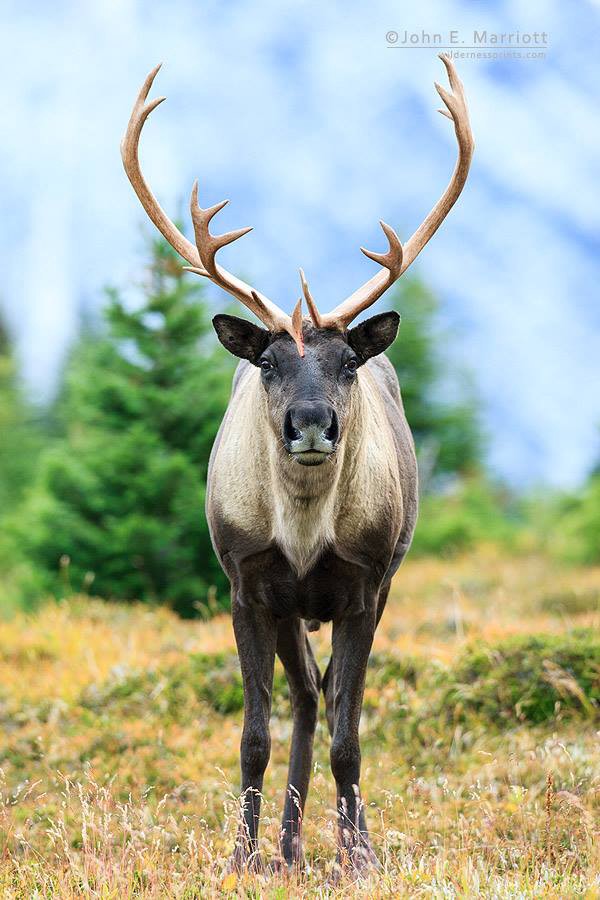
The decades-long tragedy of the caribou habitat is a proof, as good any, of cruelty and travesty inherent to current wildlife management strategies. What strikes the most is how long it has lasted. In the 1970s, a biologist, Michael Bloomfield, showed that the widespread destruction of the habitat by logging and other resource development activities threatened caribou survival. These warnings were never listened to. The B.C. government has allowed for the destruction of the habitat to continue, and the caribou population dwindled from 40,000 in the early 1900s to approximately 15,000 today, all scattered among 54 herds. Thirty of those herds are at risk of extinction and 14 have fewer than 25 individuals.
Photo credit: John E. Marriott
This is the current reality. With impunity grounded in political support — regardless of a party in power — the industrial encroachment fragments the caribou habitat and decimates their food source. Consequently, chances for the survival of the caribou diminish as their habitat shrinks in size. The resilience of nature is no match for greed and political expediency. A cycle of life gets broken. What is worse, the officially sanctioned ecological devastation not only ensures the eventual disappearance of the caribou but sentences to death wolves, cougars, and many other species that depend on the same habitat.
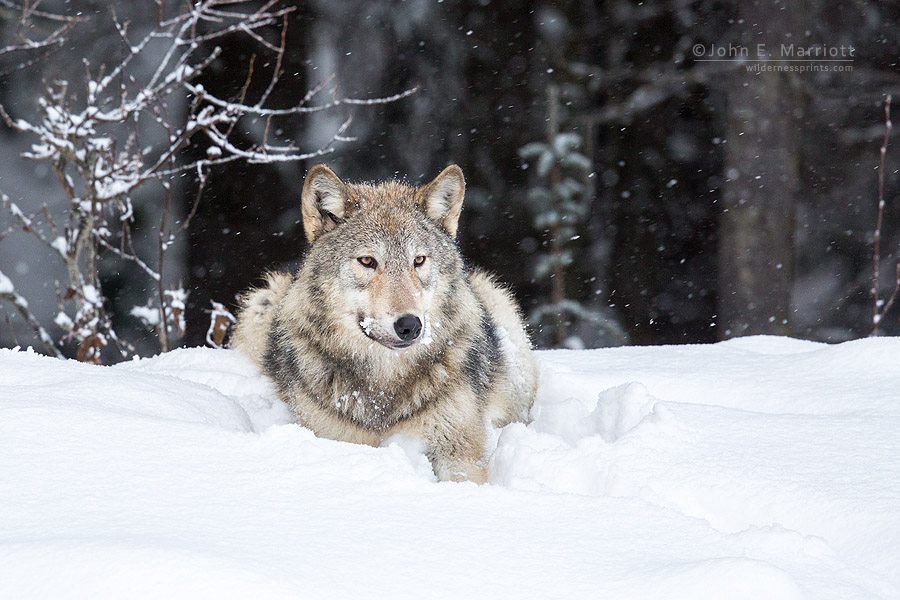
Death comes in many forms, and, for some animals, anguish and agony mark the path. The fate that wolves suffer shows most glaringly the tragedy that befalls nature when the government gives in to demands of the resource-extraction industry. In 2014, the B.C. government, with its Management Plan for the Grey Wolf, authorized the war on wolves. Since 2015, under the guise of caribou conservation, over 700 wolves have been killed. They were trapped, hunted, poisoned to death, gunned down from helicopters. Even more abhorrently, extermination tactics have used “Judas wolves” to find their packs and wipe out all of their members. But this not where the war against the wolf ends. The stated number does not include “wolf whacking” contests that take place in the interior of B.C. — an officially sanctioned bestiality that not only dooms wild animals but debases us, as human beings.
Photo credit: John E. Marriott
And, yet, even this is not enough. Now, the NDP government argues that “landscape scale habitat management is needed to support self-sustaining caribou populations”. It thus proposes a predator hunt legislation that would — in the name of reversing caribou population declines — erase more than 80 percent of the wolf population in parts of the central B.C. In other words, it would get rid of the “surplus” of wolves. To call this wildlife management approach fallacious and unethical is to be greatly euphemistic. The innocuously sounding phrase — “landscape scale habitat management” — camouflages an outright slaughter.
And it is the slaughter compounded by ecological ignorance. Any discussion about maintaining stable wolf populations — an underlying premise behind the predator hunt legislation — defeats its purpose if the exact number of wolves in a habitat remains unknown. As so is the case here. The Management Plan for the Grey Wolf states that the wolf population might be approximately 8,500. In reality, this number can be anywhere between 5,300 and 11,600, since, as the plan admits, estimating the population size is challenging due to the secretive nature of wolves, their extensive range, and the density of forested habitats they inhabit. Moreover, hunting data in B.C. lack reliability. The plan states that there is “considerable uncertainty in the current take of wolves by resident hunters and trappers as B.C. does not have a mandatory reporting system…[and] without more reliable estimates of the harvest, it is difficult to assess the sustainability of BC’s wolf harvest.” This ignorance does not, however, prevent the government, Max Foran states, from accepting “generous hunting quotas, no limit on killing females or pups, no bag-limit zones, long and sometimes open year-round hunting seasons, no license requirement for residents.” This is not management but a “wolf killing plan”, he writes.
Killing that will never stop. The ministry’s scientists claim that “a very extensive effort will be required every year to continue to keep the wolf population low” because of the wolf’s natural resilience and quick recovery. Like stubborn weeds, wolves must be eradicated repeatedly. This malignancy cannot be allowed to grow.
Unfortunately, the cruelty and the bureaucratic cold-heartedness underpinning this statement account for merely a part of its tragic perversity. However inhumane, the perpetual killing of wolves is based on the premise that, following a bout of slaughter, the species is able to recover. Only an unfounded human hubris would allow for such a premise to sustain itself. The so-called “surplus” of wolves is very fragile in the face of climate change, and wolves are vulnerable to the unpredictable ecosystem dynamics. Precariousness and unpredictability are the words that define a broad range of interdependences in the critical caribou habitat. The social-ecological system operates on various scales– some of them observable and some not — and there are tipping points, the crossing of which takes us into a place of no return. After all, we live in the times of a rapid environmental change where the only certain expectation is uncertainty. That is why the “managed” killing of predators is a callous misnomer that is bound to unleash not only savagery but also unknown ecological ramifications.
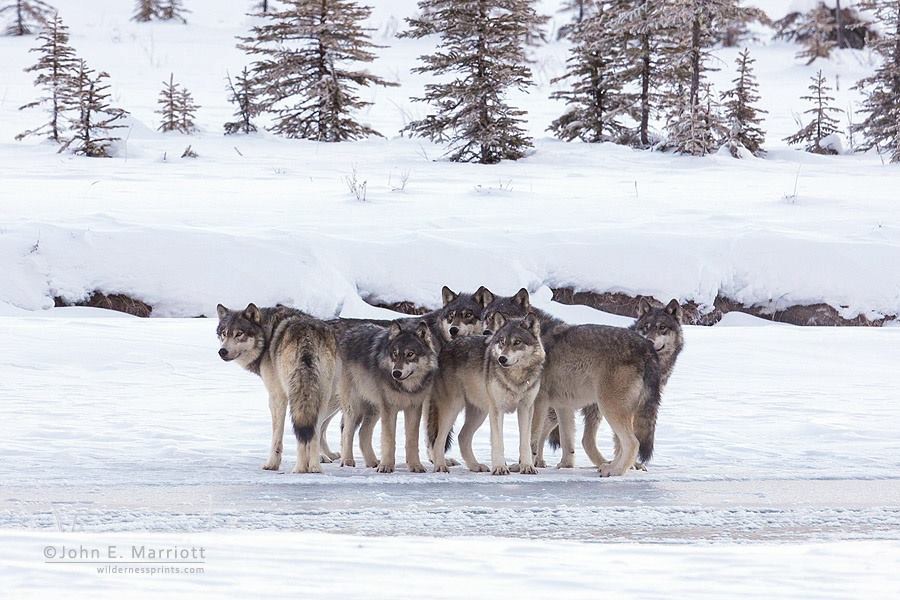
Photo credit: John E. Marriott
Still, numerical variations in the wolf population, as well as both known and unknown ecological consequences of their repeated slaughter, do not tell the whole story. What remains hidden from all of us, living far away from the land of the wolf, is individual suffering to which, through our political indifference, we implicitly consent. What we do not see is paralyzing anguish, pain, and psychological trauma that comes in the aftermath of the shattered family structure. Death destroys even those who survive. After a killing spree is temporarily over, surviving wolves return to mourn a loss. They also face a world unknown to them. As Marc Bekoff and Sadie Parr write, “those individuals that survive to make new wolf families must do so without access to the knowledge and culture held by their slain family members, something that takes generations to build. They become refugees on their own land.”
Finally, this is not only about the caribou or the wolf, but also about us, humans. Perceiving nature through the prism of its cruel and ignorant management comes at a price that we will have to pay. Destroying wolves destroys us as a society. It diminishes us. Our appreciation of and compassion for the natural world have evolved throughout centuries and molded into moral and ethical principles. We break these principles at our peril.
It is time to start peeling layers of “cultural and ideological” sediment we wrapped ourselves in. The cemented coating that clings to us offers the comfort of familiarity, but it is a false comfort that chips away at our humanity. The main argument for killing wolves in the caribou habitat is ensuring that the caribou will still be there, in the future. So our children and their children can watch them roam the forest. Given the ongoing destruction of the habitat, it will not happen no matter how many wolves we decide to shoot. But even if the demise of the caribou were to be somehow temporarily postponed by the merciless “recovery” plan, what then? Should we tell our children how many generations of wolves we have killed to accomplish this? Should we tell them that they what they see is the legacy of killing fields?
“The Ford government wants wolves and coyotes to pay the price for declining moose populations in Ontario. By re-opening a proposal abandoned by the previous government after it was outed as being unscientific and unethical, the PCs are trying to liberalize the hunting of both wolves and coyotes across northern Ontario.”
When it comes to commercial whaling, Japan is in the limelight. The country has been widely accused of using a scientific research program as a guise for hunting hundreds of whales a year and selling their meat. Last year, an international court agreed that the program isn’t scientific and ordered Japan to shut it down—to no avail.
But while Japan’s whaling program may be the most publicized, Japan isn’t the only nation hunting whales for commercial gain. Iceland does too. Along with Norway, the country openly defies a 1986 moratorium set by the International Whaling Commission (IWC), a voluntary body whose member nations agreed not to hunt medium and large whales for profit.
The solitary minke whale, which isn’t threatened with extinction, falls into this category. So does the endangered fin whale, also called the finback whale. But Icelandic whalers hunt them both anyway. This caught the attention of Jonny Zwick, a filmmaker based in California. His documentary Breach, released on Amazon Prime in November, explores the country’s commercial whaling industry.
How is it that Iceland can even hunt the animals? When the country wanted to rejoin the whaling commission in 2002 after a decade long hiatus, it included a clause in its reentry bid objecting to the commercial whaling ban. This “reservation” to the moratorium is what allows Iceland to whale commercially. Each year, the government sets what’s supposed to be sustainable kill numbers for minke and fin whales.
Pause
Unmute
Current Time 1:57
/
Duration 2:23
Loaded: 0%
Progress: 0%
Fullscreen
WATCH: See the trailer for the upcoming documentary Breach, which examines Iceland’s controversial commercial whaling industry. Video courtesy Side Door Productions
Minke meat largely appeals to tourists who can order it at Icelandic restaurants. But meat from the endangered fin whale isn’t popular at all in Iceland, so it usually gets shipped to Japan—even though there’s not a big market there, either. International trade in fin whale is banned, but another “reservation” to that ban allows Iceland to ship whale meat to Japan.
The film shows that the whale meat business isn’t exactly lucrative, but that hasn’t stopped the country’s lone fin-whaling company, Hvalur, from trying to sell its product. The business has even incorporated whale into beer and luxury dog food, and in 2014 it was forced to take a long and circuitous route to avoid European ports that blocked passage of its ships.
Intrigued by the film, I recently caught up with Zwick to discuss it. He spoke about how Icelanders feel about whaling, what shocked him most about the country’s whaling practices, and what he thinks of Hvalur’s director, Kristjan Loftsson.
How did you get interested in the topic?
My uncle is a marine biologist conservationist. He actually informed me about what was taking place in Iceland. I found it quite shocking that I’d never heard that endangered finback whales, the world’s second largest animal, were being slaughtered for commercial gain there. I decided to go and was pretty shocked by the access that I was granted—and decided that somebody needs to tell this story.
California nativeJonny Zwick produced a new documentary called Breach, which examines Iceland’s commercial whaling industry.
PHOTOGRAPH COURTESY JONNY ZWICK
What kind of story did you want to tell?
I wanted to tell the story from the Icelanders’ point of view because obviously there are a lot of objections to whaling commercially around the world—what we’ve seen in protests in Japan—but I wanted to hear it firsthand from those involved and those who’ve been surrounded by it. When I found out that 52 percent of Icelanders still supported whaling in 2013, I really wanted to hear why.
How would you compare Iceland’s whaling industry with Japan’s or Norway’s, countries that also engage in commercial whaling?
Iceland is the only country in the world to hunt the endangered finback whale, which is very different from the commercial minke whaling that takes place in Norway and Japan. Because it’s a different species—it’s an endangered species.
Iceland’s minke whaling isn’t that prevalent, but Norway is killing a ton of minke whales off the radar, and Japan is completely under the spotlight, which is appropriate because they go down into the whale sanctuaries, and they kill thousands of whales as well, but they’re minke whales and they claim for it to be research. Norway and Iceland openly admit to it being commercial whale hunting, but no one seems to give it much attention.
Whalers in Iceland cut open a fin whale, the second largest mammal, after blue whales. The country sells its meat to Japan.
PHOTOGRAPH BY HALLDOR KOLBEINS, AFP/GETTY IMAGES
As you filmed the documentary, what surprised you most?
The International Whaling Commission designated a scientific committee that spent a lot of time coming up with this number of 46 fin whales that would be established as a sustainable amount of whales that could be killed each season. The Icelandic government says that it’s adhering to the IWC regulations and rules, yet they have a quota of 154 for fin whales that can be killed every year. It was shocking to me that they’re getting away with this. They’re killing three times the amount that’s supposed to be sustainable.
Has the International Whaling Commission done anything to stop them?
A lot of NGOs and people who’ve been pushing for new legislation have almost given up on the IWC. They really don’t consider the IWC as a body that’s going to do anything about that, so they’re calling on specific governments, rather than even dealing with the IWC.
I was surprised that Iceland’s whaling industry pretty much comes down to one man, Kristjan Loftsson. What do you make of him?
He’s the son of the man who started Hvalur, this whaling company. And it’s really hard for him to let go, and he doesn’t want people telling him what to do with his heritage. At one point, it probably was profitable for Icelanders, for his company. But now it’s been proven as unprofitable, so his motives just become very obvious. And he just has this huge propaganda policy. He gets kids at a really young age to come and start working for him in the whaling stations, and he really tries to ingrain this nationalistic sentiment into them and get everybody on board with continuing his family practice.
The film shows the battle between the whaling and whale watching industries. Can you describe that dynamic?
The whale watching industry brought in about 300,000 people in Iceland last year alone, and Iceland’s entire population is 300,000. So this business is huge, and seeing a whale alive in the wild is more more valuable for somebody going to Iceland than trying it on their dinner plate. But then you have these tourists coming to Iceland, going whale watching, and then getting off the boat and actually trying this whale meat. When you get off the ships it’s advertised as an Icelandic tradition. So there’s just this weird dichotomy and there has to be education there.
Slabs of fin whale meat await packaging at the Hvalfijordur whaling station in Iceland.
PHOTOGRAPH BY INGOLFUR JULIUSSON, REUTERS
So as you hoped, did you discover why Icelanders support whaling?
It’s a nationalistic thing. They gained independence in 1944, and they want to set their own rules. They consider whales their resources, and they don’t want people telling them what to do with their resources. And they get really heated about it, and they have pride about it.
What do you want this film to accomplish?
The majority of Icelanders may be in favor of whaling, but I believe that’s primarily because they haven’t received any education about whales in their surrounding waters and don’t understand that whaling is not enhancing their economy in any way but rather is hurting it. I want the film to be able to answer questions and educate people about the illegal whale hunting taking place in Iceland. They don’t call it illegal, but it is defiant, and they are breaking international law in the trade of endangered species.
This story has been corrected to reflect that Iceland gained independence in 1944.
This story was produced by National Geographic’s Special Investigations Unit, which focuses on wildlife crime and is made possible by grants from the BAND Foundation and the Woodtiger Fund. Read more stories from the SIU on Wildlife Watch. Send tips, feedback, and story ideas to ngwildlife@natgeo.com.
More then 80 tigers have died after they were rescued from a Thailand tourist attraction dubbed Tiger Temple, a report said.
A total of about 87 felines died from a virus they had contracted after being held at the The Wat Pha Luang Ta Bua Yanasampanno temple west of Bangkok, according to London’s Independent newspaper.
“When we took the tigers in, we noted that they had no immune system due to inbreeding,” said a senior official from Thailand’s department of national parks, wildlife and plant conservation.
The official said the animals were susceptible to the canine distemper virus.
While the tigers were living at the temple, monks charged admission for people to take photos with them and bottle feed their cubs.
But the tigers needed to be removed from amid allegations that they were being drugged and illegally bred.
Local media reports claim that as many as 87 of the 147 creatures taken from the temple have died.
During a raid of the temple, Thai officials found 40 dead tiger cubs in a freezer along with 20 glass jars containing baby tigers and tiger organs.
Also, a monk tried to flee with 700 vials of tiger skin and a suitcase full of tiger teeth.
WEST MILFORD — Several bear activists are condemning the state Department of Fish and Wildlife for their use of snare traps to capture bears for research purposes after a West Milford resident, on her evening bike ride, found a bear cub screaming and tugging after it had been captured.
“It was horrifying; it’s just torture,” said Shari McAtee, who was riding her bike around 6 p.m. Sunday, Sept. 8, when she heard a loud noise. She investigated and about a half mile into the woods on Schoolhouse Road she found the cub, which she estimated weighed about 40 pounds. McAtee video recorded the distressed bear on her cell phone, showing it pulling on the cable attached to its leg that had been tied about three feet away on a nearby tree.
“I had no idea what was going on. We are near Clinton Road, so I was thinking maybe this was some sort of horrible joke or worship of some sort,” McAtee said.
McAtee said she called 911 and a few friends who are fellow bear activists.
Her friends and two West Milford police officers arrived along with a security guard with Newark’s Pequannock Watershed area, which encompasses portions of Morris, Passaic and Sussex counties. The police officers removed the restrained bear from the tree, McAtee said, but the cable remained on the bear’s leg.
McAtee said everyone dispersed after the bear was released from the tree — still with the cable attached to its leg — but on Monday morning around 8 a.m., she returned to the site and found the cub caught in some brush and crying.
Around 11 a.m. on Monday, Sept. 9, she saw DEP staff come out to the scene, tranquilize the bear and release the trap from its leg, McAtee said.
Caryn Shinske, a spokeswoman with the state Department of Environmental Protection, said via email that the department was notified the bear had been released so DEP staff went to the site, tracked the bear and captured it. They removed the cable, tagged the bear and released it unharmed, she said.
The division, she said, is “investigating” the bear’s release from the restraint but she did not go into further detail.
McAtee said she expressed concerns to the DEP officials who responded that she believed the bear had been trapped for nearly 24 hours, since she recalled seeing DEP workers in the vicinity around 11 a.m. on Sunday morning.
Shinske told the New Jersey Herald that Division of Fish and Wildlife staff check traps at least once every 24 hours, but may check sooner if a report comes in of an animal capture.
But McAtee believes keeping a bear tied up for 24 hours, or what she thinks may be more, is torture.
“What if someone tied your leg to a tree and you tried moving back and forth and had no idea what was going on with no food and water?” McAtee said.
The Aldrich foot snare is the main method used by the state for trapping and tagging bears, about 150 to 200 in a given year, Larry Herrighty, director of the Division of Fish and Wildlife, told the New Jersey Herald last year. The device, which consists of a spring-activated foot snare, is typically placed in a hole and covered with leaves and then fastened to a steel cable, which usually is attached to a nearby tree to hold it in place.
McAtee said the trapped cub’s mother was nearby on Sunday, along with another young bear, both of whom were “pacing around,”
While Herrighty told the New Jersey Herald in the interview last year that snares are always accompanied by signage to warn would-be hikers or passers-by of the trap, McAtee claims she did not see one.
McAtee expressed concerns that snares can severely mutilate and injure bears and said she would like to see them banned.
″(The Division) is torturing these bears, trapping them and leaving them there,” she said, adding that if the division puts out snares, they should be watching them at all times and be right there when a bear is caught.
While she doesn’t believe New Jersey “has the population to hunt bears,” she does think there could be better alternatives to control the bear population, such as contraceptives.
In a statement released Thursday, the New Jersey Outdoor Alliance, a self-described grassroots coalition of outdoorsmen, condemned the actions of McAtee and her fellow bear activists, including Angi Metler, who is the director of the Animal Protection League of New Jersey, for “interfering” with the Division of Fish and Wildlife’s research.
“This is a great example of how violent anti-hunting extremist organizations interfere with valid and badly-needed scientific research,” said NJOA spokesman Cody McLaughlin, “On the one hand, extremists harass Division Of Fish and Wildlife scientists while performing their essential research and promote a ban on traps that assist the division in such research.”
The state, in addition to testing the bears for ticks and various other diseases, uses the ratio of tagged bears taken during the annual hunt as a gauge of hunter success rates and to guide its ongoing bear management programs.
McAtee, however, says there is “no justifiable science basis to study bears for the purpose of hunting.”

 COURTESY OF MARY KATHERINE RAY, A VOLUNTEER FOR TRAP FREE NEW MEXICO





 Exposing the Big Game