|
|||||||||||||||||||||
|
|||||||||||||||||||||
Audubon Action Alert: Stop Cormorant Slaughter
Reply

|
|||||||||||||||||||||
|
|||||||||||||||||||||
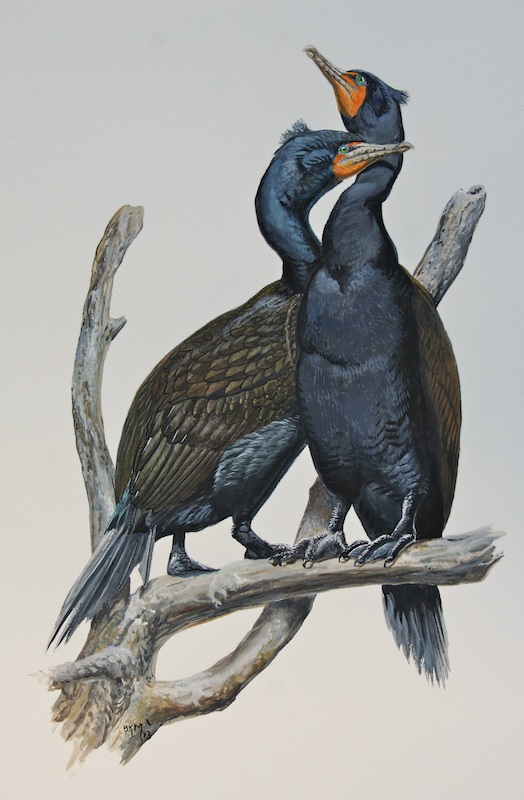
Painting Courtesy Barry Kent MacKay
Thursday, July 31, 2014 1:36 pm
A plan to kill 16,000 double-crested cormorants on East Sand Island has some residents on the North Coast scratching their heads.
Although still in the proposal phase, the plan drew many to an open house in Astoria last week to ask questions of the federal agencies involved.
“I can’t believe in this day and age we can’t come up with an alternative solution to killing things,” said Tommy Huntington of Cannon Beach.
The Alternative C plan is the preferred option of the U.S. Army Corps of Engineers to stem the ravenous consumption of juvenile salmon and steelhead each year. A final decision won’t be reached until after a public comment period and a review process are completed by the end of this year.
“I don’t want them to shoot the birds anymore than anyone else,” said Nancy Holmes of Seaside, explaining that she believes many people feel the same way.
The Army Corps released its plan to reduce the East Sand Island colony to 5,600 breeding pairs June 12. A public comment period has been extended to Aug. 19 after organizations advocated for more time. The federal agency, which manages hydropower dams and dredges the Columbia River, is required by the Endangered Species Act to come up with a management plan to control the burgeoning seabird population.
There were about 100 breeding pairs on the island in 1989, according to officials, but it has grown to 14,900 breeding pairs today. Dredge spoils were dumped there in the 1980s creating a perfectly flat and sandy location for the birds to nest.
The colony is estimated to have consumed about 11 million young salmon and steelhead annually over the past 15 years. Endangered and threatened wild stocks as well as hatchery fish are scooped up mostly in May by the seabirds as they head for the Pacific Ocean.
Since 1997 the Army Corps has done research on juvenile predation by the black birds. In 2008, they began to try out nonlethal methods to move nesting away from the mouth by hazing with lights, reducing nesting habitat and scaring them off. The available habitat is about 11 acres on the western portion of the island. In 2011, researchers began focusing on reducing that by putting in barrier fences and forcing birds from the nondesignated areas. They eventually restricted it to 4.4 acres, reducing 75 percent of prime nesting area. The federal agency even marked cormorants with satellite transmitters and banded hundreds of adults to provide information about where they moved during the restrictive period.
The Army Corps presented four options for reducing the colony to a size that would lessen the impact on endangered and threatened fish. A federal Biological Opinion of endangered Columbia River stocks requires the Army Corps to manage predation as one of three federal agencies that oversee hyrdoelectric dams on the river.
Alternative C was considered to be the best solution by the agency. The three other options did not include killing the cormorants, but forms of hazing and removal of nesting habitat.
“We feel it’s the one that gives us the most certainty of achieving the requirements that have been put upon us by the Biological Opinion,” said Joyce Casey, chief of the agency’s environmental resources branch in Portland. “It’s the most cost effective and it’s the one that has the best likelihood of not moving the problem somewhere else.”
The proposed plan includes land- and boat-based hazing and taking a limited amount of eggs, all with an “adaptive management” approach over four years. About 20 percent would be killed each year with 5,230 being taken the first year. The agency will have to file an annual depredation permit with the U.S. Fish and Wildlife Service for the “take levels.” The killing would take place on and off the island within the 15.5 mile foraging range around the island.
“It’s not a great plan,” said Holmes, adding that she’s at least glad that an adaptive management strategy is being used.
Huntington said he acknowledges the strong feelings that fishermen have about fish runs being consumed, but that the management plan shouldn’t have to be one or the other.
“You have to kill one to save the other one?” Huntington said. “It doesn’t make any sense.”
The federal agency also has to take into consideration the Caspian terns, brown pelicans and other birds on the island. The total number of nesting birds is about 60,000.
Casey said the preferred option also provides a balance because the agency wouldn’t have to eliminate all cormorant habitat on the island. With Alternative C, she said inundation of part of the nesting site will create habitat for shorebirds searching for food in the shallow water.
The Army Corps is also in the process of reducing habitat for Caspian terns on the island by about a third. The terns accounted for about 5.5 million juveniles consumed annually between 2000 and 2009.
Sanity and compassion prevail in New York… for now.
06/23/14
Wow. I am so accustomed to myth-based wildlife management policy swaying legislators (who are too lazy to do their homework), both Canadian and American, that it’s hard to believe what has happened, at least to date, in New York state (just across the lake from where I live, in Ontario). Senator Tony Avella recently announced the unanimous passage of his state legislation (S. 6589) by the state senate. This sets up a two year moratorium on plans by the ironically named Department of Environmental Conservation (DEC) to kill all mute swans in New York state: every last individual. While this has, inevitably, been called a victory for “animal rights and environmental protection groups,” it is much, much more than that. It is a victory for reason, logic, science, and yes—compassion.
Mute swans are those white swans with the curved necks, orange beaks, with black knobs at the forehead, who often “fluff” their wings into a graceful, sail-like configuration as part of their wonderful breeding display. They are seen in estate ponds, zoos, parks, and, increasingly, along urban waterfronts. Mute swans are native to Eurasia and distinct from North America’s two native swan species, the tundra swan and the trumpeter swans. Both native swans have tapered black (not orange) beaks, no knobs, and are less likely to carry their necks curved, and lack that characteristic “sail” display of the mute swan. Additionally, they are highly migratory, while mute swans are generally less so, if at all.
Seeing them—the epitome of grace and beauty—it may be difficult to understand why anyone would kill one, let alone every single one in an entire state. I think there are two answers: one official, and one not.
Officially, they are demonized for eating submerged vegetation needed by native waterfowl; for chasing native waterfowl from nesting areas, thereby usurping wetlands; and for pulling up emergent vegetation. The concern is simplified by calling the mute swan an alien, non-native, foreign bird who is displacing our native waterfowl—waterfowl that, I might add, are “game” birds shot by hunters, bringing in revenue that pays salaries of wildlife managers who want to kill off the mutes. Mutes are not very sporting prey… You can walk right up to most of them, and they tend to take food from the hands of kids, making it harder to shoot them.
But, it’s not nearly that simple. North America’s trumpeter swan was nearly exterminated by excessive hunting, particularly for the “fur” trade. (Back then, it included an equal trade in the feathered skins of birds.) We know that it nested in the western mountains and northern forests, and that many wintered on the mid to south U.S. Atlantic coast. There is no proof of them nesting much, if at all, east of the Great Plains and Mississippi drainage, but facts don’t matter to groups like DEC, and there is a massive bi-national effort to “restore” them as a breeding species in the east. No one admits it in so many words, but I suspect the hope is that, being highly migratory, they will eventually become another waterfowl species to entice the dwindling numbers of waterfowl hunters to load up their shotguns, and buy those licences so important in providing money to pay wages of wildlife managers.
But, people intuitively love mute swans, so they must be demonized. Being “alien” helps, though there is a huge hypocrisy involved. The same agencies that decry the bird’s foreign origins fail to mention that, by itself, that is hardly a problem when it comes to so many other species (including the brown trout, ring-necked pheasant, coho salmon, and other “game” animals that they, themselves, cheerfully add to the environment). So, being “alien” is only selectively a concern. In fact, most of the plants and a huge percentage of the animals we see in the wetlands are not native. More to the point, either the exact same species, or ones quite like them, co-exist with mute swans in Eurasian wetlands, begging the question (seldom asked and never answered): What makes the same, or very similar, species so vulnerable over here? And, why more vulnerable to mute swans than to trumpeter swans, whose “re”introduction is not challenged?
One of the most abundant plants in wetlands is the common reed, Phragmites, which is choking out wetlands. It is not native, but it is far too established to eliminate, and if mutes pull them out, isn’t that good? In fact, we have “Europeanized” so much of North America that it is far more suitable for mute swans than for trumpeters. Many Eurasian bird species, including other swans, have reached North America on their own, some establishing themselves as breeding species—and, in the fullness of time, the mute swan might, too. And, don’t forget that they are also common here in Ontario, across the lake, and we are not killing them… So, to keep New York mute swans free would require endlessly killing each one seen. Really, isn’t that a tad absurd?
But, most tellingly, there is nothing “bad” that a mute swan does that a trumpeter swan does not also do. (Plus, the latter is a lot noisier!) So, good for Senator Avella and his colleagues for seeing through the nonsense and making the logical, compassionate choice.
Sadly, the people in another neighboring region, the state of Michigan, show signs of being bamboozled by similar rhetoric from their own, but with a twist that would be humorous, were it not tragic for the swans… The mute swans chase Canada geese. Yes… From their nesting sites… But, do they not see the irony of also complaining about “too many” Canada geese? Also, how to explain the success that Canada geese have had in “invading” Europe, where, like mute swans in North America, the geese have escaped captivity and become established as an “alien” species? It would all be so funny, were it not so darn sad.
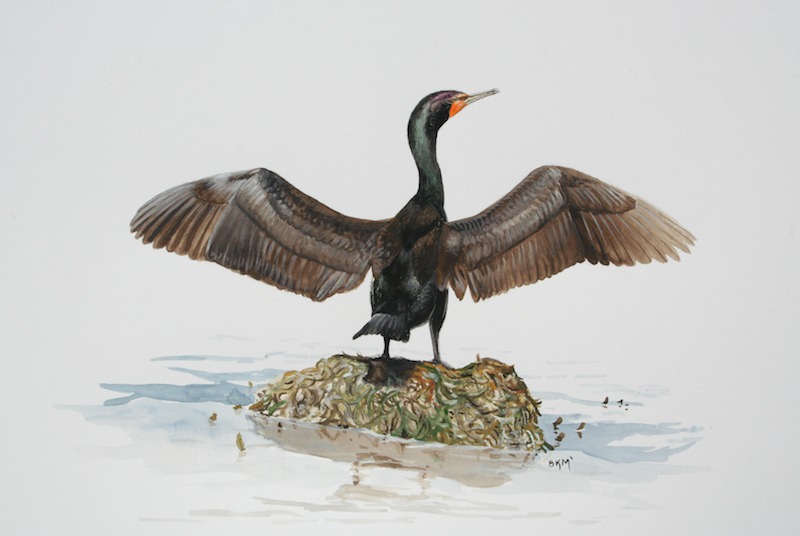
Paintings Courtesy Barry Kent MacKay
[Remember the birds next time you buy salmon or fish oil.]
Fri Jun 13, 2014.
Feds plan: Kill salmon-eating Sand Island seabirds
PORTLAND (AP) — Federal officials are proposing to kill half the large colony of cormorants in the Columbia River estuary because the large black seabirds eat too many young salmon and steelhead.
The proposal is the preferred action in a draft management plan released Thursday by the U.S. Army Corps of Engineers.
The colony of double-crested cormorants on East Sand Island near the mouth of the Columbia consumes about 11 million juvenile salmon per year as it migrates through the river to the Pacific Ocean. The fish are listed as endangered.
Officials say despite reductions in nesting habitat, the cormorant population has continued to thrive. It has increased from 100 breeding pairs in 1989 to about 15,000 breeding pairs today. That makes it the largest cormorant colony in western North America, representing over 40 percent of the region’s cormorant population.
The Corps has been studying the impact of avian predation on juvenile salmon in the Columbia since 1997. Officials also have looked into methods such as hazing with lights and using human presence to flush cormorants off potential nesting sites.
Now federal officials are proposing to reduce the colony to 5,600 breeding pairs by killing half of them, trying to scare off the others and taking their eggs.
The $1.5 million-a-year program, planned over four years, would arm federal trappers with silenced rifles and night-vision scopes to shoot the birds during their nesting season. They’d also cover eggs in oil to prevent them from hatching and inundate part of the island once the cormorant population reaches a target to limit nesting.
Once the target colony size is attained, the Corps also is proposing to modify the terrain of East Sand Island to inundate some nesting habitat.
The Corps passed over an alternative that would only use nonlethal methods, saying it would be less effective and push cormorants to nest elsewhere in the Columbia River estuary or in other coastal areas with endangered fish.
“That is a significant concern,” said Sondra Ruckwardt, the Army Corps’ project manager overseeing the plan. “We’re trying not to move the problem.”
Double-crested cormorants have orange faces and long necks, and are masters at diving to catch small fish. They are protected under the Migratory Bird Treaty Act and are native to the Columbia.
Federal officials also are trying to protect salmon by killing off sea lions — another protected species that has also proved too difficult to scare off with non-lethal methods.
The public has through Aug. 4 to comment on the cormorant plan.

By Anna Gufaston
For Friends Of Animals
The state’s plan to kill thousands of wild mute swans in New York – including the many that call Jamaica Bay home – by shooting or gassing them seems likely to be placed on hold, with Assembly members passing a bill last week that would delay the initiative and the state Senate poised to do the same this month.
The bill, introduced by Assemblyman Steven Cymbrowitz (D-Brooklyn), that was passed last Wednesday would establish a moratorium on the state Department of Envrionmental Conservation’s plan to declare the bird a “prohibitive invasive species” and wipe out the state’s entire mute swan population – numbering at around 2,200 – by the year 2025.
The bill also requires the DEC to hold at least two public hearings and to respond to all public comments before finalizing any management plan for mute swans. The DEC would additionally be required to prioritize non-lethal management techniques and include scientific evidence of projected and current environmental damage caused by the mute swan population.
State Sen. Tony Avella (D-Bayside) is the lead sponsor on the Senate version of the bill, which is expected to pass sometime this month.
Avella and Cymbrowitz introduced their legislation after the DEC last December made public its plan to eliminate the state’s mute swan population – which drew vehement criticism from elected officials and animal rights advocates.
“I was horrified to learn that our state wildlife agency would make such an extreme, unfounded proposal and do not believe that the DEC has provided evidence to justify the elimination of these beautiful swans,” Avella said in a previous statement.
Among those who have joined the legislators in their criticism is Friends of Animals, an animal advocacy organization that has long been protesting the proposal.
“Our New York office has been swamped with phone calls and emails from frantic New York residents horrified that mute swans may be wiped out entirely,” Friends of Animals’ New York Director Edita Birnkrant said in a previous statement.
TAKE ACTION
Please contact your NY State Senator and urge them to pass Senate Bill S.6589A–the bill that would save NY’s mute swans from being wiped. This bill passed in the Assembly last week and we need calls and emails to ensure it passes in the Senate and becomes law.
Please also contact the co-leaders of the NY Senate, Sen. Skelos at 518 455-3171 or skelos@nysenate.gov and Senator Klein at 518-455-3595 jdklein@senate.state.ny.us and tell them you want them to save our swans and pass this bill.
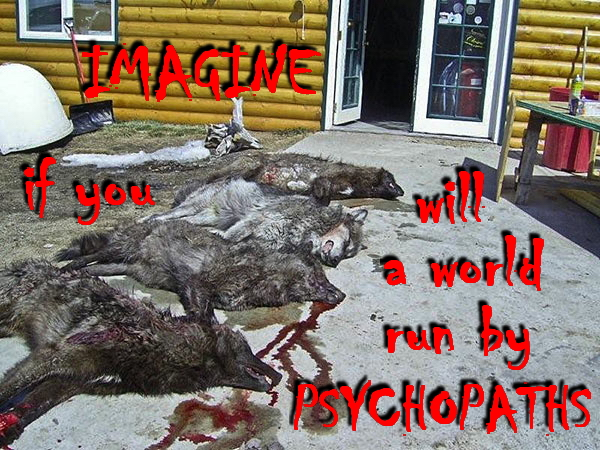
In response to this horrible crime scene photo, a Facebook friend innocently asked me, “What is the reason they do this?”
As I’ve said before, forget hunters’ feeble rationalizations. All I could tell her was: For fun? Sport? Hate? Intolerance? An overinflated sense of entitlement? Because they’re psychopaths?
Take your pick.
It seems there are a lot of reasons people can dream up to want to kill the wildlife their area is blessed with—especially if they already have their minds made up to be intolerant. Folks need to decide to accept their animal neighbors and adopt the old adage, “live and let live.”
While speculating on a murderer’s motive might make interesting tea time conversation, when it comes down to it, I don’t want to hear their justifications, their misguided notions, how they compartmentalize their killings or objectify their victims, I just want the behavior to end—one way or another.

Meanwhile, this bumper sticker is a common sight on rigs owned by commercial salmon fishermen in the area:

And shot sea lions are a common sight on beaches off the Oregon/Washington coast:

_____________________
From Sea Lion Defense Brigade:
In loving memory of the 3 sea lions KILLED this week at Bonneville Dam by the Oregon Department of Fish and Wildlife.
These scapegoated sea lions had nothing to do with the decline of salmon and were taken from their friends and family way too soon.
Humans have many food options, sea lions do not.
Rest in Peace C020, C029 and C930.
We serve in your memory.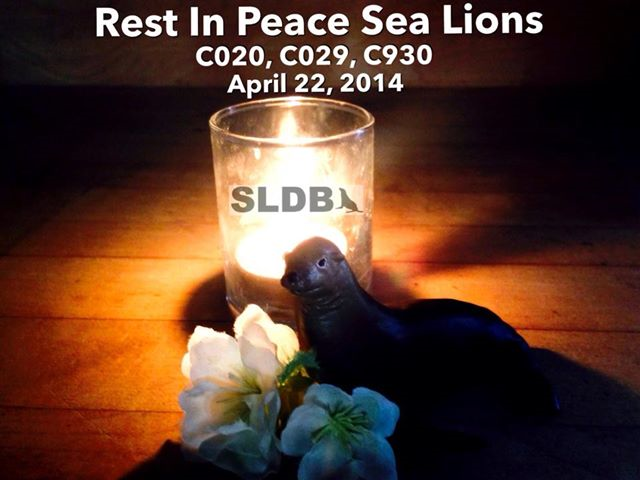
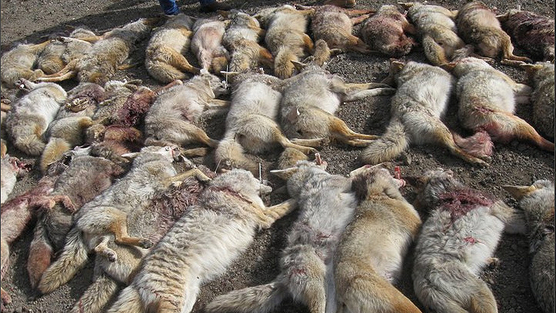
Please join Project Coyote in calling on the California Fish and Game Commission (Commission) and the California Department of Fish and Wildlife (CADFW) to prohibit predator killing contests statewide and to develop comprehensive regulations and policies to reform and modernize predator management in California.
Killing predators – or any wild animal- as part of a ‘contest’ ‘tournament’ or ‘drive’ is ethically indefensible, ecologically reckless, and contravenes new legislation (AB 2402) that Governor Jerry Brown signed into law requiring the Fish & Game Commission to use “ecosystem based management” and the best available science in the stewardship of California’s wildlife. Such wildlife killing contests have no scientific basis and degrade the reputation of the ethical sportsman of California.
WHAT YOU CAN DO: Please sign the petition and send the letter linked from here: http://www.change.org/petitions/ca-dept-of-fish-wildlife-f-g-commission-stop-coyote-killing-contest
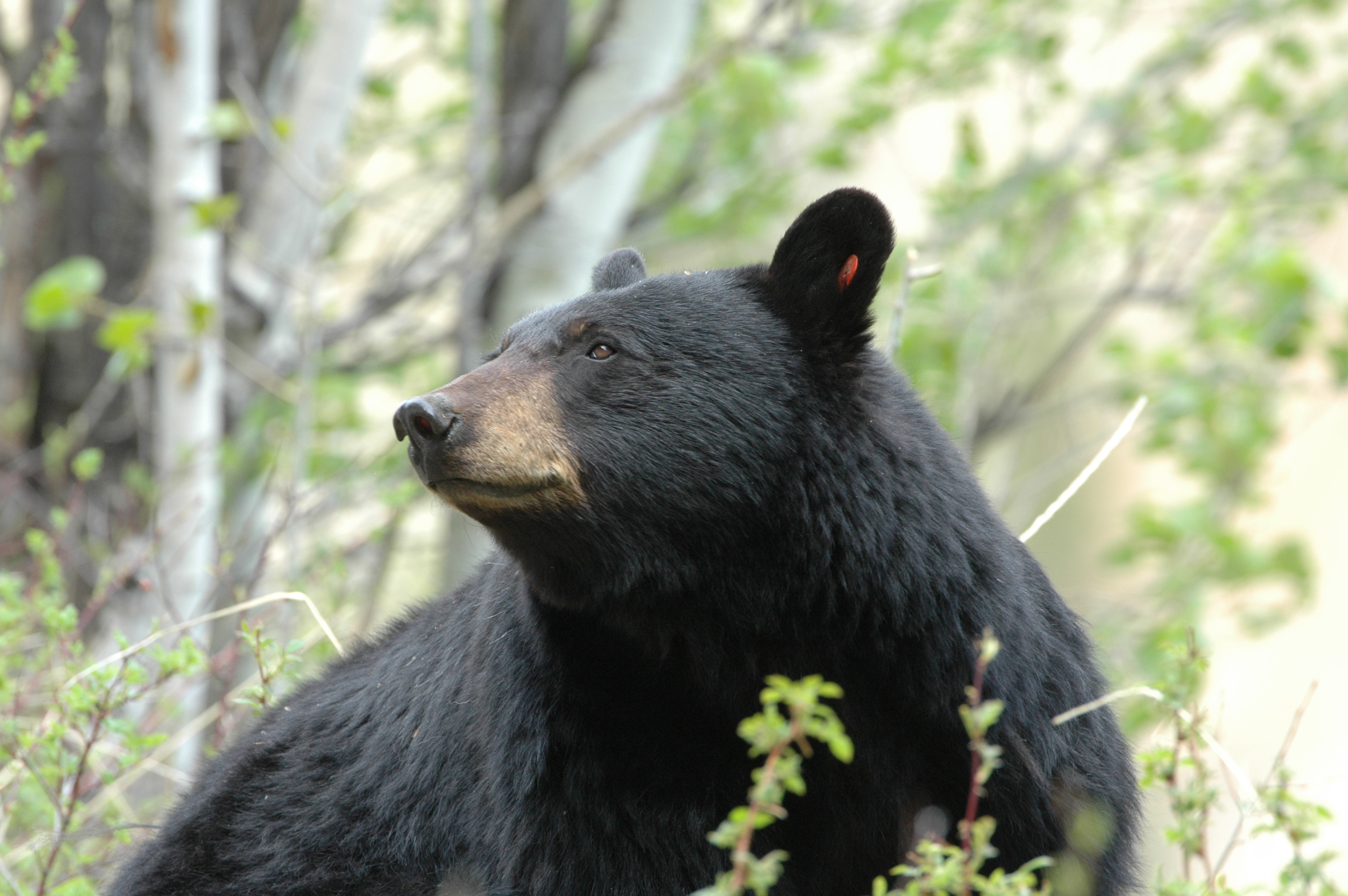
Photo Copyright Jim Robertson
[Never mind that the subdivision backs up against a wildlife sanctuary. When a non-human animal dares to threaten a human, it’s not just an eye for an eye, but SEVEN pairs of eyes for an injury.]
Florida wildlife officials said on Tuesday they killed a seventh bear, an adult female bear, hours after announcing the capturing and euthanization of a 250-pound male bear overnight.
Florida Fish and Wildlife Conservation Commission officials didn’t say that they have identified the bear that attacked Terri Frana Saturday night at her home at 1900 Brackenhurst Place in the Carisbrooke subdivision, which backs up to the Wekiva Wildlife preserve.
She received 30 staples and 10 stitches in her head after a 200-pound bear mauled her.
Authorities on Tuesday also released the 911 calls from the attack on Frana.
“She came in screaming, she said a bear attacked her,” the caller told dispatchers.
FWC said although they are testing the bears for DNA, the tests may come back inconclusive and they may never find the exact bear that attacked Frana.
FWC said that the seven bears appeared dangerous and threatening and didn’t appear to be afraid of humans.
FWC said as with the other bears, the FWC removed the bear from the neighborhood and it showed signs of being highly habituated to people.
“We yelled at him, clapped our hands at them, and yelled bad bear- they kept approaching us,” said Greg Workman of Florida Fish and Wildlife.
Sunday evening, an FWC officer shot a bear after they say it showed dangerous behavior toward officers at the scene. The FWC says the bear approached biologists at close range and showed no fear even after an officer yelled at it. Because of its behavior, the officer determined that the bear was dangerous.
Wildlife officials say other bears appear to be accustomed to people in the area, including four that were captured and put down. The fifth bear was captured Monday morning.
The FWC says officers spotted two other bears in the area that ran away at the sight of humans. This is typical wild bear behavior and no action was necessary with those bears, officials said.
“The fact that we have come across so many bears with so little fear of humans indicates that these bears are highly habituated and are regularly receiving food from people,” said Dave Telesco, the FWC’s Bear Program coordinator. “Our staff is dedicated to wildlife conservation. Having to put down these bears is a very difficult decision, but it’s the right decision to ensure public safety. Unfortunately, the saying is true: ‘a fed bear is a dead bear.’”
Frana’s husband, Frank Frana, said his wife suffered bite wounds to her head, arms, shoulder and upper thigh and had lacerations all over her body.
“But she’s fine,” Frank Frana said. “She’s still pretty traumatized from it all, but it’s unbelievable she’s fine.”
Frank Frana said his wife encountered the bears, which had pulled some trash cans out of the family’s garage, while she was checking on her children, who were playing at a neighbor’s home.
He said there were five bears rummaging through the trash when one of them stood up and attacked her.
“(My wife) was able to eventually break away and run into the house. She collapsed on the floor and my oldest son … called 911,” Frank Frana said. “It was a close call.”
The FWC on Monday will continue to check traps in the area and warning families nearby.
FWC said if you encounter a bear at close range speak to the bear in a calm, assertive voice while backing up slowly toward a secure area. Be sure you are leaving the bear a clear escape route. Stop and hold your ground if your movement away seems to irritate instead of calm the bear. Do not run or play dead. If a black bear attacks you, fight back aggressively.
The FWC also reminded residents to be aware of their surroundings and always supervise pets and children while outdoors. Residents should contact the FWC Wildlife Alert Hotline at 888-404-FWCC to report any threatening bear activity.
Paintings Courtesy Barry Kent MacKay
First, I want to thank my friend Barry MacKay for the use of his wonderful cormorant paintings in this and the previous blog post, and for alerting us about the cormorant-kill crisis (through another list).
An avid birder, wildlife advocate and Canadian blogger for Born Free USA, Barry writes, “I don’t really understand the U.S. animal protection movement’s indifference to the mass slaughtering of cormorants that has been underway for so many years, while we are stopping it in Canada, but I strongly urge anyone who cares to read a book just published: “The Double-crested Cormorant: Plight of a Feathered Pariah, by Linda R. Wires, Yale University Press, 2014. It came a week or two ago and gives you all the arguments you
need to help protect these wonderful birds from myth-based fear and loathing by “sportsmen” who just like to kill (the birds are inedible).”
http://www.openlettersmonthly.com/book-review-the-double-crested-cormorant/
The Double-Crested Cormorant: Plight of a Feathered Pariah
By Linda R. Wires
Illustrated by Barry Kent Mackay
Yale University Press, 2014
Conservation biologist Linda Wires, in an utterly remarkable new volume from Yale University Press, takes up the cause of the persecuted Phalacrocorax auritus, the double-crested cormorant, a sleek, black-plumed aquatic bird from a family thirty-five or forty species found on every continent on Earth (although the double-crested is found only in North America). “More than just an account of a maligned and persecuted animal,” Wires writes, “the cormorant’s story reflects a culture still deeply prejudiced against creatures that exist outside the boundaries of human understanding and acceptance.”
The persecution she’s alluding is a deeply-ingrained cultural thing that’s almost certainly rooted in simple commerce: for almost as long as humanity has cast its nets into bays, harbors, inlets, estuaries, rivers, wetlands, and even ponds, humanity has also labored under the conviction that it has a cutthroat competitor in the double-crested  cormorant. As a result, even though cormorants in ancient China and Japan were for centuries domesticated into allies by fishermen themselves, they’ve been extensively persecuted virtually everywhere else. Wires stresses throughout her book (which is an absorbing combination natural history monograph and passionate manifesto) that this persecution continues today, and she’s very insightful on the cultural roots of it all:
When observed in its conspicuous spread-winged pose, common to several cormorant species, the cormorant acquires another potent aspect. In this notably bat- or vulture-like posture, the cormorant stands still and upright with both wings held out wide from the sides of its body. In this stance, frequently taken up after fishing, birds typically orient themselves toward the sun or the wind, presumably to dry their feathers or regulate heat loss and gain; some researchers have suggested that wing spreading occurs to heat up the bird’s food and facilitate digestion. Whatever the exact reason, the mysterious stance has an eerie, evocative quality, conjuring up images of crucifixion and vampires, and has fueled impressions about the bird’s dark nature.
“At the heart of the cormorant’s story,” she elaborates, “is the extent to which its current treatment is (or is not) based on sound science, especially relative to its management for fisheries.” No study past or present has ever demonstrated that double-crested cormorants are true rivals to any kind of commercial fishing, and yet, largely as a result of blind prejudicial momentum, near-extinction policies persist even into the 21st century. Wires lays out in  detail the wrong-headed U.S. federal policies – several of which are up for renewal in June of this year – that allow for the wholesale slaughters of cormorant populations under the guise of “culling.”
The calamity of this kind of policy is leant all the more weight The Double-Crested Cormorant by Wires’s skill at describing the natural history of these birds, which are awkward on land (Wires notes their particularly their ungainly habit of hooking their beaks onto rocks and branches in order to pull themselves lurchingly forward, a sight I’ve seen and laughed at myself) but beautifully graceful in their natural underwater environment. They hunt by sight (they have flat corneas, which help in achieving a condition unknown to life-long book-readers: emmetropia, perfect vision) except when the water is too dark or turbulent, in which case they hunt by means as yet unknown. They nest in all manner of locations, and they’re doting parents. They’re deep divers, and although they’ll eat virtually any kind of fish they can catch (including some only a little smaller than themselves), they seem to prefer just the kind of smaller ‘junk’ species that are of no interest to commercial fisherman in any case.
It’s a quietly stunning double performance: Wires is equally proficient as both the Roger Tory Peterson of the double-crested cormorant and its Rachel Carson. Her preservationist advocacy is unflinching, and her nature-writing is eloquent – and the whole book is enlivened by gorgeous illustrations by Barry Kent Mackay, who not only captures the cormorant in all its moods and actions but also offers accompanying pictures of many of the cormorant’s fellow estuarine birds, including an especially ominous drawing of a bald eagle, and a haunting illustration of a great heron.
The result of all this is an important work, a benchmark popular study of a bird species that needs enlightened help in order to survive. The Double-Crested Cormorant: Plight of a Feathered Pariah ought to be for sale in the gift shops of every national park in the United States at the very least – and from the sound of Wires’s conclusions, several copies sent to Congress might help too.


 Exposing the Big Game