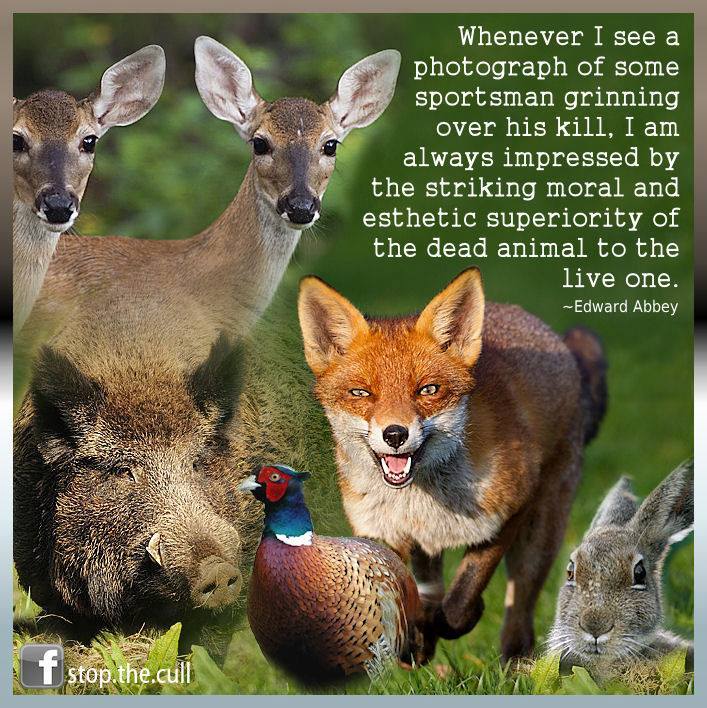
Moral and Esthetic Superiority
9


In one of Edward Abbey’s many epic books he mentions seeing a bumper sticker on the back of a gas hog, redneck rig that went something like, “Did the coyotes get your deer?” It was an unabashed show of narcissistic entitlement which spelled out just how the driver felt about nature and the need for a diverse ecosystem.
Although his type doubtless have no qualms about supporting factory farming by buying a nightly meal of meat from the local “Western Family” grocery store, when hunting season rolls around they are right there to lay claim to the wildlife as well, in the form of deer, elk, moose or pronghorn.
It don’t mean shit that apex predators such as wolves, cougars, bobcats and coyotes have nothing else to eat and have evolved over eons to live in harmony with their wild prey. Hunters think of themselves as apex predators, decked out in their best Cabella’s camouflage outfit, tearing up the land on their trusty 4-bys or 4-wheelers, hoping a deer steps out in front of them.
But as a faithful reader pointed out this morning, human hunters aren’t apex predators, they’re apex parasites (Homo parasiticus).
Personally, I’d rather “my” deer went to the coyotes and “my” elk went to the wolves, as nature intended.

Text and Wildlife Photography ©Jim Robertson. All Rights Reserved
Here’s the Table of Contents for Exposing the Big Game?
Foreword by Captain Paul Watson
Introduction
Chapter 1) Hide-hunting Holocaust Survivors Still under Fire
Chapter 2) An Act of Bison Altruism
Chapter 3) War on Coyotes an Exercise in Futility and Cruelty
Chapter 4) Time to End a Twisted Tradition
Chapter 5) Avian Superstar Both Athlete and Egghead
Chapter 6) From the Brink of Oblivion and Back Again?
Chapter 7) A Day in the Sun for the Hayden Wolves
Chapter 8) Critical Cornerstone of a Crumbling Castle
Chapter 9) Bears Show More Restraint than Ursiphobic Elmers
Chapter 10) The Fall of Autumn’s Envoy
Chapter 11) Inside the Hunter’s Mind
Chapter 12) A Magical World of Oneness
Chapter 13) Living Targets of a Dying Sport
Chapter 14) A Few Words on Ethical Wildlife Photography
In Closing
Acknowledgements:
Looking back, this was not, at the outset, planned as a podium from which to lambaste anyone’s hobby or heritage, but was originally intended as a venue for relating some of the behaviors and capabilities I’d observed among animals living in the wild, and as a celebration of life along the compassion continuum. However, after delving deeper into the histories of the species covered here—thanks in part to the invaluable references listed below—I found it impossible to simply depict their natural activities without also chronicling the shocking stories of abuse they have suffered at the hands of man. It would have been doing the animals a disservice to merely record how they naturally lived without at least alluding to the far-reaching and pervasive ways that human actions have altered their lives and sometimes their very natures. And the facts are clear: there has been no greater direct human impact on wildlife than the ongoing threat of hunting. As with the other pertinent and profound quotes from a variety of enlightened sources, this one from Edward Abbey proficiently puts it in a nutshell, “It is not enough to understand the natural world. The point is to defend and preserve it.”
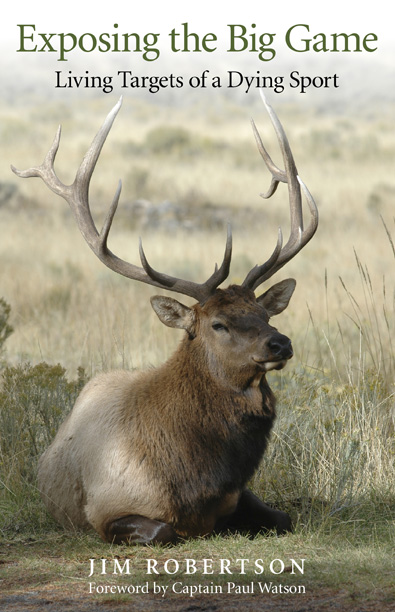
 Exposing the Big Game