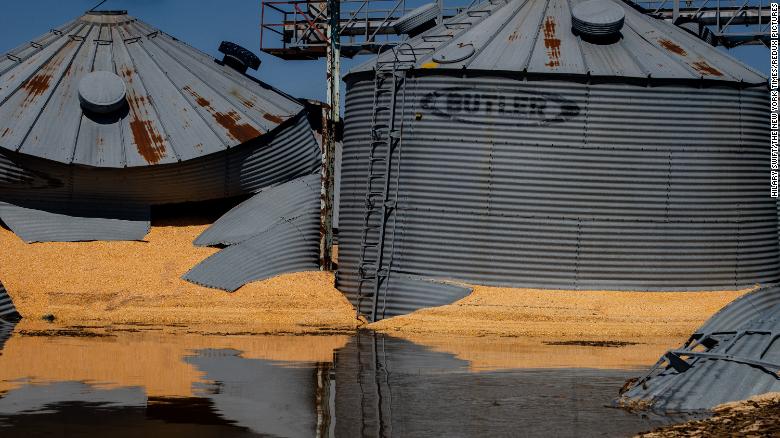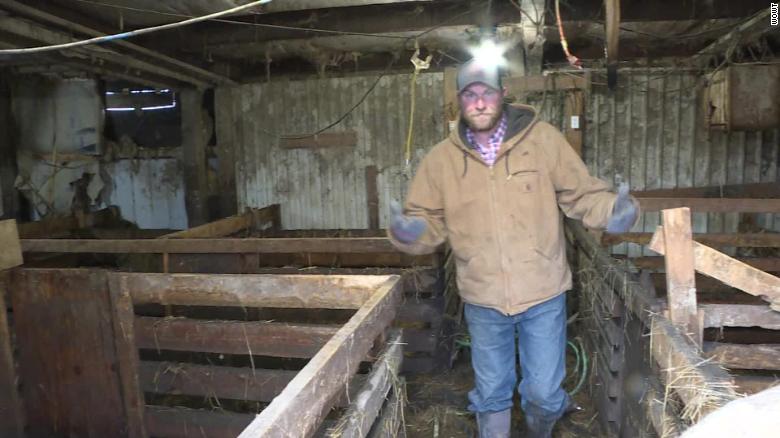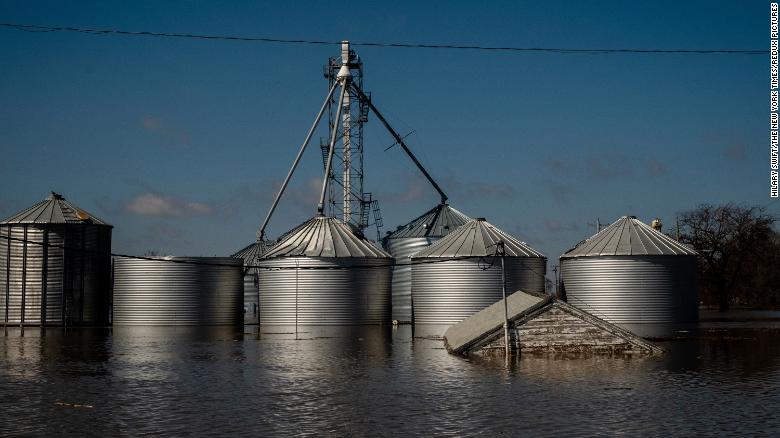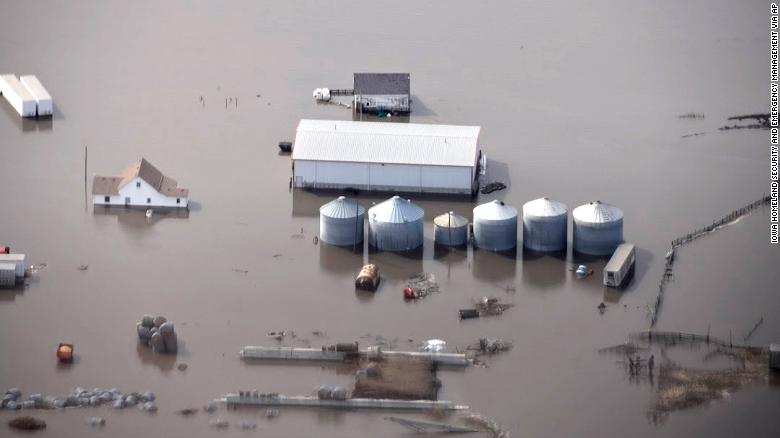
(CNN)Farmers in parts of Nebraska and Iowa had precious little time to move themselves from the floodwaters that rushed over their lands last week, so many left their livestock and last year’s harvest behind.
Rep. Alexandria Ocasio-Cortez spent plenty of air time explaining “farting cows,” as she defended her so-called Green New Deal on the premiere of Showtime’s “Desus & Mero.”
According to an initial outline of the measure, the freshman Democrat and Sen. Edward Markey (D-Mass.) said they “set a goal to get to net-zero, rather than zero emissions, in 10 years because we aren’t sure that we’ll be able to fully get rid of farting cows and airplanes that fast.”
The language was later changed to “emissions from cows.”
On Thursday night, comedy duo Desus Nice and The Kid Mero asked Ocasio-Cortez why she thought the initial reaction to the Green New Deal focused on bovine exhaust.
“In the deal, what we talk about, and it’s true, is that we need to take a look at factory farming, you know? Period. It’s wild,” Ocasio-Cortez said, according to Fox News.
“And so it’s not to say you get rid of agriculture, it’s not to say we’re gonna force everybody to go vegan or anything crazy like that. But it’s to say, ‘Listen, we gotta address factory farming. Maybe we shouldn’t be eating a hamburger for breakfast, lunch, and dinner. Like, let’s keep it real.’”
“Slow down,” Desus joked.
“But we have to take a look at everything,” the ultra-left-wing pol continued, “and what we need to realize about climate change is about every choice that we make in our lives, you know?”
The Democratic socialist also defended her call for a 70 percent marginal tax rate on incomes over $10 million.
“It really comes down to the question of, ‘Isn’t $10 million enough?’ Like, when does it stop?” she said. “At what point is it amoral that we’re building Jeff Bezos a helipad when we have the most amount of homeless people in New York City?”
Don’t ask the question if you might not like the answer.
It is a common piece of wisdom that could apply to many things. How sausages get made for example. Or, how chickens end up on our plates.
As much as many people would probably prefer to avoid the question, Mercy for Animals Canada is trying to make them face it.
For six months, an employee of the animal rights group worked inside one of the largest chicken slaughterhouses in Canada, while using a hidden camera to secretly videotape what he was seeing.
He spoke to CTV’s W5 on the condition that we not use his real name. So, we’ll call him John.
“It is one of the ugliest places you can imagine,” he said.
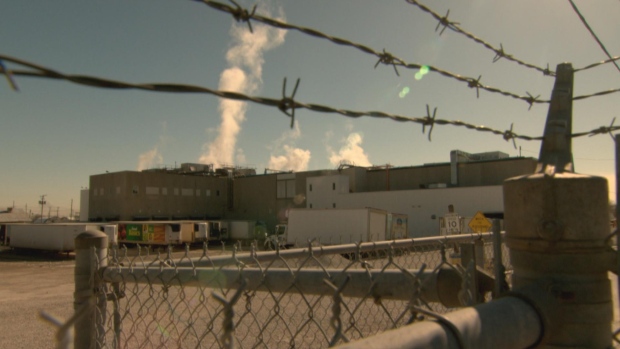
The slaughterhouse is owned and operated by Maple Lodge Farms. By any standard, the place is big, a sprawling series of factory style buildings in a field located on the edge of Brampton, Ont. near Toronto.
A steady stream of tractor trailers arrive from mostly Ontario farms that raise the chickens from hatching to slaughter.
Reading this from an app? Tap here for a better experience.
The birds are bred to grow quickly, their lives last usually no longer than two months. And the sheer numbers can be staggering.

Nearly half a million birds are slaughtered at the Maple Lodge plant every day, feeding a Canadian market that consumes more than 650 million chickens every year, making it the most popular meat source in the country.
The Maple Lodge Farms website states that it treats the birds humanely and with respect. But the undercover video shot by Mercy for Animals Canada does show things that many viewers probably would find difficult to watch.
Harsh conditions
“There are birds that arrive dead in the hot months,” John told W5. “They die from over-heating. And in the colder months, chickens die from being too cold. They actually arrive frozen like ice blocks.”

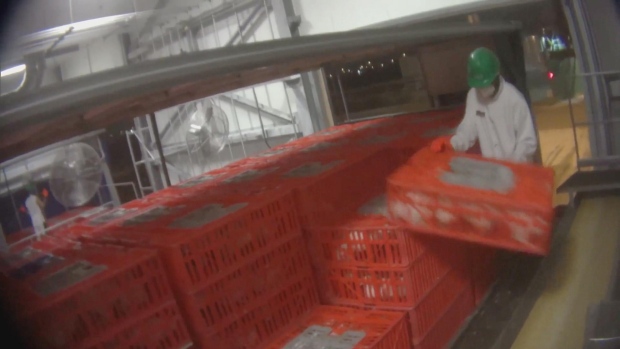
A frozen chicekn is unloaded from a crate.
Once inside the plant, the crates of chickens are unloaded, and placed, sometimes roughly thrown, onto a conveyor belt.

Then they arrive at the beginning of an assembly line.
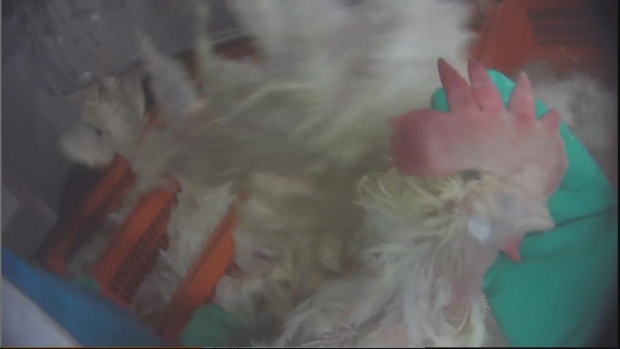
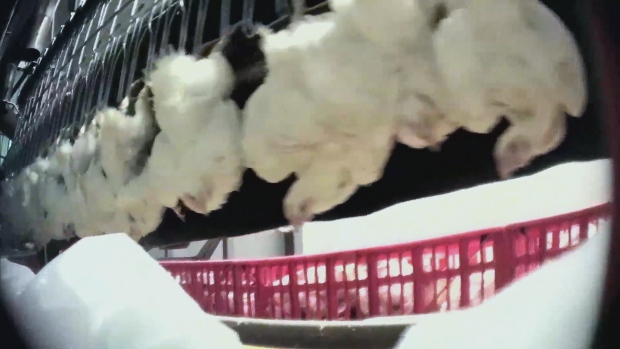
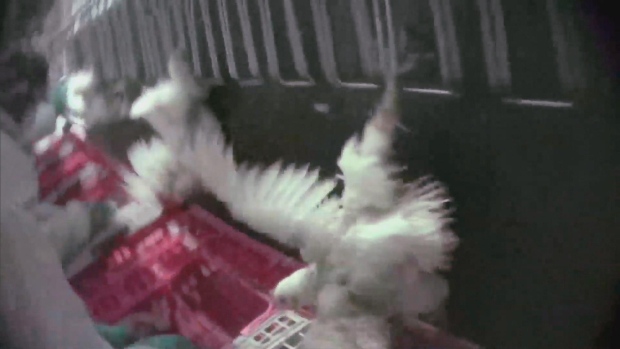
The video shows workers pulling chickens out of the crates and hanging them upside down by the legs. They have to work fast.
“Each employee is expected to hang 20 birds a minute,” John said. “So employees are hanging birds as fast as they can to keep up. So it’s being grabbed pretty violently. Sometimes you’ll see bones protruding out of the skin, you see toes ripped off. It’s pretty horrific.”

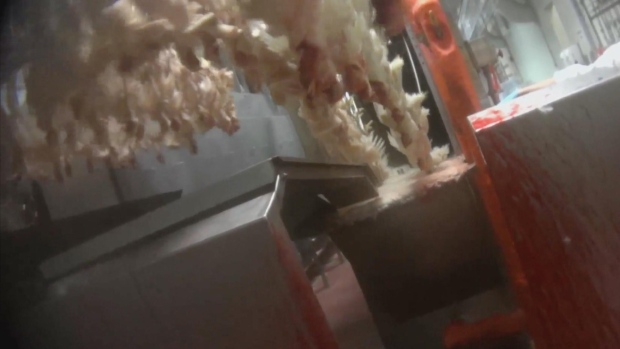
The line carrying the suspended birds then moves quickly through the various stages of the slaughter process.
The heads are pulled through an electrified pool that stuns the animals, and then through a machine that cuts their throats, and finally into scalding tanks that make it easier for another machine to pluck out the feathers.

It isn’t pretty, but it is supposed to be efficient, and humane.
Except the Mercy for Animals Canada investigator said he often saw birds come out of the stunning pool conscious, and because of their flapping and struggles to release themselves, sometimes would miss the blade designed to cut their throats.
There is a provision for that. There are employees positioned with knives so they can manually dispatch the birds that have survived till that point.
“They told me they do a thousand a day, sometimes two thousand,” John told W5.
The technology being used at Maple Lodge Farms is standard in the industry. So the inevitable question, is the company actually doing anything wrong?
Treatment ‘unacceptable’
W5 put the question to one of Canada’s poultry experts who believes that some of the things he saw in the undercover video should not happen.

University of Guelph professor Ian Duncan, right, reviews footage with W5’s Tom Kennedy.
He is Ian Duncan, a professor at the University of Guelph. After looking at video of the way crates were loaded on to the conveyor belt, he said: “That’s unacceptable, throwing them down like that.”
On the physical appearance of some of the birds, he said, “There is a bone sticking through there. Something’s been dislocated. That is very unusual. That shouldn’t happen.”

After looking at some birds hanging by one leg instead of two, he said, “That’s unacceptable. It puts huge pressure on the hip joint and there’s also a danger that when it comes to where the bird is to be stunned, it won’t go into the stunning bath properly and won’t meet the knife that’s going to cut its neck.”
When asked if birds could live through that whole process, he answered bluntly. “Yes. Yes.”
Previous conviction
Maple Lodge Farms has had trouble before. In September of 2013, it was convicted of two offences under the Health of Animals Act and later pleaded guilty to another 18 counts, all related to “…the failure to prevent undue suffering by undue exposure to weather of a large number of chickens.”
Thousands of birds had died while being transported to slaughter at Maple Lodge Farms. A few of the counts related to inadequate ventilation.
In the ruling, the judge commented, “Economic imperatives trumped animal welfare.”
The company was fined nearly $100,000 and put on probation for a period of three years, during which it was expected to comply with numerous conditions.
And now, Mercy for Animals Canada has prepared a complaint that it has forwarded to the federal regulator, the Canadian Food Inspection Agency and the Ontario Society for the Prevention of Cruelty to Animals.
Among the accusations, Mercy for Animals Canada claims:
Responses
W5 exchanged several emails and left phone messages with Michael Burrows, the CEO of Maple Lodge Farms, requesting a meeting to show him the undercover video and to get his comment.
In subsequent correspondence, Mr. Burrows wrote us back to say, “Maple Lodge Farms has stringent policies and practises that govern all aspects of animal care and food safety… The humane treatment of the birds we rely on for our livelihood is a priority and a moral responsibility that we take seriously.”
He also wrote that his company was very disturbed by what W5 had told him and he had launched his own investigation of the allegations made by Mercy for Animals Canada. But he never did agree to an interview.
W5 also telephoned and emailed the federal regulator, the Canadian Food Inspection Agency. On repeated occasions, it said it would call back. It never did.
But 20 days after W5 first contacted them, the regulator did sent an email to say “The CFIA is conducting a thorough and careful review of the complaint and will take any necessary measures that it may deem appropriate.”
It added that it has the power to impose fines, and in the event of serious and repeated offences, “…the CFIA may refer non-compliance for criminal prosecution.”
Mercy for Animals Canada is also pushing for major changes to the aging technology prevalent in the business of poultry slaughter.
Instead of the electrified pools being used to stun the birds and the automated cutter used to slice throats, the animal rights organization is openly urging the adoption of what is called Controlled Atmosphere Killing, or CAK for short.
Video from a plant in Norway shows crates of birds arriving at a CAK facility, placed inside a chamber where inert gases replace oxygen causing all birds to slip into unconsciousness and then death. Only then are they handled by humans.
A major retooling of the industry would inevitably be costly and could drive up the price and therefore, reduce the demand for chicken.

But Duncan suspects the industry will take a hard look at change anyway, especially if the poultry-consuming public begins to take a critical look at how one of their favourite foods actually arrives on their plates.
“If the video showed race horses or some other animal that people valued (being killed this way), there would be a huge outcry,” Duncan said. “Chickens can still suffer.”
Image copyrightGETTY IMAGESA study of chicken bones dug up at London archaeological sites shows how the bird we know today has altered beyond recognition from its ancestors.
With around 23 billion chickens on the planet at any one time, the bird is a symbol of the way we are shaping the environment, say scientists.
Evolution usually takes place over a timescale of millions of years, but the chicken has changed much more rapidly.
The rise of the supermarket chicken mirrors the decline in wild birds.
“The sheer number of chickens is an order of magnitude higher than any other bird species that’s alive today,” said Dr Carys Bennett, a geologist at the University of Leicester, who led the study.
“You could say we are living in the planet of the chickens.”
Image copyrightGETTY IMAGES
Image copyrightGETTY IMAGESThe researchers used the archaeological record to look at how chickens have changed over the years – and say they are a symbol of this geological era.
We are entering the Anthropocene, the period during which human activity has been the dominant influence on climate and the environment.
“Human activities have altered the Earth’s landscapes, the oceans, atmosphere and land surface,” said Dr Bennett.
“As the most numerous terrestrial vertebrate species on the planet, with a biology shaped by humans, modern chickens are a symbol of our changed biosphere.”
She said when future generations examine rocks from our time, they will probably see “tin cans, glass bottles, and bits of material that were once plastic, and amongst that will be bones of chickens”.
Domesticated animals now make up the majority of animal species on land, shaping the natural world.
Rats and pigeons ‘replace iconic species’
The vast scale of life beneath our feet
Hidden fossils enter ‘digital museum’
The domestic chicken is descended from the red jungle fowl, which is native to tropical South East Asia. The bird was first domesticated around 8,000 years ago, and rapidly spread around the world, to be used for meat and eggs.
In the 1950s the “chicken-of-tomorrow programme” was launched to produce bigger birds. Since then, the bird has undergone extraordinary changes.
It has been selectively bred to put on weight fast, which is evident from its body and the chemistry and genetics of its bones.
Meanwhile, roast chicken has gone from being an occasional treat to a global food enterprise.
The research is reported in the journal Royal Society Open Science.
Dead, decomposing animal carcasses that drown and laid in water for days are accepted in North Carolina to be rendered and sold as pet feed ingredients.
One of you wonderful pet owners out there sent me a serious concern. She read a story in the Charlotte Observer that stated “So far 3.4 million chickens and turkeys, and 5,500 hogs are dead in North Carolina from Hurricane Florence wind and floods. The numbers are expected to increase this week.” She was very worried “where all these dead animals will end up.”
Her worry was justified.
Hurricane Florence came ashore on September 14, 2018 according to an ABC News timeline. The next day – September 15, 2018 – “Florence is expected to dump another 14 to 20 inches of rain on southern and central parts of North Carolina into far northeast South Carolina. This will continue to produce “catastrophic flash flooding and prolonged significant river flooding,” the National Weather Service said.”
The “catastrophic” flooding has resulted in the death of at least “5,500 pigs and 3.4 million chickens” according to the North Carolina Department of Agriculture and Consumer Services – published in the Charlotte Observer newspaper September 18, 2018. The animals drowned.


The FDA told me the following (regarding disposal of drowned livestock in North Carolina):
FDA doesn’t “approve” the disposal method in these circumstances. As stated in the mass mortality guidance, “Owners may choose to dispose of their mortality from storms and may do so, but catastrophic loss mortality must be reported to the State Veterinarian and the proposed method of disposal must be approved prior to disposal.” Evaluating and potentially approving a proposed method of disposal would fall under the NC Department of Agriculture/State Veterinarian’s purview.
Questions were sent to North Carolina Department of Agriculture, but the agency did not respond (I understand they are a busy). The North Carolina Department of Agriculture disposal plan for millions of decomposing drowned animals was found on the agency’s website; “Mass Animal Mortality Management Plan for Catastropic Natural Disasters“.
NCDA & CS Mass Animal Mortality Management Plan for Catastrophic Natural Disasters
“Owners of livestock and poultry are responsible for the proper disposal of mortality from natural disasters.”
North Carolina tells the livestock industry that “when flooding is an issue” the primary options to dispose of millions of drown animals are (in order of NC Dept of Ag preference):
Will those decomposing animal carcasses become rendered pet food ingredients? Chances are – they will.
And worse yet – no pet owner will know which pet food will contains rendered decomposing drowned animals from Hurricane Florence.
Decomposing animal tissue in ANY food (human food or animal food) is a direct violation of the Federal Food Drug and Cosmetic Act.
“§342. Adulterated food – A food shall be deemed to be adulterated-
(a) Poisonous, insanitary, etc., ingredients
(3) if it consists in whole or in part of any filthy, putrid, or decomposed substance”
Sad, but true…No one at FDA or North Carolina Department of Agriculture (or any Department of Agriculture) enforces this law.
Pets (have and) will die because no one at FDA or any State Department of Agriculture enforces this law.
Wishing you and your pet(s) the best,
Susan Thixton
Pet Food Safety Advocate
Author Buyer Beware, Co-Author Dinner PAWsible
TruthaboutPetFood.com
Association for Truth in Pet Food

Become a member of our pet food consumer Association. Association for Truth in Pet Food is a a stakeholder organization representing the voice of pet food consumers at AAFCO and with FDA. Your membership helps representatives attend meetings and voice consumer concerns with regulatory authorities. Click Here to learn more.
What’s in Your Pet’s Food?
Is your dog or cat eating risk ingredients? Chinese imports? Petsumer Report tells the ‘rest of the story’ on over 5,000 cat foods, dog foods, and pet treats. 30 Day Satisfaction Guarantee. Click Here to preview Petsumer Report. www.PetsumerReport.com
![]()
About 3.4 million chickens and turkeys and 5,500 hogs have been killed in flooding from Florence as rising North Carolina rivers swamped dozens of farm buildings where the animals were being raised for market, according to state officials.
The N.C. Department of Agriculture issued the livestock mortality totals Tuesday, as major flooding is continuing after the slow-moving storm’s drenching rains. Sixteen North Carolina rivers were at major flood stage Tuesday, with an additional three forecasted to peak by Thursday.
The Department of Environmental Quality said the earthen dam at one hog lagoon in Duplin County had breached, spilling its contents. Another 25 of the pits containing animal feces and urine have either suffered structural damage, had wastewater levels go over their tops from heavy rains or had been swamped by floodwaters. Large mounds of manure are also typically stored at poultry farms.
North Carolina is among the top states in the nation in producing pork and poultry, with about 9 million hogs at any given time and 819 million chickens and 34 million turkeys raised each year.
The N.C. Pork Council, an industry trade group, said the livestock losses from the storm should be taken in the context.
“Our farmers took extraordinary measures in advance of this storm, including moving thousands of animals out of harm’s way as the hurricane approached,” the group said in a statement issued Tuesday. “We believe deeply in our commitment to provide care for our animals amid these incredibly challenging circumstances.”
The industry lost about 2,800 hogs during flooding from Hurricane Matthew in 2016.
Sanderson Farms, a major poultry producer in the state, said it lost about 1.7 million chickens after flooding at more than 60 of the independent farms that supply its poultry processing plants. The company said its facilities suffered no major damage, but supply disruptions and flooded roadways had caused shutdowns at some plants.
In addition, about 30 farms near Lumberton have been isolated by flood waters, hampering the delivery of feed to animals. The lack of food could cause additional birds to die if access isn’t restored quickly, the company said.
Smithfield Foods, the world’s largest pork producer, said its plants also suffered no significant damage and are operating at limited capacity. The company said it would ramp up production as roads become passable.
An environmental threat is also posed by human waste as low-lying municipal sewage plants flood. On Sunday, the Cape Fear Public Utility Authority reported that more than 5 million gallons of partially treated sewage had spilled into the Cape Fear River after power failed at its treatment plant.
The Environmental Protection Agency said Monday that 16 community water treatment facilities in North Carolina are unable to supply drinking water and that seven publicly owned sewage treatment works are non-operational due to the flooding.
Duke Energy is continuing cleanup operations Tuesday following a weekend breach at a coal ash landfill at its L.V. Sutton Power Station near Wilmington.
Duke spokeswoman Paige Sheehan said a full assessment of how much ash escaped from the waterlogged landfill is ongoing. The company initially estimated Saturday that about 2,000 cubic yards (1,530 cubic meters) of ash were displaced, enough to fill about 180 dump trucks.
The coal-fired Sutton plant was retired in 2013 and replaced with a new facility that burns natural gas. The company has been excavating millions of tons of leftover ash from old pits there and removing the waste to a new lined landfill constructed on the property. The gray ash left behind when coal is burned contains toxic heavy metals, including arsenic, lead and mercury.
Photos from the site provided to AP by Cape Fear River Watch, an environmental advocacy group, show cascades of gray-colored water spilling from at least two breaches at the landfill and flowing toward Sutton Lake, the plant’s former cooling pond which is now used for public recreation, including fishing and boating.
Sutton Lake drains into the Cape Fear River. Sheehan said Duke’s assessment is that there was minimal chance any contaminants from the spill had reached the river.
At a different power plant near Goldsboro, three old coal ash dumps capped with soil were inundated by the Neuse River. Duke said they had no indication those dumps at the H.F. Lee Power Plant were leaking ash into the river.
Duke’s handling of ash waste has faced intense scrutiny since a drainage pipe collapsed under a waste pit at an old plant in Eden in 2014, triggering a massive spill that coated 70 miles (110 kilometers) of the Dan River in gray sludge. The utility later agreed to plead guilty to nine Clean Water Act violations and pay $102 million in fines and restitution for illegally discharging pollution from ash dumps at five North Carolina power plants. It plans to close all its ash dumps by 2029.
In South Carolina, workers with electricity provider Santee Cooper erected a temporary dike in hopes of preventing flooding of an old coal ash dump at the demolished Grainger Generating Station near Conway. The dump is adjacent to the Waccamaw River, which is expected to crest at nearly 20 feet (6 meters) this weekend. That’s nine feet above flood stage and would set a new record height.

In September of last year, two executives of JBS, the world’s largest meat producer, based in Brazil, were arrested and charged with insider trading. In May 2017, the billionaire siblings—Wesley Batista, JBS’s CEO, and his younger brother Joesley, the firm’s former chairman—admitted to bribing more than 1,800 politicians and government officials, including meat inspectors, in an effort to avoid food safety checks.
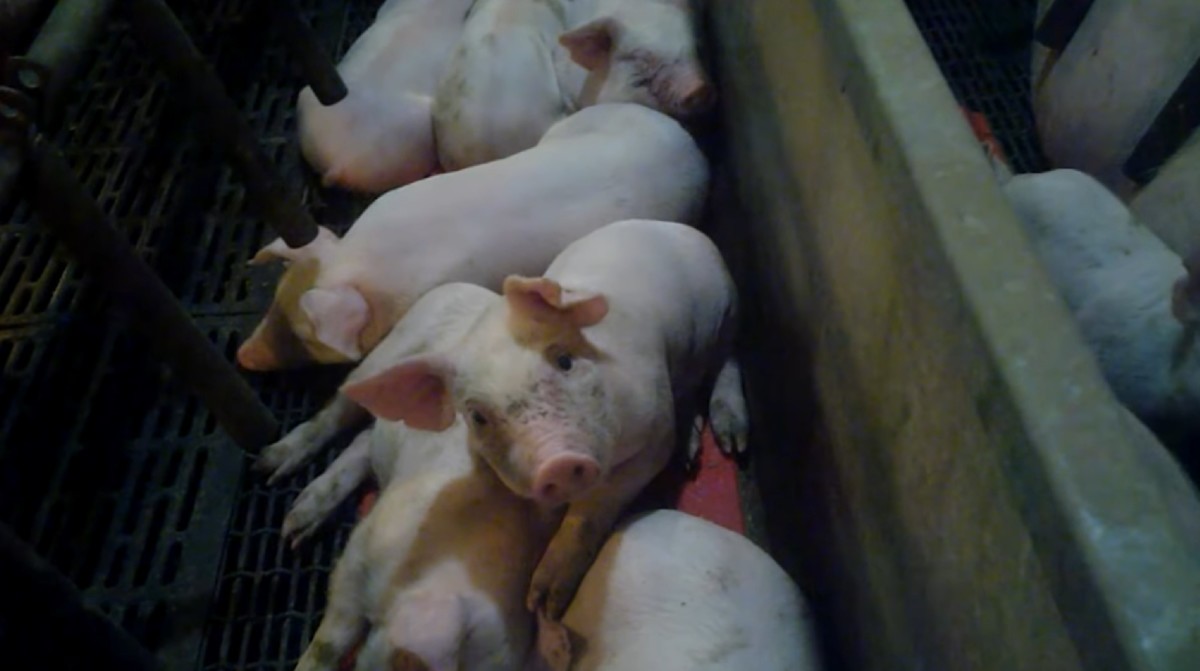
Now, new undercover video shot by a Mercy for Animals (MFA) investigator at Tosh Farms, a JBS pork supplier based in Franklin, Kentucky, exposes what the animal rights group calls the “malicious and systemic abuse of mother pigs and piglets.”
“I’ll never forget the way they looked up at me,” said Tyler, the MFA investigator, about the pigs he documented at Tosh Farms. “They all shared the same look of helplessness and fear.”
“One mother pig stumbled down a corridor with her uterus hanging outside her body. She wouldn’t live much longer,” he said on an MFA website launched specifically to document the JBS investigation, jbstorture.com.
Tyler witnessed workers at Tosh Farms kicking and striking animals in their faces, ripping out the testicles of piglets without any pain relief, and even smashing the heads of piglets against the ground in order to kill them.
Those piglets who did not immediately die were left to suffer, denied proper veterinary care. “A worker grabbed a piglet, just hours old, by the feet and swung him high and then slammed his head down against the hard concrete,” said Tyler. “Any life left quickly vanished.”
“From the day pigs are born until the day they are violently killed for JBS pork, their lives are filled with misery and deprivation,” said Matt Rice, president of MFA, in a press statement. “If JBS executives abused even one dog or cat the way their suppliers abuse millions of pigs, they would be jailed for cruelty to animals. As the largest meat company in the world, JBS has the power and responsibility to end this torture.”
Clare Ellis, publisher of Stone Pier Press, which recently released “Sprig the Rescue Pig,” the first of its Farm Animal Rescue Books for children, was appalled: “Stories like this are even more heartbreaking and upsetting when you consider how very smart, curious, affectionate and sensitive pigs are.” She added that, “Close to 99 percent of animals raised for food come from factory farms, which, in addition to being terribly cruel, do an enormous amount of environmental damage.”
Following the July 17 release of the video, which was taken between December 2017 and March 2018, JBS said it suspended shipments from that supplier site. “The images presented in the video fall completely outside the company’s standards,” JBS said in a statement, but did not name the supplier involved.
But for MFA, suspending shipments from that single supplier isn’t nearly enough. “JBS’s decision to suspend Tosh Farms as a supplier is too little, too late,” Kenny Torrella, director of communications with MFA, told Truthout. “It amounts to nothing more than meaningless PR spin.”
The group, headquartered in Los Angeles, is now calling on JBS to end factory farm cruelty across its global pork supply chains, including the elimination of painful mutilations. In addition, MFA is calling on JBS to prohibit its suppliers from housing sows in tiny gestation crates for nearly their entire lives. These metal cages, the standard of which measures just 6.6 feet x 2 feet—so small that they can’t even turn around or lie down comfortably—are where pregnant sows live in factory farms around the globe for nearly their entire lives. In the United States as of 2016, there were 5.36 million breeding sows, most of them kept in gestation crates.
Confined to tiny gestation crates, mother pigs are not only denied basic natural behaviors like playing, exploring and engaging with their peers and children, but they also must endure immense and prolonged mental and emotional suffering. “These curious animals lose their minds from frustration and stress,” writes Lucas Alvarenga, vice president of MFA in Brazil. “They often also suffer painful pressure sores from rubbing against the bars of their crates and crippling joint problems as their muscles waste away from lack of use.”
While gestation crates are still the norm across the world, things are beginning to change for the better. Canada, the European Union, New Zealand and Australia, as well as 10 US states, have banned cruel gestation crates. Further, more than 60 major food companies—including McDonald’s, Walmart, Burger King and Nestlé—have said they would ban gestation crates from their suppliers.
In addition, California voters will have the opportunity in November to ban the sale of pork from pigs confined in gestation crates. If the measure passes, that will impact Tosh Farms and JBS, as the pigs reared at Tosh are then transported to a JBS slaughterhouse in Louisville, Kentucky, which supplies pork products to stores across California.
The systemic abuse and torture of pigs is an industry-wide problem. Last year, MFA investigators at the Aurora cooperative pig factory farm in the state of Santa Catarina in Brazil, the third-largest meat producer in Brazil and a major pork exporter to the United States, recorded video of pigs and piglets enduring a wide range of cruelty, including, notes Alvarenga, “workers slicing off the tails, cutting holes in the ears and grinding the teeth of piglets without any pain relief.”
Animal rights advocates are quick to point out that pigs—as well as other animals raised for human consumption—are intelligent, have rich emotional lives and possess unique, individual personalities. For some, these are reasons to not eat them. Ellen Page, one of many celebrity vegans who have used their fame to speak out on behalf of animals raised for food, said, “The inhumane factory farming process regards animals and the natural world merely as commodities to be exploited for profit.”
“The animals who are raised to be food for humans are so much more than just burgers and bacon,” said Marc Bekoff, professor emeritus of ecology and evolutionary biology at the University of Colorado, Boulder, and co-author of The Animals’ Agenda: Freedom, Compassion, and Coexistence in the Human Age.
“Pigs, cows, chickens, turkeys and other non-human animals whose flesh is destined to wind up in our mouths were once sentient beings with rich emotional lives,” said Bekoff, who is also the co-founder, with Jane Goodall, of Ethologists for the Ethical Treatment of Animals. “But because consumers rarely interact with them while they are still alive, they don’t see that these animals feel such a wide range of emotions, ranging from joy to sadness to grief, just like we all do.”
Non-human animals aren’t the only victims of the factory farm system. Slaughterhouse workers must witness the nightmarish conditions that the animals must endure. Some workers must do the actual killing, day in and day out.
“The psychological toll this takes on a person cannot be underestimated,” writes Ashitha Nagesh. “Slaughterhouse work has been linked to a variety of disorders, including PTSD and the lesser-known PITS (perpetration-induced traumatic stress). It has also been connected to an increase in crime rates, including higher incidents of domestic abuse.”
“To help move society to a more ethical food system, we as consumers must think less about ‘what’ is on our plate and more about ‘who’ is on our plate,” said Bekoff.
TAKE ACTION: Sign the petition urging JBS to ban gestation crates and painful mutilations.
This article was produced by Earth | Food | Life, a project of the Independent Media Institute.

http://www.wktv.com/content/news/481176611.html
New York state is investing money in nearly three dozen local farms to help them curb carbon emissions and prepare for climate change.
ALBANY, N.Y. (AP) – New York state is investing money in nearly three dozen local farms to help them curb carbon emissions and prepare for climate change.
The office of Democratic Gov. Andrew Cuomo announced Friday that the state will spend $2.2 million on the program, now in its fourth year.
The money will go to 34 farms around the state. The program is intended to fund efforts to make farms more water and energy efficient, and to help them prepare for droughts or severe weather.
Some farms will spend the money on cover crops to prevent erosion and suck up carbon. Others will use the funds for efforts to capture methane from manure.
[…or they could do away with factory farming, but I guess they didn’t think of that–they’re rather shovel b.s.]
April 23, 2018
*Please Join Us For Our Daily Noon Prayer*
“COMPASSION ENCIRCLES THE EARTH FOR ALL BEINGS EVERYWHERE”
And Our Prayer for the Week from Judy Carman
*MAY 4 IS INTERNATIONAL RESPECT FOR CHICKENS DAY; ALL OF MAY IS THEIR
SPECIAL*
*MONTH*. Let’s get ready. This event was introduced by United Poultry
Concerns in
2005 “to celebrate chickens throughout the world and protest the bleakness
of
their lives in farming operations.” UPC suggests many possible actions we
can
take, as well as posters and handouts to order, on the website. This Sikh
story
brings home the truth that chickens are precious individuals who love life
just
as we do. “A man was once given a chicken by his guru and told to go and
kill it
[him or her] where nobody could see. The man tried and tried to find a place
where he could kill the chicken without anybody’s seeing and finally gave
up and
went back to the guru. ‘Why couldn’t you find a place where nobody would
see you
kill the chicken?’ asked the guru. ‘Because everywhere I went, the chicken
saw,’
said the man.” (From *How to Think if You Want to Change the World*, p. 138)
*OUR PRAYER THIS WEEK IS FOR ALL CHICKENS TO BE RESPECTED FOR WHO THEY ARE
AND TO*
*BE LIBERATED FROM HUMAN VIOLENCE AND DOMINATION:* We give thanks for United
Poultry Concerns and all the activists who have worked tirelessly for years
to
show the world that chickens are amazing, courageous, beautiful and loving
beings. We give thanks for all the information we have now to help us
educate
pre-vegans. We ask for blessings of peace for every single individual among
the
billions who are being killed. For while the killing machines grind on, we
know
that each precious chicken has lost friends, children, mothers, and suffered
terrible pain and heartache. We honor and memorialize them all—the fallen.
And
we pray for strength, clarity and inner peace, that we may stand in
solidarity
with them as long as it takes to win their freedom from human violence at
last.
And as our tears fall for them, may we also feel that spiritual joy that
comes
from being awakened to our very real kinship with chickens. What a blessing
it
is to know that they are our friends, not our food. Help us to be love and
to
bring love to all people and all beings. As always, I send my thanks to
each of
you, dear Prayer Circle members, for joining this circle of compassion and
shining the Light of Truth for all to see, so that one day soon, all beings
will
be free.
*May compassion and love reign over all the earth for all beings
everywhere.*
*Thank you all for your devotion to truth, love, liberation and peace for
all*
*beings.*
With Love, peace, and gratitude from Judy Carman, and greetings from Will,
Madeleine, and the Circle of Compassion team.
*PLEASE SHARE* this prayer by going to the Prayer Circle for Animals
Facebook <https://www.facebook.com/groups/prayercircleforanimals/>.
This prayer is posted there. You can also share ideas and prayer requests on
that facebook.
*PLEASE VISIT* the Circle of Compassion website
<http://circleofcompassion.org> for “A prayer a day for animals;”
and the Daily Noon Prayer. To help expand this ministry, donations are
gratefully accepted.
—
United Poultry Concerns is a nonprofit organization that promotes
the compassionate and respectful treatment of domestic fowl.
Don’t just switch from beef to chicken. Go Vegan.
http://www.UPC-online.org/ http://www.twitter.com/upcnews
http://www.facebook.com/UnitedPoultryConcerns
View this article online
<http://upc-online.org/respect/180428_prayer_circle_for_animals_371.html