BRUSSELS — Intensify efforts to fight global warming or start planning a funeral for the Paris Agreement, the United Nations is telling governments ahead of this year’s international climate summit.
Current plans and policies will lead to 2.6 to 3.1 degrees Celsius of global warming this century, with zero chance of limiting the temperature increase to the totemic 1.5C target agreed in Paris in 2015, according to a new report out Thursday.
In fact, existing measures are falling so far short of what’s needed that the world even risks blowing past 2C, the Paris accord’s upper limit, the U.N. warned.
The severity and frequency of dangerous heat waves, destructive storms and other disasters rises with every fraction of warming. At 3C, scientists say, the world could pass several points of no return that would dramatically alter the planet’s climate and increase sea levels, such as due to the collapse of polar ice caps.
“If nations do not implement current commitments then show a massive increase in ambition in the new pledges, followed by rapid delivery, the Paris Agreement target of holding global warming to 1.5C will be dead within a few years and 2C will take its place in the intensive care unit,” said Inger Andersen, the U.N. environment chief.
This year’s iteration of the U.N.’s so-called emissions gap report — assessing the yawning chasm between the policies required to avert climate catastrophe and what countries are actually doing — comes just weeks before world leaders gather in the Azerbaijani capital of Baku for the start of the COP29 climate summit.
There, countries face the task of hammering out a deal on how to finance climate action in the developing world. But the Baku summit is also widely seen as a stepping stone toward COP30 in Brazil next year, the deadline for governments to submit fresh plans on how they plan to meet their Paris Agreement obligations.
In light of the findings published Thursday, Andersen called for “dramatically stronger” plans, known as nationally determined contributions (NDCs); more funding for measures to curb climate change; and leadership from the largest emitters.
Wrong direction
The world is already 1.3C hotter than before the Industrial Revolution, and planet-warming greenhouse gas emissions are continuing to rise, increasing by 1.3 percent last year compared with 2022.
As a result, limiting warming to the relative safety of the Paris targets has become more difficult, requiring even steeper annual emissions cuts of 7.5 percent or 4 percent by 2030 for 1.5C or 2C, respectively.
With the policies currently in place across the globe, the world is heading for 3.1C of warming by the end of the century, the report says. Measures outlined in current NDCs, which haven’t been fully implemented, would bring that down to between 2.6C and 2.8C.
Even the best-case scenario of 2.6C, however, represents “catastrophic” warming with “debilitating impacts to people, planet and economies,” the U.N. warns.
Under all three scenarios, the world’s chances of limiting warming to 1.5C are “virtually zero,” the authors write, with global temperatures “well above” that level by 2050 and a “one-in-three chance that warming already exceeds 2C by then.”
To get on track toward 1.5C, global emissions ought to fall 42 percent by 2030, or 28 percent for a pathway to 2C — a message also included in last year’s report, aptly titled “Broken Record.”
The new NDCs — due in February 2025 — are meant to include measures and targets up to 2035. By then, global emissions should fall 57 percent for 1.5C and 37 percent for 2C, according to this year’s report, dubbed “No More Hot Air … Please!”
Andersen said that worldwide, measures to reduce emissions will require a “minimum six-fold increase” in investment, “backed by reform of the global financial architecture and strong private sector action.”
Developing countries excluding China require a massive surge in investment, the report says, as “these regions are already struggling with public health, human capital, food and energy security, rising debt and political tensions, all of which are exacerbated by climate change.”
Whether current NDCs limit the rise in global temperatures to 2.6C or 2.8C depends on funding. The lower figure would be reached under so-called conditional NDCs, meaning plans contingent on additional financial aid. Twelve percent of all NDCs are fully conditional, according to the report, with another 21 percent featuring conditional elements.
How to fund climate action in developing countries will dominate discussions in Baku. By the end of COP29, countries are meant to agree on a new long-term financial goal to replace the current $100 billion-a-year target, which was agreed in 2009 and only reached in 2022.
Countries classified as industrialized in the 1990s provide the funding. But given the enormous funding needs — some developing countries would like to see an annual target of more than $1 trillion — as well as dramatic changes in countries’ comparative wealth and emissions since then, rich countries would like emerging economies such as China to chip in.
G20 gotta take the lead
Case in point: The U.N. report shows that Beijing has drawn level with the European Union in terms of historical responsibility — both the bloc of 27 and China are responsible for 12 percent of all carbon dioxide emitted between 1850 and 2022. (The United States remains far ahead of both, accounting for 20 percent of historical emissions.)
Advertisement
Advertisement
In general, the G20 — which comprises industrialized countries such as the EU and U.S. as well as Brazil, China, India, Indonesia and Saudi Arabia — were responsible for 77 percent of global greenhouse gas emissions in 2023.
In stark contrast, all 55 African Union countries accounted for just 6 percent.
“The largest-emitting members” of the G20 “will need to dramatically increase action and ambition now and in the new pledges,” the U.N. writes.
After all, while the entire G20 accounted for 77 percent of last year’s global emissions, the largest six polluters among them were responsible for more than 60 percent. The U.N. report doesn’t name and shame, but authors are referring to China (30 percent), the United States (11 percent), India (8 percent), the EU (6 percent), Russia (5 percent) and Brazil (2 percent).
Progress among the G20 is a mixed bag: China’s emissions grew 5.2 percent in 2023, while the EU’s fell 7.5 percent; and while China is much more populous, its per-capita emissions in 2023 were 11 tons to the EU’s 7.3 tons.
U.S. emissions fell by 1.4 percent, but American per-capita emissions remain the second-highest at 18 tons after Russia’s 19 tons. India’s are just 2.9 tons — even though its emissions rose by 6 percent last year.
And while the EU, for example, is assessed as on track to reach its climate targets, many other G20 countries are not.
Show don’t tell
Most importantly, the U.N. says, world leaders need to deliver on their promises.
While current measures and NDCs all see the planet blowing past 1.5C, there is one path that gets closer to the goal: If countries deliver on all the promises they made on top of official NDCs in recent years, warming would be limited to 1.9C this century — making good on the Paris Agreement’s “below 2C” pledge, at least.
It’s also the only path among the four that would see warming plateau around 2100; under the other three scenarios, temperatures would continue to rise in the next century.
U.N. environment chief Andersen called on countries to turn rhetoric into action. Governments should enshrine their most ambitious pledges — and, ideally, more — in their upcoming NDCs, she said.
“I urge every nation: no more hot air, please,” she said, echoing the report’s title. “Use COP29 in Baku, Azerbaijan to increase action now, set the stage for dramatically stronger NDCs, and then go all-out to get on the 1.5C pathway by 2030.”
Júlia Vadler and Giovanna Coi contributed to this report.
SINGAPORE (Reuters) – Even greater efforts to strip carbon dioxide from the atmosphere will fail to avert climate change catastrophe as rising global temperatures threaten to cross a key threshold of 1.5 degrees Celsius (2.7 degrees Fahrenheit), scientists said on Wednesday.
The Intergovernmental Panel on Climate Change (IPCC) has said carbon dioxide removal (CDR) could help slow warming by reducing greenhouse gas already accumulated in the atmosphere, and even temperatures, especially if 1.5 C is exceeded.
However, even if removing carbon dioxide works, it can do nothing to mitigate other aspects of climate change, from sea level rises to changes in ocean circulation, scientists said in research published in the journal Nature on Wednesday.
“Even if you’ve brought temperatures back down again, the world we will be looking at will not be the same,” said Carl-Friedrich Schleussner of Austria’s International Institute of Applied Systems Analysis, one of the paper’s authors.
CDR refers to a range of techniques that extract and store away CO2 already in the atmosphere, including natural solutions such as forests and ocean algae, as well as new technologies that filter carbon dioxide from the air.
Existing CDR capacity takes about 2 billion metric tons of CO2 out of the atmosphere every year, but that figure must rise to about 7 billion to 9 billion tons to meet the world’s climate goals, a separate research report said in June.
Yet there are limits to how much new forest can be planted and how much CO2 can be permanently sequestered, while current technologies are expensive, said Joeri Rogelj of Imperial College London, another co-author of the paper in Nature.
“If we are starting to use land exclusively for carbon management, this can strongly conflict with the other important roles of land, be it biodiversity (or) food production,” he told a briefing.
Even the most optimistic emissions reduction scenario in the IPCC’s latest assessment report, published last year, factored in the possibility of a small overshoot of 0.1 C.
Reversing that would require the removal of about 220 billion tons of CO2, while an overshoot of 0.5 C – also consistent with the IPCC’s best-case scenario – would need more than a trillion tons removed, Rogelj said.
“The risks the world exposes itself to (from) an overshoot are much larger than acknowledged,” he said.
“Only through ambitious emissions reductions in the near term can we effectively reduce the risks from climate change.”
In the Florida Keys, one of the state’s most beloved animals also took a beating: the Key deer, a small subspecies of white-tailed deer that evolved in peaceful isolation on the islands and is now protected under the Endangered Species Act. Irma drowned them, slammed them into buildings and dragged them out to sea. “With Irma, we probably lost about 30% of the deer,” said Nova Silvy, a zoologist who has studied the deer since the 1960s on Big Pine Key, where most of them live.
Though the deer population has largely bounced back, the hurricane’s toll foreshadowed the dangerous future faced by this animal. In the coming century, the impacts of the climate crisis, especially sea level rise, will probably inundate many of the Florida Keys, including the endangered deer’s core habitat on Big Pine Key and neighboring islands.
Despite this bleak outlook, the US Fish and Wildlife Service (FWS), which administers the Endangered Species Act, has been working on proposals in recent years that would strip the Key deer of its endangered species status – even as the agency’s own scientists have highlighted the threat of rising sea levels to the deer’s habitat, according to records obtained by the Guardian and Type Investigations.
These efforts began under the Trump administration, which oversaw a concerted effort to remove protections for imperiled species, and they have outraged conservationists as well as some former FWS officials, who have opposed the agency’s attempt to remove protections for the Key deer.
Advertisement
“There are things happening [to the Key deer] down there that would raise flags for any animal,” said Tom Wilmers, a retired FWS biologist who spent years working with the Key deer. “And yet the agency is in denial. I just don’t understand how delisting or downlisting that animal helps anybody.”
More broadly, however, the plight of the Key deer is a window into the Fish and Wildlife Service’s broader failure to adequately protect endangered species threatened by the climate crisis. Most notably, an obscure but consequential legal memo from 2008, signed by top interior department officials at the end of the George W Bush administration, effectively absolves the FWS and other federal agencies that decline to regulate greenhouse gas pollution that harms endangered and threatened animals under the Endangered Species Act. As the law’s leading enforcer, FWS’s inaction is especially consequential.
“We are putting out ten gigatons of carbon emissions per year, plus or minus, and those emissions are causing the planet to warm. And we know as the planet warms a lot of things are happening, from extreme weather events to waterways being ice-free for longer,” said Stuart Pimm, a professor of conservation at Duke University. “They may not be quite as direct as someone going out with a shotgun and killing a bald eagle, but they are every bit as potent a factor in causing species extinctions.”
Presidential administrations have legal latitude to rescind the memo, but neither the Obama nor Trump administrations did so. Now, a group of scientists and conservationists, including Pimm, are calling on the Biden administration to take action by empowering the FWS to better protect imperiled species – not just Key deer, but polar bears, sea turtles and more – from the climate emergency. Until the White House does so, they say, the Endangered Species Act will remain hobbled when it comes to tackling one of the biggest threats that endangered species face.
The Key deer was supposed to be a conservation success story. By the mid-20th century the subspecies had been hunted to near extinction, leaving only a few dozen deer left, when the federal government established a wildlife refuge around Big Pine Key and listed the animal under the Endangered Species Act. From there the little deer made a comeback, and according to surveys conducted in 2020, they now number about 750 individuals or more.
On a windy spring day on Big Pine Key, Chris Bergh, a scientist and the south Florida program manager for the Nature Conservancy, points to the desiccated grey remains of several dead trees. Bergh has studied the impact of sea level rise on the Florida Keys ecosystem for more than 15 years. The pines that once stood here, he said, have retreated as rising ocean water slowly shrinks the precious freshwater pools that sustain the island’s wildlife.
Florida Key deer. Photograph: Papilio/Alamy
Indeed, even before the rising ocean fully drowns the Key deer’s home range, salt water contamination will ruin their drinking holes. Whether in 50 years or 100, the deer’s island habitat is probably doomed – so it would seem the deer are more in need than ever of the federal protections granted under the Endangered Species Act.
But the FWS has taken a different view. On 13 August 2019, its southeast regional director, Leo Miranda, drafted a memo to the agency’s top official at the time, “proposing to delist the Florida Key deer”.
“This determination,” he wrote, “is based on the best available scientific and commercial information, which indicates that the threats to this species have been eliminated or reduced to the point that the species no longer meets the definition of an endangered or threatened species.” He justified his proposal by citing the deer’s high population numbers and arguing that “there are uncertainties regarding what effects changes in sea-level will have on Florida Key deer habitat … before inundation” from rising waters.
A year earlier, though, FWS’s own scientists were already warning that sea level rise could imperil the deer’s habitat. In a draft research paper obtained by the Guardian and Type Investigations, the scientists drew on a range of existing research, including studies conducted by other federal agencies, to conclude that Key West could see between three and nine feet of sea level rise by 2100. In one set of scenarios modeled in that research, low-lying areas in south Florida like Big Pine Key would be mostly inundated between 2060 and 2080. That degree of sea level rise would wipe out the deer’s core habitat.
“The Florida Keys are going underwater due to sea level rise (SLR),” the paper’s authors wrote in an early version of the paper. “All SLR scenarios agree and depict this to happen.” The paper featured an image of what Big Pine Key could look like in the future: a tiny spit of land and a few squat mangrove trees standing above rising waters.
The draft research paper was circulated among agency staff, including Miranda, as early as August 2018. Nevertheless, FWS proceeded with its effort to remove the deer from the endangered species list until late summer 2019, according to documents obtained by Type Investigations and the Guardian through a public records request.
“I don’t know why they would do that – start writing a delisting rule at a point in time where you have the agency staff raising concerns,” said Karimah Schoenhut, a Sierra Club attorney who works on Key deer issues. “Agency scientists were pointing out sea level rise issues, saying there is no way you can delist species.”
An endangered Key deer among the debris after Hurricane Irma, in Big Pine Key. Photograph: Carlo Allegri/Reuters
Eventually, FWS backed away from the delisting plan, after the US Geological Survey found in a report that FWS had failed to take into account research that “would suggest an even greater risk to Key deer and its habitat than included in” FWS’s assessment of the deer’s status. But the agency didn’t entirely give up. Instead, it began planning to downlist the deer from “endangered” to “threatened”, a lesser classification that would not offer as much protection for the imperiled species. Internal communications obtained by the Guardian and Type Investigations show this plan remained a priority for top Trump administration officials at the interior department, but they failed to get the job done before Biden took over.
Last summer, the FWS’s scientific integrity officer concluded that the agency’s official assessment on which it based its downlisting plans did not use the “best available scientific information” and suggested that it should “not be used for decision-making”. As of January 2022, FWS was back at the drawing board, having initiated a new assessment of the Key deer’s status the previous summer, according to a statement the agency sent to the Guardian and Type Investigations. The animal’s future status as an endangered species remains up in the air.
Even if the Key deer does retain some federal protection, however, the FWS’s responsibility to protect animals from rising sea levels remains significantly curtailed – thanks in part to a legal memo issued during the final months of the George W Bush administration.
Observers say the Endangered Species Act could be a powerful tool in the fight against climate change. Under section 7, FWS has the authority to review projects undertaken, funded, or permitted by the federal government if they are likely to harm a protected species. If such projects jeopardize the survival of the species, the agency can force changes or prohibit them altogether. Environmental groups say this gives the FWS leverage to curtail fossil fuel projects or other programs whose emissions contribute to the climate crisis and threaten endangered animals.
In 2008, however, David Bernhardt, the interior department’s top lawyer at the time, signed an internal memo that effectively absolved FWS of responsibility under section 7 to regulate the climate change impacts of greenhouse gas emissions.
The memo stated that: “Where the effects at issue result from climate change potentially induced by [greenhouse gases], a proposed action … is not subject to consultation under the Esa and its implementing regulations.”
The Bernhardt memo now stands as an obstacle to climate action at FWS. It has allowed agencies including the FWS to avoid making tough decisions on greenhouse gas emissions for more than a decade, undermining the government’s ability to control fossil fuel pollution and protect the Key deer, polar bears, shorebirds, sea turtles and other species that face existential danger from melting sea ice, rising temperatures and disappearing habitats. In 2020, for instance, the Trump administration relied in part on the Bernhardt memo to avoid an endangered species consultation on its decision to scrap the Obama-era vehicle emissions standards. (Bernhardt served as interior secretary in the Trump administration.)
Environmental groups hope Biden will change course. In February 2021, a group of top researchers, scientists and academics, including Pimm, wrote Biden asking him to rescind the Bernhardt memo. They urged the agency to more fully consider greenhouse gas pollution as a threat to species protected by the Endangered Species Act. That would mean the climate danger to listed animals like the Key deer could provide a legal basis to apply the Esa in a new way to federally sanctioned fossil fuel projects – this in turn could lead to reform, including to the interior department’s vast oil and gas leasing programs. Fossil fuel production on public lands is the ultimate source of roughly a quarter of all greenhouse gas emissions in the United States.
“Climate change is the consummate challenge of our time,” said Dr Steven Amstrup, a signatory on the conservationists’ letter to Biden and chief scientist for Polar Bears International. “The US Fish and Wildlife Service should rescind the Bernhardt memo and, as the Esa requires, start addressing the existential threat greenhouse gas pollution poses to plant and animal species across all habitats.”
In response to questions about its continued use of the memo, the FWS said that “the current state of the science is such that we cannot currently establish a causal connection to tie a particular [greenhouse gas]-emitting project to measurable consequences to specific species or critical habitats”.
Amstrup disputes that rationale. He argues that in some cases, in fact, it is possible to measure the climate impact of specific fossil fuel projects on imperiled species – such as the sea level rise that threatens Key deer, or the declining sea ice that strands polar bears – by analyzing accumulated CO2 concentrations.
The interior department, meanwhile, told the Guardian and Type Investigations that it recognizes “an obligation to consider whether our actions contribute to the climate crisis, including the impacts to threatened and endangered species and their habitats.” It did not say whether it plans to rescind the Bernhardt memo.
“I don’t think the Esa by itself is going to solve the climate crisis,” said Brett Hartl, the government affairs director at the Center for Biological Diversity. But, he added, doing away with the memo “could help support efforts to move [federal agencies] to a much better place”.
Bernhardt, for his part, harshly criticized the letter conservationists sent to Biden.
“Some of the signatories to this letter like former DOI Solicitor John Leshy and former USGS employee Steven Amstrup are longtime activists, who continue to demand unworkable policies, which are not well grounded in the science or the law,” he wrote in a statement. “If successful their efforts will create additional chaos in the Esa interagency consultation process. As a result, I look forward to seeing whether the Biden administration will bend to their will on withdrawing legal opinion when the Obama administration did not.”
Leshy, in response to a request for comment on Bernhardt’s statement, said, “Scientific understanding as well as public consciousness of the close links between climate change and the earth’s rich biodiversity have advanced a great deal since then-Solicitor Bernhardt wrote his opinion in 2008. I expect the Biden administration will take a careful look at the issue his opinion addresses, as it should.”
On Big Pine Key, meanwhile, Nova Silvy continues to observe the Key deer as he has done for more than half a century – watching them rebound from near extinction to become a popular draw for tourists. He even has names for some of them – like Alba, a little doe with white legs. But he thinks the climate crisis is their biggest test yet.
“Unless we can turn it around, I think we are going to be in deep trouble with these deer,” he said. “I mean, I won’t see it – but my daughter may.”
This story was produced in partnership with Type Investigations and supported by the Alicia Patterson Foundation.
If politicians are serious about change, they need to incentivise it, say scientists and writers
Research in 2018 showed that without meat and dairy consumption, global farmland use could be reduced by more than 75% – an area equivalent to the US, China, the EU and Australia combined – and still feed the world. Photograph: DBPITT/Getty Images/iStockphoto
The UK business secretary, Kwasi Kwarteng, is considering a “full vegan diet” to help tackle climate change, saying people will need to make lifestyle changes if the government is to meet its new emissions target of a 78% reduction on 1990 levels by 2035.
But how much difference would it make if everyone turned to a plant-based diet? Experts say changing the way we eat is necessary for the future of the planet but that government policy is needed alongside this. If politicians are serious about wanting dietary changes, they also need to incentivise it, scientists and writers add.
“Probably the most important thing to point out is that emissions are often viewed as the only metric of sustainability: they are not. Impacts of farming systems on carbon sequestration, soil acidification, water quality, and broader ecosystem services also need to be well considered,” said Matthew Harrison, systems modelling team leader at the Tasmanian Institute of Agriculture.
“There is also a need to account for farming systems that may replace livestock,” he said.
The writer and environmental campaigner George Monbiot says the numbers on the impact of going vegan are different because of what scientists measure. “There are two completely different ways look at the carbon impact of diet: one is carbon released by producing this or that food – that is ‘carbon current account’. But another one is ‘carbon capital account’, which is the carbon opportunity cost of producing this food rather than another one,” he said.
“If you are producing meat, for example, what might land be used for if you took meat away? If you are growing forests there instead or peat bog there.”
Monbiot says what we eat is a “huge issue”, alongside our transport habits. “Most of what you can do at an individual level is weak by comparison to what governments need to do … but changing diet does not. That has a major impact,” he said.
“It is easier done if the government acts to change the food system but in the absence of that, we should still try and change our diets.”
In 2018, scientists behind the most comprehensive analysis to date of the damage of farming to the planet found avoiding meat and dairy products was the single biggest way to reduce your environmental impact on the planet. The research show0ed that without meat and dairy consumption, global farmland use could be reduced by more than 75% – an area equivalent to the US, China, European Union and Australia combined – and still feed the world.
“There are lots of different sectors that have an impact on emissions and the food system is surely one of the most important ones as it is globally responsible for about a third of all greenhouse gas emissions,” said Dr Marco Springmann, senior researcher on environmental sustainability and public health at the University of Oxford.
He added that the overwhelming majority of emissions were due to foods such as beef and dairy, which “means that without changing emissions associated with those products it is hard to make progress”. He said there were no good technical solutions for the fact that “cows emit methane emissions”.
“You can change feed composition but that does not change the animal and the need to feed the animal a lot of feed product,” he said. He believes the government needs to offer price incentives for sustainable products, making beef and dairy more expensive.
Frank Mitloehner, professor and air quality extension specialist at the University of California and Davis, said putting the onus on the individual was a distraction from policy changes that are needed. He said literature suggests “going vegan for two years has the same saving impact as one flight Europe to the US would generate.”
“If we really want to make a difference in carbon emissions we need to change policy. We need to have a cost for carbon that is appropriate. We need to incentivise those who can reduce greenhouse gas emissions to do so,” he said.
He believes the most important individual choice someone can make is to “go and vote … That is number one.”
Martin Heller, a research specialist at the University of Michigan, said: “There are no silver bullets for climate change. Nothing in isolation will be ‘enough’.”
He added that studies showed that even with gracious assumptions in improvements in agricultural production, feeding an anticipated population at anticipated growing demand for animal-based foods by 2050 would occupy “all of the allowable emissions if we are to stay below a 2C temperature rise”.
“We have to change the way we eat,” he said. “That certainly isn’t saying that diet change – or even becoming vegan – will ‘save the planet’. It’s more of a necessary but not sufficient kind of thing.” He added that “these diet shifts need to come with government, corporate and every other kind of action”.
“It’s also probably naive to assume that people will just change these behaviours because it’s good for the planet. It will require directed policy, changes in the restaurant and foodservice industries,” he said.
PUBLISHED THU, APR 22 20216:00 AM EDTUPDATED AN HOUR AGOEmma Newburger@EMMA_NEWBURGERSHAREShare Article via FacebookShare Article via TwitterShare Article via LinkedInShare Article via EmailKEY POINTS
President Biden is pledging to reduce U.S. greenhouse gas emissions by at least 50% by 2030, in the latest push by the administration to aggressively combat climate change.
The target more than doubles the country’s prior commitment under the 2015 Paris climate agreement.
The announcement comes before the president hosts a closely watched climate summit on Thursday’s Earth Day, with world leaders from countries like China and India.
President Joe Biden is pledging to reduce U.S. greenhouse gas emissions by 50% to 52% by 2030, in the latest push by the administration to aggressively combat climate change.
The target, announced Thursday, more than doubles the country’s prior commitment under the 2015 Paris climate agreement, when the Obama administration set out to cut emissions 26% to 28% below 2005 levels by 2025. The U.S. is currently not yet halfway to meeting that goal.
Biden’s pledge on Earth Day is in line with what environmental groups and hundreds of executives at major companies have pushed for. The president announce the target at the closely watched global leaders’ climate summit on Thursday, during which he hopes to urge global cooperation to address the climate crisis.
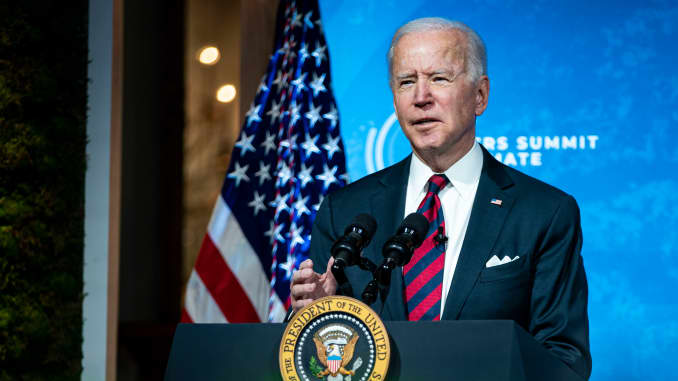
“This is the decisive decade,” Biden said at the summit on Thursday morning. “This is the decade that we must make decisions to avoid the worst consequences of the climate crisis.”
“This is a moral imperative. An economic imperative. A moment of peril, but also a moment of extraordinary possibilities,” the president said.
World leaders appear on screen during a virtual Climate Summit, seen from the East Room at the White House in Washington, U.S., April 22, 2021.Tom Brenner | Reuters
All 40 world leaders the president invited to the virtual summit will be attending, including those from China and India, and are anticipated to make new commitments. The U.K. and European Union have committed to slash emissions by 68% and 55%, respectively, by 2030. China, the world’s biggest emitter, has vowed to reach peak emissions by 2030 and be carbon neutral by 2060.
During the summit, Chinese President Xi Jinping repeated the country’s previous commitments and emphasized green development and multilateralism to reduce global emissions.
Indian Prime Minister Narendra Modi called for concrete action on climate change and announced an India-U.S. Climate and Clean Energy Agenda Partnership for 2030. He also re-confirmed the nation’s vow to install 450 gigawatts of renewable energy by 2030.
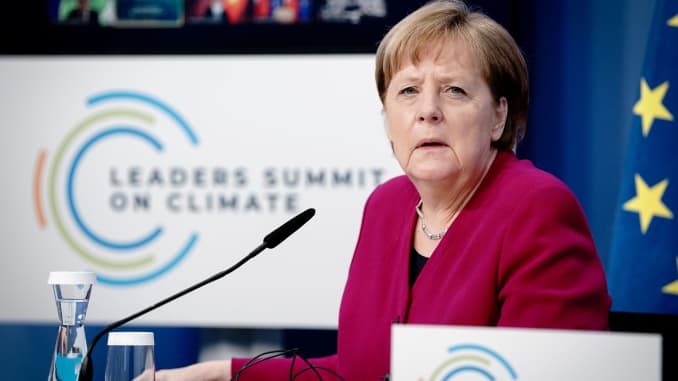
German Chancellor Angela Merkel attends a virtual Climate Summit with world leaders in Berlin, Germany, April 22, 2021.Kay Nietfeld | Reuters
Japan’s prime minister Yoshihide Suga announced a stricter emissions target of 46% reduction by 2030. Canada also updated its target and vowed to reduce 2005 emission levels by 40-45% by 2030.
The summit is a chance for the U.S. to rejoin global efforts on climate after then-President Donald Trump pulled out of the Paris accord, halted all federal efforts to reduce domestic emissions and rolled back more than 100 environmental regulations to favor fossil fuel production.
“I’m delighted to see that the United States is back, is back to work together with us in climate politics,” German Chancellor Angela Merkel said during the summit.
President Joe Biden delivers remarks during a virtual Leaders Summit on Climate with 40 world leaders at the East Room of the White House on April 22, 2021.Al Drago | Getty Images
British Prime Minister Boris Johnson, who this week announced that Britain would slash emissions by 78% by 2035, praised Biden “for returning the United States to the front rank of the fight against climate change.”
“It’s vital for all of us to show that this is not all about some expensive politically correct, green act of bunny hugging,” Johnson said. “This is about growth and jobs.”
Biden’s pledge also moves forward his campaign promise to decarbonize the country’s energy sector by 2030 and put the country on a path to net-zero emissions by midcentury.WATCH NOWVIDEO01:25Biden commits to 50% greenhouse gas reduction levels by 2030
Biden so far has proposed a $2 trillion infrastructure package that would aid a transition away from fossil fuels and toward clean energy, while promising to create green jobs. If passed, the legislation would be one of the largest federal efforts ever to reduce emissions.
“A strong national emissions reduction target is just what we need to catalyze a net-zero emissions future and build back a more equitable and inclusive economy,” Anne Kelly, vice president of government relations at sustainability nonprofit Ceres, said in a statement.
In order to achieve a net-zero economy by 2050, the U.S. must curb emissions by 57% to 63% in the next decade, according to an analysis by Climate Action Tracker, an independent group that analyzes various government climate pledges.
This week’s summit also comes ahead of a major U.N. climate conference in Glasgow, Scotland, in November, during which nations in the Paris agreement will unveil updated emissions targets for the next decade.
Still more than 2 months left in Labrador hunting season
CBC News · Posted: Apr 14, 2021 6:00 AM NT | Last Updated: 9 hours ago
This photo of a polar bear was taken just outside of Seal Islands, Labrador, by Nicholas Morris in 2018. (Submitted by Tristen Russell)
Only five of 12 licences to harvest polar bears have been filled on the north coast of Labrador, and the Nunatsiavut government says weather and climate explain this year’s drop.
Each year, licences to kill polar bears are allotted to Inuit hunters on Labrador’s north coast via random selection.
For the past two years, the Newfoundland and Labrador government has allowed 12 licences to be handed out.
In 2020, 11 of those licences were filled before the June 30 deadline.
So far this season, only five animals have been killed.
The troubles with this year’s sluggish hunt are just one detail among many about what’s emerging to be an existential issue for Labrador’s Inuit, who rely on sea ice for food, resources and survival.
“The ice conditions, the way they are now, it’s getting kind of difficult for people to get around,” said Todd Broomfield, the Nunatsiavut government’s director of renewal resources.
“When it’s difficult getting around, you can’t normally get to your places where you would hunt polar bear, so that’s having an impact this year.”
Of the five polar bears killed, three were taken from Nain hunters and one each from Hopedale and Makkovik. The licences allotted to Rigolet and Postville have not yet been filled.
According to Broomfield, the bears visit the islands peppered along Labrador’s north coast. However, a winter that has seen far less sea ice means travelling to the bears is difficult.
Shrinking sea ice in northern Labrador
22 days ago1:00Nunatsiavut residents describe the thinning sea ice, and the toll it’s taking in their communities 1:00
“It impacts your ability to get out to the outside islands where you would normally expect to see polar bear[s],” Broomfield said.
The hunt officially began in the mid-1980s with a quota of six bears for the area. In 2011 that was increased to 12 bears from the Davis Strait subpopulation, one that is said to have a population of up to 2,500 bears.
On January 13, one week before the inauguration of Joe Biden as the forty-sixth president of the United States and seven long days after the storming of the Capitol by an armed right-wing mob, it was easy enough to miss an article published in the journal Frontiers in Conservation Science, despite its eye-catching title: “Underestimating the Challenges of Avoiding a Ghastly Future.” The headline was itself a train wreck: six dully innocuous words piling up in front of a modifier more suitable to a 1950s horror comic than a sober, academic journal. But there it was: The 17 scientists who co-wrote the article, the experts who peer-reviewed it, and the journal’s editors did not consider the word “ghastly” too sensational, subjective, or value-laden to describe the future toward which our society is advancing with all the prudence and caution of a runaway locomotive. The article’s message was simple: Everything must change.
On its current track, the authors wrote, “humanity is causing a rapid loss of biodiversity and, with it, Earth’s ability to support complex life.” As many as a million animal species—and 20 percent of all species—are facing near-term extinction. Humans have altered 70 percent of the planet’s land surface and “compromised” or otherwise despoiled two-thirds of its oceans, and the climate has only begun to warm. Humanity—or some of us, anyway—“is running an ecological Ponzi scheme in which society”—or some sectors of it—“robs nature and future generations to pay for boosting incomes in the short term.” Only a radical transformation of the systems that govern our relations to one another and to the myriad forms of life with which we share the planet, the authors concurred, could deliver any hope of a “less-ravaged future.”
One week later, Joe Biden took the oath of office and quickly signed sweeping executiveorders declaring it the explicit policy of his administration “to listen to the science.” He didn’t use the word “ghastly,” but he did mention “a cry for survival … from the planet itself,” one that “can’t be any more desperate or any more clear.” This was strangely comforting to hear. He rejoined the Paris accord, revoked a slew of Trump-era executive orders, and restored, albeit temporarily, the moratorium on drilling in the Arctic that President Barack Obama had issued on his way out the door. However slow Biden had been to catch on to the true magnitude of the climate crisis during the primaries, he had, after months of sustained movement pressure, apparently begun to come around.Get independent, fact-based journalism: 3 months for $5Subscribe
To his credit, in his first week in office, Biden went further than any of his predecessors ever had. He ordered a “pause” on all new permits and leases for oil and gas drilling offshore and on federal land and shut down the Keystone XL oil pipeline, which activists had been fighting for more than a decade. He ordered federal agencies to pursue a “carbon pollution–free electricity sector no later than 2035,” and the full conversion of all government fleets to zero-emissions vehicles.
Perhaps most significantly, Biden’s actions aimed to institutionalize the mitigation of climate change as a priority in the daily workings of the federal bureaucracy. He ordered the creation of an Office of Domestic Climate Policy, a national climate adviser, a special presidential envoy for climate, and, in an explicit echo of the New Deal program—though green only with a lowercase g—a Civilian Climate Corps. He directed federal agencies to “implement a Government-wide approach that reduces climate pollution in every sector of the economy,” to center climate in foreign policy decisions, to eliminate fossil fuel subsidies, and to “promote ending international financing” of fossil fuels. There was even, in the very first section of his first climate order, a mandate for environmental justice and the protection of communities of color that had been disproportionately harmed by polluters. Whether that would mean any real inclusion—“If you’re not at the table, you’re on the menu,” as one South Carolina environmental justice activist put it to me—remains an open question. But as a signal of his administration’s priorities and its sense of urgency, it was, all the climate activists I spoke to agreed, an extremely solid start.https://3e2ce429ad8218c24d438728d948328a.safeframe.googlesyndication.com/safeframe/1-0-37/html/container.html
There was of course also a good deal of typical Democratic half-stepping. Why a “pause” on drilling and not an outright ban? (And why had the administration quietly gone ahead and approved 31 new drilling permits anyway?) Why no mention of fracking? Why not just shut down all the oil and gas pipelines that “[disserve] the U.S. national interest,” as the executive order put it, in exactly the same ways that Keystone XL did? And why not immediately declare a climate emergency, which would have opened up executive powers that would enable him to evade many of the roadblocks erected by the 50 Republicans in the Senate? Even Senate Majority Leader Chuck Schumer, no one’s idea of a radical, was urging Biden to do so. “If there ever was an emergency,” Schumer said, “the climate crisis is one.”
Still, with these and more caveats and endless sound reasons for mistrust, after four long years of Trump’s out-and-out denialist, kleptocratic mayhem, the sheer momentum of Biden’s actions did feel pretty good. At least it allowed us to contemplate the prospect ahead with something other than pure dread. But a couple of months into the Biden era, enough time has passed for it no longer to seem impolite to point out that we should not be reassured. The “ghastly future” that those 17 scientists were warning of will still arrive, right on schedule or perhaps a little early, so long as Biden stays within the frame of what now counts as pragmatic climate policy—which, it turns out, is not very pragmatic at all.
Those 17 scientists did not want you to despair. “Ours is not a call to surrender,” they wrote. It was meant as a kick in the ass—a reminder that our only chance is a thoroughgoing transformation. Specifically: “fundamental changes to global capitalism, education, and equality, which include inter alia the abolition of perpetual economic growth.” Radical as this call may seem, it was hardly an outlier demand from a few oddball pinko Ph.Ds. In 2019, 11,258 scientists from 153 countries signed a “Warning of a Climate Emergency” that called for “bold and drastic” changes to the economy, including a shift away “from GDP growth and the pursuit of affluence toward sustaining ecosystems and improving human well-being.” Two years before that, the Alliance of World Scientists made a similar call in a “Warning to Humanity” that garnered 15,364 signatures. We are supposed to listen to science now. This is what the scientists are saying: Everything must change.Get independent, fact-based journalism: 3 months for $5Subscribe
A strange sort of faith lies at the core of mainstream climate advocacy—a largely unexamined belief that the very system that got us into this mess is the one that will get us out of it. For a community putatively committed to scientific empiricism, this is an extraordinary conviction. Despite reams of increasingly apocalyptic research, and despite 25 years of largely fruitless international climate negotiations, carbon emissions have continued to rise, and temperatures along with them. We are at nearly 1.2 degrees Celsius of warming already—more than 2 degrees Fahrenheit over preindustrial averages—and three-tenths of a degree away from blowing the Paris accord’s aspiration to limit warming to a still-calamitous 1.5 degrees Celsius. Scientists now expect us to hit that threshold in about 10 years, and large swaths of the Arctic have been in actual flames for two summers running, but most governments with the option to do so are still feeding the beast that got us here.https://3e2ce429ad8218c24d438728d948328a.safeframe.googlesyndication.com/safeframe/1-0-37/html/container.html
Even with the grim opportunity presented by the Covid-19 pandemic, which slowed the economy so much that growth in fossil fuel production dropped an almost unprecedented 7 percent last year, governments—ours very much included—have so far dumped much more stimulus spending into high-carbon industries than into renewable energy. It’s as if our economic system, and the politics it breeds, will not allow us to diverge from the straight path to self-obliteration.
The faith nonetheless persists: The market will provide. It has not done so yet, but renewables are perhaps finally cheap enough—cheaper at last than conventional energy sources—that the transition is now inevitable. So the credo goes. The change that is coming will be largely technological: a bold new era of “green growth.” Modern societies erected on dirty coal and oil can be jacked up and shifted to cleaner forms of energy like an old house in need of a new foundation. Government may have a larger role in this transition than neoliberal dogma has recently allowed, but its primary task will still be to encourage innovation and feed the markets by shepherding the resulting growth.
It is no coincidence that some version of this faith, so all-pervasive now that it does not register as a piety, has been reshaping the planet for almost precisely as long as fossil energy—first coal, then oil—has been altering the atmosphere. Capitalism is guided by a carbon creed, an ecstatic vision of a market that chugs along eternally, needing only new inputs—the earth itself, commodified as minerals, or water, housing, health care, or almost any living thing—to spew out wealth that can be shoveled back into the machine, converting more and more of the biosphere into zeros in a digital account: more fleshless, magical money that can be invested once again. If appetites are bottomless, and apparently they are, shouldn’t growth be endless too?
The market’s grip on the political imagination so effectively blinds us to alternatives that we are unable fully to grasp that this is the basic script that the new administration is following. Even the Green New Deal does not substantively diverge from it. The climate crisis, an existential threat to planetary life, must be sold to Wall Street and the public at large as a growth opportunity. On January 31, John Kerry, acting as Biden’s new climate envoy, enthused to CNN’s Fareed Zakaria about “literally millions of jobs” that would soon be created, about all the “new products coming online,” and about oil companies’ newfound passion for “carbon capture and storage and so forth.” The private sector, he said, “has already made the decision that there is money to be made here, that’s capitalism, and they are investing in that future.” If that makes you nervous, it shouldn’t, Kerry insisted. The changes ahead would be like the analog-to-digital shift of the 1990s, only better: “the important point, Fareed, for people to really focus on is it’s a very exciting economic transition.”
If Kerry struck a cheerier tone than that of the doomsaying consensus in the scientific community, it wasn’t just a question of polishing a turd. “Green growth” is mainstream climate discourse. A “green transition” that does not significantly alter existing economic structures—or their vast inequities—is still, for most climate advocates, the only imaginable way forward. Kerry was speaking a made-for-TV version of the sole language available to him—one that in its most basic assumptions excludes the possibility of fundamental social transformation, and of any heresy that casts doubt on the Great God Growth. The one thing all those thousands of scientists agree on is our only hope—that the economic structures that mediate our relation to the planet must be profoundly altered—is the one thing that Kerry and Biden are quite careful not to consider at all.
In climate policy jargon, the crucial concept is “decoupling.” The notion lies deep in the hidden heart of the “sustainable development goals” held dear by international bodies such as the United Nations and the World Bank: Economic growth can be safely divorced from the ecological damage that it has heretofore almost universally wreaked. If the train of capital appears to be hurtling us toward the abyss, we can cut the engine loose and cruise someplace more comfortable: same train, same speed, different destination. Like millions of clean-tech jobs and a crisis-induced transition magically unlocking unimaginable wealth, it is an attractive and reassuring idea. The only problem is that there is next to no evidence that anything analogous has ever occurred, or that it is likely to occur in the future.
Examples of successful decoupling tend to involve shifts in the location rather than the nature of industrial production: Rich countries green their economies by offshoring the manufacture of the goods they consume to China and countries in the global south, which they can then chastise for their lax emissions standards. But Earth’s atmosphere is not divided by national boundaries. Greenhouse gases cause the same degree of global warming no matter where they are produced, and to the extent that this kind of decoupling is a meaningful measure of anything, it is only of the colonial relations that still set the terms for the shell game of global capital.
What policy wonks call “absolute decoupling”—the only kind that would do the climate any good—turns out to be a fantasy akin to a perpetual motion machine, a chimera of growth unhindered by material constraints. One recent analysis of 835 peer-reviewed articles on the subject found that the kind of massive and speedy reductions in emissions that would be necessary to halt global warming “cannot be achieved through observed decoupling rates.” The mechanism on which mainstream climate policy is betting the future of the species, and on which the possibility of green growth rests, appears to be a fiction.https://3e2ce429ad8218c24d438728d948328a.safeframe.googlesyndication.com/safeframe/1-0-37/html/container.html
This fiction is nonetheless fundamental to the very math used by international climate institutions. In 2018, the Intergovernmental Panel on Climate Change’s benchmark Special Report on Global Warming of 1.5oC—which announced in no uncertain terms that global emissions must be decreased by nearly half by 2030 and reach net zero by 2050 to avoid cataclysm at an almost unthinkable scale—set out a number of possible scenarios for policymakers to consider. It relied on algorithmic models linking greenhouse gas emissions and their climate impacts to various socioeconomic “pathways.” Whatever other variables they accounted for, though, all of the scenarios envisioned by the IPCC assumed the continuation of economic growth comparable to the past half-century’s. Even as they acknowledged levels of atmospheric carbon unseen in the last three million years, they were unable to conceive of an economy that does not perpetually expand. Fredric Jameson’s oft-cited dictum that it is easier to imagine the end of the world than the end of capitalism was baked into the actual modeling.
At the same time, all but one of the IPCC’s scenarios that envision us successfully limiting warming to 1.5 degrees Celsius rely on the use of technology to remove carbon from the atmosphere after the fact. (The one exception involves converting an area more than half the size of the United States to forest. None of the scenarios imagines that we can reach the 1.5 degrees Celsius target by cutting emissions alone.) But the technology in question is at this point largely speculative. “No proposed technology is close to deployment at scale,” the report’s authors concede, and “there is substantial uncertainty” about possible “adverse effects” on the environment. The international body, in other words, is more willing to gamble on potentially destructive technologies that do not currently exist than to even run the math on a more substantive economic transformation.
A version of this same wager animates the Biden climate plan, which, as Canada, the European Union, the U.K., and South Korea all have, commits to “net-zero emissions no later than 2050.” (China plans to reach the same goal by 2060.) This sounds like great news, and is without doubt worlds better than the status quo ante of no ambitions at all. But “net zero” is a slippery notion. It does not mean zero at all. To avoid exceeding 1.5 degrees Celsius of warming, emissions need to fall 7.6 percent every year for the next 10 years. Even with the pandemic-induced slowdown, global emissions shrank only 6.4 percent in 2020. Since, as Biden reassured a nervous oil industry during the campaign, “We’re not getting rid of fossil fuels for a long time,” net-zero calculations assume some degree of “overshoot”—i.e., they stipulate that we’re not going to be able to cut emissions fast enough, and that we’ll therefore have to rely on those same untested carbon removal technologies to eventually bring us to zero.
But a planet is not a balance sheet. The climate has tipping points—the collapse of the Antarctic and Greenland ice sheets and the Himalayan glaciers, the deterioration of Atlantic Ocean currents, the melting of the permafrost, the transition of the Amazon from rain forest to savannah. We are perilously close to hitting some of them already: In February, 31 people were killed and 165 went missing when a chunk of a Himalayan glacier broke off, releasing an explosive burst of meltwater and debris. In the most nightmarish scenario, which could be tripped with less than 2 degrees Celsius (3.6 degrees Fahrenheit) of warming, those tipping points could begin to trigger one another and cascade, locking us in, as one widely cited study put it, to “conditions that would be inhospitable to current human societies and to many other contemporary species.” Without major emissions cuts, we may reach 2 degrees Celsius of warming before 2050.https://3e2ce429ad8218c24d438728d948328a.safeframe.googlesyndication.com/safeframe/1-0-37/html/container.html
That’s a heavy risk to bet against, but there it is, pulsing away inside the net-zero promises that not only politicians but corporate boards have been proudly rolling out. Over the last two years, more and more corporations in fossil fuel–intensive industries—BP, Shell, Maersk, GM, Ford, Volkswagen, at least a dozen major airlines—have made similar pledges. Shell’s plan alone would require tree planting over an area nearly the size of Brazil. By the estimate of the NGO ActionAid, “there is simply not enough available land on the planet to accommodate all of the combined corporate and government ‘net zero’ plans” for offsets and carbon-sinking tree plantations. To save this planet, it appears we’ll need another one. This is what currently counts as pragmatism.
“If there is any one thing that global warming has made perfectly clear,” Amitav Ghosh wrote in 2016, “it is that to think about the world as it is amounts to a formula for collective suicide.” Five years later, the pandemic has drilled the point painfully home. The societies most geared toward individual profit, and most worshipful of economic expansion, have proved least capable of saving themselves. Decades of almost unbroken GDP growth have piled up riches in a few gated compounds while leaving the vast majority of Americans poorer and more vulnerable to illness, imprisonment, homelessness, and the ghastly futures that we know all too well await us. That vulnerability is far from uniform. Covid has charted a precise map of its variegated terrain, of who gets to live and who gets pushed out to die. The same map applies to the climate crisis, too.
It is at this point a truism that the responsibility for global warming is not the common property of humanity but lies overwhelmingly with the few wealthy countries, the United States above all others, that profited most from early industrialization. The corollary truism is that the poor countries that disproportionately suffer the impacts of climate change contributed next to nothing to the problem. We have since learned that what is true in global macrocosm applies at the societal level as well. The wealthy consume far more resources and emit far more carbon than the rest of us. According to a recent Oxfam report, the richest one percent produce 100 times more emissions than the poorest half of the planet’s population, and the richest 5 percent were responsible for more than a third of all emissions growth between 1990 and 2015. Leveling this gross inequity is a question of survival.
As transcendent as the notion is made to sound, the “economy” is not a god or a temple. It is the order that maintains these inequalities: a highly contingent network of relations among human beings and between humans and the rest of the planet. Like everything we might ever hope to make, it is transitory and eminently changeable. Homo sapiens have walked the earth for at least 300,000 years, but coal-fueled industrial capitalism is less than 200 years old. Its latest, fully globalized stage has been around for just a few decades, even if its roots lie in colonial dynamics that date back a few centuries. Our specific modern exaltation of “growth” dates only to the years that followed World War II. It is younger than Joe Biden, Mitch McConnell, Nancy Pelosi, and Donald Trump. Like them, it cannot survive much longer.https://3e2ce429ad8218c24d438728d948328a.safeframe.googlesyndication.com/safeframe/1-0-37/html/container.html
Last year, GDP growth in the United States fell 3.5 percent. Emissions tumbled, too. The only other time in the last three decades that they have dropped significantly was, not coincidentally, also the last time the economy contracted. But if it’s guided with intent, the cessation of endless growth does not have to mean impoverishment. The most recent “Emissions Gap Report” from the United Nations Environment Program (UNEP) projects that warming could be successfully limited to 1.5 degrees Celsius if the richest one percent reduced “their current emissions by at least a factor of 30,” which would allow the poorest 50 percent of the planet’s population to increase their per capita emissions “by around three times their current levels.” For the latter, a threefold jump in consumption is the difference between constant want and a life of basic dignity. Billionaires who drop to 1/30th of their fortunes are still multimillionaires.
As innocuous as it may sound, “growth” should be understood to describe the frenzied ruination of nearly every ecosystem on the planet so that its richest human inhabitants can hold on to their privileges for another generation or two. Rejecting the idolatry of growth means tilting the organization of our societies toward other social goods—health, for instance, and the freedom to exist on a planet that is not on fire. This should not be unimaginable. There are infinite other ways to organize a society, and the fact that we are not widely and urgently discussing them is at this point nothing short of criminal. There are voluminous literatures on degrowth, on circular economies, on mutual aid, and, yes, on socialism, too. There is the 99.999 percent of human history during which we managed to not significantly alter the atmosphere or wipe out such an enormous portion of the species with whom we share the planet. There is the living experience of every indigenous community in the United States, and of others around the globe that have been forced to invent ways to resist and survive a system determined to erase them.
Everything must change. The energy system that is heating the atmosphere was poisoning Black and brown communities in America long before climate change emerged as an issue. The industrial food chain that produces roughly half of all global greenhouse gas emissions is also leaving more than a quarter of U.S. families with children without secure access to food and millions more with a uniquely American combination of obesity and undernourishment. The globalized supply chains that fuel international shipping and aviation—which, per the UNEP, “are projected to consume between 60 and 220 percent of allowable CO2 emissions by 2050”—were deadly to local economies as well as to breathing individuals long before the pandemic revealed their extraordinary fragility.
Transportation, health care, housing, education, everything that the Covid-19 outbreak has revealed to be so murderously broken, every aspect of our lives currently controlled by shareholder profits—does that even leave anything out?—must be rethought and rebuilt in the context of terrestrial survival. The white supremacy that threatens to tear the country down while strangling the rest of the globe has proved inseparable from an ecocidal urge to dominate all forms of planetary life. (W.E.B. Du Bois saw it clearly 100 years ago: “whiteness is the ownership of the earth forever and ever.”) It must be confronted head on. A foreign policy constructed to at all costs preserve a hegemony that for most of the last century has hinged on control of the planet’s oil reserves must be radically reconfigured.https://3e2ce429ad8218c24d438728d948328a.safeframe.googlesyndication.com/safeframe/1-0-37/html/container.html
It is of course foolish to the point of derangement to imagine that Joe Biden would consent to any such transformation, much less lead the country toward one. Given the current political geography, it would be equally whimsical to suppose that any American politician or movement could ride to power on the message that this planet does not belong to us, that we share it with the dead and the still-to-be-born and with species we have not bothered to notice, and that we must learn to live among them with generosity, humility, and the sort of wisdom that does not come to human beings cheaply. However, it would be just as naïve to believe that current political configurations are any more stable or permanent than the climate, or any less vulnerable to concerted human action. If we do actually listen to the science, then we understand what ghastly futures await us and we know how bold we must be to avoid them. Any politics that presumes to be anything other than suicidal must take that knowledge as its starting point.Ben Ehrenreich @BenEhrenreich
Ben Ehrenreich is the author of Desert Notebooks: A Roadmap for the End of Time, which was published by Counterpoint Press.
Scientists don’t always like being right: take the team that warned in a paper published in 2017 that the St. Patrick Bay ice caps in Canada would soon disappear, for example. The latest NASA satellite imagery shows that their prediction has sadly come true, and even faster than they expected.
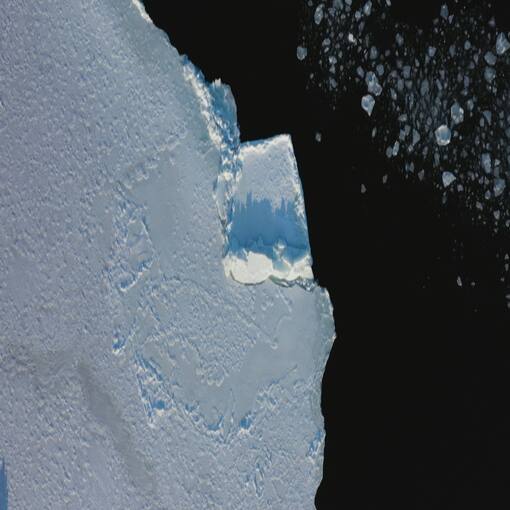
Scientists from the National Snow and Ice Data Centre (NSIDC) at the University of Colorado Boulder initially predicted the disappearance of the St. Patrick Bay ice caps would take place over five years, but it’s actually only taken three.
The frozen sheets, probably in place for several centuries, measured more than 10 square kilometres (3.86 square miles) combined at the end of the 1950s, and have now shrunk down to nothing. It’s a sign of the climate change that’s gaining momentum all around the world, and showing no signs of stopping.
“When I first visited those ice caps, they seemed like such a permanent fixture of the landscape,” says geographer and NSIDC director Mark Serreze. “To watch them die in less than 40 years just blows me away.”
Ice cover in 2015 (left) and 2020 (right). (Bruce Raup/NSIDC)
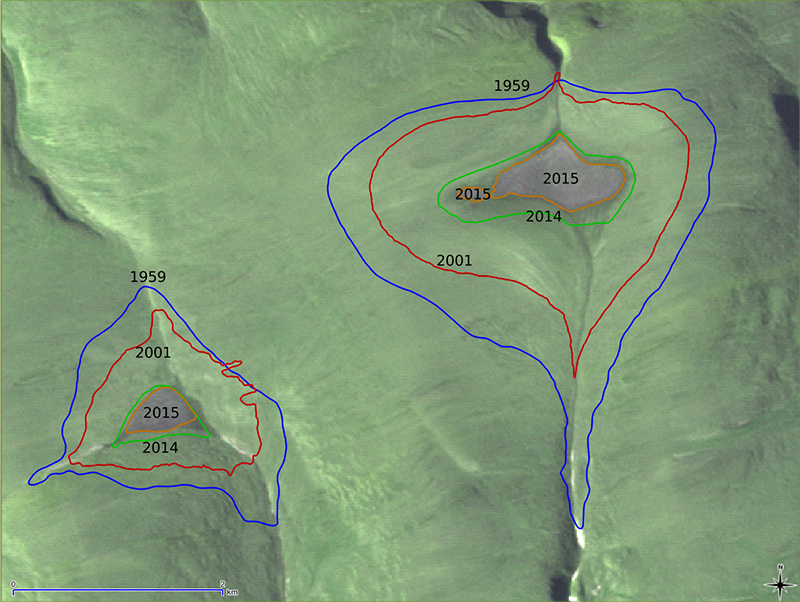
Serreze was a young graduate student when he first set foot on the ice caps in 1982, and he was the lead author of the 2017 paper alerting the world to their drastic demise. By 2015, the ice caps were only five percent the size of what they were in 1959.
The two ice caps that have vanished are part of a group on the Hazen Plateau, in the north of Ellesmere Island in Nunavut, way up in the Arctic Archipelago – one of the most northerly points of Canada.
Two ice caps often linked with the St. Patrick Bay pair, the Murray and Simmons ice caps, are faring better due to their higher elevation – in 2015 their ice cover was at 39 percent and 25 percent respectively, compared with the 1959 figure. However, scientists think they too could soon be gone.
When Serreze and his colleagues first started surveying the Hazen Plateau ice at the start of the 1980s, scientific consensus on global warming was still forming, and some researchers had suggested the planet was actually in a period of global cooling. The studies started back then were partly an attempt to find out one way or the other.
Ice cover tracked over time. (NSIDC)
Now there’s no doubt what’s happening. While the St. Patrick Bay ice caps may not be two of the most famous or significant points of geological interest in the world, they represent a small microcosm that reflects what’s happening to our planet as a whole.
They’re also a reminder that while scientists aren’t infallible, they very often do know what they’re talking about – and that when we get warnings about what’s coming our way in the future, we’d do well to take heed and to take action.
“We’ve long known that as climate change takes hold, the effects would be especially pronounced in the Arctic,” says Serreze.
“But the death of those two little caps that I once knew so well has made climate change very personal. All that’s left are some photographs and a lot of memories.”
The original 2017 research was first published in The Cryosphere.





 Innovative Techs










 Ice cover in 2015 (left) and 2020 (right). (Bruce Raup/NSIDC)
 Ice cover tracked over time. (NSIDC)
 Exposing the Big Game