Exposing the Big Game

Forget Hunters' Feeble Rationalizations and Trust Your Gut Feelings: Making Sport of Killing Is Not Healthy Human Behavior

Exposing the Big Game

Bear that attacked cruise worker was skeletal, expert says; signs of its presence on beach should have been obvious, researchers who saw it the day before say

bremenhttp://icepeople.net/2018/07/30/hiding-in-plain-sight-footprints-and-whale-carcass-should-have-been-dead-giveaway-of-polar-bears-presence-say-research-crew-members-who-saw-it-a-day-before-attack/

The cruise ship wasn’t trying to bring tourists ashore to look at a polar bear. The uneven landscape of the beach meant the animal could have been out of sight a short distance away – but a whale carcass and lots of bear tracks should have been a dead giveaway. The crew tried to scare the bear away before being forced to kill it. An expert researcher says it appears the bear was very thin.

A few more details were released Monday by officials and a lot more criticism was expressed –including from celebrities and other prominent people worldwide – about a polar bear that was fatally shot after attacking a cruise ship crew member in northern Svalbard on Saturday.

Twelve crew members from the MS Bremen cruise ship went ashore in two dinghies at Sjuøyane, a group of islands at the northernmost part of the archipelago, at about 8:30 a.m. to prepare for a shore excursion by tourists on the vessel, according to a press release issued by The Governor of Svalbard. Four of the crew were polar bear guards, according to Hapag-Lloyd Cruises, a German company which operated the ship.

“The attack happened on shore,” Police Chief Lt. Ole Jakob Malmo said in the governor’s press release. “The victim, a 42-year old man from Germany, was wounded in the head. Two of the others in the group opened fire on the bear and killed it.”

Although the crew received widespread criticism from commenters wondering why sedation or other non-lethal means were used against the bear, Malmo said such attempts were indeed made.

“Initially, the group attempted to scare away the bear by shouting and making loud noises as well as firing a signal pistol, but to no effect,” he said.

A polar bear – almost certainly the one that was shot – was spotted the day before the attack eating a whale carcass by research expedition participants aboard the M/S Clione vessel from the Czech Republic.

“He just ate and then slept and then enjoyed being there,” said Josef Elster, director of the Czech Centre for Polar Ecology.

Jan Pechar, captain of the Clione, said an uneven surface on the beach meant the bear could have been a short distance from the cruise ship crew without being seen, but the whale carcass and bear footprints were clearly visible through a telephoto lens from the ship.

“There definitely was some proof” of the bear’s very recent presence, he said.

Pechar said he reported the bear sighting, as well as others spotted in the area during the expedition, to the governor’s office. Officials at the governor’s office did not immediately respond to questions about whether such reports would have been available to others traveling in the area.

Although the bear was able to eat a large last meal, photos of its carcass suggest it was “quite emaciated,” Jon Aars, a polar bear expert with the Norwegian Polar Institute, told NRK.

“Polar bears can attack people, regardless of whether it is hungry or not, but there is a greater risk that it attacks people when it’s hungry,” he said.

The vast majority of criticism by outside commenters toward the cruise line was for causing the bear’s death by invading the bear’s natural turf.

“Let’s get too close to a polar bear in its natural environment and then kill it if it gets too close. Morons,” wrote British actor-comedian Ricky Gervais in a Twitter message.

An abundance of other accusatory Tweets – not all of them entirely consistent with the facts of the incident – were posted, forwarded and reported in a rapidly growing number of media outlets worldwide.

Extinction Symbol@extinctsymbol

Polar bear killed for acting like a wild animal: https://www.nbc4i.com/news/u-s-world/polar-bear-killed-after-attack-on-arctic-cruise-ship-guard/1331132958 

Polar bear killed after attack on Arctic cruise ship guard

Norwegian authorities said a polar bear on Saturday attacked and injured a polar bear guard who was leading tourists off a cruise ship on an Arctic archipelago. The polar bear was shot dead by…

nbc4i.com

Among the more common apparent misperceptions was the cruise line was deliberately attempting to allow passengers to view the polar bear from land (although such suspicions have been expressed by a few locals and observers at Sjuøyane noted there were bears in the area since a large amount of whale fat was on the beach where the attack occurred).

“Maybe cruise sightseeing tours shouldn’t take place then polar bear guards wouldn’t be needed to protect gawking tourists & polar bears would be left in peace & not shot dead merely to satisfy a photo-op?” wrote Jane Roberts, a British genealogist.

Hapag-Lloyd Cruises, in a statement, stated they do not intentionally bring passengers ashore to watch polar bears.

“Polar bears are only observed on board ships from safe distance,” the statement notes. “In order to prepare a shore leave, the polar bear guards will go to land as a group and without passengers to land, set up a land station and secure the area to make sure there are no polar bears. Once such an animal approaches, the shore leave would be stopped immediately.”

The cruise line stated it is working “intensively and cooperative with the Norwegian authorities for the reconstruction and enlightenment of the incident.” The governor’s office is investigating to determine if negligence or other wrongdoing was a factor in the attack.

“We expect that it will take some time to complete the investigation,” Malmo said.

Animals Need, but Don’t Get, Shade and Adequate Water during Record Heat

Canadian Blog

by Barry Kent MacKay,
Senior Program Associate

Born Free USA’s Canadian Representative

http://www.bornfreeusa.org/weblog_canada.php?p=6398&more=1#more6398

Published 08/02/18

Bison at MarinelandPhoto: Born Free USA

As I mentioned in my last blog, after a 37 year hiatus, not ever wanting to return because I had been so disturbed by the terrible care animals were receiving during my first visit, I finally made my second visit to Marineland, and the horror of the place remains for me. I had been lured by advertisements for “Aviary Safari,” a new attraction featuring 100 acres of “free-roaming” birds. I’m a bird expert; I should take a look. But it was false advertising. The attraction does not exist.

Rob Laidlaw and I were there on July 5, the last day of a brutal, record-breaking heat wave filled with government-issued heat warnings, so not surprisingly our first stop was in the cool confines of an indoor exhibit featuring harbor seals. The seals, as reported previously, all had their eyes tightly shut due to the chlorine in their tank.

Then, we went in search of the aviary that did not exist. After being told by an employee that there was no such display (for which, given how animals are cared for in Marineland, I’m grateful), we wandered off in search of other animal displays in what is, to my eyes, just a grubby theme park that happens to be located in Niagara Falls, Ontario, near Horseshoe Falls, a world-famous tourist attraction.

What we were horrified to find huge pens with no trees and very little, if any, shade, housing various hoofed ungulates, such as bison, red deer, and the closely related American wapiti. There were some improvements over the last 37 years. There were fewer bears and they were in a larger, cleaner compound, and I was pleased that the petting compound, filled with fallow deer, was not open, presumably because of the intense heat. The animals were forced to huddle in a few square feet of shade cast by the fencing.

But, what I saw in the other compounds left me sick with sorrow for the animals. Above are two photos taken of the bison compound. It was just an open, sun-blasted expanse, with but a single source of water, about the size of a pail. I’ve included a photo of a bison calf, about the size of a cow calf, so you can see the size of this water source. No place for the herd to drink; no place for them to wallow in the mud; no shade for them to cool off.

Please don’t tell me to complain. Animal protectionists have been complaining, for decades, and The Ontario SPCA once laid charges, but somehow missed what to my eyes – and those of various experts who have written reports on what they found – are the most concerning situations. And, for our troubles we are labeled, of course, as extremists. Here are the photos. Judge for yourself.

Keep Wildlife in the Wild,
Barry

Baseball-Size Hail Kills Zoo Animals In Colorado

https://www.huffingtonpost.com/entry/hail-zoo-colorado_us_5b69a10ae4b0de86f4a552d3

The massive Colorado Springs hailstorm injured more than a dozen people and damaged hundreds of cars.
X

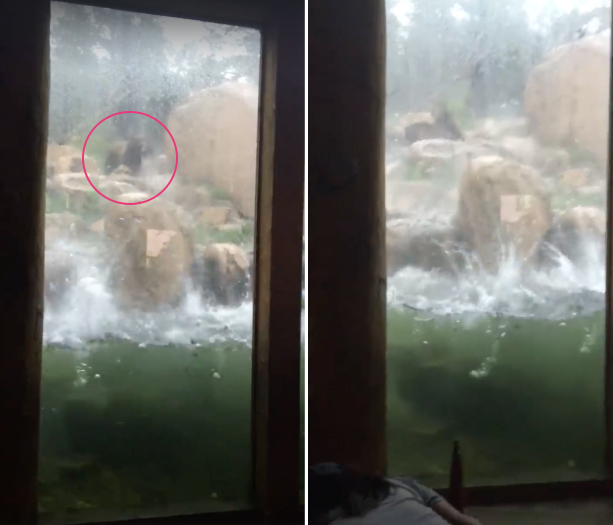
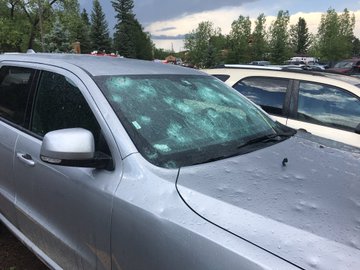
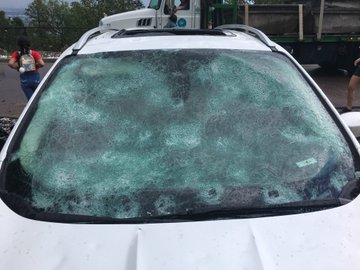
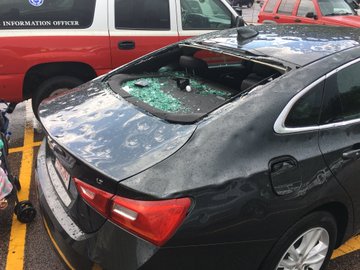
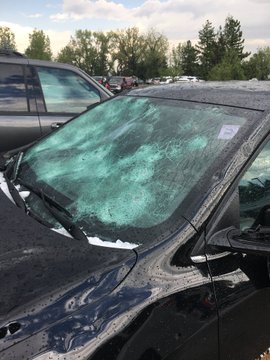
A powerful hailstorm swept through parts of Colorado on Monday, injuring 14 people, killing two zoo animals and damaging hundreds of cars.

The massive storm, which produced baseball-sized hail in some parts, prompted an evacuation at the Cheyenne Mountain Zoo in Colorado Springs as the area was pummeled with chunks of ice.

By the time the storm had passed, the zoo, which remained closed on Tuesday due to the destruction, estimated that nearly 400 cars in its parking lot were severely damaged. Two birds on exhibit died from trauma.

One of two bears (left) is seen attempting to dodge hail as it pounded the Cheyenne Mountain Zoo in Colorado Springs on Monda

STORYFUL
One of two bears (left) is seen attempting to dodge hail as it pounded the Cheyenne Mountain Zoo in Colorado Springs on Monday.

“One animal was Daisy, a 4-year-old muscovy duck. The other animal was 13-year-old cape vulture, Motswari,” the zoo said in a Facebook post.

Colorado Springs police reported that five people were transported from the zoo to hospitals for injuries. Nine others were treated at the scene and released.

“It was crazy. The zoo, when we came out of there, literally it looked like a tornado came through,” Danielle Fillis, 47, who was visiting the zoo with her husband, told the Colorado Springs Gazette. Their car was totalled, she said, and their legs were slashed by glass broken by the hail.

This New World
The current capitalist system is broken. Get updates on our progress toward building a fairer world.

“There were trees down, the whole walkway was covered in debris and animals were making a lot of noise,” Fillis added.

Brandon Sneide, who said he was a member of Colorado’s National Guard who had been deployed to Afghanistan and Iraq, said he saw one woman at the zoo covered in blood.

View image on TwitterView image on TwitterView image on TwitterView image on Twitter

CSFD PIO@CSFDPIO

an idea of some of damage to vehicles at the zoo today.

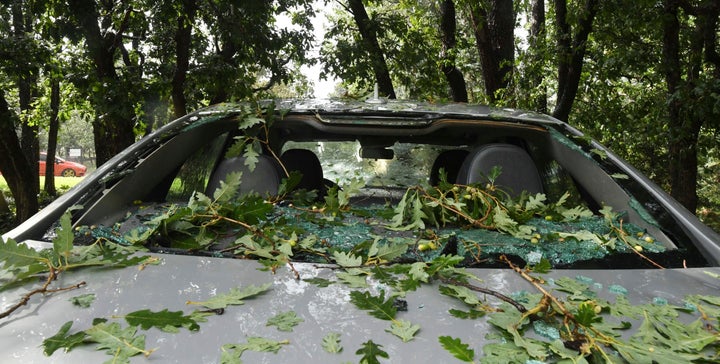
The back window of a car that was smashed by hail on Monday in the Broadmoor area of Colorado Springs is seen.

ASSOCIATED PRESS
The back window of a car that was smashed by hail on Monday in the Broadmoor area of Colorado Springs is seen.

“It was traumatic. It sounded like being in a war zone, like being in Iraq. It was scary,” Sneide told the paper.

Hailstorms are not unusual in this part of the country in the summer, according to weather experts.

“Colorado, you get hit all the time with hail, but it was a little bit larger than most hailstorms,” Pamela Evenson, a meteorologist with the National Weather Service in Pueblo, Colorado, told HuffPost on Tuesday. “Colorado has one of the highest hail rates in the country, unfortunately.”

NWS Pueblo

@NWSPueblo

GOES-16 visible satellite imagery shows the evolution of the severe thunderstorm that produced very large hail across El Paso and Pueblo counties on August 6.

In June, areas in and around Colorado Springs and Fountain were pounded by another hailstorm that caused an estimated $169 million in insured damages, according to Rocky Mountain Insurance Information Association. 

That storm was reported as the worst overnight storm in El Paso County in more than 20 years.

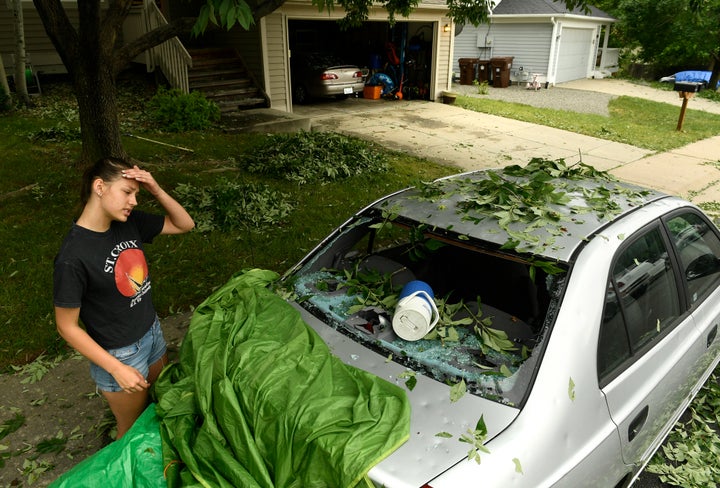
Sara Pilot, left, looks at the hail damage to her father's car outside of her home in Louisville, Colorado, on June 19.

HELEN H. RICHARDSON VIA GETTY IMAGES
Sara Pilot, left, looks at the hail damage to her father’s car outside of her home in Louisville, Colorado, on June 19.

“A bunch of people had already gotten their homes fixed, got new cars after their cars were totaled and then had the same thing happen again,” Evenson said of those residents. “It’s terrible.”

In late June, areas in and around Boulder saw baseball-sized hail that destroyed cars, rooftops and solar panels.

Heavy thunderstorms and possible severe hail were forecast for the area of Boulder again on Tuesday. Pueblo was also forecast to see thunderstorms and potential flash floods, according to the National Weather Service.

Study warns of looming potential for runaway global warming

Study warns of looming potential for runaway global warming
© Getty Images

A new study out Monday warns of the possibility of out-of-control global warming if humans fail to band together to fight the worst effects of climate change.

The analysis, conducted by researchers at the Australian National University and the Stockholm Resilience Center, among other institutions, outlines the potential for a “threshold” that, if crossed, would lead to runaway warming patterns and the advent of a “Hothouse Earth.”

If such a threshold is crossed, the study warns, global average temperatures could climb as much as 8 degrees Fahrenheit above current temperatures and sea levels could rise 30 to 200 feet.

“Crossing the threshold would lead to a much higher global average temperature than any interglacial in the past 1.2 million years and to sea levels significantly higher than at any time in the Holocene,” the study says.The report is based on a review of past research of thresholds for climate change, according to USA Today.

Even if every country that signed on to the Paris climate agreement meets its obligations under the pact and limits the global temperature increase to 3.6 degrees Fahrenheit, runaway global warming could still be a threat, the newspaper reports.

The study says that mitigating that risk would require collective global action, including a drastic transformation of “social values” and the pursuit of new technology.

“Such action entails stewardship of the entire Earth System – biosphere, climate, and societies – and could include decarbonization of the global economy, enhancement of biosphere carbon sinks, behavioral changes, technological innovations, new governance arrangements, and transformed social values,” the study says.

President Trump withdrew from the Paris agreement last year, arguing that it placed unfair burdens on the U.S. to curb carbon emissions and would ultimately hurt American businesses and industry.

Donald Trump has some thoughts on fighting wildfires. They’re nonsense.

https://www.vox.com/2018/8/6/17655626/trump-wildfire-twitter-mendocino-complex-carr-california

Humans are increasing wildfire risks, but “bad environmental laws” aren’t the problem.

A C-130 air tanker drops flame retardant on part of the Mendocino Complex Fire in California on August 5, 2018.
 Noah Berger/AFP/Getty Images

The 2018 wildfire year has been devastating. As of Monday, the National Interagency Fire Center reports that there are 60 uncontained large fires across the country, with a total of 5.1 million acres ravaged by fire so far this year.

These deadly infernos have killed several firefighters, forced hundreds of people to flee, and destroyed hundreds of homes and thousands of acres of wilderness.

The Carr Fire in Northern California is now the state’s fifth-largest fire on record after igniting more than 160,0000 acres and killing seven people. But it’s been bested in size by the Mendocino Complex fire, which, at 273,000 acres, is the second-largest in state history.

Late last month, President Trump signed a federal emergency declaration for the state of California, allowing the federal government to assist with firefighting efforts.

So it’s not surprising that Trump would weigh in on the California blazes. But on Sunday night, he used them to bash environmental regulations:

Donald J. Trump

@realDonaldTrump

California wildfires are being magnified & made so much worse by the bad environmental laws which aren’t allowing massive amount of readily available water to be properly utilized. It is being diverted into the Pacific Ocean. Must also tree clear to stop fire spreading!

And then on Monday, he took it up again, this time blaming California Gov. Jerry Brown.

Donald J. Trump

@realDonaldTrump

Governor Jerry Brown must allow the Free Flow of the vast amounts of water coming from the North and foolishly being diverted into the Pacific Ocean. Can be used for fires, farming and everything else. Think of California with plenty of Water – Nice! Fast Federal govt. approvals.

There are a few reasons these statements are bewildering. First, human activity is definitely making these fires worse: People are building in vulnerable areas, they are igniting most of these fires, and humans are driving climate change, which makes fire conditions more severe.

But environmental laws about water that would be used to put the fires out?

Even wildfire scientists have no idea what the president was referring to here. California has been parched from drought for years, so there isn’t a “massive amount of readily available water,” and what little moisture is available is closely tracked.

“We do manage all of our rivers in California, and all the water is allocated many times over. So I’m not sure what he was recommending,” LeRoy Westerling, a professor at the University of California Merced studying wildfires, told the San Francisco Chronicle. “Even if we eliminated all habitat for riparian species and fish, and allowed saltwater intrusion into the delta and set up a sprinkler system over the state, that wouldn’t compensate for greater moisture loss from climate change.”

That means if California hoarded every raindrop, as Trump recommended, it still wouldn’t completely offset evaporation from rising average temperatures and years of drought.

Peter Gleick

@PeterGleick

Trump doubles down on his previous ignorant tweet about California and fires. The only water that reaches the ocean these days is what’s left AFTER the massive diversions OUT of our rivers for cities and farms. And there’s no shortage of fire-fighting water. Nuts.

Donald J. Trump

@realDonaldTrump

Governor Jerry Brown must allow the Free Flow of the vast amounts of water coming from the North and foolishly being diverted into the Pacific Ocean. Can be used for fires, farming and everything else. Think of California with plenty of Water – Nice! Fast Federal govt. approvals.

This water also wouldn’t be all that useful for firefighters. Wildfires are a natural part of the ecosystem, so the goal is to allow these fires to burn without threatening lives and property, and spraying water isn’t the main method for containing them.

For wildland firefighters, the tools of the trade are Pulaskis, rakes, shovels, and flamethrowers that burn clearings ahead of towering infernos. Instead of fire engines, they use bulldozers. Since these firefighters aren’t usually using pump trucks and fire hoses, they aren’t limited by water. When they need to snuff out an area, they often do it by air.

These methods help firefighters clear a perimeter of potential fuel to control the spread of flames. But as Westerling added on Twitter, the president’s suggestion of “tree clear” only goes so far.

A. LeRoy Westerling@LeroyWesterling

‘Tree clearing’ isn’t goint to help with the fires burning in grass and shrub fuels. But California is investing millions in fuels treatments funded by our carbon permit auction revenue. It would be wonderful if the Federal gov emulated us, since it owns most of the trees here

Donald J. Trump

@realDonaldTrump

California wildfires are being magnified & made so much worse by the bad environmental laws which aren’t allowing massive amount of readily available water to be properly utilized. It is being diverted into the Pacific Ocean. Must also tree clear to stop fire spreading!

There were indeed regulations that prevented firefighting equipment from being used, but officials say water rules are not hampering firefighting efforts. In fact, the largest fires in California right now have plenty of water nearby.

Scott McLean, a spokesperson for the California Department of Forestry and Fire Protection, pointed out to me that the Carr Fire burned around Shasta Lake and Whiskeytown Lake, while the Mendocino Complex Fire is roaring near Clear Lake.

For a state like California that’s facing increasing heat and more frequent weather whiplashbetween extreme rain and drought, the real “bad environmental laws” worsening the situation are actually Trump’s attempts to roll back policies — like California’s Clean Air Act waiver — that would help mitigate climate change and the threat of more wildfires.

Why is Trump suddenly so interested in California water policy anyway?

For one, it appears to be an opportunity to take a swing at the state’s governor, Jerry Brown, a vociferous critic of the president.

But Trump may also be hearing about it from Rep. Devin Nunes (R-CA), a confidant who has long fought California’s water restrictions. As the New York Times reported in February:

In this district, Mr. Nunes is more closely associated with campaigning for farmers on water issues than anything to do with Russia — pushing for more dams and trying to get more water from Northern California in the face of a shortage that many fear could turn into another drought.

His efforts have largely failed to solve the problem, which his Republican constituents here blame on environmentalists and Democrats in Sacramento, California’s capital, who they say are more interested in saving the smelt from extinction than serving the region’s farmers with enough water, an issue that President Trump took up during his campaign.

The fires may have given Nunes a reason to broach the topic to Trump, who turned to Twitter to vent and jab a political opponent at the same time.

Our climate plans are in pieces as killer summer shreds records

Updated 6:46 AM ET, Sun August 5, 2018

(CNN)Deadly fires have scorched swaths of the Northern Hemisphere this summer, from California to Arctic Sweden and down to Greece on the sunny Mediterranean. Drought in Europe has turned verdant land barren, while people in Japan and Korea are dying from record-breaking heat.

Climate change is here and is affecting the entire globe — not just the polar bears or tiny islands vulnerable to rising sea levels — scientists say. It is on the doorsteps of everyday Americans, Europeans and Asians, and the best evidence shows it will get much worse.
This summer, 119 people in Japan died in a heat wave, while 29 were killed in South Korea, officials there say. Ninety-one people in Greece died in wildfires, and ongoing fires in California have taken at least eight lives. Spain and Portugal sweltered through an exceptionally hot weekend with a heat wave that has killed three people in Spain and pushed temperatures toward record levels..
Deadly heat waves will become more frequent and occur in more places on the planet in coming decades, according to a study published last summer in the journal Nature Climate Change. Extreme heat waves are frequently cited as one of the most direct effects of man-made climate change.
Remarkably, scientists can now work out in just a matter of days how much human-induced climate change has had to do with a particular weather event, using a combination of observation, historical data and current information from weather stations.
“The European heat wave was at least twice as likely to happen because of human intervention. Based on findings in Ireland it was double — and we know that with very high confidence — and based on data from all other weather stations it was more than double,” said Karsten Haustein from the World Weather Attribution Project, part of Oxford University’s Environmental Change Institute.
Scientists have been able to use this kind of modeling for more than a decade, but improved technology now allows them to do it nearly in real time, letting people understand the links between what they are seeing and climate change.
Despite the deadly summer, overwhelming evidence that humans are altering the planet, and ever-improving science that links specific weather events to global warming, the international politics around the issue of climate change are in disarray. And there are alarming signs that the planet may be in worse shape than ever before.
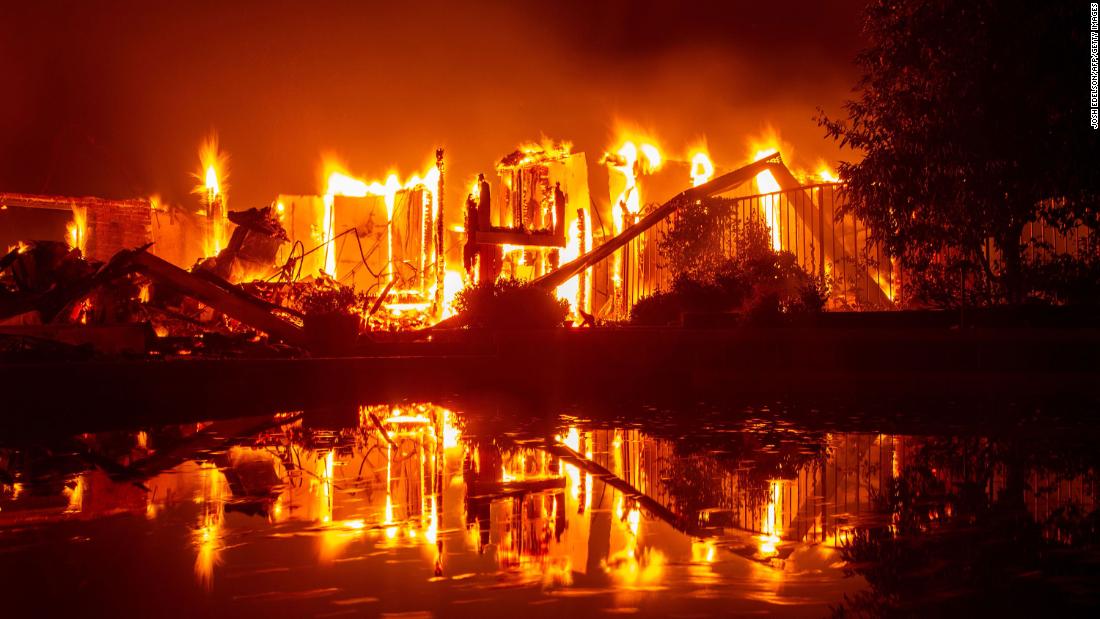
A house is caught up in the Carr fire in Redding, California, on July 27.

Carbon levels highest in 800,000 years

A report released Wednesday by the US National Oceanic and Atmospheric Administration (NOAA) gave the Earth in 2017 a grim report card.
The major greenhouse gases — carbon dioxide, methane and nitrous oxide — all rose to record levels last year. The global average carbon dioxide concentration was the highest ever recorded, and higher than at any point in the past 800,000 years, according to ice-core data.
Spending on oil and gas increased last year, pushing up the share of fossil fuels in energy supply investment for the first time since 2014, according to the International Energy Agency.Investment in renewable energy dropped 7%, while demand for coal rose, largely to keep Asia’s furnaces burning as the region rapidly develops.
And last year also saw US President Donald Trump announce his plan to pull the US from the Paris Agreement, in a striking blow to global action on climate change. The US is the world’s second-biggest emitter of carbon dioxide, and a pact without the powerhouse nation is significantly weakened.
The symptoms of climate change were also dramatic. Last year was the second or third-hottest year on record, depending on the dataset used, following three record-breaking hot years, the NOAA report showed. It was the hottest year on record without an El Niño, the natural weather event that adds to the warming of the seas and the whole planet.
A new record for global sea levels was set. Unprecedented coral bleaching occurred, and both the Arctic and the Antarctic saw record-low levels of sea ice, as warmer air and seas continued the trend of thinning out the polar ice.

Most Americans accept man-made climate change is real

The Earth has been getting steadily warmer since humans began using high levels of fossil fuels in the 18th to 19th centuries, during the Industrial Revolution. The planet has already warmed by around 1 degree Celsius since the late 19th century.
More and more Americans are starting to accept climate change is happening, despite Trump’s pledge to pull the US from the Paris Agreement.
American acceptance of climate change returned to an all-time high of 71% in October last year after sliding significantly from around a decade ago, according to the Yale Program on Climate Change Communication, which conducts quarterly surveys on attitudes to global warming. It has dropped to 70% this year so far.
Some 58% of Americans believe that climate change is mostly man-made, a clear majority but a lower percentage than in most other developed nations.
This understanding that climate change is at least happening has a lot to do with what people are seeing and experiencing, according to the Yale program’s director, Anthony Leiserowitz.
After the US was hit with several catastrophic hurricanes, the number of people who felt global warming was affecting US weather “a lot” leaped to 33% last October from 25% in May, five months earlier. That number went back down when winter came and extreme weather events subsided.
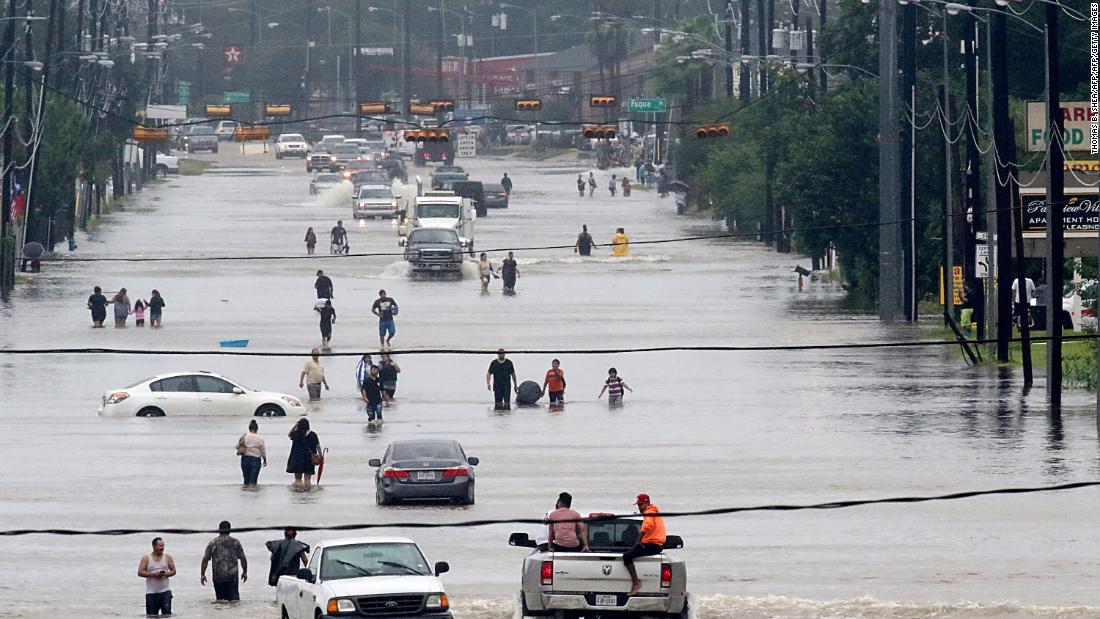
People walk through flooded roads in Houston, Texas, on August 27, 2017 as Hurricane Harvey hit the city.

“People are increasingly connecting the dots when they see these weather events happening across the United States,” Leiserowitz said.
“It’s about the pattern — if an extreme event happens once or twice, it’s just a coincidence, but three, five, 12, 22 times, seeing record-setting events, seeing 1,000-year event after 1,000-year event happen frequently, people begin to see that larger pattern, that climate change is actually affecting the weather today. And that’s a new concept for many Americans.”
This increase in awareness appears to be happening in Redding, California. The Carr Fire has torched more than 130,000 acres of land — the equivalent of nearly 100,000 football fields — and it became so big and hot this week, it created its own weather system.
Firefighter Gabriel Lauderdale, 29, has lived all his life by the forest near Redding, and he says even that’s enough time to have noticed the pattern and behavior of wildfires change dramatically.
“There seems to be more destructive wildfires and they’re happening more frequently,” said Lauderdale.
“It used to be that a 10,000-acre fire was a large fire, and in these cases, we’re seeing many exceed 100,000 acres, and they reach that size relative quickly. They move into homes and businesses, and they move very fast from structure to structure.”

The US pulls the plug on Paris

The Paris Agreement in 2015 was widely celebrated as an achievement, but it has major flaws — it is not legally binding, it’s unenforceable and soon it is likely to lack one of the world’s biggest polluters.
The agreement’s predecessor, the Kyoto Protocol, was much stronger. It set ambitious and legally binding emissions reduction targets. But it too had its problems.
It included only developed nations, so China, the world’s biggest carbon emitter, was not obliged to make reductions.
This was always a sticking point for the US. George W. Bush in 2001 pulled his country out of the Kyoto agreement, which Congress had never ratified.
Kyoto’s other major flaw was that although it was legally binding, no one was ever sanctioned for over-polluting.
So the success of Paris lies in the fact that it at least engaged more than just developed nations. Those who ratify it make pledges to combat climate change as their countries see fit, and they are obliged to report on them transparently, in more of a name-and-shame system than one with mutually set goals.
Another success of Paris is the recognition that the world should try to contain warming to 1.5 degrees Celsius above pre-industrial levels, or two degrees as a worst-case scenario.
The agreement, however, did not include the legally binding goals to reduce carbon emissions that were sought by Europe but largely opposed by the US.
Cars are blocked after a wildfire caused a road closure in Kineta in  Greece on July 23.

Now the world is left with a watered-down agreement, and the country that pushed strongly for that dilution is no longer playing along.
Todd Stern, the chief US negotiator in Paris, and the Obama administration are credited with bringing the US back into the fold after pulling out of Kyoto. But, Stern said, they knew they would never get binding targets past Congress, so they went into talks seeking an agreement that wouldn’t need Congressional approval.
Stern denies, however, that the US was the only one against binding targets, saying he would be “stunned” if all countries had agreed to get on board.
He made clear his strong disapproval of Trump’s announcement the day after it happened, and he has written op-ed after op-ed warning of the dangers of doing so.
“It’s a completely mind-bogglingly, ill-informed and unwise decision for so many reasons,” Stern told CNN, adding that the US was “too big and influential” to be left out.
Trump has governed with his “America First” agenda at the forefront of his policy making and had argued that the Paris Agreement placed “draconian” financial burdens on the American people.
“I was elected by the citizens of Pittsburgh, not Paris,” he said upon making his announcement in June last year.
With the Paris Agreement being largely non-binding and with the US out of the deal, environmental groups are calling on the rest of the world to make stronger commitments.
“All other nations have to ditch incremental action for transformational change,” said Claire Norman, speaking for Friends of the Earth in the UK.
“Other nations will need to step up — especially the UK, we used to be world-leading — and use every diplomatic and economic tool to compel the US to act.”

This Summer’s Heat Waves Could Be the Strongest Climate Signal Yet

‘In many places, people are preparing for the past or present climate. But this summer is the future.’

Extreme heat killed more than 80 people in Japan in July, just a few weeks after flooding from downpours was blamed for more than 200 deaths there. Martin Bureau/Getty Images

Extreme heat killed more than 80 people in Japan in July, just a few weeks after flooding from downpours was blamed for more than 200 deaths there. Martin Bureau/Getty Images

Sign up to receive our latest reporting on climate change, energy and environmental justice, sent directly to your inbox. Subscribe here.

https://insideclimatenews.org/news/27072018/summer-2018-heat-wave-wildfires-climate-change-evidence-crops-flooding-deaths-records-broken

Earth’s global warming fever spiked to deadly new highs across the Northern Hemisphere this summer, and we’re feeling the results—extreme heat is now blamed for hundreds of deaths, droughts threaten food supplies, wildfires have raced through neighborhoods in the western United States, Greece and as far north as the Arctic Circle.

At sea, record and near-record warm oceans have sent soggy masses of air surging landward, fueling extreme rainfall and flooding in Japan and the eastern U.S. In Europe, the Baltic Sea is so warm that potentially toxic blue-green algae is spreading across its surface.

There shouldn’t be any doubt that some of the deadliest of this summer’s disasters—including flooding in Japan and wildfires in Greece—are fueled by weather extremes linked to global warming, said Corinne Le Quéré, director of the Tyndall Centre for Climate Change Research at the University of East Anglia.

“We know very well that global warming is making heat waves longer, hotter and more frequent,” she said.

“The evidence from having extreme events around the world is really compelling. It’s very indicative that the global warming background is causing or at least contributing to these events,” she said.

Extreme Summer: Some of 2018's Most Extreme Events

The challenges created by global warming are becoming evident even in basic infrastructure, much of which was built on the assumption of a cooler climate. In these latest heat waves, railroad tracks have bent in the rising temperatures, airport runways have cracked, and power plants from France to Finland have had to power down because their cooling sources became too warm.

“We’re seeing that many things are not built to withstand the heat levels we are seeing now,” Le Quéré said.

Penn State climate scientist Michael Mann said this summer’s extreme weather fits into a pattern he identified with other researchers in a studypublished last year. The jet stream‘s north-south meanders have been unusually stationary, leading to persistent heat waves and droughts in some areas and days of rain and flooding in others, he said. “Our work last year shows that this sort of pattern … has become more common because of human-caused climate change, and in particular, amplified Arctic warming.”

Deadly Heat Waves from Canada to Japan

There are many ways to define a heat wave, but the conditions in many areas of the planet this summer have been universally recognized as severe, said Boram Lee, a senior research scientist with the World Meteorological Organization.

“From around end of June, many countries in Europe, Asia and North America have issued severe warnings,” she said. The UK, U.S., Japan and Korea all had long-lasting warnings, and Japan declared the recent heat wave a natural disaster, she added.

In Europe, scientists on Friday released a real-time attribution study of the heat wave that has baked parts of northern Europe since June. They found that global warming caused by greenhouse gas pollution made the ongoing heat wave five times more likely in Denmark, and twice as likely in Ireland.

In El Salvador, many farmers have lost their lost corn crops to drought this summer. Agriculture is suffering in the high heat and drought conditions in several parts of the world. Credit: Oscar Rivera/AFP/Getty Images

In El Salvador, many farmers have lost their lost corn crops to drought this summer. Agriculture is suffering in the high heat and dry conditions in several parts of the world. Credit: Oscar Rivera/AFP/Getty Images

“Near the Arctic, it’s absolutely exceptional and unprecedented. This is a warning,” said French heat wave expert Robert Vautard, who worked on the study for World Weather Attribution. The group previously determined that global warming made last summer’s “Lucifer” heat wave in southern Europe 10 times more likely.

“In many places, people are preparing for the past or present climate. But this summer is the future,” he said.

The geographic scope and persistence of the European heat wave stands out. An area stretching from the British Isles to Eastern Europe and north to the Arctic is bright red on European heat wave and drought maps, covering an area about as big as Texas and California combined.

Crop damage is being reported in parts Norway through Sweden, Denmark and the Baltics. Depending on conditions during the next month, more widespread crop failures could raise global food prices.

With the Jet Stream stuck well to the north, most of Europe has been feeling the heat. Credit: Met Office

In mid-July, temperatures reached all-time record highs above the Arctic Circle, around 90 degrees Fahrenheit, and hovered in the 80s for weeks at a time. In the Norwegian glacier area that Lars Holger Pilø studies, the average temperature has been 9 degrees Fahrenheit above average for the past 30 days.

“I have been working here since 2006, and we have snow records going back 60 years, and there’s nothing like what we’re seeing right now,” said Pilø, part of team of ice archaeologists who are measuring the snow and ice loss and recovering historic artifacts like arrowheads and skis that were buried for millennia.

“I’m watching with a mixture of excitement and dread. I try not to think too much about it and stick to what we do, which is rescuing the artifacts coming out of the warming. I call it dark archaeology,” he said. “I look at the ice and I think, dead man walking.”

Norwegian Meteorological Institute climate scientist Ketil Isaksen said the extreme situation in Scandinavia fits with the pattern of global warming.

“There are so many extremes now from all over the world. We’re seeing a very common pattern. For me this is a strong climate signal. Ice that’s several thousand years old, melting in the matter of just a few weeks,” he said.

Isaksen is finalizing some studies that find heat is penetrating between 30 and 50 meters deep into the ground through cracks in the rocky mountains around Norway’s fjords. Instead of just a thin skin of permafrost melting, those mountains could fall apart in large chunks when autumn rains start, threatening coastal communities with tsunamis.

“Now we have a new extreme this summer. This will probably affect slope stability, and we can expect mass movement events like debris flows and landslides in late summer,” he said.

He said the studies help define new geologic hazard areas with knowledge that some of the melted mountains will see wholesale slope failure when strong rains hit. Based on the information, emergency managers are developing new early warning systems.

The Increasing Influence of Global Warming

About the same time the Norwegian researchers were uncovering ancient tools in the Arctic tundra this summer, heat records were being set in many other parts of the world.

Temperatures in Algeria reached 124 degrees Fahrenheit, setting a record for the African continent. A few weeks earlier, a city in Oman is believed to have broken a global record when it went more than 24 hours with temperatures never falling below 108 degrees. Japan set a national record of 106 amid a heat wave that has been blamed for more than 80 deaths.

Regional western heat events are becoming so pronounced that some climate scientists see the current extremes in the U.S. as a climate inflection point, where the global warming signal stands out above the natural background of climate variability.

Global Warming's Growing Role in Extreme Heat Waves, by U.S. Region

In mid-July, a week of temperatures in the high 80s and up to 96 degrees Fahrenheit in normally cool Quebec killed more than 50 people, and while that heat wave was waning, another was building in Asia, where the Japan Meteorological Agency said that 200 of its 927 stations topped the 35 degree Celsius (95 degrees Fahrenheit) on July 15. Since then, at least 80 people have died and thousands have gone to hospitals with heat-related ailments.

“There are irrefutable scientific evidences that climate change alters both the intensity and frequency of such extreme phenomena as heat waves, and ongoing efforts are dedicated to understand how big the impact of man-made climate change is,” said the WMO’s Boram Lee.

Across social media, climate scientists are responding with a collective “we warned about this,” posting links to 10 years’ worth of studies that have consistently been projecting increases in deadly heat waves. If anything, the warnings may have been understated.

“The rise in heat waves is stronger than many climate models project,” said World Weather Attribution’s Geert Jan van Oldenborgh, who measured a record high temperature outside his office in the Netherlands on July 26, then tweeted that global warming is making the heat there 20 times more likely than in 1900.

Wildfires Out of Control

Hot and dry weather also makes forests more flammable. In Greece, after a month of record and near-record heat, flames ran wild through the community of Mati on July 23, killing at least 80 people. On July 26, a blaze in Northern California jumped the Sacramento River and spawned fire tornadoes, forcing the evacuation of parts of Redding, a city of 92,000. And in Germany, residents of southern Berlin awoke Friday to the sight of smoke on the horizon, an event that will also become more common in that part of the world.

Although climate scientists are reluctant to link any one particular fire to climate change, there is plenty of scientific evidence showing how heat-trapping greenhouse gases contribute to increased fire danger.

“Weather is a product of the climate system. We are drastically altering that system, and all the weather we observe now is the product of that human-altered climate system. One result is an increase in the frequency, size and severity of large fire events,” University of California, Merced researcher Leroy Westerling wrote on Twitter.

Residents watch as fires burn into the city of Rafina, near Athens, on July 23. Credit: Angelos Tzortzinis/AFP/Getty Images

Residents watch as fires burn into the city of Rafina, near Athens, on July 23. The blazes moved quickly through the drought-parched area, killing more than 80 people. Credit: Angelos Tzortzinis/AFP/Getty Images

University of Arizona climate researcher and geographer Kevin Anchukaitis publicized several wildfire studies from the last 10 years that all show how and why global warming is making fires bigger, more destructive and longer-lasting. “Is climate change the only factor influencing wildland fire? No, of course not—but climate change is influencing area burned and fuel aridity,” he wrote.

Tyndall Centre Director Le Quéré said she faulted some media for failing to connect global warming to the current global heat wave. “This signal is very clear,” she said, adding that some of the early stories about the deadly fire in Greece almost seemed to downplay a link to climate change.

On Friday, the WMO released a new statement highlighting the links between global warming and wildfires and reminding readers that “heat is drying out forests and making them more susceptible to burn.”

Extreme Rainfall and Flooding

There is also still reluctance to link individual extreme flood events with global warming, despite plenty of scientific evidence that today’s global atmosphere—1 degree Celsius warmer than 100 years ago—holds much more moisture that can be delivered by regional storm systems.

Those warnings were not enough to help the more than 200 people who died in Japan in late June amid a series of record-setting torrential rain storms. Regional weather patterns certainly played a role, but ocean currents and an atmosphere juiced up by global warming likely boosted moisture for the storm.

Extreme rainfall unleashed landslides and flooding that knocked homes off their foundations in Kumano, Japan. The storms and floods in early July were blamed for more than 200 deaths. Credit: Martin Bureau/AFP/Getty Images

Two years ago, Alfred Wegener Institute climate researcher Hu Yang showed how climate change is strengthening ocean currents that carry moisture from the ocean toward Japan. The research showed the currents have been getting stronger and warmer in tandem with rising atmospheric CO2 levels. Eventually, that heat is released to the atmosphere during storms, as wind or rain or both.

Yang said his continuing research is finding similar evidence that a powerful current near Japan may be “a super hotspot under global warming.” As the current strengthens, it will release its energy as water vapor, fuel for storms that can cause extra heavy rains in Japan and other parts of Asia, he said.

In the U.S., June flooding in the Midwest fits a detected pattern of increasing extreme rainfalls in that region. And in late July, 10 million people in the East, from Pennsylvania to North Carolina, were under various types of flood warnings with soggy air sloshing from the Gulf of Mexico and the Caribbean over the overheated Northeastern Atlantic toward the coast.

What Can We Do About It?

In some cases, the scientific warnings about global warming impacts have resonated. At least parts of Europe are better prepared for heat waves now than they were in 2003, when extreme heat killed up to 70,000 people, said Le Quéré.

More cities know what they need to do to protect vulnerable people in an extreme event, she said, but they lack the money to do things  like building more cooling shelters, or cooling core urban areas with green spaces and ponds.

“Maybe this is an opportunity, in a grim way, to prepare for events that will be longer and hotter,” she said. “It’s not just a case of holding our breath for three weeks and saying ‘it’s soon winter.’ It’s a time to push and protect vulnerable people and infrastructure.”

Comparing global temperature anomalies between the UK's 1976 heat wave and 2018. Credit: Simon Lee

To prepare for the new normal, people must act in the next five to 10 years, said environmental scientist Cara Augustenborg, chairperson of Friends of the Earth Europe.

“We have to consider how every new infrastructure, agricultural or development project from now on will be impacted by climate change. We need to look at planned retreat from coastlines and developing further inland, building infrastructure that is more resilient to the effects of climate change such as sea level rise and temperature extremes.

“We’ve had several years now where airport runways have melted on extremely hot days,” she continued. “That’s something we need to factor in to future construction as it’s a problem that won’t go away.”

Society also needs to think about food security, she said.

“That’s what I really lose sleep over,” she said. “Our available arable land is declining now as our global population is booming. It doesn’t take much in the way of extreme weather to have a major impact on food supplies.”

Listen to a conversation about the extreme heat and climate change with ICN Managing Editor John H. Cushman, Jr., at On Point.

We’re Going to Die in Record Numbers as Heatwaves Bake The World, First Global Study Shows

https://www.sciencealert.com/global-warming-heatwaves-mortality-rate-climbing

Be alarmed.

MIKE MCRAE
2 AUG 2018

Mounting science is painting a very bleak picture of a future of soaring temperatures, and the accompanying death toll those soaring temperatures will demand.

New research has given us the first solid prediction of how more heatwaves like the one that’s struck Europe this year will affect future death rates, finding tropical heatwaves in some areas could one day send the mortality rate skyrocketing by as much as 2,000 percent.

As temperatures climb, bodies overheat, and the chances of harsh environmental conditions (such as smog) go up. Neither is good for our health, and frequent summer heatwaves can often be too much for some people to bear.

Last month in Montreal, the deaths of 70 people were blamed on a rise in temperatures. As global warming makes these kinds of weather events more common, it’s important to consider the toll it will take on our health.

“Worryingly, research shows that it is highly likely that there will be an increase in their frequency and severity under a changing climate, however, evidence about the impacts on mortality at a global scale is limited,” says co-author Antonio Gasparrinifrom the London School of Hygiene & Tropical Medicine.

With an international team of researchers, Gasparrrini created a database of daily measurements of temperatures and mortalities from the start of 1984 to the end of 2015 for 412 communities around the globe.

They used these numbers to predict mortality rates extending back to 1977 and all the way forward to the end of this century, varying the outcomes based on several scenarios.

For the ‘business-as-usual’ scenario, the news is grim.

“This research, the largest epidemiological study on the projected impacts of heatwaves under global warming, suggests it could dramatically increase heatwave-related mortality, especially in highly-populated tropical and sub-tropical countries,” says Gasparrini.

By 2080, there’s an outside chance that Colombia could see an increase in heatwave deaths of more than 30 times today’s numbers. For Brazil and the Philippines, the numbers are only slightly less concerning, at around 10 to 20 times the current mortality rate.

Major cities in the US and Australia could see at least four times the number of deaths.

If a silver lining can be found on this research, it’s that the same models also suggest these hypothetical numbers needn’t be so high.

“The good news is that if we mitigate greenhouse gas emissions under scenarios that comply with the Paris Agreement, then the projected impact will be much reduced,” says Gasparrini.

Populations will almost certainly continue to adapt to rising temperatures as well.

Urban planning might provide infrastructure for cooler living and working conditions. Healthcare could adjust to intervene earlier in conditions where heat stress carries risks. Individuals could grow more aware of the dangers and modify behaviours.

Measures like these would have a significant impact on that bottom line, limiting casualties.

But even with a best-case scenario, where countries stick to the Paris agreement and take heatwaves seriously enough to implement programs to mediate their impact, we can expect to see a doubling in deaths in some tropical countries.

That’s not as bad as it could be, but it still means we can expect more deadly summers like 2018’s to be hitting our planet.

Realistically, healthcare programs and urban infrastructure changes won’t be universal, and governments aren’t exactly united in their stance on climate change. Developing countries or nations with unequal distributions of wealth might be less likely to implement government policies devoting resources to reducing the impact of heatwaves.

Countries like China face more than just the ravages of heat stress. A separate studycarried out by researchers at MIT suggests the North China Plain could face heatwaves that make it all but uninhabitable.

Farming in the area adds a vast amount of water to the atmosphere, creating a blanket of vapour that exacerbates the local greenhouse effect, adding half a degree to the temperature.

High humidity coupled with high temperature makes cooling down almost impossible, since in those conditions sweat can no longer evaporate. For the 400 million people who call the plains home, this could be a catastrophe.

“This spot is going to be the hottest spot for deadly heatwaves in the future, especially under climate change,” says the study’s lead author, Elfatih Eltahir.

No matter how we look at it, our warming planet is going to be a deadly one, especially for the poor and the sick.

This research was published in PLOS Medicine.

This Summer’s Heat Waves Could Be the Strongest Climate Signal Yet

‘In many places, people are preparing for the past or present climate. But this summer is the future.’

Extreme heat killed more than 80 people in Japan in July, just a few weeks after flooding from downpours was blamed for more than 200 deaths there. Martin Bureau/Getty Images

Extreme heat killed more than 80 people in Japan in July, just a few weeks after flooding from downpours was blamed for more than 200 deaths there. Martin Bureau/Getty Images

https://insideclimatenews.org/news/27072018/summer-2018-heat-wave-wildfires-climate-change-evidence-crops-flooding-deaths-records-broken

Earth’s global warming fever spiked to deadly new highs across the Northern Hemisphere this summer, and we’re feeling the results—extreme heat is now blamed for hundreds of deaths, droughts threaten food supplies, wildfires have raced through neighborhoods in the western United States, Greece and as far north as the Arctic Circle.

At sea, record and near-record warm oceans have sent soggy masses of air surging landward, fueling extreme rainfall and flooding in Japan and the eastern U.S. In Europe, the Baltic Sea is so warm that potentially toxic blue-green algae is spreading across its surface.

There shouldn’t be any doubt that some of the deadliest of this summer’s disasters—including flooding in Japan and wildfires in Greece—are fueled by weather extremes linked to global warming, said Corinne Le Quéré, director of the Tyndall Centre for Climate Change Research at the University of East Anglia.

“We know very well that global warming is making heat waves longer, hotter and more frequent,” she said.

“The evidence from having extreme events around the world is really compelling. It’s very indicative that the global warming background is causing or at least contributing to these events,” she said.

Extreme Summer: Some of 2018's Most Extreme Events

The challenges created by global warming are becoming evident even in basic infrastructure, much of which was built on the assumption of a cooler climate. In these latest heat waves, railroad tracks have bent in the rising temperatures, airport runways have cracked, and power plants from France to Finland have had to power down because their cooling sources became too warm.

“We’re seeing that many things are not built to withstand the heat levels we are seeing now,” Le Quéré said.

Penn State climate scientist Michael Mann said this summer’s extreme weather fits into a pattern he identified with other researchers in a studypublished last year. The jet stream‘s north-south meanders have been unusually stationary, leading to persistent heat waves and droughts in some areas and days of rain and flooding in others, he said. “Our work last year shows that this sort of pattern … has become more common because of human-caused climate change, and in particular, amplified Arctic warming.”

Deadly Heat Waves from Canada to Japan

There are many ways to define a heat wave, but the conditions in many areas of the planet this summer have been universally recognized as severe, said Boram Lee, a senior research scientist with the World Meteorological Organization.

“From around end of June, many countries in Europe, Asia and North America have issued severe warnings,” she said. The UK, U.S., Japan and Korea all had long-lasting warnings, and Japan declared the recent heat wave a natural disaster, she added.

In Europe, scientists on Friday released a real-time attribution study of the heat wave that has baked parts of northern Europe since June. They found that global warming caused by greenhouse gas pollution made the ongoing heat wave five times more likely in Denmark, and twice as likely in Ireland.

In El Salvador, many farmers have lost their lost corn crops to drought this summer. Agriculture is suffering in the high heat and drought conditions in several parts of the world. Credit: Oscar Rivera/AFP/Getty Images

In El Salvador, many farmers have lost their lost corn crops to drought this summer. Agriculture is suffering in the high heat and dry conditions in several parts of the world. Credit: Oscar Rivera/AFP/Getty Images

“Near the Arctic, it’s absolutely exceptional and unprecedented. This is a warning,” said French heat wave expert Robert Vautard, who worked on the study for World Weather Attribution. The group previously determined that global warming made last summer’s “Lucifer” heat wave in southern Europe 10 times more likely.

“In many places, people are preparing for the past or present climate. But this summer is the future,” he said.

The geographic scope and persistence of the European heat wave stands out. An area stretching from the British Isles to Eastern Europe and north to the Arctic is bright red on European heat wave and drought maps, covering an area about as big as Texas and California combined.

Crop damage is being reported in parts Norway through Sweden, Denmark and the Baltics. Depending on conditions during the next month, more widespread crop failures could raise global food prices.

With the Jet Stream stuck well to the north, most of Europe has been feeling the heat. Credit: Met Office

In mid-July, temperatures reached all-time record highs above the Arctic Circle, around 90 degrees Fahrenheit, and hovered in the 80s for weeks at a time. In the Norwegian glacier area that Lars Holger Pilø studies, the average temperature has been 9 degrees Fahrenheit above average for the past 30 days.

“I have been working here since 2006, and we have snow records going back 60 years, and there’s nothing like what we’re seeing right now,” said Pilø, part of team of ice archaeologists who are measuring the snow and ice loss and recovering historic artifacts like arrowheads and skis that were buried for millennia.

“I’m watching with a mixture of excitement and dread. I try not to think too much about it and stick to what we do, which is rescuing the artifacts coming out of the warming. I call it dark archaeology,” he said. “I look at the ice and I think, dead man walking.”

Norwegian Meteorological Institute climate scientist Ketil Isaksen said the extreme situation in Scandinavia fits with the pattern of global warming.

“There are so many extremes now from all over the world. We’re seeing a very common pattern. For me this is a strong climate signal. Ice that’s several thousand years old, melting in the matter of just a few weeks,” he said.

Isaksen is finalizing some studies that find heat is penetrating between 30 and 50 meters deep into the ground through cracks in the rocky mountains around Norway’s fjords. Instead of just a thin skin of permafrost melting, those mountains could fall apart in large chunks when autumn rains start, threatening coastal communities with tsunamis.

“Now we have a new extreme this summer. This will probably affect slope stability, and we can expect mass movement events like debris flows and landslides in late summer,” he said.

He said the studies help define new geologic hazard areas with knowledge that some of the melted mountains will see wholesale slope failure when strong rains hit. Based on the information, emergency managers are developing new early warning systems.

The Increasing Influence of Global Warming

About the same time the Norwegian researchers were uncovering ancient tools in the Arctic tundra this summer, heat records were being set in many other parts of the world.

Temperatures in Algeria reached 124 degrees Fahrenheit, setting a record for the African continent. A few weeks earlier, a city in Oman is believed to have broken a global record when it went more than 24 hours with temperatures never falling below 108 degrees. Japan set a national record of 106 amid a heat wave that has been blamed for more than 80 deaths.

Regional western heat events are becoming so pronounced that some climate scientists see the current extremes in the U.S. as a climate inflection point, where the global warming signal stands out above the natural background of climate variability.

Global Warming's Growing Role in Extreme Heat Waves, by U.S. Region

In mid-July, a week of temperatures in the high 80s and up to 96 degrees Fahrenheit in normally cool Quebec killed more than 50 people, and while that heat wave was waning, another was building in Asia, where the Japan Meteorological Agency said that 200 of its 927 stations topped the 35 degree Celsius (95 degrees Fahrenheit) on July 15. Since then, at least 80 people have died and thousands have gone to hospitals with heat-related ailments.

“There are irrefutable scientific evidences that climate change alters both the intensity and frequency of such extreme phenomena as heat waves, and ongoing efforts are dedicated to understand how big the impact of man-made climate change is,” said the WMO’s Boram Lee.

Across social media, climate scientists are responding with a collective “we warned about this,” posting links to 10 years’ worth of studies that have consistently been projecting increases in deadly heat waves. If anything, the warnings may have been understated.

“The rise in heat waves is stronger than many climate models project,” said World Weather Attribution’s Geert Jan van Oldenborgh, who measured a record high temperature outside his office in the Netherlands on July 26, then tweeted that global warming is making the heat there 20 times more likely than in 1900.

Wildfires Out of Control

Hot and dry weather also makes forests more flammable. In Greece, after a month of record and near-record heat, flames ran wild through the community of Mati on July 23, killing at least 80 people. On July 26, a blaze in Northern California jumped the Sacramento River and spawned fire tornadoes, forcing the evacuation of parts of Redding, a city of 92,000. And in Germany, residents of southern Berlin awoke Friday to the sight of smoke on the horizon, an event that will also become more common in that part of the world.

Although climate scientists are reluctant to link any one particular fire to climate change, there is plenty of scientific evidence showing how heat-trapping greenhouse gases contribute to increased fire danger.

“Weather is a product of the climate system. We are drastically altering that system, and all the weather we observe now is the product of that human-altered climate system. One result is an increase in the frequency, size and severity of large fire events,” University of California, Merced researcher Leroy Westerling wrote on Twitter.

Residents watch as fires burn into the city of Rafina, near Athens, on July 23. Credit: Angelos Tzortzinis/AFP/Getty Images

Residents watch as fires burn into the city of Rafina, near Athens, on July 23. The blazes moved quickly through the drought-parched area, killing more than 80 people. Credit: Angelos Tzortzinis/AFP/Getty Images

University of Arizona climate researcher and geographer Kevin Anchukaitis publicized several wildfire studies from the last 10 years that all show how and why global warming is making fires bigger, more destructive and longer-lasting. “Is climate change the only factor influencing wildland fire? No, of course not—but climate change is influencing area burned and fuel aridity,” he wrote.

Tyndall Centre Director Le Quéré said she faulted some media for failing to connect global warming to the current global heat wave. “This signal is very clear,” she said, adding that some of the early stories about the deadly fire in Greece almost seemed to downplay a link to climate change.

On Friday, the WMO released a new statement highlighting the links between global warming and wildfires and reminding readers that “heat is drying out forests and making them more susceptible to burn.”

Extreme Rainfall and Flooding

There is also still reluctance to link individual extreme flood events with global warming, despite plenty of scientific evidence that today’s global atmosphere—1 degree Celsius warmer than 100 years ago—holds much more moisture that can be delivered by regional storm systems.

Those warnings were not enough to help the more than 200 people who died in Japan in late June amid a series of record-setting torrential rain storms. Regional weather patterns certainly played a role, but ocean currents and an atmosphere juiced up by global warming likely boosted moisture for the storm.

Extreme rainfall unleashed landslides and flooding that knocked homes off their foundations in Kumano, Japan. The storms and floods in early July were blamed for more than 200 deaths. Credit: Martin Bureau/AFP/Getty Images

Two years ago, Alfred Wegener Institute climate researcher Hu Yang showed how climate change is strengthening ocean currents that carry moisture from the ocean toward Japan. The research showed the currents have been getting stronger and warmer in tandem with rising atmospheric CO2 levels. Eventually, that heat is released to the atmosphere during storms, as wind or rain or both.

Yang said his continuing research is finding similar evidence that a powerful current near Japan may be “a super hotspot under global warming.” As the current strengthens, it will release its energy as water vapor, fuel for storms that can cause extra heavy rains in Japan and other parts of Asia, he said.

In the U.S., June flooding in the Midwest fits a detected pattern of increasing extreme rainfalls in that region. And in late July, 10 million people in the East, from Pennsylvania to North Carolina, were under various types of flood warnings with soggy air sloshing from the Gulf of Mexico and the Caribbean over the overheated Northeastern Atlantic toward the coast.

What Can We Do About It?

In some cases, the scientific warnings about global warming impacts have resonated. At least parts of Europe are better prepared for heat waves now than they were in 2003, when extreme heat killed up to 70,000 people, said Le Quéré.

More cities know what they need to do to protect vulnerable people in an extreme event, she said, but they lack the money to do things  like building more cooling shelters, or cooling core urban areas with green spaces and ponds.

“Maybe this is an opportunity, in a grim way, to prepare for events that will be longer and hotter,” she said. “It’s not just a case of holding our breath for three weeks and saying ‘it’s soon winter.’ It’s a time to push and protect vulnerable people and infrastructure.”

Comparing global temperature anomalies between the UK's 1976 heat wave and 2018. Credit: Simon Lee

To prepare for the new normal, people must act in the next five to 10 years, said environmental scientist Cara Augustenborg, chairperson of Friends of the Earth Europe.

“We have to consider how every new infrastructure, agricultural or development project from now on will be impacted by climate change. We need to look at planned retreat from coastlines and developing further inland, building infrastructure that is more resilient to the effects of climate change such as sea level rise and temperature extremes.

“We’ve had several years now where airport runways have melted on extremely hot days,” she continued. “That’s something we need to factor in to future construction as it’s a problem that won’t go away.”

Society also needs to think about food security, she said.

“That’s what I really lose sleep over,” she said. “Our available arable land is declining now as our global population is booming. It doesn’t take much in the way of extreme weather to have a major impact on food supplies.”

Listen to a conversation about the extreme heat and climate change with ICN Managing Editor John H. Cushman, Jr., at On Point.

How Big a Deal Is Trump’s Fuel Economy Rollback? For the Climate, Maybe the Biggest Yet

Image
Trucks headed for delivery in California. Americans have favored larger vehicles for years now.CreditMike Blake/Reuters

WASHINGTON — President Trump’s proposal this week to weaken fuel-efficiency standards for cars and light trucks could be his most consequential climate-policy rollback yet, increasing greenhouse gas emissions in the United States by an amount greater than many midsize countries put out in a year.

Assuming the plan is finalized and survives legal challenges, America’s cars and trucks would emit an extra 321 million to 931 million metric tons of carbon dioxide into the atmosphere between now and 2035 as a result of the weaker rules, according to an analysis by the research firm Rhodium Group. A separate estimate by the think tank Energy Innovation pegged the number even higher, at 1.25 billion metric tons.

To put that in context, the extra pollution in 2035 alone would be more than the current annual emissions from countries like Austria, Bangladesh or Greece, the Rhodium Group analysis found.

How big a deal is that for global warming? The Trump administration claims it is negligible. By 2100, officials argued in their proposal, concentrations of carbon dioxide in the atmosphere would only be 0.65 parts per million higher under the rollback than they would be if the stricter Obama-era rules had stayed in place. (Current levels in the atmosphere are around 410 parts per million.)

But that’s the wrong way to look at it, according to Trevor Houser, lead author of the Rhodium Group report. Any single climate policy from a single country will look relatively modest in isolation. Stopping global warming will require a wide variety of efforts to cut emissions from every sector of nearly every country. “In that context, this single policy really does have a big impact,” he said.

His analysis estimated that the fuel-economy rollback could have a bigger effect on emissions than either Mr. Trump’s attempts to repeal the Clean Power Plan — a federal rule to curb pollution from coal-fired power plants — or his efforts to scale back regulations on oil and gas operations that release methane, a potent greenhouse gas, into the atmosphere.

There’s a simple reason for that. Many states have already been making impressive headway on cleaning up their power plants, thanks to a glut of cheap natural gas (which is pushing coal plants into retirement) and the falling cost of wind and solar power. Carbon dioxide emissions from the United States electricity sector are now on pace to fall below the targets envisioned in the original Clean Power Plan.

But pollution from cars and trucks has proved much trickier for states to take on. Transportation now accounts for one-third of America’s carbon-dioxide emissions, surpassing power plants as the largest source, and vehicle emissions have been steadily rising over the past few years. Federal fuel-economy standards were widely seen as a vital tool for curbing gasoline use.

“We’ve seen nowhere near the same progress in transportation as we’ve seen in electricity,” said Jordan Stutt, a policy analyst at the Acadia Center, a group in New England that is pushing for cleaner energy.

The original Obama-era standards would have required automakers to roughly double the fuel economy of their new cars, pickup trucks and S.U.V.s by 2025, putting out vehicles that would average roughly 36 miles per gallon on the road. The Trump proposal would halt the rise of those standards after 2021, when new cars were expected to average around 30 miles per gallon.

The Obama-era rules also granted California permission to set up a separate, more ambitious program to mandate more zero-emission cars on the road. Nine other states in the Northeast have adopted that program, which would require roughly 8 percent of new vehicles sold in-state to be plug-in hybrid, electric or hydrogen fuel cell models.

The Trump proposal plans to challenge California’s authority to mandate zero-emissions cars and to halt the clean vehicle program, which could dramatically slow the adoption of electric vehicles around the country in the near term.

“The zero-emissions vehicle waiver has been the biggest catalyst to date in bringing electric vehicles to market,” said Don Anair, research and deputy director of the Clean Vehicles Program at the Union of Concerned Scientists.

There are, however, a few important factors that could potentially counteract the climate impact of the Trump administration’s rollback, assuming that it survives any court challenge by California and other states and becomes final.

First, fuel prices will matter enormously. If oil prices increase significantly over the next decade, then many drivers might opt to buy more efficient vehicles regardless of what federal standards require. (The lower emissions numbers in the Rhodium Group analysis are based on a scenario where oil prices are high.)

But if gasoline prices stay at current levels — around $2.80 per gallon — or drop further, then Americans are expected to continue to buy S.U.V.s and other gas guzzlers, as they have been doing in increasing numbers the past few years.

Second, states could try to enact other fresh policies to try to cut emissions from the transportation sector and blunt the impact from Trump’s rollback. California and New York, for instance, have been offering tax breaks for people to buy electric vehicles, and they have been investing hundreds of millions of dollars in new charging infrastructure.

Other Northeastern states have been participating in discussions on how to reduce vehicle emissions, through steps like expanding mass transit, buying electric buses or reconfiguring cities to make them denser and more walkable.

But some of these state policies can be politically difficult and take time to enact. In the absence of stricter federal fuel economy standards, states like Connecticut and Maryland that have set legislative targets for reducing economywide emissions might struggle to meet their goals.

“Transportation is extremely complicated and it really takes all levels of government working together,” said Vicki Arroyo, the executive director of the Georgetown Climate Center, who has been working with states on plans to cut emissions from transportation. If the federal government pulls back, she said, “it’s a tremendous setback.”

The automakers themselves are another wild card. While many manufacturers have been developing new electric car models in response to the ever-rising fuel economy standards, it’s not clear how many would completely pull back if the standards were frozen. China and Europe are continuing to push hard on fuel efficiency and battery-powered vehicles, and automakers have those international markets to consider.

And the biggest wild card of all? What the next president might do. “If a new administration came in, they’d have a blank slate for rethinking the standards entirely, and there are a lot of ideas out there for standards that would be even more effective” than the Obama-era rules, said Mr. Houser.

If a future president ultimately managed to put even stricter vehicle rules in place, he said, “that would certainly reduce the magnitude of the emissions impact that we’re projecting.”