Exposing the Big Game

Forget Hunters' Feeble Rationalizations and Trust Your Gut Feelings: Making Sport of Killing Is Not Healthy Human Behavior

Exposing the Big Game

Trump only world leader not seen at G-7 meeting on climate

President Trump’s pick for leading a climate change panel is notorious for denying the science behind human-caused global warming. We dive into the counter-arguments on climate change

.USA TODAY, Just the FAQs

BIARRITZ, France – President Donald Trump skipped a G-7 session focused on climate and biodiversity that was attended by other world leaders Monday.

When U.S. reporters were ushered into the working session on climate, biodiversity and oceans taking place at the G-7 they saw an empty chair where Trump usually sits. The rest of the G-7 leaders were present.

White House press secretary Stephanie Grisham said the president had other scheduled meetings “so a senior member of the administration attended in his stead.”

Trump has reportedly told aides that the meeting of world leaders has focused too intensely on climate and other environmental issues. White House officials have said the president wants the meeting to deal more with economic issues, and Trump pushed for and secured a session on Saturday focused on the global economy.

More: Behind-the-scenes discord rattles G-7 summit despite Donald Trump’s claim that all is well

Trump has been at odds with other members of the G-7 specifically on climate after he announced in 2017 that the U.S. would formally withdraw from the Paris climate agreement. Then candidate Trump promised to withdraw the U.S. from the accord.

One simple reason we aren’t acting faster on climate change?

Images like that of a polar bear on a melting ice field are iconic. But in terms of getting people to act on climate change, they may be ineffective. Here’s why.


We’ve all seen how powerful images can make abstract crises feel concrete. Think of the photographs of a Chinese man blocking a column of tanks a day after the Tiananmen Square massacre, a naked Vietnamese girl fleeing from napalm in 1972 or of 7-year-old Amal Hussain wasting away from hunger in Yemen. When done well, photographs help people around the world make sense of unseen disasters.

Now close your eyes and try to picture climate change – one of our generation’s most pressing crises. What comes to mind? Is it smoke coming out of power plants? Solar panels? A skinny polar bear?

That’s problematic, says psychologist Adam Corner, director of Climate Visuals, a project that aims to revitalise climate imagery. “Images without people on them are unable to tell a human story,” says Corner.

Researchers have found that images like this one lack a humanising element

Researchers have found that images like this one lack a humanising element that makes them compelling… (Credit: Getty)

…compared to a photograph like this, which shows the local, human impact of pollution

…compared to a photograph like this, which shows the local, human impact of pollution (Credit: Aulia Erlangga/CIFOR)

And that kind of imagery might be a big part of why so few of us are prioritising climate action.

You might also like:
• What can I do about climate change?
• The Arctic town that is melting away
• How climate change will transform business and the work force

Climate change has an inherent image problem. While you can clearly visualise plastic pollution or deforestation, climate change has a less obvious mugshot: the gases that cause global warming, such as carbon dioxide and methane, are colourless, while impacts are slow-paced and not always visually striking.

So in the 1990s, reporters, politicians and others began using the sort of imagery that would help us begin to grasp the situation. That idea helped us understand the subject then. But it now needs revamping. For one thing, climate impacts are more evident now: take the frequency of wildfires, coastal flooding, droughts and heat waves.

Because most people aren’t that familiar with how coral should normally look

Because most people aren’t that familiar with how coral should normally look, researchers found that an image like this one, of coral bleaching, had less impact… (Credit: Getty)

a real person doing research on climate change’s impact on the coral

…than an image like this one, which shows a real person doing research on climate change’s impact on the coral (Credit: NPS)

But another reason to update climate change’s visuals is that, for the general public, ‘traditional’ climate images aren’t that compelling.

Wondering if there was a better way to tell climate change stories, Climate Visuals tested what effect iconic climate images – like that lonely polar bear – really had.

Although iconic, an image of an animal most people have never seen

Although iconic, an image of an animal most people have never seen, living in a place they have never been, may not be as effective… (Credit: Getty)

The search for Hurricane Katrina survivors

…as this image of the search for Hurricane Katrina survivors, which shows the impact of climate change in a more recognisable environment (Credit: Master Sgt Bill Huntington)

After asking people at panel groups in London and Berlin and through an online survey with over 3,000 people, the team concluded that people were more likely to empathise with images that showed real faces – such as workers installing solar panels, emergency respondents helping victims of a typhoon or farmers building more efficient irrigation systems to combat drought.

The researchers found that images like this one often don’t make an impact on the viewer

The researchers found that images like this one often don’t make as much of an impact on the viewer… (Credit: Getty)

as this kind of image

…as this kind of image, which participants thought was an intriguing take on solar energy that encouraged them to want to know more (Credit: Dennis Schroeder/NREL)

It also helped when photographs depicted settings that were local or familiar to the viewer, and when they showed emotionally powerful impacts of climate change.

Respondents in their study were also cynical of ‘staged’ pictures… and of images with politicians.

Climate Visuals’ quest is not entirely new. For over a decade, scholars have analysed the way NGOs and governments represent climate change visually, examined how the public reacts to different types of images and come up with new approaches. What it’s done differently, though, is to create the world’s largest climate image library based on those lessons.

Researchers found that a picture like this one, which highlights an individual behaviour

Researchers found that a picture like this one, which highlights an individual behaviour, can create a defensive reaction in the viewer… (Credit: Getty)

Pork meat production (Credit: Qilai Shen/Panos Pictures)

..while a striking image like this, which shows high-emissions meat production at scale, was more effective (Credit: Qilai Shen/Panos Pictures)

And for better or for worse, it’s no longer that difficult to find human-led photographs of the consequences of climate change.

“The stories we need to tell are all around us in a way they were not 20 years ago when the polar bear became an icon,” says Corner.

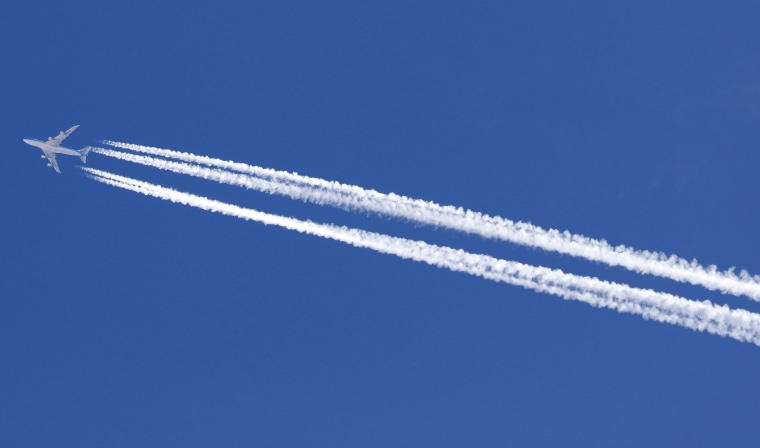
Do airplane contrails add to climate change? Yes, and the problem is about to get worse.

New research suggests the global warming effect will triple by 2050 as air travel increases.
Image: Airplane contrail

Contrails from a KLM Royal Dutch Airlines Boeing 747 jetliner flying high over Las Vegas on Feb. 27, 2019.Larry MacDougal / AP file

Birds Are Trying To Adapt To Climate Change — But Is It Too Little, Too Late?

A common guillemot (Uria aalge) brings a sprat to feed to its chick. The laying dates of this species were followed for 19 consecutive years on the Isle of May, off the coast of southeast Scotland. According to a new paper in Nature Communications, many birds are adapting to climate change — but probably not fast enough.

Michael P. Harris

Viktoriia Radchuk, an evolutionary ecologist at Berlin’s Leibniz Institute for Zoo and Wildlife Research, wanted to know how animals were responding to climate change.

So she scoured the results of more than 10,000 animal studies — on species from frogs to snakes, from insects to birds to mammals — looking for information on how changing environments were affecting animal behavior. Based on the available data, she decided to focus on birds in the Northern Hemisphere.

As detailed in a new paper in Nature Communications, Radchuk and her co-authors found that many birds are adapting to climate change — but probably not fast enough. “Which means, on average, these species are at risk of extinction,” she says.

The data focused on common and abundant bird species, such as tits, song sparrows and magpies (which are also the most well documented in studies). They showed that some bird populations are breeding, laying eggs and migrating earlier, which makes them better prepared for earlier onsets of spring — a significant effect of climate change.

Radchuk explains that when temperatures warm, plants flower earlier, and insects also develop earlier.

Enlarge this image

An adult red-billed gull (Larus novaehollandiae scopulinus) with a chick. The birds are part of a 54-year study on New Zealand’s Kaikoura Peninsula.

Deborah A. Mills

“For many birds, insects are their food source, which means that birds [should] time their egg laying to correspond to the peak of prey abundance,” she says, so their chicks have lots of food. Some birds have been shifting to earlier dates.

“We’ve known for a long time that global climate change is happening. We’ve known for a long time that animals are changing in response to this. But what we really haven’t known is how well the animals are keeping up with the selection,” says Melissa Bowlin, an ecologist at the University of Michigan-Dearborn who was not involved with the study.

The paper, which is largely based on studies from the past 30 years, comes to a stark conclusion: “The temperature is changing so fast that evolution isn’t able to keep up,” Bowlin says.

The abundance of the species in the studies is evidence that they are already better able to adapt to changing environments, says Radchuk. “So we would expect that the species that are rare and in danger already — from habitat fragmentation or invasive species or any other environmental change — would be even more sensitive to climate change.”

Bridget Stutchbury, a field biologist and ornithologist at York University in Toronto, is hopeful because birds have shown resilience in the past.

“At least for birds, many of the studies are done on species that are relatively short-lived, and they reproduce very easily,” she says. “Those traits allow them to adapt and respond quickly to changes.”

Stutchbury points to the bald eagle, whose U.S. population in the lower 48 states declined to 417 pairs in the 1960s but then rebounded to nearly 10,000 in the mid-2000s, after the federal government banned DDT and helped protect their habitat. “They can recover very quickly if we can put the environment back on track for them,” she says.

‘Unprecedented’ wildfires ravage the Arctic

Wildfire smoke is spreading from Alaska across parts of Canada.

Story highlights

  • The wildfires come as the planet is on track to experience the hottest July on record
  • Wildfires contribute to global warming by releasing carbon dioxide into the atmosphere

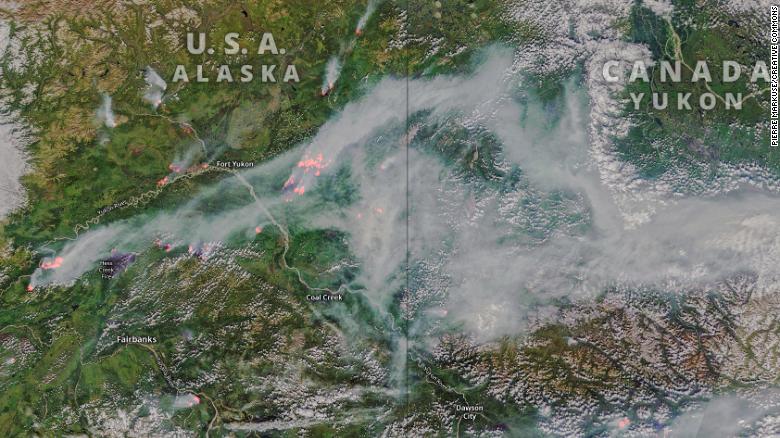
(CNN)More than 100 intense wildfires have ravaged the Arctic since June, with scientists describing the blazes as “unprecedented.”

New satellite images show huge clouds of smoke billowing across uninhabited land in Greenland, Siberia and parts of Alaska.
The wildfires come after the planet experienced the hottest June on record and is on track to experience the hottest July on record, as heatwaves sweep across Europe and the United States.
Since the start of June, Copernicus Atmosphere Monitoring Service (CAMS), which provides data about atmospheric composition and emissions, has tracked more than 100 intense wildfires in the Arctic Circle.
Pierre Markuse, a satellite photography expert, said the region has experienced fires in the past, but never this many.
Satellite images show smoke billowing across Greenland and Alaska as wildfires ravage the region.

Temperatures in the Arctic are rising at a faster rate than the global average, providing the right conditions for wildfires to spread, according to Mark Parrington, a senior scientist at CAMS.
“The number and intensity of wildfires in the Arctic Circle is unusual and unprecedented,” Parrington told CNN.
“They are concerning as they are occurring in a very remote part of the world, and in an environment that many people would consider to be pristine,” he said.
See how Europe is dealing with an extreme heatwave

Play Video

See how Europe is dealing with an extreme heatwave 01:34
The average June temperature in Siberia, where the fires are raging, was almost 10 degrees higher than the long-term average between 1981–2010, Dr Claudia Volosciuk, a scientist with the World Meteorological Organization (WMO) told CNN.
Parrington said there seemed to be more wildfires due to local heatwaves in Siberia, Canada and Alaska.
The fires themselves contribute to the climate crisis by releasing carbon dioxide into the atmosphere.
They emitted an estimated 100 megatons of carbon dioxide (CO2) into the atmosphere between 1 June and 21 July, almost the equivalent of Belgium’s carbon output in 2017, according to CAMS.
Volosciuk said wildfires are also exacerbating global warming by releasing pollutants into the atmosphere.
“When particles of smoke land on snow and ice, [they] cause the ice to absorb sunlight that it would otherwise reflect, and thereby accelerate the warming in the Arctic,” she said.

Netherlands and Belgium record highest ever temperatures

All-time records in Germany and Luxembourg could also fall in continent-wide heatwave

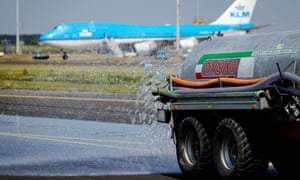
Water is sprayed on a taxiway at Schiphol airport in Amsterdam, the Netherlands
 Water is sprayed on a taxiway at Schiphol airport in Amsterdam during extreme heat. Photograph: Robin van Lonkhuijsen/AFP/Getty Images

The Netherlands and Belgium have recorded their highest ever temperatures as the second extreme heatwave in consecutive months to be linked by scientists to the climate emergency advances across the continent.

The Dutch meteorological service, KNMI, said the temperature reached 39.1C(102F) at Gilze-Rijen airbase near the southern city of Tilburg on Wednesday afternoon, exceeding the previous high of 38.6C set in August 1944.

In Belgium, the temperature in Kleine-Brogel hit 38.9C, fractionally higher than the previous record of 38.8C set in June 1947. Forecasters said temperatures could climb further on Wednesday and again on Thursday.

“The most extreme heat will build from central and northern France into Belgium, the Netherlands and far-western Germany into Thursday,” said Eric Leister of the forecasting group AccuWeather, with new all-time highs also possible in Germany and Luxembourg.

After several cities in France broke previous temperature records on Tuesday, including Bordeaux, which hit 41.2C, the national weather service, Météo France, said Paris was likely to beat its all-time high of 40.4C, set in July 1947, with 42C on Thursday.

City records in Amsterdam and Brussels are also expected to fall. Cities are particularly vulnerable in heatwaves because of a phenomenon known as the urban heat island effect, in which concrete buildings and asphalt roads absorb heat during the day and emit it again at night, preventing the city from cooling.

The latest heatwave, caused by an “omega block” – a high-pressure pattern that blocks and diverts the jet stream, allowing a mass of hot air to flow up from northern Africa and the Iberian peninsula – follows a similar extreme weather event last month that made it the hottest June on record.

Quick guide

What is causing Europe’s heatwaves?

Show

The highest ever June temperatures were recorded in the Czech Republic, Slovakia, Austria, Andorra, Luxembourg, Poland and Germany, while France registered an all-time record high of 45.9C in the southern commune of Gallargues-le-Montueux.

Clare Nullis, a World Meteorological Organization spokeswoman, said the heatwaves bore the “hallmark of climate change”. The extreme events were “becoming more frequent, they’re starting earlier and they’re becoming more intense”, she said. “It’s not a problem that’s going to go away.”

The 26-28 June heatwave in France was 4C hotter than a June heatwave would have been in 1900, according to World Weather Attribution, a new international programme helping the scientific community to analyse the possible influence of climate change on extreme weather events.

A study published earlier this year by the Swiss Federal Institute of Technology in Zürich said the summer heatwave across northern Europe last year would have been “statistically impossible” without climate change driven by human activity.

Rail passengers in Paris are given bottled water
Pinterest
 Rail passengers in Paris are given bottled water as temperatures on the city’s transport network soar. Photograph: Dominique Faget/AFP/Getty Images

KNMI has issued a code orange extreme temperature warning for everywhere except the offshore Wadden Islands and implemented its “national heat emergency” plan, while Belgium has taken the unprecedented step of placing the entire country on a code red warning.

Spain has also declared a red alert in the Zaragoza region, where the worst wildfires in 20 years took place last month. The EU’s Copernicus Emergency Management Service warned of an “extreme danger” of further forest fires in France and Spain on Thursday, with a high or very high threat level in Portugal, Italy, Belgium and Germany.

Twenty French départements were also placed on red alert. Agnès Buzyn, the health minister, said: “Nobody is immune in the face of such extreme temperatures. There are risks even if you are not particularly vulnerable.” Britain’s Met Office issued similar advice and said the UK all-time high of 38.5C, recorded in Faversham, Kent, in August 2003, could also be exceeded on Thursday.

Local authorities in France have placed restrictions on water usage in 73 of the country’s 96 départements following dramatic falls in ground and river water levels. “It’s tricky but under control, but we need to be very vigilant,” said the junior environment minister, Emmanuelle Wargon.

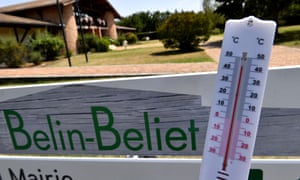
A thermometer outside the town hall of Belin-Béliet, south-western France
Pinterest
 A thermometer shows the temperature outside the town hall of Belin-Béliet in south-western France. Photograph: Georges Gobet/AFP/Getty Images

The French energy company EDF said it was shutting down two reactors at its Golfech nuclear power plant in the southern Tarn-et-Garonne region in order to limit the heating of water used to keep the reactors cool.

Scientists have said such heatwaves are closely linked to the climate emergency and will be many times more likely over the coming decades.

Last month, the Potsdam Institute for Climate Impact Research said Europe’s five hottest summers since 1500 had all occurred in the 21st century – in 2018, 2010, 2003, 2016 and 2002.

Monthly records were now falling five times as often as they would in a stable climate, the institute said, adding that this was “a consequence of global warming caused by the increasing greenhouse gases from burning coal, oil and gas”.

The regime of glaciers is headed to its end

For 35 years, a team of scientists have studied the decline of glaciers. What does their loss mean?

This article was originally published by Hakai Magazine and is republished here with permission.

Walking the icy flanks of Mount Baker — an active volcano in Washington State and one of the highest peaks in the Cascade Range — is probably one of most untainted wilderness experiences. And yet, it feels profoundly unnatural to me as I trudge up an oblique sheet of ice with crampons lashed to my boots and an ice axe hefty enough to clobber a mountain goat or a yeti gripped tightly in one hand. When I stop to fumble with my backpack and readjust my borrowed, baggy rain pants, which are failing to keep moisture from penetrating the innermost layers of my clothing, Mauri Pelto, the glaciologist who has brought me here, offers me a reprieve. “As we head into this icefall, you have to let me know,” he says quietly. “Maybe it’s just not the place for you.”

I have been asking myself this — whether this field of ice, known as the Easton Glacier, is the place for me — since the evening before, when I tried to navigate what Pelto had described as an easy jaunt to his camp more than a kilometer up a stream channel only to find myself stumbling across an obstacle course of mud, boulders, dense clusters of alder saplings, and glacial till. When I finally located his crew’s two tents well after nightfall (which, on an early August evening, arrived just before 9:00 p.m.), Pelto called out casually from inside one of them without disengaging from his sleeping bag: “Welcome to camp.” Then this morning, when we set out in the rain and I saw the glowing blue and gray leviathan of the Easton Glacier looming through the clouds, doubts churned in my stomach.

A high mountain glacier, in its frigid, deadly enormity, doesn’t feel much like a landscape meant for humans. In the European Alps, medieval myths held that glaciers carried curses and incarcerated the frozen souls of the damned. And yet, on a grand scale, where glaciers and humans coexist, our lives are entwined in ways we rarely realize. During the last ice age, the glaciers of Alaska locked up so much water that the seas lowered enough to create a land bridge to Siberia and perhaps allowed the earliest passage of humans into North America. Glaciers have carved out many of our mountain ranges, scoured out plains and prairies, and birthed rivers and lakes. Today, in many parts of the world, mountain glaciers preside over vast empires of fresh water that reach from the highest peaks to the coast: they dictate the flow of water downslope and influence the seasonal pulse of rivers and fish and the temperature and chemistry of streams and estuaries. They supply water for drinking, irrigation, and hydropower dams. But as the world gets warmer, glaciers’ influence in many regions is waning.

Pelto, a professor at Nichols College in Massachusetts, has been traveling to the northwest United States to document the behavior of glaciers every year for the past 35 years, witnessing their decline and fall, and this is why he regards the otherworldly scene before us with a kind of nonchalance. All morning, he has pointed out where the glacier used to be — in the 1990s, an area presently marked by the bit of precocious vegetation that has begun to colonize; then the early 2000s, a space now mostly comprised of bare rock and mud; then 2009, when his daughter, Jill, first came here with him as a teenager. She strides cheerfully behind him now, along with two graduate students from Maine — Mariama Dryak and Erin McConnell. Both are similarly sanguine, even though McConnell is wearing crampons that barely fit her boots, tied on precariously with some extra straps repurposed from her backpack. Through wind and rain, we have ascended a slope covered in glassy ice so hard we have had to stomp the crampons in just to get a foothold. Still, the women are unflappable and curious, lobbing questions at Pelto and at each other, and noticing formations and debris in the ice — from the geological bands left by meltstreams to a bit of tire tread and some pistachio shells presumably deposited months ago by incautious snowmobilers.

For scientists ascending the Easton Glacier in the Cascade Range of Washington State, it takes proper equipment and a sense of adventure. From left: Mariama Dryak, Erin McConnell, and Jill Pelto.
Photo by Madeline Ostrander

Ahead of us lies the icefall. Despite similar etymological origins, this unearthly terrain looks no more like a waterfall than a lunar crater resembles a river gulch. The icefall is instead a steep landscape of toothy crevasses gaping through 10 meters or more of ice thickness. I forge on, gasping and crunching across granular ice pebbles that look like glass fragments, lagging behind the others. I am quite certain that I don’t belong here, but I am too stubborn to turn back.

TO THE FIRST PEOPLES OF NORTHWEST NORTH AMERICA, the high realm of glaciers held spiritual significance. One might visit such a place seeking knowledge or guidance. “Places uncontaminated by other humans are where you found the strongest spiritual help,” recalled the late Vi Hilbert, an elder of the Upper Skagit Indian Tribe, in a 1996 interview.

But when Mauri Pelto began his work in the North Cascades — the upper section of the spine of mountains that stretches from Northern California to British Columbia — glaciers weren’t getting much scientific attention. His own obsession with them grew from his love of snow. Pelto was an avid winter athlete and considered trying out for the US Ski Team in 1983, after finishing his studies at Michigan Technological University. But two years previously, he had joined a research trip to the Taku Glacier in southeast Alaska. He was drawn to the massive icy body, fascinated by how dynamic it seemed to be — moving, pulsing, circulating air and water, almost like a living creature. And as he considered his career options, he realized he could always keep skiing. But if he wanted to spend more time in the company of glaciers, he would need to study science.

Glaciologist Mauri Pelto, hiking the Easton Glacier.
Photo by Madeline Ostrander

At the time, glaciology was an obscure scientific niche, and you could probably gather up all its experts and adherents from around the world and fit them into a single lecture hall. In 1983, he attended a meeting of the International Glaciological Society at Northwestern University outside Chicago. The gathering held a sense of urgency: glaciers were entering a period of trouble, upheaval, and loss that would likely affect their well-being for centuries if not millennia. Their role in the world could rapidly diminish as global warming robbed them of size and vitality. There was much about glaciers that the scientists wanted to account for, measure, study, and understand before the ice began to transform dramatically. The US Geological Survey (USGS) had collected some long-term glacier data, starting in 1958 with the South Cascade Glacier, about 130 kilometers northeast of Seattle, Washington. In 1964, UNESCO called for countries to conduct global research on water, and in response, Canada began an inventory of its glaciers and set up long-term monitoring projects at the Place Glacier (140 kilometers north of Vancouver, British Columbia) and the Peyto Glacier in Banff National Park in the Rockies and a number of other shorter-term glacier studies. But the approach on both sides of the border was piecemeal. By the 1980s, the USGS only kept tabs on about one glacier per major mountain range. In the United States, the National Academy of Sciences called on researchers to follow multiple glaciers in a single mountain range. But the Reagan administration was cutting budgets for a number of scientific and environmental agencies, the USGS included, and it seemed hard to imagine who would be able to follow such a recommendation.

Pelto — though still in his early 20s and then a novice at conducting science in the field — figured he could be the one. He enrolled in a graduate program at the University of Maine, but he wanted to study a place where glaciers lived in close proximity to people. So he chose as his research subject the North Cascades — even though they lay on the opposite end of the continent — because they held sway over the lives of at least several million people in their domain.

He developed a 50-year plan that would carry him all the way to a late retirement. He visited 120 glaciers in the Cascade Range and chose 10 that would receive an annual, in-person checkup. About 40 others would receive visit at least once every five years, and he would follow them remotely via aerial photography and, from the 1980s onward, satellite imagery. At the beginning, he recruited long-time mountaineers to serve on his field crews — mostly men who’d been climbing since the 1940s, including some famous characters like Bill Prater, who, with his brother Gene, invented the modern metal snowshoe to replace the old, impractical wood-and-bamboo variety. (The Easton is the launch point for one of the main climbing routes up Mount Baker, and many mountaineers have traversed it.) He collected the mountaineer’s photographs and stories, and then began to build up his own record. “It’s not just the data set,” he says. “You spend a long enough time working on anything … you develop an innate sense of what is impacting [it].”

In this illustration, Jill Pelto depicts herself measuring crevasse depth as she hikes a glacier.
Illustration by Jill Pelto

In the 1980s, the USGS thought glaciers might behave differently under warmer conditions based on the microclimates around them. But Pelto soon realized glaciers were responding in unison to climate change. “They’re all suffering,” he says.

Three decades later, the idea that glaciers are vanishing, that they are harbingers of climate change, is now well known. Six of the 120 Cascade glaciers Pelto originally surveyed have perished, including four of those he surveys by satellite imagery and two of the 10 he chose for his initial field study (which he’s since replaced with two glaciers that are still alive). When the regime of glaciers fully comes to a close — when rain and sun dominate over ice and snow — this will spell trouble for the rivers and coasts below. Few people have yet reckoned with the consequences.

IF YOU HAVE ONLY EVER GLIMPSED A GLACIER FROM AFAR, it would be easy to think of it as a large but inert smear of snow. Three years ago, I gazed at the Exit Glacier in Seward, Alaska, from a partially paved trail — an experience akin to seeing a polar bear at the zoo, so well-contained that it lost all sense of wildness or danger. So I had not imagined how ferocious the Easton would feel — angular, massive, thrumming with meltwater. We begin the day at about 1,700 meters elevation, and Pelto says we’ll stop at about 2,000 meters. But the glacier rises well above this for another 800 meters. In total, the Easton stretches about four kilometers in length and three square kilometers in area, or roughly the size of 160 Manhattan city blocks. The terrain has a primordial quality, accentuated by the pale cyan light that emanates from the ice surface. The oldest ice dates to Mount Baker’s last eruption about 6,700 years ago.

We encounter a few other creatures on the ice. They appear suddenly, like apparitions. Grosbeaks flit past us. I spot a frozen green fly of unknown origin. (Jill tells me wind can carry insects long distances up the mountain, and spiders can find themselves accidentally airborne over a glacier, propelled upward by the electrical charge differential between the ground and the atmosphere.) Then, in a shin-deep, blue pit in the snow, we find an assembly of a few hundred ice worms, each slender, inky, wriggling, and about the length of my knuckles — Mesenchytraeus solifugus, a species occurring only on coastal glaciers including the Cascade Range, the Coast Mountains of British Columbia, and mountains along coastal Alaska.

Easton’s icy world shifts and creaks, and the babble of water fills the air, sounding like a bass drum as it hits the ice, and a soprano rush and gurgle as it races along. Below the surface, the meltwater forms channels and tubes called moulins, then emerges at what are called supraglacial streams. At one such stream, Pelto and the crew pause, first to fill their water bottles. “That’s the good stuff,” Dryak exclaims, and everyone drinks deeply for several minutes. Then they measure the velocity of the same stream. Pelto tromps a few meters uphill and pours a bottle of biodegradable fluorescent green dye into the water, and McConnell pulls out a stopwatch and records how long it takes for the dye to pass below. This is not a typical glacier measurement, but Pelto feels that one might glean new information about glacier behavior by paying attention to such streams and how they evolve, mature, and change shape and speed.

The day is full of such acts of measurement, in metric and imperial depending on the instrument. Pelto carries a nine-foot steel pole, notched with foot and inch markings for gauging depth, and stops at miscellaneous locations to tap it into the snow like a fence post. The pole also has a second function—as a crevasse finder. As we enter the icefall, he taps the pole into a flat, smooth layer of snow and it drops easily, tracking nothing solid, slipping into emptiness beneath. We wend through a labyrinth of crevasses — some making wide, visible slashes across the ice, others hidden — and whenever we need to cross snow, Pelto has us walk single file as he probes the ground with his pole.

The most common way to check the health of a glacier is to calculate mass balance — an icy accounting of profits and losses — by taking field measurements of the snowdepth and the height of the glacier and combining it with a range of data from satellites and weather records to estimate the gains and losses of ice and snow. Pelto is also a collector of miscellaneous observations and data — the way some people collect curios or colorful stones — with the idea that they may at some point allow him or other scientists to learn or create something. On another glacier, he counts goats every year, though he has no zoological background. Jill, in similar spirit, has taken it upon herself to measure crevasse depth, and she perches at the edges of some of the most fearsome-looking cavities and unspools a plumb line into each. She asks us to take bets on how deep each crevasse is. Most are around 10 or 12 meters. A healthy glacier has many deep crevasses, says Pelto, the way a healthy brain has many folds.

But the ultimate goal — to create a detailed portrait of the Easton, its behavior, its past, its future — is not theoretical. Across from us, through cloud and fog, appears another white shape — the Deming Glacier, which feeds water into a hydroelectric dam that powers the approximately 90,000-person coastal city of Bellingham, Washington, mid-way between Seattle and Vancouver, British Columbia. Pelto doesn’t visit the Deming because it is so steep it’s almost inaccessible. But the Easton is a stand in, and they are both shrinking.

THE WORST MOMENT for Mauri Pelto’s glaciers so far came in 2015. A winter of sparse snow followed by a record hot summer robbed the glaciers of more ice and snow than any other season in the past 50 years. (The same season churned up the largest fires on record in Washington state and filled Seattle skies with acrid smoke.) That season, Pelto became emotional with each glacier visit. “The glaciers just looked naked. Only two of the glaciers had any snow at all on them,” he remembers. “You just had a sense—these things are going to lose so much this year. They’re never going to get it back.”

It was also a glimpse of things to come: “2015 was a perfect year that we use as a surrogate for what we think the future might be,” says Oliver Grah, the water resources program manager for the Nooksack Indian Tribe, an indigenous community whose administrative headquarters lie along the Nooksack River, halfway between Bellingham, at the river’s mouth, and Mount Baker, whose glaciers feed the river.

Easton Glacier in 1912.
Photo by E. D. Welsh
Easton Glacier in 2012.
Photo by John Scurlock/Jagged Ridge Imaging

The name Nooksack derives from a place name meaning “always bracken fern roots.” According to the community’s oral histories, the Nooksack have always lived in this watershed. Anthropological and archaeological research documents the Nooksack people’s presence from the upper elevations of Mount Baker to the river’s mouth at Bellingham Bay and northward across the U.S.-Canada border. They were only officially recognized by the US government in 1973 and currently have about 2,000 enrolled members and a modest set of offices across from some railroad tracks in the rural, unincorporated town of Deming. But they employ 15 natural resource scientists and research technicians and run an ongoing glacier hydrology research program.

Grah — who is not a tribal member but has worked for the tribe since 2011 — monitors water and streamflow along the Nooksack River, which has three forks. The middle and north forks are fed by four and 12 glaciers respectively, but the warmer south fork receives almost no glacial meltwater. The north can be as much as 5 ˚C colder than the south. Nine species of Pacific salmonids, including trout, migrate up these streambeds, but, because of the glaciers, the middle and north forks offer a safer, cooler refuge for chinook and chum in hot summer months. The salmon are paramount to Nooksack culture and diet, and the tribe has a federally protected legal right to fish in this watershed based on an 18th-century treaty.

The glaciers supply the cool water that keeps the fish healthy. When Grah and Pelto met in 2012, both saw the potential for collaborating. Two years later, the tribe began assisting Pelto with some of his research costs — via grants from the US Environmental Protection Agency and the US Bureau of Indian Affairs — in exchange for help setting up their own program to study glacier outflow. Grah and some of his colleagues trekked 11 kilometers into the wilderness on foot to set up and then regularly check a gage at the base of the Sholes Glacier, which flows into the north fork. In August 2015, they noticed that there was slightly more water coming from the glacier as the intense heat melted more ice, but also, as the glacier’s retreat laid bare the earth beneath it, more sediment and dirt filling the streams below.

The last couple of summers have been some of the hottest in the Cascade Range. The terminus, or lowest point, of the Easton Glacier — where the researchers are standing — continues to melt and recede. From left: Jill Pelto, Mauri Pelto, Mariama Dryak, and Erin McConnell.
Photo by Madeline Ostrander

The streamflow increase was temporary. Pelto says the outflow produced by glaciers in the Cascades peaked in the 1990s and has been, on average, declining ever since. If the glaciers shrink enough, the amount of water they offer to the region’s rivers could drop to a trickle. The heat and erosion could be long-term problems. Salmon need clear water to see the insects and larvae they eat, and they can’t stand temperatures much higher than 20 ˚C. “It’s summers like this that are killing us for coho,” says Ned Currence, a fish biologist and Grah’s colleague at the tribal headquarters.

On a late-summer day in 2018, I visit a spot on the south fork at the edge of farmland where Currence and another fish biologist, Treva Coe, oversee the construction of a logjam. Stacked at the edge of the stream channel is a pile of wood — logs and fallen trees, many of them with a massive root ball still attached. The logjam’s ultimate destination, a spot several meters farther into the water, is demarcated by white sandbags where a crew of mostly tribal members is seining fish to make way for the wood. The fish will eventually be allowed to swim into the cool hiding places the logjam is meant to provide: the tribe has installed more than 200 of these throughout all three tributaries and is also replanting trees along the water’s edge to create shade.

But will it be enough if summer days are regularly like this one? The air is over 30 ˚C and the sun glares — so hot that Coe insists on yanking off a pair of heavy khaki waders and boots and, with meek apologies, dipping into the river for a swim midway through our interview.

It may be hard to replace the cooling power of high mountain glaciers.

As we conclude our expedition up the Easton, I follow Pelto and his crew to a high, flat bench of snow that gets progressively deeper, from one and a half to three and a half meters at the top. The upper zone of the glacier is colder than the lower, simply because of the elevation difference, so it retains more snow. It is known as the accumulation zone. It is like the glacier’s mouth and stomach, taking in sustenance that supports the entire body of ice.

Because glaciers like this are so large, high, and dynamic, Pelto thinks some claims about their hasty demise may be exaggerated, particularly the estimate that Glacier National Park (the U.S. park not the Canadian one) will lose all of its 26 remaining eponymous ice bodies in just over a decade.

“People always ask, ‘How soon is it going to disappear? They’re melting so fast,’” he says. He points to a deep crevasse ahead of us. “But then you see how thick the ice is at a place like this. And then we’re nowhere near the thickest place of the ice.”

2e3sj4vs-jpg
In this illustration, Jill Pelto depicts herself measuring crevasse depth as she hikes a glacier.
Illustration by Jill Pelto

Whether glaciers vanish altogether or not, he insists, misses the point. Glaciers are not simply curiosities or aesthetic objects, not things we should regard with mere sentimental interest. As they lose their foothold and prominence in places like this, we will feel the effects downstream, more powerfully than most people realize. But because glaciers are usually out of sight or far above us, we have failed to appreciate them. Even today, few models of climate change or hydrology adequately account for the role of glaciers. Their losses will be felt regionally and globally: mountain glacier melt makes a substantial contribution to sea level rise.

Much of the Pelto family is now involved in telling the story of glaciers. Jill has become a well-known artist and has created a series of vivid watercolors depicting various aspects of climate change, including the loss of glacial ice. Pelto’s son, Ben, is pursuing a Ph.D. in glaciology at the University of Northern British Columbia. And for the past decade, Pelto has kept a blog called From a Glacier’s Perspective, now hosted by the American Geophysical Union, which offers observations about the world’s glaciers, including those he studies, albeit in relatively technical language. In 2017, a period of higher-than-normal snowfall followed by a record hot and parched summer, Pelto reported that his glaciers retreated an average of 12 meters at their bases. In March 2018, on his blog, he recounted the story of the annual monitoring of Easton Glacier since 1990. He has taken more than 5,000 measurements of its snow depth and melt in those nearly three decades, and the Easton has shed a quarter of its ice volume, slowed its movements, and lost crevasses. It is, in other words, slowly wasting away.

“There’s a lot of different stories,” he says. “The glaciers are suffering. I can tell that one glacier at a time. Each person cares about this certain glacier in their backyard.” But I wonder how many people consider them when they are distant and shrouded in cloud. And this may be Pelto’s true contribution — year after year, to document and try to make clear how much life and complexity is part of the high mountains.

We descend from the snow basin back toward camp. The researchers will stay on to take more measurements the next day, but I repack my belongings and prepare to head downslope alone. Pelto gives me directions to follow a ridge above the streambed that offers easier passage. In daylight, the return journey is a like a walk through time-lapse photography — the picture of glacial influence and retreat in just a few kilometers. A field of rocks and mud turns to grasses and marshes. A waterfall and then a roaring stream burst from the hillside. Seedlings and then larger saplings appear, then dense clumps of alders. As I hike down along a trail, the trees rise until they become tall, old-growth cedars and firs. Between here and the coast are hundreds of square kilometers of forests and fish and animals, patches of farmland, rural towns, and urban areas.

Glaciers, our benefactors, helped forge and feed these places for millennia. As they retreat, it will be no small thing to learn how to manage without them.

Climate Crisis Disasters Now Occur Weekly, UN Warns

A “staggering” new warning from a top United Nations official that climate crisis-related disasters are now occurring at the rate of one per week, with developing nations disproportionately at risk, provoked calls for immediate global action to combat the human-caused climate emergency.

The warning came in an interview with The Guardian, which reportedSunday:

Catastrophes such as cyclones Idai and Kenneth in Mozambique and the drought afflicting India make headlines around the world. But large numbers of “lower impact events” that are causing death, displacement, and suffering are occurring much faster than predicted, said Mami Mizutori, the U.N. secretary-general’s special representative on disaster risk reduction. “This is not about the future, this is about today.”

This means that adapting to the climate crisis could no longer be seen as a long-term problem, but one that needed investment now, she said. “People need to talk more about adaptation and resilience.”

“We talk about a climate emergency and a climate crisis, but if we cannot confront this [issue of adapting to the effects] we will not survive,” Mizutori added. “We need to look at the risks of not investing in resilience.”

Wolfgang Cramer 🌍@wolfgangcramer

“The most vulnerable people are the poor, women, children, the elderly, the disabled and displaced” https://gu.com/p/bnynz/stw 

One climate crisis disaster happening every week, UN warns

Developing countries must prepare now for profound impact, disaster representative says

theguardian.com

25 people are talking about this

The estimated annual cost of climate-related disasters is $520 billion, the newspaper noted, “while the additional cost of building infrastructure that is resistant to the effects of global heating is only about 3 percent, or $2.7 trillion in total over the next 20 years.”

“This is not a lot of money [in the context of infrastructure spending], but investors have not been doing enough,” said Mizutori. “Resilience needs to become a commodity that people will pay for.”

Sam Greene@Adaptedplanet

This isn’t just about “standards” and “early warning”. It’s about CASH going where it’s most needed. No-where near enough reaches the places where these disasters are happening every day. https://www.theguardian.com/environment/2019/jul/07/one-climate-crisis-disaster-happening-every-week-un-warns 

See Sam Greene’s other Tweets

Mizutori said that improving the systems that warn the public of severe weather and expanding awareness of which places and people are most vulnerable could help prevent lower impact disasters. She noted that while urgent work is needed to prepare the developing world, richer countries are also experiencing the consequences of global heating — including devastating wildfires and dangerous heatwaves.

The adaption measures Mizutori called for include raising — and enforcing — infrastructure standards to make houses and businesses, roads and railways, and energy and water systems more capable of withstanding the impacts of the warming world, which scientists warn will increasing mean more frequent and intense extreme weather events. She also highlighted the potential of “nature-based solutions.”

Peter Strachan — a professor and expert on energy policy, environmental management, and energy transitions at the U.K.’s Robert Gordon University — called the report “staggering” and alerted several environmental and climate advocacy groups on Twitter.

155 people are talking about this

Sharing The Guardian’s article on Twitter, the U.S.-based youth-led Sunrise Movement declared: “This is an emergency. We need political leadership that acts like it.”

Sunrise Movement 🌅

@sunrisemvmt

One climate crisis-fueled disaster every week.

That means every week, tens of thousands of people are losing their lives or livelihoods.

This is an emergency. We need political leadership that acts like it.https://www.theguardian.com/environment/2019/jul/07/one-climate-crisis-disaster-happening-every-week-un-warns?CMP=share_btn_tw 

307 people are talking about this

“This is why it’s so offensive to talk about climate impacting ‘our children/grandchildren,’” tweeted War on Want executive director Asad Rehman, referencing a common talking point among U.S., European, and U.N. leaders. “Do people of global South facing disaster every week not deserve the right to life? The answer from rich countries and those who call for net zero by 2050 is a big No.”

asad rehman@chilledasad100

This is why it’s so offensive to talk about climate impacting ‘our children/grandchildren’. Do people of global South facing disaster every week not deserve the right to life?.The answer from rich countries & those who call for net zero by 2050 is a big No https://www.theguardian.com/environment/2019/jul/07/one-climate-crisis-disaster-happening-every-week-un-warns 

156 people are talking about this

The climate crisis and the end of the golden era of food choice

https://www.vox.com/the-highlight/2019/6/17/18634198/food-diet-climate-change-amanda-little

What’s for dinner in a hotter, drier, more crowded world?

Imagine waking up in a world that has become so hot and so crowded that most of what you eat has disappeared from the grocery store altogether.

Or imagine eating only genetically engineered foods or a diet of exclusively liquid meal replacements.

These are scenarios that Amanda Little, an environmental journalist and professor at Vanderbilt University, envisions in her new book, The Fate of Food. Heat, droughts, flooding, forest fires, shifting seasons, and other factors, she argues, will radically alter our food landscape — what we eat, where it’s made, how we pay for it, and the choices we have. If we’re going to survive, she says, we’ll have to reinvent our entire global food system to adapt to the changing climate.

As Little puts it: “Climate change is becoming something we can taste.”

How could this affect the average person? Can we rely on technology and human ingenuity to bail us out? And what could our diets look like in five or 10 or 20 years? A transcript of my conversation with Little, edited for length and clarity, follows.

Sean Illing

The world is getting hotter, more crowded, and drier. Is our global food production system prepared for these changes?

Amanda Little

Yes and no.

The big paradox of our food future is this decline in arable land on the one hand, and increasing population on the other.

The Intergovernmental Panel on Climate Change has reported that the planet, given current trends, will reach a global warming threshold beyond which farming as we know it “can no longer support large human civilizations.” That’s terrifying.

But we also have to remember that this narrative of “We’re running out of food!” is as old as civilization. For millennia, there have been predictions that humans will outstrip their own edible resources — and for millennia, we’ve figured out ways to adapt and survive. The stakes are higher now than ever, but the potential solutions are also greater.

Sean Illing

What’s the threshold of global warming beyond which our current agricultural practices will break down? And how close are we to that threshold?

Amanda Little

The IPCC’s time frame is midcentury, so about 30 years from now. But disruptions in food supply are already evident almost everywhere. Right now, soy and corn farmers in the Midwest, for example, can’t plant their grains because massive storms have caused their fields to flood.

In recent months and years, extreme weather events have damaged or destroyed olive groves in Italy, vineyards in France, citrus and peach orchards in Florida and Georgia, apple and cherry orchards in Wisconsin and Michigan, avocado farms in Mexico, coffee and cacao farms in dozens of equatorial nations. There has been severe damage to dairy and livestock operations the world over.

Sean Illing

A lot of this feels abstract for people who haven’t been directly impacted by these issues, or have and don’t know it. How will this affect the average American, who can still walk into a grocery store and choose between 30 different brands of cereal or bread?

Amanda Little

Most of us are so displaced from the sources of our food that we’re experiencing these disruptions for now only as subtle fluctuations in the quality and price of our foods. The massive damage to corn and soy farms in the Midwest this spring will simply result in slightly higher costs of corn and soy.

Let’s take a more local example: I live in Nashville, Tennessee, and one of the greatest pleasures of that region are Georgia peaches. Peach trees have been blooming earlier from warmer winters, and then become vulnerable to devastating freezes that can kill off harvests and cause the fruits that do grow to be smaller in size and have degraded texture and flavor.

Those near-term effects are subtle but by midcentury may be far more significant. And if you live in India or China or parts of the Middle East and southeastern Africa, the challenges of drought, flooding, and shifting seasons are not degraded peach quality but full-blown famine. There are currently tens of millions of people in at least half a dozen subsistence-farming countries facing famine.

Sean Illing

Which foods might we lose?

Amanda Little

The most climate-vulnerable foods include those that are most fickle, needing very specific conditions to grow well, like coffee, wine grapes, olives, cacao, berries, citrus and stone fruits — as well as those that are most water-intensive, like almonds, avocados, and the alfalfa and pasture that feed cattle.

This is when some consumers start to stand up and listen: Yes, your chardonnay and strawberries are on the line.

Sean Illing

So what’s the role of technology and innovation in our food future? Will human ingenuity save us?

Amanda Little

Technology alone can’t save us, but judicious applications of technology can. I say in the book: Human ignorance and ingenuity got us into this mess, and ingenuity combined with good judgment can get us out of it.

Sean Illing

Let’s talk about some of those solutions. Your book is a kind of tour through different areas of food innovation, everything from genetic engineering to vertical farming to lab-based meats. What would you say is the most promising area of research, the one that gives you the most optimism about our ability to adapt and thrive moving forward?

Amanda Little

The weeding robot developed by a startup named Blue River Technology blew my mind. The bot can distinguish between a baby weed and a baby crop, and can annihilate that weed with incredible precision, radically reducing the use of herbicides on fields.

I watched the maiden voyage of this robot a couple years ago on a field in Arkansas. Instead of dumping billions of gallons of weed killer like glyphosate on fields, as is done in conventional agriculture, this bot was delivering tiny sniper-like jets of herbicide, making decisions in fractions of milliseconds as it was dragged down a field behind a tractor. It was staggering to see the machine make mistakes and become smarter as it learned which plants to kill and which to protect.

The bigger picture is even more exciting: Robotics can be applied to fungicides, insecticides, and even fertilizers, reducing agrochemicals in large-scale farming by 90-plus percent. It’s a future of plant-by-plant rather than field-by-field farming, which means you don’t have to do 1,000 or 10,000 acres of corn; you can intercrop fields with a variety of crops.

In other words, robotics may help us bring diversity to large-scale food production, borrowing from the lessons of agroecology.

Sean Illing

This is what you mean when you call for “third way” agriculture — this kind of past-future approach to food production?

Amanda Little

Part of what drove me to write this book was the realization that sustainable food is politicized, elitist, and riddled with misperceptions. On one hand, you have a pro-technology camp saying, as Bill Gates did a few of years ago, “Food is ripe for reinvention!” On the other, you have sustainable food advocates saying, “I want my food de-invented, thank you very much. Let’s go back to preindustrial agriculture.”

There’s a deep distrust of technology as applied to food — understandably, because industrial agriculture is so flawed. But as someone observing this debate for years, I wondered: Why must it be so binary? We need a synthesis of the two approaches.

We need a “third way” that borrows from the wisdom of traditional food production and from our most advanced technologies. Such an approach would allow us to grow more and higher-quality food while restoring, rather than degrading, public health and the environment.

Sean Illing

What will our diets look like in five or 10 or 30 years? What will we eat, and how will we grow it? Or will we grow it at all?

Amanda Little

The hope is that our diets will actually taste and look a lot like they do today. We’re living in a golden era of food diversity and accessibility. Ideally, we’ll continue to have this kind of abundance and diversity in food choices. But the provenance of those foods — where and how they’re grown — may change pretty radically.

You’re already seeing that in the realm of meats, all these plant-based alternatives coming online, like Beyond Meat, with its massive IPO recently.

In the book, I investigate “cell-based” meats, a.k.a. lab meats, where meat tissues are grown from cell biopsies taken from animals. Any kind of animal or fish protein — beef, duck, tuna — can be grown without the animal, essentially. I ate lab-grown duck meat that tasted as advertised: meaty, ducky. Years from now, these products will be ever harder to distinguish from animal-derived meats, and very possibly a part of mainstream diets.

Take another example: vertical farms growing aeroponic fruits and vegetables without soil or sun, using radically less water in urban areas. Will they taste exactly like the tomatoes grown your organic backyard garden? Possibly close. And loads of research is going into the use of genetic editing tools like CRISPR to adapt staple crops and even heirloom fruits and vegetables to new environmental pressures, so that they can become heat-tolerant, drought-tolerant, able to withstand invasive insects. These are not so much efforts to develop freaky Frankenfoods, but to help our food systems survive the new normal.

None of this means that in the future you won’t be able to eat organic, soil-grown crops or the craft meats you love today. It means that human innovation, which marries new and old approaches to food production, may be redefining sustainable food on a grand scale.

Election 2020: The Candidates’ Climate Change Positions and Accomplishments

How do the Democratic presidential hopefuls compare on their climate actions and promises to solve the crisis? With the debates coming, ICN analyzes their records.

John H. Cushman Jr.

BY JOHN H. CUSHMAN JR.

Debate 2020: The Candidates’ Climate Positions & What They’ve Actually Done

JUN 24, 2019

The Democrats running for president have a wide range of climate platforms and views on the policy choices, as these candidate profiles show. Credit: Drew Angerer/Getty Images

Anyone who views the climate crisis as a compelling issue can only be frustrated by how it has been handled in presidential debates over the years—neglected, mostly. And as the first round of debates for the 2020 election arrives, the frustration may be repeated, if for different reasons this time around.

It’s not that the issue won’t come up. It will, driven by climate events in the real world, by the extraordinary record of reversal and denial in Washington, by the emphatic alarms of scientists, and by the loud insistence of activists that candidates and the media alike do their share in focusing the spotlight on the urgency of action. Even if the interrogators don’t emphasize it, some candidates will.

To prepare for the debates, we explored the candidates’ evolution on climate change and early progress in bringing the issue to the forefront in 2020. In the following series of profiles, we focus on the most prominent candidates and those with the most detailed climate proposals, with an eye toward showing the spectrum of policy choices.

Read and share the individual profiles, candidate by candidate. ]

Sign up for InsideClimate News Weekly

Our stories. Your inbox. Every weekend.

I agree to InsideClimate News’ Terms of Service and Privacy Policy

On Wednesday and Thursday this week, 20 candidates face questioning from a panel of journalists in two rounds, with 10 candidates each evening. With so many candidates and so much ground to cover, there may be only slight attention to climate change. It may be hard to distinguish the candidates’ climate policy positions from one another, let alone to discern the complex details in depth, or to decide which answers are the more coherent, practical or politically appealing.

One goal in these profiles: to help you prepare to watch the debates, perhaps forming in your own mind what climate question you would pose to candidates beyond the most simplistic.

Instead of being asked “do you believe in global warming?” or “would you stay in the Paris treaty?”—every Democratic candidate does and would—we think they should face questions like these:

  • “How much would you demand that U.S. emissions decline in your first term, in order to put your targets within reach by the end of your second term?”
  • “Many people say we have only 12 years to act. Can you explain where that number comes from and whether you believe it?”
  • “Should fossil fuel producers be held liable for the damages being inflicted now because of emissions from our previous use of their products?”
  • “Do you think American youth have a constitutional right to a safe climate that could be enforced by the courts?”
  • “Should any of the revenues from a carbon tax be spent on research and development of clean technologies, or should it all be returned to households as a tax rebate or dividend?”
  • “How much expansion of our natural gas production would be consistent with reaching zero net emissions of carbon dioxide by 2050?”
  • “Would you rely heavily on any of these technologies: a new class of nuclear reactors? Capturing the carbon from smokestacks or the atmosphere for storage underground? Geo-engineering to reflect sunlight or seed the oceans as a carbon sink?”

Of course, you can’t count on such probing questions being asked or answered. But keeping careful, probing questions in mind may help you to sort out which candidates are truly informing the public. We, too, will parse the answers afterwards.

Following are profiles of a dozen candidates, listed alphabetically. They were drawn from those who are leading in the polls, have detailed climate platforms, or represent diverse policies.

“What’s the point of being a progressive if we can’t make progress?”
—Michael Bennet, November 2017

Been There

Sen. Michael Bennet frequently talks about the twin problems of drought and wildfire that have plagued Colorado for years, problems that scientists say will only worsen with global warming—longer wildfire seasons, shorter ski seasons, scorching drought. In an Iowa campaign speech, he said: “I spent the whole summer meeting with farmers and ranchers in places where I’ll never get 30 percent of the vote in Colorado, who are deeply worried about being able to pass their farms or ranches along to their children or grandchildren because they have no water because of the droughts.”

Done That

Bennet, a scion of a political family with insider Democratic credentials, was initially appointed to the Senate to fill a vacancy. He’s since navigated through the minefields of climate and fossil fuel policy. Notably, he repeatedly broke with most Senate Democrats to vote for the Keystone XL pipeline, an act that climate activists might not swallow easily. He bemoaned the fight over Keystone as “one of those idiotic Washington political games that bounces back and forth and doesn’t actually accomplish anything,” as he said to the Wall Street Journal.

Getting Specific

  • Bennet has published an extensive climate platform that promises zero emissions by 2050 “in line with the most aggressive targets set by the world’s scientists.”  But he hasn’t embraced the Green New Deal: “I’m not going to pass judgment one way or another on the Green New Deal,” Bennet said during an Iowa speech in February. “I’m all for anyone expressing themselves about the climate any way they want.”
  • His climate platform boosts ideas like these: Giving everyone the right to choose clean electricity at a reasonable price from their utility, and doing more to help them choose clean electric cars. Setting up a Climate Bank to catalyze $10 trillion in private innovation and infrastructure, and creating a jobs plan with 10 million green jobs, especially where fossil industries are declining. Setting aside 30 percent of the nation’s land in conservation, emphasizing carbon capture in forests and soils, and promoting a climate role for farmers and ranchers.
  • The problem he faces is squaring that with an ambivalent record on fossil fuels. His support for Keystone was not an anomaly: Bennet has been supportive of fossil fuel development generally, especially natural gas, as in his support for the Jordan Cove pipeline and natural gas export terminal project in Oregon. In a 2017 op-ed in USA Today, Bennet wrote that “saying no to responsible production of natural gas—which emits half the carbon of the dirtiest coal and is the cleanest fossil fuel—surrenders progress for purity.”
  • On the other hand, he favors protection for Alaskan wilderness from drilling.
  • According to his campaign, Bennet “does not accept money from any corporate PACs or lobbyists.” But Bennet has not signed the No Fossil Fuel Funding pledge.
  • Bennet’s climate plan doesn’t outline specific carbon pricing goals, but he recently released a carbon pollution transparency plan to recognize the full climate costs of carbon pollution when assessing the benefits of environmental protections.
  • In 2017, Bennet co-introduced a bill to allow businesses to use private activity bonds issued by local or state governments to finance carbon capture projects.
  • And he has proposed legislation to expand economic opportunities in declining coal communities.

Our Take

Bennet is a climate-aware politician from an energy-rich but environment-friendly swing state who doesn’t aggressively challenge the fossil fuel industry’s drilling, pipeline and export priorities. His platform covers the basics of emissions control, plays a strong federal hand and includes protections for public lands. But his support for the Keystone XL and other fossil development and his sidestepping of issues like carbon pricing shy away from some of the climate actions that progressives hope to push forward.

—By Nina Pullano

“The willing suspension of disbelief can only be sustained for so long.” 
—Joe Biden on climate denial, March 2015

Been There

Among the current candidates, only former Vice President Joseph Biden has debated a Republican opponent during a past contest for the White House—when he was Barack Obama’s running mate and took on Sarah Palin in 2008. It’s a moment that might come back to haunt him, because in a brief discussion of climate change—a chance to trounce her on the question of science denial or fossil fuel favoritism—he instead slipped into a discussion of what he called “clean coal,” which he said he had favored for 25 years. He explained it away as a reference to exporting American energy technology. But his loose language, taken in today’s context, sounds archaic.

Done That

Biden likes to say he was among the first to introduce a climate change bill in the Senate, and fact checkers generally agree. It was the Global Climate Protection Act of 1986 that was largely put into a spending bill in 1987. The Reagan administration pretty much ignored it, but the bill did call for an EPA national policy on climate change, and annual reports to Congress.

Biden represented Delaware in the Senate 36 years, and he had a lifetime environmental voting score of 83 percent from the League of Conservation Voters. In 2007, he supported higher fuel efficiency standards for motor vehicles, which passed, and in 2003, modest caps on greenhouse gas emissions, which didn’t.

But his longevity is a liability, because the longer the voting record, the more contradictions. He missed a key vote in 2008 on the Lieberman-Warner Climate Security Act, which was said to be the strongest global warming bill to ever make it to the Senate floor. Biden also opposed tightening fuel efficiency standards earlier in his career.

The Biden-Obama administration was strong on climate change, especially in its second term, notably achieving the landmark Paris climate agreement, asserting climate action and jobs go hand in hand. It pushed through auto fuel economy standards that deeply cut emissions. It also produced regulations on coal-fired power plants, but the rule was stymied by litigation and has been replaced with a weaker rule by the Trump administration.

Often overlooked, the Obama era stimulus package of 2009 included big investments in climate-friendly research and infrastructure. But Biden is also tethered to Obama’s “all-of-the-above” philosophy, which left ample room for the fracking boom that bolstered one fossil fuel, natural gas, over another, coal, and put the U.S. on track to become the world’s leading oil producer.

Getting Specific

  • Biden surprised some activists and pundits in June when he presented his campaign’s first climate platform. It went further than many of his previous positions, and embraced the Green New Deal as a “crucial framework.”
  • Biden foresees $1.7 trillion in spending over the next 10 years, and $3.3 trillion in investments by the private sector and state and local governments.
  • He wants Congress to pass emissions limits with “an enforcement mechanism … based on the principles that polluters must bear the full cost of the carbon pollution they are emitting.” He said it would include “clear, legally-binding emissions reductions,” but did not give details.
  • His plan also calls for support for economically impacted communities. He has been slow to agree with activists’ calls for him to swear off campaign contributions from fossil fuel interests, but his campaign has signaled that he soon will do so.

Our Take

Biden has signaled he will embrace central concepts of the Green New Deal—that the world needs to get net zero greenhouse gas emissions by 2050 and that the environment and economy are connected. He was slower to do so, and for that reason he has faced criticism from young, impatient voters.

That compounds the challenge of explaining Senate votes that took place a long time ago. But he is known for his ability to communicate with blue-collar voters who abandoned Democrats for Trump, as well as older voters who have turned out in the past.

—By James Bruggers

“The opposite of justice is not injustice, it’s inaction, indifference, apathy.”
—Cory Booker, October 2018

Been There

Sen. Cory Booker traveled to Paris during the negotiations of the United Nations climate treaty in 2015, and when he came back, he took to the Senate floor to recount conversations he had there with lawmakers from Bangladesh, one of the poorest and most vulnerable of the signatory nations. As the Himalayan glaciers melt and the oceans rise, he said, “right now Bangladesh is losing 1 percent of its arable land each year, displacing millions of Bangladeshis, literally creating climate refugees.” The richest people on the planet, he was saying, should make common cause with the poorest.

Done That

Since he rose to prominence as an organizer, council member and mayor of Newark, New Jersey, Cory Booker has built a distinct environmental brand that centers on issues of racial and class equity. By 2017, as a U.S. senator and member of the Senate Environment and Public Works Committee, he was pushing to strengthen federal environmental justice programs. This year, as a presidential candidate campaigning in South Carolina, Booker formally adopted the theme as a platform plank.

Booker has consistently achieved a nearly perfect voting record on the annual green scorecards of the League of Conservation Voters. But like most other Senate Democrats, there’s no enacted law he can point to that would mark him as an especially effective climate or environmental champion.

Getting Specific

  • Booker was among the first senators with eyes on the Oval Office to endorse the Green New Deal in December 2018, right on the heels of Bernie Sanders. The sweep of its policy prescriptions reflects his own broad agenda: more than a year ago he proposed model jobs legislation that would include federal employment support in 15 pilot cities. Booker also favors Medicare for all.
  • His past policies have not been quite that ambitious. As recently as 2016, Booker co-sponsored a non-binding resolution to establish a national goal of 50 percent clean electricity by 2030. That’s a more moderate goal than the Green New Deal’s crash program for zero emissions economy-wide.
  • Still, Booker passes most, if not all, of the litmus tests that the party’s progressive wing is presenting to presidential candidates this year. He has opposed the Keystone XL pipeline. He has said he favors a price on carbon; depending on its details this could address economic disparities.
  • Booker is one of several candidates who are willing to embrace new nuclear technology as part of a climate solution. He has been critical of fracking for natural gas, which can contaminate groundwater and impact local communities.
  • Booker has promised not to take fossil fuel money—not a big sacrifice for a candidate whose main sources of corporate finance have been in other industries, such as finance and pharmaceuticals.
  • In one distinction, Booker turned to vegetarianism as a young man and says his last non-vegan meal was on Election Day in 2014. In an interview with Vegan News, he talks expansively about the climate and other environmental benefits of avoiding meat. How that plays in states where red politics thrive on red meat is an open question. But voters in Iowa, for example, may actually be more interested in his position on corporate agriculture, family farms and industrial concentration.

Our Take

Booker once remarked on Twitter that the very first question he was asked as a candidate in Iowa was about climate change. But he rarely mentions it on the social media platform—just twice in a recent 30-day period, once when he signed the pledge not to take contributions from fossil fuel companies, and once while visiting flooded farmland. By comparison, he tweets constantly about other hot-button issues like gun control, health care, reproductive rights and social justice. A significant voice on racial and class inequities, Booker adds nuance to a debate that others sometimes give short shrift.

—By John H. Cushman, Jr.

“If this generation doesn’t step up, we’re in trouble. This is, after all, the generation that’s gonna be on the business end of climate change for as long as we live.”
—Pete Buttigieg, April 2019

Been There

Pete Buttigieg, the mayor of South Bend, Indiana, often talks about the surprising catastrophic flooding that hit his city twice in two years after he took office. A 1,000-year flood occurred in 2016. Then, in early 2018, a 500-year flood hit, costing millions and damaging thousands of homes. “For as long as we’re alive, and the younger you are the more you have on the line, you know our adult lives are going to be dominated by the increased severity and frequency of weather and even crazy chain reactions that happen,” Buttigieg wrote in an email.

Done That

Indiana is heavily coal reliant, its state leadership across the board is Republican, and it has passed so-called pre-emption laws that curtail local initiatives to address climate change and fossil fuel use. Yet Buttigieg set up an Office of Sustainability for South Bend. In the aftermath of the U.S. exit from the Paris climate accord, the city has jumped aboard campaigns by mayors to meet the treaty’s goals.

“We’ve continued to demonstrate our climate values by building LEED-certified fire stations, introducing free electric vehicle charging stations, empowering national service members to improve energy efficiency in low-income neighborhoods, and mentoring other Indiana cities seeking to lead on climate issues,” Buttigieg said.

His administration is also working to repair remaining damage from recent flooding and to ensure that vulnerable South Bend neighborhoods don’t get battered again. The city approved a contract to install gates on stormwater pipes that drain into the river, for the next time the river reaches flood stage.

Getting Specific

  • Buttigieg said he backs “a green new deal that promotes equity in our economy while confronting the climate crisis.” That includes a nationwide carbon tax which would pay dividends to Americans, and a commitment to retraining displaced workers from fossil fuel businesses that close down. His climate plan also calls for at least quadrupling federal research and development funding for renewable energy and energy storage.
  • Buttigieg signed the No Fossil Fuel Money Pledge in March. His climate plan foresees a dwindling role for fossil fuels that would be engineered by federal policies. Any new energy infrastructure would have to be “climate positive,” which could leave a loophole open, especially in the case of natural gas. He also said that while carbon capture might play a role, it should not become an excuse for continued fossil fuel development.
  • He said he would ban all new fossil fuel development on federal lands. Buttigieg wrote: “I favor a ban on new fracking and a rapid end to existing fracking so that we can build a 100 percent clean energy society as soon as possible.”
  • He recently spelled out the climate role that American farmers could play, even though many deny manmade global warming. “There are some estimates that through better soil management, soil could capture a level of carbon equivalent to the entire global transportation industry,” Buttigieg told a young questioner at an MSNBC town hall in June.

Our Take

Buttigieg, at age 37, is the youngest candidate in the Democratic primary. So when the inevitable first question comes asking if he’s too young to run for president, Buttigieg points to climate change as a big reason for his candidacy. He explains that in 2054, when he’ll be 72, the current age of Donald Trump, his generation will be suffering some of the worst effects of climate change.

His website, in a tacit nod to the links between his military record and his recognition of the climate crisis, lists the latter under the rubric of security. If he was slow to roll out specifics for addressing climate change in his burgeoning campaign, the next challenge may be to flesh out his climate positions to drive home that sense of urgency and differentiate himself from the big, more experienced pack.

—By Neela Banerjee

“When John F. Kennedy said, ‘I want to put a man on the moon in 10 years,’ he didn’t know if he could do it. But he knew it was an organizing principle. … Why not do the same here? Why not say let’s get to net zero carbon emissions in 10 years not because it’s easy, but because it’s hard?”
—Kirsten Gillibrand, April 2019

Been There

As a senator from upstate New York, Kirsten Gillibrand has seen two climate hot-button issues land in her backyard: fracking and the impacts of extreme weather. She is continuing to seek funding for recovery from Superstorm Sandy and Hurricane Irene and has cited the impacts from those storms—as well as the recent flooding in the Midwest—as evidence that leaders need to take on climate change urgently.

On fracking, her position has evolved. Early in her Senate career, Gillibrand saw fracking as bringing an “economic opportunity” to the state, though she regularly underscored the need for it to be done in a way that was safe for the environment, according to E&E. More recently, she has supported plans that would likely keep any remaining oil in the ground—making fracking a moot point.

Done That

Gillibrand boasts a 95 percent lifetime score from the League of Conservation voters, having voted on the side of environmentalists 100 percent of the time since 2014. Since becoming a senator in 2009, Gillibrand has been a member of the Environment and Public Works Committee, where she has co-sponsored multiple pieces of legislation, including bills calling for a carbon tax and for the Green New Deal.

Getting Specific

  • In late January, Gillibrand sent a letter to the environment committee chairman, John Barrasso (R-Wyo.), urging him to make the tenets of the Green New Deal central to the committee’s agenda. She went on to co-sponsor a Green New Deal resolution in the Senate, along with many of her fellow 2020 candidates.
  • She’s been an active supporter of implementing a carbon tax, and in April, was one of four co-sponsors of a Senate bill that would put a price on carbon. The bill aims to reduce greenhouse gases by an estimated 51 percent by 2029, compared to 2005 levels, while generating an estimated $2.3 trillion over 10 years. Resources for the Future found that, if implemented, the plan would lead the U.S. to outpace the targets laid out in its Paris Agreement pledge and double the utility sector carbon reductions by 2030 that were promised by Obama’s Clean Power Plan.
  • Gillibrand signed the “No Fossil Fuel Money Pledge” in March, and is an original co-sponsor of a Senate plan to create tax credits for renewable energy technology and energy efficiency. She has said that Congress needs to “facilitate the development of renewable technologies like wind and solar.”
  • Gillibrand is opposed to opening new areas of the Outer Continental Shelf to offshore drilling and cosponsored legislation to keep the Trump administration from doing so.

Our Take

Unlike most of her peers in the 2020 race, Gillibrand hasn’t put out a lengthy climate policy plan—this really isn’t her issue. But she does have a record in the Senate that, by and large, brands her as a climate progressive. Her early support of fracking may come back to bite her, though.

—By Sabrina Shankman

“As California breaks one wildfire record after another, we need to speak the truth—in order to mitigate these fires, we must combat the effects of climate change.” 
—Kamala Harris, August 2018

Been There

Kamala Harris is just the latest example of a presidential candidate using a newly won Senate seat as a launching pad, but her political profile was built in California, a state where environmental and climate policy rank high on the agenda.

As San Francisco’s district attorney she created an environmental justice unit and as California attorney general she confronted the fossil fuel industry, opposing a Chevron refinery expansion in Richmond. She frequently joined other blue-state AG’s to challenge Trump regulatory rollbacks. One of 17 to join AGs United for Clean Power in 2016, she signaled support of an investigation of ExxonMobil but did not take on the company as did Massachusetts and New York, which pursued active legal challenges that continue to this day.

Done That

In the Senate minority, Harris has opposed Trump and the Republicans on environmental issues, especially those that involve California, like rollbacks of regulations involving offshore drilling or automotive fuel efficiency standards.

She joined with five other senators to file a brief in court on behalf of San Francisco and Oakland in their climate damages lawsuit against fossil fuel companies, citing the millions of dollars the industry has spent to sow climate change doubt and influence lawmakers.

Harris, like other senators running for president, has embraced the Green New Deal. “Climate change is an existential threat, and confronting it requires bold action,” she said, adding: “Political stunts won’t get us anywhere.”

Getting Specific

  • In comparison to other candidates, Harris has been light on the details of how she would address climate change.
  • She has expressed doubts about fracking, but not embraced a ban. Her position is also vague on the role of nuclear power. In 2017, she voted in committee against a bill to spark innovation in advanced nuclear reactors, which had bipartisan support but never became law, arguing that it didn’t address waste issues.
  • She has taken no position on a carbon tax or other ways of putting a price on carbon. That’s a striking silence, given that California has long led the way with its comprehensive cap-and-trade system for restricting emissions of greenhouse gases.
  • Harris signed a pledge not to take fossil fuel money in her presidential campaign. She has taken industry donations in the past.

Our Take

There’s no question that Harris understands the importance of climate change, its causes, and the need for rapid solutions. But she has not made it a hallmark of her campaign and has shied away from the particulars. She doesn’t have the kind of comprehensive, detailed plan that many other candidates have offered, and in a few instances, such as whether to vigorously pursue an investigation of Exxon’s activities, she has backed off.

“Combatting this crisis first requires the Republican majority to stop denying science and finally admit that climate change is real and humans are the dominant cause,” her statement on the Green New Deal said. If that’s an attempt to focus attention on the problem of Donald Trump and GOP denial, it may not propel her far in a turbulent climate debate among Democrats.

—By David Hasemyer

“For some reason, our party has been reluctant to express directly its opposition to democratic socialism. In fact, the Democratic field has not only failed to oppose Sen. Sanders’ agenda, but they’ve actually pushed to embrace it.” 
—John Hickenlooper, June 2019

Been There

Former Colorado Gov. John Hickenlooper, who calls himself “the only scientist now seeking the presidency,” got a master’s degree in geology at Wesleyan University in 1980. He then went to Colorado to work as an exploration geologist for Buckhorn Petroleum, which operated oil leases until a price collapse that left him unemployed. On the rebound, he opened a brewpub, eventually selling his stake and getting into politics as mayor of Denver, 2003-2011, and governor of Colorado, 2011-2019. Both previous private sector jobs mark him as an unconventional Democratic presidential contender.

Done That

In 2014, when Hickenlooper was governor, Colorado put into force the strongest measures adopted by any state to control methane emissions from drilling operations. He embraced them: “The new rules approved by Colorado’s Air Quality Control Commission, after taking input from varied and often conflicting interests, will ensure Colorado has the cleanest and safest oil and gas industry in the country and help preserve jobs,” he said at the time. Now, as a presidential candidate, he promises that he “will use the methane regulations he enacted as governor as the model for a nation-wide program to limit these potent greenhouse gases.”

Getting Specific

Hickenlooper has made a point of dismissing the Green New Deal, which he considers impractical and divisive. “These plans, while well-intentioned, could mean huge costs for American taxpayers, and might trigger a backlash that dooms the fight against climate change,” he declared in a campaign document, describing the Green New Deal.

But his plans are full of mainstream liberal ideas for addressing climate change:

  • He endorses a carbon tax with revenues returned directly to taxpayers, and he says that the social cost of carbon, an economic estimate of future costs brought on by current pollution, should guide policy decisions.
  • He offers hefty spending for green infrastructure, including transportation and the grid, and for job creation, although he presents few details. He favors expanding research and development, and suggests tripling the budget for ARPA-E, the federal agency that handles exotic energy investments.
  • He emphasizes roping the private sector into this kind of investment, rather than constantly castigating industry for creating greenhouse gas emissions in the first place. For example, when he calls for tightening building standards and requiring electric vehicle charging at new construction sites, he says private-public partnerships should pay the costs.
  • He would recommit the U.S. to helping finance climate aid under the Paris agreement. But he also says he’d condition trade agreements and foreign aid on climate action by foreign countries.

Our Take

Hickenlooper’s disdain for untrammelled government spending and for what he sees as a drift toward socialism in the party’s ranks, stake out some of the most conservative territory in the field. He has gained little traction so far. But his climate proposals are not retrograde; like the rest of the field, he’s been drawn toward firm climate action in a year when the issue seems to hold special sway.

—By John H. Cushman, Jr.

“I am the only candidate saying, unequivocally, that I will make defeating climate change the number one priority of my administration.”
—Jay Inslee, June 2019

Been There

Since taking office in 2013, Gov. Jay Inslee has seen seven of the 10 largest wildfires on record in Washington, a state half covered with woodland. “Climate change is ravaging our forest,” Inslee said at the site of a fire that burned for three months in the Wenatchee National Forest in 2017. “The combination of beetle kill, drought and higher temperatures have made our fires, bombs, waiting to go off.”

Done That

When Inslee signed a law in May committing the nation’s 10th largest state economy to 100 percent clean energy by 2045, it was a testament to both his perseverance on climate and the power of the forces that lined up against him. For six years, Inslee pushed a vision of Washington as part of a West Coast vanguard in the fight to curb carbon emissions, but first he had to battle a Republican legislature, the state’s big oil refining industry, and even division among environmental activists. A slew of proposals either died in the state capitol or at the ballot box before Inslee could claim victory for what he called “the strongest clean energy policy in the nation.” He had to drop his goals for carbon pricing and a low-carbon fuel standard.

Getting Specific

  • The Green New Deal has “gotten people talking about climate change, it’s elevated the scope of people’s ambitions,” says Inslee. He argues he can put this “aspirational document” into action with dozens of proposals in four separate policy platforms so far—a 100 percent clean energy plan, a program to create 8 million new jobs, a strategy for U.S. re-engagement in global climate leadership, and a “Freedom from Fossil Fuels” plan. Altogether, they would cost $9 trillion, with some funding coming from a new “climate pollution fee” on the fossil fuel industry.
  • To achieve a 50 percent reduction in carbon emissions by 2030, and net zero domestic climate pollution by 2045, Inslee foresees $300 billion in annual spending leveraging $600 billion in private sector investment over the next 10 years.
  • Inslee’s plan calls for zero emissions—basically, electric vehicles only—for all new passenger vehicles, medium-duty trucks and buses by 2030, and would ensure those vehicles are made in the United States by union workers. He’d jump-start market demand for EVs with rapid electrification of government vehicles, and would encourage consumer turnover with a “Clean Cars for Clunkers” trade-in rebate program, a nod to the 2009 stimulus bill.
  • Inslee’s goal of “all clean, renewable and zero-emission energy in electricity generation by 2035” in theory leaves room for nuclear energy and carbon capture and storage, but neither are mentioned in his plans. In contrast, he talks about how federal lands can be a base for expansion of solar and wind energy, and he foresees federal action to expand and upgrade the grid and electricity storage to bolster renewables.
  • After Inslee’s repeated failed efforts to enact a carbon tax in Washington state, he turned his focus to other climate measures that he described as “more attainable in the short-term.” But he revived the idea of a levy in his latest plan. “While putting a price on the cost of climate pollution does not represent a single silver bullet, it nonetheless remains an effective tool for both ensuring that polluters pay and for generating new revenue to address the harms caused by those emissions,” he said.
  • The fracking ban in Washington state that Inslee signed into law on May 8 was not a heavy political lift in a state with no known oil or natural gas reserves. But in a reversal, Inslee also announced his opposition to other gas infrastructure projects. Inslee once thought natural gas would help reduce greenhouse gas emissions on the way to a clean energy transition; now he opposes “locking in these multidecadal infrastructure projects.” He has rebuffed industry’s efforts to open Washington’s prized coastline as a gateway for fossil fuel exports to Asia.
  • Inslee said he would enact a “G.I. Bill” to aid fossil fuel workers who lose their jobs, and protect pensions and disability payments, and a “Re-Power Fund” would boost communities now reliant on fossil fuels.
  • Inslee was the second candidate to sign the No Fossil Fuel Money pledge, on Jan. 9. Among current presidential candidates, only Sen. Bernie Sanders (I-Vt.) signed earlier.

Our Take

While embracing his role as the first presidential candidate to center a campaign around climate change, Inslee seems determined to show he’s not a single-issue candidate. When his full platform is unveiled, it will encompass up to seven separate detailed policy papers. In approaching the clean energy transition as an economic issue, a labor issue, a foreign policy issue, and more, Inslee tries to avoid the label of one-trick pony while pestering the Democratic National Committee to hold a debate on climate change alone.

—By Marianne Lavelle

“The people are on our side when it comes to climate change. Why? Because like you and I, they believe in science.” 
—Amy Klobuchar, February 2019

Been There

Sen. Amy Klobuchar speaks of Fran, a woman she met in Pacific Junction, Iowa, along the Nebraska border during recent flooding. “Hanging there on her neck was this pair of binoculars. She had me look through them and she says, ‘This is my house, I bought it with my husband, our 4-year-old twins, we were going to retire in this house, and now it’s halfway underwater.'” It’s a personal connection, but can that elevate the Minnesota senator among the other candidates?

Done That

Months into her first Senate term in 2007, Klobuchar introduced a bill to start a carbon-tracking program as a step toward a cap-and-trade system to address climate change. Another bill of hers called for an expansion of renewable energy tax credits, provisions of which later became law as part of the Emergency Economic Stabilization Act of 2008.

Getting Specific

  • Klobuchar co-sponsored the Green New Deal resolution, but she calls it aspirational rather than prescriptive, telling CNN that it doesn’t make sense to her to “get rid of all these industries or do this in a few years,” while it does make sense to “start doing concrete things, and put some aspirations out there on climate change.” She supports putting a price on carbon, but told the Tampa Bay Times “it would have to be done in some way that is not at all regressive.
  • She answered a Washington Post questionnaire on fracking by saying she doesn’t want to ban the method of extracting oil and gas, but would like to regulate it better. She has said that “safe nuclear power” along with “cleaner coal technologies” should continue to be developed as part of a comprehensive energy strategy, according to an issue brief on her Senate website.
  • Klobuchar supports research into carbon capture and storage technology and co-sponsored a 2017 bill to expand a tax credit to help carbon capture research.
  • She signed the No Fossil Fuel Funding pledge in May.

Our Take

Klobuchar describes herself as a progressive who can still win moderate voters in swing states such as Iowa and Wisconsin. On climate issues, however, her tone and positions mean that the majority of the field is to her left. She is a co-sponsor of the Green New Deal resolution but says it shouldn’t be taken literally, and she shies away from stances that could be branded as extreme, such as banning fracking. But she can argue that her actions on climate and the environment are progressive, as shown by her 96 percent lifetime rating from the League of Conservation Voters and her early support for a cap-and-trade program.

—By Dan Gearino

“Literally. Not to be melodramatic, but literally, the future of the world depends on us right now, here, where we are. Let’s find a way to do this.” 
—Beto O’Rourke, March 2019

Been There

Former Rep. Beto O’Rourke frequently cites the devastation from 2017’s Hurricane Harvey, which walloped his home state of Texas with record amounts of rain and caused $125 billion in damage, as an example of what will befall American cities if emissions aren’t brought under control. “We many not be able to live in some of the cities we call home today,” he told a crowd on a campaign stop. That could further fuel migration, already affecting places like El Paso, at the Mexican border—a “crisis of a different magnitude altogether.”

Done That

With just three terms in the U.S. House, which was dominated by the GOP at the time, O’Rourke hasn’t much of a climate record. His campaign cites green credentials earned in El Paso city government, including pollution and land use issues like copper smelting pollution and protecting grasslands from drilling.

As he rose to fame in an unsuccessful challenge to Sen. Ted Cruz last year, O’Rourke presented a sharp contrast on climate change—as deep as any Trump will present to the eventual Democratic nominee. In their final debate, Cruz denied the human role in climate change and mused that “the climate has been changing from the dawn of time.” O’Rourke retorted: “Three hundred years after the Enlightenment, we should be able to listen to the scientists.”

O’Rourke was the first candidate out of the gates with a detailed climate-specific platform, releasing a $5 trillion plan in late April that calls for the U.S. to reach net-zero emissions by 2050. That’s as big a scale as practically any candidate’s with the possible exception of Washington Gov. Jay Inslee.

“Some will criticize the Green New Deal for being too bold or being unmanageable,” O’Rourke told a crowd in Keokuk, Iowa, in March. “I tell you what, I haven’t seen anything better that addresses this singular crisis that we face, a crisis that could at its worst lead to extinction.”

Getting Specific

  • O’Rourke’s climate proposal threads the needle on whether he would support a carbon tax. It says that he will work with Congress to create a “legally enforceable standard” to get to net-zero emissions by 2050.
  • “This standard will send a clear price signal to the market to change the incentives for how we produce, consume and invest in energy, while putting in place a mechanism that will ensure the environmental and socio-economic integrity of this endeavor,” a spokesman said in an email.
  • Two days after O’Rourke issued his climate platform, he released a video on saying he had signed the No Fossil Fuel Money Pledge. He promised to return any donations above $200.
  • O’Rourke took more than $550,000 from oil industry sources during his Senate race against Ted Cruz—the second highest amount accepted by any candidate during the 2017-2018 election cycle after Cruz.
  • It was no oddity in Texas for a Democrat to favor natural gas exports, resist limits on offshore drilling, consider nuclear part of the solution, and include carbon capture technology as a way to address some of the emissions from fossil fuels. Texas is also a major wind-power state. But O’Rourke’s support for natural gas, in particular, has put him under scrutiny from commentators like Bill McKibben, who wrote in the New Yorker that the time has come to choose between fossil fuels and renewables.
  • O’Rourke’s climate plan includes $1.2 trillion for “economic diversification and development grants for communities that have been and are being impacted by changes in energy and the economy,” his campaign said. It also supports pensions and benefits owed coal industry employees.

Our Take

After declaring his candidacy, O’Rourke attempted to distinguish himself as a leader on climate. But, being from a conservative, fossil-fuel dependent state—albeit one that has embraced wind energy—O’Rourke has a complicated relationship with the oil industry. Sometimes his rationale for past votes, like opening up export markets for oil and gas, echo those of the industry. His campaign says his positions are changing as the climate threat becomes more clearly understood.

Like other candidates, O’Rourke most forcefully cites the IPCC’s warning that the world has a critical 12-year window in which to most effectively act on climate change. That’s hard to reconcile with an enduring pact with fossil fuels.

—By Georgina Gustin

“There is no ‘middle ground’ when it comes to climate policy.”
—Bernie Sanders, May 2019

Been There

Tropical Storm Irene, which in 2011 caused the deaths of six people in Vermont, forced thousands from their homes, and washed away hundreds of bridges and miles of roads, was a wake-up call for a state where Sen. Bernie Sanders is a thoroughly established favorite son. “No one thought a northern state like Vermont would be hit by such a strong tropical storm,” Sanders said.

Done That

Sanders often says he introduced “the most comprehensive climate change legislation in the history of the United States Senate.” It was a carbon tax-and-dividend bill and accompanying clean energy bill co-sponsored with then-Sen. Barbara Boxer (D-Calif.) in 2013. The bills were dead on arrival, but they marked an important shift in the Democratic drive for climate action—a pivot away from the cap-and-trade approach that had foundered, and toward carbon taxation.

Sanders’ biggest legislative climate accomplishment was a national energy efficiency grant program he introduced his first year in the Senate. It passed in 2007. He successfully pushed for $3.2 billion for the program to be included in the Obama administration’s 2009 economic recovery package. The grants were the largest investment in energy efficiency and renewable energy at the community level in U.S. history.

Getting Specific

  • The sweeping energy and social transformation known as the Green New Deal is central to the Sanders campaign, and he has left more fingerprints on it than any of the other senators running for president who co-sponsored it. Rep. Alexandria Ocasio-Cortez (D-N.Y.), who propelled it into the center ring in Washington, got her electoral start working for Sanders in his 2016 campaign. And with its emphasis on social justice, working class jobs, health care and spending without regard to revenue sources, it echoes the ideas of Sanders’ long-time economic adviser, Stephanie Kelton.
  • Sanders has long advocated an aggressive carbon tax, and one was included in the Democratic Party platform in 2016 at his campaign’s behest.
  • His consistent climate change message can be summed up in a few words: it’s real, it’s here, we caused it, and we need to shift the whole economy away from fossil fuels. So he supports nationwide bans on fracking, on new fossil fuel infrastructure, and on fossil fuel leases on public lands. He supports high speed rail, electric vehicles and public transit. He has called for phasing out nuclear energy, and he supports spending money to adapt to climate change, such as defenses against wildfires, floods, drought and hurricanes.
  • Having built his last campaign on small individual donations, Sanders was the first presidential candidate to sign the No Fossil Fuel Funding pledge launched by climate and justice groups in 2016.

Our Take

Sanders, with his open defense of democratic socialism, defines the leftist boundary of presidential politics while also staking out a populist territory that resonated well in 2016. His explicit aim is  to “keep oil, gas, and coal in the ground.” Although his signature campaign proposals (Medicare-for-All, raising the federal minimum wage to $15 per hour) aren’t about climate, the Green New Deal allows Sanders to use climate action as a vehicle for his economic and social justice aims. His proposal for a federal jobs guarantee would be tied to the need for workers to build infrastructure to aid in a clean energy transition as well as to help communities with restoration and resilience. Whether or not he emerges as the nominee, his base of voters, and his ideas, will deeply influence the 2020 campaign.

—By Marianne Lavelle

“Before the 2008 crash, investors and the government failed to address growing risks in our financial system. We’re making the same mistake with climate change today—we know it’s coming, but we’re not doing enough to stop it.”
Elizabeth Warren, September 2018

Been There

Sen. Elizabeth Warren, who represents Massachusetts, a state with strong ties to Puerto Rico, paid attention to Hurricane Maria when it spread death and lasting destruction across Puerto Rico in 2017. Warren was already fighting for debt relief for the territory before the storm. Maria brought the island’s plight into a climate focus. “There are people who have no food, there are people who have no water, there are people who have no medicine, there are people who need our help,” she said. “This is the responsibility of our government, the government that is supposed to work for us.”

Done That

Warren came to political prominence in her detailed response to the financial crisis of 2008, and that has carried over into her increasingly developed position on climate change. Look at the Climate Risk Disclosure Act that she introduced in September that would require companies to disclose the risk climate change poses to their financial assets. The bill would require companies to release information on their greenhouse gas emissions, fossil fuel holdings, and how they would be impacted by both climate policies and the effects of climate change. The bill languished, but the issue has been gaining attention from fossil fuel company shareholders in recent years and appears to be gaining traction among other candidates.

Getting Specific

  • If Warren’s campaign had a single slogan, it would be “I have a plan for that.” While she entered the race with a reputation based on issues other than climate change—some environmentalists dismissed her leadership in this realm—she has made up for it with a series of expansive and fairly detailed prescriptions.
  • She struck early with a pledge to prohibit all new fossil fuel leases on public lands, which struck a chord with the “keep-it-in-the-ground” camp—she had co-sponsored legislation on the same theme that never moved in the Republican Senate. Some, but not all, other candidates quickly echoed the promise.
  • It’s a tactic that has served her well so far: outline a far-reaching proposition and let others play catch up. That’s what happened with her biggest climate proposal so far, a $2 trillion package describing a 10-year program of investment in green research, manufacturing and exporting, all to help “achieve the ambitious targets of the Green New Deal.”
  • Her plan would include $1.5 trillion for American-made clean energy products, $400 billion in funding for green research and development and $100 billion in foreign assistance to purchase emissions-free American energy technology.

Our Take

Warren built her career in the Senate railing against Wall Street and championing consumer protection and economic equality. But her priorities are evolving as environmental and economic impacts of climate change increasingly merge.

On the campaign trail, Warren is increasingly taking a leadership role on climate issues, as when she became one of the first presidential candidates to sign the No Fossil Fuel pledge. When she released a detailed policy proposal in April to ban new oil and gas leases on federal lands, other candidates quickly followed suit. And when Joe Biden put out a big climate pledge, Warren was able to quickly trump him with an even bigger commitment of her own.

—By Phil McKenna