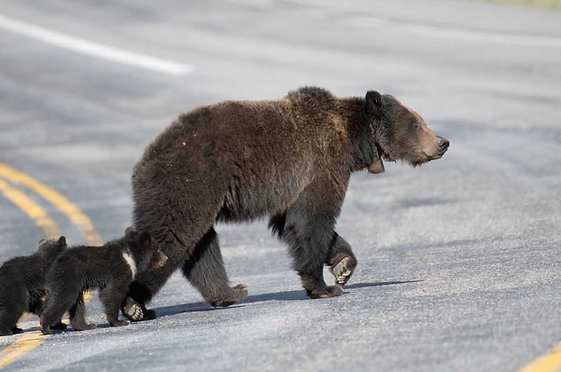
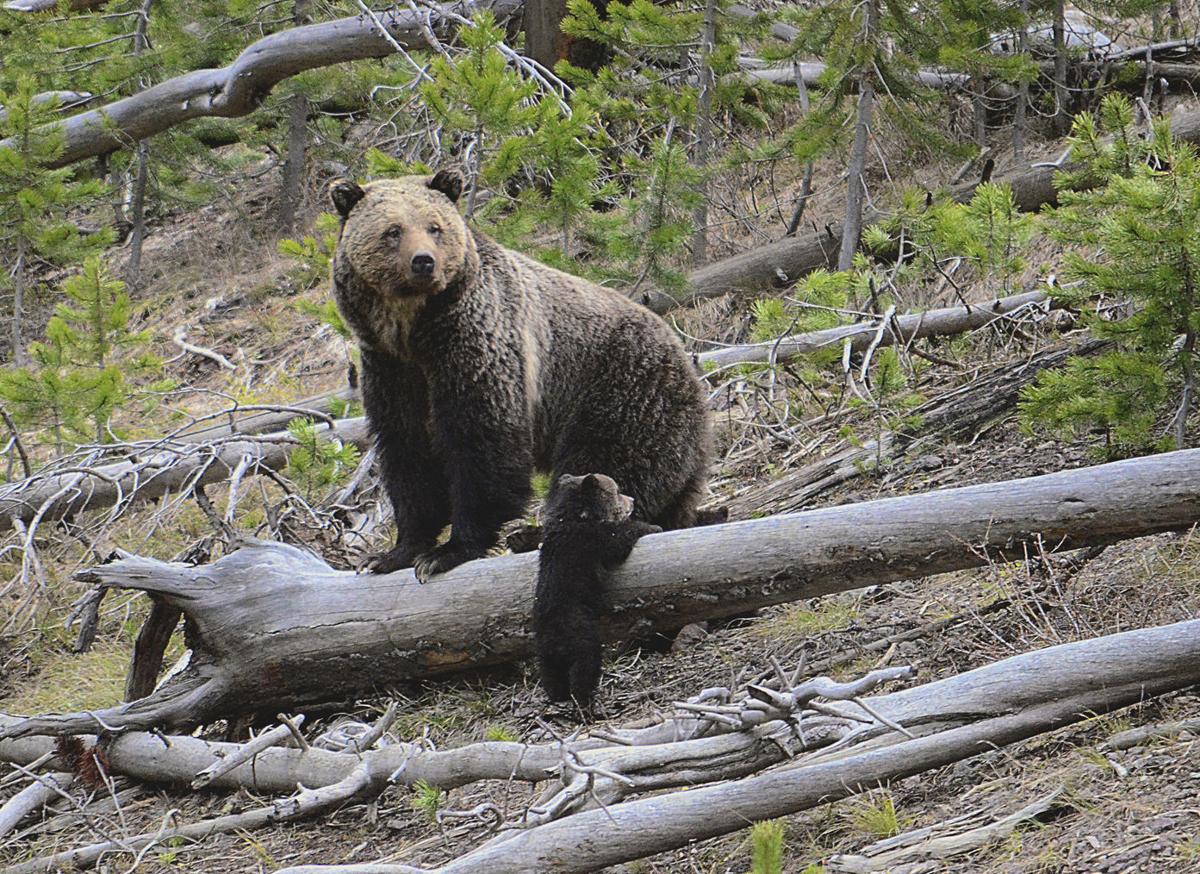
Q. Which of these 3 bears is a grizzly bear?
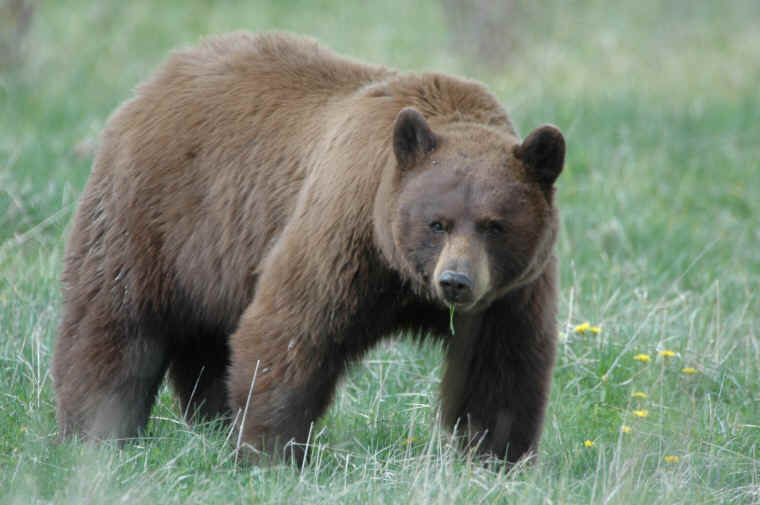
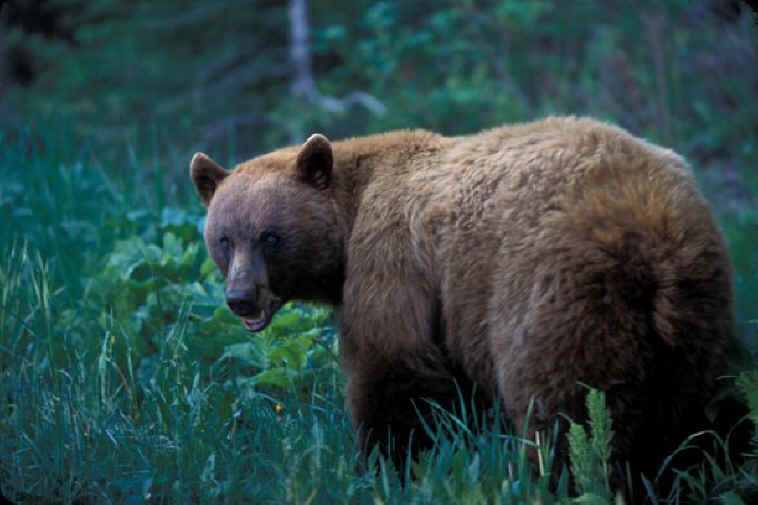
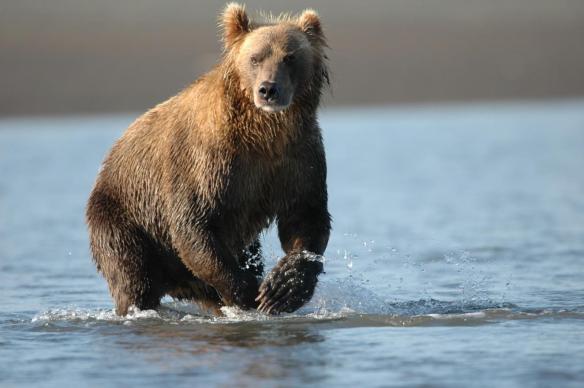
Please fll free to leave your answer in the comments section below. (And no fair going to my website for the answer, unless you are stumped).

Q. Which of these 3 bears is a grizzly bear?
Please fll free to leave your answer in the comments section below. (And no fair going to my website for the answer, unless you are stumped).
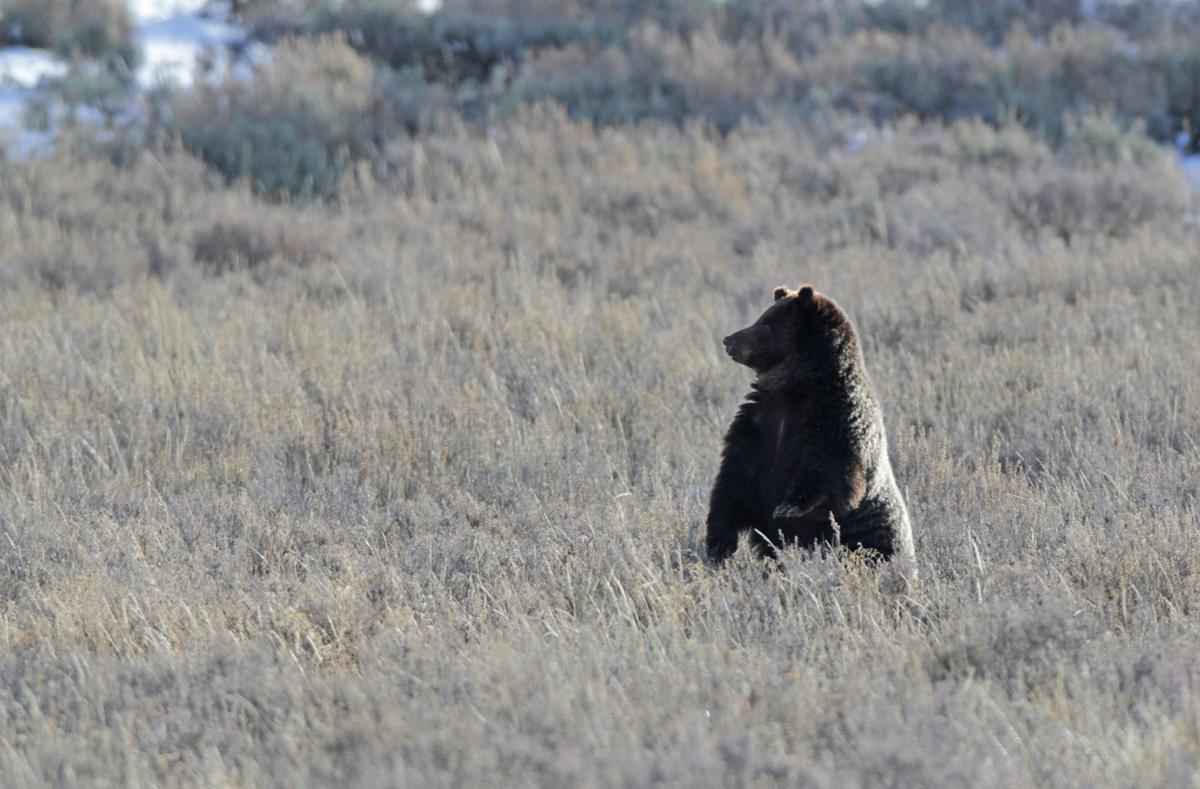
The federal government should be looking at restoring grizzly bears throughout the Rocky Mountains from Arizona and California to Washington, according to a lawsuit filed by the Centers for Biological Diversity on Thursday.
And the U.S. Fish and Wildlife Service must also update grizzly recovery plans it hasn’t touched since 1993, the suit alleges. The environmental group filed the case with U.S. District Court Judge Dana Christensen in Missoula. Last fall, Christensen vacated the service’s attempt to delist grizzlies in the Greater Yellowstone Ecosystem from federal Endangered Species Act protection. The federal government has appealed that ruling to the U.S. 9th Circuit Court of Appeals.
“They just want to point to success in the Greater Yellowstone Ecosystem, remove protections and wash their hands of grizzly bears,” CBD attorney Collette Adkins said on Thursday. “We’re saying you can only achieve true recovery if you look at these other areas and evaluate whether those are places grizzlies can recover. We want the Fish and Wildlife Service to take a look at least at the places it identified itself in the 1993 plan, and do what they promised — evaluate those additional areas.”
Fish and Wildlife Service grizzly recovery coordinator Hilary Cooley said the service had received the lawsuit, but had no further comment on Thursday.
The grizzly bear received threatened status under the Endangered Species Act in 1975. Before the Lewis and Clark expedition in 1805, an estimated 50,000 grizzlies inhabited most of the states west of North Dakota and south to Mexico. Due to loss of habitat and predator-removal efforts, only a few hundred grizzlies remained on about 2% of their historical range by the 1970s in the lower 48 states.
Today, about 2,000 grizzlies roam remote parts of Montana, Idaho and Wyoming, with most concentrated around Yellowstone National Park and the Northern Continental Divide Ecosystem between Missoula and Glacier National Park. The FWS 1993 recovery plan also monitors small grizzly populations in Montana’s Cabinet-Yaak Ecosystem and Idaho’s Selkirk Ecosystem, as well as large swaths of the Bitterroot Ecosystem along the Montana-Idaho border and the North Cascades Ecosystem in Washington that have no known resident grizzlies.
The CBD lawsuit claims that the 1993 plan stated the service would evaluate within five years the potential for grizzly recovery in the San Juan Mountains of Colorado. In a 2011 update, the service stated “other areas throughout the historic range of the grizzly bear in the lower 48 states should be evaluated to determine their habitat suitability for grizzly bear recovery.” Those other areas included parts of New Mexico, Arizona, Utah, California, Nevada, Oregon and southern Washington.
The Fish and Wildlife Service created a plan to reintroduce grizzlies as an experimental population in the Bitterroots in 2000, but the project was never funded and drew opposition from both people who argued the bears threatened their safety and people who said the plan didn’t extend enough protection for the bears. A similar reintroduction plan is under consideration for the North Cascades Ecosystem.
The suit also alleges the Endangered Species Act requires the Fish and Wildlife Service to produce five-year updates on the grizzly’s recovery status, which the service hasn’t done since 2011. While CBD acknowledges the service updated its recovery plans for the Greater Yellowstone and Northern Continental Divide ecosystems in advance of attempts to delist those populations, the group maintains the service has to include the whole continental United States recovery area. Adkins said CBD petitioned the service to update the plan in 2014, but was refused.
“There are other areas in the West that fall in the historic range of grizzly bears where they could be reintroduced and do very well,” CBD attorney Andrea Santarsiere said on Thursday. “We know they’re important carnivores that have benefits on ecosystems, so if that reintroduction is successful, we would see some ecosystem benefits. It’s not like we’re proposing to introduce grizzly bears into city centers. We’re talking about wild landscapes where conflict is very low or nonexistent, and areas where they’ve survived in the past.”
June 26, 2019
|https://www.grizzlytimes.org/single-post/2019/06/26/Felicia%E2%80%99s-Fate-The-Trials-of-a-Grizzly-Bear-Mom?fbclid=IwAR3IzIPH62LCsuFQnb5KffJQ3QR6z3VMFqKmnA58M11fEd0FdHLwCnzD-mE
Grizzly bears reside at a symbolic nexus that seems to relentlessly spawn conflict. Almost invariably, this conflict organizes around incidents that catalyze a mix of fear, anger, grief, and empathy—all inescapably configured by peoples’ mental constructs. There is the reality of bears, and then there are our contested inventions of who they are, what they should be, and what it all means. More complicating yet, grizzly bear-centric conflicts often arise from different ideas about how we should treat them and what that means for the institutions we create to manage ourselves.
Such seems to be the case with an incident unfolding around a grizzly bear called Felicia by her admirers, and #863 by those captive to the instrumentalizing impulses of wildlife management.
Who is Felicia?
Felicia is a tragic figure who could have easily been a character in classic Greek literature or a Victorian novel. She is a bear’s version of the young woman who got in trouble with the law and ended up a single mom in a rough neighborhood trying to scrape together a living while fending off predatory males. If that isn’t cause for Freudian psychological projection, I’m not sure what is.
Insofar as the facts of Felicia’s life are concerned, we know a few, but with ample scope for imaginative invention. We know nothing about her cub-hood, whether nurturing, traumatic, or indifferent. She first shows up in our human records as a (probably) newly-independent 2-year-old on the Shoshone National Forest wandering near human habitations eating human foods in an area with a long history of negligence on the part of human residents. In response, Wyoming Game & Fish (WGF) managers trapped her and a sibling, and then hauled them 75 miles as the crow flies to a location east of Grand Teton National Park. A year later she was trapped yet again by researchers roughly 20 miles east of where she was released the year before. So, by the time she was 3-years-old she had already been trapped, drugged, and handled by humans twice, and was probably not only tolerant of people, but also inclined to seek us out as a source of food. Not an auspicious start.
Felicia apparently lived out her remaining two adolescent years in or near the Blackrock Creek drainage on the Bridger-Teton National Forest below Togwotee Pass, probably never too far from Highway 26, the main connector between Moran Junction and points east. During winter of 2019 she gave birth as a 6-year-old to her first litter of cubs in the confines of a den, after which she emerged to face the considerable challenges confronting a first-time mom trying to keep two cubs alive in a neighborhood teeming with humans and other bears. By May she had lost her first cub. By early June she was being hounded by at least one male bear intent on breeding. For the boar, her surviving cub was at best an impediment to his purposes. By late June, she had apparently abandoned her last cub in the midst of on-going pursuit by these one or more males. When last seen, the cub was frantically trying to reunite with its mom—destined to starve or be killed by a predator if unsuccessful.
Enter Humans
Felicia has probably never been very far from people most of her life. She has been observed by a number of people on a number of occasions, which axiomatically means she’s been near people more often than she’s been seen. More important to this story, she has been near and even on Highway 26 since leaving her den this spring with cubs—literally walking down the highway centerline at times. As described by many, she has seemed “frantic” and “inexperienced.” Among other things, she has predictably incurred substantial risk of being killed by vehicles travelling at 65 mph along Highway 26, and may have even been hit by a car mid-June.
As predictably, she and her cubs have attracted great crowds of tourists, gawkers, photographers, and fans intent on seeing a grizzly bear, getting a killer photo of a grizzly, keeping track of her well-being, or just simply being part of the scene. The result has been emerging roadside mayhem—in the midst of cars and semis intent on making time between Dubois and Moran Junction.
Hence, with the certitude of a Greek drama, managers from Wyoming Game & Fish Department (WGF) arrived trying to “get on top of the situation.” The first apparent intervention by WGF was what, at best, could charitably be described as an ad hoc effort to haze her away from the highway. More helpfully, and thanks largely to the efforts of her advocates, Wyoming Department of Transportation (WDOT) rapidly deployed temporary signs that reduced the speed limit near where she was active to 40 mph—which could have saved her life if she was indeed hit by a car.
Since then, the crowds have grown, not diminished, at the same time that the comparative absence of people with authority to manage the situation, notably from WGF or the US Forest Service, has raised questions about motives, resources, and competence on the part of involved bureaus. Rumors have also surfaced about impromptu efforts by private individuals with suspect motives to haze Felicia and her surviving cub, while tensions mount along with odds of some additional tragic outcomes, not only for Felicia, but also for an over-aggressive photographer.
And, off stage, the passion, stridency, and even vitriol have mounted. Felicia’s partisans have promulgated passionate pleas for some sort of remedy. In response, Trumpian thugs have responded with profanity, video clips featuring their middle finger, and the message that most or all grizzlies should be killed. In some bizarre quadrant of it all, one of WGF’s putative public servants, an out-of-control Brian DeBolt, likewise accosts a photographer at a service station saying “f..k you photographers.” Little if any of this is about Felicia or her cub. Most is about human emotions and root symbolic stakes.
Sound like a Greek tragedy? Probably should.
A Classic Profile
Felicia fits a classic profile that typifies a non-trivial number of female grizzlies I’ve either personally known or have been acquainted with from afar. These females take up residence near people, probably as early as their adolescent years, largely because it is a space safe from the hazards and harassments of other bears, especially large potentially violent boars. This attraction to people, highways, and homes only strengthens with birth of their first cubs. Adult male grizzlies will kill cubs as means of triggering estrus in females that would otherwise be available for breeding only once every three years. Moreover, with prerogative to any resources they want, these males tend to preempt backcountry habitats and avoid annoying and potentially lethal humans.
The upshot is that areas near people become a figurative shield against predatory boars for females trying to find food and keep their offspring alive. These females then perversely incur the perhaps less obvious hazards of living near people and, in the process, become the centerpiece of a roadside circus, with unpredictable consequences for everybody involved, although predictable mounting exasperation for wildlife managers.
Roadside grizzly bear moms end up being between the proverbial rock and hard place, hemmed in by lethal boars and mobs of people. No wonder these mother bears often seem frantic, especially when tending their first cubs.
Variations on the Theme
Given this basic profile, there are variations on the theme, including the famous roadside dame of Grand Teton National Park—bear #399. Number 399 stands out as an individual who has figured out how to negotiate the human niche with considerable aplomb and minimal related hazards to the crowds of people who gather to collect photographic trophies or just simply stand awestruck. As a result, #399 has more-or-less successfully raised four litters of cubs, with a fifth currently in the nursery. (For more on #399 see this page and this page in Grizzly Times).
However, there are important differences between Felicia and #399. For one, #399 seems to be a much more grounded individual. And, yes, for those who resist the idea that animals are sentient beings with personalities, there are, in fact, enormous differences among individual grizzly bears, as between Felicia and #399. For another, #399 roams Grand Teton National Park where managers have a more benevolent mandate compared to the Forest Service, WGF, and WODT—all of which hold sway to some extent over the fate of Felicia and her remaining cub. Number 399 often has Park Service attendants focused on controlling traffic and crowds. Felicia does not.
And then there is the tragic tale of Bear #59, a roadside denizen of Yellowstone National Park with whom I worked closely during 1984-1986. Notably, # 59 and Felicia have some remarkable similarities. Number 59 could likewise have been called “frantic,” if not desperate. She likewise lost her first litter of cubs, followed by the loss of her second. She was likewise hounded by hordes of sight-seers and photographers who were, at that time, not closely tended by managers. Roadside viewing of grizzly bears was an emerging, even novel, phenomenon that Park managers were still scrambling to deal with. Of particular relevance to the developing situation with Felicia, #59 ended up killing a photographer named William Tesinsky. Tesinsky relentlessly pursued her while she was frantically digging roots in an attempt to remedy a profound deficit of body fat—with only a month to go until denning. Needless to say, she was subsequently killed by managers, despite the fact that all of the blame lay on Tesinsky’s shoulders.
A cautionary tale indeed.
What to Do?
All of this begs the question of what to do about Felicia and, more importantly, her surviving cub. Indeed, this question is on a lot of peoples’ minds. Perhaps more importantly, though, this challenge broaches the broader issue of what to do about increasing numbers of similar bears in similar situations—but where ultimate authority is held by dysfunctional and undemocratic state wildlife management agencies in a world overrun by humans.
Felicia ended up in a niche that includes private land residences and a major US highway funneling virtually all of the east-west traffic from a swath 100 miles wide. Given the imperatives of commerce and communication, there are few options for affecting traffic speeds and volumes—unlike in a National Park. And it is an inescapable fact that bears are being increasingly killed by collisions with vehicles traveling at high speeds along heavily-trafficked highways.
Likewise, odds are high that someone will be injured under circumstances where mobs containing unknowledgeable, inexperienced people—or even people greedy for the next best photograph—have more-or-less unrestrained access to a roadside grizzly, especially one accompanied by cubs. No matter how judicious or habituated the bear may be, someone is guaranteed to cross a boundary out of rudeness, stupidity, or avarice.
Some Improbable Prospects
Perhaps most urgently, Felicia’s surviving cub requires attention. Yet, as one of a species protected by the US Endangered Species Act, the cub is subject to the authority of the US Fish & Wildland Service in the form of a person sitting at a desk in Missoula, Montana, 300 miles away, which de facto results in deferral of authority to WGF managers on the scene. Yet these officials as a matter of culture and policy are loathe to intervene in something deemed “natural,” especially when there is uncertainty about whether Felicia has completely abandoned the cub, and even more so when to do so would be tacitly at the behest of “bleeding hearts” they despise.
Indeed, most WGF officials seem to harbor unabashed animosity towards not only people who emotionally identify with individual bears, but also the roadside bears themselves. As Dan Thompson, Wyoming’s Large Carnivore Specialist, said: “Habituation towards people and the roadside bear situation, it’s not something that we’re supportive of…” Despite recent soothing sounds to the contrary, it seems unlikely that WGF officials will scoop up Felicia’s cub and send it to a sanctuary. More likely it will just simply disappear.
Hazing Felicia away from the highway and perhaps conditioning her to avoid humans likewise has very limited prospects of success. As someone who has been involved in and closely privy to research on and applications of aversive conditioning, the contingencies of success are so numerous and stringent as to debar practical application in a situation such as this one. Felicia does not have—nor does she probably perceive herself as having—any good options. The least bad option from her perspective would probably be to endure any pain or discomfort meted out in predictably haphazard ways by WGF officials rather than confront the more certain threat posed by bigger badder bears in the backcountry. I have seen bears in a similar plight literally allow themselves to be beaten to death at the hands of aversive conditioners rather than abandon a putative roadside sanctuary.
More Promising Possibilities
Which, again, begs the question of what can be done? WGF almost certainly considers bears such as Felicia and her cubs to be readily expendable, and so are probably not highly motivated. Setting such attitudes aside for the moment, there are at least two measures that could be taken with prospects of yielding future benefits, perhaps not for Felicia, but for bears in future similar plights.
Nearer-term, agencies with authority over roadsides and highways could institutionalize remedial measures. WDOT could reduce speed limits on a seasonal rather than ad hoc temporary basis for stretches of highway likely to be frequented by grizzlies. The US Forest Service and WGF could create teams of Bear Rangers on call to deal with roadside situations as they emerge, and trained to manage and educate the entailed crowds. The National Park Service in both Yellowstone and Grand Teton Parks has perfected this method, based largely on employment of relatively low-cost volunteers. Given the passionate interest, considerable resources, and evident expertise of Grand Teton National Park personnel and nearby Jackson Hole residents, teams of bear rangers would seem an easy fix.
Longer-term, a comprehensive infrastructure of fencing and crossing structures could be installed with prospects of yielding considerable benefits for bears and other wildlife. Research in the Bow Valley of Banff National Park and along Highway 93 in the Mission Valley of Montana has demonstrated the efficacies of such measures. On the down side, this kind of infrastructure is expensive, needs to be comprehensive, and would, moreover, create an obvious visual and psychological barrier between people and the bears that are the object of their affection, interest, and perhaps avarice.
Tragedy But with a Future
Felicia’s prospects seem bleak captive as she is to a hazardous near-human niche and prey to the apathy and even outright hostility of Wyoming’s wildlife managers. Prospects for Felicia’s surviving cub seem bleaker yet. This young inexperienced bear has little buffer against lack of sustenance or vagaries of the world, and is likewise prey to indifference and platitudes on the part of those with authority over its fate. And none of this is likely to change any time soon given the politics of Wyoming and a culture of willful blindness in the US Fish & Wildlife Service.
Yet there is hope in the long game. Bear Rangers can be assembled, trained, and effectively deployed. A comprehensive infrastructure of highway crossings and diversions can be built. Even more ambitious yet, state wildlife management can be reformed to better represent who we are becoming, and to even pioneer a more compassionate vision of how to treat wildlife.
But achieving such long-term and prospectively resource-intensive outcomes is contingent on a fundamental reorientation. Advocates for bears such as Felicia need to do what might seem unthinkable and shift focus from a perhaps unredeemable near-term situation to higher-order and longer-term goals. Energy and even outrage is often found in the moment, but meaningful gains predictably require sustained and strategic political engagement.
Even more fundamental yet, accommodation and care for bears such as Felicia will necessarily be rooted in a foundational reordering and realignment of societal priorities—away from the self-gratification of a local culture organized around thrill sports and entertainment of elites; away from a national obsession with the distractions of digital media and related indifference to the plight of other sentient beings; instead to a committed, humble, and deeply-felt obligation to help others without power or voice.
May 13, 2019
|https://www.grizzlytimes.org/single-post/2019/05/13/Social-Carrying-Capacity-Politspeak-Bamboozle
As a scholar and social scientist I get annoyed when concepts are deployed for partisan purposes without regard for intellectual integrity. Having said that, I suspect that most politicians would find my distress silly, which is to be expected of a breed that exists to promote partisan ends using whatever rhetoric serves the immediate purpose. More to the point, politicians specialize in propaganda, one definition of which is: “Official government communications to the public that are designed to influence opinion. The information may be true or false, but it is always carefully selected for its political effect.” So, politspeak, in the spirit of Politburos and other perversions of public service.
But I expect something quite different from public servants working for administrative agencies. These people are tasked with implementing legislated policy as honestly and faithfully as possible, and, through that, maximizing benefits for the broader public they serve. Policy-relevant information is to be obtained, used, and communicated openly, with as little prejudice as possible. In other words, public communications by folks working for government bureaus should not be in the form of propaganda—not politspeak, at least in a democratic society, at least ideally.
Lethal Invocations
This brings me to public statements made during recent years by spokespeople for the federal and state agencies that manage our wildlife—more specifically, the use of a particular concept by grizzly bear managers in the Yellowstone ecosystem: that of “social carrying capacity.” To be fair, this usage is nested within a broader movement among wildlife managers who invoke “social carrying capacity” as justification for killing all sorts of animals, which may partly explain but not excuse such prevarications.
And that’s the point. “Social carrying capacity” is invariably used to justify killing more animals. Here’s a sampler: by the Florida Wildlife Commission to institute a sport hunt on the threatened Florida black bear and increase lethal control of the endangered Florida panther; by the Maine Department of Inland Fisheries & Wildlife to increase levels of sport hunt on black bears in Maine; by Montana Fish, Wildlife & Parks to increase the harvest of mountain lions; by David Mech, a USGS wildlife scientist, to justify hunting wolves in Oregon and Wisconsin; and by the US Fish & Wildlife Service and state wildlife management bureaus of Montana and Wyoming to remove Endangered Species Act (ESA) protections and institute a sport hunt on grizzly bears in the Yellowstone Ecosystem, which is my focus here.
The Amorphous “We”
So what do wildlife managers seem to be saying when they invoke “social carrying capacity” as justification for killing these animals? Basically, it comes down to this: the assertion that “people” will not tolerate any more of these large carnivores (read grizzly bears for Yellowstone), which means that “we’ve” reached the limits for how many can be supported in a given area, which means that “we” need to start reducing numbers by killing more animals. In the case of Yellowstone’s grizzlies, the preferred method for killing these bears is through a sport hunt. “People” are viewed as a homogeneous blob, and socially-defined “carrying capacity” as some kind of objective fixed reality.
Conceptual Pedigree
It is worth noting that none of the wildlife managers deploying the concept of “social carrying capacity” have any obvious expertise in conceptualizing, assessing, or otherwise measuring social phenomena. They are certainly not social scientists. And they are certainly not acquainted with the pedigree of the concept they so freely invoke.
So what are the academic roots of “social carrying capacity”? This concept was first developed by social scientists thinking about the numbers of people that could recreate in an area before their collective enjoyment was critically impaired. Alan Graefe, currently at Penn State, and Jerry Vaske, of Colorado State University, wrote an article in 1984 that reviewed “social carrying capacity” applied to recreation and concluded that it was “…not an absolute value waiting to be discovered, but rather a range of values which must be related to specific management objectives for a given area.” Bill Burch, of the Yale School of Forestry & Environmental Studies (as well as a friend of mine), wrote the concept off as being essentially useless in papers that he published during 1981 and 1984 in the journal Leisure Sciences. One of his articles was aptly titled “Much Ado About Nothing.”
Nonetheless, Dan Decker and Ken Purdy, both at Cornell, wrote a paper in 1988 that extended the concept to wildlife management, modifying the term to read “wildlife acceptance capacity.” Various academics have since tried to apply this wildlife-specific concept, resurrecting the moniker of “social carrying capacity.” Ben Peyton of Michigan State University recently related the concept to wolves in the Upper Peninsula of Michigan. Not surprisingly, he concluded that there were four sub-populations of people typified by differing degrees of tolerance for wolves (from highly tolerant to highly intolerant), and that these levels of tolerance were rooted in basic beliefs about the benefits of wolves as well as concerns about negative impacts. He was not brash enough to construe from this how many wolves might be able to live in the Upper Peninsula. Rather, he noted that there was a wide range of highly fungible ideas about what that number might be.
An Amorphous Concept
To be fair, the concept of “social carrying capacity” gets at something fundamentally important, which is that people hold different perspectives about animals such as grizzly bears, which might translate into different ideas about how many of these animals they want, as well as willingness to encounter them or sustain material harm.
But there are huge problems with trying to package all of this in a concept such as “social carrying capacity,” which implies an ability on the part of wildlife managers to derive an unambiguous estimate of how many animals—say, grizzly bears—can live in an area, and from that arrive at some unimpeachable justification for deciding how many of these animals to kill. But such has been the presumption in virtually every instance where a wildlife manager has deployed the concept of “social carrying capacity.”
Morphous Differences
In fact, people have perspectives that engender different attitudes and expectations, with implications for how wildlife are managed. And these perspectives vary widely in reflection of different world views, different life experiences, and different external circumstances, all of which can be related to demographic proxies such as gender, age, race, place of residence, level of education, type of employment, and so on.
More explicitly, social science research has shown over and over again that white males with less education, living in rural areas, and employed in agriculture have notoriously little tolerance for large carnivores such as grizzly bears. Interestingly, most of these guys are hunters. And, of direct relevance to the drama of Yellowstone’s grizzly bears, these guys dominate wildlife management by holding the purse strings and controlling wildlife commissions. Moreover, they are among the politically best connected of all in the states of Wyoming, Idaho, and Montana where we are trying to sustain the few grizzly bears left in the contiguous United States.
Put another way, “people” are not a homogeneous blob when it comes to political power or perspectives about grizzly bears. Nor are there an unambiguous number of grizzlies (or any other wildlife species) that can be sustained given the diversity of these human perspectives. In reality, peoples’ perspectives are way too varied and fungible to be translated into anything like an estimate of “carrying capacity,” including for grizzlies in Yellowstone. Different people want different things, with only inexact notions of how that might translate into size and distribution of a wildlife population–or levels of conflict and rates of encounter.
As important, people can have huge effects on these more concrete outcomes by how they behave and whether they chose to modify their behaviors. For example, whether ranchers in the Upper Green River Basin of Wyoming chose to employ husbandry practices know to substantially reduce conflicts with grizzlies, or whether the US Forest Service chooses to revoke grazing permits for regressive ranchers who don’t make a good faith effort.
Politspeak
So, what the heck is going on with our wildlife managers? More specifically, what’s going on with state and federal managers charged with managing grizzly bears in Yellowstone?
The answer is pretty straight-forward. Grizzly bear managers are using “social carrying capacity” as rhetorical cover for maintaining the status quo. And the status quo is largely about serving political masters (read conservative white male hunters, ranchers, or energy executives) who dominate wildlife commissions and have direct-line access to congressional delegations, state legislatures, and governor’s offices controlled by fellow regressive conservatives.
More correctly, wildlife managers are talking about political carrying capacity configured by their assessment of career prospects and the budgetary or other special interests of the wildlife management agencies they work for. To be fair, agency culture is also a major factor, including a deep-seated prejudice against predators that kill animals that would otherwise generate agency revenues through the sale of licenses to hunt large herbivores—at least according to agency myth.
Lethal Consequences
In Yellowstone, the consequences for grizzlies and those who care about them have been dramatic. The solemn intonation of “social carrying capacity” by wildlife managers has served as justification for drawing lines on maps with profound consequences for the life expectancies of grizzly bear. The current Primary Conservation Areas and Demographic Monitoring Areas for managing grizzly bears delimit the bounds beyond which these bears vaporize into the oblivion of institutionalized intolerance. Importantly, these existential lines do not denote much that is explicitly “social,” but rather much that is regionally political.
Interestingly, the notion of “social carrying capacity” was seized upon by opportunistic agency managers during 2004-2007 to capture rhetoric voiced by “advisory councils” constituted by the governors of Montana and Wyoming during 2002-2003. Notably, these highly politicized “councils,” billed as representing a “wide range of stakeholder interests,” served primarily to set the stage for the 2007 removal of ESA protections for Yellowstone grizzly bears—a move later over-turned by federal courts. This recent history uncannily foreshadows the current widely-publicized move by Montana’s governor to convene yet another “advisory council” that will no doubt intone, yet again, the presumed diktat of “social carrying capacity” as, yet again, presumed imperative to remove ESA protections for grizzly bears throughout the Northern Rockies. Or, more transparently: kill more grizzly bears as a balm to the wounds of ranchers, farmers, and conservative ideologues sustained by already ample federal subsidies.
Betraying the Public Trust
All of this brings me back to where I started. I am aggravated, not just by the betrayal of intellectual integrity implicit to how Yellowstone’s grizzly bear managers are using “social carrying capacity,” but also by the extent to which this usage is clearly part of a propaganda campaign that serves the partisan interests of wildlife management agencies and the politically well-connected few that they serve—not the broader public interest. It is especially egregious that a federal bureau such as the US Fish & Wildlife Service is so fully complicit in this betrayal of the public interest when this agency should be representing the interests of all people in the United States, not just ranchers and hunters in states such as Wyoming.
Social carrying capacity? The term should be relegated to the trash bin of Orwellian Politspeak.
Missoulian May 8, 2019
https://missoulian.com/opinion/editorial/build-public-credibility-by-making–
grizzly-advisory-council-transparent-from
It speaks to Montanans’ high interest in grizzly bears that 157 individuals
have been nominated to serve on a grizzly bear advisory committee that may
have 20 seats at most. Now comes the difficult task of whittling down the
lengthy list of volunteers.
Gov. Steve Bullock is already committed to ensuring the committee
encompasses the widest possible range of perspectives and a comprehensive
variety of expertise. But Bullock must also take pains to make his selection
process as transparent as possible, and to fully explain to the public the
reasoning behind his picks. At a minimum, the names and qualifications of
the volunteers need to be posted on the Montana Fish, Wildlife and Parks
website. That way, when the eventual selections are made, people can see for
themselves just how representative the council is.
After all, the advisory council will represent the general public on
critical grizzly bear management matters, an issue of looming importance as
the bears face the likely loss of federal protections.
Montana shares responsibility for four grizzly recovery zones, each of which
is home to its own unique challenges. Moreover, on top of the regional
distinctions, a key component to successful recovery involves connecting
genetically isolated populations. The council must therefore consider how to
promote healthy bear populations while also finding effective ways to reduce
conflicts with humans.
According to the Montana Fish, Wildlife and Parks website, the advisory
council will consider how best to:
. Maintain and enhance human safety
. Ensure a healthy and sustainable grizzly bear population
. Improve the response to conflicts involving grizzly bears
. Engage all partners in grizzly-related outreach and conflict prevention
. Improve intergovernmental, interagency, and tribal coordination
That’s a tall order, and to that end, the members of the council clearly
should come to the table prepared to share expertise on bear behavior – but
also human behavior. Montanans across the state will need to learn how to
safely share a home with grizzly bears.
As FWP Region 2 Supervisor Randy Arnold noted in a recent Missoulian news
article: “There are a lot of folks who will soon be dealing with grizzly
bears who have not been a part of this conversation.” The governor’s
advisory council offers an opportunity for these folks to have their
concerns considered and answered before any major problems arise.
But Governor Bullock must first reassure the public that no legitimate
concern will be ignored, and no voice will go unheard. He can get started on
the right foot and set a clear expectation of transparency throughout the
process by being open with the public as he selects the members of the
Grizzly Bear Advisory Council.
^^^^^^^^^^^^^^^^^^^^^^^^^^^^^^^^^^^^^^^^^^^
A study led by Susan Solomon found that the CO2 we add to the atmosphere
every day remains there for centuries, “so that atmospheric temperatures do
not drop significantly for at least 1,000 years<<
Groups Intend to Sue Over New Wyoming Grizzly Hunt Law
CHEYENNE, WYO. (AP) — Environmental groups have filed notice they intend to sue over a new Wyoming law that could authorize grizzly bear hunting even though grizzlies are federally protected.
The Sierra Club, Center for Biological Diversity, Wyoming Wildlife Advocates and Western Watersheds Project sent the notice Wednesday to Wyoming officials including the director of the Wyoming Game and Fish Department.
Wyoming and Idaho were preparing to hold grizzly bear hunts in 2018 when a federal judge in Montana ruled the bears needed re-listing as a threatened species.
On Friday, Wyoming Gov. Mark Gordon signed a bill that would allow the state Game and Fish Commission to plan a grizzly bear hunt, anyway.
The groups say Wyoming lacks authority to hold a grizzly hunt. Wyoming officials didn’t immediately respond to a request for comment.

Charlie Russell loved to fly, and he seldom phoned first those times when he would fly his Kolb ultralight airplane north from Hawk’s Nest ranch on the boundary of Waterton Lakes National Park, to our “ranchette” near the Crowsnest Pass. We would hear the thrum of the plane’s Rotax motor bouncing off the nearby Livingstone Range, then the tiny white two-seater, looking like a giant lawn dart, grew suddenly loud as he buzzed the place, wagging his wings close enough for us to see his snaggle-toothed grin. Our horses would tear down the field, eyes rolling from his low approach. He would circle over the road, then sail in under the Fortis power line, set the plane down on the gravel and taxi up to our cattle guard. Then he’d get out, grab a length of rope from the cockpit and tie off the plane to a fence post with a cowboy slip knot so the wind couldn’t blow it over. He had long promised to take my wife Myrna for a ride, and one day she called him on it. “Well, I guess today’s the day then,” he grinned. I didn’t like the look of the clouds over Centre Peak, but Myrna’s face said, “You don’t get a vote.”
“Just tell me that you don’t have a halibut jig tied to the tail wheel this time.”
“What’s he talking about?” Myrna demanded.
“Ha!” laughed Charlie. “He’ll tell you later.”
Charlie Russell died on May 7 in Calgary due to complications following a five-hour surgical procedure. Charlie used up his nine lives long ago, but his death at 76 was still shocking to those who knew him well. Few people have lived as intensely as this man, or as dangerously. He has flown in some of the worst conditions on earth and walked or crawled (with a broken back one time) away from both a hang-glider and an ultra-light crash, and over time he prevailed in a number of forced landings. He is, he was, internationally famous for the ground-breaking work he and the artist Maureen Enns did at Kambalnoye Lake, Kamchatka, in Russia, living in close proximity with brown bears and raising orphaned cubs which not only survived the wilds but eventually reproduced. A mentor to many naturalists, his experiments in “exploring the possibilities of trust” challenged the prevalent orthodoxy of his day, which held that bears that have no fear of humans are always extremely dangerous, and that all bears are unpredictable and therefore always a threat to humans. Yet he was wise enough to know that what he learned working with those wild bears in BC and Kamchatka, in true wilderness settings, should not be applied by the layman to human-influenced bears in our southern national parks.
Charlie was raised in bear country and learned all the skills of mountain bush craft and horsemanship guiding hunters on his father’s pack-train. In 1960 Charlie and his brother Dick roughed it through Canada and Alaska to help Andy Russell make his groundbreaking film Grizzly Country. After studying photography in New York, and a stint living in New Zealand with his first wife, Margaret, Charlie took up ranching at Hawk’s Nest, his family home. But his heart wasn’t in it and he spent a lot of his time working on conservation projects, such as the Waterton Biosphere Reserve initiative. Many bears were dying at the hands of ranchers and hunters in southwest Alberta at that time. This bear of a man, Russell, was angered by the carnage, for as he often growled, “Anything that hurts the bears, hurts me.” He became the first Canadian rancher to deliberately move cattle carcasses to safe places on his ranch near the park boundary, so that bears could feed on them without being shot.
Eventually Charlie gave up on ranching, and in the 1990s he took a job guiding tourists on grizzly-bear-watching tours in the Khutzeymateen inlet of BC. Charlie’s superb talent at reading ursine body language, and his sensitive, ego-free approach to all wildlife, allowed for close encounters of the ursine kind. Myrna and I are two of the many people that have sat with him on a big driftwood log at the water’s edge as a female grizzly grazed on sedges at our feet, unafraid of us, and offering no threat to us. As a former park warden, I helped to capture many bears, but I never felt as reassured around them as I felt in Charlie’s company. His skill as a bear guide led to an offer in 1991 to work with filmmakers Jeff and Sue Turner of Princeton, BC. With Charlie’s help, they shot a famous BBC documentary on the Kermode “Spirit Bears” of Princess Royal Island. Charlie worked on documentaries, wrote books, collaborated with conservation groups and biologists and helped shape public opinion to push for a grizzly sanctuary in both the Khutzeymateen and Kamchatka and a protected area for Kermode bears on Princess Royal Island.
In 1993 the Turners’ plan called for Charlie to provide and pilot an ultralight plane, capable of water landings, to be used as an aerial camera platform. Charlie and his late son Anthony Russell began building the plane at Hawk’s Nest—all over Hawk’s Nest, since he didn’t have a big enough barn for the project. Every building on the place had a piece of the plane in it and Charlie was getting increasingly frantic to get the thing riveted together as a deadline for departure for the island loomed. On a snowy March day, I joined filmmaker Jeff Turner to help Charlie with some last-minute detailing. We worked all day; darkness found us riveting the cockpit canopy carefully onto thin steel tubing. I suddenly stubbed my toe on a snow-covered object. “Shit! What’s this thing, Charlie?” Charlie peered down at it for a second, distracted, bent down and swept the snow off it with his boot. “It’s just the in-flight computer.”
“Oh, is that all it is? Wow. I thought I had stepped on something important.”
I worried about that computer later that spring, when Canadian Geographiccommissioned me to write a feature article on the Kermode bears with Charlie to supply the photos. As a result I spent about four weeks that summer and fall on the island, hosted by the Turners at their camp. One did not just swan around taking notes with the hard-working Turners, and I soon found myself humping camera gear through the rainforest with Charlie. The white bears were living up to their reputation as ghosts of the rainforest, staying out of sight and waiting for the coho to run. Charlie had already befriended both black and white bears he encountered in the bush, and could identify individuals by size, shape and colouration. One day, we were sitting on a log taking a break while a black bear fished in a desultory manner nearby. The rains, and the main run of salmon that rain would trigger, had not yet begun. Charlie grinned at me, ran his fingers through his thick black hair, then leaned over in a bear-like manner and stirred the water with a calloused paw, peering intently into the stream. The black bear splashed over and took up a position next to him almost touching his shoulder. I froze, too startled to get my little Balda camera out of my pack. The bear peered intently into the water, and then, realizing there was no fish in sight, backed away slowly, giving Charlie a sidelong glance. His body language said, “Dude—that is not funny.”
We were working one day in a creekbed, picking our way among slimy boulders and fish guts, stringing up a thousand feet of climbing rope between fir trees for an overhead camera sequence. Charlie pointed out a giant flat topped boulder in midstream. “I was playing with a bear on that rock one day, and things got out of hand.”
“Playing?”
“Yeah. I was up there taking a break, and he came down the bank, spotted me, and came up to visit.”
“To visit?”
“Yeah. I’ve come to know him pretty well. I could tell he was feeling playful. He was really inviting me to wrestle. I wasn’t sure if I should, but he was so friendly. Anyway, he stood up. He had a really mischievous gleam in his eye, and I thought what the heck. So I got ready to grapple with him. God, they are so strong! He just knocked me right over. I landed on those boulders.”
“Jesus Christ!”
“Yeah. I could tell he was surprised. I looked up, and he was peering down at me. I think it really puzzled him, how weak humans are. He didn’t mean to hurt me. I was really banged up for a while there.”
“Jesus H. Christ on a crutch. You were playing King-of-the-Castle with a bear?”
“Yeah. I think I went a bit too far that time,” he added, sheepishly.
Those who know Charlie’s books might say he should have known better. He had wrestled with a bear before, in Waterton Park in the ’80s when he and his son, Anthony, then age 11, wandered in between a black bear sow and her cubs. The little sow attacked, and Charlie and Anthony were soon in a tag team bout with her. She knocked Anthony down and Charlie went after her with fists and boots. When she got on top of Charlie, Anthony, armed with a piece of elk antler he had found earlier, whacked her over the head. She then bit Anthony on the behind, and Charlie again attacked until the sow finally retreated. The sow was fine, and the humans escaped with bruises and puncture wounds, but Charlie always said that Anthony had saved his life that day.
As a former park warden I helped capture many bears, but I never felt as reassured around them as I felt in Charlie’s company.
But about that halibut jig. We were sitting in the cook tent over coffee one morning with Sue, Jeff and their daughter Chelsea, when Charlie popped the question I had been dreading. “Will you fly with me?”
Charlie knew I hated flying. I nearly choked on the coffee, set the cup down. “I’d be happy to,” I lied.
The two us, both heavyweights, climbed into the little plane and strapped in, while Jeff Turner pushed us away from the pier. We had a windscreen in front of us, but were otherwise open to the weather. The motor sits behind the passengers on this craft. There was no intercom, so once the motor started conversation was by sign language. We taxied down the inlet and I could see why it was going to be hard to keep this plane aloft just by force of my willpower alone, since there were no armrests to grip in white-knuckled fear while will-powering. Charlie punched me in the shoulder, a big grin on his face, and opened the throttle as we raced down the inlet. This is a short takeoff plane, but our run seemed to go on forever, and we did not lift off the water. Frowning, he slowed down and we taxied back to try it again. I can’t recall how many times we attempted take-off; it seemed like 10 but was probably only three. At last we returned to the pier, the motor idling. “Well, I guess it’s just not in the cards today,” I said, happily.
“No problem,” said Charlie. “I know what we need. Just stay in the plane while I get it.”
He hurried up the beach to camp, and soon returned with his fishing tackle box in one paw. As I watched, puzzled, he pulled out a lead halibut jig with its attached hook, and tied it to the tail-wheel with some fishing line. “We’ve got it now,” he said with a happy grin as he settled back behind the controls.
“We’ve got it? Are we trolling for halibut now?” I asked, mystified.
“Ha! We’re going to catch some air.”
Once more we hurtled down the inlet, two porkers making the ultralight nose heavy. But this time, the halibut jig was just enough tail weight (at 17.6 ounces) to pull the tail down allowing the wings to catch some lift. And we flew around and around up above Princess Royal Island and Laredo Inlet looking for white Kermodes, and scared the hell out of some tourists in a yacht in an 80-mph swoop. And except one time when I took a ride in a sailplane, I felt about as close to being an eagle, and like an eagle, oblivious to fear, as I have ever been.
In Kamchatka Charlie learned how to find a hole in the fog and spiral his plane up into the clear sky. He made many personal sacrifices in choosing to devote his life to finding a way through the foggy notions people have about bears and our relationship to nature. The best way to honour Charlie is to make some new holes in the fog of misunderstanding that keeps people from living at peace with nature, and therefore with ourselves.
This article was originally published in The Tyee, June 1, 2018. Sid Marty is a writer and long-time resident of southern Alberta. He has published five books of non-fiction and three of poetry. His Leaning on the Wind: Under the Spell of the Great Chinook andThe Black Grizzly of Whiskey Creek were finalists for Governor General’s Awards.
Pt. 2: https://albertaviews.ca/part-2-tribute-charlie-russell/?fbclid=IwAR1LNBXAWPNf3NDVk30jyuBCv3QgJUyh9N3O88T1ejmWHyGATKchaCFKYZo

A grizzly bear cub searches for fallen fruit beneath an apple tree a few miles from the north entrance to Yellowstone National Park in Gardiner, Montana on Sept. 25, 2013.Alan Rogers / The Casper Star-Tribune via AP
BILLINGS, Mont. — U.S. government attorneys filed notice Friday that they are appealing a court ruling that blocked the first public hunts of grizzly bears in the Northern Rockies in decades.
The appeal challenges a judge’s ruling that restored threatened species protections for more than 700 bears in and around Yellowstone National Park.
Protections for the animals had been removed in 2017. When the ruling from U.S. District Judge Dana Christensen came down in October, Wyoming and Idaho were on the cusp of hosting their first public hunts for grizzly bears in the Lower 48 U.S. states since 1991.
Federal biologists contend Yellowstone-area grizzlies have made a full recovery after a decades-long restoration effort. They want to turn over management of the animals to state wildlife agencies that say hunting is one way to better address rising numbers of bear attacks on livestock.
But wildlife advocates and the Crow Indian Tribe successfully sued to stop the hunts. Their attorneys persuaded Christensen that despite the recovery of bears in Yellowstone, the species remains in peril elsewhere because of continued threats from climate change and habitat loss.
The Yellowstone population has rebounded from just 136 animals when they were granted federal protections in 1975.
Grizzlies in recent years have returned to many areas where they were absent for decades. That has meant more dangerous run-ins with people, such as a Wyoming hunting guide who was killed this fall in a grizzly attack.
Christensen’s ruling marked the second time the government has sought to lift protections for Yellowstone bears only to be reversed in court.
The agency initially declared a successful recovery for the Yellowstone population in 2007. But a federal judge ordered protections to remain while wildlife officials studied whether the decline of a major food source — whitebark pine seeds — could threaten the bears’ survival.
The Fish and Wildlife Service concluded last year it had addressed that and all other threats.
There was speculation the agency would not appeal the latest ruling and instead draft a new proposal to get the animal off the threatened list.
That possibility was raised by the agency’s grizzly bear recovery coordinator during a meeting last month with Wyoming state lawmakers, according to the Powell Tribune.
Friday’s appeal signals that at least for now the court battle over grizzlies will grind on.
But Andrea Santarsiere with the Center for Biological Diversity, one of the plaintiffs in the case before Christensen, said the government still has the option in coming months to dismiss the case.
“I think Fish and Wildlife should go back to the drawing board and come up with a new plan to actually recover grizzly bears across the West, rather than a piecemeal approach,” she said.
Also pending before the 9th Circuit are appeals from parties that intervened on behalf of the Fish and Wildlife Service. They include the states of Idaho and Wyoming and groups representing hunting interests, gun rights and agriculture.
Cody Wisniewski with the Mountain States Legal Foundation said that if allowed to stand, Christensen’s ruling could make it harder for other species to be taken off the threatened and endangered species list.
“Opinions like this move the goalposts,” he said.
U.S. Fish and Wildlife spokeswoman Jennifer Strickland referred questions about the case to the Department of Justice, which did not provide an on-the-record comment.
Conserving wildlife at the extreme edges of the natural world, whether in the Arctic, Tibet, or Mongolia, presents huge challenges, from potholed roads (or no roads) to hypothermia, bear attacks, and even arrest. In Extreme Conservation, Joel Berger, professor of conservation biology at Colorado State University and scientist at the Wildlife Conservation Society, takes us on a journey to some of the most remote places on the planet, and introduces us to some of its rarest animals.
When National Geographic caught up with him at his home in Fort Collins, Colorado, he described how he was arrested in Russia, how climate change is bringing more and more species together in new and unpredictable ways, and why man’s best friend is increasingly a menace to wildlife.
Your work focuses on animals living in some of the most inhospitable places on earth. Introduce us to some of these creatures and tell us what draws you to these places. Are you a masochist, or what?
[Laughs] Good question, Simon! I do work in places that are a little bit off the radar. A lot of people know about elephants, say, in East Africa but people don’t know much about a species that lived with woolly mammoth called muskoxen. They’re an Arctic-only species, though they are not an ox and they don’t make musk. They’re more of a goat-antelope. They live in the cold, wind-swept tundra, from Greenland across Northern Canada into Arctic Alaska, and now a little bit into the Siberian Arctic.
PHOTOGRAPH COURTESY OF THE UNIVERSITY OF CHICAGO PRESS
As we know, the world is warming. Most people believe that, even if the U.S. administration at the highest levels does not. This creates a lot of issues for cold-adapted species because they’re not used to warm weather. What happens when it rains rather than snows in the middle of winter and then everything freezes? The work I’m doing with my colleagues is both at the top of the world and at high elevations, in the Himalayas and the Tibetan Plateau. It is dealing with animals that are having problems with heat because as things warm it changes precipitation, ice, and snowfall. And these are very recent changes for these little-known, cold-adapted animals.
One of the odder things your work in the Arctic involved was dressing up as a bear and a caribou. What was that all about?
[Laughs] Most of my work has been in Arctic Alaska and over in eastern Arctic Russia. As the ice recedes, polar bears are ending up on islands and we’re trying to figure out how muskoxen are going to do with this potential predator on land. The best way as a scientist to get information is through experiments. In my case, my lab is the tundra. So I dress up as a bear and approach these groups of muskoxen to try and understand whether they’re recognizing bears. Can they tell a white bear is a polar bear versus a grizzly bear?
Occasionally, it gets dangerous. Male muskoxen are 800 pounds or so, with hooked horns, a bit like a Cape buffalo. I’m usually down on all fours with my fake cape and fake bear head. One time I was charged and I had to get rid of them fast. The fake head went flying up in the air, and the cape flew off in the other direction. Fortunately, the charging muskox got very confused as this biped stood up. All of a sudden, I was no longer a bear, but a screaming human!
Do you travel with your bear suit?
Oh, yeah, I do travel with the bear suit. [chortles] I get on an airplane and put down the fake head right next to me on the seat. The people sitting next door are either horrified or laughing. They’re not quite sure what to think! I’m as straight as can be but sometimes I break up on it, too. [laughs]
One of the surprising developments in the Arctic is the convergence of brown and polar bears. Tell us about so-called “pizzlies” and what they reveal about the changing climate.
Scientists have discovered that at least 10 different hybrid bears have been confirmed for DNA, which means we’re getting mating between brown and polar bears. Because of a warming Arctic, we’re bringing these species together. We now have grizzlies on islands in the Canadian Arctic where they had not appeared before, and we’ve got more polar bears on land scavenging whales and grizzlies scavenging those same whales. We don’t know what the outcomes are going to be. But we do know that we’ve got changing systems because of changing ice in the Arctic. And this has implications not only for the wildlife but also for the humans who subsist on the wildlife.
According to the proverb, dogs are man’s best friends. But they’re not wildlife’s best friends, are they? Talk us through some of the issues in Bhutan and elsewhere.
Of maybe 700 million dogs in the world, close to 50 percent of them are free-roaming in one sense or another. That doesn’t mean they’re totally feral but in places like Bhutan, Chile, and parts of Patagonia we’ve got dogs that are not under much control. Free-roaming dogs have been detected causing havoc in wide parts of the Himalayas and Mongolia, where they’re attacking different endangered species, from snow leopards to chiru, an antelope in Tibet that was the mascot for the 2008 Beijing Olympics. There are also attacks on takin, the national mammal of Bhutan, and other species in Central Asia. We don’t see this in the West so much, where dogs are usually under control. But in many other parts of the world dogs are causing havoc to wildlife.
Like many readers, I suspect, the takin is new to me. Introduce us to this strange animal, and its equally unusual home in the valley of Tsharijathang, in Bhutan.
Takin have been described as part wildebeest, part moose, and part pig. It’s a very unusual species that is rumoured to have been the source for the legend of the Golden Fleece. It’s a large animal, up to about 800 pounds, with beautiful fur, and is part of the goat-antelope group. They occur on cliffs and steep slopes in mountainous areas in China, Bhutan, and Burma. They are secretive, living in forests down low, where they’re a prey of tigers, or up high the young can be the prey of snow leopards. We know very little about them because of the deep forest habitat they occur in. Only in summer, when they migrate very high, do they emerge from the forests, and that’s when we get the best glimpse of them.
When I started my field work with some Bhutanese colleagues they told me it’s a five-day hike to get into the area, with three 17,000-foot passes. I was in my early 60s but I was like, “OK, I’m game, let’s do it!” It was a challenging way to enter some of these pristine landscapes where herders still raise domestic yaks and some horses. Snow leopards also occur in the system, so it’s a fascinating area few people ever see. And, yes, there are takin.
It’ll soon be time to get out our cashmere sweaters again. But according to you we may also be contributing to the extinction of many animals in Central Asia, including the iconic snow leopard. Unravel the threads for us.
Ninety percent of the world’s cashmere comes from two countries: Mongolia and China. The people on the land, the herders, rightfully want to do what the rest of us want, and have a sustainable economy and support their families. But as they increase the number of goats that produce the world’s high-quality cashmere, the goats nibble everything. As a result, a half-dozen endangered species are not having access to the food they need, species like saiga, which is a very odd antelope with a dangling proboscis. Other species that are impacted include Przewalski horses, khulan, an endangered desert ass in the Gobi, and blue sheep, which are not endangered but are major prey of snow leopards. And as the herders are incentivized to produce more and more goats, the situation becomes increasingly more dire for species on the land. Nobody wants people to get impacted, so the difficulty is finding the right type of solutions that can help people on the land but still benefit the species that occur there.
Wrangel Island, in the Russian Arctic, has to be one of the least-visited places on Earth. Put us on the map and explain why you call it a post-apocalyptic landscape.
It can be accessed only by boat or helicopter. But I could not get from my sites in Alaska to Wrangel. I had to fly to Moscow, go nine times zones east, land at a port 240 miles from Wrangel, and wait for a Russian helicopter to drop me in.
I call it post-apocalyptic because not only are there polar bears, but wolves have gotten there on their own, though the nearest point on land is 80 miles away. Caribou have been brought in and reindeer, which have gone feral. Wolverines have also made it from the Siberian coastline, traversing ice and frozen seas to get there. Now you’ve got a mixture going on between hybrid dogs that now look like wolves, or wolves that look like hybrid dogs. Muskoxen were also brought over at the request of the Russian Government, when we had a good relationship with them.
We still participate with Russian scientists, despite some of the acrimony at political levels. Conservation is the province of everybody. And it’s a marvellous place to work! It’s got a lot of wildlife and may be the forerunner of what the world is going to look like as different assemblages of species come together.
You’ve done 33 expeditions, including 19 to the Arctic, seven in Mongolia and seven in Tibet and the Himalayas. Talk us through some of the highs and lows of those journeys.
[Laughs] A major high would be coming across muskoxen and polar bear tracks on one of those bluebird days when it might be 20 degrees Fahrenheit below zero, but no wind, and sparkling ice. One of the lows was flying from Moscow and landing in a Siberian town called Pevek. Russian Security Border Patrol folks came on, I’m the only Americanski on the plane, and I am escorted off, my passport confiscated, and taken to the police station. Everything is being done in Russian, a language I am unfamiliar with, and the only words that I understand are C-I-A. [laughs]
In Mongolia, I ended up in the emergency room because my legs were going into spasms and for three days I wasn’t able to hold any food. But one kind of sucks it up. There are many other scientists and explorers who go out there and do similar things. But we do realize that there are some trade-offs.
At the end of the book, you write, “In the absence of commitment on both global and local scales, the iconic wildlife of the world’s highest mountains and greatest steppes will cease to persist.” Are you optimistic or pessimistic about the future?
There are a lot of reasons to be pessimistic but if that’s the view we choose to take there are going to be no chances. On a personal level, I’m optimistic! There are a lot of countries investing in conservation. Russia has stepped up with 191 islands in the Arctic that are protected as of 2016. Places in Western China the size of California have been linked together for conservation. Chile is planning to link 10 of their national parks. In the U.S., the number of people per year that go to national parks and zoos eclipses all professional baseball, football, and basketball combined. People care about nature and wildlife, and that’s why I am optimistic.
This interview was edited for length and clarity.
 Exposing the Big Game