Sick Minds Think Alike

Well, the Boston bombers are finally caught or killed and the streets are safe to jog on once again. Now, the only questions that remain are, what kind of people use gunpowder and ball bearings to kill their fellow sentient beings, and why? Well, I ask those questions every day—at least during waterfowl hunting season.

Maliciously spraying lead into a flock of migratory birds may not seem like terrorism to you, but to the ducks and geese on the receiving end of the shrapnel, it certainly does. Don’t get me wrong and somehow think I’m in any way trying to belittle or brush off the horrendous cruelty inflicted on others by the Boston bombers. No, quite the opposite—I want to get to the root of this kind of evil and weed it out of our species, if possible.

So why do people do it? What could possibly motivate someone to bury any scrap of compassion they might have and prey on the innocent? How do they justify the act of killing so many and how can they rationalize away the cruelty they’ve inflicted?

Perhaps the answer can be found in a recent quote from filmmaker Jennifer Siebel Newsom, in this case talking about the growing menace of violence against women: “…it’s about a culture that views women as objects to be acted upon rather than fully realized human beings,”

Objectification—now, isn’t that just what we’re talking about when someone kills, bullies or otherwise victimizes another to further an agenda or satisfy their own self interests? Just as the abuser objectifies women and the bomber objectifies innocent bystanders, hunters view their non-human targets as objects to be acted upon, rather than as fully realized beings.

And speaking of objectifying birds, here’s Huffington Post travel blogger William D. Chalmers’ idea of a joke in the face of a potential global pandemic: an article entitled, “Avoiding Avian Flu While Traveling in China,” wherein he lists the “…top 10 things to avoid in Shanghai as a traveler during the recent avian flu outbreak:

1. No wet markets where chickens are “processed” for dinner. They do things different here in China, no plastic-wrapped boneless chicken breasts in aisle three… they eye-ball their dinner.

2. No squab on a stick as pigeons may be a migratory transmitter. Oh, sorry, you didn’t know squab was pigeon! The things you learn traveling.

3. No less-than-over-hard runny eggs for breakfast. And push away that soft boiled egg too.

4. Avoid alternative modes of popular transportation used by farmers, such as chicken buses!

5. Attracting and posing for pictures with flocks of pigeons in local parks and gardens is probably not a good use of your time.

6. Although well-cooked poultry is fine, you might want to rethink that kung pao chicken or chicken satay. And chicken soup may not be the cure for what ails you.

7. Look on the bright side: eating out in Shanghai is cheaper as KFC is offering super special promotions.

8. While visiting China and jet-lagged up at 3 a.m., maybe you should change the channel when Alfred Hitchcock’s Birds comes on.

9. Try to forget the menacing virus; odds are you’ll probably succumb to the smog or a traffic accident.

10. Three words: designer surgical masks! They are all the rage among fashionistas here.”

Okay, well I’ve got another point to add to his list:
11. Forget the KFC or other over-cooked poultry products—try the tofu; that way you won’t bring the bird flu back home with you to spread among the rest of us…
DSC_0035

Just Out for a Bit of Fun

“I think it’s cruel that they would take sport in stuff like that. Very cruel. It’s just sophomoric, juvenile.”

That quote could just as easily have been a humane person’s reaction to witnessing any legal goose, pheasant, elk or wolf hunt, but in this case it was in reference to a speeding driver running over 92 protected shorebirds on the Washington coast (on the same stretch of beach mentioned in this earlier post, Compassion for All, Not Just the Endangered).

Shorebirds, like the dunlins who were senselessly killed, huddle close together on the beaches this time of year, which makes the act of running over nearly eight dozen of them at one time no great challenge for anyone willing to stoop to such an act.

The driver was most likely just out for a bit of fun when they spotted the flock of migratory birds dead ahead. After plowing through the birds—who have an uncanny knack of flying off at the last minute to avoid any vehicle following the posted speed limit of 25mph, but who must not have been ready for someone going twice that speed—chances are the driver said to his passengers something like, “that was pretty neat.”

That same line was uttered by a Dubois taxidermist and outfitter, Joe Hargrave, who, on Oct. 5, just four days after their season opened, became one of Wyoming’s first hunters to legally kill a wolf since 1974.

“It was pretty neat to be able to hunt them because they’re a magnificent animal,” Hargrave said. “I like to see them in the wild just like elk, moose and everything else. It is nice to be able to have the opportunity to hunt them.” (The U.S. Fish and Wildlife Service removed wolves from the endangered species list in Wyoming on Sept. 30, kicking off the first hunting season since wolves were placed on the list in 1974. Conservation groups have filed three lawsuits seeking to re-list the wolves; they are expected to be decided sometime in 2013.)

People for the Ethical Treatment of Animals and the Wildlife Rehab Center of North Coast are offering a reward for information leading to the arrest of the person responsible for the illegal killing of the protected shorebirds. Meanwhile, thousands of unprotected migratory geese, deer, elk, cougars, coyotes and wolves are shot each year by people with the same motive as those thrill seeking, sophomoric, sociopathic beach drivers—they’re just out for a bit of fun.

Text and Wildlife Photography© Jim Robertson

Text and Wildlife Photography© Jim Robertson

Road Hazard?

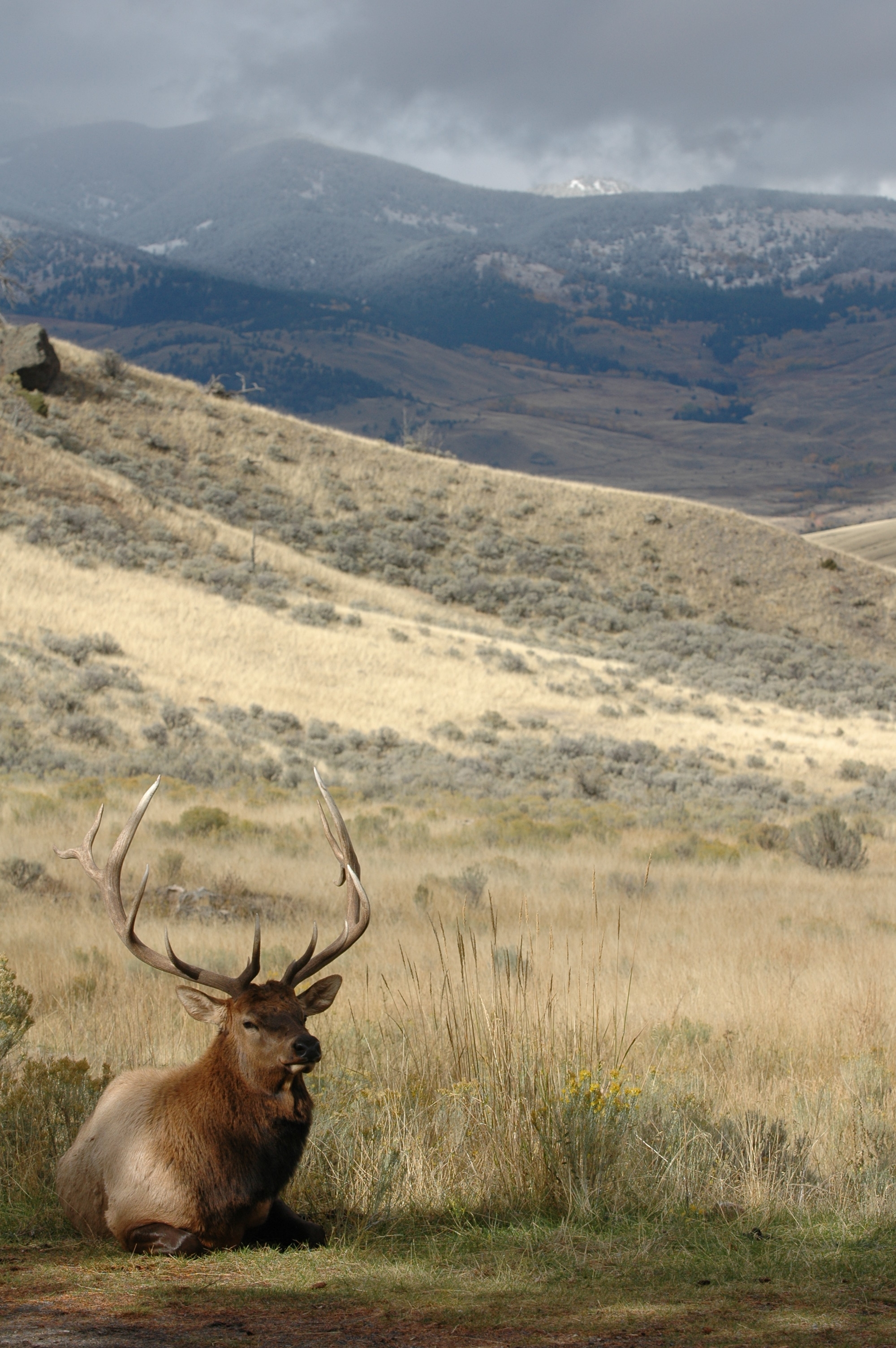
Driving to work early the other morning, I came within inches of hitting a bull elk who decided, at the last minute, to run across the highway right in front of me. Fortunately no one else was on that lonely stretch of road at the time, for if I hadn’t stomped on the brakes and cranked the wheel to the left, we would probably both be dead. I saw up close and personal how hitting an animal as large as that could do lethal damage. But the experience did not change my attitude on whether migratory wildlife should be considered a road hazard.

There’s no doubting the fact that we humans—in our full metal jacketed projectiles, lumbering headlong 60 mph through the former wilderness—are the real hazards. We’re the ones breaking nature’s rules by inventing machines that can go so fast they can put an end to anyone they run into. But, we drive like we’re saying, “We have important places to go—everyone else beware or be damned! No lowly animal better get in our way!”

If this incident had proven fatal for us, I would have wanted my epitaph to read: “I’m sorry beautiful creature. There’s nowhere I had to be that was worth the risk of ending your precious life.”