‘Go eat a couch if you want’ (Photo: Instagram / Whoopi Goldberg)
American actor and TV personality Whoopi Goldberg has been slammed for having a ‘triggered fit’ over plant-based meat.
The celebrity featured on talk show The View earlier this month, where she defended her right to consume bacon.
“What I don’t want is no choice…,” the star said. “I like the bacon, I want the bacon, you don’t have to eat it… No one should tell you that you can’t have something.”
The comment received backlash from animal-rights charity PETA, who said it couldn’t help but ‘call-out’ Goldberg for her ‘rant on The View’.
‘Enormous suffering’
“Really, Whoopi? Eating bacon is your Friday cause? Your ‘choice’ really hurts. Be kind,” PETA said. “Animals should have a choice though. Eating bacon causes enormous suffering and ends a pig’s life.
“It’s so easy to make choices that don’t support suffering and death. We urge you to consider that.”
‘Making a fuss’
“Hey I understand PETA is making a fuss because I like bacon,” Goldberg tweeted to her 1.5 million followers.
“I never said I was a vegan, and just like I want choice over my body, I want the same for what goes into my body. I would NEVER suggest that ANYONE pressure any one of YOU to change your vegan habits. Go eat a couch if you want.”
‘Animals are not property’
The star’s response added to the controversy, with a plethora of vegans highlighting the cruelty of bacon.
“You spoke a truth in you that you didn’t realize you had, Whoopi,” one user tweeted.
“Animals are not property just as human beings are not property. They don’t belong to us. They deserve to have control over what happens to their bodies just as we do.”
October 2 is World Day for Farmed Animals. On the website for the annual recognition of what these billions of nonhuman animal (animal) beings go through at the hands of humans before they’re brutally killed for unnecessary meals we read:
“Each year, an estimated 70 billion cows, pigs, chickens, turkeys, and other sentient land-based animals are caged, crowded, deprived, drugged, mutilated and macerated in the world’s factory farms. Then they are brutally slaughtered for our dinner table. Countless aquatic animals are caught and suffocated by vast trawler nets, so we can have our fish fillet or tuna fish salad.”
Slaughtering sentience: How much pain per pound do these animals suffer?
“…the question is not, Can they reason? nor, Can they talk? but, Can they suffer? Why should the law refuse its protection to any sensitive being?… The time will come when humanity will extend its mantle over everything which breathes…” —Jeremy Bentham
It’s a sad fact that the amount of pain and suffering these animals endure before they’re killed truly is incalculable. So-called “food animals,” including fishes and other aquatic animals, are intelligent and sentient, feeling beings. (See “It’s Time to Stop Pretending Fishes Don’t Feel Pain.”) When someone eats animals and animal products, they’re consuming a good deal of pain and suffering. While many people are led to believe that consuming dairy is OK, because the animals are kept alive, dairy animals also deeply suffer when they’re used and abused as “milk machines.” (See “The Scary Facts of Dairy Violate the Five Freedoms” and “The Mistreatment of Female ‘Food Cows’ Includes Sexual Abuse.”)
It’s also important to recognize that “being smart” really isn’t a factor in how much animals, including humans, suffer. It’s what they feel that’s important. (See, for example, “Are Pigs as Smart as Dogs and Does It Really Matter?” and references therein.) A young girl once asked me if so-called “food animals” suffer like her companion dog suffers when he’s in pain. When I said, “Yes, they do,” she blanched and almost started crying.
At another talk I was asked, “How much pain per pound do these animals suffer?” and I said that it was really impossible to calculate any meaningful number, but it’s a good question to get discussions going about what these animal beings endure in their relatively short and horrific lives.
I often hear people say that farmed animals aren’t treated all that bad and that there are regulations and laws that adequately protect them. However, it’s a fact that the regulations and laws that supposedly protect farmed animals are incredibly weak and weakly enforced, and egregious violations are very common.
Far too much lip service is given to protecting these amazing and fascinating animals. And it’s because people—including those who use them and eat them—know that there is incredible and inexcusable suffering among the trillions of food animals who wind up in humans’ mouths that regulations and laws exist in the first place. If these animals didn’t suffer, there would be no reason to protect them. Current regulations allow for more than 1,100 pigs to be slaughtered per hour.
Even with iconic animal welfarist Dr. Temple Grandin’s work to help farmed food animals along, the amount of pain and suffering farmed food animals endure is reprehensible, and, of course, avoidable. Only an extremely tiny percentage of these sentient beings may, in fact, benefit, as they trod along her so-called “stairway to heaven” on their way to the killing floor while hearing, seeing, and smelling the slaughter of others. Their lives before their death sentence are actualized—right after birth, as they mature, and when they’re shipped to slaughterhouses as if they’re unfeeling objects—and are inarguably, brutally horrific. (See “Stairways to Heaven, Temples of Doom, and Humane-Washing” and “My Beef With Temple Grandin: Seemingly Humane Isn’t Enough.”)
The language we use to refer to other animals really matters. On World Day for Farmed Animals, let’s honor all nonhumans who are used for food. It’s really a matter of who we eat, rather than what we eat, when it comes to the sentient nonhumans who wind up in our mouths. A few years ago, after I gave a talk and asked people to consider who they are choosing to eat rather than what they were eating, I learned that five people changed their meal plans because the word who made them realize “they were eating pain and suffering.”
Asking people to change their meal plans isn’t some sort of “radical animal rights” move, as some claim it to be. In fact, it’s all about decency. It’s about showing respect and compassion and honoring who these individuals really are: namely, deeply feeling sentient beings. We need a Golden Rule for how we treat other animals based on decency. Silence isn’t golden; it’s deadly.
It’s high time to phase out food animals and animal products once and for all. All of these animal beings need all the help they can get and then some. World Day for Farmed Animals is a perfect time to honor and to respect who these fascinating beings truly are.
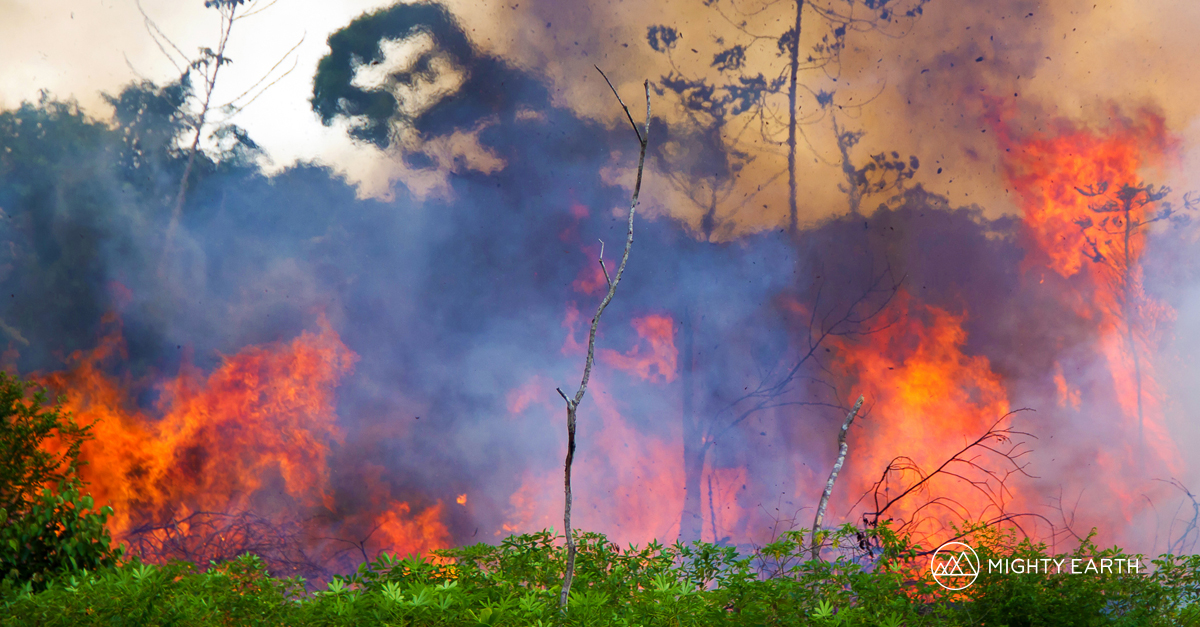
The burning of the Amazon and the darkening of skies from Sao Paulo, Brazil, to Santa Cruz, Bolivia, have captured the world’s conscience. Much of the blame for the fires has rightly fallen on Brazilian President Jair Bolsonaro for directly encouraging the burning of forests and the seizure of Indigenous Peoples’ lands.
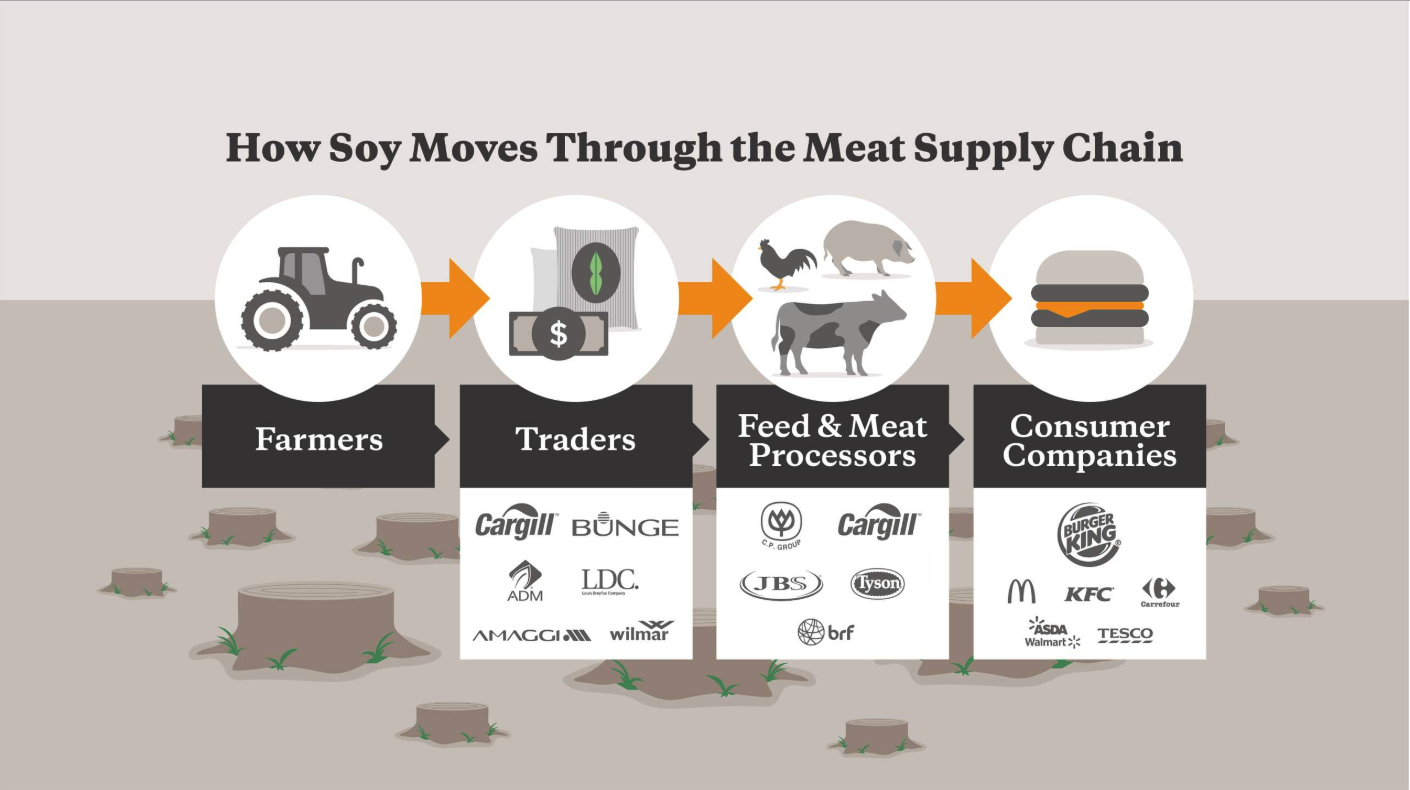
But the incentive for the destruction comes from large-scale international meat and soy animal feed companies like JBS and Cargill, and the global brands like Stop & Shop, Costco, McDonald’s, Walmart/Asda, and Sysco that buy from them and sell to the public. It is these companies that are creating the international demand that finances the fires and deforestation.
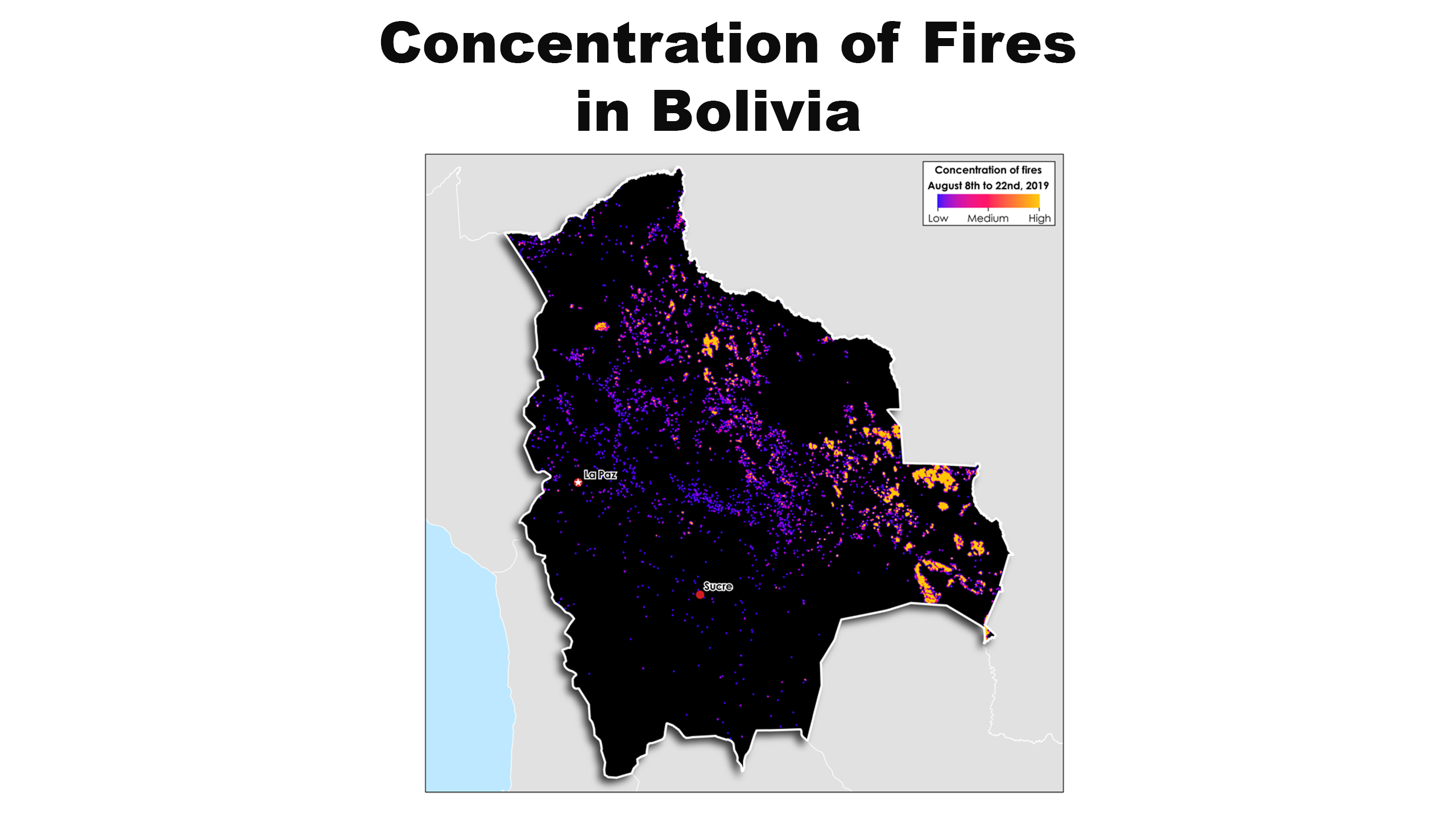
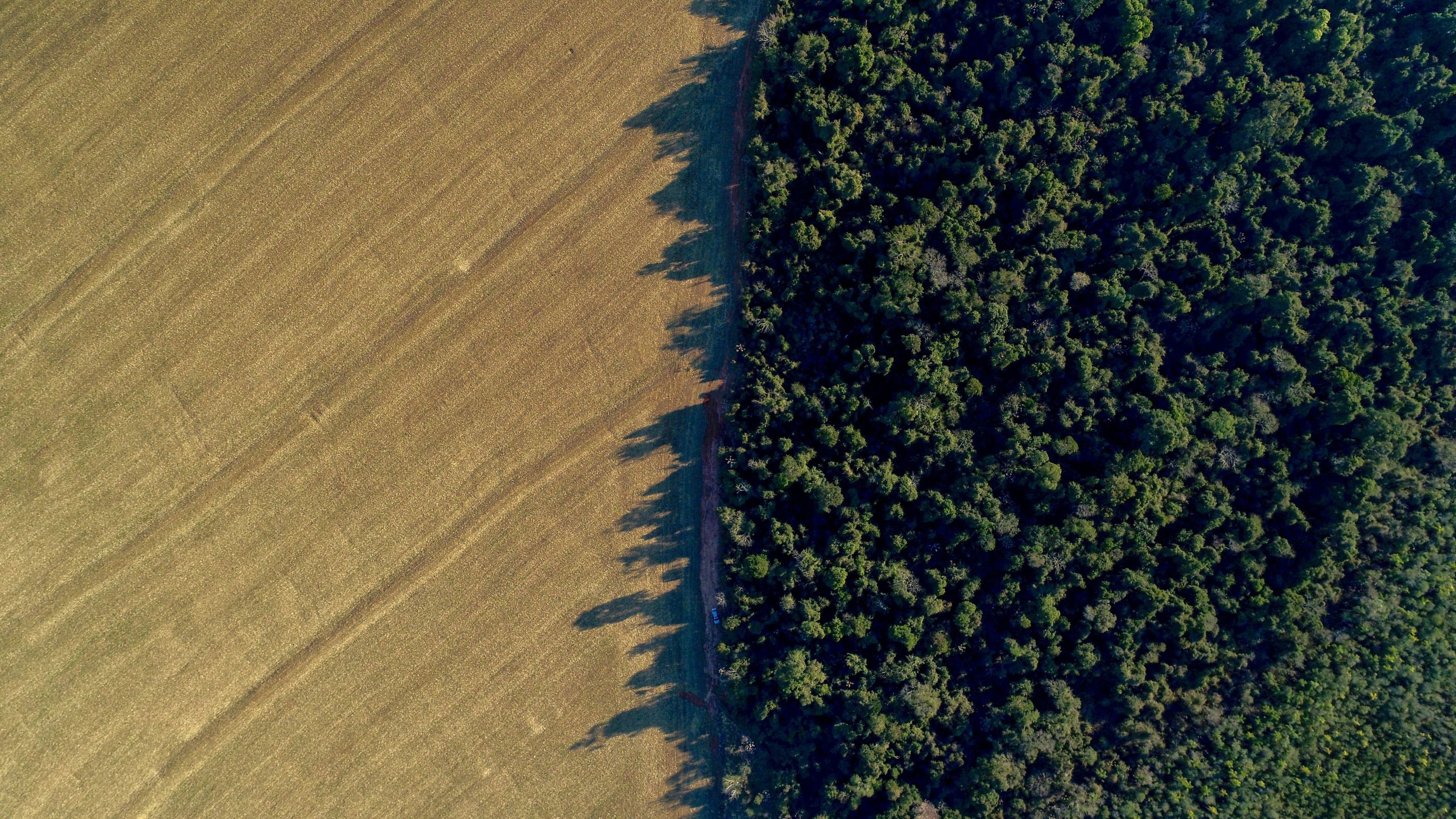
The transnational nature of their impact can be seen in the current crisis. Their destruction is not confined to Brazil. Just over the border, in the Bolivian Amazon, 2.5 million acres have burned, largely to clear land for new cattle and soy animal feed plantations, in just a few weeks. Paraguay is experiencing similar devastation.
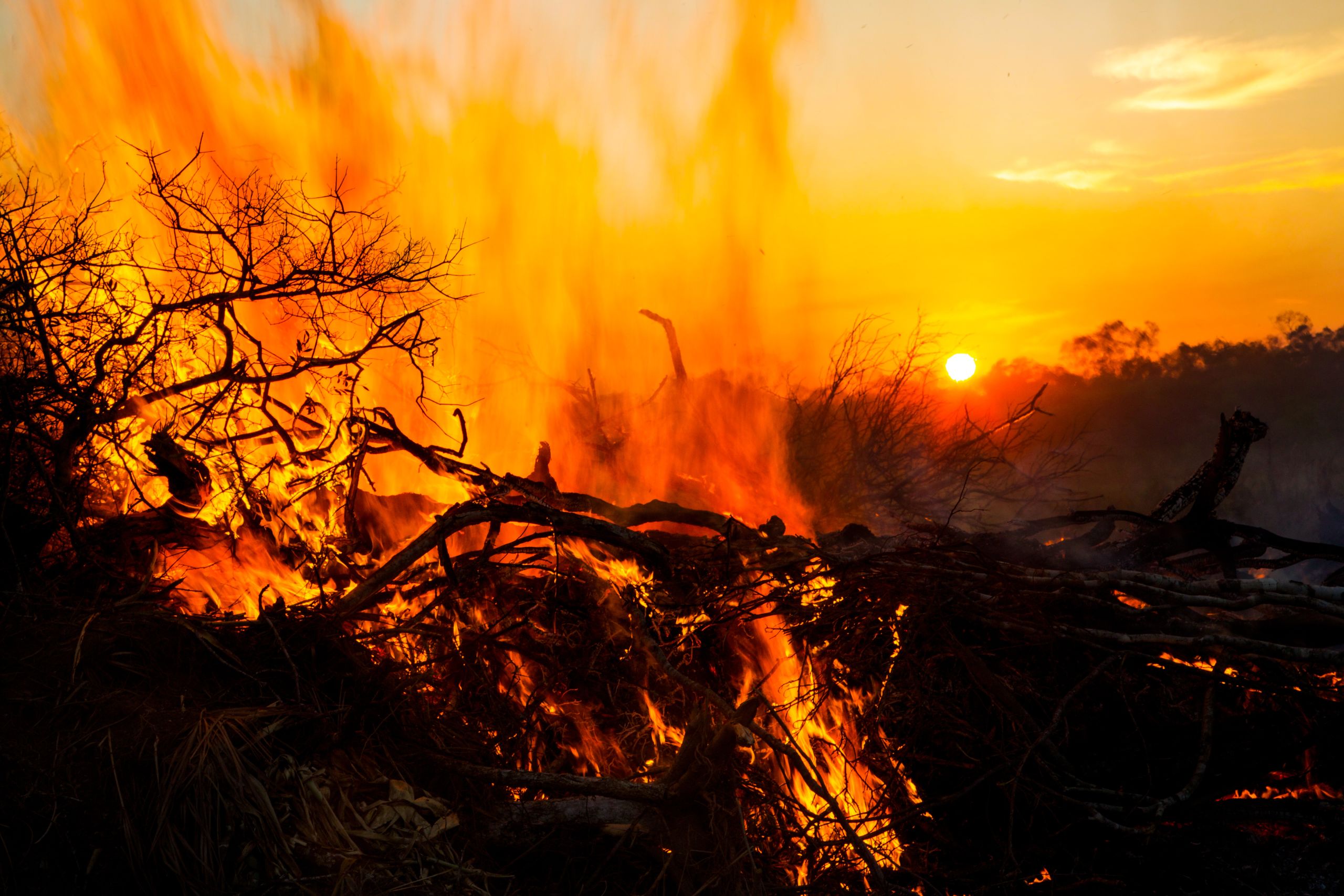
Logs burn at sunset in Bolivia. Photo Credit: 2017, Jim Wickens/Ecostorm
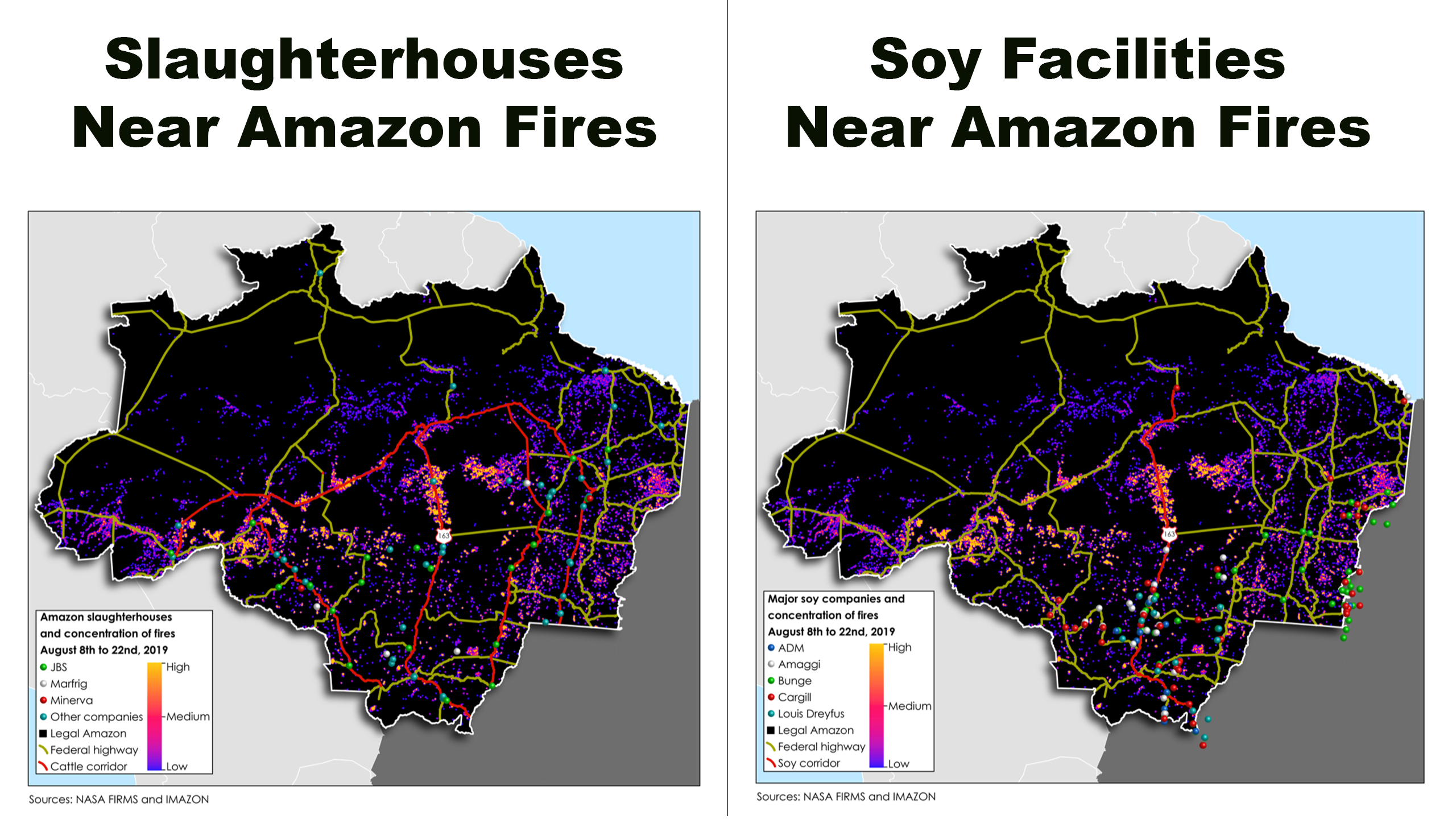
New maps and analysis from Mighty Earth, based on data from NASA, CONAB, and Imazon and released here for the first time, show which companies are most closely linked to the burning:
Cattle
Both domestic and international demand for beef and leather has fueled the rapid expansion of the cattle industry into the Amazon. From 1993 to 2013, the cattle herd in the Amazon expanded by almost 200% reaching 60 million head of cattle. While deforestation for cattle had been reduced thanks to both private sector and government action, the new wave of deforestation this year shows that the large international beef and leather companies and their customers and financiers continue to create markets for deforestation-based cattle.
The effects of this demand can be seen in the clustering of deforestation near slaughterhouses and roads that have access to slaughterhouses. The company most exposed to deforestation risk in the maps above is JBS, both Brazil’s largest meatpacker, and the world’s largest meat company. JBS, like other major Brazilian meatpackers signed the 2009 Cattle Moratorium, pledging not to buy beef from cattle connected to deforestation. However, investigations by government and NGOs have repeatedly found serious violations by JBS, including through laundering cattle.
These scandals reached their apotheosis with the Cold Meat (Carne Fria) scandal in 2017, in which the Brazilian government enforcement agencies produced extensive evidence showing that JBS was sourcing cattle from protected areas. This and other investigations found that JBS violated both government and its own policies by buying laundered cattle that had been raised in areas linked to deforestation and then transported to “clean ranches” to evade the requirements. The two brothers who control the company were imprisoned for their role in corruption scandals in Brazil.
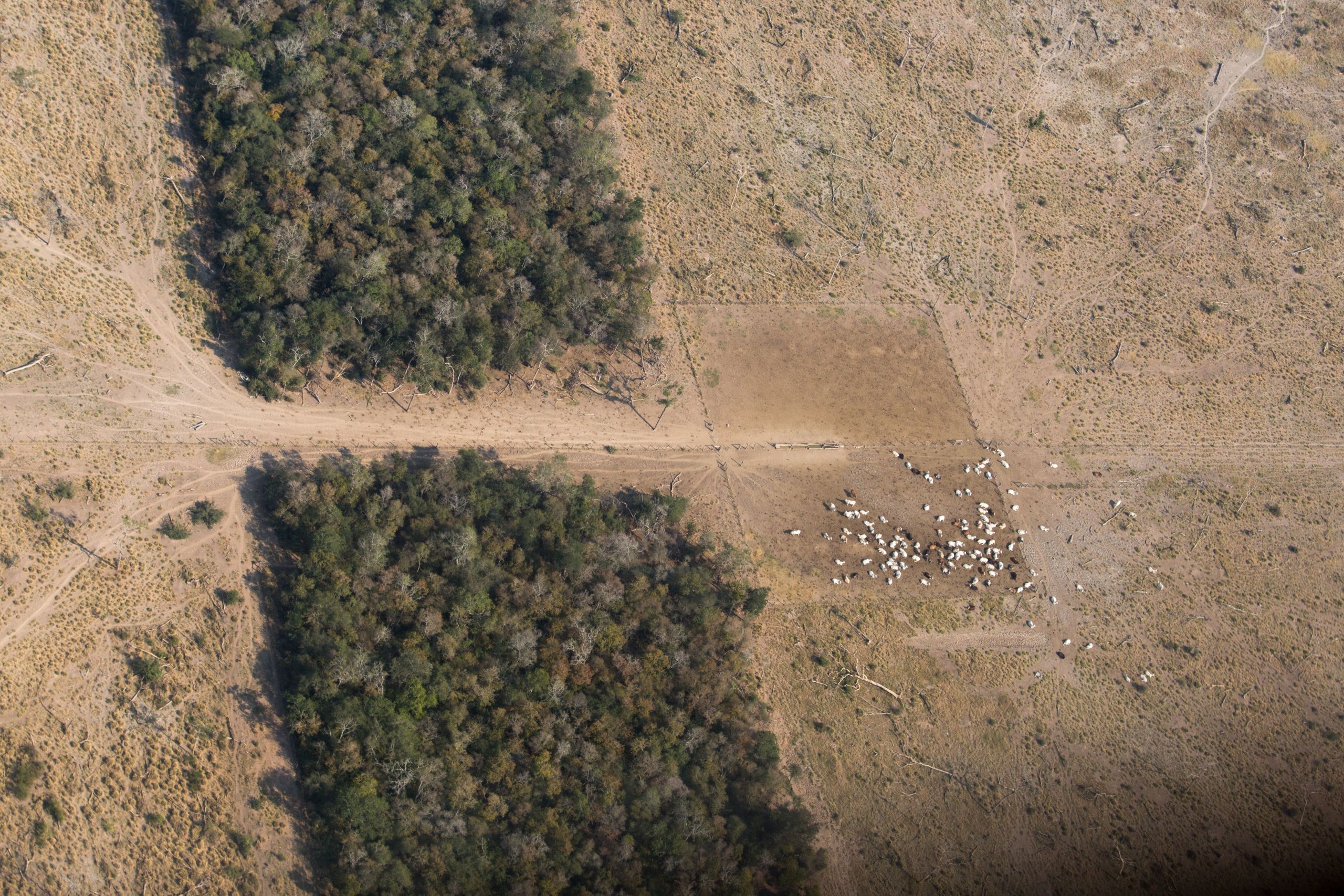
Aerial cattle field and forest edge. Photo credit: Jim Wickens/Ecosotrm
Soy
Soy supply chains work differently from cattle, and that is reflected in the maps above. Much of the current wave of deforestation has happened close to BR-163. Big soy farmers routinely transport their soy down Highway BR-163 to Cargill’s major port at Santarem, where it is put on ships and sent around the world to be fed to livestock in Europe, China, and elsewhere. There are similar dynamics around other highways on the map. Cargill, Bunge and other leading soy traders have participated in the Amazon Soy Moratorium in Brazil for the last dozen years, in which they committed to cease sourcing from suppliers who engaged in deforestation for soy. Overall, the Soy Moratorium has been a major success, virtually eliminating deforestation for soy.
However, the Soy Moratorium contained two major loopholes. First, the big soy traders can continue to purchase soy from farmers who engage in large-scale deforestation, as long as the deforestation is for crops other than soy. The location of the deforestation close to BR-163 suggests that farmers are exploiting this loophole to continue deforestation even as they sell soy to major traders like Cargill and Bunge. The location of the deforestation close to BR-163 suggests that farmers are exploiting this loophole to continue deforestation even as they sell soy to major traders like Cargill and Bunge.
Second, the Soy Moratorium only applies to the Brazilian Amazon. Major soy traders have continued to drive deforestation in the Bolivian Amazon Basin, the Brazilian Cerrado, and the Gran Chaco of Argentina and Paraguay, creating a major incentive for the rapid deforestation in Bolivia in the last several weeks. Mighty Earth’s reports The Ultimate Mystery Meatand Still At Itshowed Cargill’s extensive links to deforestation in the Bolivian Amazon basin, and its repeated refusal to take action against key suppliers even when confronted with repeated evidence. And as much attention as the Amazon is getting, Brazil’s half a billion acre, highly biodiverse forest-savannah mosaic known as the Cerrado has been even more deforested. While 80% of the Amazon is still intact, cattle, soy and agriculture interests have destroyed more than half of the Cerrado, putting this ecosystem at even greater risk. Mighty Earth found that in the Cerrado, where deforestation has continued, two companies were primarily responsible for driving deforestation, Cargill and Bunge.
Cargill is the largest trader of soy from Brazil and the world’s largest food and agriculture company. Mighty Earth’s July 2019 report The Worst Company in the World profiled Cargill’s extensive deforestation in South America and elsewhere around the world, building on previous investigations in Bolivia, Brazilian Cerrado, Paraguay, and Argentina.
Although Bunge is a bigger player in the Cerrado, across South America – in Bolivia, Paraguay and Argentina, Mighty Earth’s previous analyses of deforestation linked to soy animal feed in South America found Cargill most closely associated with deforestation. The company has refused to discontinue suppliers Mighty Earth found engaged in deforestation after evidence was shared with them, and has bitterly resisted efforts to expand successful industry-wide platforms for monitoring and policing deforestation to South America outside the Brazilian Amazon.
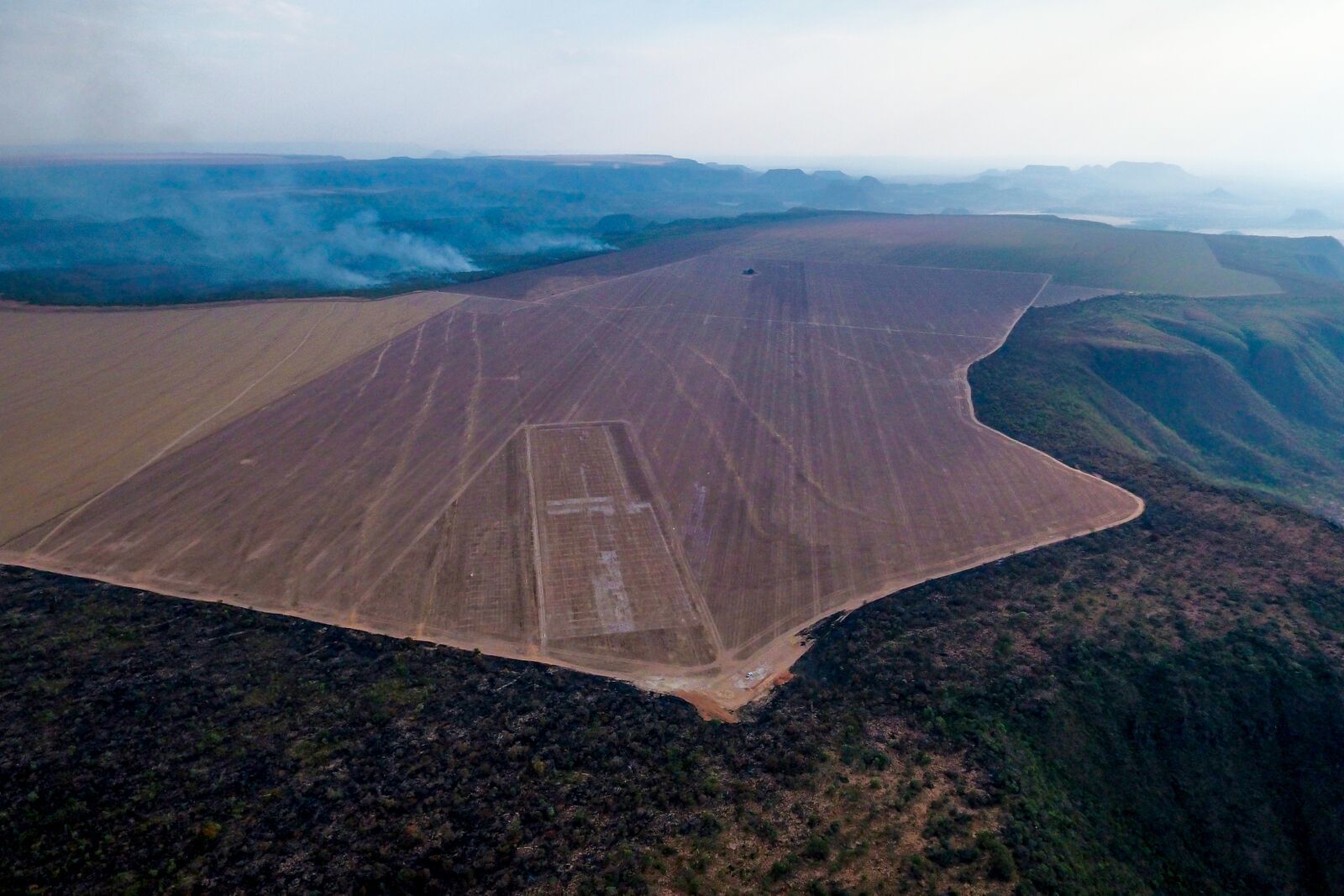
Table top mountains in the Brazilian Cerrado reduced to soy cultivation. Photo credit; Jim Wickens/Ecostorm
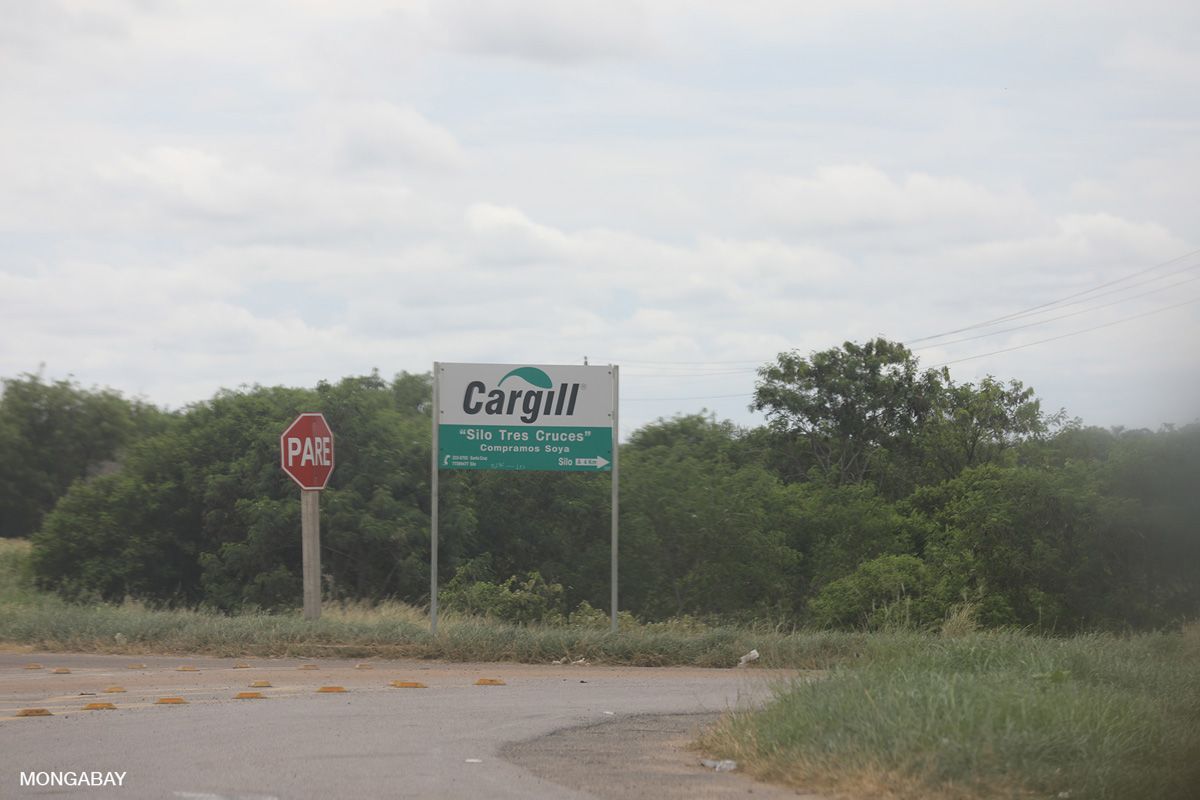
Sign for a Cargill silo in Bolivia reads ‘We buy soy’. Cargill is the biggest privately-held company in the U.S., and while it might not be a household name, people consume its products every day. Photo credit: Jim Wickens/Ecostorm
Five years ago, companies including Cargill, Unilever, and Yum Brands stood on stage at the Climate Summit in New York and proclaimed their commitment to removing deforestation from their supply chains by 2020. So too has the Consumer Goods Forum, whose members include Walmart, Mars and Danone.
They have yet to deliver on this commitment.
Now, with one year until their deadline and the Amazon in flames, it is far past time to act.
These companies must take responsibility for the impacts of their products. They must eliminate the market incentives that promote this reckless environmental destruction.
The Consumer Goods Forum and companies like McDonald’s, Burger King, and Ahold Delhaize – which owns Stop & Shop as well as Hannaford, Food Lion, Pea Pod, and Giant supermarkets – cannot continue to look the other way while the Amazon burns. They should instead source only from suppliers and regions that show evidence of eliminating deforestation. Not in another ten years. Not in five years. Not in one year. Now. Today.
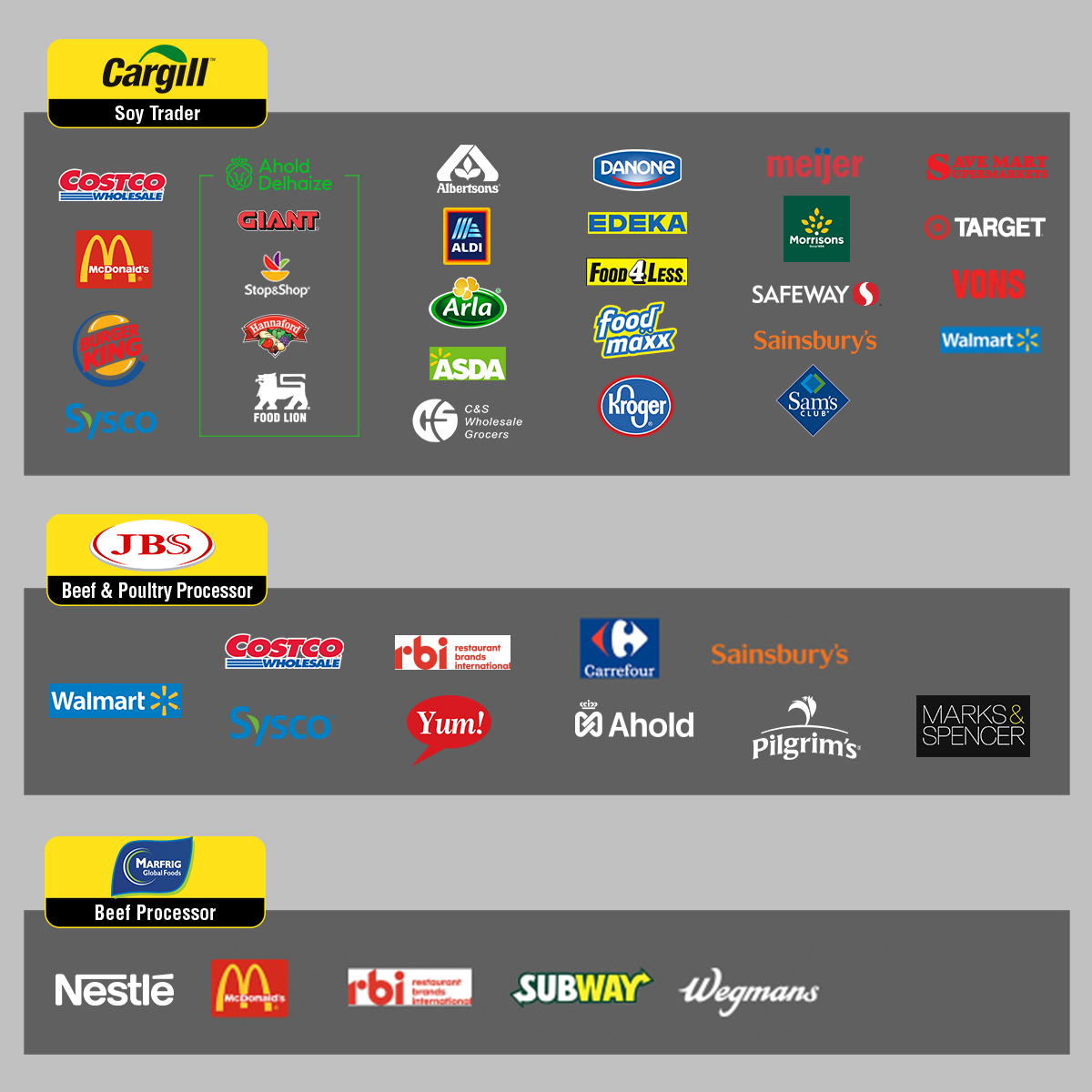
The chart below shows the largest customers of the slaughterhouses and soy animal feed traders most associated with cattle and soy deforestation, respectively.
Brands
Several brands stand out for their contracts and relationships with the suppliers most responsible for deforestation.
Ahold Delhaize: The Netherlands-based supermarket powerhouse owns the brands Stop & Shop, Giant, Food Lion, and Hannaford in the United States and Albert Heijn, Delhaize, Etos, Albert, Alfa-Beta, and others across Europe. While consistently touting its sustainability commitments, Ahold continues selling its customers products from some of the worst companies in the world. With knowledge of Cargill’s ongoing child labor issues and its role in deforestation across South America, Ahold has simultaneously pushed Cargill to do a better job even while launching a joint venture partnership with them to provide the store-branded meat to Stop & Shop stores. In addition, Ahold Delhaize conducted business worth a whopping $113 million with JBS in 2019 through food sales and other partnerships.
As egregious as Ahold Delhaize’s actions are, they are not alone:
McDonald’s: McDonald’s is probably Cargill’s largest and most important customer. McDonald’s restaurants are essentially storefronts for Cargill. Cargill not only provides chicken and beef to McDonald’s, they prepare and freeze the burgers and McNuggets, which McDonald’s simply reheats and serves.
Sysco: With $55 billion in annual revenue, Sysco is the world’s largest distributor of food products to restaurants, healthcare facilities, universities, hotels, and inns. Despite claiming that they will “protect the planet by advancing sustainable agriculture practices, reducing our carbon footprint and diverting waste from landfill, in order to protect and preserve the environment for future generations,” they have honored Cargill as their most valued supplier of pork and beefand did $525 million worth of business with JBS in 2019 through sales and other partnerships.
Costco: Both JBS and Cargill list Costco as one of their top customers. Popular with families and small business owners, it ranks as the world’s third largest retailer. Costco states that it “has a responsibility to source its products in a way that is respectful to the environment and to the people associated with that environment.” According to their website, “Our goal is to help provide a net positive impact for communities in commodity-producing landscapes, by doing our part to help reduce the loss of natural forests and other natural ecosystems, which include native and/or intact grasslands, peatlands, savannahs, and wetland.” Nevertheless, according to Bloomberg, Costco conducted $1.43 billion worth of business with JBS in 2019.
Burger King/Restaurant Brands International: Burger King’s practice of selling meat linked to Cargill and other forest destroyers has earned the fast food giant a ‘zero’ on the Union of Concerned Scientists deforestation scorecard. Burger King has asked Cargill to stop destroying forests in their supply chain…but the deadline isn’t until 2030. It is also a significant customer of JBS. Burger King is part of the Restaurant Brands International (RBI) chain that also includes Tim Horton’s and Popeye’s.
Nestle: Based in Switzerland, Nestle is the largest food and beverage company in the world. Nestle was among the first companies to make zero-deforestation commitments, but only started actually monitoring its supply chains nine years later in 2019 – and only for palm oil, not for soy or pulp/paper. Recently certifying 77 percent of its supply chain as deforestation-free, Nestle continues to buy from Cargill for its pet food subsidiary, Nestle Purina Petcare. Bloomberg data also shows Nestle as one of Marfrig’s top customers.
Carrefour: The French company Carrefour is one of the world’s largest supermarket chains, the majority owner of the largest supermarket chains in Brazil, and at risk for cattle-driven deforestation. It has significant supply chain links to Cargill and JBS. Carrefour has committed to eliminating deforestation from its products by 2020, but the policy does not apply to processed or frozen beef products—which means that only around half of Carrefour’s beef distribution in Brazil is covered by its zero-deforestation policy. According to Chain Reaction Research, 35 percent of the beef and beef products it sampled came from slaughterhouses located within the Legal Amazon including a 2.3 percent from high-risk slaughterhouses.
Casino: Casino, which owns Pão de Açúcar, is a French supermarket giant that prizes its reputation for sustainability in its home country. But as the second-largest supermarket chain in Brazil, it continues to purchase from Cargill, Bunge, and Brazil’s major cattle suppliers.
Walmart: Arkansas-based corporation Walmart is the single-largest company in the world by revenue, and also the largest private employer. Walmart also has a major presence in the UK, through its wholly-owned subsidiary ASDA. Walmart’s stated policy is “as a member of the Consumer Goods Forum, we supported the resolution to achieve zero net deforestation in our supply chain by 2020,encourage our suppliers of [beef, soy, palm oil, pulp and paper] products to work to source products produced with zero net deforestation. We ask suppliers to avoid ancient and endangered forests, to encourage conservation solutions, and to increase recycled content.” Nevertheless, Walmart conducted business with JBS worth $1.68bn in 2018 and remains a leading customer of Cargill meats and other products.
E. Leclerc: E.Leclerc is a French retail chain, with more than 600 locations in France and more than 120 stores outside of the country. Of the supermarket chains in France, Leclerc has perhaps the least robust sustainability policies. A recent report by Sherpa, France Nature Environment and Mighty Earth shows Leclerc failing on soy sustainability measures across the board. The company refuses to join industry calls to protect the endangered Cerrado, has not fulfilled legal obligations to disclose its sources, and has neither develop an alert mechanism to identify risk or follow up on deforestation alerts provided by others. E.Leclerc’s latest sustainability report makes no commitments on meat sourcing, or any other commodity but palm oil.
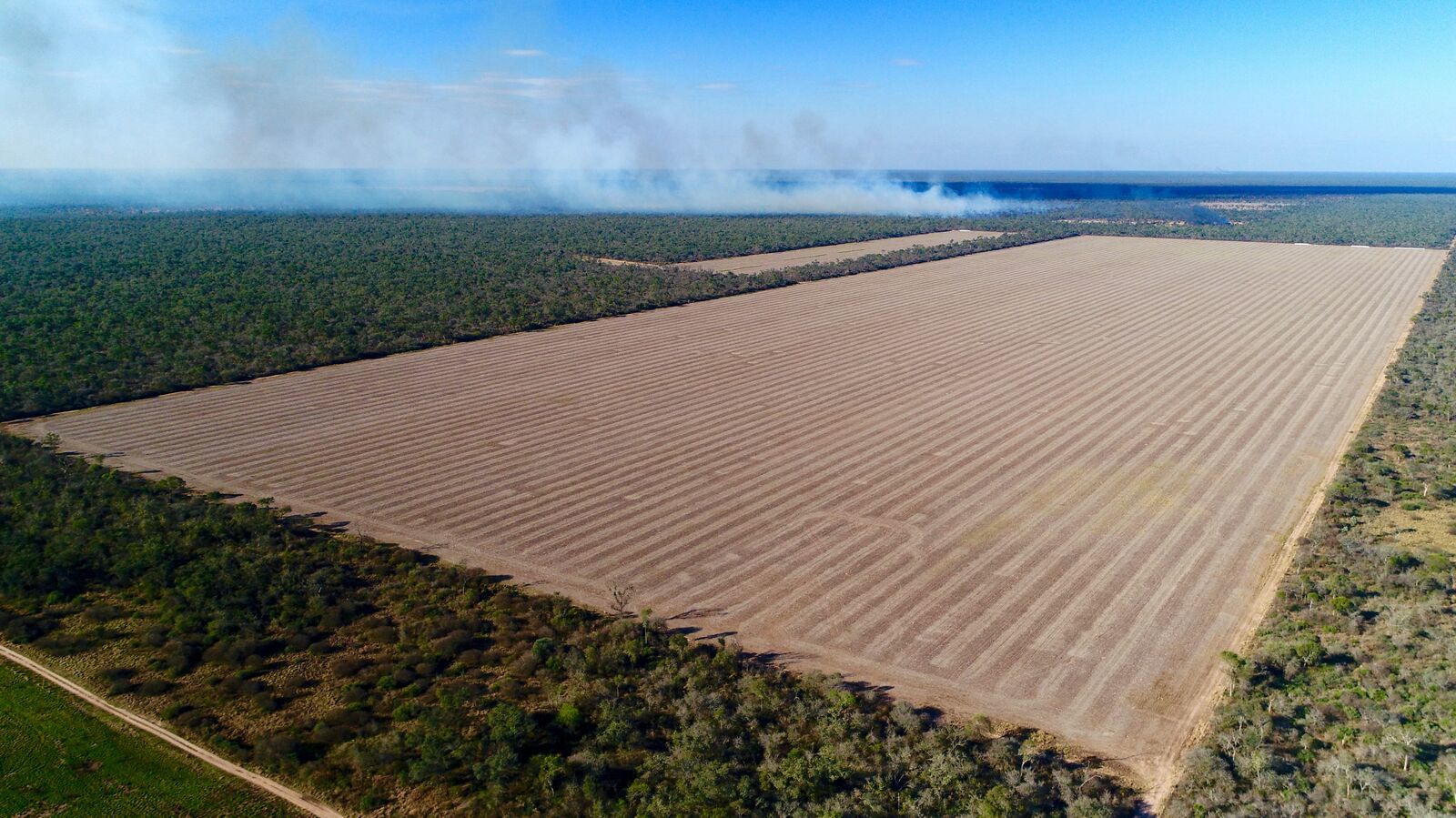
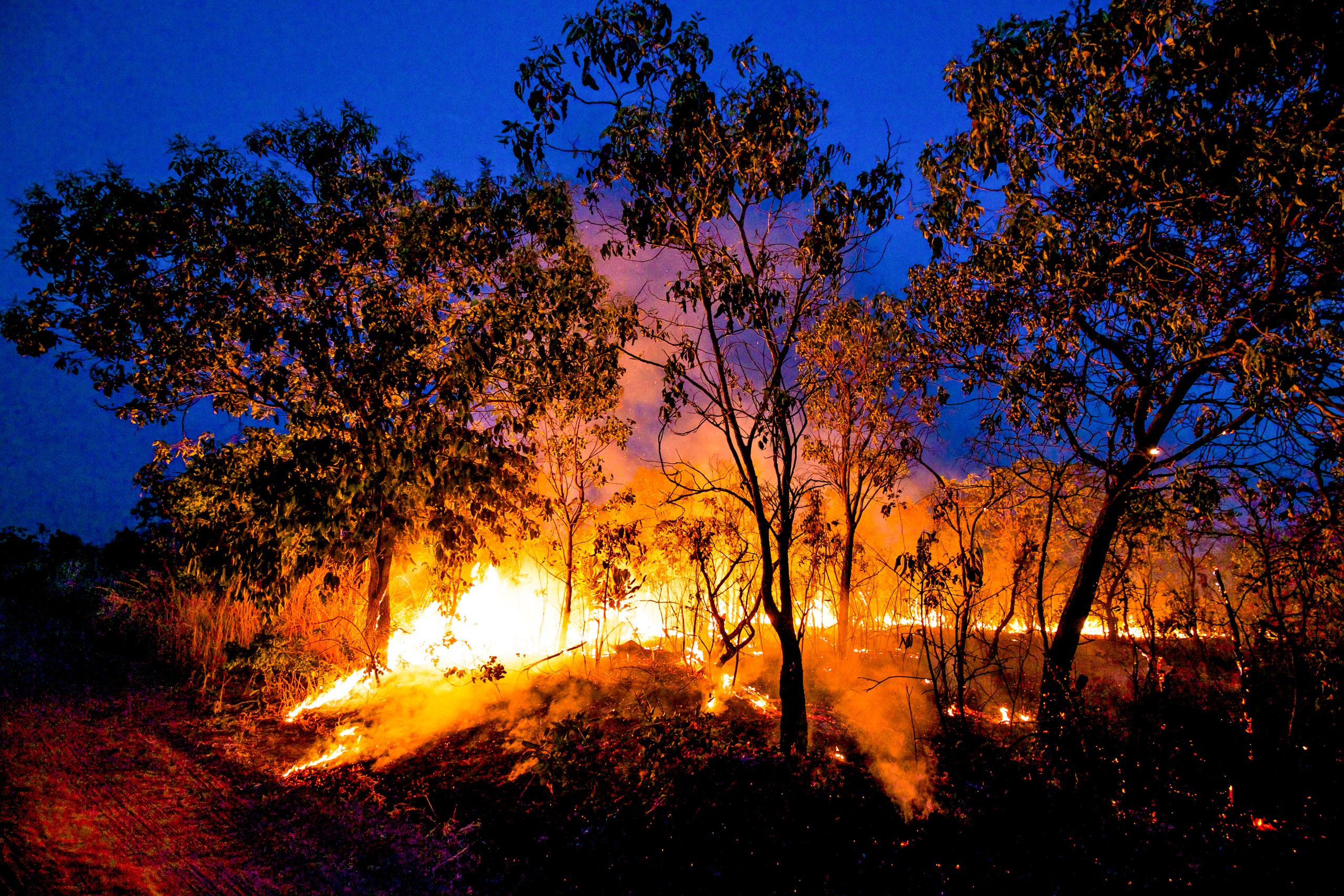
By night forest fires can be seen for miles, tearing through Brazil’s Cerrado ecosystems. Photo credit: 2017, Jim Wickens/Ecostorm
A Preventable Disaster
While the rate of burning has increased dramatically in the last several months in response to Bolsonaro’s policies, these companies have been driving deforestation for years across South America. In many cases, they have bitterly resisted efforts to create systems that would allow for agriculture to expand without deforestation.
Bolsonaro’s mobilization of the army to fight the fires may help in the short term, as will Bolivian president Evo Morales’ new willingness to accept international help to fight fires. But as long as these international companies are creating a market for beef, pork, and chicken that is indifferent to deforestation, this type of environmental disaster is likely to continue.
After years of remarkably successful conservation initiatives that cut Brazil’s deforestation rate by two-thirds, Brazil’s president Jair Bolsonaro has reopened the doors to rampant destruction as a favor to the agribusiness lobby that backs him. That industry is accountable for the atmosphere of lawlessness, deforestation, fires, and the murder of Indigenous peoples that followed. According to data released by Brazil’s National Institute for Space Research (INPE), deforestation of the Brazilian Amazon in July 2019 increased 278 percent over the previous July. Bolsonaro responded to this news by firing the head of the INPE.
The recent fires are the latest example of the cattle and soy industries trying to take advantage of a culture of impunity in both Brazil and Bolivia. Since January 2019, more than 74,000 fires have broken out across Brazil – an 85 percent increase from the same point in 2018. In Bolivia, 2.5 million acres have burned in two weeks.
These are not wildfires. Nearly all are the result of intentional land clearing attempts undertaken by ranchers and industrial soy farmers feeding global markets and international companies. In fact, on August 10, farmers in the Amazon held a “Day of Fire” to show their support for Bolsonaro’s policies.
According to the Smithsonian Institute, these fires, which are large enough to see their effects from space, pose a significant threat to the “lungs” of the planet, one of the world’s last best defenses against climate change.
The deforestation crisis in Brazil and Bolivia wouldn’t be happening without companies like Cargill, Bunge, and JBS and their customers – companies like Stop & Shop, McDonald’s, Burger King, and Sysco – who create the market demand that finances the destruction.
China hits back at Trump criticism of its WTO ‘developing country’ status
29 Jul 2019
E
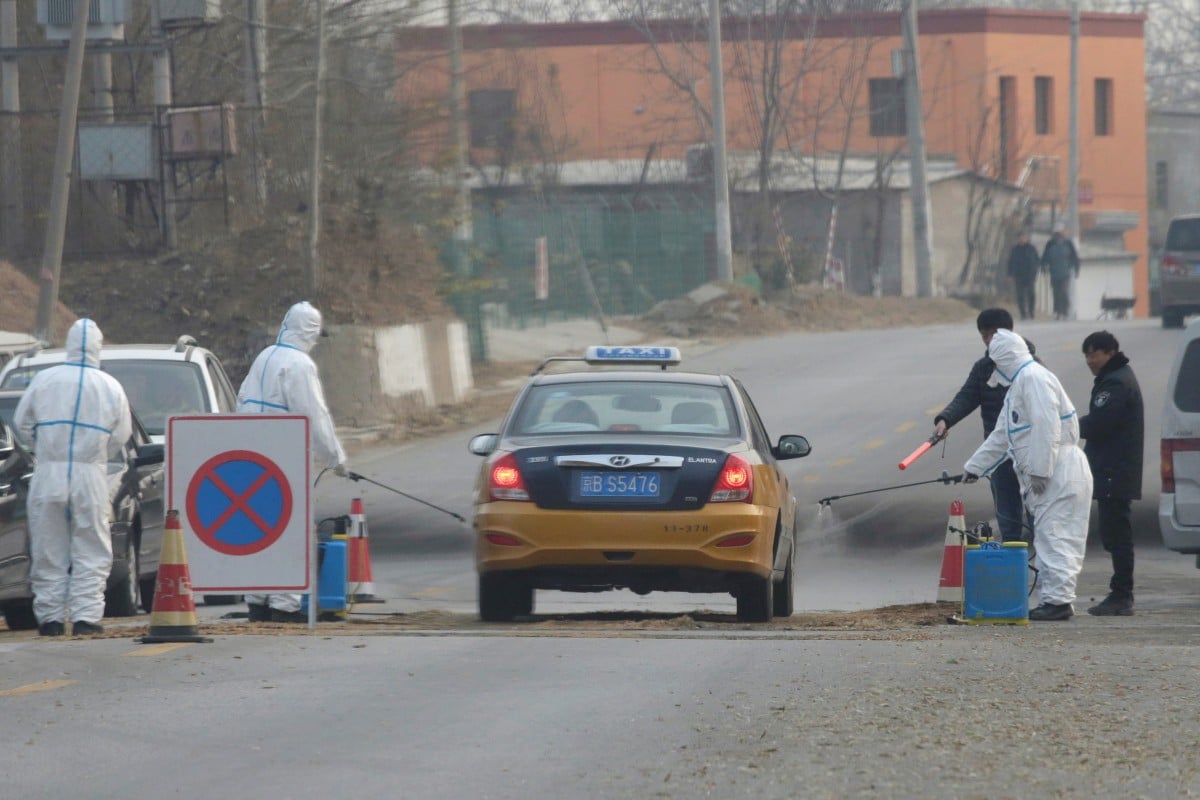
Since the first African swine fever outbreak in Liaoning province in August 2018, the disease has affected animals across the country, forcing China to cull more than 1.1 million pigs from an estimated herd of 350 million. Photo: Reuters
China’s pork prices will reach a record level by the fourth quarter of 2019 due to the impact of African swine fever on domestic production, even as imports continue to surge, according to a Rabobank report.
Pork prices rose by nearly 30 per cent in June compared with a year earlier, according to the Ministry of Agriculture and Rural Affairs, with the spread of African swine fever showing no sign of abating, causing domestic production to plunge.
“China’s pork and hog prices are likely to break the previous record high in 2016 by the fourth quarter,” said Pan Chenjun, the report’s author and a senior analyst for animal protein at Rabobank.
Prices for other meats, including chicken, are also expected to rise substantially, putting further pressure on the discretionary spending of Chinese consumers.
China’s pork and hog prices are likely to break the previous record high in 2016 by the fourth quarterPan Chenjun
Pan forecasts that the wholesale price for pork will reach 30 yuan (US$4.36) per kilogram, while hogs will reach 22 yuan. Wholesale prices for pork in June stood at 21.59 yuan a kilogram.
Pork prices hit record levels three years ago after farmers held back pigs from slaughter to rebuild herds after widespread culling in 2014 when prices were low.
SUBSCRIBE TO SCMP TODAY: INTL EDITION
Get updates direct to your inbox
SUBMIT
By registering for these newsletters you agree to our T&C and Privacy Policy
Rabobank projected that China’s 2019 output will slump by 25 per cent, with an additional 10 to 15 per cent decline in both the nation’s herd and its pork production in 2020.
The Dutch bank, in its third-quarter report on pork, said that there will be “more shipments expected in the second half of 2019”, which will add to China’s already surging pork imports in the first half of the year in an attempt to fill the gap created by the falling domestic production.
Pan said that Chinese pork imports were likely to exceed 3 million tonnes in 2019, more than triple the 1.19 million tonnes last year, according to data from the General Administration of Customs. In June, imports soared 62.8 per cent to 160,467 tonnes, bringing the total for the first half of the year to 818,703 tonnes, according to customs data.
Given that China is the world’s largest pork producer and consumer, the devastating impact of African swine fever on pig herds has taken a toll on global markets for pork and related commodities. Its smaller pig population will mean that China will need to import less soybeans for pig feed, compounding the uncertainties surrounding the commodity already created by the US-China trade war.
Rabobank said many pig producers in exporting countries also remain cautious about expanding their production despite a rising global trade, increasing pressure on supply and prices globally in 2020.
To meet its growing protein supply deficit, China has also bought more chicken meat from abroad, albeit under its own strict import restrictions. Imports of frozen chicken meat soared 107.8 per cent to 71,921 tonnes in June compared with a year ago. Increasing demand is expected to push up chicken prices, where a 50 per cent gain in 2019 “would not be surprising”, said Pan.
China began to import more pork in March when domestic wholesale prices started to rise.
– which fell 75 per cent to 1,609 tonnes between July and December 2018 after China retaliated with tariffs in response to US duties on Chinese goods – have rebounded. Since January, imports from the US have more than tripled from 5,788 tonnes to 17,603 tonnes in May.
Since the first African swine fever outbreak in Liaoning province in August 2018, the disease has affected animals across the country, forcing China to cull more than 1.1 million pigs from an estimated herd of 350 million. Photo: AP
Share:
US pork imports to China face a 62 per cent tariff, but Bloomberg has cited unnamed sources saying that Beijing has approved duty waivers for some Chinese companies.
Global markets have adjusted to expectations that an agreement to end the trade war is unlikely in the short-term. However, Rabobank thinks the resumption of negotiations between the world’s two largest economies in Shanghai on Tuesday and Wednesday could result in China reviewing its tariffs on US pork imports.
Diseases like African swine fever will continue to negatively affect global animal protein output, according to the Rabobank report. Chinese domestic pork production will take more than five years to recover from the outbreak, due to the challenges of restocking that include a lack of solutions to prevent disease and the need for additional investment to restock herds, it said.
The decline comes at a time when demand for pork and meat from the growing middle class populations in China, India and other emerging economies in Southeast Asia is rising.
Dirk Pfeiffer, a professor of veterinary medicine and life science at City University of Hong Kong, said pig producers eager to capitalise on rising demand for meat and pork by China’s middle class, a result of the “economic success of mainland China”, did not invest properly in infrastructure to protect against disease.
“And how are you going to roll that back now? Pork prices have now gone up, that means many of the people will buy chicken instead. So farmers may increase chicken production, then we may have more bird flu,” Pfeiffer said.
Pork prices have now gone up, that means many of the people will buy chicken instead. So farmers may increase chicken production, then we may have more bird fluDirk Pfeiffer
African swine fever will also put downward pressure on middle-class consumer spending, which Beijing is counting on to help boost growth in an economy that is expanding at its slowest pace in nearly three decades. China’s middle class accounts for around 400 million people, or 28.6 per cent of the 1.4 billion population.
Economists at Capital Economics warned that Chinese consumption growth will be weighed down in the near term by consumer price inflation which is set to reach an eight-year high, due in large part to rising pork prices resulting from African swine fever.
“This will drag down real income growth and likely lead to a further deterioration in consumer sentiment,” they said in a report this month.
rose 2.7 per cent in June compared to a year-earlier, driven by higher food prices in pork and fruits, according to the National Bureau of Statistics.
Since the first African swine fever outbreak in Liaoning province in August 2018, the disease has affected animals across the country, forcing China to cull more than 1.1 million pigs from an estimated herd of 350 million.
Rabobank pointed out that Chinese data showed that sow, or mother pig, inventory had dropped 26.7 per cent and the number of hogs had fallen 25.8 per cent at the end of June compared with a year ago. But it believes that the herd losses in specific regions are much worse, down by 40 to 60 per cent since last August. For 2019, the bank expects the total herd loss to exceed 50 per cent.
“No one in the world knows what to do exactly, because what we have [in China] is 50 per cent of the [world’s] pig population … and it’s on less than half the space of the country,” added Pfeiffer. “That is such an amount of biomass that there is just no quick fix.”
This article appeared in the South China Morning Post print edition as: Pork prices to hit record level in 2019 due to swine fever
USDA is offering $75 million in funding for the eradication and control of feral swine through the Feral Swine Eradication and Control Pilot Program (FSCP) in a joint effort between USDA’s Natural Resources Conservation Service (NRCS) and Animal and Plant Health Inspection Service (APHIS).
In the 2018 Farm Bill, $75 million was designated to establish a “feral swine eradication and control pilot program” over the next five years to help landowners with trapping and to use modern technology to control feral hogs. The $75 million will be a 50-50 split between NRCS (for on-farm trapping and technology related to capturing and confining feral swine) and APHIS (for operational removal of feral swine).
“Our intent is to work on joint projects together – we are laying framework now for what those projects will consist of and identifying areas where feral swine populations are high,” said Dale Nolte, program manager for the USDA APHIS National Feral Swine Damage Management Program. “Our focus will be to reduce agricultural damage from feral swine.”
NRCS plans to direct up to $33.75 million of the allocated FSCP funds toward partnership efforts to work with landowners in identified pilot projects in targeted areas. Applications are being accepted now through Aug. 19 for partners to carry out activities as part of these pilot projects in select areas of Alabama, Arkansas, Florida, Georgia, Louisiana, Mississippi, North Carolina, Oklahoma, South Carolina and Texas that have been determined to have the highest feral swine population densities and associated damages in the country.
Pilot projects will consist broadly of three coordinated components: 1) feral swine removal by APHIS; 2) restoration efforts supported by NRCS; and 3) assistance to producers for feral swine control provided through partnership agreements with non-federal partners. Projects will last from one to three years.
“The projects selected for funding will allow APHIS and NRCS to collectively reduce the damage and disease caused by one of the most destructive and formidable invasive species in the United States,” said APHIS Administrator Kevin Shea. “Overall, this pilot program builds upon and expands work already underway by APHIS’ National Feral Swine Damage Management Program to both manage feral swine and eliminate populations in partnership with local government, the private sector, industry and academia.”
NRCS is accepting proposals from non-federal partners to provide landowner assistance for on-farm trapping and related services as part of the pilot projects described above. NRCS will provide funding for these services through partnership agreements. The funding limit for a single award is $1.5 million. Awardees will be required to provide at least 25% of the partnership agreement budget as a match to NRCS funding.
David Herring, president of the National Pork Producers Council and a pork producer from Lillington, N.C., issued a statement thanking USDA for implementing this important Farm Bill program to reduce feral swine populations.
“Wild pigs are difficult to control and when in close proximity to domestic production, they are almost impossible to control. Most seriously, we are concerned about the spread of feral swine carrying diseases, including African swine fever (ASF), an animal disease affecting only pigs and with no human health or food safety risks,” Herring said. “While outbreaks of ASF continue throughout China and other parts of Asia, there are no reported cases in the United States. With no vaccination available, prevention is our only defense and that’s why this program is so vitally important.
Additional information on the complete funding announcement and about specific pilot projects, including target areas and the roles for which partner assistance is being requested, can be found on the FSCP webpage. Applications must be submitted through Grants.gov by 5 p.m. Eastern Time on Aug. 19.
China’s food supply is being imperiled as new reports warn that up to 50 percent of China’s 440 million pigs are now at risk from African Swine Fever infection.
The South China Morning Post reported that Chairman Chan Kin Yip of the Federation of Hong Kong Agricultural Associations claimed that Chinese mainland pig farmers told him African Swine Fever has spread to 30 percent of mainland pigs, while another Hong Kong pig farmer based in China told Yip the exposure rate is as high as 50 percent.
With $23.8 billion of agricultural imports from the U.S. in 2017, retaliatory tariffs directly aimed at President Trump’s rural voter base were expected to be China’s hammer to bludgeon the U.S. into abandoning its trade war. Accounting for 17 percent of U.S. agricultural exports, Chinese customers were number one in soybeans, number two in pork and hay, number three in dairy and poultry, number four in beef, and number five in wheat.
First detected in August 2018, the raging pandemic of highly communicable African Swine Fever has spread to every mainland province and Hong Kong. The virus causes blackened lesions, diarrhea, abortion, respiratory illness, and then death in seven to ten days.
With production declines of 35 percent and prices spiking 40 percent, the disease is wreaking havoc on the China’s $128-billion-a-year pork industry. Although Beijing has encouraged the provinces to provide financial support to large-scale pig farms, the loss of sales and cost to cull up to 220 million infected pigs is a huge burden on the people.
The African Swine Fever has jumped the Chinese border to over 52 cities in Vietnam, leading to the culling of more than 2 million pigs. With the fear of the disease growing, Prime Minister Nguyen Xuan Phuc instructed various ministries to urge more pig culling.
U.S. Customs and Border Protection, partnering with the Department of Agriculture, confiscated 1 million pounds of Chinese pork smuggled into a port in New Jersey in March. Meat was mislabeled and hidden “among other products such as ramen noodles and tide detergent pods” in 50 shipping containers, according to the Feed Navigator.
Tightening of customs controls at Japan, South Korea, Thailand, and Taiwan borders is beginning to cause delivery delays in Asia’s highly integrated production supply chains.
Geopolitical Futures emphasizes that China’s food supply is also being endangered due to other developing risks. The Fall Armyworm has spread to 220,000 acres (89,000 hectares) in Southern China, ruining primarily corn and some sugarcane crops. With no natural predators in China, the USDA warned that “there is a high probability that the pest will spread across all of China’s grain production area within the next 12 months.”
The Chinese government recently confirmed another episode of A(H5N6) bird flu in China’s Xinjiang Province. The outbreak killed only 1,015 of 2,545 birds in the area, but an additional 11,900 will be culled to prevent the disease’s spread. A(H5N6) avian flu is considered especially dangerous because the World Health Organization has identified A(H5N6) as a trans-species virus that mutated in 2016 to begin infecting humans.
Geopolitical Futures cautions regarding China existential risks, “[E]ven if food supplies can be met (which is in question at this point), rising prices also pose a threat to food availability to a country with high levels of low-income and poverty-stricken families.”
China’s food supply is being imperiled as new reports warn that up to 50 percent of China’s 440 million pigs are now at risk from African Swine Fever infection.
The South China Morning Post reported that Chairman Chan Kin Yip of the Federation of Hong Kong Agricultural Associations claimed that Chinese mainland pig farmers told him African Swine Fever has spread to 30 percent of mainland pigs, while another Hong Kong pig farmer based in China told Yip the exposure rate is as high as 50 percent.
With $23.8 billion of agricultural imports from the U.S. in 2017, retaliatory tariffs directly aimed at President Trump’s rural voter base were expected to be China’s hammer to bludgeon the U.S. into abandoning its trade war. Accounting for 17 percent of U.S. agricultural exports, Chinese customers were number one in soybeans, number two in pork and hay, number three in dairy and poultry, number four in beef, and number five in wheat.
First detected in August 2018, the raging pandemic of highly communicable African Swine Fever has spread to every mainland province and Hong Kong. The virus causes blackened lesions, diarrhea, abortion, respiratory illness, and then death in seven to ten days.
With production declines of 35 percent and prices spiking 40 percent, the disease is wreaking havoc on the China’s $128-billion-a-year pork industry. Although Beijing has encouraged the provinces to provide financial support to large-scale pig farms, the loss of sales and cost to cull up to 220 million infected pigs is a huge burden on the people.
The African Swine Fever has jumped the Chinese border to over 52 cities in Vietnam, leading to the culling of more than 2 million pigs. With the fear of the disease growing, Prime Minister Nguyen Xuan Phuc instructed various ministries to urge more pig culling.
U.S. Customs and Border Protection, partnering with the Department of Agriculture, confiscated 1 million pounds of Chinese pork smuggled into a port in New Jersey in March. Meat was mislabeled and hidden “among other products such as ramen noodles and tide detergent pods” in 50 shipping containers, according to the Feed Navigator.
Tightening of customs controls at Japan, South Korea, Thailand, and Taiwan borders is beginning to cause delivery delays in Asia’s highly integrated production supply chains.
Geopolitical Futures emphasizes that China’s food supply is also being endangered due to other developing risks. The Fall Armyworm has spread to 220,000 acres (89,000 hectares) in Southern China, ruining primarily corn and some sugarcane crops. With no natural predators in China, the USDA warned that “there is a high probability that the pest will spread across all of China’s grain production area within the next 12 months.”
The Chinese government recently confirmed another episode of A(H5N6) bird flu in China’s Xinjiang Province. The outbreak killed only 1,015 of 2,545 birds in the area, but an additional 11,900 will be culled to prevent the disease’s spread. A(H5N6) avian flu is considered especially dangerous because the World Health Organization has identified A(H5N6) as a trans-species virus that mutated in 2016 to begin infecting humans.
Geopolitical Futures cautions regarding China existential risks, “[E]ven if food supplies can be met (which is in question at this point), rising prices also pose a threat to food availability to a country with high levels of low-income and poverty-stricken families.”
News Editor, LIVEKINDLY | New York City | Contactable via: kat@livekindly.co
Vegan celebrity Miley Cyrus was just one of many to lose her home this past week in the California Woolsey Fire. Despite this, the star says that she is grateful that she was able to rescue her pets and make it out alive with her fiance, actor Liam Hemsworth.
“Completely [devastated] by the fires affecting my community. I am one of the lucky ones,” Cyrus wrote on Twitter yesterday. “My animals and LOVE OF MY LIFE made it out safely & that’s all that matters right now.”
She continued, “My house no longer stands but the memories shared with family & friends stand strong. I am grateful for all I have left. Sending so much love and gratitude to the firefighters and LA country Sheriff’s department! If you are interested in getting involved see next tweet…. Donate $ , Time , Supplies. I love you more than ever, Miley.”
The award-winning Cyrus isn’t shy about the love she has for all animals – she even dedicated her 2015 album, “Miley Cyrus and Her Dead Petz,” to her deceased companions. That same year, the singer toldthe New York Times that spending time at home with her pets is one of her favorite activities.
According to People Magazine, Cyrus’s extended four-legged family includes Barbie, a former lab beagle rescued by the Rescue + Freedom Project, Emu the dog, who the singer immortalized in a tattoo in 2017, and former shelter pups Happy, Mary Jane, Bean, Milky, Dora, and Tani.
The award-winning artist is also mom to four rescue cats – Kiki, Lilo, Shanti Om BB, Harlem – and a pig named Pig Pig (formerly known as Bubba Sue), who Cyrus posed with on the cover of Paper magazine in 2015. Last October, the singer-songwriter even took a break from touring to help care for her beloved pigs. “Literally the only reason I’m not touring is because of those [censored] pigs. That’s how much I love those pigs,” she said.
Cyrus’s compassion isn’t just limited to her companion animals. The star has been a vegan since 2013 and has used her 40.4 million strong social media following to stand up for animal rights and to promote cruelty-free fashion. Last December, Cyrus and her sister Noah received a Libby Award, an annual awards ceremony hosted by peta2, for “Best Voice for the Animals” for their work in promoting compassion towards animals.
The record-breaking rains that started with Hurricane Florence are continuing to strain North Carolina’s hog lagoons.
Because of the storm, at least 110 lagoons in the state have either released pig waste into the environment or are at imminent risk of doing so, according to data issued Wednesday by the North Carolina Department of Environmental Quality. That tally more than tripled the Monday total, when the department’s count was 34.
When a pig in a large-scale farm urinates or defecates, the waste falls through slatted floors into holding troughs below. Those troughs are periodically flushed into an earthen hole in the ground called a lagoon in a mixture of water, pig excrement and anaerobic bacteria. The bacteria digest the slurry and also give lagoons their bubble gum-pink coloration.
North Carolina has 9.7 million pigs that produce 10 billion gallons of manure annually, mostly on large-scale farms and primarily in low-lying Sampson and Duplin counties. Both counties were affected by Florence.
When storms like Florence hit, lagoons can release their waste into the environment through structural damage (for example, when rains erode the banks of a lagoon and cause breaches). They can also overflow from rainfall or be swept over by floodwaters.
Whatever the cause, the result when a lagoon leaks can be environmental trouble. If the untreated waste enters rivers, for example, algal blooms and mass fish die-offs can happen, as they did in 1999 during Hurricane Floyd. That year, many animals drowned in lagoon slurry.
Hog lagoons and the associated large-scale farms, also known as concentrated animal feeding operations, or CAFOs, have been a sore spot in the eastern part of the state, where residents say that the operations harm their health and well-being.
“Life expectancy in North Carolina communities near hog CAFOs remains low, even after adjusting for socioeconomic factors that are known to affect people’s health and life span,” Dr. H. Kim Lyerly, a professor of cancer research at Duke, said in a statement. The Duke study stops short of drawing a causal link.
Last week, Andy Curliss, chief executive of the North Carolina Pork Council, said that the pig producers had learned a lot from Hurricane Floyd. In 2016, Hurricane Matthew caused 14 lagoons to flood but none breached, according to the pork council.
“A lot of the farms that were flooded were bought out and closed,” he said. “That’s why you didn’t see the same impact in Matthew — we had maybe 15 floods, no breaches.”
The North Carolina Pork Council said in a statement Wednesday afternoon that while most of their 2,100 hog farms were resuming normal operations, a small number of farmers have had to take extreme measures like using boats to reach their barns.
As Florence approached, farmers tried to free up more space in lagoons by spraying manure onto fields, said Heather Overton, a spokeswoman for the North Carolina Agriculture Department.
Will Hendrick, a staff attorney with the environmental nonprofit group Waterkeeper Alliance, said that manure sprayed on fields could run off into rivers, streams, and groundwater supplies if the fields flooded.
A livestock farm in eastern North Carolina photographed by Waterkeeper Alliance on Monday. Credit Rick Dove/Waterkeeper Alliance
Excess nitrates in groundwater, such as those associated with pig manure, are linked with health problems like blue baby syndrome. In some cases of the syndrome, nitrogen binds to the hemoglobin in a baby’s blood and makes red blood cells unable to carry oxygen. The syndrome’s name comes from the fact that the lack of oxygen causes the baby’s skin to take on a bluish tint. The syndrome can also be caused by heart defects
Part of the problem, said Alexis Andiman, an associate attorney with the environmental nonprofit law firm Earthjustice, is that storm standards for pig lagoons currently date from the 1960s.
As part of a settlement in a lawsuit that Earthjustice levied against the state, “the storm standard will be tied to a National Oceanic and Atmospheric Administration standard from 2006,” Ms. Andiman said. “But that’s still kind of old.”
As for the animals, most of them were relocated before the storm. As of Wednesday the North Carolina Department of Agriculture reported that an estimated 5,500 pigs had died because of Florence. Chickens and turkeys, however, weren’t so lucky. An estimated 3.4 million birds were killed. The poultry producer Sanderson Farms said in a news release that they’d lostan estimated 1.7 million broiler chickens.
The Department of Environmental Quality’s data is self-reported by farmers, many of whom may have left their farms to avoid the storm surge and floodwaters. The number of spills reported could increase as more farmers make their way back to their farms. But luckily, in a region that has struggled with too much rain, the rest of the week’s forecast is mostly sunny.
In September of last year, two executives of JBS, the world’s largest meat producer, based in Brazil, were arrested and charged with insider trading. In May 2017, the billionaire siblings—Wesley Batista, JBS’s CEO, and his younger brother Joesley, the firm’s former chairman—admitted to bribing more than 1,800 politicians and government officials, including meat inspectors, in an effort to avoid food safety checks.
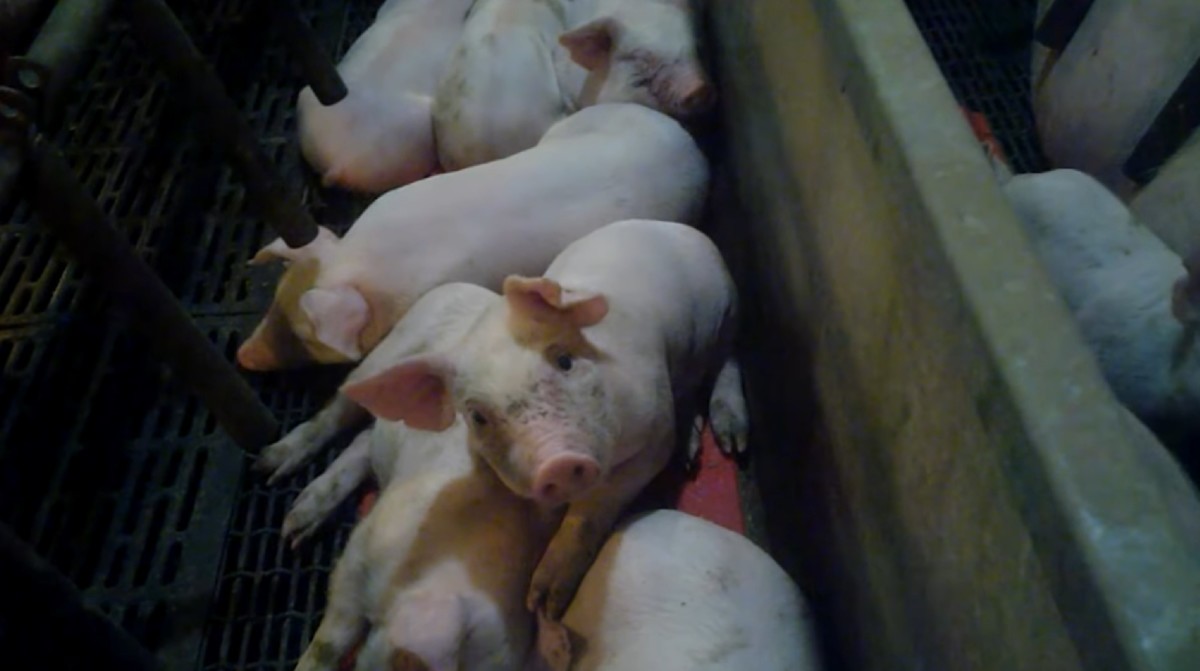
Now, new undercover video shot by a Mercy for Animals (MFA) investigator at Tosh Farms, a JBS pork supplier based in Franklin, Kentucky, exposes what the animal rights group calls the “malicious and systemic abuse of mother pigs and piglets.”
“I’ll never forget the way they looked up at me,” said Tyler, the MFA investigator, about the pigs he documented at Tosh Farms. “They all shared the same look of helplessness and fear.”
“One mother pig stumbled down a corridor with her uterus hanging outside her body. She wouldn’t live much longer,” he said on an MFA website launched specifically to document the JBS investigation, jbstorture.com.
Tyler witnessed workers at Tosh Farms kicking and striking animals in their faces, ripping out the testicles of piglets without any pain relief, and even smashing the heads of piglets against the ground in order to kill them.
Those piglets who did not immediately die were left to suffer, denied proper veterinary care. “A worker grabbed a piglet, just hours old, by the feet and swung him high and then slammed his head down against the hard concrete,” said Tyler. “Any life left quickly vanished.”
Stay in the loop
Never miss the news and analysis you care about.
“From the day pigs are born until the day they are violently killed for JBS pork, their lives are filled with misery and deprivation,” said Matt Rice, president of MFA, in a press statement. “If JBS executives abused even one dog or cat the way their suppliers abuse millions of pigs, they would be jailed for cruelty to animals. As the largest meat company in the world, JBS has the power and responsibility to end this torture.”
Clare Ellis, publisher of Stone Pier Press, which recently released “Sprig the Rescue Pig,” the first of its Farm Animal Rescue Books for children, was appalled: “Stories like this are even more heartbreaking and upsetting when you consider how very smart, curious, affectionate and sensitive pigs are.” She added that, “Close to 99 percent of animals raised for food come from factory farms, which, in addition to being terribly cruel, do an enormous amount of environmental damage.”
Following the July 17 release of the video, which was taken between December 2017 and March 2018, JBS said it suspended shipments from that supplier site. “The images presented in the video fall completely outside the company’s standards,” JBS said in a statement, but did not name the supplier involved.
But for MFA, suspending shipments from that single supplier isn’t nearly enough. “JBS’s decision to suspend Tosh Farms as a supplier is too little, too late,” Kenny Torrella, director of communications with MFA, told Truthout. “It amounts to nothing more than meaningless PR spin.”
The group, headquartered in Los Angeles, is now calling on JBS to end factory farm cruelty across its global pork supply chains, including the elimination of painful mutilations. In addition, MFA is calling on JBS to prohibit its suppliers from housing sows in tiny gestation crates for nearly their entire lives. These metal cages, the standard of which measures just 6.6 feet x 2 feet—so small that they can’t even turn around or lie down comfortably—are where pregnant sows live in factory farms around the globe for nearly their entire lives. In the United States as of 2016, there were 5.36 million breeding sows, most of them kept in gestation crates.
Confined to tiny gestation crates, mother pigs are not only denied basic natural behaviors like playing, exploring and engaging with their peers and children, but they also must endure immense and prolonged mental and emotional suffering. “These curious animals lose their minds from frustration and stress,” writes Lucas Alvarenga, vice president of MFA in Brazil. “They often also suffer painful pressure sores from rubbing against the bars of their crates and crippling joint problems as their muscles waste away from lack of use.”
While gestation crates are still the norm across the world, things are beginning to change for the better. Canada, the European Union, New Zealand and Australia, as well as 10 US states, have banned cruel gestation crates. Further, more than 60 major food companies—including McDonald’s, Walmart, Burger King and Nestlé—have said they would ban gestation crates from their suppliers.
In addition, California voters will have the opportunity in November to ban the sale of pork from pigs confined in gestation crates. If the measure passes, that will impact Tosh Farms and JBS, as the pigs reared at Tosh are then transported to a JBS slaughterhouse in Louisville, Kentucky, which supplies pork products to stores across California.
The systemic abuse and torture of pigs is an industry-wide problem. Last year, MFA investigators at the Aurora cooperative pig factory farm in the state of Santa Catarina in Brazil, the third-largest meat producer in Brazil and a major pork exporter to the United States, recorded video of pigs and piglets enduring a wide range of cruelty, including, notes Alvarenga, “workers slicing off the tails, cutting holes in the ears and grinding the teeth of piglets without any pain relief.”
“The animals who are raised to be food for humans are so much more than just burgers and bacon,” said Marc Bekoff, professor emeritus of ecology and evolutionary biology at the University of Colorado, Boulder, and co-author ofThe Animals’ Agenda: Freedom, Compassion, and Coexistence in the Human Age.
“Pigs, cows, chickens, turkeys and other non-human animals whose flesh is destined to wind up in our mouths were once sentient beings with rich emotional lives,” said Bekoff, who is also the co-founder, with Jane Goodall, of Ethologists for the Ethical Treatment of Animals. “But because consumers rarely interact with them while they are still alive, they don’t see that these animals feel such a wide range of emotions, ranging from joy to sadness to grief, just like we all do.”
Non-human animals aren’t the only victims of the factory farm system. Slaughterhouse workers must witness the nightmarish conditions that the animals must endure. Some workers must do the actual killing, day in and day out.
“The psychological toll this takes on a person cannot be underestimated,” writes Ashitha Nagesh. “Slaughterhouse work has been linked to a variety of disorders, including PTSD and the lesser-known PITS (perpetration-induced traumatic stress). It has also been connected to an increase in crime rates, including higher incidents of domestic abuse.”
“To help move society to a more ethical food system, we as consumers must think less about ‘what’ is on our plate and more about ‘who’ is on our plate,” said Bekoff.
TAKE ACTION: Sign the petition urging JBS to ban gestation crates and painful mutilations.
This article was produced by Earth | Food | Life, a project of the Independent Media Institute.













 First detected in August 2018, the raging pandemic of highly communicable African Swine Fever has spread to every mainland province and Hong Kong. The virus causes blackened lesions, diarrhea, abortion, respiratory illness, and then death in seven to ten days.


 Exposing the Big Game