Exposing the Big Game

Forget Hunters' Feeble Rationalizations and Trust Your Gut Feelings: Making Sport of Killing Is Not Healthy Human Behavior

Exposing the Big Game

Russian Watchdog Warns Six Walrus Calves From ‘Whale Jail’ May Be Smuggled To China

Zeeshan Aziz (@imziishan) 13 minutes ago Thu 05th December 2019 | 05:29 PM Russian Watchdog Warns Six Walrus Calves From ‘Whale Jail’ May Be Smuggled to China A Russian environmental watchdog has questioned the legitimacy of an appeal by the Akvatoriya company in Vladivostok to sell to China six baby walruses that were captured in 2018 in Chukotka by two companies implicated in the recent “whale jail” scandal, the watchdog’s press service told Sputnik on Thursday

MOSCOW/VLADIVOSTOK (UrduPoint News / Sputnik – 05th December, 2019) A Russian environmental watchdog has questioned the legitimacy of an appeal by the Akvatoriya company in Vladivostok to sell to China six baby walruses that were captured in 2018 in Chukotka by two companies implicated in the recent “whale jail” scandal, the watchdog’s press service told Sputnik on Thursday.

According to the Federal Agency for Supervision of Natural Resources (Rosprirodnadzor), on November 25, 2019, Akvatoriya lodged a request to issue a permit under the Convention on International Trade in Endangered Species of Wild Fauna and Flora to export six baby walruses from Russia to China. The documents provided by the company, however, raised questions on the origin of the animals.

“Thus, taking into account that the date of birth indicated in the animals’ passports is 2018, the age of the animals at the time of capture could not exceed 10 months. There is no information about the address and conditions of keeping the walruses in the exporter’s request. As part of the review procedure, we sent a request to the Russian Federal Fisheries Agency on the legitimacy of catching the given walruses,” the press service stated.

According to the Russian legislation, capturing walruses that young is illegal. On Tuesday, the Russian Environment Ministry ordered head of Rosprirodnadzor Svetlana Radionova to check Srednyaya Bay, where the baby walruses were held in captivity. In addition, in March, one of the workers of the “whale jail” confirmed that there were walruses among the animals stranded in captivity.

The scandal involving the “whale jail” erupted last year when environmentalists found that a large group of marine mammals was held in captivity in Srednyaya Bay of the Primorsky Region. The stranded animals were being prepared to be smuggled to China. As a result of a probe into the illegal fishing of aquatic animals and animal abuse, the companies responsible for the violation were fined a total of 150 million rubles
($2.4 million). The trapped orcas and belugas were steadily released in groups from June to November.

https://www.urdupoint.com/en/world/russian-watchdog-warns-six-walrus-calves-from-779542.html

NRA Was ‘Foreign Asset’ To Russia Ahead of 2016, New Senate Report Reveals

Enlarge this image

A visitor to the at the National Rifle Association annual meeting walked past signage for the event in Indianapolis, Saturday, April 27, 2019.

Michael Conroy/AP

Updated at 11:53 a.m. ET

The National Rifle Association acted as a “foreign asset” for Russia in the period leading up to the 2016 election, according to a new investigation unveiled Friday by Sen. Ron Wyden, D-Ore.

Drawing on contemporaneous emails and private interviews, an 18-month probe by the Senate Finance Committee’s Democratic staff found that the NRA underwrote political access for Russian nationals Maria Butina and Alexander Torshin more than previously known — even though the two had declared their ties to the Kremlin.

The report, available here, also describes how closely the gun rights group was involved with organizing a 2015 visit by some of its leaders to Moscow.

Then-NRA vice president Pete Brownell, who would later become NRA president, was enticed to visit Russia with the promise of personal business opportunities — and the NRA covered a portion of the trip’s costs.

Tax-exempt organizations are barred from using funds for the personal benefit of its officials or for actions significantly outside their stated missions. The revelations in the Senate report raise questions about whether the NRA could face civil penalties or lose its tax-exempt status.

Attorneys general in the state of New York and the District of Columbia are conducting separate probes into alleged wrongdoing at the gun rights organization. These probes have a broader scope than the Senate report, which focuses on Russia.

Majority response: This is overblown

The Republican majority on the Senate Finance Committee, which was consulted periodically throughout the Democrats’ investigation, said Friday the report was overblown.

In the Republicans’ analysis of Wyden’s report, the majority argued that it does not account for U.S.-Russia relations at the time and contains “much conclusory innuendo… and repeatedly attempts to paint a picture that does not exist.”

The Republicans also argued that if the NRA committed any infractions, they would be small and do not put the NRA’s tax-exempt status at risk.

“To the extent NRA funds were used improperly in any facts discussed in the [Democratic report led by Wyden], it appears to have been minor, hardly a rounding error for an organization with hundreds of millions of dollars in revenue each year and nothing that cannot be corrected with minor intermediate sanctions,” the Republican analysis states.

Kremlin links were clear

Wyden’s 77-page report centers on Butina — a convicted Russian agent now in federal prison — and Torshin, a former Russian government official who has been sanctioned by the United States.

The report indicates that top NRA officials were aware of Butina’s and Torshin’s links with the Kremlin even as they sought to work more closely together under the banner of gun rights.

In an email later circulated to two senior NRA staff members, Butina wrote that a purpose of the 2015 Moscow trip was that “many powerful figures in the Kremlin are counting on Torshin to prove his American connections” by showing he could bring prominent NRA officials to Russia.

At another point, Butina suggested to participants on the 2015 NRA trip to Russia that she might be able to set up a meeting between them and President Vladimir Putin, referring to him as “Russia’s highest leader.”

NRA facilitated political access

Despite these declarations about their ties to the Russian government, NRA officials paid for and facilitated Torshin and Butina’s introduction into American political organizations.

Butina and Torshin received access to Republican Party officials at NRA events.

It was a explicit interest expressed by Butina: In one 2015 email to an NRA employee, Butina wrote, “is there a list of U.S. governors or members of Congress that might be present at some time during the [NRA] annual meeting?”

The employee responded with a list.

The NRA also helped them forge connections with groups such as the Council for National Policy, the National Prayer Breakfast, the National Sporting Goods Wholesalers Association and Safari Club International.

“NRA resources appear to have been used to pay for membership and registration fees to third party events for [Torshin and Butina] as well as to arrange for transit to and lodging for many of those events throughout 2015 and 2016,” the report states.

Report contradicts NRA denials

The Senate report notes that in 2018, then-NRA spokeswoman Dana Loesch repeatedly denied that the group leaders’ 2015 trip to Moscow was sanctioned by the gun rights group.

But in a letter obtained by the committee, then-NRA President Allan Cors wrote to Torshin on NRA letterhead after consulting with NRA staff and former NRA President David Keene.

Cors designated two NRA figures to lead the trip: “Dave Keene and [top NRA donor] Joe Gregory will represent the NRA and our five million members better than anyone else,” he wrote.

During the course of the investigation, Brownell’s lawyer also told the committee that Brownell believed the trip was an official NRA event.

This view is further strengthened by the committee’s evidence that NRA staff prepared itineraries, gathered briefing materials, applied for tourist visas, paid for some of the travel expenses, and provided the delegation with NRA gifts to give to Russian officials.

The Senate investigation also found evidence that the NRA tried to hide various payments related to the trip.

Brownell covered approximately $21,000 in expenses related to the trip; in June 2016, the NRA reimbursed Brownell just over $21,000.

After questions were raised about the trip in 2018, Brownell paid the NRA $17,000 — a transaction that Brownell’s lawyer told the committee was requested by the NRA as a way of “getting the trip off the NRA’s books.”

NRA leaders sought business opportunities

The Senate investigation concludes that a number of NRA figures on the 2015 trip traveled to Russia “primarily or solely for the purpose of advancing personal business interests, rather than advancing the NRA’s tax-exempt purpose.”

Brownell, then a vice president of the NRA, is the CEO of a major firearms supplier bearing his last name.

In an email to a staffer at his business, Brownell described his trip as “an opportunity to be hosted in Russia to broaden our business opportunities … to introduce our company to the governing individuals throughout Russia.”

“The NRA directly facilitated Brownell’s effort to travel to Moscow early to explore business opportunities with Russian weapons manufacturers,” the report concludes.

Another member of the trip, NRA donor and then-Outdoor Channel CEO Jim Liberatore, told the Senate committee through his lawyer that his participation in the 2015 Moscow trip was “purely commercial.”

Wyden seeks IRS probe

Wyden, the top Democrat on the Senate Finance Committee, said at the conclusion of his investigation that his staff had revealed information that shows that the National Rifle Association may have abused its tax-exempt status.

The next step, he says, is for the IRS to launch its own inquiry.

“The totality of evidence uncovered during my investigation, as well as the mounting evidence of rampant self-dealing, indicate the NRA may have violated tax laws,” Wyden said. “The IRS needs to examine these findings and investigate other publicly reported incidents of potential lawbreaking.”

Punishment for illegal catching rare animals to be toughened in Russia

14:06 24/09/2019

MOSCOW, September 24 (RAPSI) – A bill to toughen punishment for illegal capture and sale of especially valuable wild animals and marine biological resources belonging to species listed in the Red Book has passed its third and final reading in the State Duma.

Amendments, according to a statement of the lower house of parliament, would be introduced into the Criminal Code of the Russian Federation.
Under them, such crimes against rare animals would be recognized as medium and grave.

Thus, illegal catching, keeping, purchase, transportation or sale of red-listed animals and marine biological resources would be punishable by community service or imprisonment for up 4 years instead of current 3 years. If the crime is committed with the use of job position or is publicly demonstrated on the Internet or in media, it would be punished with prison terms of up to 6 years instead of current 5 years.

The bill also toughens punishment for illegal buying rare animals online. Currently, it is punished with community service or imprisonment for up to 4 years. Under the draft law, such actions would result in jail terms of up to 5 years. Those purchasing rare species through the Internet with the use of official position would face up to 7 years behind bars instead of currently stipulated 6 years.

Punishment for crimes of this type committed by a group of people in conspiracy and with the use of job position would be also tightened by 1 year, from current maximum 7 to 8 years in custody.

According to the State Duma Chairman Vyacheslav Volodin, both poachers and their assistants would not have a chance to avoid sanctions as the bill introduces a separate provision on penalties for non-officials using job position to commit the crime, namely employees of national parks and special nature reserves. Previously, responsibility was not set for them.

http://rapsinews.com/news/20190924/304121302.html

Russia to release whales from ‘jail’ in far east after outcry

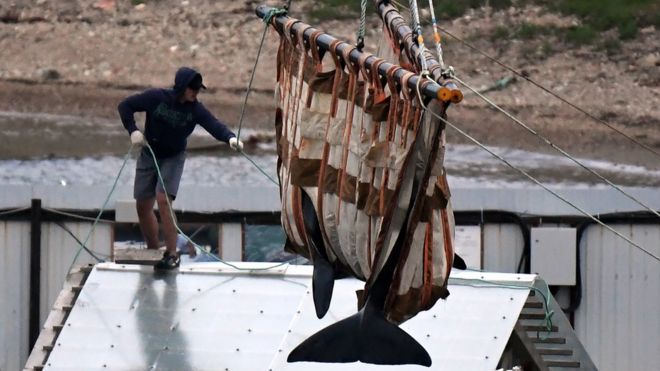
Experts of the Russian Research Institute of Fisheries and Oceanography (VNIRO) begin an operation to release the first two orcasImage copyrightGETTY IMAGES
Image captionExperts released two orcas from the so-called “whale jail” on Thursday

Russia has started to release a group of nearly 100 captive whales which have been kept in small pens in the far east of the country.

It comes after the so-called “whale jail” provoked an international outcry, with marine scientists and celebrities calling for the mammals to be released.

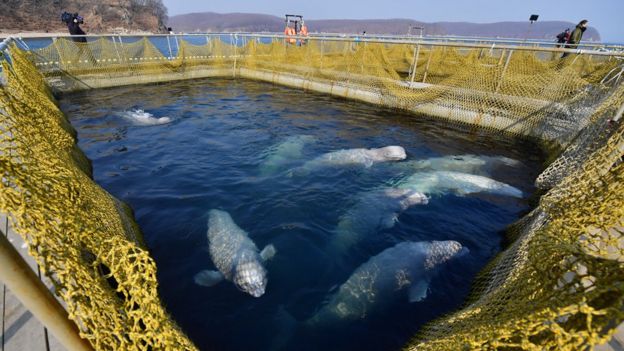
In total, 11 killer whales (orcas) and 87 belugas are being kept in cramped enclosures on the Sea of Japan.

They will be released in stages and the process will take several months.

“We have taken the only sensible decision at the recommendation of scientists to release the animals to their natural habitat where they were caught,” Deputy Prime Minister Alexei Gordeyev told reporters on Thursday.

“This operation will take about four months,” he added. Eight whales will reportedly be freed in the first stage of the process.

President Vladimir Putin praised the decision during his annual televised phone-in in which he fields questions from members of the public.

“The killer whales alone – as far as I know – are worth around 100 million dollars,” he said. “When it’s big money, problems are always hard to solve. Thank God things have started moving.”

What was the “whale jail”?

The juvenile whales were caught last year in the Sea of Okhotsk. They were then transported more than 1,300km (800 miles) south and kept in cramped pens near the port town of Nakhodka.

Although Russia allows the capture of whales for scientific purposes, experts feared the animals were bound for theme parks or aquariums in China.

Individual orcas, often caught illegally, can fetch millions of dollars. Belugas are sold for tens of thousands of dollars.

Belugas at Srednyaya Bay, 1 Mar 19Image copyrightGETTY IMAGES
Image captionThe belugas are in cramped pens which are taking a toll on their health

Greenpeace Russia, an environmental group, raised the alarm about the animals last October. They believe at least four of the whales died while in captivity.

Many are known to be in poor health and some have shown signs of hypothermia. In the wild whales swim tens of kilometres every day – and that keeps them warm – but in small pens they get cold.

In January, Greenpeace also reported that some of the whales were showing skin lesions and flipper deterioration. Some of those injuries may have been caused by bumping into the sea ice.

Who campaigned for their release?

The confined whales scandalised scientists, politicians and activists around the world.

Environmental groups demanded the release of the mammals and celebrities have also campaigned to rescue them.

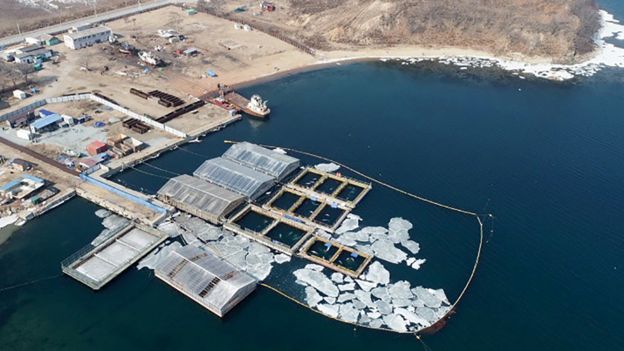
Whale pens, 1 Mar 19Image copyrightGETTY IMAGES
Image captionThe whale pens are at a remote site by the Sea of Japan

Hollywood star Leonardo DiCaprio urged his social media followers to sign a petition – and more than 1.5m people have done so.

Pamela Anderson, the former model and Baywatch TV star, wrote to President Vladimir Putin, urging action to release the whales. She is active in the International Fund for Animal Welfare (IFAW).

Earlier this month, the companies that caught the whales were fined for breaking fishing rules. One company – White Whale – was fined 28.1 million rubles ($433,000; £430,000).

Charles Vinick, executive director of the Whale Sanctuary Project, said the release should be conducted “as humanely as possible”.

“We have provided extensive recommendations [about how to do this],” he told the BBC. “While they are not able to follow all of our recommendations, we hope they can follow as many as possible.”

“It’s all about the welfare of the animals,” he added.

Hungry polar bear seen wandering the Russian city of Norilsk

By Gianluca Mezzofiore and Nathan Hodge, CNN

A hungry and exhausted young polar bear was spotted wandering in the suburbs of the Siberian industrial city of Norilsk this week, hundreds of miles from its usual habitat.

This is just the latest recent sighting of a bear in a Russian urban area, but the last time a polar bear appeared near Norislk was more than 40 years ago, Anatoly Nikolaichuk, head of the Taimyr Department of the State Forest Control Agency, told Russian state news agency TASS.

“He is very hungry, very thin and emaciated. He wanders around looking for food. He almost doesn’t pay attention to people and cars,” Oleg Krashevsky, a local wildlife expert who filmed the animal close up, told CNN. “He is quite young and possibly lost his mother.”

“He probably lost orientation and went south,” Krashevsky added. “Polar bears live on the coast which is more than 500 kilometers (310 miles) away from us. How he got to Norilsk is not clear.”

Sea ice across the Arctic is rapidly retreating due to climate change, forcing the bears to travel farther to find food.

Local residents were warned to be careful entering the tundra zone of the Talnakh region, where the bear was seen, according to an announcement from the local civil defense and emergency situations ministry on TASS.

The animal was first seen by a group of teenagers, who filmed it and posted the video on Instagram, Krashevsky said.

“I saw it was not fake and raised the issue with local authorities,” he said. “As an expert on bears, I went to look for him … I found him in the middle of the day.”

Local news site NGS24.RU on Wednesday quoted Andrei Korobkin, the head of the state department of wildlife protection, as saying that experts would be arriving from Krasnoyarsk to examine the bear and determine possible symptoms of exhaustion or physical trauma.

The specialists will bring provisions as well as medicine to restore the bear’s health, NGS24.RU reported.

Polar bears are on the International Red List of Threatened Species and in the Red Book of Russia of endangered species. Citing experts, TASS said there are 22,000 to 31,000 polar bears in the world. In the north of Krasnoyarsk, a vast administrative region in Siberia, the bears inhabit the coast and islands of the Arctic Ocean, the agency added.

In April, a starving polar bear was spotted in the village of Tilichiki in the far eastern Kamchatka Peninsula, also hundreds of miles from its usual habitat.

In February, the remote Russian archipelago of Novaya Zemlaya declared a state of emergency over what local authorities described as an “invasion” by dozens of the hungry animals.

Still snarling after 40,000 years, a giant Pleistocene wolf discovered in Yakutia

Sunday, Jun 09 2019
All Cities
Choose Your City
‘Lake Baikal is contains more water than the five US great lakes combined’
Mike Carter, The Observer, 2009
By The Siberian Times reporter
07 June 2019

Sensational find of head of the beast with its brain intact, preserved since prehistoric times in permafrost.

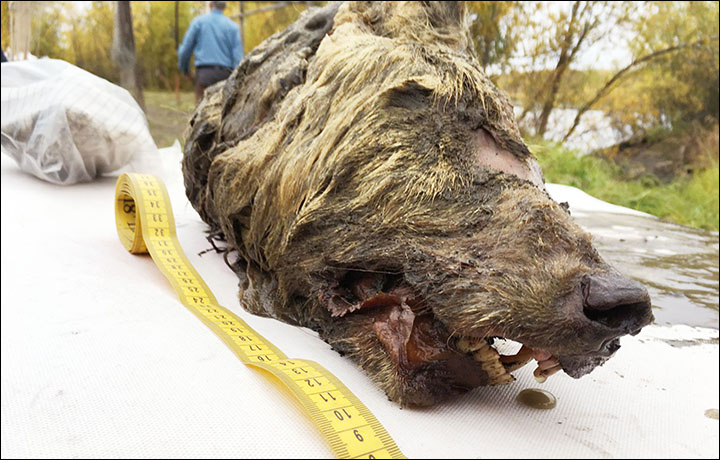
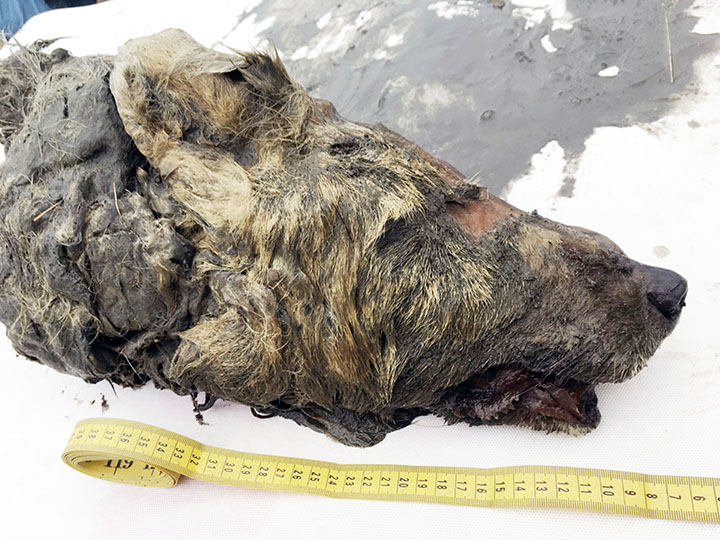
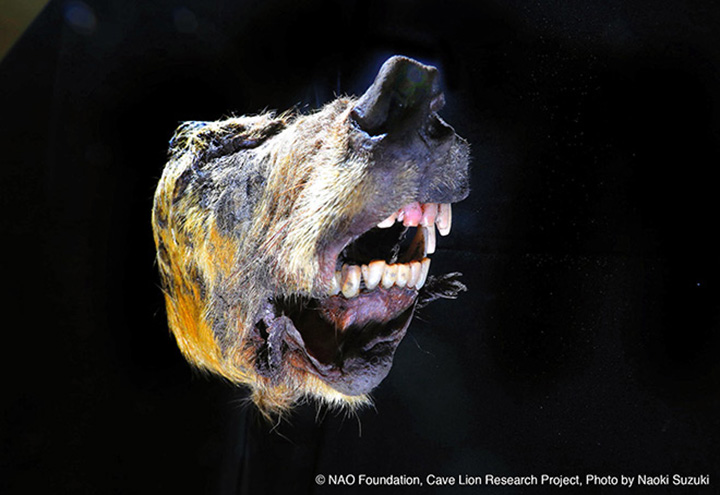
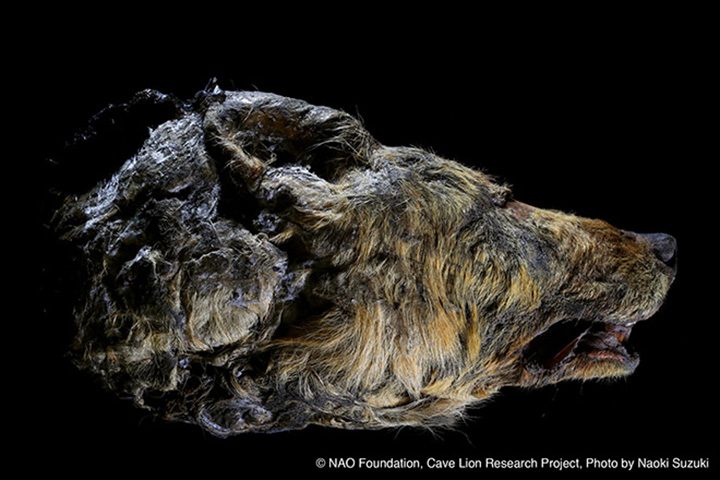
The Pleistocene wolf’s head is 40cm long, so half of the whole body length of a modern wolf which varies from 66 to 86cm. Picture: Albert Protopopov

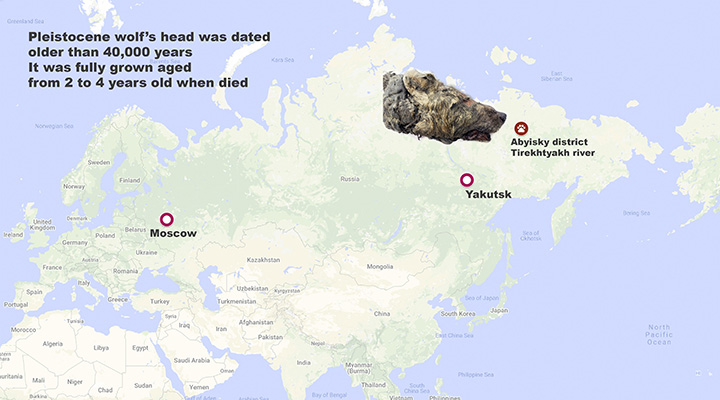
The severed head of the world’s first full-sized Pleistocene wolf was unearthed in the Abyisky district in the north of Yakutia. 

Local man Pavel Efimov found it in summer 2018 on shore of the Tirekhtyakh River, tributary of Indigirka.

The wolf, whose rich mammoth-like fur and impressive fangs are still intact, was fully grown and aged from two to four years old when it died. 

Pleistocene wolf

The wolf, whose rich mammoth-like fur and impressive fangs are still intact, was fully grown and aged from two to four years old when it died. Picture: Albert Protopopov

The head was dated older than 40,000 years by Japanese scientists.

Scientists at the Swedish Museum of Natural History will examine the Pleistocene predator’s DNA.

‘This is a unique discovery of the first ever remains of a fully grown Pleistocene wolf with its tissue preserved. We will be comparing it to modern-day wolves to understand how the species has evolved and to reconstruct its appearance,’ said an excited Albert Protopopov, from the Republic of Sakha Academy of Sciences. 

Map

Local man Pavel Efimov found it in summer 2018 on shore of the Tirekhtyakh River, tributary of Indigirka.

The Pleistocene wolf’s head is 40cm long, so half of the whole body length of a modern wolf which varies from 66 to 86cm. 

The astonishing discovery was announced in Tokyo, Japan, during the opening of a grandiose Woolly Mammoth exhibition organised by Yakutian and Japanese scientists. 

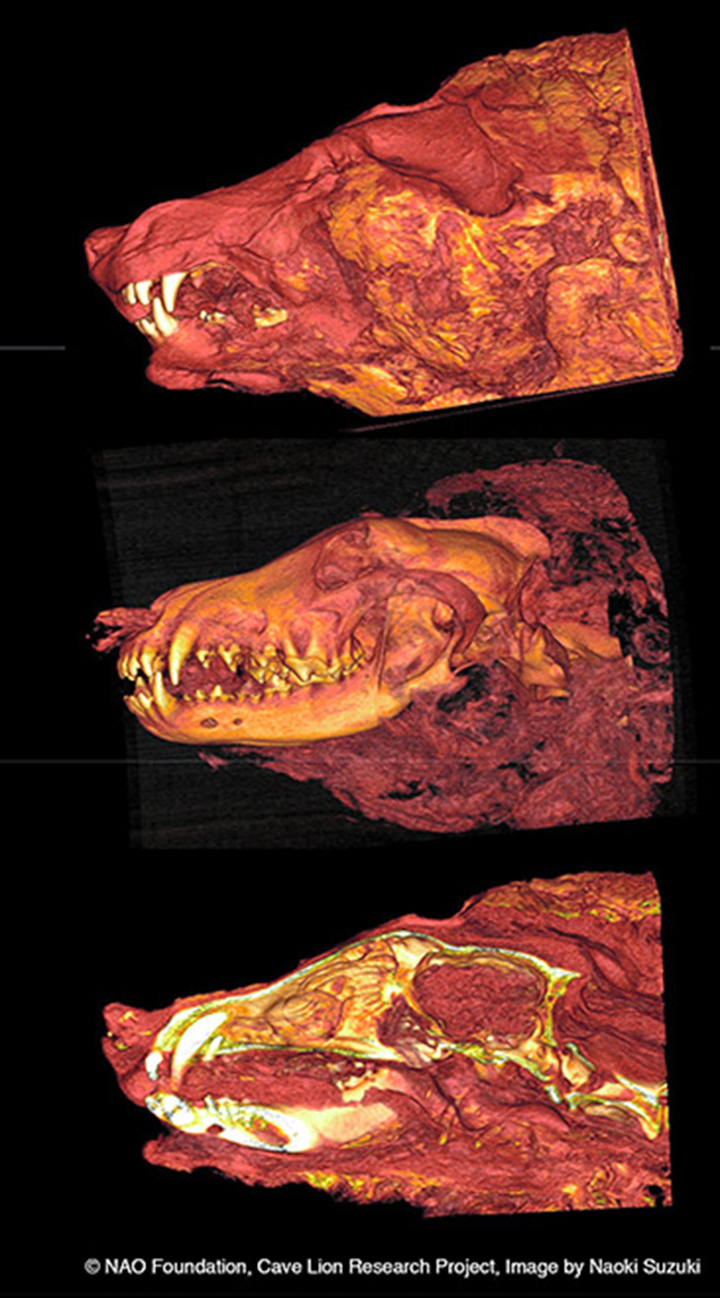
CT scan


CT scan


CT scan

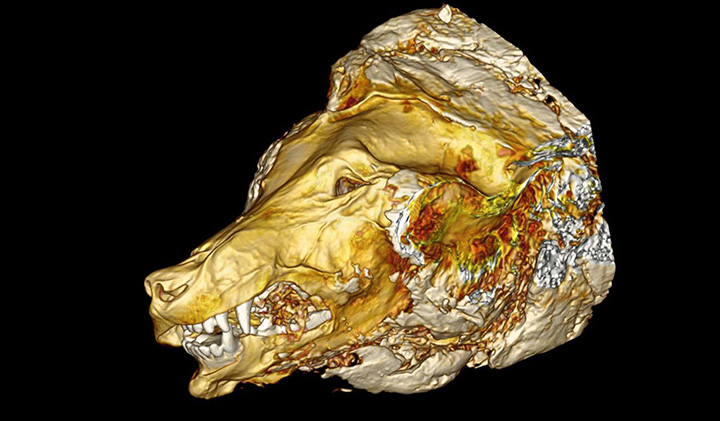
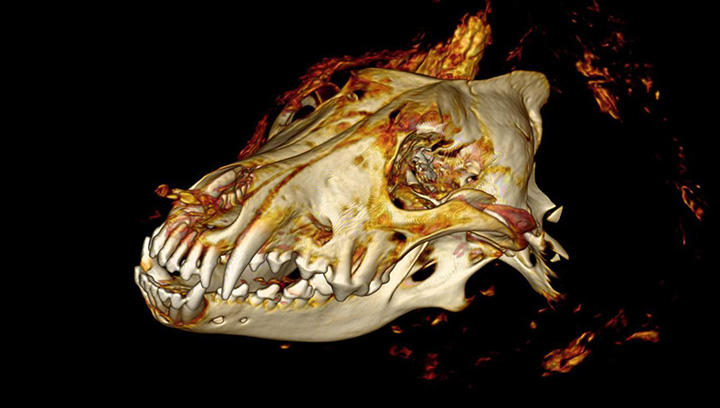
CT scan of the wolf’s head. Pictures: Albert Protopopov, Naoki Suzuki

Alongside the wolf the scientists presented an immaculately-well preserved cave lion cub. 

‘Their muscles, organs and brains are in good condition,’ said Naoki Suzuki, a professor of palaeontology and medicine with the Jikei University School of Medicine in Tokyo, who studied the remains with a CT scanner. 

‘We want to assess their physical capabilities and ecology by comparing them with the lions and wolves of today.’

Pleistocene wolf


Pleistocene wolf

‘This is a unique discovery of the first ever remains of a fully grown Pleistocene wolf with its tissue preserved.’ Pictures: Naoki Suzuki

n Russia, a battle to free nearly 100 captured whales

I[AFP] Maria ANTONOVA ,AFP•February 22, 2019

Captured marine mammals seen from above in enclosures at a holding facility in Srednyaya Bay in the Far Eastern town of Nakhodka (AFP Photo/Sergei PETROV)
Nearly 100 killer and beluga whales were captured last summer for sale to oceanariums, especially the Chinese market (AFP Photo/Sergei PETROV)
Greenpeace activists and supporters rally in Moscow, demanding the release of the orcas and beluga whales back into the wild (AFP Photo/Alexander NEMENOV)

1 / 4
Captured marine mammals seen from above in enclosures at a holding facility in Srednyaya Bay in the Far Eastern town of Nakhodka Captured marine mammals seen from above in enclosures at a holding facility in Srednyaya Bay in the Far Eastern town of Nakhodka (AFP Photo/Sergei PETROV)

Dozens of orcas and beluga whales captured for sale to oceanariums have brought Russia’s murky trade into the spotlight, but efforts to free them have been blocked by government infighting.

Russia is the only country where orcas, or killer whales, and belugas can be caught in the ocean for the purpose of “education”. The legal loophole has been used to export them to satisfy demand in China’s growing network of ocean theme parks.

Photos of a total of 11 orcas and 87 belugas crammed into small enclosures at a secure facility in the Far Eastern town of Nakhodka sparked a global outcry, and the Kremlin on Friday stepped in, saying the fate of “suffering” animals must be resolved.

“There have never been that many animals caught in one season and kept in one facility before anywhere in the world,” said Dmitry Lisitsyn, head of the Sakhalin Environmental Watch group, who has emerged as a point person in the campaign to release the whales captured last summer back into the wild.

Russian investigators launched two probes into poaching and animal cruelty, while Russia’s environmental watchdog said it has refused to issue permits to export the whales.

But the investigations and any potential court case could drag on for months.

The Russian government is split between the environment ministry that says the animals must be released, and the fisheries agency that defends their capture as part of a legitimate industry.

President Vladimir Putin has ordered his ministers to “decide on the fate of the whales” by March 1, a decree said Friday.

“The animals are suffering” and may die, said Kremlin spokesman Dmitry Peskov, adding that they “are being kept in conditions that are inadequate for such young animals of these species.”

– 200 orcas left –

The captured killer whales belong to the rarer seal-eating population of the species, which does not interbreed or interact with fish-eating orcas.

The environment ministry has tried to list the seal-eating type as endangered, ministry representative Olga Krever said.

“This population has only 200 adult animals” in Russian waters, she said.

But the agriculture ministry, which controls the fisheries agency and oversees non-protected sea species, views orcas as competitors for Russia’s fish stocks and doesn’t believe they are under threat, Krever said, calling the dispute a “big problem.”

Marine mammal researchers say there are good chances of a successful release, but the fisheries agency told AFP that it “carries high risks of their mass death”.

“Neither orcas nor belugas are endangered,” and are simply a resource that can be used according to existing legislation, agency representative Sergei Golovinov said.

– ‘Stars of the shows’ –

Both the United States and Canada stopped catching wild orcas in the 1970s due to negative publicity, so China relies on Russian exports.

There are 74 operational ocean theme parks in mainland China featuring whales and dolphins, according to the China Cetacean Alliance, which monitors the industry. More are under construction.

“Orcas are like the cherry on the cake” for new Chinese venues, said Greenpeace Russia campaigner Oganes Targulyan at a recent protest against whale capture.

“They are the stars of the shows.”

All 17 killer whales that Russia has exported since 2013 — which officials value at up to $6 million each — have gone to China, according to CITES wildlife trade figures.

Though the animals in Nakhodka are unlikely to get green-lighted for export, their fate is unclear.

The urgency of the situation is clear however: one killer whale went missing from the Nakhodka facility this week, Sakhalin Watch said Thursday, suspecting it may be dead.

In the West, there is widespread opposition to keeping the highly intelligent marine mammals in parks like the US chain Sea World, but in Russia public opinion is not so certain.

Companies that caught the animals are not giving up. At the weekend, they launched a new Instagram account, praising the Nakhodka facility and defending the oceanarium industry.

– ‘Lobbyist muscle’ –

On Saturday, dozens of pro-industry supporters disrupted a rally to free the whales. They showed up with signs reading “Each orca is 10 jobs” for the crews hired to catch them, and only left when police arrived on the scene.

“We see that the capturing companies are putting up a fight,” Lisitsyn said. “They are using their lobbyist muscle.”

Researchers meanwhile are already starting to organise to prepare for a potential release of the animals.

“There has never been so many animals released in the past,” said Dmitry Glazov, a beluga whale researcher at the Severtsov Institute of Ecology and Evolution in Moscow.

He said a project of that scale would certainly require international expertise and funding. The whales, which have been fed dead fish, would need to go through an adaptation period to make sure they can rely on their natural food sources.

“For science, releasing this many animals would be invaluable,” he said.
“But there needs to be a decision first.”

https://www.yahoo.com/news/russia-battle-free-nearly-100-captured-whales-033412177.html

HUNTER KILLS SON IN HORRIBLE HUNTING ACCIDENT

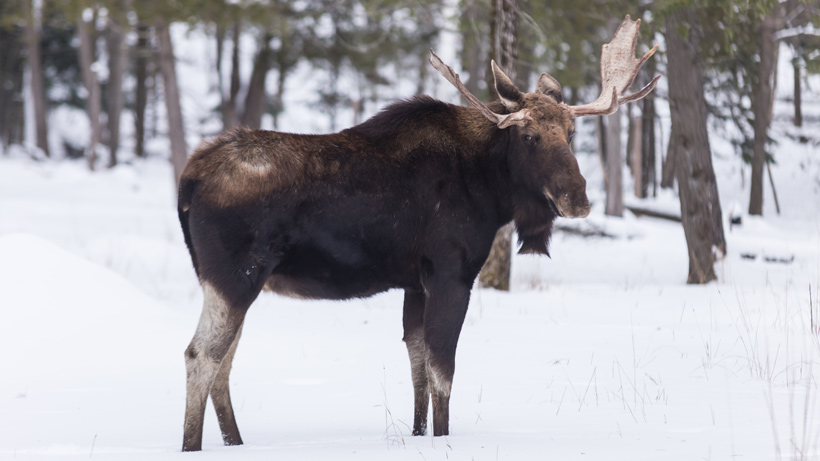
Moose

Photo credit: Dreamstime

Here’s another reminder to always confirm what you’re shooting at before making the shot. A Russian hunter recently shot and killed his son after thinking he was a moose. According to the Moscow Times, an investigator said, “The hunter fired a rifle into a moving object in poor visibility, mistakenly believing that it was a moose.”

Instead, it was the hunter’s 18-year-old son, who died from his father’s misguided shot. The incident took place in Khanty-Mansiysk in northern Russia, about 2,000 miles east of Moscow.

“Having come closer, the hunter saw that he mortally wounded his 18-year-old son,” the investigator told the Moscow Times.

Reports have not released the names of the father or his son. The father is charged with “death caused by negligence,” which means he could face possible jail time, the Moscow Times reports.

https://www.gohunt.com/read/news/hunter-kills-son-in-horrible-hunting-accident

The Man Who Befriended Bears

(RYAN PERUNIAK)

Charlie Russell loved to fly, and he seldom phoned first those times when he would fly his Kolb ultralight airplane north from Hawk’s Nest ranch on the boundary of Waterton Lakes National Park, to our “ranchette” near the Crowsnest Pass. We would hear the thrum of the plane’s Rotax motor bouncing off the nearby Livingstone Range, then the tiny white two-seater, looking like a giant lawn dart, grew suddenly loud as he buzzed the place, wagging his wings close enough for us to see his snaggle-toothed grin. Our horses would tear down the field, eyes rolling from his low approach. He would circle over the road, then sail in under the Fortis power line, set the plane down on the gravel and taxi up to our cattle guard. Then he’d get out, grab a length of rope from the cockpit and tie off the plane to a fence post with a cowboy slip knot so the wind couldn’t blow it over. He had long promised to take my wife Myrna for a ride, and one day she called him on it. “Well, I guess today’s the day then,” he grinned. I didn’t like the look of the clouds over Centre Peak, but Myrna’s face said, “You don’t get a vote.”

“Just tell me that you don’t have a halibut jig tied to the tail wheel this time.”

“What’s he talking about?” Myrna demanded.

“Ha!” laughed Charlie. “He’ll tell you later.”

Charlie Russell died on May 7 in Calgary due to complications following a five-hour surgical procedure. Charlie used up his nine lives long ago, but his death at 76 was still shocking to those who knew him well. Few people have lived as intensely as this man, or as dangerously. He has flown in some of the worst conditions on earth and walked or crawled (with a broken back one time) away from both a hang-glider and an ultra-light crash, and over time he prevailed in a number of forced landings. He is, he was, internationally famous for the ground-breaking work he and the artist Maureen Enns did at Kambalnoye Lake, Kamchatka, in Russia, living in close proximity with brown bears and raising orphaned cubs which not only survived the wilds but eventually reproduced. A mentor to many naturalists, his experiments in “exploring the possibilities of trust” challenged the prevalent orthodoxy of his day, which held that bears that have no fear of humans are always extremely dangerous, and that all bears are unpredictable and therefore always a threat to humans. Yet he was wise enough to know that what he learned working with those wild bears in BC and Kamchatka, in true wilderness settings, should not be applied by the layman to human-influenced bears in our southern national parks.

Charlie was raised in bear country and learned all the skills of mountain bush craft and horsemanship guiding hunters on his father’s pack-train. In 1960 Charlie and his brother Dick roughed it through Canada and Alaska to help Andy Russell make his groundbreaking film Grizzly Country. After studying photography in New York, and a stint living in New Zealand with his first wife, Margaret, Charlie took up ranching at Hawk’s Nest, his family home. But his heart wasn’t in it and he spent a lot of his time working on conservation projects, such as the Waterton Biosphere Reserve initiative. Many bears were dying at the hands of ranchers and hunters in southwest Alberta at that time. This bear of a man, Russell, was angered by the carnage, for as he often growled, “Anything that hurts the bears, hurts me.” He became the first Canadian rancher to deliberately move cattle carcasses to safe places on his ranch near the park boundary, so that bears could feed on them without being shot.

Eventually Charlie gave up on ranching, and in the 1990s he took a job guiding tourists on grizzly-bear-watching tours in the Khutzeymateen inlet of BC. Charlie’s superb talent at reading ursine body language, and his sensitive, ego-free approach to all wildlife, allowed for close encounters of the ursine kind. Myrna and I are two of the many people that have sat with him on a big driftwood log at the water’s edge as a female grizzly grazed on sedges at our feet, unafraid of us, and offering no threat to us. As a former park warden, I helped to capture many bears, but I never felt as reassured around them as I felt in Charlie’s company. His skill as a bear guide led to an offer in 1991 to work with filmmakers Jeff and Sue Turner of Princeton, BC. With Charlie’s help, they shot a famous BBC documentary on the Kermode “Spirit Bears” of Princess Royal Island. Charlie worked on documentaries, wrote books, collaborated with conservation groups and biologists and helped shape public opinion to push for a grizzly sanctuary in both the Khutzeymateen and Kamchatka and a protected area for Kermode bears on Princess Royal Island.

In 1993 the Turners’ plan called for Charlie to provide and pilot an ultralight plane, capable of water landings, to be used as an aerial camera platform. Charlie and his late son Anthony Russell began building the plane at Hawk’s Nest—all over Hawk’s Nest, since he didn’t have a big enough barn for the project. Every building on the place had a piece of the plane in it and Charlie was getting increasingly frantic to get the thing riveted together as a deadline for departure for the island loomed. On a snowy March day, I joined filmmaker Jeff Turner to help Charlie with some last-minute detailing. We worked all day; darkness found us riveting the cockpit canopy carefully onto thin steel tubing. I suddenly stubbed my toe on a snow-covered object. “Shit! What’s this thing, Charlie?” Charlie peered down at it for a second, distracted, bent down and swept the snow off it with his boot. “It’s just the in-flight computer.”

“Oh, is that all it is? Wow. I thought I had stepped on something important.”

I worried about that computer later that spring, when Canadian Geographiccommissioned me to write a feature article on the Kermode bears with Charlie to supply the photos. As a result I spent about four weeks that summer and fall on the island, hosted by the Turners at their camp. One did not just swan around taking notes with the hard-working Turners, and I soon found myself humping camera gear through the rainforest with Charlie. The white bears were living up to their reputation as ghosts of the rainforest, staying out of sight and waiting for the coho to run. Charlie had already befriended both black and white bears he encountered in the bush, and could identify individuals by size, shape and colouration. One day, we were sitting on a log taking a break while a black bear fished in a desultory manner nearby. The rains, and the main run of salmon that rain would trigger, had not yet begun. Charlie grinned at me, ran his fingers through his thick black hair, then leaned over in a bear-like manner and stirred the water with a calloused paw, peering  intently into the stream. The black bear splashed over and took up a position next to him almost touching his shoulder. I froze, too startled to get my little Balda camera out of my pack. The bear peered intently into the water, and then, realizing there was no fish in sight, backed away slowly, giving Charlie a sidelong glance. His body language said, “Dude—that is not funny.”

We were working one day in a creekbed, picking our way among slimy boulders and fish guts, stringing up a thousand feet of climbing rope between fir trees for an overhead camera sequence. Charlie pointed out a giant flat topped boulder in midstream. “I was playing with a bear on that rock one day, and things got out of hand.”

“Playing?”

“Yeah. I was up there taking a break, and he came down the bank, spotted me, and came up to visit.”

“To visit?”

“Yeah. I’ve come to know him pretty well. I could tell he was feeling playful. He was really inviting me to wrestle. I wasn’t sure if I should, but he was so friendly. Anyway, he stood up. He had a really mischievous gleam in his eye, and I thought what the heck. So I got ready to grapple with him. God, they are so strong! He just knocked me right over. I landed on those boulders.”

“Jesus Christ!”

“Yeah. I could tell he was surprised. I looked up, and he was peering down at me. I think it really puzzled him, how weak humans are. He didn’t mean to hurt me. I was really banged up for a while there.”

“Jesus H. Christ on a crutch. You were playing King-of-the-Castle with a bear?”

“Yeah. I think I went a bit too far that time,” he added, sheepishly.

Those who know Charlie’s books might say he should have known better. He had wrestled with a bear before, in Waterton Park in the ’80s when he and his son, Anthony, then age 11, wandered in between a black bear sow and her cubs. The little sow attacked, and Charlie and Anthony were soon in a tag team bout with her. She knocked Anthony down and Charlie went after her with fists and boots. When she got on top of Charlie, Anthony, armed with a piece of elk antler he had found earlier, whacked her over the head. She then bit Anthony on the behind, and Charlie again attacked until the sow finally retreated. The sow was fine, and the humans escaped with bruises and puncture wounds, but Charlie always said that Anthony had saved his life that day.

As a former park warden I helped capture many bears, but I never felt as reassured around them as I felt in Charlie’s company.

But about that halibut jig. We were sitting in the cook tent over coffee one morning with Sue, Jeff and their daughter Chelsea, when Charlie popped the question I had been dreading. “Will you fly with me?”

Charlie knew I hated flying. I nearly choked on the coffee, set the cup down. “I’d be happy to,” I lied.

The two us, both heavyweights, climbed into the little plane and strapped in, while Jeff Turner pushed us away from the pier. We had a windscreen in front of us, but were otherwise open to the weather. The motor sits behind the passengers on this craft. There was no intercom, so once the motor started conversation was by sign language. We taxied down the inlet and I could see why it was going to be hard to keep this plane aloft just by force of my willpower alone, since there were no armrests to grip in white-knuckled fear while will-powering. Charlie punched me in the shoulder, a big grin on his face, and opened the throttle as we raced down the inlet. This is a short takeoff plane, but our run seemed to go on forever, and we did not lift off the water. Frowning, he slowed down and we taxied back to try it again. I can’t recall how many times we attempted take-off; it seemed like 10 but was probably only three. At last we returned to the pier, the motor idling. “Well, I guess it’s just not in the cards today,” I said, happily.

“No problem,” said Charlie. “I know what we need. Just stay in the plane while I get it.”

He hurried up the beach to camp, and soon returned with his fishing tackle box in one paw. As I watched, puzzled, he pulled out a lead halibut jig with its attached hook, and tied it to the tail-wheel with some fishing line. “We’ve got it now,” he said with a happy grin as he settled back behind the controls.

“We’ve got it? Are we trolling for halibut now?” I asked, mystified.

“Ha! We’re going to catch some air.”

Once more we hurtled down the inlet, two porkers making the ultralight nose heavy. But this time, the halibut jig was just enough tail weight (at 17.6 ounces) to pull the tail down allowing the wings to catch some lift. And we flew around and around up above Princess Royal Island and Laredo Inlet looking for white Kermodes, and scared the hell out of some tourists in a yacht in an 80-mph swoop. And except one time when I took a ride in a sailplane, I felt about as close to being an eagle, and like an eagle, oblivious to fear, as I have ever been.

In Kamchatka Charlie learned how to find a hole in the fog and spiral his plane up into the clear sky. He made many personal sacrifices in choosing to devote his life to finding a way through the foggy notions people have about bears and our relationship to nature. The best way to honour Charlie is to make some new holes in the fog of misunderstanding that keeps people from living at peace with nature, and therefore with ourselves.

This article was originally published in The Tyee, June 1, 2018. Sid Marty is a writer and long-time resident of southern Alberta. He has published five books of non-fiction and three of poetry. His Leaning on the Wind: Under the Spell of the Great Chinook andThe Black Grizzly of Whiskey Creek were finalists for Governor General’s Awards.

Pt. 2: https://albertaviews.ca/part-2-tribute-charlie-russell/?fbclid=IwAR1LNBXAWPNf3NDVk30jyuBCv3QgJUyh9N3O88T1ejmWHyGATKchaCFKYZo

New Russian law forbids killing & mistreating animals, restricts petting zoos & illegal circuses

Published time: 28 Dec, 2018 15:23 Get short URL

New Russian law forbids killing & mistreating animals, restricts petting zoos & illegal circuses A tiger roars during a circus performance. © Sputnik / Evgeny Biyatov

We are responsible for those we tame. And it’s now a law in Russia as Vladimir Putin put his signature under new legislation, which bans killing, pitting and other forms of mistreatment of animals.

The Law on Responsible Treatment of Animals prohibits the killing of animals “under any pretext.” It also outlaws shooting or poisoning stray dogs and cats, which has been happening in many Russian cities in recent years. Homeless animals are to be captured, sterilized, vaccinated and released with a special microchip.

Organizing animal fights and hounding beasts at other animals or people has also been made illegal.

The law orders pets to be kept in proper conditions by their masters. It bans contact or petting zoos from being opened at the malls, which is a common thing across Russia, as well as hosting animals at bars and restaurants.
Also on rt.com Russian Hachiko: Loyal pooch spends weeks outside hospital awaiting master’s recovery (VIDEO)

In April, two bears escaped from a café and caused major havoc in Yaroslavl Region. One of the animals was captured, but the other went to the village and had to be shot dead.

The law makes life harder for numerous semi-legal circuses across Russia, which often use dangerous wild animals in their shows. In October, Russia was shocked after a lioness attacked a four-year-old girl during a traveling circus performance in Krasnodar Region. The child survived but suffered lacerated wounds to the face and other injuries.

The wild animals owned in violation of the law and without a proper license will from now be seized by the state. Hosting them at flats, residential homes and country houses has also been banned.

The new legislation states that an animal can’t be simply thrown into the street, but “should be passed to a new owner or the shelter.”
Camels, ostriches and other exotic creatures have been recently found in the wild in Russia after their disingenuous masters disposed of them.

Dog owners will also face some restrictions as the law obliges them to walk their companions only in specially designated areas. It also allows punishing those, who refuse to pick up feces left by their pets in the street, with fines.

READ MORE: Helpless dog saved from horrible death after getting stuck in middle of frozen Siberian lake (VIDEO)

The legislation, aimed at protecting animal rights, was first introduced to the parliament in 2010 and has taken almost eight years to be finalized by the lawmakers.

https://www.rt.com/russia/447604-russia-animal-rights-law/