Iceberg twice the size of Washington, D.C., breaks off Pine Island glacier in Antarctica

Doyle Rice

USA TODAY
The Pine Island glacier spawned an iceberg over 115 square miles that quickly shattered into pieces. This image from space shows the freshly broken bergs.

  • The Pine Island glacier “is one the fastest-retreating glaciers in Antarctica.”
  • Over the past 8 years, the Pine Island glacier is losing about 58 billion tons of ice per year.
  • This “reveals the dramatic pace at which climate is redefining the face of Antarctica.”

An iceberg twice the size of Washington, D.C., has broken off the Pine Island glacier in Antarctica, scientists reported this week.

“The Pine Island glacier recently spawned an iceberg over (115 square miles) that very quickly shattered into pieces,” the European Space Agency (ESA) said in a statement.

The Pine Island glacier “is one of the fastest-retreating glaciers in Antarctica,” according to NASA. The glacier and the nearby Thwaites glacier together contain “enough vulnerable ice to raise global sea level by 1.2 meters (4 feet),” NASA said.

“What you are looking at is both terrifying and beautiful,” Mark Drinkwater, head of the Earth and Mission Sciences Division at the ESA, told CNN. “It is clear from these images (that the Pine Island glacier) is responding to climate change dramatically.”

The glacier has been losing large chunks of ice over the past three decades. While large calving events like this one used to take place at Pine Island glacier every four to six years, they’re now a nearly annual occurrence, The Washington Post said.

More from Antarctica:It was nearly 65 degrees in Antarctica, which may be the warmest day ever recorded there

“Its floating ice front, which has an average thickness of approximately 500 meters (1,640 feet), has experienced a series of calving events over the past 30 years, some of which have abruptly changed the shape and position of the ice front,” the ESA said.

Over the past eight years, the Pine Island glacier is losing about 58 billion tons of ice a year, according to a study in the Proceedings of the National Academy of Sciences.

“The Copernicus twin Sentinel-1 all-weather satellites have established a porthole through which the public can watch events like this unfold in remote regions around the world,” Drinkwater said in a news release.

“What is unsettling is that the daily data stream reveals the dramatic pace at which climate is redefining the face of Antarctica,” he said.

There’s a ‘doomsday glacier’:Warm water discovered beneath Antarctica’s ‘doomsday’ glacier, scientists say

New U.S. law requires probe of Marshall Islands nuclear dump threatened by rising seas

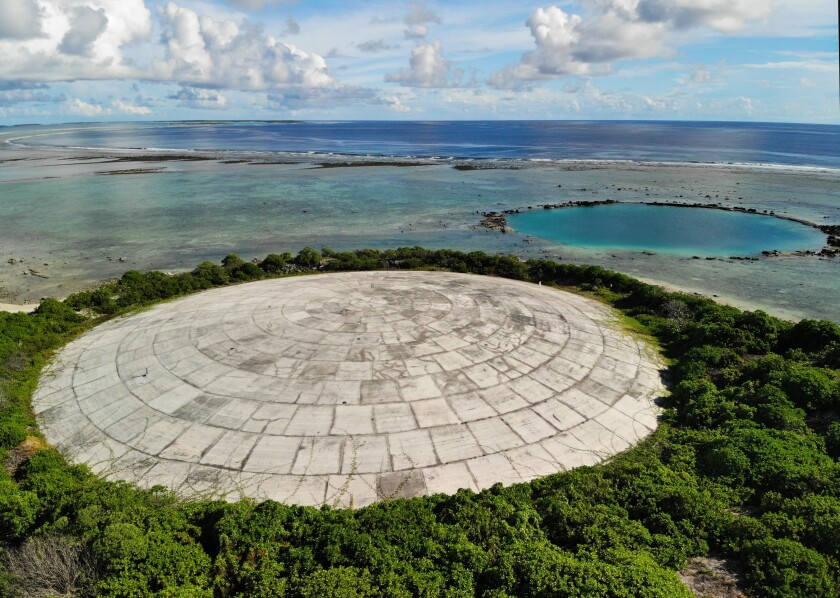
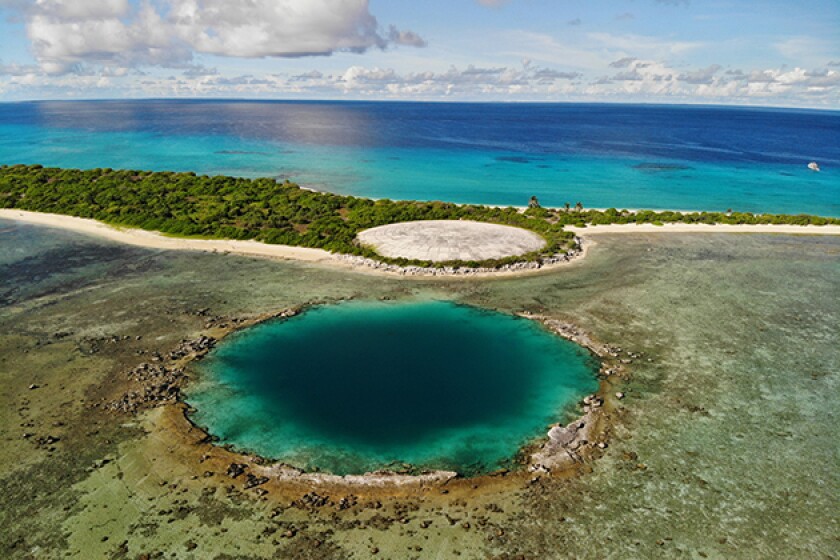
Runit Dome in the Marshall Islands

Congress has ordered the U.S. Department of Energy to investigate the status of a nuclear waste dump, Runit Dome, in the Marshall Islands.
(Carolyn Cole / Los Angeles Times

Congress is demanding that the Department of Energy investigate an aging, cracking U.S. nuclear waste dump threatened by climate change and rising seas in the Marshall Islands.

As part of the new National Defense Authorization Act, signed last week by President Trump, the energy agency must submit a report by mid-June on the risks that Runit Dome poses to the people, environment and wildlife of Enewetak lagoon — the site of 44 nuclear bomb detonations during the Cold War.

It must also include an assessment of how climate change could affect the site, although the term “climate change” was dropped as the bill moved through the Senate Armed Services Committee, which is chaired by Oklahoma’s James M. Inhofe, one of Congress’ most outspoken climate change skeptics.

According to the law, the energy agency must submit a report that includes an “assessment of how rising sea levels might affect the dome.”

The investigation was applauded by at least one representative of the Marshall Islands, which continues to contend with the radioactive legacy of U.S. nuclear testing. The island nation sits in a remote part of the central Pacific, 5,000 miles southwest of Los Angeles.

“We are encouraged by the inclusion in the [act] of the requirement,” said Rhea Moss-Christian, chairwoman of the Marshall Islands’ National Nuclear Commission, a three-person government panel that reports directly to the president on nuclear issues in the islands.

She said the original language for the bill, which was introduced by U.S. Rep. Tulsi Gabbard (D-Hawaii), required a plan for relocating the waste, as well as an assessment of how local food is affected by the dome.

Moss-Christian said her committee was disappointed these elements were not included in the final version, which the president signed. But she added that she was hopeful the new law “will yield useful results to better inform our decision making.”

There was no immediate response from the Lawrence Livermore National Laboratory, which the Energy Department has assigned to monitor Runit Dome and the radiation leaking from it.

The waste site, known alternatively as the Tomb, or simply the Dome, holds more than 3.1 million cubic feet — or 35 Olympic-size swimming pools — of U.S.-produced radioactive soil and debris, including lethal amounts of plutonium.

Nowhere else has the United States saddled another country with so much of its nuclear waste, a product of its Cold War atomic testing program.

From 1946 to 1958, the United States detonated 67 nuclear bombs on, in and above the Marshall Islands — vaporizing whole islands, carving craters into its shallow lagoons and exiling hundreds of people from their homes.

Department of Energy contractors admitted last spring that the dome is vulnerable to rising sea levels and storm waves, and is leaking into Enewetak lagoon. Studies have shown elevated levels of radioactive contamination in local seafood, including giant clams.

This year, the Los Angeles Times published an investigation of the dome and Enewetak lagoon, revealing that it was the location of at least a dozen biological weapons tests and also the repository for 130 tons of soil from an irradiated Nevada testing site.

The investigation also documented decades of U.S. deception in the Marshall Islands, including the withholding of critical information about people’s exposure to radiation. Thousands of documents about the testing program are still classified, leaving many Marshallese distrustful and unsure about the full impact of U.S. weapons testing there.

For decades, the Marshallese have expressed alarm about Runit Dome and its potential risk to the 650 inhabitants of Enewetak lagoon, who fish and harvest seafood from the lagoon, and collect coconut, pandanus, coconut crabs and breadfruit from islands in the atoll.

In July, a team led by Emlyn Hughes of Columbia University’s K=1 Project — a program designed to investigate nuclear weapons issues across the globe — found elevated levels of radiation on Runit Island.

According to their research, levels were higher than those found emanating from soils near the sites of the Chernobyl meltdown and the Fukushima disaster.

“At last the U.S. government seems to be getting serious about addressing this serious environmental issue that it created decades ago,” said Michael Gerrard, a legal scholar at Columbia University’s law school. “This is a very welcome development.”

It also comes soon after the U.S. announced its intention to extend its Compact of Free Association with the Marshall Islands, which was set to expire in 2023.

The compact, which was initially signed in 1986, provides the Marshallese government with funding, allows its citizens to work and travel in the United States without visas, and provides the U.S. government with a strategic military base on Kwajalein Atoll — the center for U.S. intercontinental ballistic missile testing.

Recently, the United States and another world power have been vying for influence over the Marshall Islands, because of its strategic position in the Pacific.

As China has increased its financial and military presence in the region, the United States has been losing footing with formerly staunch allies, including Kiribati and the Solomon Islands.

Many Marshallese argue the U.S. has not done enough to address its history of radioactive contamination in the islands or help the nation deal with the growing assaults of climate change.

A recent general election in the Marshall Islands could determine whether the government develops a closer relationship with China, which has been courting the island nation. The results are still not official, but New Zealand media reported that an opposition slate of candidates is ahead and could triumph over incumbent President Hilda Heine, resulting in policies more favorable to China.


Antarctica’s ice is degrading faster than we thought, and there may be no way to stop the consequences

Why can't we seem to care about the climate crisis?

JUST WATCHED

Why can’t we seem to care about the climate crisis?

PlayMuteMute

Current Time2:12
/
Duration Time2:12
Loaded: 0%

Progress: 0%

Fullscreen

Why can’t we seem to care about the climate crisis? 02:12

(CNN)There are plenty of ominous indicators of the consequences of climate change, but few are more worrying to scientists than the ice sheets of Antarctica at our planet’s southern pole.

These ice sheets have been melting for quite some time, and it doesn’t take a degree in physics to understand the risk there. As the ice melts it flows into the ocean, causing sea levels to rise. And rising sea levels are obviously a huge problem.
Don't believe these climate change lies

Don’t believe these climate change lies 02:35
Now, new NASA-funded research published in the journal PNAS reveals a concerning complication. Scientists from the Georgia Institute of Technology, NASA Jet Propulsion Laboratory and the University of Washington ran hundreds of simulations to predict how one large ice sheet, Thwaites Glacier, could degrade over the next 50 to 800 years.
The results showed the glacier was more in danger of becoming unstable that previously thought.
The Thwaites Glacier.

Small changes could lead to a watershed moment

“Unstable” here means something very specific. An “instability” in an ice sheet essentially makes it a frozen, ticking time bomb. The area of the glacier behind where it cantilevers over the water is eaten away, which can cause the glacier’s ice to break off and flow faster out to sea and add to rising sea levels.
What’s more ominous, the research finds, is that once this instability is triggered it’s hard, if not impossible, to stop.
“If you trigger this instability, you don’t need to continue to force the ice sheet by cranking up temperatures. It will keep going by itself, and that’s the worry,” lead author Alexander Robel said in a release.
In other words, even if climate change was magically reversed, it wouldn’t necessarily stop the dangerous and rapid rise in sea levels that could be triggered by unstable ice sheets.
How climate change will impact your region

Play Video

How climate change will impact your region 01:57

The ‘worst-case’ scenario

Robel, an assistant professor at Georgia Tech’s School of Earth and Atmospheric Sciences, says the “worst-case scenario” could be a rise of two or three feet from the Thwaites glacier alone.
While Robel suggests engineers and planners start building future critical infrastructure farther away from the sea-level line, you don’t need to pack up your coastal homes like it’s high tide yet. This potential acceleration of sea level rise could come into full effect 200 to 600 years from now.
This seems like a long time from now, because we will all be dead by then. But the Earth and its future generations hopefully won’t be, and climate scientists want to keep it that way.

The Laws Of Ecology And The Survival Of The Human Species

08/05/2016 04:04 pm ET | Updated Aug 05, 2016

The Laws Of Ecology And The Survival Of The Human Species

I was raised in a small fishing village on the Passamaquoddy Bay in New Brunswick, Canada and I still vividly remember the way things were in the Fifties. The way things were then is not the way things are now.

I’m not talking about technological, industrial or scientific progress. I’m referring to the health and stability of eco-systems. What was once strong is now weak. What was once rich in diversity is now very much the poorer.

I have been blessed, or perhaps cursed, with the gift of near total recall. I see the images of the past as clearly as the days that were. As a result it has been difficult for me to adapt to diminishment. I see the shells on the beaches that are no longer there, the little crabs under the rocks, now gone, the schools of fishes, the pods of dolphins, the beaches free of plastic.

I began traveling the world in 1967 — hitch-hiking and riding the rails across Canada; joining the Norwegian merchant marine; crossing the Pacific and Indian Oceans; traveling through Japan, Iran, Mozambique and South Africa, working as a tour guide in Turkey and Syria, co-founding the Greenpeace Foundation in 1972 and, in 1977, founding the Sea Shepherd Conservation Society.

2016-08-04-1470340589-1361975-seashepherdfoundercaptainpaulwatson903.jpg

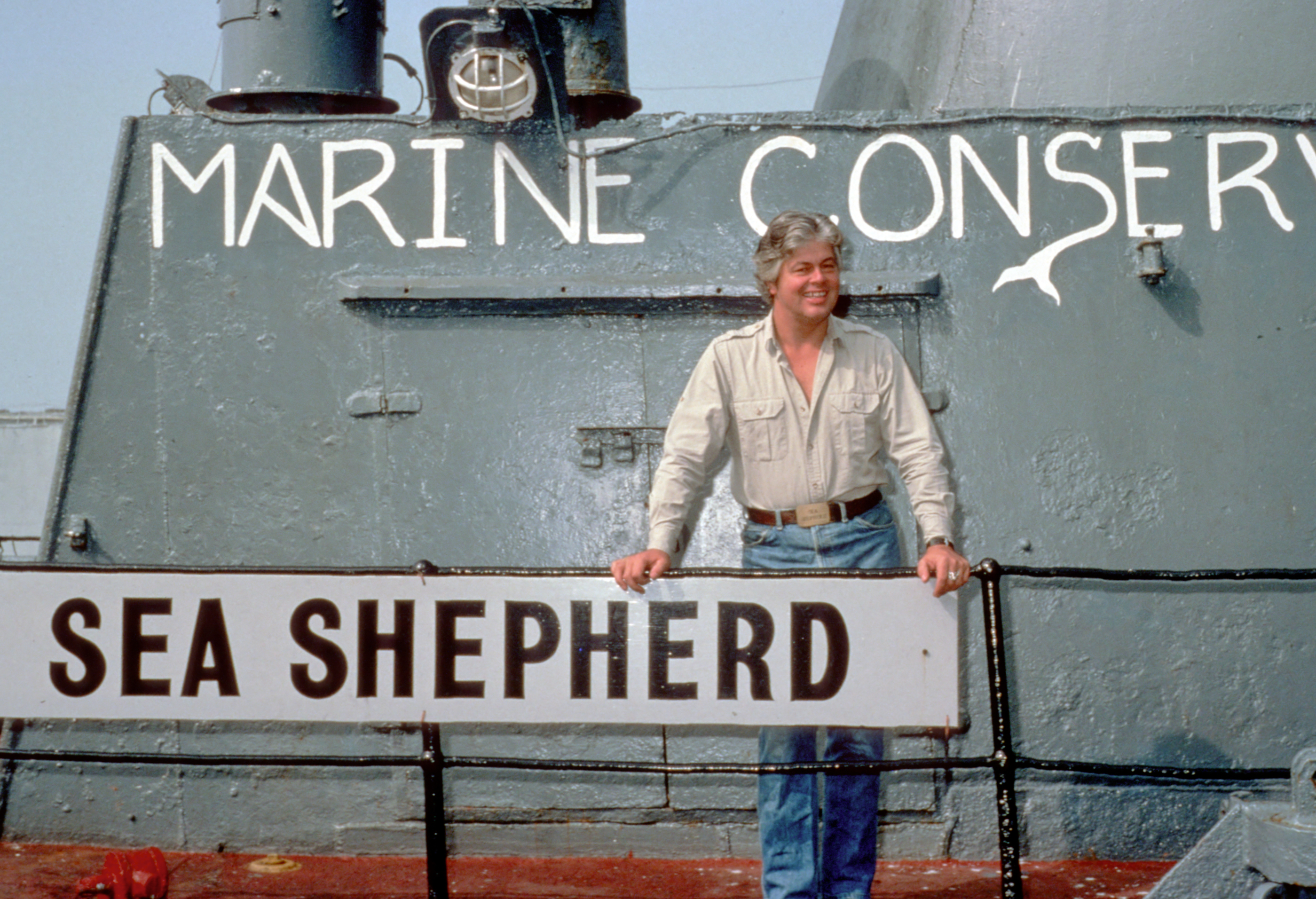
Sea Shepherd founder Paul Watson some forty years ago when he founded the non-profit.

Many things that I saw then no longer exist – or have been severely damaged, changed and diminished.

In the Sixties we did not buy water in plastic bottles. In the Sixties the word ‘sustainable ‘was never used in an ecological context, and except for Rachel Carson, there were very few with the vision to see into the future, where we were going, what we were doing.

But slowly, awareness crept into the psyche of more and more people. People began to understand what the word ecology meant. We saw the creation of Earth Day, and in 1972, the first global meeting on the environment in Stockholm, Sweden that I covered as a journalist.

Gradually, the insight into what were doing became more prevalent and to those who understood, the price to be paid was to be labeled radicals, militants, and a new word – eco-terrorist.

The real “crime” of eco-terrorism was not burning down a ski lodge, toppling a power line or spiking a tree. Such things are only outbursts of desperation and frustration. The real crime of eco-terrorism was having thought, perception, and imagination. In other words, the questioning of the modern economic, corporate and political paradigm.

The word eco-terrorism should be more accurately used for the destruction caused by progress like the Union Carbide disaster in Bhopal or the BP Deep Water Horizon spill in the Gulf of Mexico.

2016-08-04-1470340757-6508043-anoilrig756.jpg

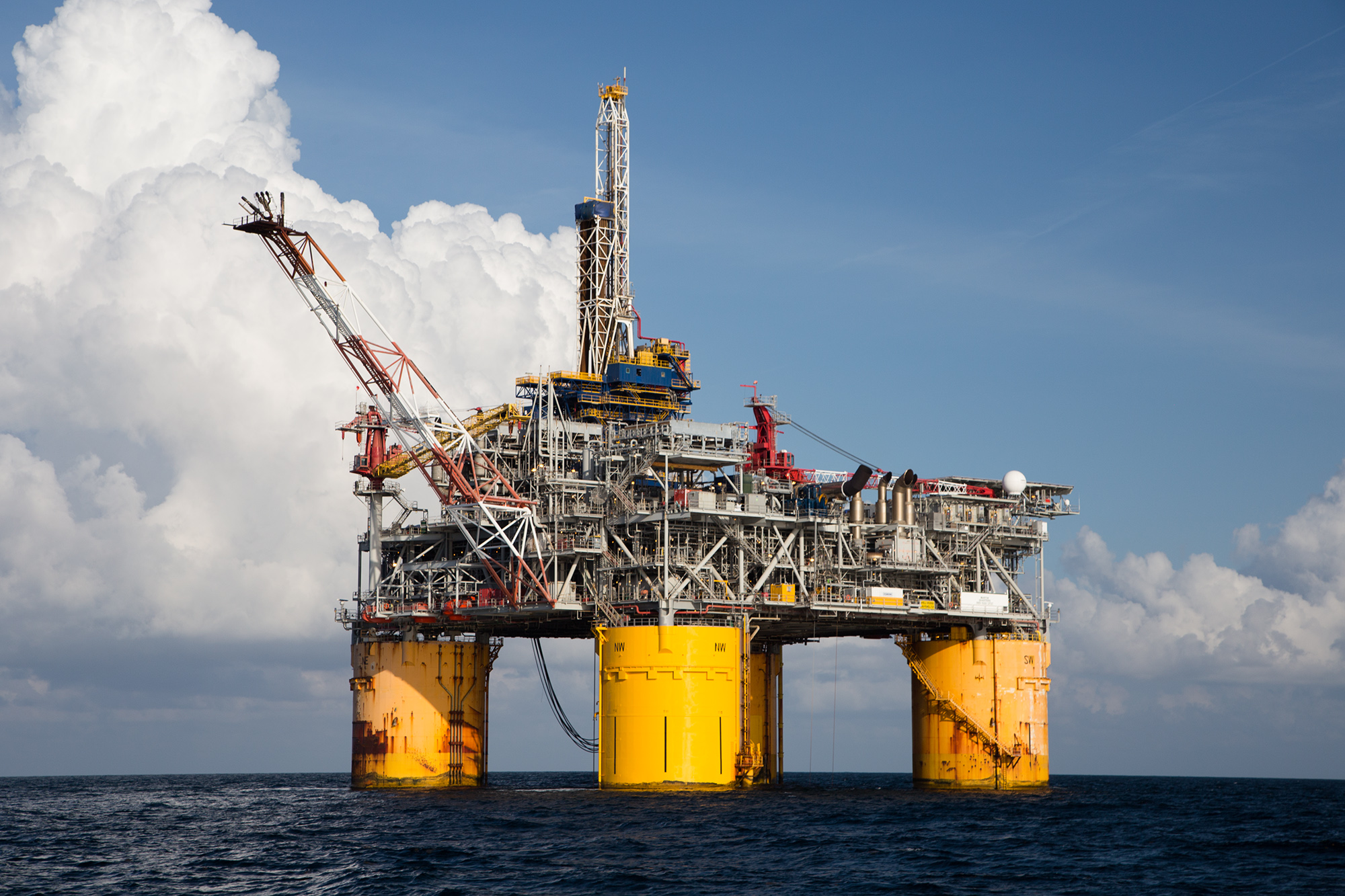
Picture of an oil rig taken during Sea Shepherd’s Operation Toxic Gulf in 2014.

In the Seventies, the late Robert Hunter, along with Roberta Hunter, Dr. Patrick Moore, David Garrick, Rod Marining and myself observed and wrote down the three laws of ecology. What we realized was that these laws are the key to the survival of biodiversity on the planet and also the key to the survival of the human species. We realized that no species could survive outside of the three basic and imperative ecological laws.

The law of diversity: The strength of an eco-system is dependent upon the diversity of species within it.

The law of interdependence: All species are interdependent with each other.

The law of finite resources: There are limits to growth and limits to carrying capacity.

The increase of population in one species leads to the increase in consumption
of resources by that species. This leads to diminishment of diversity of other species, which in turn leads to diminishment of interdependence among species.

For example, increasing diminishment of phytoplankton populations in the sea is causing diminishment of many other species as well as a 40% diminishment in oxygen production since 1950. Diminishment of whale populations has contributed to the diminishment of phytoplankton populations because whale feces are a major source of nutrients (esp. iron and nitrogen) for phytoplankton.

The planet simply cannot tolerate 7.5 billion (and growing) primarily meat and fish eating necrovores. The killing of 65 billion domestic animals each year is contributing more greenhouse gases to the planet than the entire transportation industry. The industrial stripping of life from the sea is causing unprecedented biodiversity collapse in marine eco-systems.

Ecological systems globally are collapsing from coral reefs to rainforests because humanity is exploiting resources far beyond the capacity of eco-systems to create and renew natural resources.

Diminishment of eco-systems is also leading to the breakdown of human social structures causing global conflict in the form of wars and domestic violence. Terrorism is not the cause of society’s problems, it is merely a symptom.

Humans are compromised by medieval paradigms like territorial dominance, hierarchical desires and superstitious beliefs combined with primitive primate behavior like greed and fear.

2016-08-04-1470345289-7416340-bloodbathinleynarclaimedfourpregnantfemales377.jpg

Sea Shepherd’s 2010 Faeroe Islands Dolphin Defense Campaign: Operation Grindstop. Photo credit: Sea Shepherd /Sofia Jonsson

The fishing village that I lived in as a child is no longer a fishing village. The relative innocence of our lives as children of the Fifties and Sixties is no more. The African bush, the Arctic tundra, the marine reserve of the Galapagos Islands, the Great Barrier Reef, the Amazonian rainforests that I once traveled through are no longer what they recently were.

Humans have this amazing ability to adapt to diminishment. It’s a trait that was exceptionally useful when we lived as hunter-gatherers. We adapted to food shortages, to changes in the weather and to the world as it evolved around us. Today we are trying to adapt to the destruction brought on by ourselves and that adaption is taking the form of more and more control by governments and corporations and a blind reliance on corporate technologies.

We no longer have the empathy we once felt. I vividly remember the events of October 23rd, 1958. I was seven years old on the day of the Springhill Mine Disaster in Nova Scotia. 75 men died and 99 were rescue. I remember crying for the fate of people I did not know and feeling excited every time a miner was brought to the surface alive. I no longer have that capacity. Perhaps I lost it when I became an adult, or perhaps society no longer has room for such emotions.

Disaster happened and we grieved for people we did not know. A few weeks ago nearly 100 people were viciously murdered within a few kilometres of where I live when a deranged man mowed them down with a large truck in Nice, France. Last week, a priest was beheaded in France. Every week brings us more stories about mass killings in the Middle East, Africa, America etc. It’s a worldwide pain-fest of chaos and violence and yet it is met with complacency for the most part and a predictable Facebook posting of — “say a prayer for Paris, or Orlando, or Nice, or Beirut, or Istanbul” in a litany of self-indulgent adaptation to tragedy, before being quickly forgotten.

This is not the world of my childhood. We remembered the horrors of World War II with real emotion. I remember talking with both World War I and World War II veterans and feeling their pain. Today it’s just another short-term item on the news, in a world that seeks to escape through movies, celebrities, video games and increasingly more fanatical religious fervor.

Here is the reality. As human populations increase, the consumption of resources increases with it. But because resources are finite and the rate of renewables is overcome by demand, this can only lead to one result — the collapse of resource availability.

And because we are literally stealing resources from other species, this will lead to
diminishment of species and habitats, which will contribute to even more resource diminishment.

2016-08-04-1470342962-4408964-draggingontotheship273.jpg

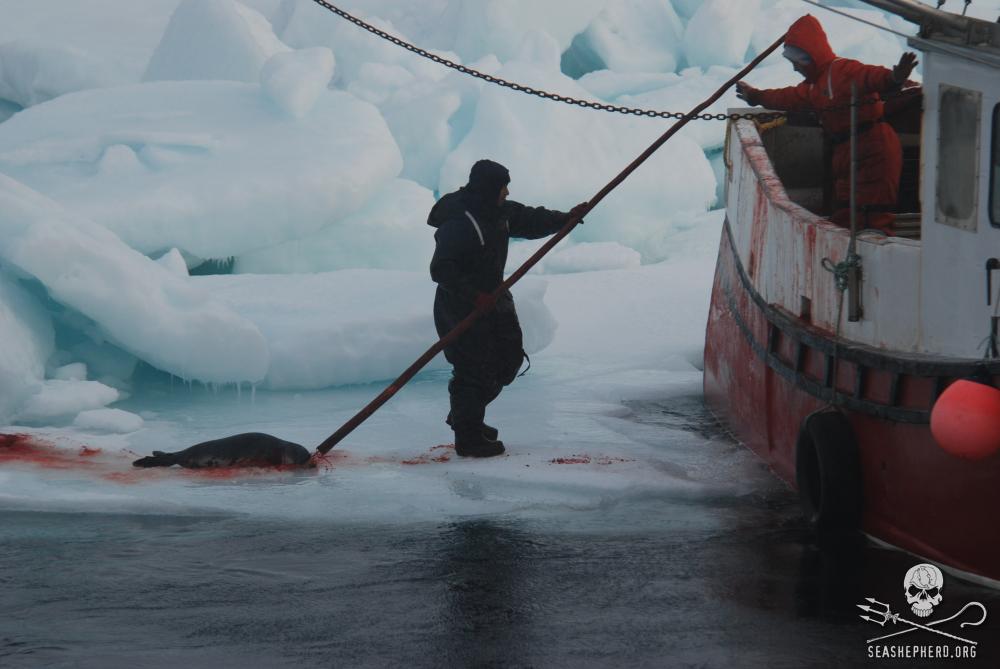
Sea Shepherd’s 2008 Seal Defense Campaign photographs the murder and carcass dragging of a seal. Photo credit: Sea Shepherd / Greg Hager

At COP 21, I called for an end to worldwide government subsidies for industrialized fishing and at least a 50-year moratorium on commercial industrialized fishing. That solution was not given a moment’s thought at a conference that did not even take into account the imperative role of the Ocean in addressing climate change.

My opinion of COP 21 is that governments were not looking for solutions. They were looking for the appearance of solutions. They certainly did not want to hear about solutions from people like me. They want solutions that are accompanied by jobs and profit. The one thing they do not want is any form of economic sacrifice.

I also do not believe that the majority of humanity — certainly not the leadership — understand the true gravity of the situation. There are six viewpoints concerning climate change: 1. Denial 2. Acceptance, with the view of it being a positive development. 3. Acceptance with the belief that science and technology will save the day. 4. Acceptance, but refusal to fully appreciate the consequences. 5. Apathy. 6. Acceptance with the resolve to find real solutions.

Those who are in denial have vested self interests in doing so, motivated primarily by greed or ignorance. My old Greenpeace colleague Patrick Moore sees climate change as an opportunity for longer growing seasons and better weather. (He lives in Canada and I don’t think he’s really thought it through.) Others like Elon Musk see our salvation in science, in moving off-world or developing artificial eco-systems on Earth. Most responsible world leaders recognize the problem but are too politically-impotent to address it with realistic solutions because those solutions would not be politically popular. And as with everything, the majority of the world is apathetic and too self-absorbed with entertaining themselves (developed world) or surviving (underdeveloped world).

On this path we are on now, the future is somewhat predictable. More resource wars, more poverty, more accumulation of wealth by the minority of privileged people, more disease, more civil strife and with the collapse of biodiversity – global mass starvation, and pestilence.

The rich tapestry of all our cultures and all our achievements in science and the arts hangs by threads linked to biodiversity.

If the bees are diminished, our crops are diminished. If the forests are diminished, we are diminished. If phytoplankton dies, we die! If the grasses die, we die!

We exist because of the geo-engineering contributions of millions of diverse species that keep our life support systems running. From bacteria to whales, from algae to the redwoods. If we undermine the foundations of this planetary life-support system, all that we have ever created will fall. We will be no more.

We made the mistake of declaring war on nature, and because of our technologies it looks like we are going to win this war. But because we are a part of nature, we will destroy ourselves in the process. Our enemy is ourselves and we are slowly becoming aware of that indisputable fact. We are destroying ourselves in a fruitless effort to save the image of what we believe ourselves to be.

In this war, we are slaughtering — through direct or indirect exploitation — millions of species and reducing their numbers to dangerously low levels while at the same time increasing human numbers to dangerously high levels.

2016-08-04-1470343170-9873528-dolphinoffalandintestines645.jpg

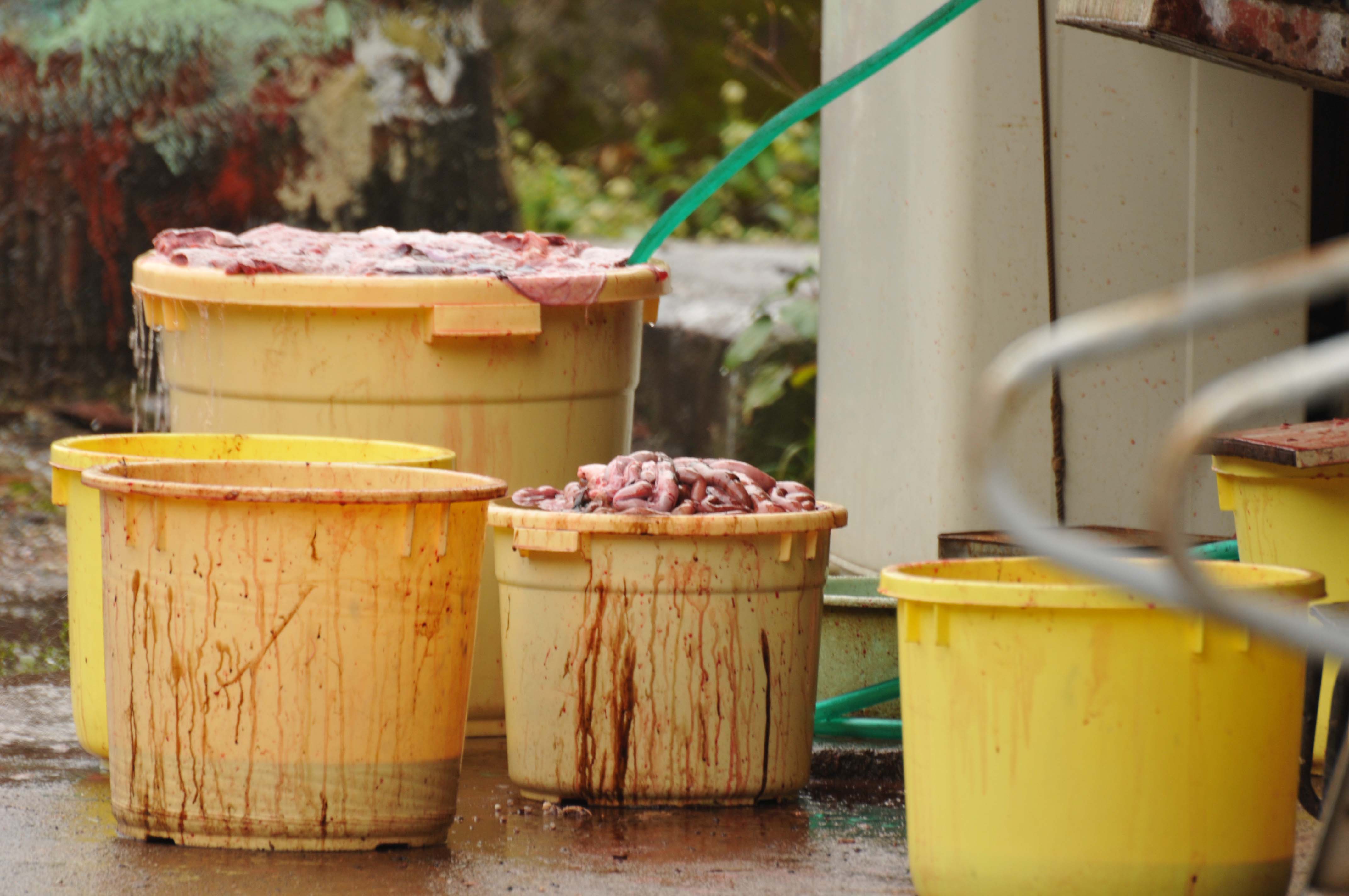
Dolphin offal and intestines photographed during the 2011-12 Taiji Dolphin Defense Campaign. Photo credit: Sea Shepherd / Christoph Heylen

We are fighting this war against nature with chemicals, industrialized equipment, ever increasing extraction technologies (like fracking) and repression against any and all voices that rise up in dissent.

In our wake over the past two centuries we have left a trail of billions of bodies. We have tortured, slain, abused and wasted so many lives, obliterated entire species; and reduced rich diverse eco-systems to lifeless wastelands as we polluted the seas, the air and the soil with chemicals, heavy metals, plastic, radiation and industrialized farm sewage.

We were once horrified by the possibility of a Chernobyl or a Fukushima. But the accidents happened and we adapted and accepted. Now we are complacent.

In the process we are becoming sociopathic as a species. We are losing the ability to express empathy and compassion. We idolize soldiers, hunters, and resource developers without giving a thought to their victims. We revel in violent fantasies hailing two-dimensional fantasy killers as heroes. We have become increasingly more Darwinian in our outlook that the weak (other species) must perish so that the strong (ourselves) may survive. We forget that Darwinism recognizes the laws of ecology and we cannot pick and choose when it comes to the laws of nature. In the end nature controls us, we do not control nature.

The consequences of our actions are not going to happen centuries from now. They are going to happen within this century. Oceanic ecosystems are collapsing — now! The planet is getting warmer — now! Phytoplankton is being diminished — now!

To be blunt — the planet is dying now, and we are killing it!

From what I have experienced and from what I see there is only one thing that can prevent us from falling victim to the consequences of ignoring the laws of ecology.

We must shake off the anthropocentric mindset and embrace a biocentric understanding of the natural world. We can do this because we have wonderful teachers in indigenous communities worldwide who have lived biocentric lifestyles for thousands of years just as our species all once did. We need to learn to live in harmony with other species.

We need to establish a moratorium on industrialized fishing, logging and farming.

We need to stop producing goods that have no intrinsic value — all the useless plastic baubles for entertainment and self-indulgence. We need to stop mass-producing plastic that is choking our global seas. We need to stop injecting poisons into the soil and dumping toxins into the sea. We need to abolish cultural practices that destroy life for the sole purpose of entertaining ourselves.

Of course it won’t be easy but do we really want the epitaph for our species to be, “Well we needed the jobs?”

Without ecology there is no economy.

I am not a pessimist and I’ve never been prone to pessimistic thoughts. There are solutions. We see people of compassion, imagination and courage around us working to make this a better world — devoting themselves to protecting species and habitats; finding organic agricultural alternatives; and developing more eco-friendly forms of energy production. Innovators, thinkers, activists, artists, leaders and educators — these people are among us and their numbers are growing.

It is often said that the problems are overwhelming and the solutions are impossible. I don’t buy this. The solution to an impossible problem is to find an impossible solution.

It can be done. In 1972, the very idea that Nelson Mandela would one day be President of South Africa was unthinkable and impossible — yet the impossible became possible.

It’s never easy but it is possible and possibilities are achieved through courage, imagination, passion and love.

I learned from the Mohawks years ago that we must live our lives by taking into account the consequences of our every action on all future generations of all species.

If we love our children and grandchildren we must recognize that their world will not be our world. Their world will be greatly diminished and unrecognizable from the world of our childhoods. Each and every child born in the 21st Century is facing challenges that no human being has ever faced in the entire history of our species:

Emerging pathogens from the permafrost. (Just this summer, an anthrax virus from a recently thawed reindeer carcass broke out killing 1,500 reindeer and hospitalizing 13 people in Russia.) Eruptions of methane opening huge craters in the earth in Siberia, mass-accelerated extinction of plants and animals, pollution, wars and more wars, irrational violence in the form of individual, religious and state terrorism, the collapse of entire eco-systems.

This is not doom and gloom fear mongering. It is simply a realistic observation of the consequences of our deliberately ignoring of the laws of ecology. I call it the Cassandra Principle.

Cassandra was the prophetess of ancient Troy whose curse was the ability to see the future and to have everyone dismiss her prophecies. No one listened to her, instead they ridiculed her. Yet she was right. All that she predicted came to pass and Troy was destroyed.

Years ago I had a critic in the media label me as a doom and gloom Cassandra. I replied, “Maybe, but don’t forget one thing. Cassandra was right.”

2016-08-04-1470346349-3492535-sscsgalapagosdirectorseanohearngimenezonasharkfinningarrestoperation226.jpg

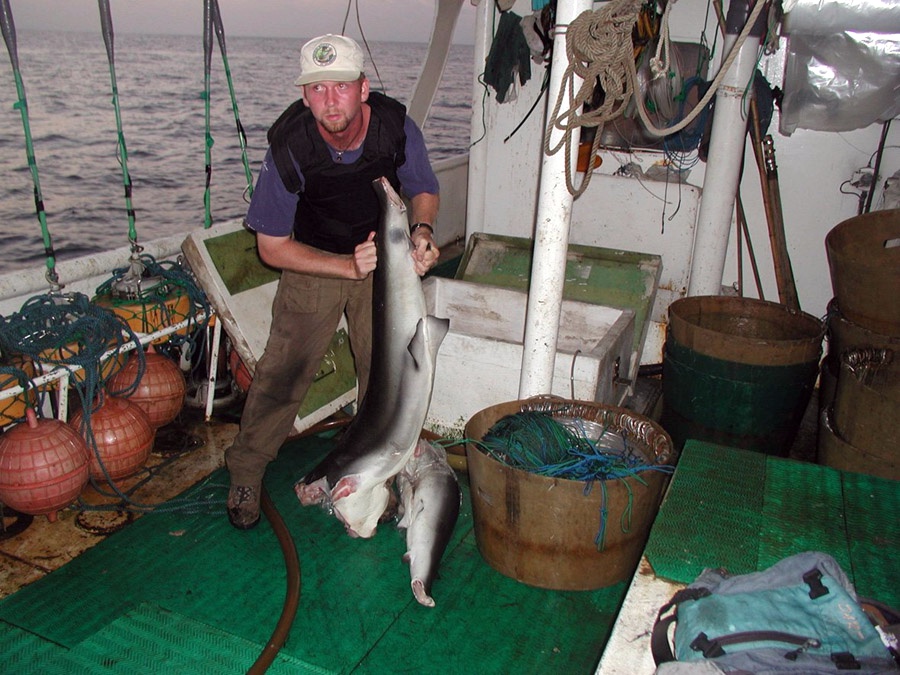
Sea Shepherd’s Galapagos Director Sean O’Hearn-Gimenez on a shark finning arrest operation om 2007.

And over the years I have made predictions (that were ridiculed and dismissed) that have come true. In 1982 I publicly predicted the collapse of the North Atlantic Cod fishery. It happened a decade later. In 1978 I predicted the destruction of one half of the African elephant population in Defenders magazine. I was wrong. Some two thirds of the population have been destroyed. In 1984, I predicted ecological destruction by salmon farms including the spreading of viruses to wild salmon populations. Every prediction was based on observation with reference to the laws of ecology and every prediction was dismissed.

Nothing has changed. Today I am predicting the death of worldwide coral reef eco-systems by 2025, the total collapse of worldwide commercial fishing operations by 2030; and the emergence of more virulent viral diseases in the coming decades. It does not take any exceptional foresight to predict that war will be the major business of the next half-century, as well as the rise of more authoritarian governments.

Recently my old friend Rod Marining, also a co-founder of Greenpeace, said to me: “The transformation of human consciousness on a mass scale can not happen, unless there are two factors. First, a huge mass visual death threat to survival of our species, and two, the threat of the loss of a people’s jobs or their values. Once theses two factors are in place humans begin to transform their thinking over night.”

I have seen the future written in the patterns of our behavior, and it is not a pleasant future, in fact it is not much of a future at all.

The four horses have arrived. As death sits astride the pale horse, the other three horses of pestilence, famine and war and terrorism are stampeding at full gallop toward us while our backs are turned away from them. And when they trample us, we may look up from our latest entertainment triviality to see ourselves in the dust of the ecological apocalypse.

I also see the possibility of salvation. By listening to the words and observing the actions of indigenous people. By looking into the eyes of our children. By stepping outside the circle of anthropocentrism. By understanding that we are part of the Continuum. By refusing to participate in the anthropocentric illusion. By embracing biocentrism and fully understanding the laws of ecology, and the fact that these laws cannot — must not — be ignored if we wish to survive.

The Laws Of Ecology And The Survival Of The Human Species

http://www.huffingtonpost.com/paul-watson/the-laws-of-ecology-and-t_b_11324490.html

08/05/2016

by Captain Paul Watson Founder of the Sea Shepherd Conservation Society

I was raised in a small fishing village on the Passamaquoddy Bay in New Brunswick, Canada and I still vividly remember the way things were in the Fifties. The way things were then is not the way things are now.

I’m not talking about technological, industrial or scientific progress. I’m referring to the health and stability of eco-systems. What was once strong is now weak. What was once rich in diversity is now very much the poorer.

I have been blessed, or perhaps cursed, with the gift of near total recall. I see the images of the past as clearly as the days that were. As a result it has been difficult for me to adapt to diminishment. I see the shells on the beaches that are no longer there, the little crabs under the rocks, now gone, the schools of fishes, the pods of dolphins, the beaches free of plastic.

I began traveling the world in 1967 — hitch-hiking and riding the rails across Canada; joining the Norwegian merchant marine; crossing the Pacific and Indian Oceans; traveling through Japan, Iran, Mozambique and South Africa, working as a tour guide in Turkey and Syria, co-founding the Greenpeace Foundation in 1972 and, in 1977, founding the Sea Shepherd Conservation Society.

2016-08-04-1470340589-1361975-seashepherdfoundercaptainpaulwatson903.jpg

Sea Shepherd founder Paul Watson some forty years ago when he founded the non-profit.

Many things that I saw then no longer exist – or have been severely damaged, changed and diminished.

In the Sixties we did not buy water in plastic bottles. In the Sixties the word ‘sustainable ‘was never used in an ecological context, and except for Rachel Carson, there were very few with the vision to see into the future, where we were going, what we were doing.

But slowly, awareness crept into the psyche of more and more people. People began to understand what the word ecology meant. We saw the creation of Earth Day, and in 1972, the first global meeting on the environment in Stockholm, Sweden that I covered as a journalist.

Gradually, the insight into what were doing became more prevalent and to those who understood, the price to be paid was to be labeled radicals, militants, and a new word – eco-terrorist.

The real “crime” of eco-terrorism was not burning down a ski lodge, toppling a power line or spiking a tree. Such things are only outbursts of desperation and frustration. The real crime of eco-terrorism was having thought, perception, and imagination. In other words, the questioning of the modern economic, corporate and political paradigm.

The word eco-terrorism should be more accurately used for the destruction caused by progress like the Union Carbide disaster in Bhopal or the BP Deep Water Horizon spill in the Gulf of Mexico.

2016-08-04-1470340757-6508043-anoilrig756.jpg

Picture of an oil rig taken during Sea Shepherd’s Operation Toxic Gulf in 2014.

In the Seventies, the late Robert Hunter, along with Roberta Hunter, Dr. Patrick Moore, David Garrick, Rod Marining and myself observed and wrote down the three laws of ecology. What we realized was that these laws are the key to the survival of biodiversity on the planet and also the key to the survival of the human species. We realized that no species could survive outside of the three basic and imperative ecological laws.

The law of diversity: The strength of an eco-system is dependent upon the diversity of species within it.

The law of interdependence: All species are interdependent with each other.

The law of finite resources: There are limits to growth and limits to carrying capacity.

The increase of population in one species leads to the increase in consumption
of resources by that species. This leads to diminishment of diversity of other species, which in turn leads to diminishment of interdependence among species.

For example, increasing diminishment of phytoplankton populations in the sea is causing diminishment of many other species as well as a 40% diminishment in oxygen production since 1950. Diminishment of whale populations has contributed to the diminishment of phytoplankton populations because whale feces are a major source of nutrients (esp. iron and nitrogen) for phytoplankton.

The planet simply cannot tolerate 7.5 billion (and growing) primarily meat and fish eating necrovores. The killing of 65 billion domestic animals each year is contributing more greenhouse gases to the planet than the entire transportation industry. The industrial stripping of life from the sea is causing unprecedented biodiversity collapse in marine eco-systems.

Ecological systems globally are collapsing from coral reefs to rainforests because humanity is exploiting resources far beyond the capacity of eco-systems to create and renew natural resources.

Diminishment of eco-systems is also leading to the breakdown of human social structures causing global conflict in the form of wars and domestic violence. Terrorism is not the cause of society’s problems, it is merely a symptom.

Humans are compromised by medieval paradigms like territorial dominance, hierarchical desires and superstitious beliefs combined with primitive primate behavior like greed and fear.

2016-08-04-1470345289-7416340-bloodbathinleynarclaimedfourpregnantfemales377.jpg

Sea Shepherd’s 2010 Faeroe Islands Dolphin Defense Campaign: Operation Grindstop. Photo credit: Sea Shepherd /Sofia Jonsson

The fishing village that I lived in as a child is no longer a fishing village. The relative innocence of our lives as children of the Fifties and Sixties is no more. The African bush, the Arctic tundra, the marine reserve of the Galapagos Islands, the Great Barrier Reef, the Amazonian rainforests that I once traveled through are no longer what they recently were.

Humans have this amazing ability to adapt to diminishment. It’s a trait that was exceptionally useful when we lived as hunter-gatherers. We adapted to food shortages, to changes in the weather and to the world as it evolved around us. Today we are trying to adapt to the destruction brought on by ourselves and that adaption is taking the form of more and more control by governments and corporations and a blind reliance on corporate technologies.

We no longer have the empathy we once felt. I vividly remember the events of October 23rd, 1958. I was seven years old on the day of the Springhill Mine Disaster in Nova Scotia. 75 men died and 99 were rescue. I remember crying for the fate of people I did not know and feeling excited every time a miner was brought to the surface alive. I no longer have that capacity. Perhaps I lost it when I became an adult, or perhaps society no longer has room for such emotions.

Disaster happened and we grieved for people we did not know. A few weeks ago nearly 100 people were viciously murdered within a few kilometres of where I live when a deranged man mowed them down with a large truck in Nice, France. Last week, a priest was beheaded in France. Every week brings us more stories about mass killings in the Middle East, Africa, America etc. It’s a worldwide pain-fest of chaos and violence and yet it is met with complacency for the most part and a predictable Facebook posting of — “say a prayer for Paris, or Orlando, or Nice, or Beirut, or Istanbul” in a litany of self-indulgent adaptation to tragedy, before being quickly forgotten.

This is not the world of my childhood. We remembered the horrors of World War II with real emotion. I remember talking with both World War I and World War II veterans and feeling their pain. Today it’s just another short-term item on the news, in a world that seeks to escape through movies, celebrities, video games and increasingly more fanatical religious fervor.

Here is the reality. As human populations increase, the consumption of resources increases with it. But because resources are finite and the rate of renewables is overcome by demand, this can only lead to one result — the collapse of resource availability.

And because we are literally stealing resources from other species, this will lead to
diminishment of species and habitats, which will contribute to even more resource diminishment.

2016-08-04-1470342962-4408964-draggingontotheship273.jpg

Sea Shepherd’s 2008 Seal Defense Campaign photographs the murder and carcass dragging of a seal. Photo credit: Sea Shepherd / Greg Hager

At COP 21, I called for an end to worldwide government subsidies for industrialized fishing and at least a 50-year moratorium on commercial industrialized fishing. That solution was not given a moment’s thought at a conference that did not even take into account the imperative role of the Ocean in addressing climate change.

My opinion of COP 21 is that governments were not looking for solutions. They were looking for the appearance of solutions. They certainly did not want to hear about solutions from people like me. They want solutions that are accompanied by jobs and profit. The one thing they do not want is any form of economic sacrifice.

I also do not believe that the majority of humanity — certainly not the leadership — understand the true gravity of the situation. There are six viewpoints concerning climate change: 1. Denial 2. Acceptance, with the view of it being a positive development. 3. Acceptance with the belief that science and technology will save the day. 4. Acceptance, but refusal to fully appreciate the consequences. 5. Apathy. 6. Acceptance with the resolve to find real solutions.

Those who are in denial have vested self interests in doing so, motivated primarily by greed or ignorance. My old Greenpeace colleague Patrick Moore sees climate change as an opportunity for longer growing seasons and better weather. (He lives in Canada and I don’t think he’s really thought it through.) Others like Elon Musk see our salvation in science, in moving off-world or developing artificial eco-systems on Earth. Most responsible world leaders recognize the problem but are too politically-impotent to address it with realistic solutions because those solutions would not be politically popular. And as with everything, the majority of the world is apathetic and too self-absorbed with entertaining themselves (developed world) or surviving (underdeveloped world).

On this path we are on now, the future is somewhat predictable. More resource wars, more poverty, more accumulation of wealth by the minority of privileged people, more disease, more civil strife and with the collapse of biodiversity – global mass starvation, and pestilence.

The rich tapestry of all our cultures and all our achievements in science and the arts hangs by threads linked to biodiversity.

If the bees are diminished, our crops are diminished. If the forests are diminished, we are diminished. If phytoplankton dies, we die! If the grasses die, we die!

We exist because of the geo-engineering contributions of millions of diverse species that keep our life support systems running. From bacteria to whales, from algae to the redwoods. If we undermine the foundations of this planetary life-support system, all that we have ever created will fall. We will be no more.

We made the mistake of declaring war on nature, and because of our technologies it looks like we are going to win this war. But because we are a part of nature, we will destroy ourselves in the process. Our enemy is ourselves and we are slowly becoming aware of that indisputable fact. We are destroying ourselves in a fruitless effort to save the image of what we believe ourselves to be.

In this war, we are slaughtering — through direct or indirect exploitation — millions of species and reducing their numbers to dangerously low levels while at the same time increasing human numbers to dangerously high levels.

2016-08-04-1470343170-9873528-dolphinoffalandintestines645.jpg

Dolphin offal and intestines photographed during the 2011-12 Taiji Dolphin Defense Campaign. Photo credit: Sea Shepherd / Christoph Heylen

We are fighting this war against nature with chemicals, industrialized equipment, ever increasing extraction technologies (like fracking) and repression against any and all voices that rise up in dissent.

In our wake over the past two centuries we have left a trail of billions of bodies. We have tortured, slain, abused and wasted so many lives, obliterated entire species; and reduced rich diverse eco-systems to lifeless wastelands as we polluted the seas, the air and the soil with chemicals, heavy metals, plastic, radiation and industrialized farm sewage.

We were once horrified by the possibility of a Chernobyl or a Fukushima. But the accidents happened and we adapted and accepted. Now we are complacent.

In the process we are becoming sociopathic as a species. We are losing the ability to express empathy and compassion. We idolize soldiers, hunters, and resource developers without giving a thought to their victims. We revel in violent fantasies hailing two-dimensional fantasy killers as heroes. We have become increasingly more Darwinian in our outlook that the weak (other species) must perish so that the strong (ourselves) may survive. We forget that Darwinism recognizes the laws of ecology and we cannot pick and choose when it comes to the laws of nature. In the end nature controls us, we do not control nature.

The consequences of our actions are not going to happen centuries from now. They are going to happen within this century. Oceanic ecosystems are collapsing — now! The planet is getting warmer — now! Phytoplankton is being diminished — now!

To be blunt — the planet is dying now, and we are killing it!

From what I have experienced and from what I see there is only one thing that can prevent us from falling victim to the consequences of ignoring the laws of ecology.

We must shake off the anthropocentric mindset and embrace a biocentric understanding of the natural world. We can do this because we have wonderful teachers in indigenous communities worldwide who have lived biocentric lifestyles for thousands of years just as our species all once did. We need to learn to live in harmony with other species.

We need to establish a moratorium on industrialized fishing, logging and farming.

We need to stop producing goods that have no intrinsic value — all the useless plastic baubles for entertainment and self-indulgence. We need to stop mass-producing plastic that is choking our global seas. We need to stop injecting poisons into the soil and dumping toxins into the sea. We need to abolish cultural practices that destroy life for the sole purpose of entertaining ourselves.

Of course it won’t be easy but do we really want the epitaph for our species to be, “Well we needed the jobs?”

Without ecology there is no economy.

I am not a pessimist and I’ve never been prone to pessimistic thoughts. There are solutions. We see people of compassion, imagination and courage around us working to make this a better world — devoting themselves to protecting species and habitats; finding organic agricultural alternatives; and developing more eco-friendly forms of energy production. Innovators, thinkers, activists, artists, leaders and educators — these people are among us and their numbers are growing.

It is often said that the problems are overwhelming and the solutions are impossible. I don’t buy this. The solution to an impossible problem is to find an impossible solution.

It can be done. In 1972, the very idea that Nelson Mandela would one day be President of South Africa was unthinkable and impossible — yet the impossible became possible.

It’s never easy but it is possible and possibilities are achieved through courage, imagination, passion and love.

I learned from the Mohawks years ago that we must live our lives by taking into account the consequences of our every action on all future generations of all species.

If we love our children and grandchildren we must recognize that their world will not be our world. Their world will be greatly diminished and unrecognizable from the world of our childhoods. Each and every child born in the 21st Century is facing challenges that no human being has ever faced in the entire history of our species:

Emerging pathogens from the permafrost. (Just this summer, an anthrax virus from a recently thawed reindeer carcass broke out killing 1,500 reindeer and hospitalizing 13 people in Russia.) Eruptions of methane opening huge craters in the earth in Siberia, mass-accelerated extinction of plants and animals, pollution, wars and more wars, irrational violence in the form of individual, religious and state terrorism, the collapse of entire eco-systems.

This is not doom and gloom fear mongering. It is simply a realistic observation of the consequences of our deliberately ignoring of the laws of ecology. I call it the Cassandra Principle.

Cassandra was the prophetess of ancient Troy whose curse was the ability to see the future and to have everyone dismiss her prophecies. No one listened to her, instead they ridiculed her. Yet she was right. All that she predicted came to pass and Troy was destroyed.

Years ago I had a critic in the media label me as a doom and gloom Cassandra. I replied, “Maybe, but don’t forget one thing. Cassandra was right.”

2016-08-04-1470346349-3492535-sscsgalapagosdirectorseanohearngimenezonasharkfinningarrestoperation226.jpg

Sea Shepherd’s Galapagos Director Sean O’Hearn-Gimenez on a shark finning arrest operation om 2007.

And over the years I have made predictions (that were ridiculed and dismissed) that have come true. In 1982 I publicly predicted the collapse of the North Atlantic Cod fishery. It happened a decade later. In 1978 I predicted the destruction of one half of the African elephant population in Defenders magazine. I was wrong. Some two thirds of the population have been destroyed. In 1984, I predicted ecological destruction by salmon farms including the spreading of viruses to wild salmon populations. Every prediction was based on observation with reference to the laws of ecology and every prediction was dismissed.

Nothing has changed. Today I am predicting the death of worldwide coral reef eco-systems by 2025, the total collapse of worldwide commercial fishing operations by 2030; and the emergence of more virulent viral diseases in the coming decades. It does not take any exceptional foresight to predict that war will be the major business of the next half-century, as well as the rise of more authoritarian governments.

Recently my old friend Rod Marining, also a co-founder of Greenpeace, said to me: “The transformation of human consciousness on a mass scale can not happen, unless there are two factors. First, a huge mass visual death threat to survival of our species, and two, the threat of the loss of a people’s jobs or their values. Once theses two factors are in place humans begin to transform their thinking over night.”

I have seen the future written in the patterns of our behavior, and it is not a pleasant future, in fact it is not much of a future at all.

The four horses have arrived. As death sits astride the pale horse, the other three horses of pestilence, famine and war and terrorism are stampeding at full gallop toward us while our backs are turned away from them. And when they trample us, we may look up from our latest entertainment triviality to see ourselves in the dust of the ecological apocalypse.

I also see the possibility of salvation. By listening to the words and observing the actions of indigenous people. By looking into the eyes of our children. By stepping outside the circle of anthropocentrism. By understanding that we are part of the Continuum. By refusing to participate in the anthropocentric illusion. By embracing biocentrism and fully understanding the laws of ecology, and the fact that these laws cannot — must not — be ignored if we wish to survive.