Meet the ‘Extreme Conservationists’ Fighting to Stop Namibia’s Seal
Slaughter In the new Pivot series ‘The Operatives,’ Pete Bethune and his
commando team pursue environmental criminals around the world.
August 15, 2014 By Todd Woody
When veteran conservationist Pete Bethune steps off the elevator at
TakePart’s Los Angeles headquarters dressed in camouflage, a military-style
rucksack slung across his back, he looks likes he’s ready to parachute into
some remote locale to do battle with poachers and other environmental
evildoers.
Which he is.
The 49-year-old tattooed New Zealander leads a team of conservationist
commandos in The Operatives, a new television series that premieres Sunday
on Pivot, the television network owned by Participant Media, TakePart’s
parent company.
Bethune gained fame in 2010 when he commanded the Ady Gill, a high-tech
trimaran that was part of a Sea Shepherd fleet trying to stop Japanese
whaling ships in the Southern Ocean. A Japanese boat rammed the Ady Gill,
and when Bethune boarded the whaler he was arrested. Taken to Japan, Bethune
was jailed for five months before being released and deported.
Now he’s back with a team that travels the world to confront eco-villains
poaching protected wildlife, fishing in marine sanctuaries, and illegally
mining for gold in rainforests home to endangered animals such as the
jaguar.
“We got environmental criminals pillaging the world as we speak, and we’re
going to take them on,” says Bethune.
He calls it “extreme conservation.”
The first episode of The Operatives takes the team to the West African
country of Namibia, where local men club to death more than 80,000 baby Cape
fur seals each year.
The Namibian government claims the seal cull is needed to protect fish
stocks. But environmentalists argue there’s another motive: The pelts of the
dead seal pups are exported to make clothing.
In 2006, for instance, Namibia set the cull quota at 85,000 seals, according
to the International Union for Conservation of Nature.
“This high harvest level has been retained despite several years with very
high mortality levels for pups along with many thousands of adult deaths in
Namibia,” the IUCN states in a report.
Namibia and Canada are the only countries that permit the clubbing to death
of baby seals.
Environmentalists estimate that the fur trade brings at most $500,000 to
Namibia. Tourism, on the other hand, is worth $681 million annually,
according to the government. Among the attractions that lure tourists:
the country’s wildlife, including fur seals.
To Kill or Not to Kill? New Hope in the Fight to Save Baby Seals
While the IUCN says that there have been reports that fur seals have had
some impact on fishing, it noted that many seals also die after being
entangled in fishing lines or are illegally shot by fishermen.
In the first The Operatives episode, Bethune and his team travel overland
from South Africa to Namibia. They take an inflatable boat down the coast
under cover of darkness and then swim to shore through shark-infested
waters. Why the subterfuge? The cull they want to document is taking place
on the site of a diamond mine, and the operatives must sneak onto the beach
and avoid capture to film the carnage.
We won’t reveal any spoilers, but it’s extreme viewing. Check out the
preview below
Video at link:
http://www.takepart.com/article/2014/08/15/extreme-conservationists-fight-st
op-seal-slaughter-namibia
Tag Archives: seals
Plastic in Our Oceans
Another reason to bring your own bag to grocery store:
…estimates show that in the next 20 years there could be a pound of plastic for every two pounds of fish in the sea...
From Ocean Conservancy
Last week, I spoke to a packed room at the U.S. State Department’s “Our Ocean” conference. This landmark event, hosted by Secretary of State John Kerry, brought together international government leaders, expert scientists, and global activists like Leonardo DiCaprio to discuss the future of our ocean.
My message was simple: The avalanche of plastic reaching our ocean is as destructive as it is unnecessary. It can be stopped.
Plastics can kill animals like sea turtles, seals, and whales [not to mention, thousands of sea birds]. Once in the ocean, much of the plastic breaks into bite sized pieces animals are eating those pieces, along with the toxic pollutants that plastic adsorbs.
If we do not respond, estimates show that in the next 20 years there could be a pound of plastic for every two pounds of fish in the sea.
In rapidly growing countries, plastic consumption is outpacing waste management. Travel to places like the Philippines, and you’ll see houses built up right to the water’s edge. With no alternative in place, inevitably waste ends up in rivers and streams, and water becomes invisible below a sea of trash.
I believe we have a solution to stop the avalanche but not without your help, and we have to act fast.
We must stop trash at its source — before it enters the ocean. To do that, we need to work with companies and governments in industrializing countries to build critical waste management systems. If we do, we can keep trash out of the ocean and provide billions of people the sanitation they deserve.
At Ocean Conservancy, we are launching a major campaign to work with the most innovative international companies and make this happen.
PETA offers up to $5,000 for info about seal-killing
Thu May 8, 2014 ChinookObserver.com
OCEAN PARK, Wash. — A prominent animal-rights group is offering as much as $5,000 for information leading to the arrest and conviction of the party responsible for an April incident that led to the mortal injury and subsequent euthanization of a mother seal, and the disappearance of her newborn seal pup.
In a press release today, Sophia Charchuck, a spokesperson for People for the Ethical Treatment of Animals, wrote, “Officials have yet to make any arrests. That’s why PETA is offering up to $5,000…”
The incident occurred some time on the morning of Sunday,

A mother harbor seal, who had recently given birth, was found dead on the beach north of the Ocean Park beach approach last week, thought to have been a victim of an intentional vehicular killing.
Photo by SUZY WHITTEY / Chinook Observer
April 20, just hours after the mother seal had given birth. Herb McClintock, an Ocean Park retiree and volunteer who searches local beaches for injured wildlife on a near daily basis had placed warning signs around the animals, but it appears that a speeding driver plowed through the area, severing the mother’s tail. By the time McClintock returned around 8:30 that morning, the mother seal was near death, and the baby had vanished. Experts say there were no clues that hinted at the pup’s fate, but surmised that it could have been carried off by an animal, swept out to sea, or abducted by the assailants.
“It’s such an example of cruel callousness – I think a lot of people would be shocked by it,” Kristin Simon, a Senior Cruelty Caseworker with PETA said in a phone interview Thursday afternoon.
According to Simon, PETA has offered rewards for a variety of abuse, neglect and abandonment cases, but they prioritize violent crimes against animals, because studies have indicated that people who abuse one animal are likely to continue hurting animals, and may escalate to violence against human beings.
“People who abuse animals rarely do so only once and almost never stop there,” Simon said. The organization tends to offer rewards in instances where police investigations have stalled out, due to a lack of witnesses.
“We offer rewards generally in cases of unsolved cruelty to animals where police feel the reward could help bring someone to justice. When they don’t have those leads and just don’t have enough information to pursue the case, that’s where we step in,” Simon said. “Whoever can harm an animal, especially in this way has a level of callousness, and is very likely to share it with someone else … I think it’s highly likely someone knows something.”
Simon said the strategy has proven successful, and PETA has paid out “quite a few” rewards, which they fund through donations and the sale of merchandise.
“Our rewards are very successful because it is a lot of money. Who out there couldn’t use $5,000, just for doing the right thing?” Simon said.
This afternoon, NOAA enforcement officer Kevin Mitchell confirmed that his agency is actively investigating the incident, but declined to discuss the details of the investigation.
“There was some evidence, but I can’t discuss it any further. I can’t discus how great – or not great – it was,” Mitchell said.
According to him, acts of apparently intentional cruelty toward marine life are relatively rare on local beaches.
“I’ve been based out of Astoria now for two years and while I’ve worked other incidents that involved prohibited human interaction with marine mammals, this is the first case that I know of like this.”
Mitchell said he welcomed the reward.
“Any time a reward is offered, it can certainly help an investigation. A lot of times, with incidents that NOAA investigates, they occur in very rural areas without a lot of evidence left behind,” Mitchell said, “The best thing we can hope for is witnesses to the event or after the fact coming forward.”
Anyone with information about this case is encouraged to contact the National Oceanic and Atmospheric Administration’s Office of Law Enforcement toll-free at 1-800-853-1964 .
PETA Offers Up to $5,000 Reward for Help in Nabbing Person Who Killed Mother Seal

A mother harbor seal, who had recently given birth, was found dead on the beach north of the Ocean Park beach approach last week, thought to have been a victim of an intentional vehicular killing.
Photo by SUZY WHITTEY / Chinook Observer
http://www.peta.org/media/news-releases/peta-offers-5000-reward-help-nabbing-person-killed-mother-seal/
Federal Officials Seeking Culprit and Missing Baby Seal
For Immediate Release:
May 8, 2014
Contact:
Sophia Charchuk 202-483-7382 begin_of_the_skype_highlighting
202-483-7382 FREE end_of_the_skype_highlighting
Ocean Park, Wash. – On April 19, a pregnant harbor seal gave birth on a beach just north of Ocean Park. Concerned residents set up a perimeter—complete with red flag–draped warning signs—and checked on the seals periodically. On the morning of April 20, a concerned resident arrived to find that someone had apparently driven a truck into the area and run over the seal, severing her tail. The seal had to be euthanized because of the extent of her injuries, and her baby remains missing.
Officials have yet to make any arrests. That’s why PETA is offering up to $5,000 for information leading to the arrest and conviction of the person or persons responsible for this violent crime.
Would you please consider sharing this information with your audience? It might be the only way to apprehend those responsible for this heinous act.
“Study after study has confirmed that people who hurt animals often go on to hurt human beings,” says PETA Director Martin Mersereau. “PETA is urging anyone with information to come forward now, before another violent act is committed.”
Anyone with information about this case is encouraged to contact the National Oceanic and Atmospheric Administration’s Office of Law Enforcement toll-free at 1-800-853-1964 begin_of_the_skype_highlighting
1-800-853-1964 FREE end_of_the_skype_highlighting .
For more information, please visit PETA.org. To listen to PETA’s anti-violence public service announcement—which features Inglourious Basterds star and Hostel director Eli Roth—please visit http://www.petatv.com/audio/psas/Eli_Roth_PSA_V3.mp3.
Sea Shepherd UK Offers Reward for Conviction of Anyone Illegally Killing Iconic Scottish Seals
http://www.seashepherd.org/news-and-media/2014/04/27/sea-shepherd-uk-offers-reward-for-conviction-of-anyone-illegally-killing-iconic-scottish-seals-1581
This article was originally written and published by Sea Shepherd UK
Sea Shepherd UK is offering a £5000 reward for photographic or video evidence leading to the successful prosecution of employees, representatives, contractors or agents of the Scottish Wild Salmon Company (AKA – Usan Salmon Fisheries Limited) or any companies or individuals for illegally killing iconic Scottish seals.
Scottish Wild Salmon Company employees with firearm used for shooting seals at Gardenstown Harbour – April 2014Sea Shepherd UK is currently engaged in our Scottish Seal Defence Campaign based near Banff in Aberdeenshire. We are extremely pleased that the Scottish Wild Salmon Company has announced that they are currently not taking out firearms in order to shoot seals in Gamrie Bay, this is solely due to the presence of our campaign crew who have been monitoring their activities to ensure that no seals are killed. However, the Scottish Wild Salmon Company needs to understand that Sea Shepherd is relentless in its mission to defend ocean wildlife, and we will extend our Scottish Seal Defence Campaign for as long as the seals need protection.
The government of Scotland provides companies, including the Scottish Wild Salmon Company, with licenses to kill seals. However, the legislation requires that seals may only be shot as a last resort after all other methods of control have been applied. The actions of the fishing companies themselves are attracting seals to the salmon. Seals in this particular area do not typically eat salmon, but are being drawn by the large catches of salmon trapped in nets.
Scottish Wild Salmon Company has a non-lethal solution available for us in the form of Acoustic Deterrent Devices (ADDs), and they have recently announced they will now rely on ADDs at other Salmon netting sites. Unfortunately, bullets are always cheaper and easier than non-lethal alternatives. Although shooting seals in Gamrie bay is currently suspended due to Sea Shepherd UK’s monitoring and patrols – the shooting of seals could return if we were to leave (which we have no intention of doing).
Why does it take policing by an NGO to make companies do the right thing under the law? Without effective policing by Marine Scotland (the agency responsible for the seal killing licenses), it is left to Sea Shepherd to once again uphold national and international laws which governments neither cannot, nor will not enforce.
David Scott, Director of Sea Shepherd UK stated, “Since the Scottish seal cull resumed in January 2011, Usan Salmon Fisheries Ltd has slaughtered more seals than any other firm holding licences to kill these wonderfully friendly and inquisitive animals. The damage they are doing to Scotland’s reputation as a world leading eco-tourism destination cannot be overstated. The damage to the local seal population is evident for all to see.”
Seal which washed up on Gardenstown Beach after being shot by the Scottish Wild Salmon Company in 2013The Scottish people recently voted for the seals to be one of Scotland’s Big 5 iconic species, and by needlessly slaughtering beautiful Scottish seals the Scottish Wild Salmon Company is damaging Scotland’s image around the world.
The only course of action for the Scottish Wild Salmon Company is to immediately relinquish their seal killing licences and publically announce that they are now a seal-friendly company.
In order to qualify for any Sea Shepherd reward, the information or evidence provided must directly lead to the apprehension and conviction of the person(s) responsible for the crime and the case for which information is supplied must still be open with the appropriate authorities. Law enforcement officers (and any persons who obtain such information by way of their occupation) are not eligible for Sea Shepherd rewards.
To encourage local residents to help defend their seals – Sea Shepherd UK is also offering £100 for new (taken after 27th April 2014) clear images or video of the Scottish Wild Salmon Company shooting seals within their current licence conditions in Gamrie Bay.
To submit information or evidence on the illegal killing of seals by the Scottish Wild Salmon Company or any other company or individuals – please e-mail Sea Shepherd UK’s campaign crew at: report@seashepherduk.org including as many details, clear photographs and video as possible.
Seal/Sea Lion Killers Are Guilty of Hate Crimes
(Note: The following was based on an earlier post I wrote on December 18, 2012, entitled Wolf Hunters Are Guilty of Hate Crimes. The wolf hunting and the seal/sea lion killing situations are so similar that about all I had to do was substitute the words seal/sea lions for wolf.)
It occurs to me that the killing of seal and sea lions by those who detest them qualifies as a hate crime. By definition, a hate crime is: A crime, usually violent, motivated by prejudice or intolerance toward a member of a social group.
Well, you don’t get a much more social group than a herd of sea lions—and you don’t find any greater prejudice or intolerance than among those who hate the seal family.
In addition to charges of pre-meditated murder and kidnapping, the person or persons who ran over the mother seal and left with her newborn pup in Ocean Park, WA, should be charged with committing hate crimes.
The same goes for the people who have been hatefully killing sea lions up at Bonneville Dam.
Your Custom and Cultural Quaintness Won’t Get You Out of it This Time
Your hatred of seals and sea lions runs deep. Your father was a commercial fisherman, like his father before him. If they taught you anything about fishing, it was that marine mammals are the enemy. They serve no earthly purpose; the only good one is a dead one.
Never mind that seals and sea lions evolved over tens of millions of years to adapt to aquatic habitats, eventually becoming nature’s perfect fishers; that species of fish and other sea life evolved in harmony with pinnipeds and so were able to withstand their level of predation; or that the reasons salmon are more scarce than they were for your grand-pappy are all because of human activity—including commercial fishing.
That so-called “evolution” stuff is just some big lie made up by “scientists” who don’t know shit from Shinola and probably work for that other arch-enemy: the federal government. (Forget that the government has practically handed you a living since they granted your ancestors their first commercial fishing license.)
Your bible tells you the Earth is only 6,000 years old and that your god loves you better than he does any damn seal or sea lions. Anything you think you have to do to feed your family is forgivable in the eyes of the lord. Studying nature, any further than learning where the schools of fish are likely to be on a given day, is heresy.
Your sense of entitlement is trumped only by your all-consuming hatred of seals and sea lions. So what if they look cute and comical hauled out on beaches or docks in the marina, those beaches and docks belong to you, not them! So do the fish they steal from you and the nets they mess up when they get entangled in them.
So you bring your rifle along whenever you’re out at sea. Shooting them, as your daddy did before you, is the one thing that makes you feel better. It feels good when you see your bullet find its mark and tear into their flesh. It’s not legal anymore, but no one’s watching or does anything about it. You’d have to be pretty obvious to get into any trouble.
Who cares that most of them don’t die outright, but instead suffer slowly with of lead poisoning or infection. Most of them sink to the bottom eventually—out of sight, out of mind.
Sometimes they wash up on your beach or haul out to give birth. It really burns you when people appreciate them and try to protect them with signs warning drivers to watch out for them.
Last week a pregnant seal hauled out and people gushed while she brought yet another seal into the world. If there’s one thing there are too many of, it’s seals and sea lions. God will back you up on that. Do-gooders waited and watched over her, placing signs around her to warn motorists.
It shouldn’t have been an issue, since the upland dunes are off-limits to driving, but your hatred of seals and sea lions blinds you to rules and regulations. The do-gooders were around all day and into the evening, so you wait until the early-morning tide, when no one will witness.
You’ve watched the seal from a distance and know just where to find her as you drive your big, jacked-up four-by-four a mile north of the Ocean Park beach approach. This is your home turf and you know exactly where to go. You find the seal and her pup just where you saw them the day before, in the upland dune grass, where the feds say you shouldn’t drive because some nesting birds take precedence over your fun.
The signs on either side of the seals are visible before the animals are, and you use them to help you zero in on your target. Shooting them would be easier, but the noise might attract attention, so you do the next best thing—you run right over the mother seal, severing her tail.
Checking on your handy work, you see that she’s bleeding badly and will no doubt die

A mother harbor seal, who had recently given birth, was found dead on the beach north of the Ocean Park beach approach last week, thought to have been a victim of an intentional vehicular killing.
Photo by SUZY WHITTEY / Chinook Observer
from her wounds. The pup, on the other hand, is unharmed, but bleating noisily. Someone will probably nurse it back to health if they find it there, so you stuff the newborn pup in a sack, throw it in the back of the truck and bring it to your property in the woods.
What you do with the pup there, people can only speculate. It might come out later in your trial. You were sloppy this time; you left tire tracks where people don’t normally drive. It’s not like no one knows you or ever sees you driving the beach there.
You shocked a lot of people and a lot of folks are angry. People may like to celebrate fishermen, but your feeble rationalizations and your custom and cultural quaintness won’t get you out of it this time.
Violent Seal Killers Threaten Sea Shepherd UK Crew – Caught on Camera
http://www.seashepherd.org/news-and-media/2014/04/21/violent-seal-killers-threaten-sea-shepherd-uk-crew-caught-on-camera-1576
Sea Shepherd crewmembers were being threatened with violence by the Scottish Wild Salmon Company’s seal killers
Photo: Sea Shepherd UKAs predicted by Sea Shepherd on Good Friday, the killing team of the Scottish Wild Salmon Company escalated tensions in the Scottish seal killing grounds with an unprecedented attack on a member of Sea Shepherd UK’s campaign crew.
As residents of Gardenstown were preparing for breakfast on Easter Monday, Sea Shepherd crewmembers were already being threatened with violence by the Scottish Wild Salmon Company’s seal killers.
In a dramatic 8 a.m. confrontation which took place away from the Harbour in the town’s New Ground, three employees of the Scottish Wild Salmon Company, one carrying a rifle, cornered just one of our crewmembers, leaving him fearful of extreme violence.
The crewmember had the presence of mind to keep his camera running throughout, and the situation was saved when other members of the Sea Shepherd campaign crew arrived with their own cameras. Realizing that any further illegal acts on their part were being recorded, the thugs backed away and returned to their command base.
In a dramatic confrontation, three employees of the Scottish Wild Salmon Company, cornered one of our crewmembers
Photo: Sea Shepherd UKSea Shepherd UK has now reported the situation and shown video footage to Police Scotland. Sea Shepherd UK is confident that charges can now be brought against the ringleader of the Scottish Wild Salmon Company’s out-of-control thugs.
Given the escalating situation, Sea Shepherd UK has now asked the Hunt Saboteurs Association to reactivate their undercover teams as well as introduce new covert operatives to the area. Other Sea Shepherd volunteers and specialist intervention teams are also now heading to Banffshire in order to defend Scottish seals from these violent people.
The Scottish government issues companies such as the Scottish Wild Salmon Company with licenses to shoot seals, which they claim threaten fish stocks. However the legislation requires that seals may only ever be shot as a last resort after all other methods of control have been applied. The actions of these companies themselves are drawing seals to the salmon. Seals in this area do not normally eat salmon, but when salmon netting companies trap wild fish in large numbers, it is only natural that the captured fish attract seals. As we’ve seen with the sea lions on the Columbia River on the Oregon/Washington border here in the U.S., these animals are being targeted for the simple “crime” of eating fish. Moreover, the wild salmon that are heading up the coast are being caught by fishermen before they have a chance to spawn, so the fishing itself is killing this particular fishery and is therefore completely unsustainable.
The non-lethal solution is to deploy Acoustic Deterrent Devices (ADDs), which the Scottish Wild Salmon Company does have available to them. Unfortunately, lethal bullets are cheaper than the non-lethal alternative, and so, without effective policing by Marine Scotland (the agency responsible for the seal killing licenses), it is left to Sea Shepherd to once again uphold national and international laws which governments neither can’t nor won’t enforce.
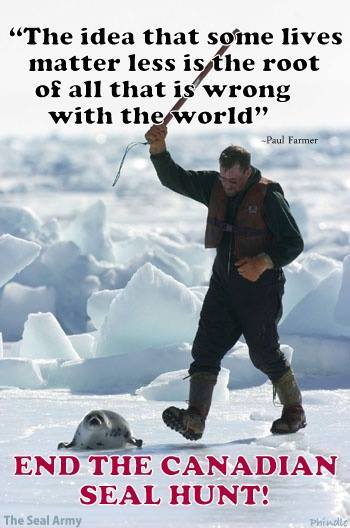
The Canadian government fantasy about the seal hunt is just not that widely shared
Canadian Blog
by Barry Kent MacKay,
Senior Program Associate
Born Free USA’s Canadian Representative
Barry is an artist, both with words and with paint. He has been associated with our organization for nearly three decades and is our go-to guy for any wildlife question. He knows his animals — especially birds — and the issues that affect them. His blogs will give you just the tip of his wildlife-knowledge iceberg, so be sure to stay and delve deeper into his Canadian Project articles. If you like wildlife and reading, Barry’s your man. (And we’re happy to have him as part of our team, too!)
Advice to Gail Shea and the Canadian Government: Here’s How to Impress the EU
The Canadian government fantasy is just not that widely shared
You may wonder why I, a long time opponent of Canada’s east coast commercial seal hunt, would offer advice to those who fight people like me: the Canadian government. No fear. Anything not fitting the current Canadian government’s ideology is ignored, and yet I live in hope. Call it Canadian pride, or what is left of it, but I hate how we’re increasingly considered to be so backward and regressive on issues pertaining to the environment and animal welfare by so much of the rest of the world—including the European Union (EU), whose ban on the import of products from the east coast commercial seal hunt is opposed by Member of the Canadian Parliament, Gail Shea.
Recently, she was quoted as blaming the “the animal rights movement” for China’s apparent reticence to import products, claiming that we had “put a lot of pressure” on the Chinese. Think how that sounds in Europe or China. The so-called “animal rights movement,” whatever she thinks that may be, is supported by volunteered donations (not taxes), and has its hands full with multitudes of humanitarian and environmental concerns in China—from imports of endangered species through dwindling habitat for its own endangered fauna; to horrific zoo, fur, and livestock farm conditions; to a lack of laws providing animal protection; to the live skinning of dogs, cats, or other meat animals in street markets; to shark fin soup; to killer pollution that has caused birds to drop from the sky and marine life to go extinct; to there being virtually no local NGO (non-governmental organization) of its own dedicated to animal protection. And, compared to the resources available to the Government of Canada, what “pressure” do you think humanitarians have? Trade sanctions? Travel restrictions? Call in the ambassador? Mobilize military assets?
So, my first piece of advice to Shea and her colleagues: get real if you want the Europeans to take Canada seriously when it fights to lift the ban on products from the east coast commercial hunt. And to be fair, China is moving forward on environmental and animal protection issues, yes—but no western NGO influences China’s government policy.
Shea is fully in her right to claim that no “baby” seals are killed, but she should understand that, for it to be a truthful statement, a seal has to suddenly stop being a baby at about three weeks of age. But, redefining words does not change their meaning for the rest of the world.
The federal government (dominated by a party most Canadians did not vote for) has continually disgraced itself on many fronts, including the recently-announced (and ironically named) Fair Elections Act, which, if passed, will reduce the number of votes cast by citizens. (But, most foreigners don’t know about that sort of domestic issue.) However, because the issue is of global significance, they do know that former Minister of Natural Resources, Joe Oliver, referred to “environmental and other radical groups” as threatening “to hijack our regulatory system to achieve their radical ideological agenda.” Oh, the irony, coming from a government that has systematically cut funding to research that demonstrates the risk of over-fishing or global climate change. I’ve been a Canadian longer than the Prime Minister and have never seen a more ideological government—and part of the ideology is to ignore facts or expert opinion. It’s no wonder that the Conference Board of Canada ranked our environmental record 15th out of 17 industrial countries, with, a year later, Simon Frazer University ranking us 24th out of 25 Organization for Economic Co-operation and Development nations on environmental performance.
It is hard to reconcile the Canadian decision to contemptuously close, without a trace of consultation with the scientists affected, more than a dozen science libraries run by the Department of Fisheries and Oceans (DFO) and Environment Canada, including the then-newly refurbished, century-old St. Andrews Biological Station in New Brunswick—literally throwing hundreds of thousands of documents, including unpublished material with irretrievable baseline data, into dumpsters!
Just recently, Shea has made moves to reduce protection of breeding habitat of various fish stocks, and to ignore utterly scientific advice in order to support west coast salmon farming that puts native stocks at serious risk. In fact, there is a long history of bad decisions by a succession of fisheries ministers for both parties that have formed governments, resulting in numerous losses of valued fish stocks (but nothing like the anti-environmental fanaticism we now see). With such contempt for science, is it any wonder that claims that the commercial seal hunt is supported by “science” are taken with more than a grain of salt in Europe? People can judge for themselves by viewing video online, to which the government has responded by tabling a bill that would prevent observers from getting close enough to sealers to film how they do it. That’s just so typical. Never have I seen such opacity, such secrecy, and such contempt for openness and accountability as is displayed by this government.
In addressing the World Trade Organization, Leona Aglukkaq, Minister of the Environment (who once asked us to celebrate the killing of a polar bear), was miffed that the EU imported seals from Greenland. That’s because it’s an aboriginal hunt… but so is the hunt for seals in northern Canada, and products from it are also not banned: a point Canada ignores, to the detriment of northern “subsistence” sealers’ interests. They have a monopoly. Subsistence, yes, but Europeans know that trade with them is a function of European colonization. The real irony is that the Canadian government has continually ignored warnings about climate change that so profoundly puts northern traditions at risk from melting permafrost and diminishing ice, including the sea ice so essential to seals and polar bears.
It is ironic, too, that—again ignoring any science that shows that gray seals are not proved to be a threat to commercial fisheries (and could help them in their role as apex predators)—Canada claims that they should be culled, and claims that no seal is wasted, when there is no market. Again, the Europeans are informed on such matters.
Canada loves to mention foie gras, bullfights, and fox hunting as examples of European traditions equal to the seal hunt in cruelty. But, to compassionate (and logical) Europeans, two wrongs don’t make a right, and the fact is that the EU is far ahead of Canada in trying to set standards for increasingly humane treatment of animals. As the recent trial of Maple Lodge, our largest chicken producer, shows, we have a very long way to go. Meanwhile, the humane movement also fights these “traditions,” success dependent on public support. The trajectory, in Europe and many other regions, is forward, toward ever more animal welfare. Not so, sadly, here in Canada.