Exposing the Big Game

Forget Hunters' Feeble Rationalizations and Trust Your Gut Feelings: Making Sport of Killing Is Not Healthy Human Behavior

Exposing the Big Game

Adult Onset Hedonism

264431_455824994498980_1177070538_n

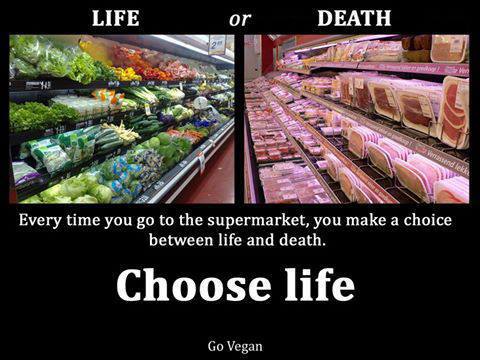
Practically everywhere you look lately are signs of a growing backlash against the progressive vegan movement. It seems people, many who’ve never tried going a day without eating animal products, are tired of being told vegetarian is healthier than flesh-eating and veganism is better still—its carbon footprint being only a fraction of the gargantuan impact of the standard American diet. Plus, vegans have the benefit of a clearer conscience than a person who contributes to animal suffering on a daily basis (assuming said person cares at all about animals). But many are comfortable with their meat addiction and don’t see any reason to ever change. And though they’re still the vast majority and therefore have nothing to fear from the efforts of outnumbered do-gooders, they see it as an attack on their right to be as hedonistic as they so desire and have begun a collective counterattack, just to show ‘em.

A prime example is the subject of a December 4, 2014, article in UT-San Diego. The piece by Michele Parente, cleverly entitled, “Meat trend has some seeing red,”

As in other major cities across the country, San Diego’s current mania for all things meat defies that other growing trend of eating only plant-based food. “I ordered double sausage out of spite,” one diner posted on Facebook, along with a photo of people eating at sidewalk tables, inches away from picketers. “For every animal you don’t eat, I’m going to eat three,” posted another.

Parente started the article out (glibly),

Meat is all the rage in San Diego right now and that’s got some people broiling.

A proliferation of pork-centric places has sprung up all over the county, along with eateries serving up all manner of beef, game, organ and exotic meats. Hungry for a meatier experience? How about a pre-dinner demonstration on how to butcher a whole animal or even the opportunity to slaughter your entrée yourself? And while the current carnivore craze is sating foodies…

What?! Wait a minute. Slow down there and let us un-hipsters catch up; just what the hell is a “foodie,” anyway? It sounds like some kind of baby talk to me. Well, I looked it up and as it turns out that’s not far off. According the Urban Dictionary’s first two definitions, a “foodie” is,

  1. Foodie: A douchebag who likes food.

Douchebag – “I’m a big foodie.”

Non-doucher – “Really? I like food too, but I’m not a tool.” 

  1. Foodie: A dumbed-down term used by corporate marketing forces to infantilize and increase consumerism in an increasingly simple-minded American magazine reading audience. The addition of the long “e” sound on the end of a common word is used to create the sensation of being part of a group in isolationist urban society, while also feminizing the term to subconsciously foster submission to ever-present market sources.

Though the terms “gastronome” and “epicure” define the same thing, i.e. a person who enjoys food for pleasure, these words are perceived by the modern American consumer as elitist due to their Latin root forms and polysyllabic pronunciation

If you’ve ever heard the postpartum cries of a newborn unwillingly evicted from the warmth of a watery womb, or witnessed the incessant tantrum of a terrible two-year old, you know that babies can be a bit self-centered. They don’t really seem to care about others around them; they just want whatever they don’t have, and you’d better figure out what that is—and fast. Meanwhile, in a similarly self-absorbed manner, “foodies” believe they are entitled to make the art of stuffing their gullet an “adventure,” eating whatever they want—or whomever they want—the rights or interests of the victims of their carnivorous quests be damned.

Popular pulp among narcissistic “locavores” is new book touting the alleged virtues of “adult onset hunting.” At the height of hedonism, these nouveau-savage self-actualizers not only find fulfillment in consuming wild animals but also in all forms of related carnage, including (but not limited to) stalking, shooting, snuffing out, dismembering and butchering them first.

Parente’s article continues,

…a small group of animal-rights activists holding “Meat is Murder” signs has been picketing S&M Sausage & Meat each week since it opened in Hillcrest about a month ago.

A recent DIY butchery event, provocatively called Death For Food, was canceled after an online campaign launched by lawyer and seal defender Bryan Pease attracted about 2,500 protesters and threats of a potential boycott against Suzie’s Farm, where the farm-to-guillotine-to-table dinner was scheduled to be held. 

The restaurant, whose logo is a hog on its back, feet in the air and apple in the mouth, is an unabashed haven for adventurous meat eaters, offering everything from kangaroo hotlinks to alligator-antelope Andouille sausage and fried pig ears. “Anything we can find that used to be breathing… Its customers are equally unapologetic.

 “The audience is quite frankly demanding and wants to be part of the experience,” Freeman said. “They want the thrill and adventure of dining they get with whole-animal (butchery).” “…it gives you an experience.”

The otherwise nauseating article does include a good quote from Stephanie Shaw, a PETA spokeswoman, that sums up the vegan message in a nutshell.

“Any restaurant that serves meat, whether it’s farm to table, whole-animal butchers or McDonald’s … is supporting the violent and untimely or unnecessary death of an animal that wanted to live,” Shaw said. “With every meal, we have the opportunity to choose cruelty or kindness.”

10390198_10203908802183160_4406257953417926087_n

More Pro-Hunt Drivel: Locavore movement takes to deer hunting across US

http://news.yahoo.com/locavore-movement-takes-deer-hunting-across-us-171134620.html?soc_src=mediacontentstory&soc_trk=ma

MONTPELIER, Vt. (AP) — A decades-long national decline in the number of hunters has prompted states to tap into a new group of hunters — people who demand locally produced food, but don’t know the first thing about bagging a deer.

Books and blogs on the topic are numerous, and state wildlife departments are offering introductory deer hunting classes in urban areas to recruit newbies who want to kill their own local, sustainable and wild meat in what some say is an ecologically friendly way.

“It’s not easy and it’s not a surefire way to fill a freezer every year but it’s certainly more rewarding than even raising a cow behind your house and butchering it,” said Chris Saunders, hunter education coordinator for the Vermont Department of Fish and Wildlife. The department offered an introductory deer hunting course in Burlington this fall to recruit new hunters.

The number of people holding hunting licenses nationally had dropped over the last 30 years starting in 1983, mostly because of changes in demographics, such as an aging population and more people moving into urban areas, said Mark Damian Duda, executive director of Virginia-based Responsive Management, which does surveys for federal and state fish and wildlife departments.

But hunting participation increased by 9 percent from 2006 to 2011, the latest U.S. Fish and Wildlife Service’s national five-year survey found, and wildlife officials around the country suspect that it’s local food connoisseurs — or locavores — partly helping to level it off.

Reasons for hunting vary — recreation, spending time with friends and family, finding a trophy buck. The number of those hunting for meat nearly doubled from 16 percent in 2006 to 35 percent in 2011, according to a national survey of 1,000 hunters published last year by Responsive Management and other outdoors agencies. The survey found that part of the increase was driven by the locavore movement.

That’s why graduate student Francis Eanes, 27, enrolled in an introductory hunting course this summer and fall in Madison, Wisconsin.

“The motivation really was something that I can do for myself as a way of knowing where my food comes from,” he said. “I’ve worked on farms for a number of years and enjoy picking and helping grow some of my own produce and it seemed like a natural extension to apply that to at least some of the meat that I eat.”

He’s slaughtered pasture-raised rabbits and chickens, and said he feels at ease about killing a deer since it’s able to roam free and grow in a natural habitat. With a clean shot, the deer dies quickly, Eanes said.

“It’s definitely easier to pull carrots or pick tomatoes, but I’m fairly confident that if an opportunity were to present itself, I’d be able to take the shot,” said Eanes, who plans to get a deer during the state’s rifle season, which started Saturday.

Success isn’t guaranteed. Saunders told his hunting class — where meat was the No. 1 motivation for the attendees — that the success rate of hunters is between 15 and 18 percent.

But for many new hunters, it goes beyond knowing where your food comes from.

They enjoy the outdoors, the skill and the unknown — and there’s no negative ecological footprint, said Tovar Cerulli, author of “A Mindful Carnivore.” The 34-year-old former vegetarian and vegan turned hunter wrote his master’s thesis on what he calls adult-onset hunting.

Deer are part of the forest where he lives in Marshfield, Vermont, he said, and if he gets one, he shares it with friends and family. The frozen meat tends to last he and his wife an entire year.

The experience of taking a piece of venison that he shot and butchered out of the freezer is more satisfying than taking out store-bought food out to cook.

“There’s such a specific and direct connection to where that came from and I know that individual animal, where it was, exactly when I killed it,” he said. “It’s all very specific and direct and personal.”

Onlookers dismayed by elk-herding hunters

Elk ambush

Elk ambush

A crowd of hunters participating in the Teton park hunt herded elk from a no-hunting area into a barrage of bullets on Wednesday, upsetting nonhunting passersby.

Thursday, November 20, 2014 4:30 am

Witnesses say hunters in Grand Teton National Park drove a herd of elk from a no-hunt zone and toward an awaiting firing line Wednesday.

The scene at the sage flats north of Kelly was a surprise to Michigan resident and Jackson Hole visitor Joanna Childers, who was on a wildlife safari during her first visit to Teton park.

Subscription Required

An online service is needed to view this article in its entirety. You need an online service to view this article in its entirety.

http://www.jhnewsandguide.com/news/environmental/onlookers-dismayed-by-elk-herding-hunters/article_a21e928d-926e-5fd9-b92c-9886d4d0fe3e.html?mode=story


“It looked like a bunch of hunters surrounded a pack of elk,” Childers said. “Hunters were staked out in the road and around the field.

“You see these animals and they’re in a pack and there a bunch of rifles pointed at them from every direction,” she said. “Overall, it was kind of sad and pretty unfair.”

Wildlife photographer Tom Mangelsen — long an opponent of the park hunt — said hunter behavior Wednesday was as egregious as he’s seen.

By Mangelsen’s account, around 11 a.m. a person pushed a herd of about 100 elk out of an area off limits to hunters near Kelly. Once the herd was on the move, chaos ensued, he said.

“All the sudden somebody shot and they just opened fire on them,” Mangelsen said. “It’s really poor sportsmanship — it was illegal and it was just a display of totally barbaric hunting.”

The photographer estimated that 30 people were involved in the drive, that 25 shots were fired and that eight to 10 elk were killed.

Teton park officials did not corroborate many of the details described by Mangelsen and others, but said some hunters were ticketed Wednesday.

“There was quite a bit of action as far as hunters go and the movement of elk near Kelly,” park spokeswoman Jackie Skaggs said. “At least two citations have been issued.”

Two hunters shot and killed bull elk Tuesday in the park, where harvest is restricted to cows and calves. The elk were confiscated by the Wyoming Game and Fish Department, Skaggs said.

One of those hunters was also cited for shooting at a running herd, she said.

Rules unique to the park hunt prohibit firing more than one shot at a group of running animals.

Seven park rangers were still in the field at the time Skaggs spoke with the Jackson Hole Daily, and she said it’s possible there were other violations.

It’s legal for hunters to drive elk out of areas where hunting is prohibited in the park, Skaggs said.

Mangelsen said some people were firing from the road, which is illegal. Photos he provided show hunters with rifles and shooting sticks setting up on the roadside.

Jeff Soulliere, another local photographer, said the display left him speechless.

“It absolutely was a mess,” Soulliere said. “This is a national park, and you’ve got tourists on the road right next to hunters with high-powered rifles.

“It really struck me as, ‘you got to be kidding me,’ ” he said. “No one was taking safety into consideration because they were herding and surrounding them and they could have shot each other.”

[Too bad they didn’t.]

Trophy Hunter = Serial Killer, Any Questions?

One of the would-be hunter-commenters here recently demanded I explain why I compare hunters to pedophiles and serial killers. Since, as a rule, I don’t approve comments from hunters or their apologists (and because I felt it was so bloody obvious), that question hasn’t been answered here since June 10, in a post entitled, Poachers and Pedophiles are Like Apples and Oranges.

But now that Corey Knowlton has added his voice to the choir of Fuddself-confessed twisted-psycho-hunter-perverts with the telling statement to the WFAA, “I’m a hunter; I want to experience a black rhino. I want to be intimately involved with a black rhino,” it’s time to re-examine the connection in a little more detail. What kind of mind uses the word “experience” for the act of taking a life? Ted Bundy called his murders “possessing.” Like a trophy hunter, he felt entitled to claim another’s life for his own pleasure. In his case, the lives were young co-eds and 12 year old girls—in Knowlton’s case, endangered rhinos. Ted Bundy’s third person narrative of his predations could easily be mistaken (aside, perhaps, from the level of literacy) with Ted Nugent describing one of his trophy kills: “The fantasy that accompanies and generates the anticipation that precedes the crime is always more stimulating than the immediate aftermath of the crime itself. He should have recognized that what really fascinated him was the hunt, the adventure of searching out his victims. And, to a degree, possessing them physically as one would possess a potted plant, a painting, or a Porsche. Owning, as it were, this individual.”

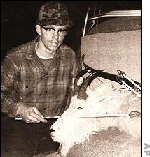
Pertaining to the likes of Alaskan trophy hunter turned-serial killer, Robert Hansen, who preyed on exotic dancers and child6-4Hansens-trophy-goat prostitutes, in addition to Dall sheep, mountain goats and countless other species, conservationist Gareth Patterson wrote: “Certainly one could state that, like the serial killer, the trophy hunter plans his killing with considerable care and deliberation. Like the serial killer, he decides well in advance the type of victim–that is, which species he intends to target. Also like the serial killer, the trophy hunter plans with great care where and how the killing will take place–in what area, with what weapon. What the serial killer and trophy hunter also share is a compulsion to collect trophies or souvenirs of their killings. The serial killer retains certain body parts and/or other trophies for much the same reason as the big game hunter mounts the head and antlers taken from his prey…as trophies of the chase.”

And, as I put it the last time I addressed the pedophilic serial killer/trophy hunter connection: …the analogy between a trophy hunter and a serial killer has been well established—both are single-minded in their quest for the kill, placing their own perverse desires above the self-interests—indeed, the very lives—of their victims. Both perpetrators like to take souvenirs from their kills, and neither one cares what the rest of the world thinks of their actions.

On hunting predators

1453351_1488724231352782_186999841_n

We hunt predators but we can’t say why

The New West / By Todd Wilkinson | Posted: Wednesday, November 12, 2014 1:15 pm

Consider this loaded question: Should grizzly bears, wolves and cougars be hunted for sport? Worldwide, given their rarity and declining numbers, should lions, leopards, cheetahs, jaguars and tigers?

If so, why?

Across North America we find ourselves in another big game hunting season. For many the harvest is as much about putting meat in the freezer — a form of modern subsistence — as it is about the profoundly personal act of communing with nature.

From an early age, a lot of us were taught two guiding ethical principles: Don’t take the life of an animal unless you intend to eat it, and, if you do kill, there ought to be a good reason.

As states sanction hunts of iconic predators (grizzlies and black bears, wolves, mountain lions and coyotes), there remains a fact: People will eat little of those animals that they kill.

The search for a rationale in targeting predators must necessarily speak to reasoning beyond the simplistic argument advanced by fish and game departments that selling hunting tags generates revenue.

The issue of whether there’s an underlying moral — and compelling biological — justification for killing predators is taken up by two university professors in a new thought-provoking scientific analysis, “Wolf Hunting and the Ethics of Predator Control,” soon to be included in a new book, “The Oxford Handbook of Animal Studies.”

Author John Vucetich is a well-known Midwest wolf researcher and conservation biologist at Michigan Tech University; Michael P. Nelson is on the faculty at Oregon State University. In their paper they examine why large carnivores — which possess undeniable ecological value — are hunted.

Before we proceed let it be clear that Vucetich and Nelson did not write the paper to advance an anti-hunting agenda. They wanted to determine if any “good reason” for hunting predators exists.

“What counts as an adequate reason to kill a sentient creature?” they ask. “The hunting community has long recognized the value of this question to understanding the conditions under which various kinds of hunting is appropriate.”

Vucetich and Nelson consider the spectrum of societal attitudes toward predator hunting as expressed by trophy hunters, government wildlife managers, those who hunt for food, those who eat no meat and animal rights advocates.

They dissect the premise that predators must be controlled to ensure healthy populations of elk, deer, moose and pronghorn — and even, as is sometimes asserted, to protect people. They test the assertion that the best way of promoting conservation of a species is to place a value on its head and hunt it.

They also scrutinize the attitudes of so-called “wolf haters,” pointing out that unlike hunters of edible big game, whose pursuit seems to make humans more respectful of the animal, many who kill wolves are actually driven by a lack of empathy.

In a statement certain to spark debate, they charge: “Many instances of wolf poaching … are wrong because they are primarily motivated by a hatred of wolves. These instances of poaching qualify as wrongful deaths, if not hate crimes.

“To legalize such killing does not make them any less wrong. Moreover, people who threaten to poach wolves unless wolf killing is legalized are engaging in a kind of ecological blackmail … .”

Vucetich and Nelson also share thoughts about trapping: “A trophy is a kind of prize, memento or symbol of some kind of success. To kill a sentient creature for the purpose of using its body or part of it as a trophy is essentially killing it for fun or as a celebration of violence.

“And although there was once a time when trapping wolves for their pelts might have been a respectable means of making a living because wolf pelts were then a reasonable way to make warm clothing,” they state, “we no longer live in that time.”

Ultimately Vucetich and Nelson conclude that killing predators for sport isn’t justified biologically or on moral and ethical grounds.

They take government agencies and universities to task for not brokering honest discussions about such controversial issues as wolf management and predator control with citizens and students.

So often we do things in our society, they suggest, without bothering to provide the “good reason” for why.

Readers can judge for themselves. A copy of the analysis is attached to the online version of this story.

Rural America Loves Sport Hunting

It may be a given that for many (if not most) American ruralites, hunting season is their favorite time of year. Like pumpkins at Halloween or colored lights at Christmastime, camo, orange vests and empty beer cans are symbolic of the season. But don’t let the PR puff about self-sufficiency or sustainability fool you, this celebration is strictly motivated by the thrill they get from killing.

Few, if any, western hunters actually need to “harvest” wild “game” to survive in the modern world. It’s all about the “sport” these days, and perhaps for some, outdated “tradition.” It’s never made more clear than when you pull up to a gated logging road in your muddy, decades-old light pickup to look for mushrooms and find yourself parked between a pair of shiny new $50,000.00, ¾ ton mondo trucks, just off the showroom floor—their owners out for a day of hunting. That $50 grand would go a long way toward feeding a hungry family, if that was really the reason for their vicious exploits.

Want more proof that they don’t really need the deer or elk meat to survive? For the past couple of weeks, I’ve been trying to get ahold of the local construction company to have a load of gravel delivered before the rainy season makes my driveway impassable to anyone without a 4×4. Finally, the owner of the company returned my call and sheepishly confessed that he’s been away on “vacation” (no second guesses doing what) and since returning, hasn’t been able to reach any drivers. “They’re all out hunting,” he explained, expecting me to understand.

Well, the problem is, the elk and deer are the only neighbors I consider my true friends. Sorry, but I’m not too understanding when I hear that folks can afford to take time off from high-paying trucking jobs to go on weeks-long trips to murder my friends.

It’s clearly just a sport to them, not a matter of survival.

Text and Wildlife Photography ©Jim Robertson, 2014. All Rights Reserved

Text and Wildlife Photography ©Jim Robertson, 2014. All Rights Reserved

Nearly 40,000 oppose Idaho wolf-hunting contest

PC_logo_vector_3_line_tagline2
Donate-button 2 Email button You Tube button Twitter button Facebook button
  COYOTE_Killing_Contest_Coyote Bodies FAIR USE
“Nearly 40,000 oppose Idaho wolf-hunting contest”
~Reuters, Oct. 28, 2014

Reuters is reporting nearly 40,000 citizens opposed proposed “Predator Derby” in Idaho targeting wolves, coyotes, bobcats, foxes and other predators as part of a killing contest for fun and prizes on more than 300 million acres of public lands in Idaho this coming January (and for 4 more years after that!).

Thanks to all who responded to our call to action to write to the Bureau of Land Management (BLM) in opposition to this slaughter. We are making progress because of YOU!

Project Coyote is doing everything that we can to stop this proposed wildlife massacre. And we are on the brink of winning our battle to ban this practice in California (final vote by the California Fish and Game Commission will be December 3rd).

But we need your help to win this war against wildlife. Please make an emergency gift to our Ban Wildlife Killing Contests Campaign today.

Please join our monthly giving program by becoming a committed donor to support this critical work to defend the coyotes, wolves, foxes, bobcats and other animals who have no voice.

Everything Wrong With Teen Hunter Kendall Jones’ New Hunting Show


By Melissa Cronin

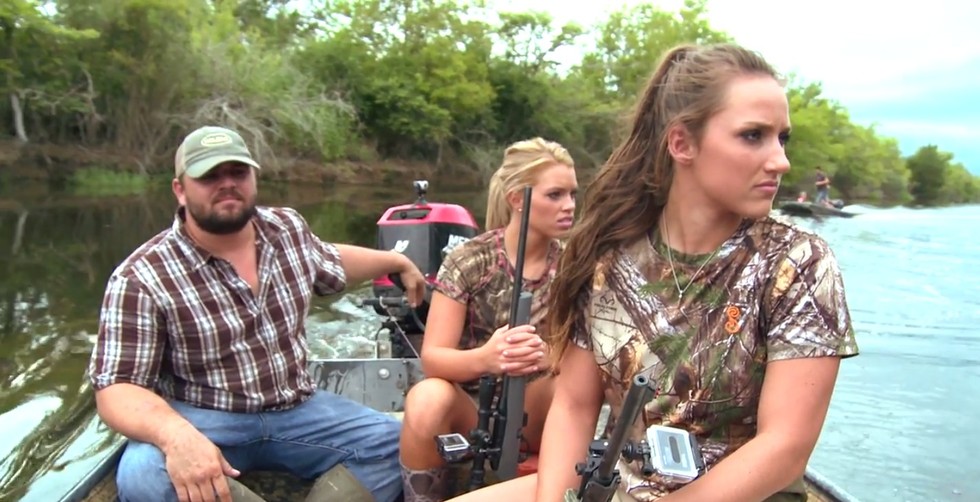
The YouTube series, titled “Game On,” features Jones and a friend setting out on hunting trips together. The first episode, a poorly-made jaunt to Lake Charles, La. for a crocodile hunt, begins with the line, from Jones’ friend Taylor Altom: “I want to shoot a gator in the face.” The pair travel through the swamp in search of alligators for a weekend with the help of a local hunter.

WARNING: Disturbing Images

  • (Kendall Jones/YouTube)The episode, which can be seen at this link, ends with Jones shooting an alligator who was caught on a baited hook in the head as her guide holds it up about six inches away from her. She’s careful to thank her Remington, a nod to the show’s sponsor.

  • (Kendall Jones/YouTube)The American alligator was taken off the U.S. Fish and Wildlife’s Endangered Species List in 1987, and is actually faring pretty well. But hunting methods like baited hooks have been criticized before as inhumane ways of killing the animals. During alligator hunts, a short wooden peg is usually attached to a line, baited with beef or roadkill and then thrown into the water or tied to a branch to lure the alligator. Because take isn’t allowed after sunset, it’s possible that alligators will have to spend the entire night on a line before they’re shot with a gun or bow and arrow.

    When Jones was attacked for hunting big game in Africa, a petition started by a Cape Town native calling on her to be banned from hunting in African states gained over 150,000 signatures. Another petition asked Facebook to remove her grisly hunting photos — which they eventually ended up doing. No word yet on whether YouTube will do the same thing.

    Hunter Encourages 11-Year-Old Son To Kill Rare Albino Deer

    https://www.thedodo.com/hunter-encourages-11-year-old–775070621.html?utm_source=ahiaFb

     By Stephen Messenger

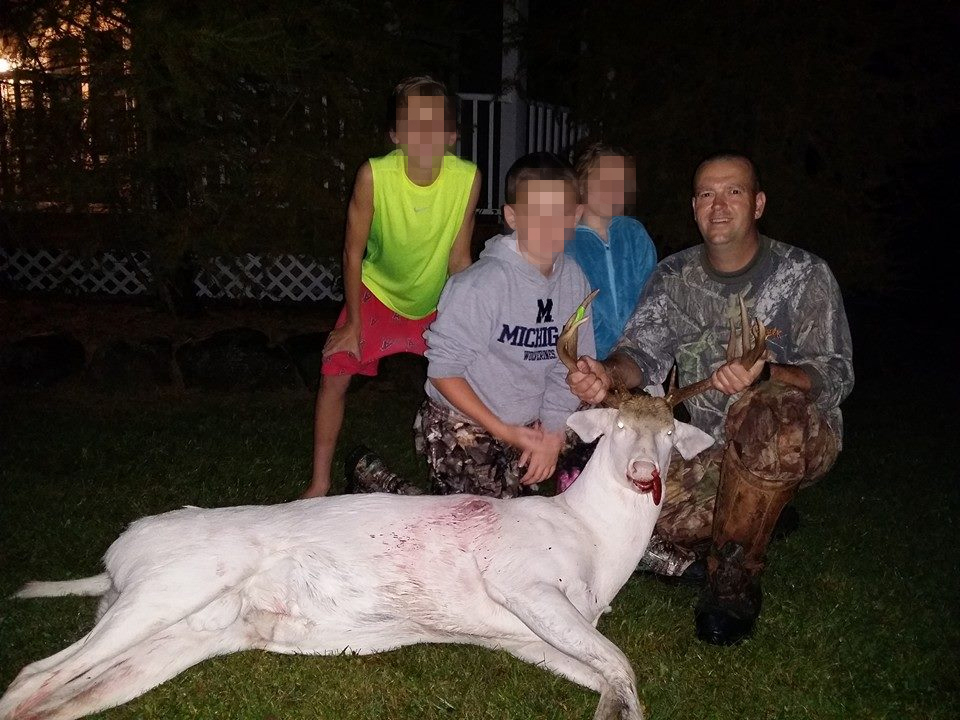
    An 11-year-old boy in Michigan had an encounter last week with one of nature’s most awe-inspiring sights — an albino deer, alive and free in the wild. Only about one in 20,000 deer are born with albinism, and far fewer survive to maturity like this one had.

    But the boy was on no nature walk; he was on a hunting trip with his father, and the rare deer wouldn’t survive the day.

    Warning: Graphic image below

    With the encouragement of his father, Mick Dingman, the sixth-grader steadied his crossbow and fired a fatal shot through the deer’s lungs, besmirching that snow-white coat with the spill and splatter of blood. The rare animal had been seen by folks around town leading up to that moment, but now this deer was the Dingmans’ alone.

    Dingman tells the Livingston Daily that he plans to commemorate the killing by getting the 12-pointed buck mounted by a taxidermist: “It’s too rare and too pretty not to spend the extra money and have the whole thing done.”

    “[My son] kind of feels like a rock star right now,” says Dingman, adding that the youth’s supposed accomplishment has caught the attention of hunting magazines, who are interested in sharing the story. But not everyone is so excited.

    (Facebook/Mick Dingman)

    Amy Sprecher, in neighboring Wisconsin, runs a white deer protection group composed of hunters and non-hunters who are opposed to killing albinos — and she says stories like this are “maddening.”

    “It’s just wrong. I don’t understand why’d you’d want to take that animal away from everybody,” Sprecher told The Dodo. “There are people who want to hunt white deer for bragging rights, but that’s not what hunting is about. Hunters that would never shoot a white deer don’t understand these people either.”

    And Sprecher is not alone in her outrage. Not long after the Livingston Daily posted this photo and story online, readers began expressing anger.

    “Wouldn’t you much rather observe something so rare again year after year than just stare at this giant full mounted carcass for the rest of your life?” writes Christina Brown.

    “This deer was in our backyard in the spring and my wife took a picture. All of the people near us wanted to only shoot pictures, not the deer. We aren’t anti hunting but instead wanted this rare deer to be able to spread his genes so his legacy lives on after he died of a natural cause,” writes Tim Reinert.

    Given the rarity of albino deer, four states, Illinois, Iowa, Tennessee and Wisconsin, have made it illegal to kill them. Critics have argued that laws protecting white deer are based more on emotion than science — arguing that albinism is a genetic disorder, not something to be cherished — but emotions surrounding white deer is certainly nothing new.

    According to Native American tradition, white deer, like the one killed by Mick Dingman’s son, are one of the most sacred creatures on the planet.

    “Albino animals are looked at as a spirit animal, which you are suppose to learn from rather than shoot and kill,” Jonnie J. Sam, from Michigan’s Ottawa Indian tribe, told The Dodo.

    “I’d be more inclined to see if the animal has something to teach me, but sadly not everybody looks at it that way.”