Colorado Hunter In Cross Hairs After Online Bullying By Anti-Hunting Activists

[I don’t encourage people to visit these sites and “bully” the poor trophy hunters, but if the animal-killers don’t want to receive a lot of angry comments from animal advocates then they shouldn’t post photos of themselves smugly posing with their victims. That’s why child molesters don’t pose with their victims. This article doesn’t make the connection; the only victim they see is the one with the rifle.]

http://denver.cbslocal.com/2014/03/27/colorado-hunter-in-cross-hairs-after-online-bullying-by-anti-hunting-activists/

March 27, 2014
DENVER (CBS4)- A picture of a hunter posing on Facebook with her kill, a mountain lion, has put her in the cross hairs of groups that oppose hunting. She claims she’s being harassed online by animal activists- some have threatened her life.

“My first hunting experience was when I was three years old,” said Charisa Argys.

Argys lives in Buena Vista and grew up with a love of hunting after being introduced to the sport by her father.

“It’s always been quality time for us. It’s always been a time when we got to get away,” said Argys.

In February 2013 she hunted and shot a 175-pound male mountain lion. She posted pictures of her kill on the internet.

“I am very proud of what I had accomplished that day,” said Argys.

One year later that picture would result in online threats.

“My picture had been placed on an animal rights activist page,” said Argys.

That picture quickly made the rounds in cyberspace as anti-hunting organizations picked it up and re-posted it, along with hundreds of comments, some of them hurtful.

“They were calling me horrible names. They were saying they wanted to kill me, they wanted to see me dead, they called me fat, they called me ugly, they called me the B-word, they called me the C-word,” said Argys. “There really wasn’t anything they weren’t willing to call me and to say.”

One comment reads, “The only answer is to take out these psychopaths. Problem solved — animals saved.”

Another comment calls for “an eye for an eye.”

And another, “You are a disgrace to those of us who respect life, human and animal. I’d love to hunt YOU and hand YOUR head on my living room wall.”

“You know it was definitely cyberbullying. These were not just threats but I would say they were terroristic threats,” said Argys.

Argys’ shooting and killing the mountain lion is legal in Colorado.

“Absolutely it’s legal. It’s part of wildlife management,” said Colorado Parks and Wildlife spokesman Mike Porras. “You may not like hunting, we understand that. But there’s a right way and a wrong way to express your opinions.”

Porras said Argys is not the first female hunter to be the target of attacks on the internet.

“I mean there are Facebook pages harassing women that have posed with their harvest,” said Porras.

Argys said she did not expect that type of reaction when she posted her picture on the internet, “I had no idea that this type of behavior was going on.”

Argys said Silva Wadhwa, a former reporter with CNBC based in Germany, claims to have started the firestorm.

In a Facebook message to Argys, Wadhwa wrote that she doesn’t agree with trophy killing. She went on to state, “But I do not and will not ever condone or encourage insults, threats or death wishes.”

Argys said the internet comments continue but she vows not to be intimidated, “If I don’t stand up for myself and I don’t take a position on what I feel passionate about how can I expect my children to stand up if it happens to them?”

She also plans to keep hunting.cougar cub
“It was an extreme hunt and it was well worth it,” said Argys.

According to the Colorado Parks and Wildlife, Argys hunted her mountain lion in an area where there is an effort to reduce the number of wild cats.
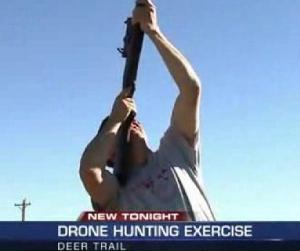
Drone-Assisted Hunting Banned in Alaska

http://www.smithsonianmag.com/smart-news/drone-assisted-hunting-banned-alaska-180950251/?no-ist

by Rose Eveleth smithsonianmag.com

Alaska takes big game hunting seriously, and, in a recent meeting of the Alaska Board of Game, the state officially banned the use of unmanned aerial vehicles to help hunters track prey.

Alaska Wildlife Troopers told the board that, while drone-assisted hunting was still rare, they worried that, as the technology got cheaper, more hunters would start using it, Casey Grove at Anchorage Daily News reports. In 2012, a hunter took down a moose using a drone, and troopers couldn’t do anything about it because the practice wasn’t technically illegal. “Under hunting regulations, unless it specifically says that it’s illegal, you’re allowed to do it,” Wildlife Trooper Captain Bernard Chastain told Grove.

To get ahead of potential problems, the board decided to make spotting and shooting game with a drone illegal. This is similar to the law that bans hunters from using aircraft to follow and shoot animals. With aircraft, it’s legal to shoot the animal if you take it down a day or more after spotting it with the plane but, with drones, any kind of tracking and killing will not be allowed. According to Grove, these laws stem from a “principle of fairness”—not to the animals, but to the other hunters. “Other people don’t have a fair opportunity to take game if somebody else is able to do that,” Chastain says.

According to Valentina Palladino at the Verge, this isn’t the first use of drones banned by hunting communities. Colorado will vote on a rule that would require permits to use drones while hunting. And in Illinois, PETA’s drones, which were tracking hunters, were made illegal. And not only can you not hunt animals, but delivering beer by drone is apparently also a no-go. Spoil sports.

Colorado-man-offering-drone-hunting-lessons-in-Deer-Trail

What’s Not to Like about Guns

Guns. Sure, I own a few. What good god-fearin’ American doesn’t? I figure it’s my duty to keep the arms manufacturers afloat. Of course, mine are just to keep those other gun nuts at bay. I hope I never have to use them, but if someone’s spoilin’ for a gunfight, well that’s ok too.

So, what’s not to like about guns? Well, for starters, they’re noisy, and they’re made for killing. And since it’s illegal to shoot each other, most people use them against non-human animals.

Some folks out here in rural America are so proud of their guns they wear it like a badge. They advertise it all over their loud pickup trucks so no one seeing the cute little Pomeranians in their cab mistakes them for some kind of anti-gun pinko.

Mostly, I don’t like the noise they make. And I guess I empathize with the animals too much. Whenever you hear gunfire, ya have to wonder who the hell’s out there shooting now and what, or who, are they shooting at this time.

Text and Wildlife Photography ©Jim Robertson, 2014.

Text and Wildlife Photography ©Jim Robertson, 2014.

Bill to prohibit mountain lion hunting hits a snag

http://rapidcityjournal.com/news/local/communities/chadron/bill-to-prohibit-mountain-lion-hunting-hits-a-snag/article_7d2aad20-b10d-11e3-bb3c-001a4bcf887a.html

             
2014-03-21 By JoANNE YOUNG Lincoln Journal Starcougar cub                         Rapid City Journal                    

The bill that would halt mountain lion hunting in Nebraska was expected to get final approval Thursday morning from the Legislature.

It didn’t happen.

As the Legislature reached the lunch hour, the bill was pulled for the day by Speaker Greg Adams.

What took place between 9:53 a.m., when final reading on the bill (LB671) began, and 11:58 a.m. when debate stopped, was a not-so-well defined filibuster led by Omaha Sen. Scott Lautenbaugh and several other senators. Near the end of the morning, a motion by Ernie Chambers of Omaha, who introduced the bill, to delay it until the last day of the session, which would kill the bill, was made and then withdrawn by Chambers.

Chambers said Lautenbaugh’s plan was a political maneuver to determine the length of a filibuster on final reading. That kind of extended debate on final reading is exceedingly rare.

But that’s the kind of session this has been.

The morning debate went on for 2 hours and 5 minutes. There is no official time for how long a filibuster can go on final reading before a motion to force a vote on the bill, a cloture motion, can be made.

Lautenbaugh’s constitutional amendment on historical horseracing (LR41CA) is expected to be debated on final reading Tuesday, and amendments and a possible filibuster are pending on that resolution.

Speaker Greg Adams said the filibuster on the mountain lion bill was unanticipated when he put the agenda together.

The Legislature recessed for lunch and Adams said senators would not continue with the bill when they reconvened.

The bill is not on Friday’s agenda. Chambers said Thursday night he expects the bill could come back on final reading next week.

During the filibuster, opponents brought up arguments that the protection of the constitutional right to hunt could be violated by the bill.

Chambers has said through debates on the bill that the small number of mountain lions the Game and Parks Commission has verified in the state shows there is no need at this time to manage the game animal. There also have been no reports of attacks by lions on livestock or people in the state.

The Game and Parks Commission scheduled two hunting seasons this year, both of which have ended.

Two male lions were killed in January in the Pine Ridge and a female was killed in February in Sheridan County as part of two hunting seasons.

Chambers especially objected to the commission allowing hunters in the Pine Ridge to use dogs to chase the lions into trees, making them easier to shoot.

In addition to those killed in hunting seasons this year, two mountain lions were killed in traps, one of those a female, and one was run over by a car.

Lead that’s left behind threatens local wildlife

http://www.santafenewmexican.com/news/local_news/lead-that-s-left-behind-threatens-local-wildlife/article_5b78a00f-3ba4-551f-b096-22e8a482d4ef.html

March 16, 2014 8:45 pm E95688ABF88792AE42A8914230F586_h316_w628_m5_cBUxDElwb
By Staci Matlock
The New Mexican

Two thin bald eagles brought to The Wildlife Center near Española in January died despite efforts by staff to save them.

The culprit was lead poisoning, according to blood tests and necropsies performed on both birds.

Lead ammunition is a deadly problem for animals and birds, even when they haven’t been shot with it, according to Katherine Eagleson, executive director of The Wildlife Center. In the case of the two eagles, they likely scavenged carcasses of animals that had been shot with lead bullets.

Lead ammunition in carcasses left behind by hunters is one source of lead that can poison wildlife. Lead shot and bullets used for target practice in rural areas like a stock pond on the Caja del Rio mesa is another source of lead poisoning. A third is lead sinkers anglers use to weigh down fishing line. Waterfowl accidentally consume abandoned line weighted with the sinkers or eat fish that have ingested the tiny lead sinkers.

Eagleson said there are plenty of other ammunition choices.

“We’re not saying don’t hunt. There are alternatives that work. Go buy them. It is a simple fix,” Eagleson said.

While steel shot is more expensive and some gun enthusiasts say it isn’t as accurate as lead bullets, Eagleson suggested hunters “get closer and hunt better.”

She said there are plenty of alternatives to lead sinkers that aren’t more expensive.

The link between lead and health problems in humans and animals is widely known. Lead accumulates in tissue over time. In people, it has been linked to anemia and neurological problems. Lead was federally banned from paint in 1977 and from pipes for drinking water in 1981.

The health impacts of lead shot on waterfowl and scavengers have been heavily studied in the past few decades, but impacts on other wildlife have been studied less. A 2011 study found high levels of lead toxicity in a free-roaming cougar in Oregon.

The federal government banned the use of lead shot for hunting waterfowl over water bodies in 1991 after it was estimated that 2,700 tons of shot was ending up in wetlands each year. More than 30 states, including New Mexico, have some restrictions on lead ammunition. New Mexico bans the use of lead ammunition when hunting common moorhens (marsh hens), soras (marsh birds), Virginia rails, snipes, doves, band-tailed pigeons, upland game or migratory game birds on all lands owned or managed by the state Game Commission.

New Mexico’s neighbors vary widely in restricting lead ammunition. Colorado bans lead shot only in the Alamosa/Monte Vista/Baca National Wildlife Refuge Complex.

But that still leaves plenty of land where lead shot can be used. It is particularly popular for people who shoot coyotes. Those carcasses are eaten by a variety of other wildlife that may eat the lead shot, Eagleson said.

Texas bans lead bullets for use on game birds in wildlife management areas and federal wildlife refuges. In 2013, California became the first state to ban all ammunition containing lead. The ban will be phased in completely by 2019.

Not everyone agrees with restricting or banning lead ammunition.

The National Shooting Sports Foundation trade group opposes any bans or restrictions on “traditional ammunition” containing lead cores unless “sound science” proves lead bullets adversely affect wildlife, human or environmental health. Hunters have used lead-based ammo for centuries without adverse health affects, according to a statement on the group’s website.

Studies of lead toxicity in wildlife and birds are available from The Journal of Wildlife Diseases, http://www.jwildlifedis.org.

Anti-hunters Outnumber Hunters by Three to One

whoownschart

It’s like the 1% vs. the 99% ratio. This graph came from an opinion piece entitled, “Who Owns the Wildlife?” which starts out:

More and more we as a society are facing problems with how wildlife of all types are managed in the United States. We see increasing conflicts and polarization between hunting and anti-hunting groups. On the one side, invoking the pioneer tradition of our ancestors, hunting groups contend that the right to hunt is undeniable and is essential to the sound management of our wildlife resources. On the other hand, anti-hunting groups contend that the need to kill wildlife animals is no longer justified and hunting represents a next to barbaric act against living, feeling animals.

Long line of hunters on a mountain trail.

Long line of hunters walk a mountain trail. Hunters contend that they are the only ones who should have a say in how wildlife are managed.
[I just want to interject here that as a wildlife photographer/watcher, the parking permit I purchase (the same one that comes with a hunting or fishing license) allegedly goes toward enhancing habitat. I recently saw the results of my contribution when I pulled down what used to be a quiet road which ends at a river and found that the “game” department had built a huge paved parking lot with 20 lined, blacktop spaces for trucks and boat trailers. They also put in a boat launch with a brand new dock and installed a shiny new 2-seater pit toilet–all for the sake of duck hunters and sport fishermen. Meanwhile, they did nothing for ducks or wildlife habitat.]


On one side, hunters contend that because they pay the bills for the management of wildlife resources through their licenses and a federal excise tax on their hunting equipment, they are the only ones who should have a say in how wildlife are managed. On the other side, anti-hunters argue that moral objections to the slaying of innocent animals overrides any priority as to who has a say in these matters. 

And the arguments go on and on….

Bill allowing gun silencers while hunting passes out of committee

By Jim Siegel
The Columbus Dispatch • Wednesday March 12, 2014

Despite opposition from the League of Ohio Sportsmen, which called it a “bad bill with good intentions,” a House committee yesterday passed a bill that would allow Ohio hunters to use silencers.

Larry Mitchell Jr., executive director of the organization, said the goal of allowing hunters to use silencers should be accomplished through the Ohio Division of Wildlife’s rulemaking process. He said that route would be quicker and more flexible than passing legislation and putting it into law.

The bill, he said, “opens the door to the General Assembly to take away the authority of the wildlife professionals to write rules that address both the safety of our angling and hunting community but also address wildlife management principles.”

“With a few calls … this could all be handled in a few weeks,” he said. Asked if talks with the Division of Wildlife about changing the silencer rule could continue if the bill passes, Mitchell said the agency is generally reluctant to take on a new rule if a bill is moving.

Follow @OhioPoliticsNow for more news from the Statehouse

Supporters say the use of silencers will help protect hunters from hearing damage.

Also yesterday, about 50 members of the Ohio Coalition Against Gun Violence marched to the Statehouse to lobby for action on another piece of legislation, House Bill 31, which would set standards for safe storage of firearms. The bill stalled after just two hearings.

Rep. Bill Patmon, D-Cleveland, sponsor of the bill, said losing one child killed by an unsafely stored gun is unacceptable. “If you don’t trust your child with knives, hot water, lawnmowers and running cars, why would you trust them with a .45?” A violation of the law would be a third-degree misdemeanor.

On the silencer bill, the Buckeye Firearms Association played host to about 20 lawmakers and legislative aides in February at the Black Wing Shooting Center in Delaware to demonstrate the effect of placing a silencer on a .45-caliber pistol and .308-caliber rifle.

Some lawmakers were unfamiliar with the impact of a silencer and were concerned their use would make it difficult to know if someone is hunting nearby, or illegally hunting on private lands.

An audiologist from Ohio State University recorded a 15 percent or more reduction in volume with a silencer. It was enough, he said, to protect ears from damage but still loud enough to be heard from several hundred yards away.

Asked by Rep. Gary Scherer, R-Circleville, whether the bill addresses what happens if silencer technology improves, Mitchell said approving silencers by rule would allow for more flexibility to deal with such changes. Scherer voted no on the bill.

Knox Williams, president of the American Silencer Association, said the equipment will never be able to suppress the sound a bullet makes when it breaks the sound barrier.

Williams said 29 states allow game hunting with a silencer, including Pennsylvania, West Virginia, Kentucky and Indiana.

Mitchell said the bill would affect fewer than 1 percent of hunters, but Williams argued that once silencers are approved, that number will rise. Silencer sales in recent years have been booming, he said, and Ohio is now the fourth-largest silencer market in the country.

http://www.dispatch.com/content/stories/local/2014/03/11/Bill-allowing-gun-silencers-during-hunting.html

E95688ABF88792AE42A8914230F586_h316_w628_m5_cBUxDElwb

What’s the difference between a Poacher and the Owner of Jimmy John’s Gourmet Sandwiches

http://catastrophemap.org/wordpress/?p=3180

ANSWER: One does it for money, the other does it for fun Jimmy John Liautaud

Jimmy John’s Owner Jimmy John Liautaud Likes To Kill Large Mammals
NO STUDIES YET AVAILABLE ON COMPENSATION ISSUES FOR BIG GAME HUNTERS WHO OWN COMPANIES THAT MAKE TORPEDO SHAPED SANDWICHES

In addition to loss of habitat, elephants, rhinos and big cats are being hunted to extinction globally by humans who need their parts. In the case of elephants and rhinos, the tusks and horns are the booty. These are valuable commodities, used primarily in Asia to make little religious trinkets (ivory tusks) and as aphrodisiacs (rhino horns). The animals are usually alive when the poachers tusks and horns are cut away. The world’s remaining big cat are hunted for their skins.Is heinous as this trade it, the motive is profit, enough profit that poachers are less likely to be individuals and more likely to be warlords, or even members of various African military forces moonlighting. They’re in it for the money and the authorities are losing the battle nearly everywhere. 2012 was a record year for rhino massacres, with four out of five remaining species nearing final extinction.Congo elephant massacre

This is a fundamentally different motivation than that of Jimmy John’s sub sandwich empire Jimmy John Liautaud, who loves to go on safari for the sheer pleasure of killing large animals. Look at the big grin of triumph as he poses with their corpses. This is a happy fellow who has proven once again that he can master nature as long as he has a safari staff and a big fucking gun.

Jimmy participates in the safaris on private game preserves, where the safari companies essentially own the prey whose guaranteed death is their profit center. In fact, here’s a handy link to Johan Calitz Safaris’ photo page, featuring a host of mighty men with their subdued trophies.

In case you are looking for patterns, Johnny is also politically inclined to the right wing. He just hates providing health care for his workers, and publicly announced plans to reduce workers’ hours in order to avoid the Affordable Care Act’s requirement to provide health coverage or pay a penalty.

_____________________________

[As I pointed out in my post “‘Kill ‘Em All Boyz’ Are ‘Ethical’ Hunters Once Again,” Poachers or not, it all ends the same for the animals they killed.]

Jimmy John is a big man. With the photos to prove it.

http://www.smilepolitely.com/splog/jimmy_john_is_a_big_man._with_the_photos_to_prove_it/

        June 10, 2011 / 4:29pm /                   Robert Hirschfeld
.
..for now tales of Jimmy John’s violent exploits are limited to using his (tax-dwindled) funds to live out fantasies of stalking, predation, and slaughter in exotic locales.

Jimmy, I’ll finance your next trip if you think you’re man enough to do it bare-handed.

p.s. Your sandwiches are shit.

——-

An update based on my thoughts in communicating with a few commenters:

Thank you to all who have read, forwarded, and provided insightful commentary or information-and this would include an invitation to and preemptive thanks for anyone who can provide a legitimate defense beyond, “Who cares?”  I think it’s immediately apparent that a lot of people care.

Also, a special tip of the hat to Jonathon Childers, who alerted SP to these photos.

I fully appreciate skepticism and the withholding of support for the targeting and criticism of another human until reason and sense dictate otherwise.  I believe the photos do dictate such responses, though context and additional information are always warranted.

I could have written a longer, investigative piece, and tied in trophy hunting with the ills of our civilization, but I chose not to.  Positive and negative consequences follow.  One of the positives is that, in deferring from framing the discussion analytically, readers have felt inclined to weigh in on important subjects like economic models, animal cruelty, debased human behavior abroad and on-site (if I want to feel apocalyptic I go read internet comment threads), and the need to find constructive solutions.

– See more at: http://www.smilepolitely.com/splog/jimmy_john_is_a_big_man._with_the_photos_to_prove_it/#sthash.pY1dfzRz.dpuf

FoA challenges Congress’ betrayal of endangered antelope

Today international animal protection organization Friends of Animals filed
a Complaint challenging the constitutionality of a provision that was buried
in the 2014 Federal Budget by Congressman John Carter of Texas that seeks to
eliminate Endangered Species Act protection for three species of African
antelope held captive on U.S. sport-hunting ranches.

“After the better part of a decade on the losing end of Friends of Animals’
efforts to protect these amazing antelope, private hunting ranch operators
that profit on the killing of these animals chose to show their disrespect
for our justice system by turning to their Congressional pawn,
Representative John Carter,” said Priscilla Feral, president of Friends of
Animals. “Fortunately for the antelope, Friends of Animals won’t let them be
killed so easily and will continue to fight on their behalf in the
courtroom.”

Mike Harris, director of Friends of Animals’ Wildlife Law Program, explains
that the provision in the Federal Budget, Section 127, purports to undo
Friends of Animals’ 2009 victory in which a federal judge told the U.S. Fish
and Wildlife Service that it could not exempt these hunting ranches from theHuntingTrophiesJamieKripke600
permitting requirements in Section 10 of the Endangered Species Act. Section
127 also seeks to interfere with Friends of Animals’ 2013 lawsuit
challenging whether USFWS’s permitting of more than 100 of these hunting
ranches violated the Endangered Species Act’s conservation purposes.

“Representative Carter’s attempt to strip legal protections for these
endangered animals reeks of special interest favoritism,” Harris said. “His
budget rider is not only harmful to the antelope, but also to American
democracy. It is now up to the court to stop this misuse of Congressional
power.”

Today, addax and dama gazelles are nearly wiped out in Northern Africa due
to hunting, war, desertification of habitat, human settlement and
agribusiness. FoA has facilitated the reintroduction of the antelope within
Ferlo National Park in northwest Senegal. Through member support, FoA funds
habitat restoration efforts at Ferlo National Park. For example, in fiscal
year 2013, $66,000 went toward expanding the Oryx Fence Project, which
includes dama gazelles. One hundred and 20 oryx and 20 dama gazelles
benefitted, along with other animals, from these funds. FoA has also
collaborated with European and Middle Eastern specialists in captive
breeding of arid ecosystem gazelle species to restore these animals to the
wild.

The full Complaint can be viewed on the Friends of Animals’ website:

http://friendsofanimals.org/sites/default/files/kcfinder/files/Antelope_Ride
r_Complaint%20FINAL.pdf