Urge Georgia Legislators to Oppose Raccoon Torture!

If House Bill (H.B.) 423 passes, it will allow hunters to trap and cruelly confine raccoons for use in field trial competitions. This bill has passed through the House and is now with the Senate Natural Resources and Environment Committee, which may discuss it as early as March 11. Your voice and the voices of everyone you know are desperately needed right now. Please forward this alert far and wide!

Every minute in confinement is already a terrifying eternity for raccoons, who, during field trial competitions, are flung high into trees or hauled across fields and bodies of water as frantic dogs give chase. They must repeatedly endure this hellish ordeal, often for hours on end, and many are badly injured or even killed during the trials. Survivors risk developing chronic and contagious stress-induced disorders, which could eventually prove fatal after their release.

Please urge the members of the Senate Committee  and your senator to oppose H.B. 423. Let them know that field trials are inhumane and harmful to local ecosystems and can spread disease. Tell them that these events should remain illegal in Georgia!

Action Alert Here:  https://secure.peta.org/site/Advocacy?cmd=display&page=UserAction&id=5343

Wildlife Photography Copyright Jim Robertson

Wildlife Photography Copyright Jim Robertson

Petition: Stop the legal slaughter of Polar Bears by trophy hunters

1975210_217349905127731_192938778_n

https://www.change.org/petitions/the-canadian-government-stop-the-legal-slaughter-of-polar-bears-by-trophy-hunters

Animal First! (www.animalfirst.org)

Petition by

Animal First! (www.animalfirst.org)

Polar Bears are some of the most majestic and beautiful animals in the world. The global population estimate is between 20 000 and 22 000. This classifies the Polar Bear as ‘threatened.’ Polar Bears are threatened by pollution High levels of chemicals and PCBs. Another threat is global warming. Without ice Polar Bears are unable to reach their prey.

But the most immediate threat is hunting. Over 1000 polar bears are hunted annually! This prevents the Polar Bear population from increasing to a healthier number. Canada is the only nation in the world that allows Polar Bear hunting by non-natives and non-citizens. (Polar Bears also live in Alaska, Russia, Greenland, & Norway) Canada sells polar bear hunting licenses to trophy hunters. The main problem with this is that 60% of Polar Bears reside in Canada.

The Canadian government are paying hunters for Polar Bear hides! The government pre-pays hunters for the hides of bears shot in this subsistence hunt, and then sells the hides at auction for up to $11,000 (which also goes to the hunter), it blurs the line between a subsistence hunt and a commercial hunt.

Polar Bears are protected under national law and international treaty, so Canada’s Polar Bears can only be harvested by Inuit hunters for subsistence, OR by trophy hunters guided by Inuit.

The major threat for Polar Bears in Canada is the commercial hunt. Canada is the ONLY nation in the world that allows Polar Bear hunting by non-natives and non-citizens trophy hunters. Why? The answer is easy: MONEY! Pure greed for profit! Canada charges 750 Canadian dollars per Bear!

Allowing hunting by non-natives and non-citizens and selling hunting licenses to trophy hunters creates a bloody business where radical hunters sell hunting tours to Canada and kill Polar Bears. The hunt of one male Polar Bear is offered for 35.000 $ and as we know there are enough rich people who book these tours to get their trophy! There is also an increase in polar bear skin sales!

By booking one of these horrifying tours, the trophy hunters are allowed to go to 5 or 6 day hunting trips in which they chase polar bears with several dogs and after a long chase, when the Polar Bear is exhausted from running, he stops to finally try to make the dogs that are surrounding him go away, at which point the hunter gets closer and shoots several arrows (!!!) until he is finally dead. This means pure torture for the Polar Bear. Cruelty on animals can not be worse than this.

Tell the Canadian government to stop the legal slaughter of one of the highest endangered species in the world. We are horrified and shocked that you sell the life of one of the most majestic and beautiful animals in the world to hunting tour operators like:

http://polarbearhunting.net/ or http://52safari.com/

The irresponsible killing of this threatened species for pure trophy hunting as well as commercial trade in polar bear products must be stopped — now! Before it’s too late!

We need a lot of signatures to put pressure on the Canadian Government! So please share this petition to as many people as possible.

To:
Environment Canada
THE CANADIAN GOVERNMENT
Ministry of Agriculture
Environment Canada Inquiry Centre
Environment Canada National Office
Species at Risk Public Registry
Fisheries and Oceans Canada
Minister of the Environment, Peter Kent
Canadian Wildlife Service Environment Canada

Dear [Decision Maker],

Dear Stephen Harper,

I have learned that Canada is the only nation in the world that still allows Polar Bears to be killed by trophy hunters and for the commercial trade in their skins. Canada sells Polar Bear hunting licenses to non-natives and non-citizens trophy hunters. That creates a bloody business where radical hunters sell hunting tours to Canada and kill Polar…

Read More and sign the petition: https://www.change.org/petitions/the-canadian-government-stop-the-legal-slaughter-of-polar-bears-by-trophy-hunters

Whither the Hunter/Conservationist?

By George Wuerthner On March 5, 2014

Many hunter organizations like to promote the idea that hunters were the first and most important conservation advocates. They rest on their laurels of early hunter/wildlife activist like Teddy Roosevelt, and George Bird Grinnell who, among other things, were founding members of the Boone and Crocket Club. But in addition to being hunter advocates, these men were also staunch proponents of national parks and other areas off limits to hunting. Teddy Roosevelt help to establish the first wildlife refuges to protect birds from feather hunters, and he was instrumental in the creation of numerous national parks including the Grand Canyon. Grinnell was equally active in promoting the creation of national parks like Glacier as well as a staunch advocate for protection of wildlife in places like Yellowstone. Other later hunter/wildlands advocates like Aldo Leopold and Olaus Murie helped to promote wilderness designation and a land ethic as well as a more enlightened attitude about predators.

Unfortunately, though there are definitely still hunters and anglers who put conservation and wildlands protection ahead of their own recreational pursuits, far more of the hunter/angler community is increasingly hostile to wildlife protection and wildlands advocacy. Perhaps the majority of hunters were always this way, but at least the philosophical leaders in the past were well known advocates of wildlands and wildlife.

Nowhere is this change in attitude among hunter organizations and leadership more evident than the deafening silence of hunters when it comes to predator management. Throughout the West, state wildlife agencies are increasing their war on predators with the apparent blessings of hunters, without a discouraging word from any identified hunter organization. Rather the charge for killing predators is being led by groups like the Rocky Mountain Elk Foundation, and others who are not only lobbying for more predator killing, but providing funding for such activities to state wildlife agencies.

For instance, in Nebraska which has a fledging population of cougars (an estimated 20) the state wildlife agency has already embarked on a hunting season to “control” cougar numbers. Similarly in South Dakota, where there are no more than 170 cougars, the state has adopted very aggressive and liberal hunting regulations to reduce the state’s cougar population.

But the worst examples of an almost maniacal persecution of predators are related to wolf policies throughout the country. In Alaska, always known for its Neanderthal predator policies, the state continues to promote killing of wolves adjacent to national parks. Just this week the state wiped out a pack of eleven wolves that were part of a long term research project in the Yukon Charley National Preserve. Alaska also regularly shoots wolves from the air, and also sometimes includes grizzly and black bears in its predator slaughter programs.

In the lower 48 states since wolves were delisted from the federal Endangered Species Act and management was turned over to the state wildlife agencies more than 2700 wolves have been killed.

This does not include the 3435 additional wolves killed in the past ten years by Wildlife Services, a federal predator control agency, in both the Rockies and Midwest. Most of this killing was done while wolves were listed as endangered.

As an example of the persecutory mentality of state wildlife agencies, one need not look any further than Idaho, where hunters/trappers, along with federal and state agencies killed 67 wolves this past year in the Lolo Pass area on the Montana/Idaho border, including some 23 from a Wildlife Service’s helicopter gun ship. The goal of the predator persecution program is to reduce predation on elk. However, even the agency’s own analysis shows that the major factor in elk number decline has been habitat quality declines due to forest recovery after major wildfires which has reduced the availability of shrubs and grasses central to elk diet. In other word, with or without predators the Lolo Pass area would not be supporting the number of elk that the area once supported after the fires. Idaho also hired a trapper to kill wolves in the Frank Church/River of No Return Wilderness to increase elk numbers there.

Idaho hunters are permitted to obtain five hunting and five trapping tags a year, and few parts of the state have any quota or limits. Idaho Governor Butch Otter recently outlined a new state budget allotting $2 million dollars for the killing of wolves—even though the same budget cuts funding for state schools.

Other states are no better than Idaho. Montana has a generous wolf six month long season. Recent legislation in the Montana legislature increased the number of wolves a hunter can kill to five and allows for the use of electronic predator calls and removes any requirement to wear hunter orange outside of the regular elk and deer seasons. And lest you think that only right wing Republican politicians’ support more killing, this legislation was not opposed by one Democratic Montana legislator, and it was signed into law by Democratic Governor Steve Bullock because he said Montana Dept of Fish, Wildlife and Parks supported the bill.

Wyoming has wolves listed as a predator with no closed season or limit nor even a requirement for a license outside of a “trophy” wolf zone in Northwest Wyoming.

The Rocky Mountain West is known for its backward politics and lack of ethics when it comes to hunting, but even more “progressive” states like Minnesota and Wisconsin have cow-towed to the hunter anti predator hostility. Minnesota allows the use of snares, traps, and other barbaric methods to capture and kill wolves. At the end of the first trapping/hunting season in 2012/2013, the state’s hunters had killed more than 400 wolves.

Though wolves are the target species that gets the most attention, nearly all states have rabid attitudes towards predators in general. So in the eastern United States where wolves are still absent, state wildlife agencies aggressively allow the killing of coyotes, bears and other predators. For instance, Vermont, a state that in my view has undeserved reputation for progressive policies, coyotes can be killed throughout the year without any limits.

These policies are promoted for a very small segment of society. About six percent of Americans hunt, yet state wildlife agencies routinely ignore the desires of the non-hunting public. Hunting is permitted on a majority of US Public lands including 50% of wildlife “refuges as well as nearly all national forests, all Bureau of Land Management lands, and even a few national parks. In other words, the hunting minority dominates public lands wildlife policies.

Most state agencies have a mandate to manage wildlife as a public trust for all citizens, yet they clearly serve only a small minority. Part of this is tradition, hunters and anglers have controlled state wildlife management for decades. Part of it is that most funding for these state agencies comes from the sale of licenses and tags. And part is the worldview that dominates these agencies which sees their role as “managers” of wildlife, and in their view, improving upon nature.

None of these states manage predators for their ecological role in ecosystem health. Despite a growing evidence that top predators are critical to maintaining ecosystem function due to their influence upon prey behavior, distribution and numbers, I know of no state that even recognizes this ecological role, much less expends much effort to educate hunters and the public about it. (I hasten to add that many of the biologists working for these state agencies, particularly those with an expertise about predators, do not necessarily support the predator killing policies and are equally appalled and dismayed as I am by their agency practices.)

Worse yet for predators, there is new research that suggests that killing predators actually can increase conflicts between humans and these species. One cougar study in Washington has documented that as predator populations were declining, complaints rose. There are good reasons for this observation. Hunting and trapping is indiscriminate. These activities remove many animals from the population which are adjusted to the human presence and avoid, for instance, preying on livestock. But hunting and trapping not only opens up productive territories to animals who may not be familiar with the local prey distribution thus more likely to attack livestock, but hunting/trapping tends to skew predator populations to younger age classes. Younger animals are less skillful at capturing prey, and again more likely to attack livestock. A population of young animals can also result in larger litter size and survival requiring more food to feed hungry growing youngsters—and may even lead to an increase in predation on wild prey—having the exact opposite effect that hunters desire.

Yet these findings are routinely ignored by state wildlife agencies. For instance, despite the fact that elk numbers in Montana have risen from 89,000 animals in 1992 several years before wolf reintroductions to an estimated 140,000-150,000 animals today, Montana Department of Fish, Wildlife and Parks does almost nothing to counter the impression and regular misinformation put forth by hunter advocacy groups like the Rocky Mountain Elk Foundation or the Montana Sportsmen for Fish and Wildlife that wolves are “destroying” Montana’s elk herds.

I have attended public hearings on wolves and other predator issues, and I have yet to see a single hunter group support less carnivore killing. So where are the conservation hunters? Why are they so silent in the face of outrage? Where is the courage to stand up and say current state wildlife agencies policies are a throw-back to the last century and do not represent anything approaching a modern understanding of the important role of predators in our ecosystems?

As I watch state after state adopting archaic policies, I am convinced that state agencies are incapable of managing predators as a legitimate and valued member of the ecological community. Their persecutory policies reflect an unethical and out of date attitude that is not in keeping with modern scientific understanding of the important role that predators play in our world.

It is apparent from evidence across the country that state wildlife agencies are incapable of managing predators for ecosystem health or even with apparent ethical considerations. Bowing to the pressure from many hunter organizations and individual hunters, state wildlife agencies have become killing machines and predator killing advocates.

Most people at least tolerant the killing of animals that eaten for food, though almost everyone believes that unnecessary suffering should be avoided. But few people actually eat the predators they kill, and often the animals are merely killed and left on the killing fields. Yet though many state agencies and some hunter organizations promote the idea that wanton waste of wildlife and unnecessary killing and suffering of animals is ethically wrong, they conveniently ignore such ideas when it comes to predators, allowing them to be wounded and left to die in the field, as well as permitted to suffer in traps. Is this ethical treatment of wildlife? I think not.

Unfortunately unless conservation minded hunters speak up, these state agencies as well as federal agencies like Wildlife Services will continue their killing agenda uninhibited. I’m waiting for the next generation of Teddy Roosevelts, Aldo Leopolds and Olaus Muries to come out of the wood work. Unless they do, I’m afraid that ignorance and intolerant attitudes will prevail and our lands and the predators that are an important part of the evolutionary processes that created our wildlife heritage will continue to be eroded.

Whither the Hunter/Conservationist?

copyrighted wolf in river

12 Year Old Montana Girl Murders Her First Mountain Lion

[The oh boy, happy day reporting is about as hard to take as the photo of the dead cougar. Here’s the headline the mainstream paper gave this vile act of murder: ]

Darby girl bags her first mountain lion

                                                                               
 2014-03-03   Two weeks after her 12th birthday, Darby girl bags her first mountain lion                         missoulian.com
March 02, 2014 6:00 pm  •
DARBY – Taylor Wohlers was 3 years old when she experienced her first mountain lion hunt.

It was something she never forgot.

The excitement of the chase through snow, over rocks and up steep mountains. The sound of the dogs baying at the base of the tree. And then finally, the sight of a snarling mountain lion high up in the tree.

From that first hunt seen from a backpack carried by her father, Wohlers has been on well over 20 mountain lion hunts in the past decade.

All through those years, she counted the days until she would actually be old enough to have a hunting license.

She turned 12 on Feb. 12 and bought her first license that very day.

Montana state law required that she wait another five days to actually use her mountain lion tag. By then, the state-set quota for mountain lions in the southern Bitterroot was down to one female.

Her dad, Ben Wohlers, was determined to do his best to help his daughter fill her first tag.

On Wednesday – exactly two weeks after she turned 12 – Taylor was called into the school office and told to grab her snow gear.

Her dad had found a mountain lion near Sula.

“It had come down and crossed in my tire tracks,” Ben Wohlers said. “I knew it was close. When I turned the dogs out, they were on it right away. She’s been on a lot longer chases than this one.”

The longest chase the father and daughter enjoyed covered close to 11 miles as they walked from the lookout tower at Gird Creek to the bottom of the mountain.

*****

After the much shorter hike Wednesday, Taylor remembers seeing the lion snarling up in the tree.

“I stood there and looked at it for a little while,” Taylor said. “And then I used my dad as a rest to take aim.”

Her father sat down on the ground and she placed the barrel of the AR-15 .223-caliber rifle across his shoulder.

A short time later, the mountain lion hunting season in the Bitterroot officially came to an end.

“Ideally, we would have looked for a big tom, but that part of the season was closed,” Ben Wohlers said. “This was the last one in the valley for this year.”

Taylor had only been legally old enough to hunt in Montana for two weeks.

This wasn’t the first time that she’s hunted. In the summer of 2012, she traveled to Alaska to shoot a black bear while being filmed by the Skull Bound TV production company.

She used a .300 Winchester Magnum to kill the bear at 168 yards.

Her dad took her to Canada last year in search of a mountain lion, but they couldn’t find the right one there.

Last week’s hunt was one that neither father nor daughter will ever forget.

“I want a life-size mount,” Taylor told her dad inside his taxidermy shop filled with life-size mounts of a wide variety of critters.

Wohlers looked at his daughter and smiled.

“That’s probably what we’ll do then,” he said. “We’ll probably do a life-size mount for you.”

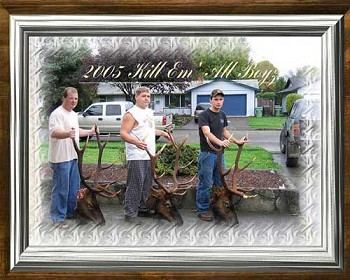
“Kill ‘Em All Boyz” Are “Ethical Hunters” Once Again

Ever since a friend sent me an article from back in 2006 about the poaching ring4cbfbced5cc75_image who gave themselves the narcissistic name the “Kill ‘Em All Boyz,” I’ve been wondering when they would be back in the Washington state “game” department’s good graces and be allowed to hunt again.

I found the answer in an October 20, 2008 article by the Daily Astorian entitled “Tip alerted WDFW officials to poaching gang” which reported that Micky Ray Gordon, ringleader of the “Kill ‘Em All Boyz” (who pleaded guilty to pleaded guilty to charges of first-degree animal cruelty, illegal hunting with hounds, second-degree criminal trespass and third-degree malicious mischief and was sentenced in ‘08 to 13 months in prison, following a seven-month undercover investigation by the Washington Department of Fish and Wildlife) would be eligible to purchase a hunting license again after only five years of suspension.

The other poachers were given even more lenient sentences, with even shorter
suspensions before they could hunt again. According to the article, “Brian Hall, 20, pleaded guilty to second-degree criminal trespass, third-degree malicious mischief and second-degree hunting with dogs. He was sentenced to 30 days in jail and $1,500 in fines, and will not be eligible to purchase a hunting license for two years. Adam Lee, 21, pleaded guilty to hunting with a suspended license and was sentenced to 30 days in jail and $1,850 in fines. And Joseph Dills, 23, pleaded guilty to a variety of charges, ranging from second-degree big-game hunting to using bait to hunt for bear. His total penalties amounted to 65 days in jail and $2,050 in fines.” At their press time, “Dills [was] pending trial in Lewis County on charges of committing other hunting violations.”

The article also states that this “case has provoked outrage among the hunting community in Southwest Washington and Northwest Oregon, in part because of the nature of the crimes but also because Gordon and his gang were initially referred to as “hunters” and not “poachers.” That sentiment was echoed by a comment I received earlier today from a hunter who piously stated, “Please remember. These are poachers, not to be confused with legal, ethical, ‘pay for conservation’ hunters.”

Well, they can go out and buy a hunting license now, just as legally as anyone. Does that make them different people? Are they “ethical” hunters again now that they’re
1800308_664612120267816_1839536551_nallowed to re-up their annual hunting licenses and bear, elk, deer, cougar,
bobcat, etc., etc. tags? How do these former poachers’ mindsets differ from the
average hunters? Is it just a matter of how many they killed at one time; or
the fact that they were not playing fair by the law-abiding hunters?

Poachers or not, it’s all ends the same for the animals they killed.

________________________
Anyone who witnesses a wildlife violation call WDFW’s toll-free Poaching Hotline at (877) 933-9847

The economics and ethics of trophy hunting

BY JUDITH LAVOIE, MARCH 2014, FOCUS ONLINE
Studies call into question BC Liberals’ plans to expand bear hunting.
The magic of watching black bears overturning rocks and scooping up crabs on a Tofino beach, the once-in-a-lifetime excitement of seeing a Spirit Bear near Klemtu or witnessing the awe-inspiring power of grizzlies feeding on salmon in the Great Bear Rainforest are vignettes of BC that both tourists and residents carry close to their hearts.
So it is not surprising that a study by the Center for Responsible Travel at Stanford University in Washington concludes that live bears are worth more in cold, hard cash than dead bears. Not surprising, that is, to anyone except BC’s provincial government.
Instead of boosting the profitable business of bear viewing, the government is looking at extending the length of the spring black bear hunt and is re-opening the grizzly hunt in three areas of the Kootenays and one in the Cariboo—all formerly closed because of over-hunting.
Another indication of where provincial sympathies lie came during the first week of the spring sitting of the Legislature, when government introduced changes to the Wildlife Act—changes that will allow corporations, not just individuals, to hold guide outfitting areas, making it easier for a group of people to jointly purchase territories and reducing liability for individual owners. Assistant guides will no longer have to be licensed, allowing guide outfitters more flexibility during peak periods, something the industry says will reduce red tape.
Forests, Lands and Natural Resource Operations Minister Steve Thomson said in the Legislature, “Proposed amendments to the Wildlife Act will help provide the guide outfitting industry, an industry that generates $116 million in economic activity each year, with additional business certainty.”
What he didn’t note is that bear viewing is far more lucrative for BC. In 2012, the Center for Responsible Travel found that bear viewing in the Great Bear Rainforest generated 12 times more in visitor spending than bear hunting and 11 times more in direct revenue for the BC government than bear hunting by guide outfitters—$7.3 million for bear viewing and $660,500 for non-resident and resident hunting combined. As for jobs, bear-viewing companies in the Great Bear are estimated to seasonally employ 510 people while guide outfitters generate only 11 jobs.
Despite such statistics and a growing antipathy to allowing well-heeled hunters to slaughter top predators for the sake of a rug on the floor or head on the wall (a 2013 poll found 88 per cent of BC residents opposed trophy hunting, up from 73 per cent in 2008), the government seems determined to expand the hunt.
Russ Markel of Outer Shores Expeditions, a company that takes tourists to wild areas of BC’s coast on a wooden schooner, feels trophy hunting adversely affects bear tourism, so expanding hunting could adversely affect his—and government—revenues. Markel can’t keep up with the demand for trips now, but an incident near Bella Coola last May left tourists shaken. “It was a horrible situation. People used the area for bear viewing and so the bears got used to it and then some random guy with a rifle turned up and a bear was killed,” he said.
The Guide Outfitters Association of BC, however, states: “Guide outfitting and wildlife viewing have co-existed for two decades and can continue to do so…It is important we separate the emotion from the science.”
But the science is not settled and there is long-standing controversy over the accuracy of population estimates and veracity of kill numbers.
Grizzly bears are listed federally as a species of special concern. Yet in BC, between 2001 and 2011, out of an estimated population of 15,000 bears, more than 3500 animals were killed, including 1200 females, according to a Raincoast Conservation Foundation study. More than 2800 of those animals, including 900 females, were killed by trophy hunters. Others were killed by poachers, accidents or conservation officers.
A Ministry of Forests, Lands and Natural Resource Operations spokesman said in an email that the decision to re-open hunts is based on the best available science and is focused on areas where increasing grizzly populations can sustain a conservative hunt. A recent peer-reviewed study, co-authored by two provincial wildlife biologists, re-affirmed that grizzly populations are being sustainably managed.
But Raincoast Conservation senior scientist Paul Paquet scoffs at such claims. “Regional kill rates for sub-populations that are being hunted are much higher and not sustainable,” said Paquet, who co-authored a paper showing that, over the last decade, kills frequently exceeded targets.
As for black bears, the province estimates there are 120,000 to 160,000 black bears in BC and the harvest in 2012 was 3876—a number based on a sample survey of hunters—which is well below the sustainability level, said the ministry spokesman.
Raincoast Conservation executive director Chris Genovali questions the numbers and said kill numbers could be much higher. “They shouldn’t be considering extending the season when they have no reliable or accurate estimate of the number of black bears in BC. That’s disturbing,” he said.
NDP environment critic Spencer Chandra Herbert is also uncomfortable with government numbers. “Government does not have the evidence to back up what it’s doing because it has cut about 25 percent of the folks who would be out counting bears, looking at habitat issues, and enforcing poaching laws,” he said. But Chandra Herbert stopped short of committing the NDP to ending the trophy hunt. “We would actually do the science,” he said.
Growing awareness of the trophy hunt is fuelled by media pictures of slain bears and anyone picking up a hunting magazine is bombarded by images of jubilant hunters trying to make the animal they have just blown out of existence appear lifelike.
Barb Murray of Bears Matter, a group spearheading a petition asking the province to end the hunt, said, “We have wealthy people from the US and China coming to BC to kill our biggest and best.”
As pressure mounts for a close look at the ethics and rationale of trophy hunting, many question government’s insistence on continuing and expanding the hunt. Is it a leftover from the Liberal’s 2001 decision to immediately scrap an NDP-imposed moratorium on grizzly hunting or pressure from interest groups?
“Given widespread public disapproval for this ethically and culturally unacceptable trophy hunt, current provincial management of grizzlies seems to be driven more by bad political science than good biological science,” said Genovali.
Change may lie in the hands of First Nations. In 2012, Coastal First Nations banned trophy hunting in the territories of nine member nations—an area covering most of the Great Bear Rainforest—but the province continues to claim jurisdiction.
Heiltsuk tribal councillor Jess Housty hopes the recent economic study will bring change. “Last fall we learned the science used to justify the bear hunt is deeply flawed. Now we see the economics are completely backwards,” she said.
Coastal First Nations are trying to educate hunters, including approaching them in the field. “If the Coastal First Nations’ Bears Forever campaign has taught trophy hunters anything, I hope it’s that 9 out of 10 British Columbians support the Nations on the front line and that their unethical and unsustainable practice of killing bears for sport will no longer happen in the shadows,” Housty said.
The First Nations campaign complements Raincoast Conservation’s effort to buy up guide-outfitting licences, which, so far, has eliminated trophy hunting in about 30,000 square kilometres of the BC coast.
Another tactic is pressure on other countries. In 2004, after intense lobbying from NGOs, the European Union banned importation of grizzly bear parts and the ban stands today, despite challenges by the federal and provincial governments.
Meanwhile, Barb Murray of Bears Matter is pinning her hopes on local pressure. “The senseless killing of grizzly bears is morally indefensible and has no place in modern wildlife management practices and policies. Killing these magnificent creatures for sport and bragging rights does not, in any way, contribute to the conservation of the species or increased safety for humans,” says the petition going to Premier Christy Clark.
http://www.focusonline.ca/?q=node/691

Photo Copyright Jim Robertson

Photo Copyright Jim Robertson

If You Love Wolves, Love Elk and Hate Hunting

Wolf advocates have known for a long time now that ranching is the nemesis of all things natural and wild, and that if you want to help the wolves, boycott beef, leather, wool, lamb and mutton. But lately hunters like those in the Idaho trophy elk hunting industry have been out to prove that they are a wolf’s gravest threat.

Not only do certain Idahoans want to run wolves out of lands cleared for ranching, they want to eliminate them from the wilderness as well.

They see public lands, such as the Lolo National Forest and the Frank Church wilderness area, as private breeding grounds for elk specimens they love to kill, and they’re not willing to share those specimens with the likes of wolves.

Some wolf lovers respond with hatred for the cows and sheep themselves, and disregard for deer and elk. But wolves need elk and deer to survive, therefore wolf lovers should also be elk and deer lovers and wilderness advocates. Ultimately, a true wolf lover is not only anti-cattle and sheep ranching, but also anti-deer, moose, caribou and elk hunting.

Wolf advocates who are indifferent to ungulates and accepting of hunting and ranching will never see an end to wolf hunting or “control.”

Text and Wildlife Photography ©Jim Robertson

Text and Wildlife Photography ©Jim Robertson

A Big Deal Out of Nothing?

As most of you know, this blog, as a rule, does not allow comments from self-proclaimed wildlife killers or their apologists, for the same reason a victim’s rights group might have a policy not to approve comments from abusers of vulnerable human victims. However, once in a while I post a hunter’s comment if it gives us particular insight into how their minds work.

According to the following comment to the post “High School Class Sponsoring Crow Hunting Tournament,” crows, coyotes, deer, hogs and ducks are “nothing,” but domesticated chickens may have some value…

“I think you are all making a big deal of out of nothing. I grew up in Sasakwa, I graduated from Sasakwa, and I hunt deer, ducks, and hogs. I don’t see why crows or coyotes are any different. My family lives in the country and we have animals. Coyotes will come and kill our chickens if we don’t keep an eye out for them.

“And we are not ruthless killers. Many kids and adults in Sasakwa have taken Hunter Safety Courses and hunt. Just because our community puts a hunting event together doesn’t mean there will be a big school shooting.”

Well, that’s what the shooters from Columbine would have said. Granted, not every bully becomes a serial killer, but the shooting of crows or coyotes for the sake of a sporting event is abusive in its own right. The contest-killing of sentient beings may not qualify as mass murder according to the laws of the day, but it’s certainly not “nothing.”

Text and Wildlife Photography ©Jim Robertson, except where noted

Text and Wildlife Photography ©Jim Robertson, except where noted

HSUS Activists oppose sport hunting of mountain lions

http://journalstar.com/niche/neighborhood-extra/news/activists-oppose-sport-hunting-of-mountain-lions/article_7fd9ba8e-95d3-5096-9f47-ad9aed6d5c17.html
4 hours ago

Nebraskans asked state lawmakers to further strengthensnrsslion state animal protection laws during Humane Lobby Day on Monday (Feb. 24).

Participants urged state lawmakers to support legislation pertaining to several animal-related issues, including penalties for animal abandonment and neglect and prairie dog population management. Advocates urged against passage of a bill that would permit the sport hunting of mountain lions. The Humane Society of the United States sponsored Humane Lobby Day.

The Humane Society of the United States is the nation’s largest animal protection organization, rated the most effective by its peers. Since 1954, The HSUS has been fighting for the protection of all animals through advocacy, education and hands-on programs.

HSUS rescues and cares for tens of thousands of animals each year, but its primary mission is to prevent cruelty before it occurs. More details may be found at humanesociety.org.

Defeat the Sportsmen Heritage Act!!

URGENT – CALLS NEEDED TODAY Defeat the Sportsmen Heritage Act

In Defense of AnimalsPlease act immediately! We need you to make calls RIGHT NOW or before the end of the workday today, Friday, February 21, at the latest. These bills could be taken up and move very fast Monday, February 24, or soon after.

Senate bill 1996 and its seven companion bills are extremely bad for wildlife and the non-hunting public alike. The goal of this package of bills, collectively called SHARE (Sportsmen’s Heritage and Recreation Act), is to further “sportsmen’s” interests by opening more federal land to hunting, fishing, and trapping, allowing the importation of polar bear “trophies” from Canada, and allowing hunting in National Parks.

WE MUST KILL THESE BILLS!

The House has already passed the Sportsmen’s Heritage and Recreational Enhancement Act of 2013. Now there is Senate bill 1996, and a package of seven companion bills, all of which would tragically hurt wildlife and take away the rights of the majority of Americans who don’t hunt, trap, or fish.

If enacted, these bills would:

  1. Mandate a free-for-all of trappers/hunters/fishermen/recreational shooters on 700 million acres of National Forests and Bureau of Land Management land (BLM) – federal public land that belongs to YOU. Trapping is implicit and defined as a subtype of hunting and as such, trapping is green-lighted without being mentioned again. This is analogous to the National Wildlife Refuge System Improvement Act of 1997 by Don Young (R-AK), which turned National Wildlife Refuges System from sanctuaries into playgrounds for hunters, anglers, and trappers.
  2. Make hunting, fishing, and trapping a “priority public use” of federal lands. National Forests and BLM land are hunted, trapped, and fished already. Many have public shooting ranges. The bills would go even further by placing one class of visitors above the majority of recreationists on federal public lands who don’t hunt, trap, or fish. The bills would be a menace to public safety and interfere with other visitors’ quiet, peaceful enjoyment of nature.
  3. Get hunters into National Parks through a backdoor. While hunting is prohibited in National Parks, “skilled volunteers” (read: hunters) would be allowed in the killing (culling) of wildlife populations on federal lands.
  4. Allow polar bear “trophies” from Canada be imported into the US. That would stimulate hunting of this imperiled species.
  5. Bar the Environmental Protection Agency from regulating lead in ammunition and fishing sinkers. Lead is a neurotoxin which we’ve eliminated from gasoline, paint, and toys. But 3,000 tons of lead shot and bullets per year are fired into the wild and 4,000 tons per year from fishing tackle is lost in ponds and streams. Many birds of prey ingest spent lead fragments when feeding on animals that were shot and are themselves killed.

What We Need From You:

  1. We only want to contact the Senators listed at the end of this alert. Please look at the list of Senators below. If none of your Senators are listed, no action is necessary, but please stay tuned. If you do see your Senator(s) listed, please CALL them immediately – before the end of the workday today, Friday, February 21. See our list of Senators to call below.
  2. To the person in the office of the Senator(s), say this:
    “Please ask Senator _________ to call the cloakroom and state that he has concerns about all of the following bills: S.1996 Bipartisan Sportsmen’s Act, S. 170 Recreational Fishing and Hunting Heritage and Opportunities Act, S. 738 Permanent Electronic Duck Stamp Act, S. 847 Polar Bear Conservation and Fairness Act of 2013, S. 1212 Target Practice and Marksmanship Training Support Act, S. 1335 Sportsmen’s Act, S. 1634 Hunter and Farmer Protection Act of 2013, and S. 1660 SPORT Act.”

Have the office person read back the bill numbers to ensure they’re correct. If asked for reasons for the Senators to be concerned see 1-5 above.

List of Senators to contact, sorted by state:

<strong>California:</strong><br>Boxer, Barbara – (D – CA) 112 Hart Senate Office Building Washington DC 20510 (202) 224-3553 Contact: <a href=”http://www.boxer.senate.gov/en/contact/&#8221; target=”_blank” data-mce-href=”http://www.boxer.senate.gov/en/contact/”>www.boxer.Senate.gov/en/contact/</a&gt;

Feinstein, Dianne – (D – CA) 331 Hart Senate Office Building Washington DC 20510 (202) 224-3841 begin_of_the_skype_highlighting (202) 224-3841 FREE  end_of_the_skype_highlighting Contact: www.feinstein.Senate.gov/public/index.cfm/e-mail-me
Colorado:
Bennet, Michael F. – (D – CO) 458 Russell Senate Office Building Washington DC 20510 (202) 224-5852 begin_of_the_skype_highlighting (202) 224-5852 FREE  end_of_the_skype_highlighting Contact: www.bennet.Senate.gov/contact/
Connecticut:
Blumenthal, Richard – (D – CT) 724 Hart Senate Office Building Washington DC 20510 (202) 224-2823 begin_of_the_skype_highlighting (202) 224-2823 FREE  end_of_the_skype_highlighting
Delaware:
Coons, Christopher A. – (D – DE)  127A Russell Senate Office Building Washington DC 20510 (202) 224-5042 begin_of_the_skype_highlighting (202) 224-5042 FREE  end_of_the_skype_highlighting Contact: www.coons.Senate.gov/contact/
Carper, Thomas R. – (D – DE) 513 Hart Senate Office Building Washington DC 20510 (202) 224-2441 begin_of_the_skype_highlighting (202) 224-2441 FREE  end_of_the_skype_highlighting Contact: carper.Senate.gov/public/index.cfm/email-senator-carper
Hawaii:
Hirono, Mazie K. – (D – HI) (202) 224-6361 begin_of_the_skype_highlighting (202) 224-6361 FREE  end_of_the_skype_highlighting Contact: www.hirono.Senate.gov/contact
Schatz, Brian – (D – HI)  722 Hart Senate Office Building Washington DC 20510 (202) 224-3934 begin_of_the_skype_highlighting (202) 224-3934 FREE  end_of_the_skype_highlighting Contact: www.schatz.senate.gov/contact
Illinois:
Kirk, Mark – (R – IL)  524 Hart Senate Office Building Washington DC 20510 (202) 224-2854 begin_of_the_skype_highlighting (202) 224-2854 FREE  end_of_the_skype_highlighting Contact: www.kirk.Senate.gov/?p=contact
Indiana: Harkin, Tom – (D – IA)  731 Hart Senate Office Building Washington DC 20510 (202) 224-3254 begin_of_the_skype_highlighting (202) 224-3254 FREE  end_of_the_skype_highlighting Contact: www.harkin.Senate.gov/contact.cfm
Maine:
Collins, Susan M. – (R – ME) 413 Dirksen Senate Office Building Washington DC 20510 (202) 224-2523 begin_of_the_skype_highlighting (202) 224-2523 FREE  end_of_the_skype_highlighting Contact: www.collins.Senate.gov/public/index.cfm/email
Maryland:
Cardin, Benjamin L. – (D – MD)  509 Hart Senate Office Building Washington DC 20510 (202) 224-4524 begin_of_the_skype_highlighting (202) 224-4524 FREE  end_of_the_skype_highlighting
Mikulski, Barbara A. – (D – MD) 503 Hart Senate Office Building Washington DC 20510 (202) 224-4654 begin_of_the_skype_highlighting (202) 224-4654 FREE  end_of_the_skype_highlighting Contact: www.mikulski.Senate.gov/contact/
Massachusetts:
Markey, Edward J. – (D – MA) 218 Russell Senate Office Building Washington DC 20510 (202) 224-2742 begin_of_the_skype_highlighting (202) 224-2742 FREE  end_of_the_skype_highlighting Contact: www.markey.senate.gov/contact
Michigan:
Stabenow, Debbie – (D – MI) 133 Hart Senate Office Building Washington DC 20510 (202) 224-4822 begin_of_the_skype_highlighting (202) 224-4822 FREE  end_of_the_skype_highlighting Contact: www.stabenow.Senate.gov/?p=contact
Levin, Carl – (D – MI)  269 Russell Senate Office Building Washington DC 20510 (202) 224-6221 begin_of_the_skype_highlighting (202) 224-6221 FREE  end_of_the_skype_highlighting Contact: www.levin.Senate.gov/contact/
New Hampshire:
Shaheen, Jeanne – (D – NH) 520 Hart Senate Office Building Washington DC 20510 (202) 224-2841 begin_of_the_skype_highlighting (202) 224-2841 FREE  end_of_the_skype_highlighting Contact: www.shaheen.Senate.gov/contact/
New Jersey:
Booker, Cory A. – (D – NJ) 141 Hart Senate Office Building Washington DC 20510 (202) 224-3224 begin_of_the_skype_highlighting (202) 224-3224 FREE  end_of_the_skype_highlighting Contact: www.booker.senate.gov/?p=contact
New Mexico:
Udall, Tom – (D – NM) 110 Hart Senate Office Building Washington DC 20510 (202) 224-6621 begin_of_the_skype_highlighting (202) 224-6621 FREE  end_of_the_skype_highlighting Contact: www.tomudall.Senate.gov/?p=contact
New York:
Gillibrand, Kirsten E. – (D – NY) 478 Russell Senate Office Building Washington DC 20510 (202) 224-4451 begin_of_the_skype_highlighting (202) 224-4451 FREE  end_of_the_skype_highlighting Contact: www.gillibrand.Senate.gov/contact/
Schumer, Charles E. – (D – NY) 322 Hart Senate Office Building Washington DC 20510 (202) 224-6542 begin_of_the_skype_highlighting (202) 224-6542 FREE  end_of_the_skype_highlighting Contact: www.schumer.Senate.gov/Contact/contact_chuck.cfm
Ohio:
Brown, Sherrod – (D – OH) 713 Hart Senate Office Building Washington DC 20510 (202) 224-2315 begin_of_the_skype_highlighting (202) 224-2315 FREE  end_of_the_skype_highlighting Contact: www.brown.Senate.gov/contact/
Oregon:
Wyden, Ron – (D – OR)  221 Dirksen Senate Office Building Washington DC 20510 (202) 224-5244 begin_of_the_skype_highlighting (202) 224-5244 FREE  end_of_the_skype_highlighting Contact: www.wyden.Senate.gov/contact/
Pennsylvania:
Casey, Robert P., Jr. – (D – PA) 393 Russell Senate Office Building Washington DC 20510 (202) 224-6324 begin_of_the_skype_highlighting (202) 224-6324 FREE  end_of_the_skype_highlighting Contact: www.casey.Senate.gov/contact/
Rhode Island:
Reed, Jack – (D – RI) 728 Hart Senate Office Building Washington DC 20510 (202) 224-4642 begin_of_the_skype_highlighting (202) 224-4642 FREE  end_of_the_skype_highlighting Contact: www.reed.Senate.gov/contact/
Whitehouse, Sheldon – (D – RI)  530 Hart Senate Office Building Washington DC 20510 (202) 224-2921 begin_of_the_skype_highlighting (202) 224-2921 FREE  end_of_the_skype_highlighting Contact: www.whitehouse.Senate.gov/contact/
Vermont:
Sanders, Bernard – (I – VT) Class I332 Dirksen Senate Office Building Washington DC 20510 (202) 224-5141 begin_of_the_skype_highlighting (202) 224-5141 FREE  end_of_the_skype_highlighting Contact: www.sanders.Senate.gov/contact/
Leahy, Patrick J. – (D – VT) 437 Russell Senate Office Building Washington DC 20510 (202) 224-4242 begin_of_the_skype_highlighting (202) 224-4242 FREE  end_of_the_skype_highlighting Contact: www.leahy.Senate.gov/contact/
Washington:
Murray, Patty – (D – WA) 154 Russell Senate Office Building Washington DC 20510 (202) 224-2621 begin_of_the_skype_highlighting (202) 224-2621 FREE  end_of_the_skype_highlighting Contact: www.murray.Senate.gov/public/index.cfm/contactme
Cantwell, Maria – (D – WA) 311 Hart Senate Office Building Washington DC 20510 (202) 224-3441 begin_of_the_skype_highlighting (202) 224-3441 FREE  end_of_the_skype_highlighting Contact: www.cantwell.Senate.gov/public/index.cfm/email-maria
Wisconsin:
Baldwin, Tammy – (D – WI) 717 Hart Washington DC 20510 (202) 224-5653 begin_of_the_skype_highlighting (202) 224-5653 FREE  end_of_the_skype_highlighting Contact: www.baldwin.Senate.gov/contact

http://ida.convio.net/site/PageServer?pagename=SportsmenHeritageAct&autologin=true&AddInterest=1022