WTF’s Up w/MFWP?

What the Fuck (WTF) is up with the Montana state wildlife officials these days? Now they want to make it even easier to hunt and trap wolves in their state.

Last year, just after wolves were removed from federal endangered species protection, the Montana Fish, Wildlife and Parks department (MFWP) seemed comparably tame (well, compared to Idaho anyway). Though they wasted no time in implementing the state’s first season on wolves in seventy-some years, at least they spared wolves the torment of trapping.

Ignoring 7,000 letters in support of wolves, this year they added trapping to their wolf assault and upped the original “bag limit” from one to three per trapper—before the season even started. Instead, they’re bowing to the whims and whinings of ranchers, hunters and trappers who have called for an expansion of wolf killing and more liberal rules than the state had last year, when “only” 166 wolves were ruthlessly murdered. MFWP officials responded to anti-wolf, anti-nature, anti-environmental pressure by making the 2012 season longer, eliminating most quotas and allowing wolf trapping for the first time.

The agency is now mercilessly asking for additional measures in the form of a state House Bill, HB 73. Their proposal would let hunters and trappers buy multiple tags; use electronic wolf calls; reduce the price of a non-resident tag from $350 to $50 and eliminate the potentially life-saving requirement that hunters wear fluorescent orange outside of elk and deer season. (Okay, I’ll go along with that last one—who cares if wolf hunters shoot each other?)

“We want to get a wolf bill out of the Legislature so we can implement those things that can potentially make a difference,” said FWP spokesman Ron Aasheim, adding selfishly, “More management flexibility. That’s what we want now.”

The House committee will also take up a second bill by Republican Rep. Ted (oh shit, not another Ted!) Washburn, of Bozeman, which would also limit the total number of wolves allowed to live in the entire state (we’re talking 147,046 square miles) to no more than 250. Washburn’s plan also asks for an Oct. 1-Feb. 28 wolf hunting season and an even longer season for special districts next to Yellowstone and Glacier National Parks!!

No doubt you all remember that fateful day in 2011 when congress lifted federal protections for wolves in Montana and Idaho, handing management over to those openly hostile states.

Meanwhile, the nefarious Montana state wildlife officials are currently opposing federal Threatened Species protection for the depressingly rare wolverine, down to only 35 breeding individuals in the lower 48.

Not many hunters can honestly say that they don’t mind sharing “their” elk, moose or deer with the likes of wolves, cougars or coyotes. But those few who claim to support a diversity of life need to realize that every time they purchase a hunting license and a deer or elk tag, they validate wolf hunting and trapping. To game managers, every action, right down to the purchase of ammo and camo at Outdoor World, is a show of support for their policies—including killing wolves to ensure more deer, elk, moose or caribou for hunters to “harvest.”

A far cry from living up to their laughably undeserved reputation as the “best environmentalists,” hunters are just foot-soldiers carrying out a hackneyed game department program of “harvesting” ungulates and “controlling” predators. It’s an agenda based not on science or the time-tested mechanisms of nature, but on the self-serving wants of a single species—Homo fucking sapiens (HFS). Modern hunting is about as anti-environmental as mining, clear-cut logging, commercial fishing or factory farming.

Text and Wildlife Photography ©Jim Robertson, 2012. All Rights Reserved

Text and Wildlife Photography ©Jim Robertson, 2012. All Rights Reserved

Misery-Makers Love Company

The old saying, “misery loves company” has gotten so shopworn it’s become a cliché. But there’s a new saying (I know it’s new because just I thought it up today), a variation on that old one, which goes: “Misery-makers love company.” The point being, those who cause suffering don’t like to think they’re the only ones doing it.

Hunters, for example, are emboldened and find affirmation by recruiting others to take up their “sport.” It’s the same thing motivating trappers to form associations or duck hunters to form clubs. It’s why bowhunters spend so much time in chat rooms, and it’s part of the reason coyote and/or wolf haters hold social events called “contest hunts.”

Meanwhile, meat eaters feel a stronger sense of entitlement when they see so many others blindly munching on corpses. The same holds true for rodeo fans who get confirmation every time ESPN airs yet another calf-tormenting event.

The list could go on and on. As good people everywhere start citing their own examples, the saying, “Misery-makers love company,” is destined to become an overused cliché itself.

Text and Wildlife Photography ©Jim Robertson

Text and Wildlife Photography ©Jim Robertson

Who’s the Real Anti?

When it comes to hunting, I’m definitely an “anti.” As I point out in my book, Exposing the Big Game: “Not only am I anti-hunting, I’m avidly anti-trapping, anti-seal clubbing and anti-whaling. For that matter, I’m anti any form of bullying that goes on against the innocents—including humans. I am not an apologist for the wanton inhumanity of hunting in the name of sport, pseudo-subsistence or conservation-by-killing.”

Most of all, I’m pro-wildlife, pro-nature and pro-animal.

If you’re following this blog, you probably feel the same. According to hunters, you’re one of the “antis.” Hunters like to stereotype us all with a negative brush stroke, yet they are the real “antis.”

Hunters are anti-wildlife, anti-wilderness, anti-nature and when it comes down to it, anti-animal. Most of all, they’re anti-competition, i.e., they’re anti-cougar, anti-coyote and unquestionably anti-wolf. Just ask the Idaho Anti-Wolf Coalition, who tried to get an initiative on the ballot in 2008 calling for the removal of “all” of the wolves in their state, “by whatever means necessary.”

Now, you might be thinking, “Surely hunters aren’t always negative; they must be pro-something?” Well, you’d be right—they’re pro-killing, pro-death, and when it comes right down to it, pro-animal cruelty.

Let’s face it, you can’t kill an animal without being cruel; and therein lies the real reason I’m anti-hunting.

Text and Wildlife Photography ©Jim Robertson, 2012. All Rights Reserved

Text and Wildlife Photography ©Jim Robertson, 2012. All Rights Reserved

“I’d like to put an arrow in that.”

It’s bad enough to know that there are sadistic sociopaths by the thousands setting traps and snares for wolves out in Yellowstone’s tri-state area, or shooting arrows into deer throughout the Midwest and across the Mississippi; but some of these straightjacket escapees get an extra thrill, adding insult to injury, by taunting those of us who care.

Wolf advocates have been harassed, threatened and made to endure gut-wrenching photos of animals murdered in the most tweaked and twisted ways. Another favorite game the terrible-two-year-olds like to play is to post disparaging comments alongside photos of living animals they’d like to see stuffed and mounted on their trophy wall.

A recent example was a comment left under this bighorn ram photo on Exposing the Big Game’s Facebook page, “I’d like to put an arrow into that.”

Text and Wildlife Photography© Jim Robertson

Text and Wildlife Photography© Jim Robertson

Crazed killers such as these get off on knowing how much their glib comments upset the rest of us. But, as with any bully, cyber-bullies need someone to pick on. They feed on our reactions; take that away and it leaves them feeling as impotent as they obviously are.

The thing they fear the most is being ignored—a mouse hovering over the delete button is Godzilla to them. Therefore, whenever I get one of their comments, I send it straight to the trash can and banish the sender for good measure. In an instant their power is squashed. With that one quick click of the finger, we can get some small sense of satisfaction. They can’t get to us if we don’t let them in.

198333_531743856838438_1843100664_n

It’s Hard to Be Ethically Consistent While Tap-Dancing on Eggshells

Over the weekend I received the following question, which I’ll attempt to answer below…


Dear Mr. Robertson,

I was wondering your opinion on the subject of animal rights vs. the rights of indigenous people. What do you think about hunting by Native American tribes, or the hunting of seals by the Inuit? Also, of course, the various other tribes around the world that have their culture based off of hunting. What do you think about their participation in hunting, trapping, etc?


Hmmm, one of those questions…one of those I-wouldn’t-touch-that-with-a-ten-foot-pole kind of questions. Do I risk being called a hypocrite, or “culturally elite?” I could spend all day tip-toeing around this—tap-dancing on egg shells—but here’s an answer just off the top of my head:

My objection to hunting, trapping and seal clubbing is colorblind as well as culture-blind. I oppose cruelty to animals, no matter who is doing the shooting, trapping or clubbing. A victim doesn’t suffer any less because of the ethnicity or cultural beliefs of their executioner. An animal’s right to a life, free from harm, trumps anyone’s right to exploit or kill them (unless someone is literally starving to death and has no other options, which is not the case for most who hunt, trap, club seals, harpoon whales or trade in bushmeat).

Why oppose the Japanese or the Faeroese for slaughtering dolphins or pilot whales and not the Makah for killing grey whales, or even the Inuit for hunting bowhead whales? We’re all part of the species, Homo sapiens, and our ancestors all used to live by hunting and trapping. For better or worse, we’re all moving forward technologically, so there’s no reason we shouldn’t all move forward in our treatment of non-human animals.

That’s my humble opinion, anyway. It might not be popular, but it’s ethically consistent.

Text and Wildlife Photography© Jim Robertson

Text and Wildlife Photography© Jim Robertson

Ban Wolverine Trapping—as a Matter of Principle

In an uncharacteristically uplifting post last week (semi-satirically entitled “Be of Good Cheer”), I shared the news that wolverines—critically endangered from decades of falling prey to the “tradition” of fur trapping—are for now off the hit list of species allowable to trap in Montana, thanks to an injunction filed by animal advocacy groups that resulted in a Temporary Restraining Order (TRO). While about every other “furbearer” in that state remains at risk, to the wolverine now spared the prospect of being caught by the leg in a steel-jawed trap for days and nights on end until some trapper arrives and clubs them to death this is nothing short of a Christmas miracle!

But that miracle may be short-lived if trappers and the Montana Fish Wildlife and Parks department—who are trying desperately to reverse the TRO against wolverine trapping—have their way.

In addition to being inherently cruel and demented, trapping is a lazy-man’s blood sport. Even some hunters resent the ease at which trappers can score a kill. A trapper can be likened to a fisherman who casts several baited hooks out into a lake and leaves them there, not bothering to come back for a week or so to see what he’s caught. All the while, the animal struggles and suffers—out of sight, out of mind…

Throughout recorded history, trapping has been the greatest threat to the existence of wolverine and their kin. Entire populations have been wiped out across the country, from the Sierra Nevada to the southern Rockies and from Washington’s Cascade mountains to the Minnesota woodlands.

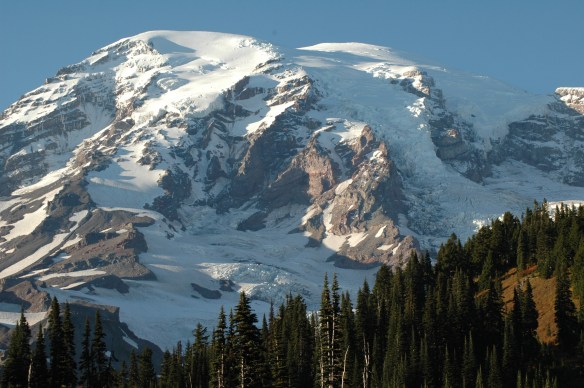
In their 1927 book entitled Mammals and Birds of Mount Rainier National Park, authors Walter Taylor and William Shaw give accounts of Washington wolverines trapped and poisoned around the turn of the Twentieth Century. They write, “The wolverine, if ever common, has undergone a marked decrease throughout the Cascade Range, probably due to the increasing price put on his pelt by the fur trade.” Even a hundred years ago these two had the foresight to observe, “Where possible, the balance of nature should be left to establish itself.”

Text and Wildlife Photography© Jim Robertson

Text and Wildlife Photography© Jim Robertson

I couldn’t agree more.

The shadowy wolverine is one savage scavenger who is very dear to my heart. Despite their scarcity, I’ve been extremely fortunate to see them on four separate occasions, each one a high point in my memory. If my life were to flash in front of me, it would appear as a wildlife slide-show set to music—a Bolero, building in intensity—featuring images of black bears and cougars; bison, bighorns and bugling elk; snowshoe hare and ermine in a frosty meadow; pine marten in the boreal forest; mink and otters in the wetlands and badgers in the sagebrush. Moose, wolves, lynx and grizzlies in the wilds of Alaska would appear as the music reaches a crescendo, followed by a wolverine effortlessly scaling an alpine slope as the grand finale.

The first timeI saw a wolverine was in 1978, on a steep, snowy mountainside in Washington’s rugged North Cascades range. I was on a solo climb, my ice ax at the ready to avoid an uncontrolled, high-speed slide to the valley bottom. Suddenly, a fast-moving, dark-colored animal raced across an even steeper pitch about 50 yards above. Judging by the size and shape, my initial impression was coyote or wolf; then as I watched it move and got a better view of its stature, I recognized it for what it was—a wolverine! After he streaked out of sight, I continued my slow ascent, kicking steps into the snow and sinking my ice ax in for safety’s sake, up to where his trail—the only remaining sign of the incredible spectacle I’d just witnessed—crossed the steepest pitch of the slope. When I reached the wolverine’s distinctive, five-toed tracks, I could see that though his rapid traverse appeared effortless, he had dug his sharp claws deep into the snow with each step—confirming that a wolverine is as well adapted to its mountain habitat as an otter is to water, or a raven to air.

Since I considered it my back yard, I was thrilled to know that the North Cascades National Park and adjoining wilderness areas comprised a habitat extensive and secluded enough for such a secretive animal—and we’re talking sasquatch secretive—to feel at home.

I knew it had probably been a once in a lifetime sighting, but when some of the snow melted, I decided to return and planned to stay a while this time. I crossed the slope where I’d last seen the wolverine and headed over a pass into a trail-less, glacier-carved valley in search of a likely den site. Thinking like a wolverine, I chose a spot that had rarely, if ever, been visited by human beings, setting up camp by a small alpine tarn. As luck would have it, I came across a set of the familiar five-toed tracks that led up toward a small cave under a rocky cliff. Not wanting to disturb the cave’s occupants, I watched the opening from a respectful distance. Within minutes, I heard the sound of falling rocks and looked up to see a wolverine, probably a mother, eying me suspiciously from the ledge above her den.

Appreciating how unwelcome I was, I quickly determined that I had accomplished all I could hope to achieve without annoying the animal to the point that she might leave the area for good. Though I was tempted to stay around in hopes of a photo op, I instead did the right thing and moved on, leaving that wild place to the wildlife who depend on it.

Not being a fan of intrusive hardware, like the ear tags or radio collars used in the study of wild animals, I never reported the sighting or the location of the den to wildlife “authorities.” I object, on behalf of animals everywhere, to the ham-fisted treatment of wildlife for “research” purposes, and I knew that rather than taking my word for it, some overeager biologists, wildlife “managers” or other self-appointed “experts” would march out there and trap, collar or otherwise traumatize the animal.

My misgivings proved justified. Years later, I learned that at least two young wolverines were trapped, jabbed with needles, immobilized and manhandled; their ears were tagged and they were fitted with awkward, bulky radio-collars. It seems the biologists at the scene badgered their captives in every way imaginable, short of sending them to Abu Ghraib or on a hunting trip with Dick Cheney.

Worse yet, by meddling with such rare and reclusive animals—keeping one of them confined for days until “game experts” from Missoula, Montana could make the trip across two states to get some hands-on of their own—they may have separated one yearling from her mother. (Judging by the tracks around the box-trap, mama wolverine must have stayed around until people roared into the area on snowmobiles, forcing her to reluctantly abandon her trapped youngster and retreat further into the wilderness.)

After an Interminable imprisonment in a claustrophobic box trap, and then awaking from an unsettling tranquilization surrounded by gawking people—now with tags in her ears and a burdensome collar around her neck—another young female wolverine trapped by biologists in Washington fled through the Pasayten Wilderness and across the border into Canada.

When a Forest Service biologist told the Seattle Times, “…the best way to ensure wolverines continue in Washington is to learn as much about this population as we can,” I had to wonder if tormenting an animal so much that she hurriedly left the relative safety of Washington State (where a voter-approved initiative has banned recreational fur trapping) was really the best way to ensure the species continues. Canada and Alaska persist in allowing that archaic tradition. Putting animals through unnecessary suffering is just part of doing business up there—not a safe place for a “fur-bearer” of any kind.

Further knowledge is always helpful, but surely new information can be acquired through the use of remote cameras and other less disruptive methods. And really, how much more do we need to know before we reach information overkill?

We already know a lot about wolverines, such as the fact that they are the largest terrestrial mustelid—the brontosaurus of the weasel family. Among their relatives, the only species any larger are the sea otter and the Amazonian of all otters, the giant otter of the Amazon River basin. A wolverine looks like an oversized, striped mink or a small, elongated, agile bear. (Sorry I don’t have a photo of one to include here; all the sightings I’ve had have been brief, and all of the wolverine moved too quickly to get a clear photograph—just a couple of the challenges of using only ethically-acquired images.)

Putting their trademark pungent anal scent glands to good use, they seem to take special pleasure in fouling trapper’s cabins (whether for recreation or revenge, only the wolverine really knows…and they’re not telling). Possibly their best known attribute is their ferocity—wolverines could easily be considered the Tasmanian devils of the Northern Hemisphere. But a real-world Bugs Bunny would no doubt meet his match with these part-time predators.

The main thing we need to know about wolverines, we already well know: as a species, their numbers are perilously low.

I had my third wolverine sighting in the mid-1980s, on the volcanic flanks of Alaska’s remote Mount Katmai. I was backpacking with a couple of friends when we surprised a wolverine who crossed barely 20 yards in front of our path. He reacted not by baring his teeth and snarling, but by getting the hell out of there to the relative safety of a rocky cliff formed by a geologically recent lava flow. The naturally acrobatic animal leapt up from ledge to ledge with the fluid grace of a furry brown waterfall flowing in reverse. Within a few seconds the wolverine scaled a pitch that would have taken an hour and a half of effort for a skilled rock climber.

The encounter made me realize that, contrary to their notorious reputation for fierceness, wolverines will go to great lengths to avoid people. Clearly, in order to thrive, sensitive species like wolverine require vast expanses of wild land—and a minimum of human activity.

The most recent sighting I had was just a few years back, during one of my many trips into Yellowstone while living near the park in southwest Montana. That sighting was bittersweet as the wolverine was barely within the park boundary, and I knew all too well that trapping was legal at the time anywhere outside the protection of Yellowstone National Park. I couldn’t help but think just how easy it would be for a trapper to snag this far-ranging park animal in one of their horrible torture devices. All they’d need is a state permit, a few steel-jawed leg-hold traps, a snowmobile and a complete and utter lack of conscience, remorse or compassion.

There are only around 250 to 300 wolverines in the continental United States, but for reasons that have nothing to do with science and everything to do with “higher priorities” and political pressure from trappers, they are still currently considered only a “candidate” for federal Endangered Species Act protection.

Even the Montana state game department must understand that a population as pitifully low as the wolverine’s suffers immensely when a trapper kills even one individual. Prior to the TRO, “game managers” were set to allow five wolverines to be sacrificed to the gluttonous trappers. What’s the point of having a season on five wolverines? Clearly it’s symbolic—just a matter of principle for them. But a principle is supposed to be a moral or ethical standard based on something upright and upstanding, not an immoral standard based on something lowly and loathsome like trapping.

It’s high time to ban wolverine trapping entirely—as a matter of principle!
Text and Photography© Jim Robertson

Text and Photography© Jim Robertson

Montana Wolverine hearing set for January 10th

In the middle of writing a post on wolverines celebrating the end of trapping in Montana, I was informed that trappers and the Montana Fish Wildlife Parks Department are frantically trying to reverse the Temporary Restraining Order (TRO) and commence with the wolverine trapping season.  The agency is even getting other states wildlife agencies involved to act as witnesses. Stay tuned for my lengthy, updated wolverine post; in the meantime, Here’s the latest article on the situation–note that the follow up hearing is set for January 10th…….

A Helena judge issued a temporary restraining order that will delay Montana’s wolverine trapping season.

Written by Tribune staff
A Helena judge issued a temporary restraining order that will delay Montana's wolverine trapping season. The season was set to begin Saturday.
AP File Photo/Glacier National Park, Jeff Copeland

A district court judge in Helena granted a temporary restraining order against the state’s wildlife agency that blocks the opening of Montana’s wolverine trapping season until at least early next year.

The season was set to open Saturday.

The restraining order was sought by a coalition of groups trying to halt wolverine trapping in Montana. Helena District Judge Jeffery Sherlock granted the order. A follow-up hearing is set for Jan. 10.

The eight-group coalition, led by the Western Environmental Law Center, wants to ban wolverine trapping until the U.S. Fish and Wildlife Service determines if the wolverine will be placed on the federal list of threatened and endangered species.

Ken McDonald, wildlife bureau chief for Montana Fish, Wildlife & Parks in Helena, said Montana’s quota of five wolverines is based on sound wildlife management science that doesn’t put the state’s wolverine population at risk.

In 2010, USFWS determined that threats to the wolverine included climate change but declined to list it as an endangered or threatened species due to higher priorities. At the time, USFWS suggested that the wolverine population is stable or expanding and that between 250 and 300 wolverines inhabit the northern Rocky Mountains.

McDonald said FWP will immediately begin to examine the restraining order and consider legal options but for now trappers are prohibited from pursuing wolverines in Montana.

Be of Good Cheer

I get the feeling some people won’t be satisfied until I’ve plumbed the deepest, darkest depths of hunter/trapper depravity. I’ve had people ask me to write blog posts on issues as nauseating to cover as Wyoming’s new bounty on coyotes, and the glib manner in which some Wyomingites brag about cutting off coyotes ears in the parking lot of the “Sportsmen’s” Warehouse to claim their $20.00 bounty (following the same ugly tradition of  their forbearers who claimed cash at the fort for Indian scalps); incidents as horrible as the black bear (pictured here) who got caught in a 217855_388677001217027_1495584697_ntrap that some sick, twisted asshole set for pine marten; or report on how poachers are killing off the last of the world’s big cats; or go into how vacuous bowhunters sound when they praise one another for impaling animals for sport, or the malevolent tone used by wolf hunters or trappers when they get away with murdering beings far superior to them in every way.

The problem is, whenever I go there I get so irate I could end up saying something like, “They should all be lined up and shot, their bodies stacked like cordwood and set ablaze to rid the world of every last speck of their psychopathic evil once and for all.”

Well I’m not going to do that…at least not during the holiday season…

December should be a time for being of good cheer and spreading hopeful news, such as the pleasantly surprising announcement that, thanks to a lawsuit filed by Footloose Montana, along with several other litigants, the state of Montana put on hold its annual trapping season on wolverine this year, just 24 hours before that particular brand of butchery was set to begin! Of course, nearly every other “fur-bearing” animal in the state—from beavers and muskrats, to marten, fisher and mink; from otters and bobcat, to wolves, foxes and coyotes—is fair game for any sick fuck who feels the sadistic urge to set out a trapline in the wilderness…or just out of town.

But at least the wolverines—critically endangered from years of falling prey to a “celebrated” historic tradition, now down to only 35 successfully breeding individuals in the western United States—are illegal to trap right now.

Hallelujah! Thank goodness there’s some happy news to share with you this time of year!

Text and Wildlife Photography© Jim Robertson

Text and Wildlife Photography© Jim Robertson

Trapping: the Indiscriminate Evil

Text and Wildlife Photography ©Jim Robertson, 2012. All Rights Reserved

Footloose Montana reports that the 2012/13 Trapping season has begun, and with it, the first incident of someone’s beloved dog being caught in a trap: “Monte,” a yellow lab cross was injured today in a leg-hold trap set submerged at the Bitterroot River Florence Fishing Access in Florence, Montana.  She survived his ordeal, but suffered an injury on her leg and a broken tooth.  This is sure to be the first of many pet incidents this trapping season.  Particularly with many new trappers pursuing wolves on our public lands this year, please be cognizant of the danger…

I have had more than my share of heart-wrenching experiences with the gruesome evils of trapping. On a walk near our cabin, my dog stepped into a trap that clamped down onto his front paw, prying his middle toes apart. He yelped in horror and frantically tried to shake it off, biting at the trap, at his paw and at me as I fought to open the mindless metal jaws that continued to cut deeper into his tender flesh.

My efforts to release him only caused more excruciating pain. After battling with the unrelenting spring for many interminable minutes, I was finally able to loosen the degenerate device enough to pull his foot free.

Another dog I rescued was caught in two steel-jawed leg-hold traps. One was latched onto her front leg while the second gripped a hind leg, forcing her to remain standing for untold, agonizing hours. Judging by how fatigued and dehydrated she was, she’d been held immobile for several days. The sinister traps caused so much damage that a vet had to amputate one of her injured legs.

Traps are an indiscriminate evil. No animal, wild or domestic, should suffer such torture for the sake of sport, recreation or the mindless pursuit of pelts.

Folks in Montana can Call Footloose at (406) 274-7878 if…

1.      You need advice on releasing your pets from traps

2.      You would like us to do a pet release workshop in your community

3.      You have an incident to report

4.      You have information about trap sightings or locations

______________________________________________________

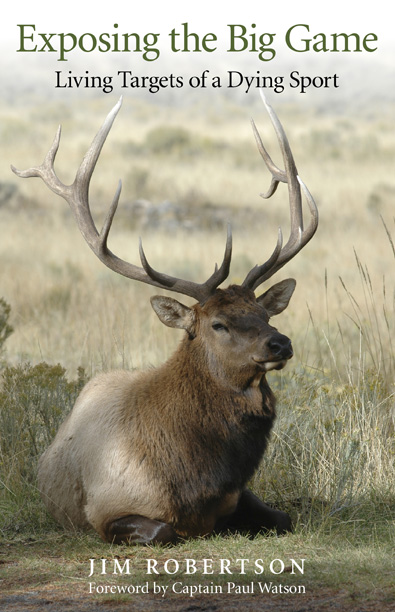
Portions of this post were excerpted from the book, Exposing the Big Game: Living Targets of a Dying Sport    

Text and Wildlife Photography ©Jim Robertson, 2012. All Rights Reserved

Chapter Titles

Here’s the Table of Contents for Exposing the Big Game?
Foreword by Captain Paul Watson

Introduction

Chapter 1) Hide-hunting Holocaust Survivors Still under Fire

Chapter 2) An Act of Bison Altruism

Chapter 3) War on Coyotes an Exercise in Futility and Cruelty

Chapter 4) Time to End a Twisted Tradition

Chapter 5) Avian Superstar Both Athlete and Egghead

Chapter 6) From the Brink of Oblivion and Back Again?

Chapter 7) A Day in the Sun for the Hayden Wolves

Chapter 8) Critical Cornerstone of a Crumbling Castle

Chapter 9) Bears Show More Restraint than Ursiphobic Elmers

Chapter 10) The Fall of Autumn’s Envoy

Chapter 11) Inside the Hunter’s Mind

Chapter 12) A Magical World of Oneness

Chapter 13) Living Targets of a Dying Sport

Chapter 14) A Few Words on Ethical Wildlife Photography

In Closing

Acknowledgements:

Looking back, this was not, at the outset, planned as a podium from which to lambaste anyone’s hobby or heritage, but was originally intended as a venue for relating some of the behaviors and capabilities I’d observed among animals living in the wild, and as a celebration of life along the compassion continuum. However, after delving deeper into the histories of the species covered here—thanks in part to the invaluable references listed below—I found it impossible to simply depict their natural activities without also chronicling the shocking stories of abuse they have suffered at the hands of man. It would have been doing the animals a disservice to merely record how they naturally lived without at least alluding to the far-reaching and pervasive ways that human actions have altered their lives and sometimes their very natures. And the facts are clear: there has been no greater direct human impact on wildlife than the ongoing threat of hunting. As with the other pertinent and profound quotes from a variety of enlightened sources, this one from Edward Abbey proficiently puts it in a nutshell, “It is not enough to understand the natural world. The point is to defend and preserve it.”