The “Conservationists” are about to go hunting – again

The following blog post is from the Friends of Edie Road (a group of  bird watchers and wildlife watchers who are proposing repurposing the Edie Road area to non-hunting for three primary reasons:

1. Having hunters and other visitors present in quantity at the same time, in the same area, is an accident waiting to happen.

2. The growing base of non-hunting visitors is seriously under-represented in the WDFW land use decision making process. There are many more birders and photographers visiting the site than hunters.

3. This site is unique for birding because it is flat, easily accessible, and most important: a large variety of bird species love it.

http://friendsofeideroad.org/blog/blog_index.php?pid=10&p=&search=#blt

August 21st, 2013

I never meant this website to become a sounding board for a debate on the appropriateness of hunting as exemplary human behavior. However, I have received so many emails alleging that hunters are conservationists, I feel compelled to offer a few comments that hopefully some of the email writers may consider.
Conservation, according to my dictionary, is the act of conserving; prevention of injury, decay, waste, or loss; preservation, as conservation of wildlife.
The word conservation has been hijacked by people who take pleasure in doing the exact opposite of the definition. They inflict injury, kill and maim without any emotional regret of compassion, and lay waste to entire flocks of wild creatures every season. Hunting is bloody, emotionless killing for pleasure, and changing the description to “recreational opportunity” does not change the act. Nor does the use of “harvesting” make migrating waterfowl into a crop. Nor does describing a hunter as conservationist make that true. The pheasant season is once again upon us. The state sponsored killing of tame, farm-raised pheasant will frighten most of the shorebirds away from Eide Road until the end of November. This is not the way to demonstrate conservation.
But if you hunters look out along the paved road and parking area, you will see that there is an new and growing group of real conservationists emerging. They have invaded your hunt club by posting their yellow Discover Pass inside their windshield. They don’t carry guns but field guides, spotting scopes, and cameras. They exhibit a combination of awe and respect for the wild creatures they encounter, and shock and dismay at seeing them needlessly killed.
Your email comments talked about hunting’s wonderful heritage, all the land hunters paid for with “duck stamps” and how no species can thrive without scientific management. You have bought into the justification propaganda the NRA fashions to sell more guns and ammo. All the land hunters may have helped set aside does not justify killing the animals that occupy that land — for their own good.
Cruelty by any other name is still cruelty.

Some hunter apparently couldn’t wait for a pheasant so he unloaded his 12 gauge on the Discover Pass sign at Eide Road – mid-August 2013.

Letting Wildlife Live Makes Good Economic Sense

Hunting vs Birding and Wildlife Watching

June 2012
Peter M. W. Murray

•Birding and Wildlife watching contributed $38.4 billion dollars to the nation’s economy in 2001. This resulted in $95.8 billion added to the economy, accounted for over 1 million jobs and 13 billion in tax revenue.
•Birdwatching is the fastest growing form of outdoor recreation….up 236 % from 1982- 2001. Birders spent $32 billion, generating $85 billion of economic benefits to the country, produced $13 billion of tax revenue and accounted for 863,406 jobs.
•Hunting and Fishing contributed $24.8 billion to the nation’s economy in 2001. This added $67 billion to the economy and accounted for over 575,000 jobs. $2.3 billion in taxes were generated by this sector of the economy.(Int Ass of Fish and Wildlife Agencies)
•2010 Yellowstone had 3,640,205 visitors.
•$2.5 billion was spent by tourists in Montana in 2010.

Photo copyright Jim Robertson

Photo copyright Jim Robertson

Beware the Beaver

Apparently some folks need to be reminded: don’t try to manhandle a beaver that doesn’t want to be touched.

A fisherman in Belarus learned that the hard way; when he reached down to pick it up, the beaver—no doubt feeling cornered—bit him in what was unfortunately a major artery. The 60 year old angler died of his wounds, but he was probably too old to learn from the experience anyway. Perhaps others can learn from it instead.

Again, in case you missed it above, DON’T TRY TO PICK UP WILD ANIMALS! Humans aren’t known for being the most benign of creatures, especially to a beaver, whose species we once hunted and trapped practically to extinction. It’s perfectly understandable that they would distrust an approaching two-legger, especially one who is intent on hooking fish. Any animal will do what it can to defend itself against the threat of being killed and/or eaten. Beavers have a couple of very sharp, tree-lopping teeth to resort to when push comes to shove.

Some papers reported that the human victim was trying to pick the animal up to pose with it for a photo. If so, it was another case of stupidity for the sake of vanity. Still, it won’t necessarily earn him a coveted Darwin Award; others have him beat. I knew a photographer that used to frequent Yellowstone (past tense, since he’s no longer with us) who would creep up to within a few yards of a grizzly bear’s fresh kill, hoping for a close-up shot.

Although the aim of wildlife photography is non-lethal, photographers shouldn’t take it as a free pass to disturb animals at will. Unfortunately, some who “shoot” with a camera have a mind-set similar to that of a typical trophy hunter. Wearing face paint and cammo from head to toe (some are in fact off-season hunters, while others just enjoy dressing up like one), these self-serving photographers are often seen standing along the roadway photographing animals who are quite obviously aware of their presence. Believing themselves invisible (cleverly disguised as a tree or a bush), they crowd in and get as chummy as they want to their quarry, no matter that their urge for closeness isn’t mutual.

I couldn’t count how many times I’ve seen people, both professionals and point-and-shooters, run right up to a bison, elk, moose or bear hoping for a trophy shot or souvenir. Every year, irresponsible photo-getters are gored, trampled or charged by animals annoyed enough to feel they must defend themselves. But untouchably elite Homo sapiens don’t like being put in their place, and over-protective parks’ departments routinely execute a one-strike-you’re-out policy in response to any defensive actions taken by ordinary nonhumans.

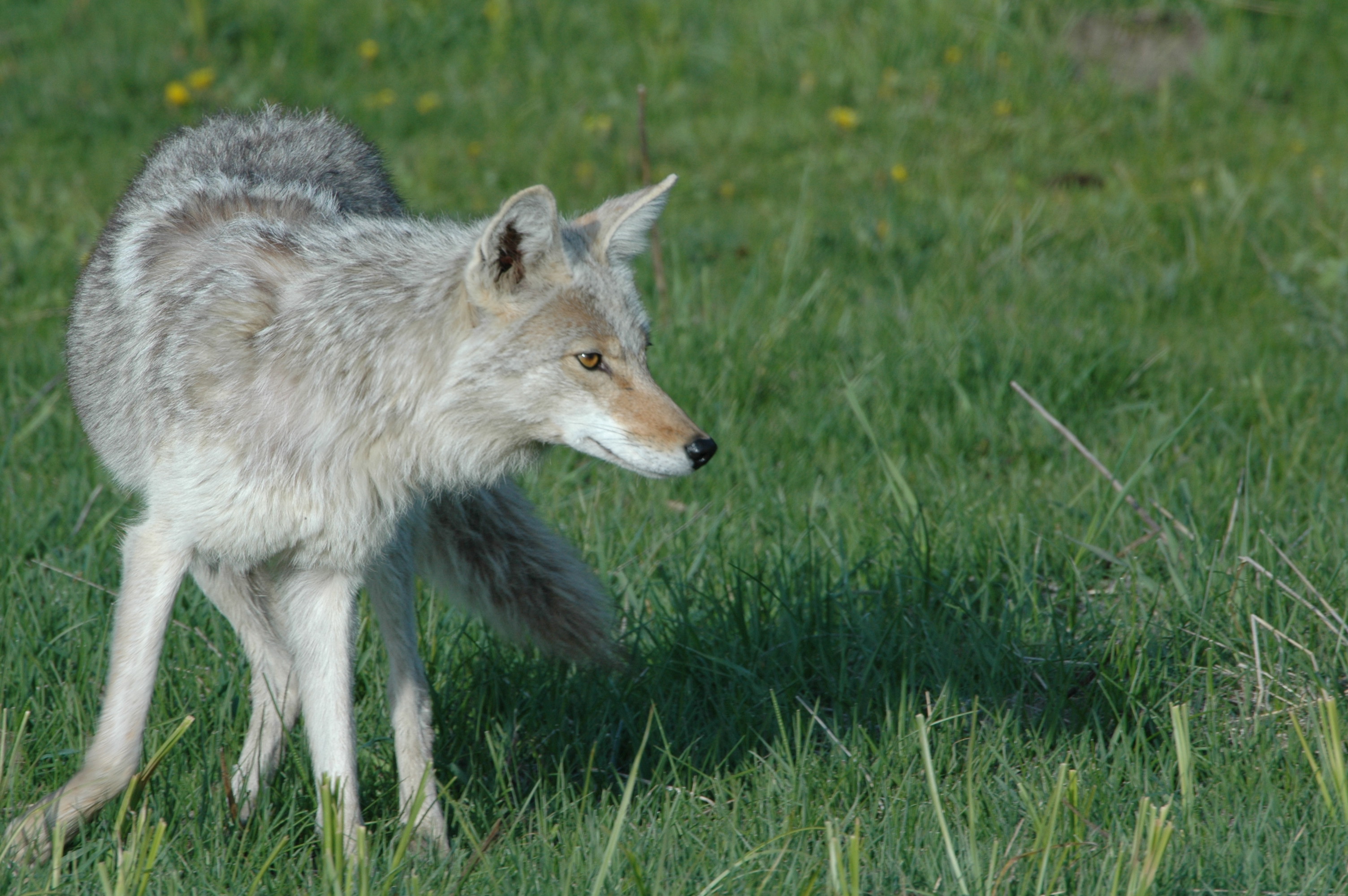
Careless behavior by photographers can force animals to leave their familiar surroundings, separate mothers from their young or interrupt natural activities necessary for survival. Hardly a day goes by without the inevitable park visitor committing the amateurish, impatient act of yelling or honking at a peaceful herbivore so he or she will quit grazing and look up towards the camera. And there’s always some joker who throws part of his sandwich out the window to draw in a bear or coyote.

Once in Yellowstone I reported such an incident to a ranger who pointed at the coyote and asked, “Is that the culprit?” “No,” was my exasperated reply, “The culprit is the guy who threw out his sandwich!”

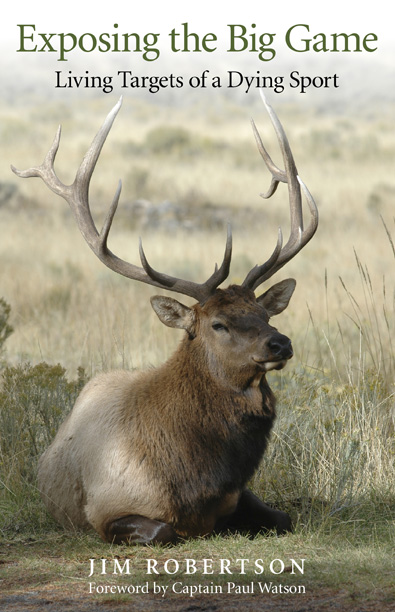
Portions of this post were excerpted from the book, Exposing the Big Game: Living Targets of a Dying Sport

Text and Wildlife Photography ©Jim Robertson, 2013. All Rights Reserved

Text and Wildlife Photography ©Jim Robertson, 2013. All Rights Reserved

Chapter Titles

Here’s the Table of Contents for Exposing the Big Game?
Foreword by Captain Paul Watson

Introduction

Chapter 1) Hide-hunting Holocaust Survivors Still under Fire

Chapter 2) An Act of Bison Altruism

Chapter 3) War on Coyotes an Exercise in Futility and Cruelty

Chapter 4) Time to End a Twisted Tradition

Chapter 5) Avian Superstar Both Athlete and Egghead

Chapter 6) From the Brink of Oblivion and Back Again?

Chapter 7) A Day in the Sun for the Hayden Wolves

Chapter 8) Critical Cornerstone of a Crumbling Castle

Chapter 9) Bears Show More Restraint than Ursiphobic Elmers

Chapter 10) The Fall of Autumn’s Envoy

Chapter 11) Inside the Hunter’s Mind

Chapter 12) A Magical World of Oneness

Chapter 13) Living Targets of a Dying Sport

Chapter 14) A Few Words on Ethical Wildlife Photography

In Closing

Acknowledgements:

Looking back, this was not, at the outset, planned as a podium from which to lambaste anyone’s hobby or heritage, but was originally intended as a venue for relating some of the behaviors and capabilities I’d observed among animals living in the wild, and as a celebration of life along the compassion continuum. However, after delving deeper into the histories of the species covered here—thanks in part to the invaluable references listed below—I found it impossible to simply depict their natural activities without also chronicling the shocking stories of abuse they have suffered at the hands of man. It would have been doing the animals a disservice to merely record how they naturally lived without at least alluding to the far-reaching and pervasive ways that human actions have altered their lives and sometimes their very natures. And the facts are clear: there has been no greater direct human impact on wildlife than the ongoing threat of hunting. As with the other pertinent and profound quotes from a variety of enlightened sources, this one from Edward Abbey proficiently puts it in a nutshell, “It is not enough to understand the natural world. The point is to defend and preserve it.”

Like the KKK, the NRA will eventually Fade Away

Comparatively speaking, the body of hunters in America is withered and shrunken, only a wee fraction of its former self. Today there are six times as many photographers, bird watchers and others who enjoy seeing animals alive as those compelled to make them lie down and die. Like the KKK and the SLA, the NRA has seen its day and will rightfully fade away. Literally, figuratively and statistically, hunting is a dying sport.

But non-hunters should not be lulled into a false sense of security for wildlife. Sportsmen, though a skeletal minority, are a shrill and voluble 5 (or 6) percent when it comes to forcibly interjecting themselves into animal issues; they‘re reluctant, to say the least, to kiss their blood-sport goodbye and join the civilized world.

The NRA and other heavily-funded hunting groups are pushing to pass laws such as the odious “Hunting Heritage Protection“ acts (already shoved on several states), aiming to enshrine their perceived “birthright“ to shoot and kill nonhumans recreationally.

Worse yet are the unconstitutional Hunter Harassment laws, which essentially punish residents and land-owners for trying to protect animals and keep hunters off their properties. In direct answer to the drop in sportsmen’s numbers, meddlesome state game departments are encouraging young kids to get a taste for killing (perverting their natural affinity for animals).

Alabama opens deer season two days early for children under the age of 16 (so they’ll have a better crack at “bagging“ one), and Maine holds a “Youth Deer Day,” allowing pre-season bow hunting for children ages 10 to 16. States like Illinois and Colorado are preying on women by offering hunting lessons for single mothers, while the private pro-hunting programs “Becoming an Outdoors-woman“ and the NRA’s “Women on Target” are seeking to enlist the future Sarah Palins of America.

Fouler still are the ongoing schemes to open more and more public lands to hunting…

_______________________________________________

The preceding was excerpted from the book, Exposing the Big Game: Living Targets of a Dying Sport