Misery-Makers Love Company

The old saying, “misery loves company” has gotten so shopworn it’s become a cliché. But there’s a new saying (I know it’s new because just I thought it up today), a variation on that old one, which goes: “Misery-makers love company.” The point being, those who cause suffering don’t like to think they’re the only ones doing it.

Hunters, for example, are emboldened and find affirmation by recruiting others to take up their “sport.” It’s the same thing motivating trappers to form associations or duck hunters to form clubs. It’s why bowhunters spend so much time in chat rooms, and it’s part of the reason coyote and/or wolf haters hold social events called “contest hunts.”

Meanwhile, meat eaters feel a stronger sense of entitlement when they see so many others blindly munching on corpses. The same holds true for rodeo fans who get confirmation every time ESPN airs yet another calf-tormenting event.

The list could go on and on. As good people everywhere start citing their own examples, the saying, “Misery-makers love company,” is destined to become an overused cliché itself.

Text and Wildlife Photography ©Jim Robertson

Text and Wildlife Photography ©Jim Robertson

Just Out for a Bit of Fun

“I think it’s cruel that they would take sport in stuff like that. Very cruel. It’s just sophomoric, juvenile.”

That quote could just as easily have been a humane person’s reaction to witnessing any legal goose, pheasant, elk or wolf hunt, but in this case it was in reference to a speeding driver running over 92 protected shorebirds on the Washington coast (on the same stretch of beach mentioned in this earlier post, Compassion for All, Not Just the Endangered).

Shorebirds, like the dunlins who were senselessly killed, huddle close together on the beaches this time of year, which makes the act of running over nearly eight dozen of them at one time no great challenge for anyone willing to stoop to such an act.

The driver was most likely just out for a bit of fun when they spotted the flock of migratory birds dead ahead. After plowing through the birds—who have an uncanny knack of flying off at the last minute to avoid any vehicle following the posted speed limit of 25mph, but who must not have been ready for someone going twice that speed—chances are the driver said to his passengers something like, “that was pretty neat.”

That same line was uttered by a Dubois taxidermist and outfitter, Joe Hargrave, who, on Oct. 5, just four days after their season opened, became one of Wyoming’s first hunters to legally kill a wolf since 1974.

“It was pretty neat to be able to hunt them because they’re a magnificent animal,” Hargrave said. “I like to see them in the wild just like elk, moose and everything else. It is nice to be able to have the opportunity to hunt them.” (The U.S. Fish and Wildlife Service removed wolves from the endangered species list in Wyoming on Sept. 30, kicking off the first hunting season since wolves were placed on the list in 1974. Conservation groups have filed three lawsuits seeking to re-list the wolves; they are expected to be decided sometime in 2013.)

People for the Ethical Treatment of Animals and the Wildlife Rehab Center of North Coast are offering a reward for information leading to the arrest of the person responsible for the illegal killing of the protected shorebirds. Meanwhile, thousands of unprotected migratory geese, deer, elk, cougars, coyotes and wolves are shot each year by people with the same motive as those thrill seeking, sophomoric, sociopathic beach drivers—they’re just out for a bit of fun.

Text and Wildlife Photography© Jim Robertson

Text and Wildlife Photography© Jim Robertson

Situation Update: Judge lets wolf season resume near Yellowstone

Judge lets wolf season resume near Yellowstone

By MATTHEW BROWN, Associated Press
Updated 7:42 pm, Wednesday, January 2, 2013
BILLINGS, Mont. (AP) — Wolf hunting and trapping can resume near Yellowstone National Park after a Montana judge on Wednesday blocked the state from shutting down the practice over concerns that too many animals used in research were being killed.

The restraining order from Judge Nels Swandal allows hunting and trapping to resume in areas east and west of the town of Gardiner in Park County.

State officials closed the gray wolf season in those areas on Dec. 10. That came after several wolves collared for scientific research were killed, drawing complaints from wildlife advocates.

The move prompted a lawsuit from sporting groups and a state lawmaker from Park County, Rep. Alan Redfield, who said the public was not given enough chance to weigh in on the closures.

In his order, Swandal sided with the plaintiffs. He said the lack of public notice appeared to violate the Montana Constitution and threatened to deprive the public of the legal right to harvest wolves.

He ordered the state “to immediately reinstitute and allow hunting and trapping of wolves in all areas of Park County.”

A Jan. 14 hearing was scheduled in the case. The other plaintiffs are Citizens for Balanced Use, Big Game Forever, Montana Outfitters and Guides Association and Montana Sportsman for Fish and Wildlife.

A spokesman for the state, Ron Aasheim, said Montana wildlife commissioners followed proper public notice requirements before issuing the closures.

Wildlife advocate Marc Cooke said the lawsuit over the 60-square-mile closure area revealed the “irrational hatred” of some hunting and trapping supporters.

“You have 145,000 square miles in Montana, and they’re fighting over a measly 60 square miles of land that is critical habitat for these animals. To me, it’s very vindictive,” he said.

Montana had an estimated 650 wolves at the end of 2011. Through Wednesday hunters reported killing 103 of the animals and trappers had killed at least 30 more.

State officials lifted quotas on wolves across most of Montana this spring in hopes of decreasing a predator population blamed for livestock attacks and driving down elk numbers in some areas.

But park officials said at least seven Yellowstone wolves — including five wearing tracking collars — were shot by hunters in Montana, Idaho and Wyoming. Also shot were four collared wolves originally from the park but now living outside it. Three more shot in the vicinity of the park had unknown origins and were not wearing collars, park officials said.

The current season marks Montana’s first experience with wolf trapping since the animals lost their endangered species protections last year under an order from Congress.

Wolf hunting has also been contentious in Wyoming this season. The state took over wolf management from the U.S. Fish and Wildlife Service on Oct. 1, and hunters killed 43 wolves out of a 52-animal quota before Wyoming’s hunt ended Dec. 31.

Coalitions of environmental groups have filed federal lawsuits, now pending in Washington, D.C., and Denver, seeking to force the U.S. Fish and Wildlife Service to reclaim wolf management from Wyoming.

The groups say they’re concerned that Wyoming’s wolf management plan won’t ensure long term survival of the species, which the federal government reintroduced into Yellowstone in the mid-1990s.

Wolves in Wyoming are classified as unprotected predators that may be shot on sight in most of the state. They’re managed as trophy game animals in a flexible trophy hunting zone on the outskirts of Yellowstone.

Idaho also allows hunting and trapping of wolves, although it allows a maximum of 30 animals a year to be taken in a zone just outside Yellowstone. Through Wednesday, hunters and trappers in Idaho reported killing 154 wolves statewide, including 11 near Yellowstone.

_________________________________________

Well, there’s the facts and figures according to the Associated Press. I don’t know what to say. This time I’m in agreement with Marc Cooke; these hunting groups and some Montana state reps have an “irrational hatered” of wolves. As I said in an earlier post, wolf hunting should be considered a hate crime.

Time to put our full support behind the coalitions of environmental groups who’ve filed federal lawsuits seeking to force the U.S. Fish and Wildlife Service to take back wolf management from Wyoming. Come to think of it, Montana and Idaho need to be included in that lawsuit…

Text and Wildlife Photography ©Jim Robertson

Text and Wildlife Photography ©Jim Robertson

The Infertile Union

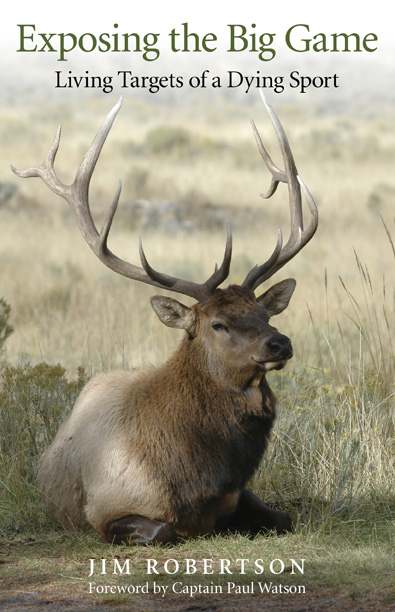
So you don’t get the idea I go around unfairly picking on small grassroots groups, here’s an excerpt from my book, Exposing the Big Game: Living Targets of a Dying Sport, wherein I take on the Goliath of all national green groups for siding with hunting…

Sport hunters have enjoyed so much laudation of late they’re beginning to cast themselves as conservation heroes. What’s worse is that many modern, influential green groups are swallowing that blather, hook, line and sinker. Maybe they ought to reread the words of Sierra Club founder, John Muir:

“Surely a better time must be drawing nigh when godlike human beings will become truly humane, and learn to put their animal fellow mortals in their hearts instead of on their backs or in their dinners. In the meantime we may just as well as not learn to live clean, innocent lives instead of slimy, bloody ones. All hale, red-blooded boys are savage, fond of hunting and fishing. But when thoughtless childhood is past, the best rise the highest above all the bloody flesh and sport business…”

Henry David Thoreau, another nineteenth-century nature-lover whose forward-thinking writings were an inspiration to Muir, cautions, “No humane being, past the thoughtless age of boyhood, will wantonly murder any creature which holds its life by the same tenure he does. The hare in its extremity cries like a child. I warn you, mothers, that my sympathies do not make the usual philanthropic distinctions.”

If those dated messages and mockery are lost on twenty-first-century Sierra-clubbers, Edward Abbey’s sentiment should be obvious enough for anyone, “To speak of harvesting other living creatures, whether deer or elk or birds or cottontail rabbits, as if they were no more than a crop, exposes the meanest, cruelest, most narrow and homocentric of possible human attitudes towards the life that surrounds us.”

Early vanguards of ecological ideology recognized Homo sapiens as just one among thousands of animal species on the planet, no more important than any other in the intricate web of life. They also abhorred sport hunting.

But a shocking turn-around is taking place in the current bastardization of the environmental movement. The Sierra Club and other large, corporate green groups are embracing (read: sleeping with) powerful hunting groups like the Safari Club International and the National Rifle Association (NRA). In a transparent effort to appear down-home and therefore more in touch with nature, they’re making the fatal mistake of joining frces with sportsmen whose conservation “ethic” exists only so their preferred prey species can be slain again and again.

The infertile union between super-sized modern green groups and mega-bucks hunting clubs must have been sired by their shared conviction that humans are the most crucial cogs in the wheel of life (or at least the squeakiest wheels in the dough machine). As the only animal capable of coughing up cash when the collection plate comes around, human beings (every last gourmandizing, carnivorous one of them) are the primary concern; their wants must be given priority over those of all other species. Contemporary environmental organizations, seduced by a desire to engage as many paying members as they can get their hands on (regardless of their attitudes towards animal life), must believe blood-soaked money is as green underneath as any.

Forever stagnating in “thoughtless childhood,” members of hunting groups like the NRA live for the day they can register a record-breaking trophy with the Boone and Crocket Club—formed by Roosevelt “to promote manly sport with rifles.” Fund for Animals creator, Cleveland Amory, took issue with the sporty statesman in his anti-hunting epic, Man Kind? Our Incredible War on Wildlife. A benevolent humanitarian for humans and nonhumans alike, Mr Amory wrote, “Theodore Roosevelt…cannot be faulted for at least some efforts in the field of conservation. But here the praise must end. When it came to killing animals, he was close to psychopathic. Dangerously close indeed (think: Ted Bundy). In his two-volume African Game Trails, Roosevelt lovingly muses over shooting elephants, hippos, buffaloes, lions, cheetahs, leopards, giraffes, zebras, hartebeest, impalas, pigs, the not-so-formidable 30-pound steenbok and even (in what must have seemed the pinnacle of manly sport with rifles) a mother ostrich on her nest.

But don’t let on to a hunter your informed opinion of their esteemed idol, because, as Mr Amory points out, “…the least implication anywhere that hunters are not the worthiest souls since the apostles drives them into virtual paroxysms of self-pity.” Amory goes on to say:

The hunter, seeing there would soon be nothing left to kill, seized upon the new-fangled idea of “conservation” with a vengeance. Soon they had such a stranglehold [think: Ted Nugent] on so much of the movement that the word itself was turned from the idea of protecting and saving the animals to the idea of raising and using them—for killing. The idea of wildlife “management”—for man, of course—was born. Animals were to be “harvested.” They were to be a “crop”—like corn.

Fortunately, a faithful few are seeing through the murky sludge spread where green fields once thrived. Sea Shepherd Conservation Society’s Captain Paul Watson (founder and president of about the only group still using the word conservation to mean protecting and saving animals) recently took another in a lifetime of steadfast stands by resigning from his position on the Board of Directors of the Sierra Club. He refused to be a part of their whorish sleeping with the enemy—their pandering to sportsmen by holding a “Why I Hunt” essay contest, complete with a grand prize trophy hunt to Alaska. To think of how many trees were needlessly reduced to pulp for this profane effort when the answer to why hunters hunt was so succinctly summed up in just one sentence by Paul Watson, “Behind all the chit-chat of conservation and tradition is the plain simple fact that trophy hunters like to kill living things.”

Just as the naïve young girl who falls for the charms and promises of a sunny sociopath learns, the hard way, about his hidden penchant for abuse and violence, the Sierra Club and other middle-ground eco-friendly groups may soon learn the dangers of looking for Mr. Goodbar in all the wrong places. How will they divorce themselves from this unholy alliance when the affair goes sour and sportsmen reveal their malicious, hidden agenda by calling for another contest hunt on coyotes or cull on cougars, wolves or grizzly bears to do away with the competition for “their” deer, elk, moose or caribou?
front-cover-low-res6

Wolves Are the Only Management “Tool” Necessary

I didn’t mean to set off a pissing match in my last blog post by quoting a group’s recent statement to the Missoulian, “We at Wolves of the Rockies understand and acknowledge the importance of hunting as a tool for managing wolves, and we stand beside the ethical hunter in doing so.” I’m sorry if I misinterpreted that statement, but I thought it made their position on wolf hunting pretty clear: they support it.

And I think it’s obvious what they’re saying with the lines, “We are not advocating the end of wolf hunting. We have only asked for a slight modification to the state wolf management plan to accommodate other legitimate values in this specific locale. Remember, Montana’s wildlife is owned by ALL the people, not just hunters.”

It sounds to me like they feel that wolf “management” through hunting and trapping is acceptable, as long as it doesn’t conflict with another “legitimate value” some other human being has placed on the canines. I would argue that wolves themselves have intrinsic value, as individuals and as a species.

While I whole-heartedly applaud this group’s part in getting a buffer zone closed to hunting and trapping implemented around Yellowstone National Park in Montana (“only for this year,” according to the Montana Wildlife Commission chair Bob Ream), I have to question whether anything is worth legitimizing wolf hunting and trapping as “management tools” like they did in their articles to the press. When the back-patting and back-pedaling are over, it’s time to bring the focus back on the real problem—the fact that wildlife are considered “property” of the states, to be “managed” as they see fit.

Commissioner Ream said they made the closure because of the “particular and unique situation” of collared Yellowstone wolves being shot. He assured hunters and ranchers that the closure will not affect the goals of the commission for the overall Montana wolf hunt and trapping season in any significant way because this is such a small area, and one with almost no winter livestock.

Still, it could have a big effect conserving Yellowstone’s small and shrinking wolf population, now down to only about 80 wolves. The park’s wolf population of 170 wolves three or four years ago began to drop when inter-pack rivalry and low surviving pup numbers took their toll. Clearly, wolves have self-regulating population control systems which kick into play before their numbers get too far out of hand (which is more than can be said for hunters and trappers).

Wolves play an important part in nature’s narrative, a role that has served both predator and prey for eons. Rightful kings returning from exile, wolves are far from new to the Yellowstone ecosystem. Their 71-year absence was the result of a heartless bounty set by the real newcomers to the fine-tuned system of checks and balances that has regulated itself since life began.

New to the scene are cowboys on four-wheelers with their monoculture crop of cows and ubiquitous barbed-wire fences. New are pack trains of hunters resentful of any competition from lowly canines, yet eager to take trophies of wolf pelts, leaving the unpalatable meat to rot. And new is the notion that humankind can replace nature’s time-tested order with so-called wildlife “management,” a regime that has never managed to prove itself worthy.

Unmatched manipulators, modern humans with their pharmacies, hospitals, churches, strip malls, sporting goods stores, burger joints and fried chicken franchises have moved so far beyond the natural order that population constraints, such as disease or starvation, are no longer a threat to the species’ survival (as long as society continues to function). Hunting is no longer motivated by hunger. Twenty-first century sport hunters are never without a full belly, even after investing tens of thousands of dollars on brand-new 4X4 pickups, motorboats, RVs and of course the latest high-tech weaponry.

But wolves can’t afford to be acquisitive; if they run low on resources, they must move on or perish. Theirs is a precarious struggle, without creature comforts or false hopes of life everlasting.

~ From the book, Exposing the Big Game: Living Targets of a Dying Sport

Text and Wildlife Photography ©Jim Robertson, 2012. All Rights Reserved

Text and Wildlife Photography ©Jim Robertson, 2012. All Rights Reserved

Sleeping With the Enemy

Q. When are wolf advocates not really wolf advocates?

A. When they advocate for wolf hunting.

While other wildlife groups have worked to get this long-suffering species back under ESA protection, the Montana-based, Wolves of the Rockies not only told the Missoulian, “We are not advocating the end of wolf hunting,” but followed up that howler with an article in the Great Falls Tribune, in which they stated: “We at Wolves of the Rockies understand and acknowledge the importance of hunting as a tool for managing wolves, and we stand beside the ethical* hunter in doing so.”

This group asked permission to use some of my wolf photos on their Facebook page. Assuming they were on the side of the wolves, I allowed it. Given their recently stated attitude, I am forced to rescind my permission and ask them to remove my photos from their site.

Why would a wolf advocacy group publically announce their support for wolf hunting, at the risk of alienating wolf supporters and undermining the efforts of other groups fighting the barbaric treatment of wolves across the country?

This question was answered nicely (nicer than I would have) by a Facebook friend with what she  called ‘just her two cents’ (but I would argue it’s worth a lot more than that): “I’ve seen other organizations feel they have to outwardly ‘support’ hunting to get the attention of game departments, DNRs, politicians etc., in order to appear ”mainstream” & therefore afforded a sympathetic ear and/or seat at the table….I DISagree with that stance because it doesn’t work. Even if you have 100 or 1000 hunters on your side, the wildlife management system is not going to support or implement non-lethal conservation or management practices. I’ll bet Wolves of the Rockies die a little inside when they say they support hunting as a tool for wolf management, because I think in a perfect world they don’t want them hunted any more than the rest of us do. It’s too bad they have taken a position of compromise…”

I see it as kind of a, “If you can’t beat ‘em, join ‘em” approach; the same kind of thing that the Washington-based group, Conservation Northwest, pulled** during the state’s helicopter attack on the Wedge pack earlier this year. What these groups don’t realize is that when you sleep with the enemy, you don’t get just a little bit pregnant.

*see, In the Eyes of the Hunted, There’s No Such Thing as an “Ethical Hunter”

** see, Save the Wolves —Abolish Ranching and Hunting Now

And if you haven’t already, please sign these petitions to Stop Wolf Hunting in North America

and to Stop Wolf Trapping in Montana

Text and Wildlife Photography ©Jim Robertson

Text and Wildlife Photography ©Jim Robertson

Who’s the Real Anti?

When it comes to hunting, I’m definitely an “anti.” As I point out in my book, Exposing the Big Game: “Not only am I anti-hunting, I’m avidly anti-trapping, anti-seal clubbing and anti-whaling. For that matter, I’m anti any form of bullying that goes on against the innocents—including humans. I am not an apologist for the wanton inhumanity of hunting in the name of sport, pseudo-subsistence or conservation-by-killing.”

Most of all, I’m pro-wildlife, pro-nature and pro-animal.

If you’re following this blog, you probably feel the same. According to hunters, you’re one of the “antis.” Hunters like to stereotype us all with a negative brush stroke, yet they are the real “antis.”

Hunters are anti-wildlife, anti-wilderness, anti-nature and when it comes down to it, anti-animal. Most of all, they’re anti-competition, i.e., they’re anti-cougar, anti-coyote and unquestionably anti-wolf. Just ask the Idaho Anti-Wolf Coalition, who tried to get an initiative on the ballot in 2008 calling for the removal of “all” of the wolves in their state, “by whatever means necessary.”

Now, you might be thinking, “Surely hunters aren’t always negative; they must be pro-something?” Well, you’d be right—they’re pro-killing, pro-death, and when it comes right down to it, pro-animal cruelty.

Let’s face it, you can’t kill an animal without being cruel; and therein lies the real reason I’m anti-hunting.

Text and Wildlife Photography ©Jim Robertson, 2012. All Rights Reserved

Text and Wildlife Photography ©Jim Robertson, 2012. All Rights Reserved

Since when is Murder Considered Vegan?

On Monday, Salon.com was the first out of the gates with the rumor that Adam Lanza was “an organic vegan” who “didn’t want to hurt animals.” By now, with the help of Fox News and Rush Limbaugh, that news has probably made it clear around the ever-widening Bible belt, up through the armpit of Idaho to the outback outhouses of Alaska’s North Slope.

But whether or not Lanza eschewed animal flesh, he really couldn’t be considered an ethical vegan since vegans make every effort to avoid harming animals and—although some people are loathe to admit it—humans are animals. Ultimately, Adam Lanza’a  food choices have no more bearing on his decision to go on a killing spree at Connecticut’s Sandy Hook Elementary than the fascinating anecdote that he was left-handed (if he was) or that he had Asperger’s syndrome, a mild form of autism (which he did). (But, the point that his mother was a paranoid, survivalist gun-hoarder might actually have some bearing on the case).

The fact is, Lanza simply snapped. For whatever reason, the troubled twenty-year-old went completely off the deep end and acted out for no other explainable reason than insanity itself. None of his victims had anything to do with hurting animals; they were just innocent first graders minding their own business.

What concerns me is that some otherwise normal, caring vegan will snap in the name of the animals and set the entire animal rights movement back for years to come. Just today I received the following comment to one of my blog posts:

“When the subject of Wolf-murder was first mentioned, last year, I said people should put an ultimatum into the public domain to this effect: Kill ONE Wolf and TEN vermin will be randomly executed as retribution. Kill a SECOND Wolf and TWENTY MORE people will die. Kill a THIRD Wolf and FORTY more people will be slotted. For each Wolf murdered, the number of vermin ‘offed’ as retribution will be doubled, and absolutely ANYONE will become an X-Ray, with no concessions to age or gender or anything else. THAT is the way to do business…”

Although this commenter may sound like they’ve already gone postal, I think their point was to inspire others to take aggressive action. She doesn’t even live on this continent and couldn’t possibly act on her vindictive recommendations.

I’m certainly not going to argue that some of the wolf-killers out there don’t deserve a taste of their own medicine; but what if one of the hunters “randomly executed” turned out to be a good person in-the-making, such as the former hunter who recently wrote this?:

“I stopped hunting and trapping long ago. For years, I was ambivalent about speaking out because I accepted the cultural and psychological influences motivating those who grew up considering unnecessary killing a sport.  I’ve come to recognize how superficial, shallow, fleeting and self-destructive is this violent indulgence. I’ve come 180 degrees. For me, it is the senseless open seasons on wolves, bears, and in Wisconsin, even mourning doves.”

Nothing sways public opinion against someone’s cause more than when they decide to go on a shooting spree—especially if their victims are human.

Text and Wildlife Photography ©Jim Robertson

Text and Wildlife Photography ©Jim Robertson

Wolf Hunters Are Guilty of Hate Crimes

It occurs to me that the killing of wolves by those who detest them qualifies as a hate crime. By definition, a hate crime is: a crime, usually violent, motivated by prejudice or intolerance toward a member of a social group.

Well, you don’t get a much more social group than a wolf pack—and you don’t find any greater prejudice or intolerance than among wolf-haters and hunters.

In an effort to defend his wolf hunting, wildlife snuff-filmmaker Randy Newberg presented the following shocking testimony to the court of public opinion (via NPR News), “Having these hunting seasons [on wolves] has provided a level of tolerance again.”

The U.S. Fish and Wildlife Service, Montana, Idaho and Wyoming state game departments and, most shocking of all, Yellowstone wolf biologists, are all going along with this line of thinking. But allowing wolf haters to have their fun by giving them a season on the object of their disdain is akin to letting the Clan get away with murder once in a while, believing it will “provide a level of tolerance again.”

Text and Wildlife Photography ©Jim Robertson, 2012. All Rights Reserved

Text and Wildlife Photography ©Jim Robertson, 2012. All Rights Reserved

Killing Wolves Provides “a Level of Tolerance”?

Yep, you read it right, according to Randy Newberg, who hunts wolves and makes hunting television programs, many people who live in Wyoming, Montana and Idaho don’t like wolves and hate that the federal government forced their recovery on them, “Having these hunting seasons has provided a level of tolerance again.” Newberg told NPR News that wolf hunts are easing the animosity many local people feel toward the predator. And Yellowstone biologist, Doug Smith, adds, “To get support for wolves, you can’t have people angry about them all the time, and so hunting is going to be part of the future of wolves in the West. We’ve got to have it if we’re going to have wolves.”

So, let me get this straight, in order to placate and appease good ol’ boys and get them to put up with the presence of one of North America’s most historically embattled endangered species, we have to let them kill some of them once in a while? Wolf hunting and trapping are just a salve—a bit of revenge-killing for them–why not let them have their fun? By this logic, they should also be entitled to shoot an Indian every so often (like their forefathers who tried to wipe them out), to help promote tolerance and cultural acceptance.

Excuse me, but why should we care what wolf hunters think they need to get them to go along with the program—those people are sick, end of story. Just look at their evil, gloating grins and smug, satanic smirks plastered on their faces whenever they pose with their “trophy” wolf carcasses. But don’t bother telling them that they’re vacuous, malicious little goblins, apparently they enjoy being hated by wolf-lovers—otherwise they wouldn’t pose for the camera and spread their gruesome images around the internet whenever they make a kill.

In the spirit of promoting tolerance, it only seems fair that wolf advocates be allowed a season on them in return for all the losses they’ve endured. I don’t know if it would really engender a feeling tolerance, but it can always be justified as a way of “managing” or “controlling” them, and thinning their numbers.

Text and Wildlife Photography ©Jim Robertson, 2012. All Rights Reserved

Text and Wildlife Photography ©Jim Robertson, 2012. All Rights Reserved