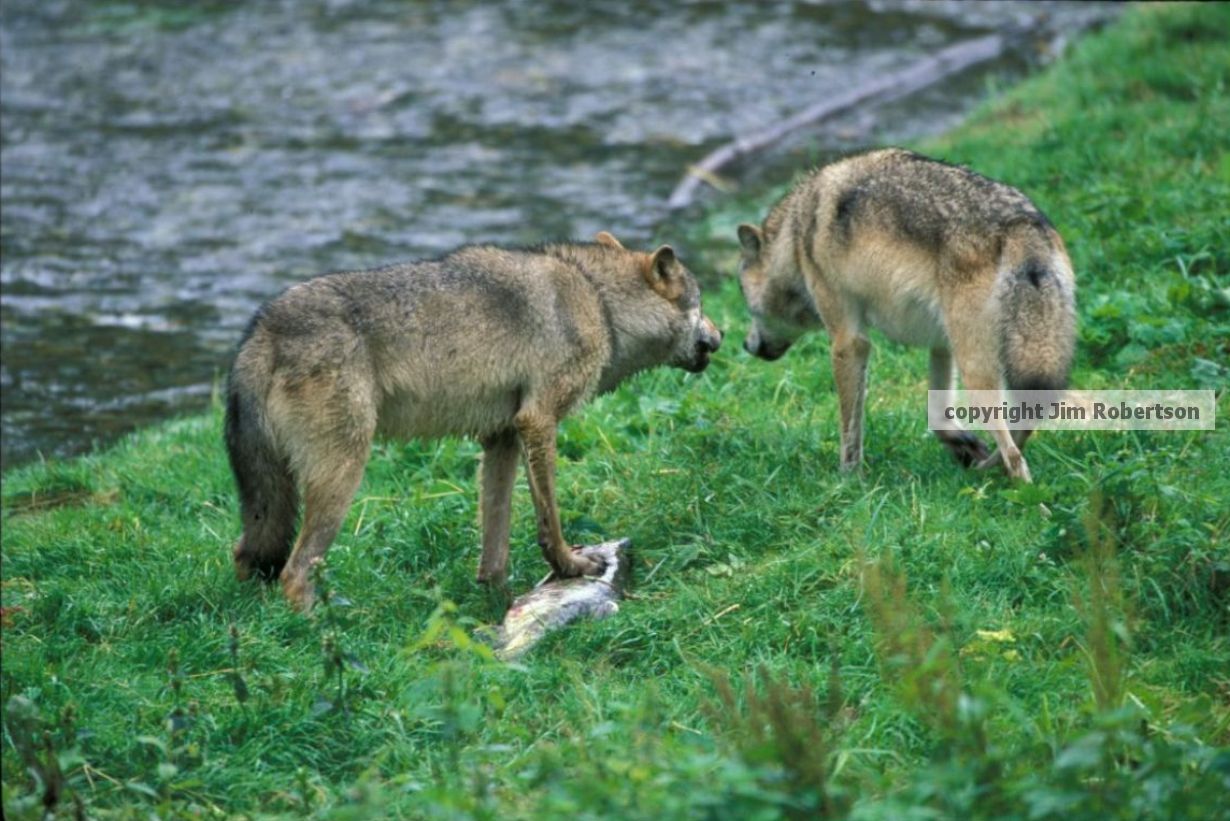
110 Wolves Have Been Killed After Day 8 Of Hunting Season

http://news.wpr.org/post/110-wolves-have-been-killed-after-day-8-hunting-season

By

The Department of Natural Resources says that as of Wednesday morning, 110 wolves have been killed in the wolf hunting and trapping season.

The season just started last week. Last year, 117 wolves were killed during the entire two month season. DNR official Tom Hauge says the faster pace of this year’s harvest remains a bit of a mystery.

“We really don’t have any good ideas as to why that is,” says Hauge. “But the trappers are out in large numbers this year and are having some good success.”

Most of the 110 wolves killed this year, were first caught in traps. Two people concerned about the possibility of using dogs to hunt wolves testified before the DNR Board today. Dogs are banned from the wolf hunt until December 2.

A wolf-hunting zone in far northeastern Wisconsin closed earlier this afternoon.

Just Call Me a Cow Hugger

People often ask if I get a lot of uninvited remarks from anti-wolf or pro-hunting trolls. The answer is, not as many as you might think. It seems the smart hunters (again, not so many as you might suppose) know better than to waste their time writing to this blog, since any pro-kill comments go straight to the cyber-round file never to reach the light of day. I usually know right away which comments are from hunters; they’re the ones that start off with, “You people are all a bunch of tree huggers…” (Guilty as charged.)

But there are others whose comments also deserve being jettisoned off the cyber-map. I’m talking about those single-minded “wolf people” who blame the cows themselves for the persecution of wolves, as though cows enjoy their lot in life and are part of a grand conspiracy against predators, in league with the very ranchers who brand, dehorn and ultimately slaughter them. These one-note wolf folks should know that not only am I a tree-hugger and a wolf-lover, I’m also a bunny, deer and cow hugger.

In an earlier post, entitled “Animal Industry = Animal Abuse,” I wrote of hearing the cows lowing for their calves. Tonight I’m hearing it again. To me, the sounds they make are every bit as mournful as the howling of wolves, and for good reason. Not only are cows raised just to be killed and eaten by humans, theirs is a lifetime of abuse at the hands of man. Forcibly impregnated, many cows see their calves snatched away just as they start to bond with them. Unlike their wild ancestors, they’re never allowed to freely migrate to wherever conditions are more favorable for them. There are always barbed wire fences, or some bully on horseback or four-wheeler bossing them around or telling them where to go.

Taking it out on the cows (as a psychiatrist in Arizona  did when he killed seven cows in his driveway) is like wishing ill on caged elephants because you disagree with zoos or on rabbits because you hate animal experimentation. Slave auctions were repugnant because people were “treated like cattle.” Well, why should any sentient being be bought and sold like chattel? But no abolitionist ever wished harm on the slaves themselves…

The cows didn’t choose to be born in wolf habitat; they’re there because some fourth generation rancher’s forefather killed off the original wolves, claimed the land and stuck cows on it. If you want to blame someone, blame today’s ranchers for continuing the practice.

In other words, pick on someone with your own brain size. Cows know all they need to know to be a cow. A cow will never be born the next Einstein, but by the same token, no cow will ever be the next Hitler, Ted Bundy or Ted Nugent.

1379284_544626882259670_451791472_n

Does It Really Make Sense for 6,000 People to Kill 600 Wolves?

http://www.care2.com/causes/wolf-hunter-gets-it-all-wrong-in-interview-but-hes-on-the-winning-side.html

Does It Really Make Sense for 6,000 People to Kill 600 Wolves?

In a short video recently released, the Center for Biological  Diversity asks if you would pay $19 to kill a wolf. You probably wouldn’t, but  6,000 people in Montana just did.

Montana has an estimated 625 wolves left. Sadly, new changes to the hunting  season, which started in September, could prove to be a disaster for those  remaining wolves. It was extended to run for six months during which time  hunters will now be allowed to take five wolves each, and they’ll be able to use  traps, bait and electronic calls. The extra long season could also put pregnant  and nursing females in the crosshairs because they’ll be allowed to continue  through the spring. As an added bonus for hunters, out of state hunting fees  have been reduced from $350 to $50.

In an attempt to get the other side of the story, the Digital Journal’s  Justin King interviewed Montana hunter Jason Maxwell, who runs a pro-wolf hunting Facebook page.  According to him, no one wants wolves in the state, and they “should be hunted  24/7 just like the coyote.” He also believes they were never actually endangered  because there are thousands in Canada and Alaska and that people who don’t live  in wolf states shouldn’t get to have an opinion.

While he sounds almost reasonable in the interview, he spews vitriol in the  comments section and elsewhere on the Internet, proving that, at least for some,  wolf hunting is about nothing more than hate, arrogance, intolerance and  sometimes petty revenge. While he cites numbers from  the state, trying to get a straight answer from  wildlife officials about where the science is and how they came up with them in  the first place is apparently as easy as trying to herd cats.

Last year, Montana Fish, Wildlife and Parks reported that 225 wolves were  killed – 128 by hunters, 97 by trappers –  during the 2012-2013 season.  This was an increase from the previous year, with more than half of the wolves  being killed on public lands. Another 104 were killed by the state throughout  the year.

Conservationists fear the consequences of such policies if hunting is allowed  to continue at this rate under state management. This year, Wyoming wants to  reduce numbers by 60 percent, which will leave only abut 100 wolves. Since they  lost ESA protection in the Great Lakes and Northern Rockies, more than 1,700  have been brutally killed.

When asked whether the government or environmentalists have hunters’  interests at heart, Maxwell responded that the “pro wolf side is fighting for  the preservation of one animal while hunters and sportsmen are fighting for the  preservation of all wildlife. The introduction is not just about the wolf it is  also about maintaining the wildlife the wolf preys on.”

If that were true, predators would have dibs on prey, and if anything still  needed to be “managed” then maybe human interference could be justified. In  Montana’s case, indiscriminate killing with the sole intent to reduce the number  of wolves to appease special interest groups isn’t management; It’s just a  bloodbath.

Also, for conservationists, fighting to protect an apex predator and keystone  species has beneficial cascading effects on other species, including plants, in  the environments they’re present in. For some areas, they’re also a popular  tourist draw which helps support local economies.

When it comes to wolf management, the very agencies charged with keeping  track of numbers and deciding their fate have a serious conflict of interest due  to the facts that hunting licenses generate revenue and there are no  consequences for poor management policies or ignoring science unless the wolf  population drops below the number required by the federal government, at which  point they would lose management authority.

The Feds Still Want Them Off the Endangered Species List

The U.S. Fish and Wildlife Service (FWS) is still defending its proposal to  remove Endangered Species Act (ESA) protections for all wolves in the lower 48,  with the exception of Mexican gray wolves, despite how terrible state management  has proven to be.

As of September, there were 18,000 public comments opposing the delisting.  There were also three public hearings scheduled; While one hearing in Washington  D.C. took place, the other two in California and New Mexico were canceled thanks  to the shutdown. However, organizations are still calling for more public  hearings in states where wolves live or may appear so the public can actually  have an opportunity to weigh in.

An independent peer review is also required to remove a species from the ESA.  However, at the end of the summer the process was put on hold when three  scientists were kicked off the peer review because they had added their names to  a letter that was sent to the Department of the Interior questioning the science  behind the proposal to delist wolves.

According to the Center for Biological  Diversity, this is the first time the FWS has put restrictions on scientists who  may have an “affiliation with an advocacy position.” In this case the scientists  in question didn’t necessarily have a stance as wolf advocates, they just did  exactly what they were supposed to do. They looked at the available data and  formed an opinion. Their opinions just didn’t match the objectives of the FWS,  so they got blacklisted.

The FWS should continue to do its job, which is to ensure wolves are not  subjected to out of control hunting policies and intolerance or the special  interests of very vocal hunting and ag groups who continue to call for more to  die.

Keeping ESA protection for wolves in the lower 48 won’t impact decisions in  the northern Rocky Mountains or western Great Lakes, where wolves are present,  but it will keep protections for the rest who are venturing into their historic  range in other parts of the U.S. where there is suitable habitat in Pacific  Northwest, southern Rocky Mountains, Northeast and California. Their continued  survival depends on their ability to expand, instead of being confined by  arbitrary lines they’ll never understand.

TAKE ACTION!

There’s still time to speak up on behalf of wolves. Since the peer review  debacle, the FWS has extended the comment period until October 28. Please submit a comment asking that wolves remain  protected under the ESA.

As for Maxwell, yes there is a petition calling on Facebook to  shut down his page for promoting violence towards animals if you care to sign  it.

Read more: http://www.care2.com/causes/wolf-hunter-gets-it-all-wrong-in-interview-but-hes-on-the-winning-side.html#ixzz2hIH0SZo4

Wildlife Watchers Outnumber Hunters 5-1

Wages from wildlife watchers

FWP takes measured approach to adding new wildlife stakeholders

LAURA LUNDQUIST, Chronicle Staff Writer September 15, 2013

Autumn can seem distant if you’re a hunter with a license burning a hole in your pocket and more than a month left until rifle season.

Big-game rifle hunters must bide their time, sighting in their scopes or scouting their locations while waiting for Oct. 26. Meanwhile, bird hunters and archers are already out in the fields, enduring summer temperatures as they make the best of the time they have.

Such has been the fall ritual for many Montanans.

But just as fall now has fewer cool days, it also has fewer hunters.

That doesn’t bode well for Montana Fish, Wildlife & Parks, which depends on sportsmen’s dollars.

FWP is reassessing its finances to decide how much to increase license fees to manage wildlife through another decade. The dwindling number of sportsmen may require FWP to turn to a new funding pool: the nongame user.

Wildlife watchers and photographers are a growing segment of the population that outnumbers sportsmen 5-to-1 nationwide. In 2011, wildlife watchers spent more than $400 million on viewing equipment and travel in Montana.

While some wildlife watchers agree that they should contribute to wildlife agencies, the details of how to target a fee and what it should pay for have eluded managers for more than 20 years.

“State Parks had that challenge, and they got those license-plate fees,” said Montana Audubon Program Director Janet Ellis. “The Legislature needs to figure out how FWP can get a little slice of something like that.”

For a century, sportsmen have been the financial backbone of state wildlife management because of license fees and taxes on guns, ammunition and fishing gear.

Prior to the digital age, such funding was solid.

According to a U.S. Fish and Wildlife Service national survey, conducted every five years, the number of hunters with Montana tags has been fairly steady since 1991, bouncing around 200,000.

In 2011, when the number of hunters appears to have rebounded nationwide, 50,000 fewer hunters ventured into Montana’s wildlands, according to the survey.

That estimate is not exact, but FWP financial analyst Hank Worsech said license sales supports that decline.

He calculated that license sales have declined 2.5 percent over the past three years. Last year was the first that nonresident hunting licenses didn’t sell out.

The Wildlife Society calculated a 36 percent drop in the sale of Duck Stamps, required for all who hunt waterfowl, since the 1970s.

Some claim nonresident hunters aren’t coming to Montana due to perceptions that predators have eliminated game.

But states without wolves have similar problems. For instance, Vermont had a 50-percent drop in nonresident hunters.

A more worrying explanation is that older hunters are retiring from the game and fewer youth are coming in. Half of hunters are 50 or older. Young people tend to be more interested in video games and social media.

“Western states are competing for less and less people,” Worsech said.

Fishing has managed to hold on to greater popularity, but it too has seen a decline.

The trend could destabilize future FWP funding.

FWP depends on license sales for half its budget because it receives no money from the state’s general fund. Federal money accounts for most of the rest.

“We operate in a world of, ‘We have a product to sell and we run on the revenue we collect.’ We’re different from other state agencies — we run more like a business,” said FWP Finance Division administrator Sue Daly.

License sales were brisk enough until four years ago. But since 2009, sales totals have decreased while the bills continued to increase, putting the agency in the red.

Part of that deficit is planned.

Montana’s Legislature, like those in several states, considers license fee increases every 10 years. During the ensuing decade, the FWP bottom line slides from black to red as inflation rises.

This time, it’s different.

Fewer license sales have combined with inflation to force the bottom line down faster. To slow the decline, FWP cut some programs, and committees are proposing to eliminate some discounted licenses.

If the negative-sales trend continues, legislators will have to hike license fees significantly to keep the budget on par.

That’s bound to prompt complaints from some hunters.

But some, like Randy Newberg, think Montana’s fees are low considering the hunting opportunity they provide and the conservation efforts that benefit the state economy.

“We need to tie (fee increases) to an annual consumer price index. Small increases are easier to swallow than a big increase,” Newberg said. “If hunters aren’t willing to pay more, they’re saying, ‘I’m willing to give up my seat at the table.’”

That table may get a bit more crowded in the next few years.

“I’m trying to sell my members on (fee increases) because there is pushback,” said Montana Wildlife Federation spokesman Nick Gevock. “But we need to look beyond hunters and anglers because everyone enjoys wildlife. Funding will be the conservation challenge of the 21st century.”

FWP has watched as other states recently confronted that challenge.

Wyoming Game and Fish had to cut its 2014 budget by $4.8 million because of declining license sales and the Wyoming Legislature’s refusal to approve a fee increase.

Last summer, after watching its license sales decrease by 25 percent, Idaho Fish and Game organized the Idaho Wildlife Summit to find alternative funding.

“As far as trying to find non-consumptive funding, that was never the overall plan. But we knew we were plowing new ground,” said Idaho game spokesman Mike Keckler. “Since then, the regional working groups have helped us come up with a few ideas for funding nongame programs.”

Keckler said the summit was meant to renew enthusiasm for wildlife.

But some hunting groups weren’t enthusiastic because wildlife watchers include wolf watchers. So controversy overshadowed the search for solutions.

Some groups, such as Sportsmen for Fish and Wildlife, accused the Idaho Summit and the Association of Fish and Wildlife Agencies of favoring wildlife viewers and photographers over hunters.

Non-consumptive users shouldn’t have a say in the wildlife management that sportsmen have paid for, according to a Lobo Watch blog post written by Toby Bridges.

Big Game Forever spokesman Ryan Benson said wolves caused the financial problem, along with associated lawsuits.

“I don’t think we should scrap the user-based model,” Benson said. “States couldn’t protect their wildlife because of a federal program. The federal wolf recovery was a major contributing factor so there should be some help from the federal level.”

In Montana, FWP Commissioner Dan Vermillion recently suggested that wildlife advocates could contribute to that user-based model.

When wolf advocates claimed thousands opposed increasing wolf-hunt quotas, Vermillion suggested that they buy wolf tags. If FWP saw a sudden surge in license sales, then they’d have a better feel for the number of wolf advocates, Vermillion said.

That didn’t go over well with wolf advocates, but Vermillion said FWP needs to find ways to bolster hunters’ contributions.

“I think we’re tricking ourselves if we don’t recognize that Montana and the U.S. are changing. Look at Bozeman – it’s full of wildlife enthusiasts,” Vermillion said. “Hunting and fishing are important, but we need to bring new stakeholders to the table.”

Wolves of the Rockies spokeswoman Kim Bean said advocates would never buy tags because they fund only collaring and lethal control.

Wolfwatcher Coalition executive director Diane Bentivegna said her 250,000 members would send contributions to wildlife agencies in every state that manages wolves but there’s a catch: The money could go only toward non-lethal wildlife programs.

“Under current budgetary structure, we aren’t allowed to say where our contributions go. We would like to introduce legislation that would allow us to fund agencies and have it go toward the programs that we support,” Bentivegna said.

Not every species has a support group, and direct donations aren’t regular enough to help.

Wildlife agencies need to find a vehicle, such as a tax on equipment or a license plate fee, that provides a steady flow of money if non-traditional contributions are to be helpful.

Montana has a non-game donation that residents can make when they file their taxes, but it brings in only about $27,000 a year.

This summer, FWP non-game section chief Laurie Hanauska-Brown organized a meeting to “have the first discussion” with wildlife and birding organizations about how to bring more users in.

“The message can’t be communicated as, ‘C’mon you non-consumptive users, it’s time to step to the table,’” Hanauska-Brown said. “We want to make sure we’re covering all the species so that we can bring more people on board.”

FWP is taking a very long-term approach with non-consumptive funding and will focus on more concrete options first, Hanauska-Brown said.

Newberg, although not opposed, is skeptical that recreational users will step up. He cited the failure of the Conservation and Reinvestment Act in 2000, when several manufacturers and groups rejected a tax on outdoor equipment.

“It was finally their chance to do what hunters do, but they bailed out,” Newberg said. “Hunters and anglers pay an excise tax. It’s disingenuous to say, ‘We want a say in wildlife, but we don’t want to pay for anything.’”
Wildlife Photography ©Jim Robertson, 2013. All Rights Reserved

Wildlife Photography ©Jim Robertson, 2013. All Rights Reserved

Top Ten New Names for Wildlife “Services”

The U.S. Department of Agriculture’s “Wildlife Services” department needs to be renamed…again.

That warped, wretched little wildlife-killing agency formally “Animal Damage Control” isn’t fooling anyone with their innocuous appellation: Wildlife “Services.” Even the New York Times recently ran an editorial entitled, “Agriculture’s Misnamed Agency,” declaring: “It is time the public got a clear picture of what Wildlife Services is up to, and time for the Department of Agriculture to bring the agency’s work into accord with sound biological practices.”

Marc Bekoff dubbed the agency, “Murder Incorporated”—others have given it a less wholesome label. Hoping we would go easy on them, USDA representatives asked the staff of Exposing the Big Game (me, myself, and my wife) to come up with another new name for their Wildlife “Services” department. Here’s what we came up with:

Top Ten New Names for Wildlife “Services”

10) Wildlife Termination Services
9) Government-issued Animal Abusers
8) Evil Anti-Wildlife Nazis
7) Seven Psychopaths
6) Biodiversity Busters
5) U.S. Department of Nimrods
4) A Bunch of Loathsome Cattle-Barron Butt-kissers
3) Chaos
2) The Animal Abolition Agency
1) Two words: Wildlife Disservices

__________________

A division of the:

USDA-Logo

America’s Top 10 Threats to Trapping; or, The enemy of my enemy is my friend

525140_440817092654544_311118433_n

http://www.ussportsmen.org/trapping/americas-top-10-threats-to-trapping-2/

Posted on August 22, 2012

Courtesy of the U.S. Sportsmen’s Alliance/ http://www.ussportsmen.org.

There are many forces in America working to end trapping and wise wildlife management. Here are a few of those anti-trapping groups:

1- Sierra Club—this group’s board of directors has let America know it opposes any and all trapping—period. The official Sierra Club statement reads: “The Sierra Club considers body-gripping, restraining and killing traps and snares to be ecologically indiscriminate and unnecessarily inhumane and therefore opposes their use.” This position earns this group a No. 1 spot.

2- PETA—best known for being wackos, this group opposes fur, trapping and anything non-vegan. PETA also wanted to “trap” and euthanize problem hogs in Florida to prevent them from being hunted.

3- Humane Society of the United States—this radical animal rights group lists trapping as wildlife abuse. This group is currently being sued for violation of federal racketeering laws.

4- American Society for the Prevention of Cruelty to Animals (alias ASPCA)—states openly on its website that “The ASPCA is against the use of leg-hold or body gripping traps to capture wild animals because of the pain and distress that they cause.” The group also opposes hunting.

5- Defenders of Wildlife—this group opposes wolf hunting and trapping, and launched an aggressive on-line campaign to skew an Idaho wolf trapping survey in its favor. D o W reported it had 39,000 followers overwhelm the Idaho Game and Fish Commission’s website.

6- Born Free USA—this radical animal rights group labels trapping as “barbaric” and has a trapping victims fund to help cover veterinarian costs for animals—including wildlife—caught in traps. It distributes a free “How to Organize an Anti-Trapping Campaign” booklet through its Animal Protection Institute group.

7- In Defense of Animals—opposes trapping and has created a “furkills” website to promote the group’s propaganda—and to collect funds. The group also encourages followers to create a display in their local public library to display leaflets, posters, and books about the cruelty involved in trapping or leg-hold traps.

8- Animal Welfare Institute: Opposes trapping and is pushing the Refuge from Cruel Trapping Act in Congress to end trapping on national wildlife refuges. Filed a lawsuit in 2008 to stop coyote and fox trapping in Maine under the guise of protecting Canada lynx.

9- Center for Biological Diversity: has campaigns underway to stop wolf trapping and hunting in Montana, Wyoming and Idaho, and another in New Mexico to save Mexican gray wolves. Some of the group’s “urgent letters of action” also includes requests for donations to end trapping.

10- Footloose Montana—works to oppose wolf trapping and the management of these large predators in Montana while other wildlife species, like elk, dwindle in numbers at the hands, or paws, of wolves. Also works to end trapping on public lands.

As you can tell, trappers and hunters need to work together to overcome these radical forces…

An Answer to an Anti-Wolf Extremist

Here’s a letter to a local Washington state newspaper from a budding anti-wolf extremist, followed by my response letter…

“Damage wolves do”
Dear Editor:
I am writing in response to Lorna Smith’s column (April 3), “Why are we so afraid of wolves?”
It’s not the wolf itself, it’s the killing they do to our deer and livestock that I’m afraid about.
I have a friend who lives in Arlie, Mont., where the wolves are abundant. He states that the wolves have completely destroyed the elk herds in his area – and are now preying on the deer.
He also states that the economy has really suffered in the area as the sportsmen are not coming to hunt anymore.
Also, there was an article in the April 2013 Western Horseman magazine. One of the featured articles was “Range Riders of the Upper Green.” The story is of Doc Foster – his main job was caring for the cattle. He states that dealing with the predator-livestock conflict took most of his time – that the wolves attack the cattle herd in a pack and focus on dragging the cattle down by the back and hindquarters. “They are killers,” Foster says. “They [wolves] eat the heart, liver and lungs and then go on.”
Is the wolf an animal we want protected in our area?
Seems like several new wolf pairs have just “arrived” in Washington state lately.
Betty Wagoner
And my response?…

Dear Editor,

It’s bad enough to read a damaging letter from an anti-wolf extremist (“Damage wolves do”) who asks, “Is the wolf an animal we want protected in our area?” as if it’s our birthright to pick and choose which species are welcome and which are not. But when the main thrust of the letter seems to be to spread disinformation—aimed at striking terror in the hearts of hunters—that “wolves have completely destroyed the elk herds” in Montana, well, someone has to set the record straight.

Having recently lived in Montana, I’ve seen and photographed my share of wolves, but also thousands of elk; and some of the mule deer herds were nearly a hundred strong in places. According to a 2012 Montana Fish, Wildlife and Parks Department survey, there are 141,078 elk in the state, 55% over their management “objective” of 90,910; but rather than allowing wolves to solve their elk “problem,” they want to reduce the number of both elk and wolves. That policy is not scientific; it’s downright kill-happy.

Meanwhile, there are currently fewer than 600 wolves in that state (hunters and trappers killed nearly 200 last season). Yet Montana wildlife officials say they are hoping to reduce the wolf population to around 450. Of course, that number does not even come close to representing a recovered state wolf population by any historical standards when you consider that 10,261 wolves were destroyed between 1884 and 1886 in Montana alone after a bounty was first initiated there—or that 380,000 wolves once roamed the lower 48.

An alleged threat to the cattle industry is certainly no excuse for today’s rampant killing of these important predators. Out of the approximately 2.6 million cattle in the state, only 74, or .0003%, were taken by wolves in 2011.

But if there has been any drop in business for the trophy elk hunting industry, it’s because wolves keep elk on the move; wilder and less complacent. In one of their most telling remarks, Montana hunters have complained that wolves make elk “too hard to hunt.” Ever their lackeys, state game managers have used that claim as an excuse to promote wolf hunting, rather than sticking up for wolves by pointing out that they are just doing their job of preventing elk from over-grazing.

So next time you hear hunters complaining about wolves, remember, it’s not because they really think wolves are going to eliminate all “their” elk—they just don’t want to have to walk too far from the pickup truck to make their kill.

Text and Wildlife Photography ©Jim Robertson, 2013. All Rights Reserved

Text and Wildlife Photography ©Jim Robertson, 2013. All Rights Reserved

Oregon Ranchers Want to Get into the Predator-Kill Game

Oregon Ranchers Want More Authority To Kill Wolves

AP | April 16, 2013 1:04 p.m. Salem, Oregon
by:AP
Part of Series:
Ecotrope
Eastern Oregon ranchers are asking the Oregon Legislature for more authority to kill wolves that threaten their livestock.

Gray Wolf
U.S. Fish and Wildlife Service

Gray Wolf

Ranchers told a House committee Tuesday that their existing authority to kill wolves caught in the act of killing livestock isn’t enough. Three Eastern Oregon legislators have proposed allowing ranchers to kill any gray wolf they reasonably believe has attacked or harassed their livestock.

Conservationists worry that wolf populations would dwindle.

Both sides are planning meetings to work on a compromise. The House Environment and Natural Resources Committee took no action on the bill Tuesday.

____At the same time, also from Oregon:

URGENT ALERT!

Cougar killing bills are moving to the Oregon house floor.

1. Please immediately contact your representatives and ask them to vote NO on bills that allow counties to overturn the Oregon state law prohibiting the unethical practice of setting packs of hounds on cougars to chase them up trees for easy targets by trophy hunters.

These bills set a terrible precedent by letting counties decide which state laws they chose to acknowledge.

You can find your representatives’ contact information here:
http://www.leg.state.or.us/findlegsltr/

2. Contact Governor Kitzhaber and ask him to VETO any bills that increase cougar mortality and/or overturn the ban on cougar hounding. Tell him you voted with the majority of Oregonians twice to keep unethical trophy hunting practices out of Oregon, not just out of your county.

Governor Kitzhaber
503-378-4582
http://www.oregon.gov/gov/Pages/ShareYourOpinion.aspx

For more information on cougars go to:

http://predatordefense.org/cougars.htm

copyrighted-wolf-argument-settled

Man, I Wish You Were Never Born

Some folks wonder why I sound like such a misanthropist when I talk about the human species. Although to me the answer appears obvious, I suppose I should explain myself to those who might think of human beings as “superior,” “God’s chosen ones” or in some other way entitled to do as they will to the planet and its non-human inhabitants.

I don’t hold all people to blame equally. I certainly don’t blame you, dedicated reader. You can’t help being born human any more than a wolf, sea lion, salmon or slug has any say over who or what they were born. But there are those who seem to go out of their way to fuel my misanthropy. You see, humans don’t just kill other animals to fill their bellies; they destroy them in droves out of spite, to eliminate the competition…or just for fun.

When I hear hate-speech against wolves from hunters who’d rather have them eradicated again than have to work a little harder to “get their elk;” or come across a starving sea lion on the beach and then read that emaciated sea lion pups are washing up in California by the hundreds–all due to their food being robbed by overly-industrious-yet-completely-terrestrial commercial fishermen who have no business taking anything from the sea; or learn that dolphins are being repeatedly shot to death by people along the Gulf coast I tend to get a bit cynical of the notion that man was created in the image of any kind of benevolent god.

Text and Wildlife Photography ©Jim Robertson, 2013.

Text and Wildlife Photography ©Jim Robertson, 2013.

In commenting about the recent rash of dolphin shootings, Randall Lockwood, senior vice president of the Forensic Sciences and Anti-Cruelty Projects department at the American Society for the Prevention of Cruelty to Animals (ASPCA), said, “One of the things that seems to underlie most intentional animal cruelty and acts of abuse is a need for power and control. A lot of severe animal cruelty [comes from an] absence of empathy, and also a sense that [the perpetrators] have a right to do these things.”

Backing up the premise that people act out of an overblown sense of entitlement, Robert Grillo, founder of the group Free From Harm, writes, “Not only do we assert our supremacy over nonhumans, we act upon it at every opportunity. The notion that human interests “trump” animal interests when we create an imaginary conflict of interest is particularly delusional when one considers that we wantonly kill 60 billion land animals and kill another trillion or so aquatic animals every year just to suit our pleasure in eating them, not for any legitimate need to survive.

“In fact, Professor Gary Francione of Rutgers University continually points to the schizophrenic nature of our relationship with animals. Francione simply asks us to look at the big picture: 99% of our animal use is unnecessary and for purposes of pleasure, entertainment, curiosity and education.”

While Nobel laureate Isaac Bashevis Singer wrote, “In relation to animals, all men are Nazis,” perhaps a more appropriate analogy for today’s world would be, “In relation to animals, all humans are serial killers.” How many parents of serial killers have secretly thought to themselves, “I wish Teddy would have never been born?” Considering how well the Earth got by before Homo sapiens came along and started messing with things, and how much mankind resembles a serial killer in its domineering attitude towards animals, I have to say, “Man, I wish you were never born.”

Life on Earth can take a lot of abuse and still come back for more, but it’s never had to withstand more than a few hundred thousand predacious hominids at a time. I don’t find much solace in the prediction by statisticians that the skyrocketing human population “will start to level off when it reaches 10 billion.” TEN BILLION over-consumptive human carnivores devouring everything in their collective path sounds like a monoculture of jabber-mouth two-leggers to me.

Text and Wildlife Photography ©Jim Robertson, 2013.

Text and Wildlife Photography ©Jim Robertson, 2013.

Wolves Need Their Own Untouchables

During the reign of Al Capone, when organized crime syndicates held Chicago in a stranglehold, a response team known as “The Untouchables” was formed to restore sanity to the war-torn city. With politicians and the cops in their back pockets, the crime bosses of yesteryear were able to act with impunity—to get away with murder, so to speak.

An analogous situation exists today, with anti-wolf fanatics in the role of the organized crime gangs and wolves as innocent victims. With corrupt state legislators and wildlife agencies in their pockets, organized wolf-haters are flexing their political muscles to push anti-wolf laws through everywhere the embattled canines can be found.

Some recent examples include: wolf hating troops to pressure the USFWS to delist wolves across the US., Big Game Forever, Don Peay and the Utah Legislature want to stop wolves from returning to Utah and, posted by Ralph Maughan on his website on March 26, Anti-wolf, anti-wilderness going after “pro-wolf” Washington state commissioners in hearing today…

Efforts by Washington state anti-wolf forces intercepted-

Below is an alert from anti-wolf folks in Washington State. This is an interesting example of the kind of email campaign that is being used by anti-wolf forces in a state where pro-wolf opinion is strong.

Those who support wilderness and wolves and other wildlife might want to do just the opposite of the recommendations below.
– – – – – –

Eliminate Pro-Wolf Wildlife Commissioners Now!

This is the most important thing that you can do to help hunting and the increasing wolf problem in our state. The Republicans are giving us this opportunity on a silver platter. Remember, all four guys up for confirmation on the Wildlife Commission have had a state senate hearing and they were not voted on. They can sit unconfirmed until their term expires without ever having another hearing. They don’t have to be voted on, but now they are being brought up for a vote. The Senate Natural Resources Committee Chair is bringing these guys up for hearings even though he doesn’t have to. The writing is so clear. The hunting community and ranchers are being thrown a political bone. This session Republicans were unified on gun issues. They only had two or three defecters at most on the anti-gun legislation. The GOP finally has some political clout and they are willing to do what the Democrats do – share the wealth with people that support them. I am a political realist whose passion is preserving our Second Amendment and right to hunt. Republicans in this state want to be our allies, now we have to do our part. We may never again have a chance to make a bigger splash than this. The Republicans on the committee need to hear from us and so does Hargrove. There are pro-hunting Democrats who support managing wolves 100%.

First we need to achieve our goal with each of these commissioner confirmations in committee, then the commissioners will face a vote by the full Senate. There’s a fair chance of influencing these confirmations because the full Senate did approve two of Senator Smith’s wolf bills which are now in the House. These wildlife commissioner confirmations only go before the Senate, so we do not have to worry about passing in the House. Therefore we only have two hurdles, getting the committee to vote as we would like and then getting the full Senate to vote as we would like. It’s a numbers game and it’s hard to know exactly how many messages we need to send to accomplish this goal, so we need as many messages sent as possible. Ask friends, family and any groups you belong, ask anyone you think you can convince to send email or call today.

As of Friday March 22 a Washington legislator informed us that nobody is contacting the Senate Committee regarding the confirmation of the four Wildlife Commissioners on March 26. This is the perfect chance for hunters, fishers, ranchers, and other concerned persons to have a direct impact on the Wildlife Commission. The hearing for confirmations is at 1:30 pm on March 26.

Please take 1 or 2 minutes and call or email: DO IT NOW IF YOU WANT A CHANGE!

CALL:
The committee assistant is Katharine Grimes (360) 786-7419 and ask her to forward a messages to each committee member to CONFIRM Wildlife Commissioners Mahnken and Carpenter and to OPPOSE Wildlife Commissioners Jennings and Kehne.

EMAIL: (copy and paste email list)
Kirk.Pearson@leg.wa.gov; John.Smith@leg.wa.gov; Christine.Rolfes@leg.wa.gov; Jim.Hargrove@leg.wa.gov; Mike.Hewitt@leg.wa.gov; Adam.Kline@leg.wa.gov; Linda.Parlette@leg.wa.gov;

(copy and paste subject)
Confirmation of WDFW Wildlife Commissioners

(copy and paste message or write your own)
Senate Natural Resources and Parks Committee

RE: Confirmation of WDFW Wildlife Commissioners

copyrighted-wolf-argument-settled