Still Undecided? Vote against the Bow Hunter

If you’re one of those hold-out voters we keep hearing about who hasn’t yet decided who to elect for President, here’s an idea for you: cast your vote against the guy that boasts a bow hunter as his Vice-presidential partner in crime—the Robin to his Batman. (That would be the Republican, Mitt Romney—in case you’ve been lucky enough to miss his outspoken VP sidekick and hunting addict, Paul Ryan, yammer on and on about his favorite hobby of launching aluminum shafts tipped with razor-sharp arrowheads into the bodies of innocuous, peace-loving deer.)

I can understand and relate to the disillusionment anyone might feel about our current President. Some of the things he’s pulled—joking about eating dogs, removing their canine cousins, the wolves, from the federal Endangered Species list thereby casting their fates into the eager hands of hostile states, or relegating  horses and burros to the slaughterhouse—are unforgivable. We can’t let him get away with that sort of thing in the future.

But, there’s no doubt that the other candidate would commit equally atrocious crimes against animals, in addition to mocking global warming with his stated goals of approving the Keystone pipeline and opening up fragile federally protected lands to oil drilling. Adding insult to injury, Romney had to go and tap not just a hunter, but a goddamned bowhunter—the most sadistic strain of killer out there—for a running mate.

Unfortunately for dedicated animal advocates, we’re forced to have to choose between the lesser of two evils yet again. In this case, the bowhunter is clearly the greater evil on the ballot.

Text and Wildlife Photography ©Jim Robertson

Chapter Titles

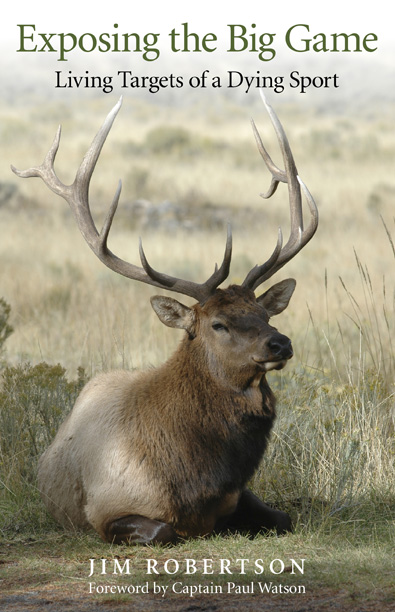
Here’s the Table of Contents for Exposing the Big Game?
Foreword by Captain Paul Watson

Introduction

Chapter 1) Hide-hunting Holocaust Survivors Still under Fire

Chapter 2) An Act of Bison Altruism

Chapter 3) War on Coyotes an Exercise in Futility and Cruelty

Chapter 4) Time to End a Twisted Tradition

Chapter 5) Avian Superstar Both Athlete and Egghead

Chapter 6) From the Brink of Oblivion and Back Again?

Chapter 7) A Day in the Sun for the Hayden Wolves

Chapter 8) Critical Cornerstone of a Crumbling Castle

Chapter 9) Bears Show More Restraint than Ursiphobic Elmers

Chapter 10) The Fall of Autumn’s Envoy

Chapter 11) Inside the Hunter’s Mind

Chapter 12) A Magical World of Oneness

Chapter 13) Living Targets of a Dying Sport

Chapter 14) A Few Words on Ethical Wildlife Photography

In Closing

Acknowledgements:

Looking back, this was not, at the outset, planned as a podium from which to lambaste anyone’s hobby or heritage, but was originally intended as a venue for relating some of the behaviors and capabilities I’d observed among animals living in the wild, and as a celebration of life along the compassion continuum. However, after delving deeper into the histories of the species covered here—thanks in part to the invaluable references listed below—I found it impossible to simply depict their natural activities without also chronicling the shocking stories of abuse they have suffered at the hands of man. It would have been doing the animals a disservice to merely record how they naturally lived without at least alluding to the far-reaching and pervasive ways that human actions have altered their lives and sometimes their very natures. And the facts are clear: there has been no greater direct human impact on wildlife than the ongoing threat of hunting. As with the other pertinent and profound quotes from a variety of enlightened sources, this one from Edward Abbey proficiently puts it in a nutshell, “It is not enough to understand the natural world. The point is to defend and preserve it.”

Live With It, Elmers!

Sorry Elmers, it’s time to snuff out one of the most overused and overstated rationalizations for your beloved sport.

Hunters would have you ingest the preposterous pabulum that hunting helps animals; that hunters are their philanthropic fairy godparents (well-armed well-wishers, if you will) performing the gallant duty of keeping animal populations in check; that animals won’t go on living unless they kindheartedly kill them (this of course is all the more outrageous in light of how many species have been wiped off the face of the earth, or perilously close to it, exclusively by hunting).

But deer, along with most other animal species—besides Homo sapiens, have built-in mechanisms that cause their reproduction rate to slow down when their population is high or food is scarce.  Though state “game” departments are usually loath to share any information that might work against one of their arguments for selling hunting licenses, even they know that in reality the wildlife can ultimately take care of their own. According to the Western Association of Fish and Wildlife Agencies, “A mule deer herd that is at or above the carrying capacity of its habitat may produce fewer fawns than one that is below carrying capacity.”

The fact is, hunting encourages ungulates to reproduce more, thus seemingly warranting the alleged need for population controls via, you guessed it, more hunting.

Hunting industry propagandists have a lot of people convinced that culling is a necessary evil for controlling animal overpopulation. Lethal removal is their one-size-fits-all solution, no matter the circumstance. But there are always alternatives to that fatal fallback position. When we finally get past the viewpoint of animals as objects, or “property of the state,” and start to see them instead as individuals, the justifications for culling begin to wear thin.

Many places that provide habitat for healthy populations of deer could also support the natural predators who evolved alongside them. All that’s required of humans is to get out of the way and let nature take its course, or, in some cases, repair the damage they’ve done by reintroducing wolves or other native carnivores who were fool-heartedly eradicated. Yet, in the western US and Alaska, as well as in Canada, natural predators are still being killed to allow deer, moose or elk hunters a better chance at success. While some people complain that these browsers and grazers have gotten too tame, hunters in states like Idaho and Montana are whining that wolves make the elk too wild and thus harder for them to hunt.

I tend to be even more cynical about areas where humans have claimed every square inch for themselves and aren’t willing to share with native grazers. When I hear grumbling about deer, elk or geese pooping on a golf course, I have a hard time relating to people’s grievances. It’s the height of speciesism to expect that these animals should face lethal culling for successfully adapting to an unnaturally overcrowded human world.

Ours is the invasive species, overpopulating and destroying habitats wherever we go. We wouldn’t want some other being jumping to a knee-jerk “cull them all” reaction every time humans reached their carrying capacity in a given area.

Sooner or later Mother Nature will tire of humans’ destructive dominance and come up with a way to bring life back into balance. I can just hear her telling off the hunters: “Other animals have a right to be here too—just live with it, Elmers!”

______________________________________________________________

Portions of this post were excerpted from the book, Exposing the Big Game: Living Targets of a Dying Sport 

Text and Wildlife Photography ©Jim Robertson

Some Cold Hard Facts about Wisconsin Wolf Hunting

Facts about Wisconsin Wolf Hunting:

  • The state of Wisconsin’s wolf hunting season began at an hour before dawn today, October 15th, and runs non-stop until the end of February.
  • Wisconsin received more than 20,000 applications for just 1,160 permits, some from as far away as Florida, Texas, and California. (Meanwhile, in Minnesota, wildlife officials have set a quota of 400 wolves and awarded 6,000 permits.)
  • State rules allow hunters to slay wolves by a crude assortment of methods and with a callous array of sadistic devices, including luring with bait, strangulation by snaring and slow-death in steel-jawed leg-hold traps.
  • In addition, the state had planned to allow hunters to start using hounds to hunt wolves beginning Nov. 26, when their deer season ends. But Dane County Judge Peter Anderson issued a temporary injunction against the use of dogs on Aug. 31, after humane societies and environmental groups sued. (Though Wisconsin currently does not allow the use of hounds for hunting wolves, they do allow hounding for bears, raccoons and many other undeserving species).
  • Kurt Thiede, the Wisconsin Department of Natural Resources* (DNR) lands division administrator, has issued a statement in support of the use of hounds: “We … have learned from other states that harvesting a wolf can be difficult. The use of dogs is a key way to increase hunter success. We will continue to work with the court to remove the injunction on the use of dogs….” (*Note to Mr. Thiede and the rest of the DNR: Wolves are not a “resource,” they are intelligent, sentient beings. Also, killing them is not “harvesting,” it’s murder!)
  • Wolves were once abundant in Wisconsin, numbering around 5,000 in the 19th century, before they were hunted and trapped to extinction.
  • Wolves have recently been shown to contribute to a greater diversity of understory plants, as well as improved deer herd and trout stream conditions, but the Wisconsin DNR has decided to allow hunters and trappers to kill 201 wolves this year alone.
  • Today the wolf population is growing and DNR estimates that the state could support 700 to 1,000 wolves. Yet they speculated that “this level may not be socially tolerated” and therefore have decided to limit the state’s wolf population to only 350 individuals. Of course, hunters and trappers are all-too eager to help…

Again, the injunction on the ‘hounding’ is only in place UNTIL DEC 20TH

Voice your objections to the use of hounds for wolf hunting and tell the court that hounding is not acceptable! Tell the governor and the legislators that the Wisconsin wolf hunt is exceptionally savage and will give the state a black eye. Please continue to put pressure on the governor’s office, the legislators, and the tourism department:

Governor Scott Walker

govgeneral@wisconsin.gov

608-266-1212

115 East Capitol

Madison, WI 53702

Wisconsin residents can find contact info for your legislators here: www.wisconsin.gov/state/core/government.html

You may also want to tell the tourism department that you will be unable to bring your family to Wisconsin for any future vacations, as you do not patronize the wolf killing states:

Wisconsin Dept. of Tourism

1-800-432-8747 or 608-266-2161

201 West Washington Ave.

P. O. Box 8690

Madison, WI 53708-8690

tourinfo@travelwisconsin.com

Text and Wildlife Photography ©Jim Robertson


Pray for Snow Drought

The customary mantra for those of us who have who have spent much time in search of powder to ski in the semi-arid mountains of Montana is, “Pray for snow!”  Consequently, I never thought I’d catch myself chanting, “Pray for Snow Drought,” but after reading the Montana Fish, Wildlife and Parks department’s “2012 elk hunting outlook,” a late winter is what I’m praying for—for the elk’s sake. You’ll see what I mean as you read their outlook (and pay no attention to their glib use of depersonalizing words like “harvest” or “hunting opportunities” for the senseless murder of noble beings like elk—psychopaths can’t help themselves):

“There are elk in Montana’s hills and if the big sky drops some snow hunters could be in for a banner season in many areas.

“’Most hunters are going to find elk populations in good physical shape and will benefit from liberal hunting opportunities,’ said Quentin Kujala, Montana Fish, Wildlife & Parks’ wildlife sections coordinator in Helena. ‘If the weather cooperates, and if hunters do their homework and line up access early where it’s needed, we’d expect very good harvest numbers by season’s end in late November.’

“Montana’s general, five-week long, elk hunting season opens Oct. 20.

“Kujala noted that cold and snowy conditions should lead to elk hunting success, while mild weather usually spells lower elk harvests, despite additional elk-hunting permits and more liberal seasons. ‘We’re all hoping the weather tips to hunters’ favor this fall,’ Kujala said.”

All? Not me! Not the elk! Sorry, Mr. Kujala, those of us who care about elk are praying that Montana’s current drought conditions last well into November.

Checking their regional population rundown, it’s clear that—despite the occasional natural wolf predation that sportsmen are quick to freak out over—elk are doing pretty well in the state. According to Montana FWP, “Biologists say elk numbers are at or above management objectives in most hunting districts.” “…the milder winter of 2011-2012 led to good calf recruitment…” “Elk populations are healthy and growing. Elk populations are solid.” and “The biggest challenge for hunters continues to be finding access.”

Whether it’s wolves competing for “their” elk “harvests” or a few darned private land owners who won’t let hunters kill animals on their properties, it seems like hunters and their game department lackeys always have something to bitch about.

Text and Wildlife Photography ©Jim Robertson

The Wolf was Better off Endangered

Paradoxical as it may seem, wolves were better off endangered.  Not as a species perhaps, but to the individual wolf stuck for days in a steel-jawed leg-hold trap, or to the pack forced to dodge a hail of gunfire from cammo-clad snipers and a volley of arrows from a phalanx of archers, it must feel like the misguided war on wolves has begun anew.

Now that they have been declared “recovered” here, wolves are again under threat of the trap and rifle just as they were during the environmentally reckless Nineteenth Century.

By 1872, the year President Grant created Yellowstone National Park (in part to protect “game” species like elk from wanton destruction by overeager hunters), 100,000 wolves were being annihilated annually. 5450 were killed in 1884 in Montana alone, after a wolf bounty was initiated there. Wyoming enacted their bounty in 1875 and in 1913 set a penalty of $300 for freeing a wolf from a trap.

Though the federal Endangered Species Act safeguarded wolves from overzealous state hunting and trapping laws, as the director of the USFWS pointed out, the ESA is “not an animal protection act.”

The right of an American species not to be hunted to extinction is a relatively new advancement. At present, it‘s about the only right extended to the nonhumans in this, the land of the free. Alas, the river of speciesism still runs deeper than the Potomac at spring breakup.

Founding father and second US president, John Adams, may, or may not, have believed that all men were created equal, but he clearly took a dim view of the wildlife native to our formerly pristine land. In 1756 he openly expressed his scorn for the world his ancestors had strived to transform: “Then, the whole continent was one continued dismal wilderness, the haunt of wolves and bears and more savage men…Then our rivers flowed through gloomy deserts and offensive swamps.“

Unfortunately for any animal not blessed enough to be born human, our unalienable rights to life and liberty were specific initially only to white males, next, to all males and then to all human animals regardless of gender or sexual orientation but as yet do not extend to the nonhuman animals with whom we share this planet.

Our lawmakers have had a sad history of turning a blind eye to the most basic rights of those who differ from us primarily in that all four of their limbs are used for walking and they don‘t wax the hair off their backs. This seems a little biased when you consider that in terms of social skills, devotion to family and intellect relevant to survival animals, like wolves, are every bit our equals.

Why is this happening? So that “sportsmen” can claim all the “game” species for themselves. The return to full-scale wolf hunting gives today‘s anti-wolf bigots their chance to drive this misunderstood embodiment of wilderness back to the brink of oblivion.

____________________________________________

Portions of this post were excerpted from the book, Exposing the Big Game: Living Targets of a Dying Sport

Text and Wildlife Photography ©Jim Robertson

Leave Wolves the Hell Alone

Northeastern Washington cattle rancher Len McIrvin has made it clear: he really hates wolves—especially members of the local Wedge pack. Though the rancher way of life depends on government handouts and write-offs, he’s been unwilling to accept compensation for the cows he claims to have lost to wolves, fearing it would legitimize protection of the natural predators.

It may not be fair to compare him and his son to poachers Bill White and son, who illegally killed most of the Lookout Pack (Washington’s first confirmed wolf pack to return home from Canada), since the McIrvins appear to operate above board by deferring to the state game department to do the dirty work for them. But they are all cut of the same cloth—cattle ranchers who think wolves serve no Earthly purpose and should be eliminated (once again).

It’s no wonder some ranchers feel they can get away with murder, so to speak. They’ve gotten used to having everything handed to them, ever since the government paid for the cavalry to wage war with the Indians and bankrolled bounties and poisoning campaigns against wolves to make room for their private ranches—and ensure “Manifest Destiny” (the doctrine or belief prevalent in the 19th century that the United States had the God-given right to expand into and possess the whole of the North American continent). But Western ranchers aren’t satisfied with keeping cows on their vast tracts of private land (possibly given to their ancestors free of charge back in the homesteading era); they want the Feds to throw in a few thousand acres of cleared national forest land so they can expand their claim out into the neighboring wildlife habitat.

The US Forest Service contends that grazing fees bring in funds as part of their “Multiple Use” policy, but ranchers contribute only about $1.35 per “Animal Unit Month” (a detached, depersonalizing term for a cow and calf pair feeding for four weeks on public forests). According to a 2005 Government Accounting Office report, that paltry one dollar and thirty-five cent fee covers only a tiny fraction of the grazing program’s administrative costs, making this in essence just another a subsidy program in disguise.

Still, McIrvin feels entitled to prevail upon his buddies in the game department and local politicians to do whatever they can to make the entire Wedge pack disappear. He recently told the Capital Press that the only compensation he’s interested in is a dead wolf for every dead calf, copping a Bill White-like attitude: “This isn’t a wolf problem, we always could take care of our own problems,” adding that the only acceptable option is trapping and poison. Now he’s at it again, making extreme statements in any paper that’ll print them. Yesterday he showed his hand by making this fanatical comment to the Seattle Times: “Wolves have never been compatible with raising livestock.”

Okay, so you want to be an extremist, eh, rancher? (I’m doing the Clint Eastwood talking to a chair bit now…) Go ahead, punk, make my day. Two can play at that game; I’ll show you extreme. Hows about you damned cattle barons gettin’ your cows off my national forest and leavin’ my wolves the Hell alone. The wolves were here first and your poor cows don’t want to be livin’ out on some steep, brushy clearcut anyway. In fact, maybe it’s time you got outta cattle-ranchin’ altogether and started growin’ some healthy, organic crops insteada turnin’ your introduced livestock out into the woods to tempt the wolves and compete with the native deer, elk and moose who belong there.

Text and Wildlife Photography © Jim Robertson

No Offense, but You’re an Animal

I’m an animal, and if you don’t know it yet, it’s my duty to inform you, you’re one too. All we animals, the big-brained two-leggers, the furry four-leggers, the feathered and the finned are carbon-based creatures made up of the same ingredients. Every last earthling oozed from the same original, primordial stew pot.

The sooner we accept that we’re all animals, the sooner we can make peace with the others of this planet, rather than doing battle with them. Ultimately, it’s to our detriment that we deny evolution any longer. Humankind can’t live in a vacuum. We need all our best science to figure how to live with the many diverse, interconnected life forms that help keep this planet hospitable.

Bill Nye, ‘the Science Guy,’ recently stated in his Big Think video (which has been viewed nearly 3 million times so far), “I say to the grownups, if you want to deny evolution and live in your world, that’s completely inconsistent with the world we observe, that’s fine. But don’t make your kids do it.”

In rebuttal, the spokesman of a group of ‘Young Earth Creationists’ proclaimed, “No, we are not just evolved animals as Nye believes; we are all made in the image of God.” Young Earth Creationists, or ‘Biblical Creationists,’ as they prefer to be called, believe in a literal interpretation of the creation story in the book of Genesis. They say the weeklong account of God creating the earth and everything in it represents six 24-hour periods (plus one day of rest) and date the age of the earth between 6,000 and 10,000 years.

Nye’s view falls in line with the vast majority of scientists, who date the age of the earth and the universe as 4.5 billion years old. “The idea of deep time of billions of years explains so much of the world around us. If you try to ignore that, your worldview becomes crazy, untenable, itself inconsistent,” Nye said in his video. Still, polling from Gallup has shown for the past 30 years that between 40-46% of the survey respondents believe in creationism: that God created humans and the world within the past 10,000 years.

Granted, there are folks whose belief in creationism compels them to treat “God’s creatures” with compassion. As far as I’m concerned, people can believe whatever they want—as long as it promotes kindness to all sentient beings. Although I’ve never read it, I understand the Bible contains a number of passages that promote benevolence toward the vulnerable. (Before someone says something like, ‘If you haven’t read the bible, you’re ignorant of what you speak,’ I will argue that a person could end up even more ignorant and confused after reading it.)

Unfortunately, for the majority of believers, creationism leads to a sense of human superiority and the self-serving notion that we humans are in a higher realm of importance than the rest of the animal kingdom. This convenient fallacy has been used to justify the exploitation of animals over the centuries and continues to have widespread acceptance to this day.

For example, my uncle, a hunter who boasted of killing the largest black bear in the state, held to a word for word interpretation of the Bible which led to his belief that, “Humans were meant to subdue the earth” drawing his own conclusion, “There’s no earthly purpose for cougars.” His reasoning, shared by so many people the country over, was: to make life better for humans we should rid the world of species like cougars, bears, coyotes and wolves. Another example of this kind of stinkin’ thinkin,’ Republican vice Presidential candidate Paul Ryan is a “pro-life” creationist bow-hunter who doesn’t see the hypocrisy in committing the sin of killing non-human animals for sport.

The idea of creationism was abandoned by the mainstream scientific community shortly after Darwin introduced The Origin of Species in 1859. By 1880 nearly every major university in America was teaching evolution. Bill Nye summed up his video with, “In another couple centuries I’m sure that worldview [creationism] won’t even exist. There’s no evidence for it.” While it seems only logical that any continued cultural advancement would include the acceptance of sciences such as geology, paleontology and evolution, I’m not so sure I share his optimism for the further progress of humanity.
Text and Wildlife Photography ©Jim Robertson

Wolves and Coyotes are Ever the Scapegoats

(The following excerpt from the chapter, “War on Coyotes an Exercise in Futility and Cruelty,” in the book, Exposing the Big Game: Living Targets of a Dying Sport, parallels points I raised about wolves being incriminated in yesterday’s post—just substitute wolves for coyotes and sheepman for cattle rancher)…


In removing weak or diseased animals from a given gene pool, coyotes, as well as wolves and cougars, secure healthy traits for future generations. Furthermore, although introduced livestock (their wariness bred out of them through the domestication process) are far more vulnerable, it’s been documented that predators like coyotes would prefer to stick to their usual prey—yet they are ever the scapegoats.

As Jack Olsen, author of Slaughter the Animals, Poison the Earth, put it:

“By simple dint of pounding over and over on the same points, the sheep industry has succeeded in characterizing all predators as deadly killers that would rather dine on lamb than anything else that lives on the range. In the sheepman’s demonology of the coyote, every fallen sheep is brought down by coyotes. If Canis latrans comes across a dead sheep and plays his natural role as carrion-eater, the rancher shows teeth marks as proof of murder. If a sheep falls dead and the coyotes ignore the carcass, the sheepman charges an even more heinous crime: killing for pleasure. No matter what the predator does, a diabolical explanation is provided, and grandiose overstatement becomes the rule. Two lambs dying at birth are transformed into twenty lambs killed by coyotes.” 

Ordinarily a writer of true crime books, such as Son, a Psychopath and his Victims and I, the Creation of a Serial Killer (about a murderous trucker whose violence continuum began with a long history of cruelty to animals, including coyotes), Olson did not have to stray far from that genre in addressing the mentality of the kind of nutcase who would victimize coyotes.

Wildlife Photography Copyright Jim Robertson

The Only Acceptable Option?

Make no mistake, not only is the mainstream media frequently full of shit, but also they distort the truth to fit their agenda. Case in point: the Spokane, Washington Spokesman Review ran an article on August 17th entitled, “Stevens County ranch reports new wolf attacks.” For one thing, the validity of the so-called “attacks” is still in question; and also, they didn’t happen on a ranch.

It turns out these alleged wolf attacks were on calves—not adult cows—yet the injuries were so minor some observers speculated that they could have been made by a strand of barbed wire. I’ve seen enough wolf kills to know that unless you arrive at the scene just when they were made, there wouldn’t be enough left on a calf-sized carcass to identify the cause of death. Wolves kill out of hunger and they eat what they bring down post haste, before the smell attracts a bear or any other scavengers.

Part way into the article, the “Inland Empire’s” largest newspaper revealed that the calves were not on the private Diamond M ranch, but on a Colville National Forest cattle grazing allotment, leased by the McIrvin family. That means the McIrvins (or their dogs or other guard animals) were not out with the cattle, so it’s highly unlikely anyone arrived on the scene of a fresh wolf kill.

I lived for many years in that part of Washington and worked in the Colville National Forest. I pity the cows, who are cruelly de-horned, trucked up to the ends of the logging roads and left to fend for themselves on some thistle-covered clear cut with only a dried up creek for water. My wife’s father “ran cattle” in the same way. It would be a big week if he checked on them twice. But he only had 30 “head” of cattle; the Diamond M ranch has over 400.

Rancher Len McIrvin has a state-issued wolf kill permit for depredation if wolves are caught in the act, but has said there’s little chance of meeting that requirement. The environmental organization Conservation Northwest released a statement questioning whether McIrvin made a “good faith effort” to reduce the risk of conflict between wolves and his livestock. “It’s unclear in this case whether the right livestock stewardship steps have first been tried to reduce conflict potential,” Mitch Friedman, Conservation Northwest executive director, said in the statement. “If we expect wolves to behave, ranchers need to meet them halfway.”

But Irvin told the Capital Press (a cattle industry tabloid posing as a newspaper) that the only compensation he’s interested in is a dead wolf for every dead calf. “This isn’t a wolf problem, we always could take care of our own problems,” he said, adding that the only acceptable option is trapping and poison.

Text and Wildlife Photos Copyright Jim Robertson